ACUTE LOWER BACK PAIN
DR Ayesha Anwer Ali
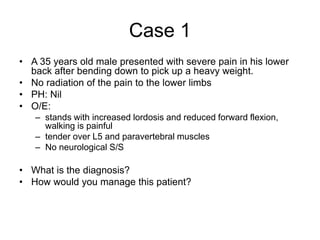
Case 1
• A 35 years old male presented with severe pain in his lower
back after bending down to pick up a heavy weight.
• No radiation of the pain to the lower limbs
• PH: Nil
• O/E:
– stands with increased lordosis and reduced forward flexion,
walking is painful
– tender over L5 and paravertebral muscles
– No neurological S/S
• What is the diagnosis?
• How would you manage this patient?
Case 2
• A 37 years old male presented with severe pain in his lower back
after bending down to pick up a heavy weight.
• The pain is radiating down the back of his left leg as far as the ankle
• PH: Nil
• O/E:
– Walks with pain
– ↓ back movements especially the forward flexion
– The muscle power was difficult to assess because of the pain
– Normal ankle dorsiflexion (bilaterally) but weak left ankle planter flexion
and big toe flexion
– Altered sensation over the lateral side of the left foot
– No other neurological S/S
• What is the diagnosis?
• How would you manage this patient?
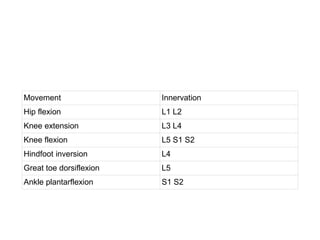
MOVEMENTS
Movement Innervation
Hip flexion L1 L2
Knee extension L3 L4
Knee flexion L5 S1 S2
Hindfoot inversion L4
Great toe dorsiflexion L5
Ankle plantarflexion S1 S2
Back pain
• Is the leading cause of occupational
disability in the world.
• 50 - 80%
• With aging population and sedentary live
this situation is unlikely to change.
Aim
To provide an evidence based overview of
low back pain to the primary health career.
Common causes of low back pain
• Mechanical (80 – 90%)
• Neurogenic (5 – 15%)
• Non-mechanical spinal conditions (1 – 2%)
• Referred visceral pain (1 – 2%)
• Other (2 -4 %)
Mechanical causes (80 – 90%)
• Unknown causes
• Degenerative disc or joint disease
• Vertebral fracture
• Congenital deformity
• Spondylolysis
• instability
Neurogenic causes (5 – 15%)
• Herniated disc
• Spinal stenosis
• Osteophytic nerve root composition
• Annular fissue with chemical irritation to
the nerve root
• Failed back surgery syndrome
• Infections (e.g. herpes zoster)
Non-mechanical spinal conditions
(1 – 2%)
• Neoplastic (primary or secondary)
• Infection (osteomyelitis, discitis or abscess)
• Inflammatory arthritis
• Paget’s disease
• Other (e.g. Sheuermann’s disease, Baastrup’s
disease)
Referral visceral pain (1 – 2 %)
• GI diseases
• Renal diseases
Other (2 - 4%)
• Fibromyalgia
• Somatoform disorder
• Mallingering
Management of acute low back pain in ED
• Rule out the serious causes
• Pain management
Red flags
• Cauda equina Syndrome
• Spine fractures
• Malignancy or infection
Investigations
• No investigations are required in majority
of cases
• Limited role of X ray in non traumatic low
back pain
• Lab investigations if red flags are present
Pharmacological treatment
• Simple analgesia
• NSAID
• Opiates
• Steroids
• Muscle relaxant
The real Management
• Discussing expectations
– Likely to have pain for 6/5
– Up to 60% will have pain and decrease
function after one year
• Educate your patient
• Medications
back_pain.pptx
back_pain.pptx
back_pain.pptx
back_pain.pptx
back_pain.pptx

back_pain.pptx

  • 1.
    ACUTE LOWER BACKPAIN DR Ayesha Anwer Ali
  • 2.
    Case 1 • A35 years old male presented with severe pain in his lower back after bending down to pick up a heavy weight. • No radiation of the pain to the lower limbs • PH: Nil • O/E: – stands with increased lordosis and reduced forward flexion, walking is painful – tender over L5 and paravertebral muscles – No neurological S/S • What is the diagnosis? • How would you manage this patient?
  • 3.
    Case 2 • A37 years old male presented with severe pain in his lower back after bending down to pick up a heavy weight. • The pain is radiating down the back of his left leg as far as the ankle • PH: Nil • O/E: – Walks with pain – ↓ back movements especially the forward flexion – The muscle power was difficult to assess because of the pain – Normal ankle dorsiflexion (bilaterally) but weak left ankle planter flexion and big toe flexion – Altered sensation over the lateral side of the left foot – No other neurological S/S • What is the diagnosis? • How would you manage this patient?
  • 4.
  • 5.
    Movement Innervation Hip flexionL1 L2 Knee extension L3 L4 Knee flexion L5 S1 S2 Hindfoot inversion L4 Great toe dorsiflexion L5 Ankle plantarflexion S1 S2
  • 6.
    Back pain • Isthe leading cause of occupational disability in the world. • 50 - 80% • With aging population and sedentary live this situation is unlikely to change.
  • 7.
    Aim To provide anevidence based overview of low back pain to the primary health career.
  • 8.
    Common causes oflow back pain • Mechanical (80 – 90%) • Neurogenic (5 – 15%) • Non-mechanical spinal conditions (1 – 2%) • Referred visceral pain (1 – 2%) • Other (2 -4 %)
  • 9.
    Mechanical causes (80– 90%) • Unknown causes • Degenerative disc or joint disease • Vertebral fracture • Congenital deformity • Spondylolysis • instability
  • 10.
    Neurogenic causes (5– 15%) • Herniated disc • Spinal stenosis • Osteophytic nerve root composition • Annular fissue with chemical irritation to the nerve root • Failed back surgery syndrome • Infections (e.g. herpes zoster)
  • 11.
    Non-mechanical spinal conditions (1– 2%) • Neoplastic (primary or secondary) • Infection (osteomyelitis, discitis or abscess) • Inflammatory arthritis • Paget’s disease • Other (e.g. Sheuermann’s disease, Baastrup’s disease)
  • 12.
    Referral visceral pain(1 – 2 %) • GI diseases • Renal diseases
  • 13.
    Other (2 -4%) • Fibromyalgia • Somatoform disorder • Mallingering
  • 14.
    Management of acutelow back pain in ED • Rule out the serious causes • Pain management
  • 15.
    Red flags • Caudaequina Syndrome • Spine fractures • Malignancy or infection
  • 16.
    Investigations • No investigationsare required in majority of cases • Limited role of X ray in non traumatic low back pain • Lab investigations if red flags are present
  • 17.
    Pharmacological treatment • Simpleanalgesia • NSAID • Opiates • Steroids • Muscle relaxant
  • 18.
    The real Management •Discussing expectations – Likely to have pain for 6/5 – Up to 60% will have pain and decrease function after one year • Educate your patient • Medications