CARDIO
PULMONARY
RESUSCITATION
BY: ROMMEL LUIS C. ISRAEL III
1
WHAT DOES CPR STANDS FOR?
C= Cardio (Heart)
P = Pulmonary (Lungs)
R = Resuscitation (Recover)
BY: ROMMEL LUIS C. ISRAEL III
2
DEFINITION
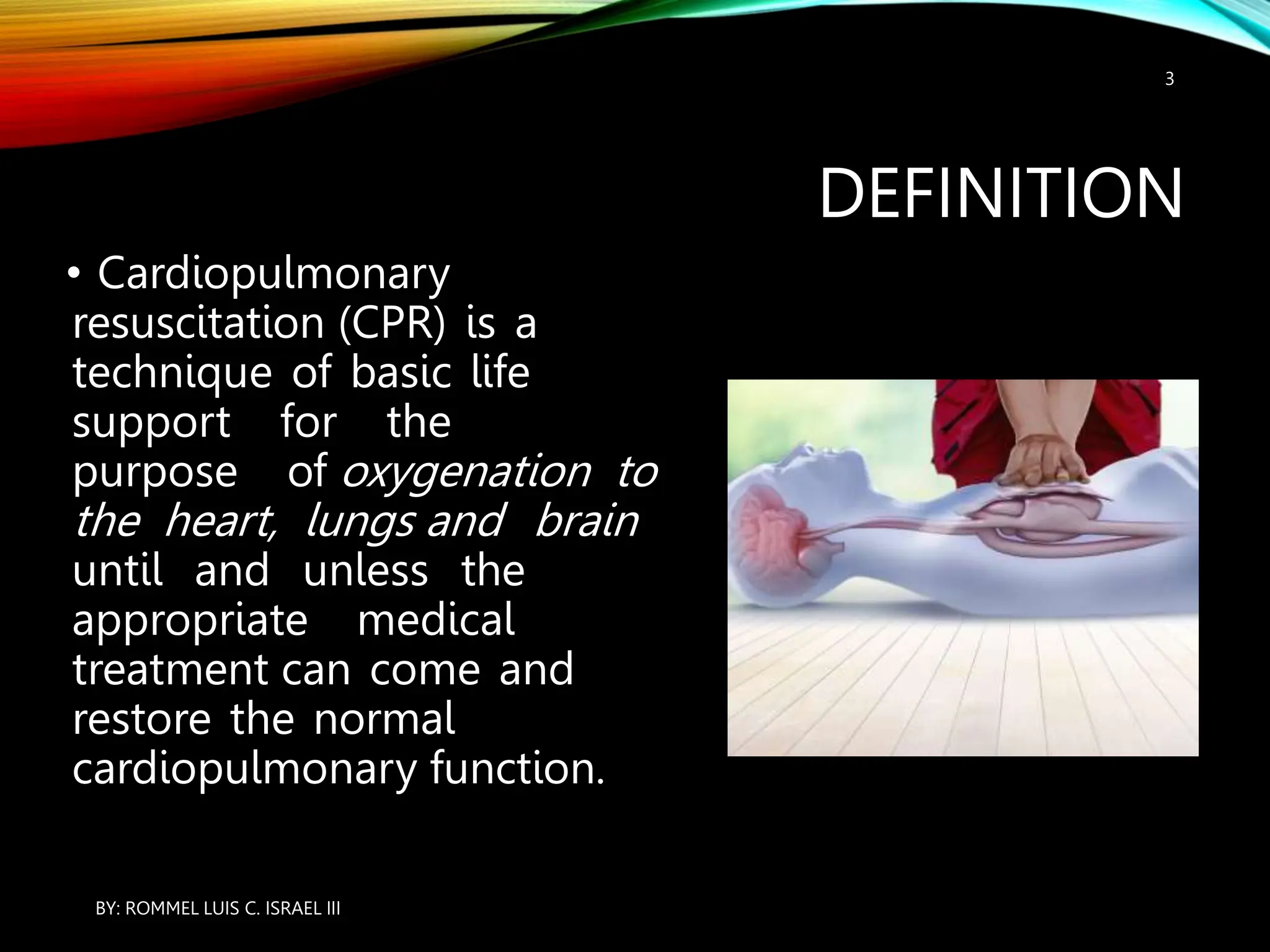
• Cardiopulmonary
resuscitation (CPR) is a
technique of basic life
support for the
purpose of oxygenation to
the heart, lungs and brain
until and unless the
appropriate medical
treatment can come and
restore the normal
cardiopulmonary function.
BY: ROMMEL LUIS C. ISRAEL III
3
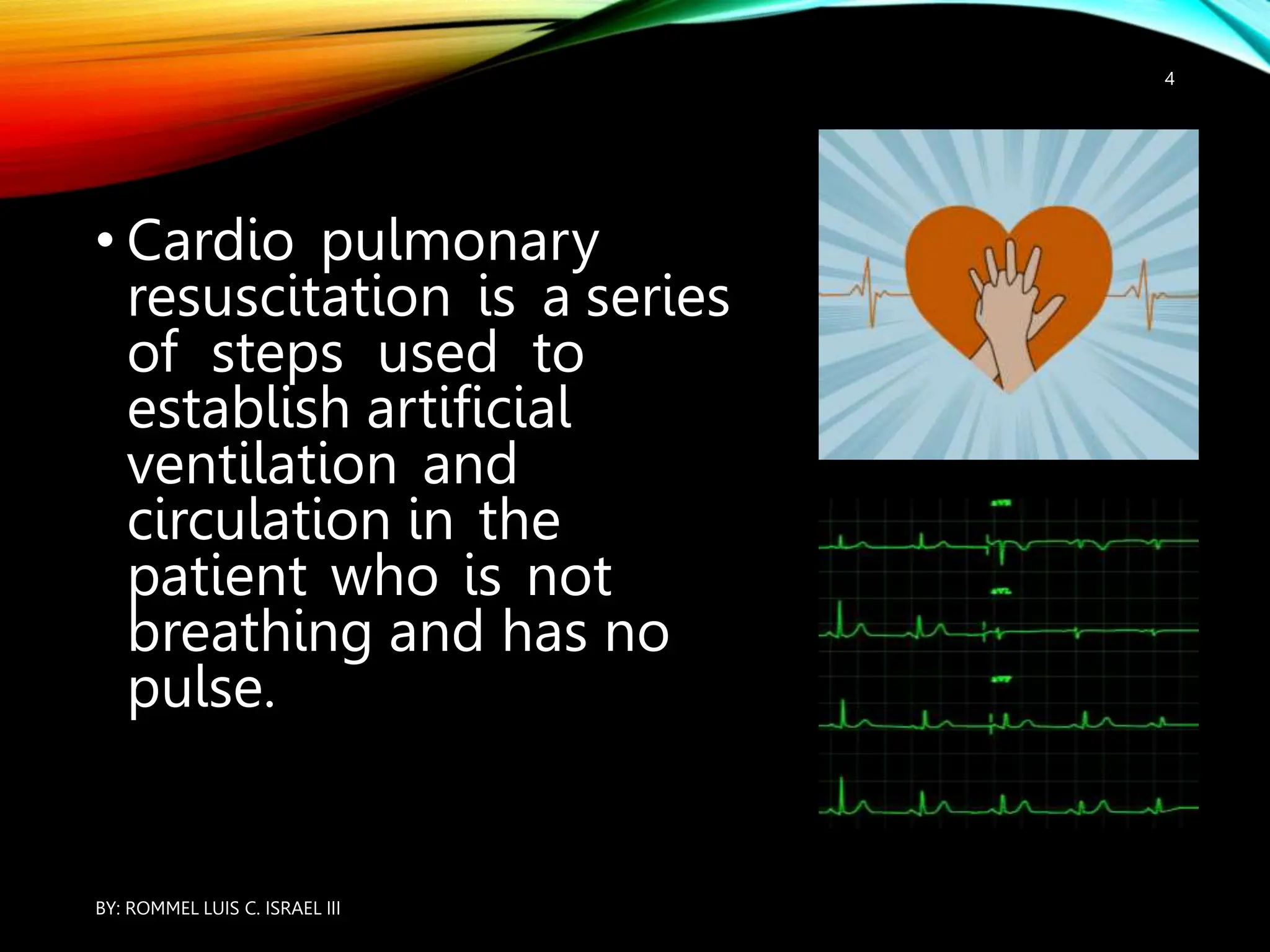
• Cardio pulmonary
resuscitation is a series
of steps used to
establish artificial
ventilation and
circulation in the
patient who is not
breathing and has no
pulse.
BY: ROMMEL LUIS C. ISRAEL III
4
PURPOSE
Restore cardiopulmonary
functioning
Prevent irreversible brain
damage from anoxia
BY: ROMMEL LUIS C. ISRAEL III
5
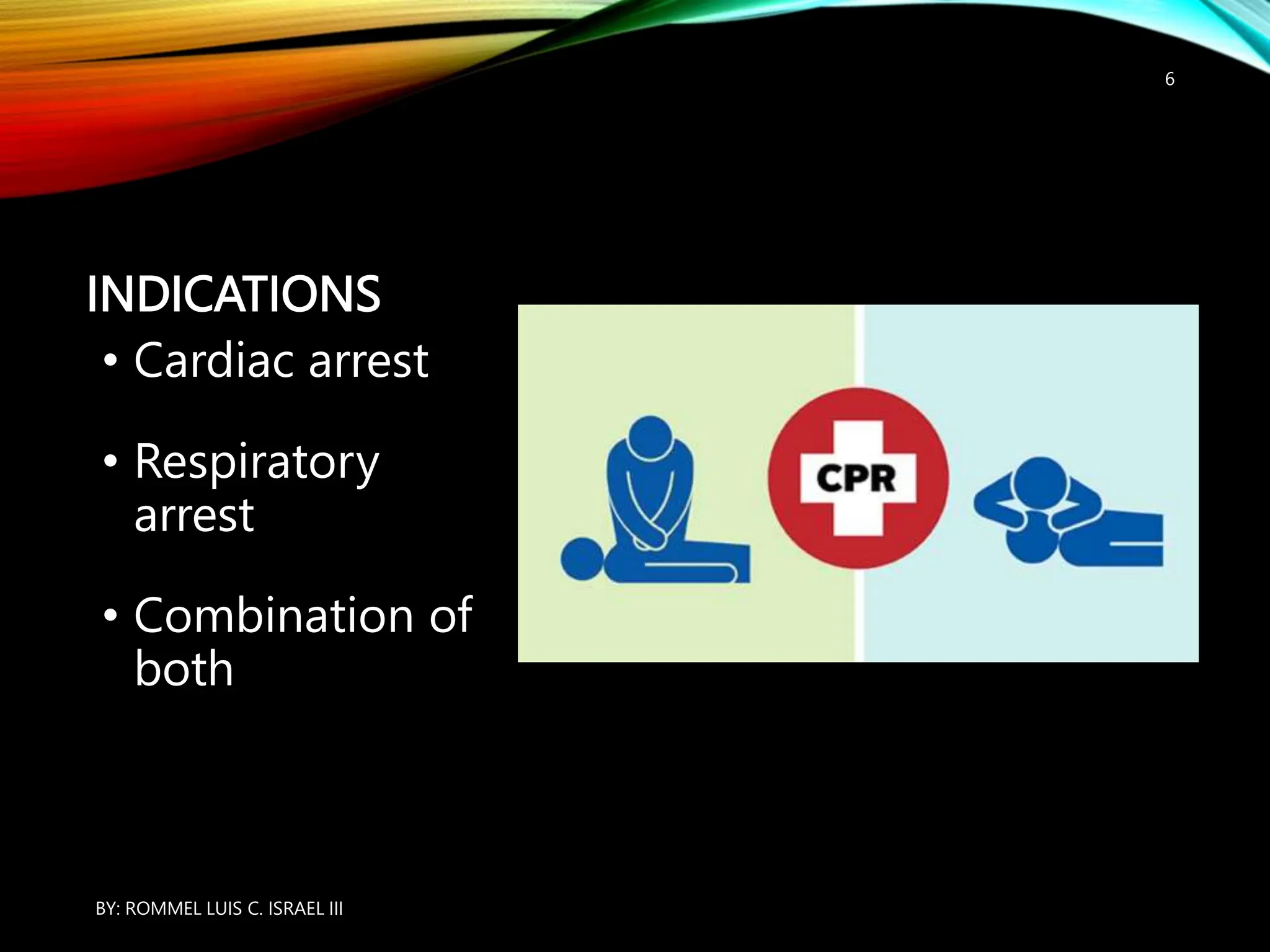
INDICATIONS
• Cardiac arrest
• Respiratory
arrest
• Combination of
both
BY: ROMMEL LUIS C. ISRAEL III
6
WHAT IS CARDIAC ARREST?
•It is loss of cardiac function, breathing
and loss of consciousness.
BY: ROMMEL LUIS C. ISRAEL III
7
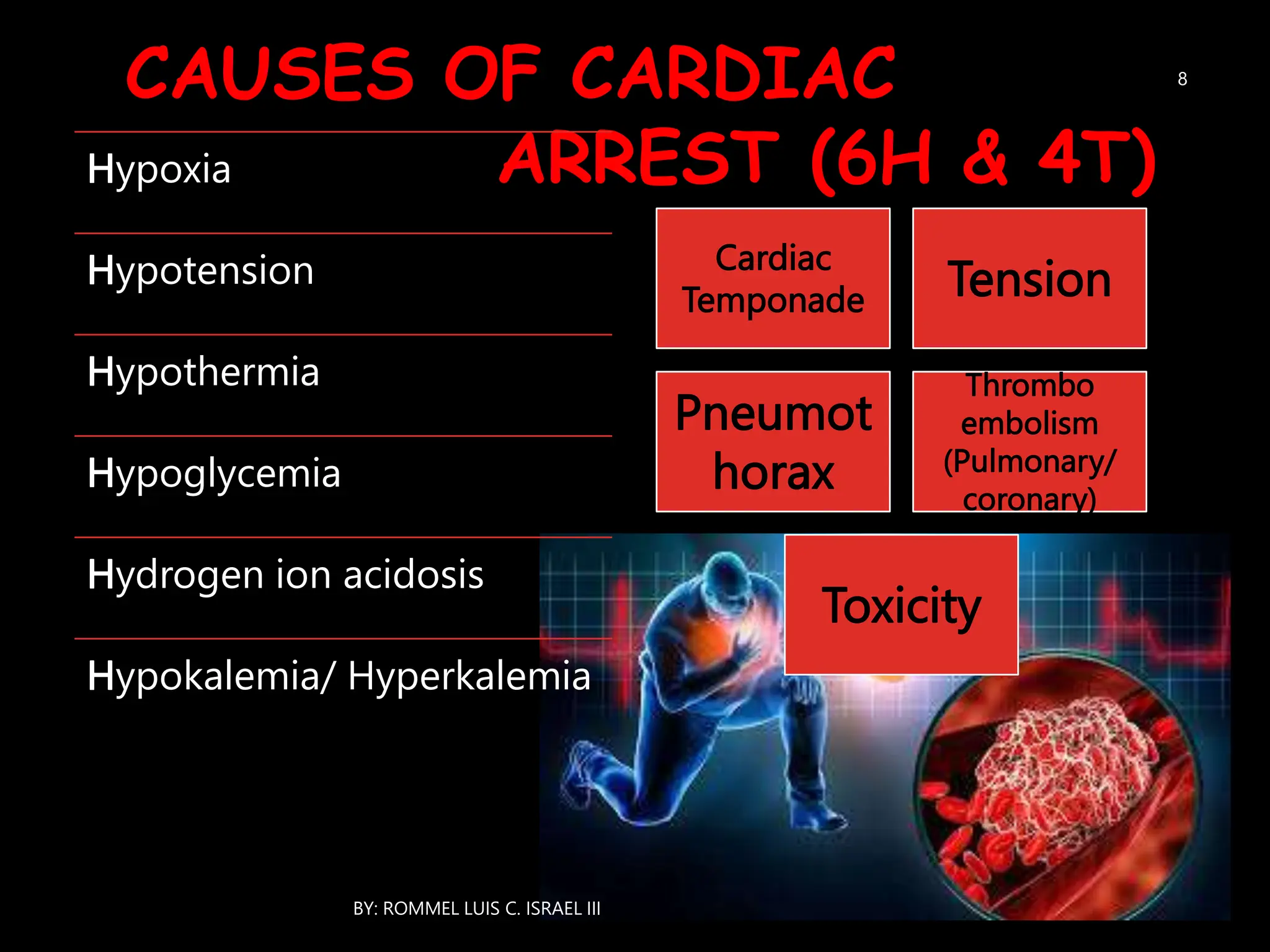
CAUSES OF CARDIAC
ARREST (6H & 4T)
Hypoxia
Hypotension
Hypothermia
Hypoglycemia
Hydrogen ion acidosis
Hypokalemia/ Hyperkalemia
Cardiac
Temponade Tension
Pneumot
horax
Thrombo
embolism
(Pulmonary/
coronary)
Toxicity
BY: ROMMEL LUIS C. ISRAEL III
8
BY: ROMMEL LUIS C. ISRAEL III
9
DIAGNOSIS OF CARDIAC
ARREST (TRIAD)
Loss of
consciousness
Loss of apical &
central pulsations
(carotid &
femoral)
Apnea
BY: ROMMEL LUIS C. ISRAEL III
10
HOW CPR WORKS?
The air we breath in, travels to our lungs were oxygen is picked up
our blood and then pumped by the heart to our tissue and organs.
When a person experiences cardiac arrest- whether due to heart
in adults or the elderly or an injury such as near drowning or
trauma in a child- the heart goes from a normal arrhythmic
called ventricular fibrillation, and eventually ceases to beat
This prevents oxygen from circulating throughout the body,
killing cells and tissue.
BY: ROMMEL LUIS C. ISRAEL III
11
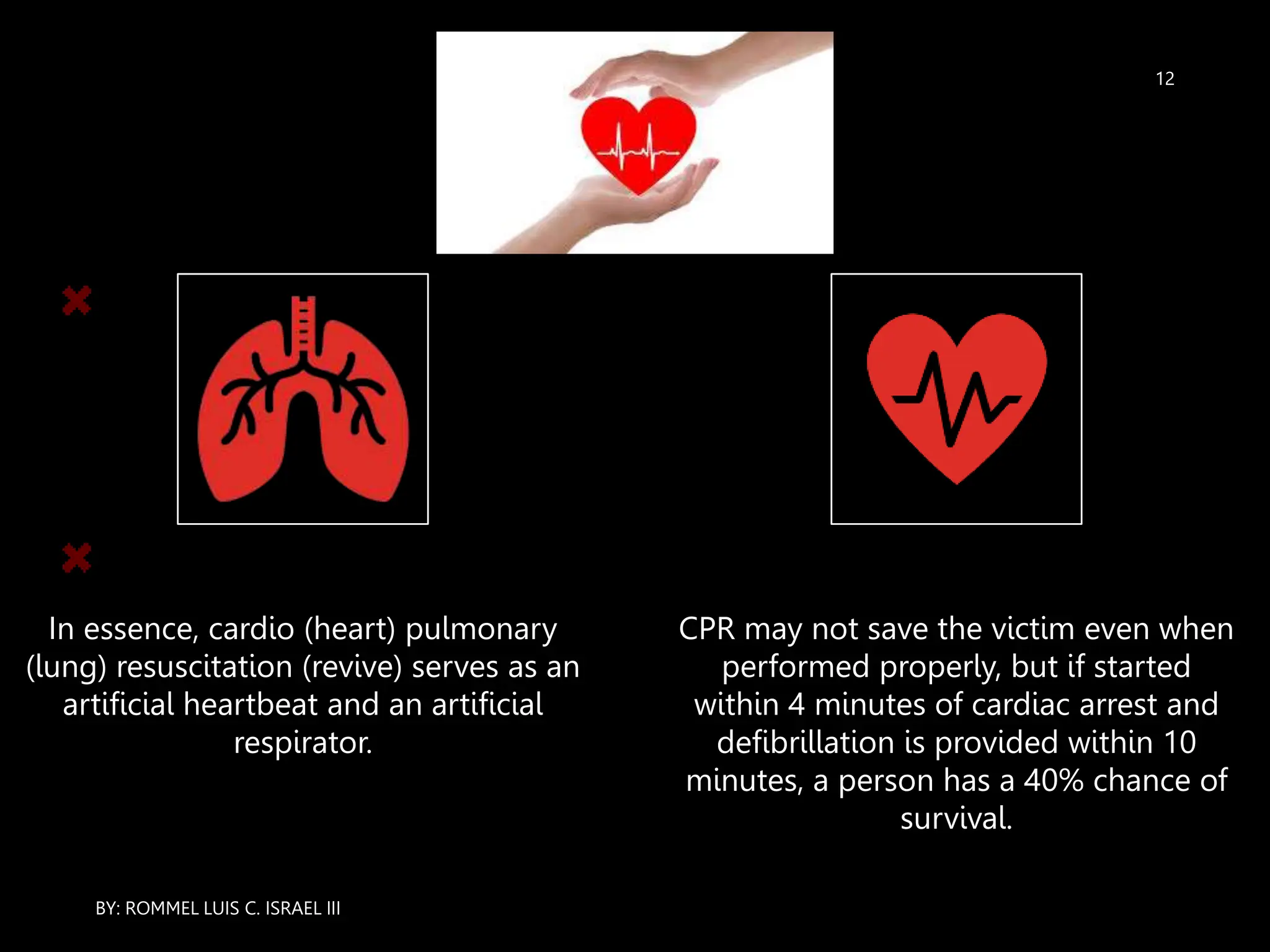
In essence, cardio (heart) pulmonary
(lung) resuscitation (revive) serves as an
artificial heartbeat and an artificial
respirator.
CPR may not save the victim even when
performed properly, but if started
within 4 minutes of cardiac arrest and
defibrillation is provided within 10
minutes, a person has a 40% chance of
survival.
BY: ROMMEL LUIS C. ISRAEL III
12
PHASES OF THE CPR
PHASES STEPS
Phase I Basic Life
Support
C= Circulation
A= Airway
B= Breathing
Phase II Advance
Cardiac
Support
D= Drugs
E= ECG
F= Fibrillation
Phase III Prolonged Life
Support
Post
Resuscitation
Care
BY: ROMMEL LUIS C. ISRAEL III
13
What is Basic Life Support (BLS)?
• It is life support without the use of
special equipments.
What is Advanced Life Support
(ACLS)?
• It is life support withthe use of
special equipment (e.g.. Airway,
endotracheal tube, defibrillation)
BY: ROMMEL LUIS C. ISRAEL III
14
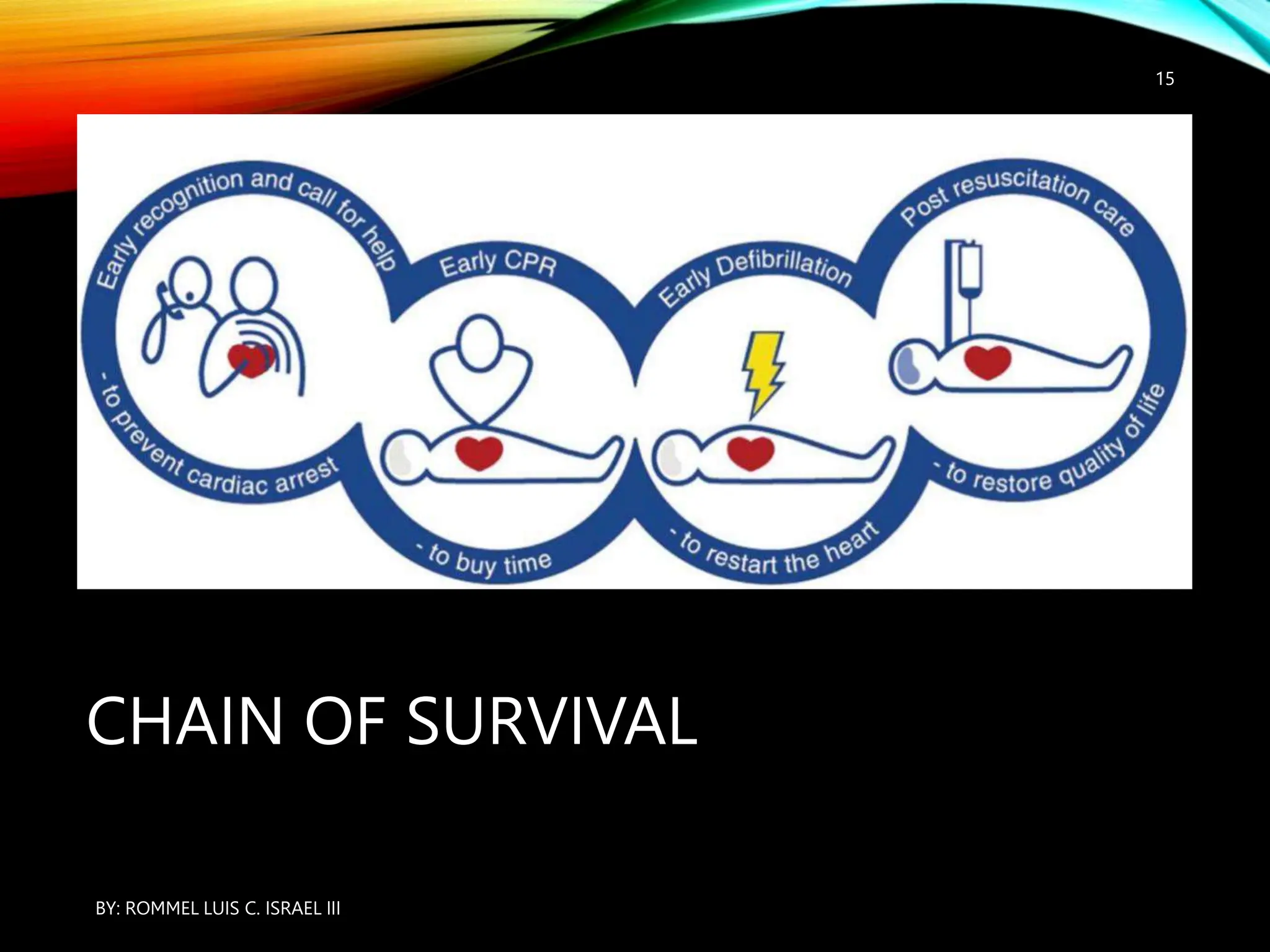
CHAIN OF SURVIVAL
BY: ROMMEL LUIS C. ISRAEL III
15
1. EARLY
RECOGNITION
Assessment is of
crucial importance. It
includes
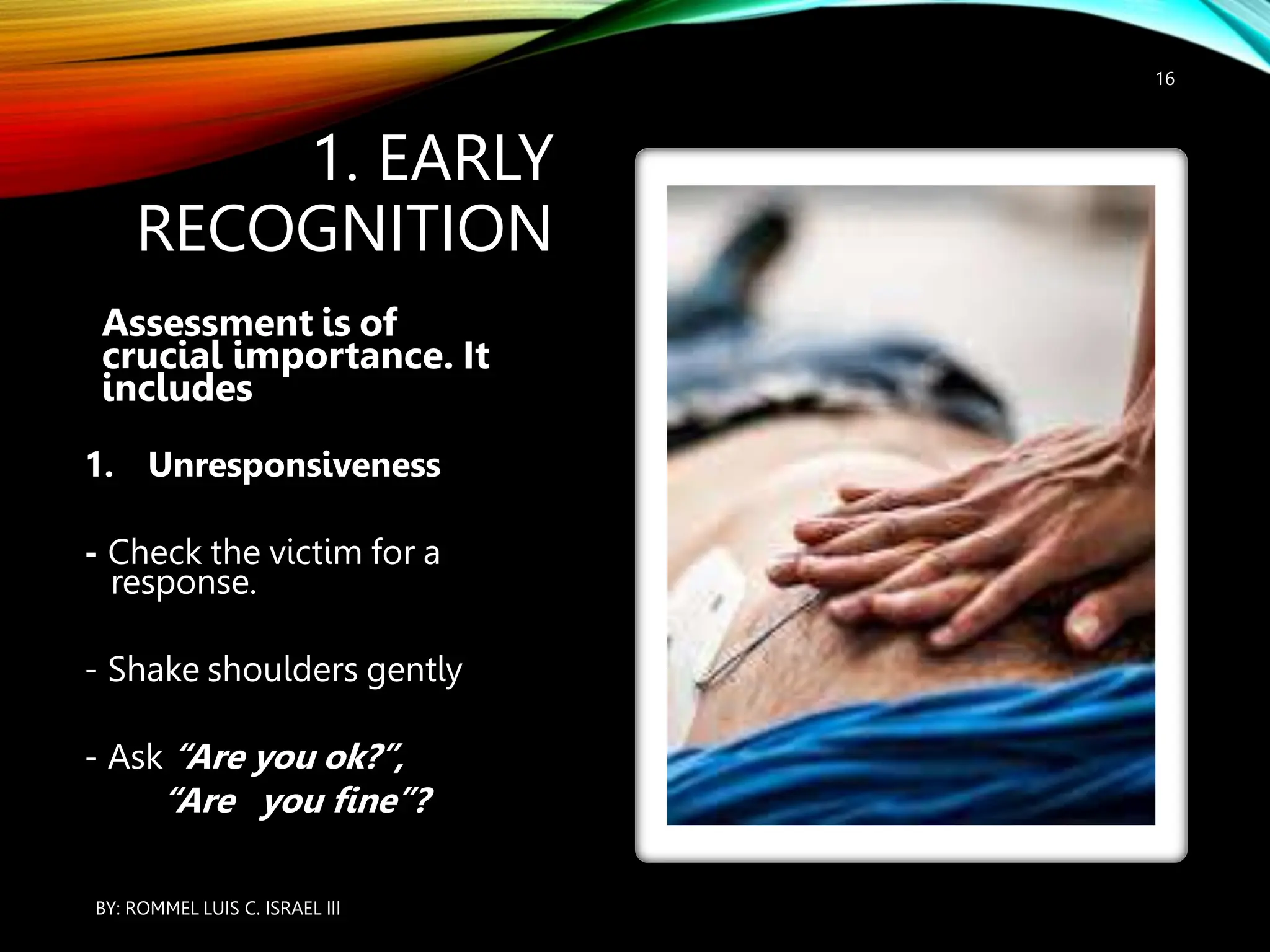
1. Unresponsiveness
- Check the victim for a
response.
- Shake shoulders gently
- Ask “Are you ok?”,
“Are you fine”?
BY: ROMMEL LUIS C. ISRAEL III
16
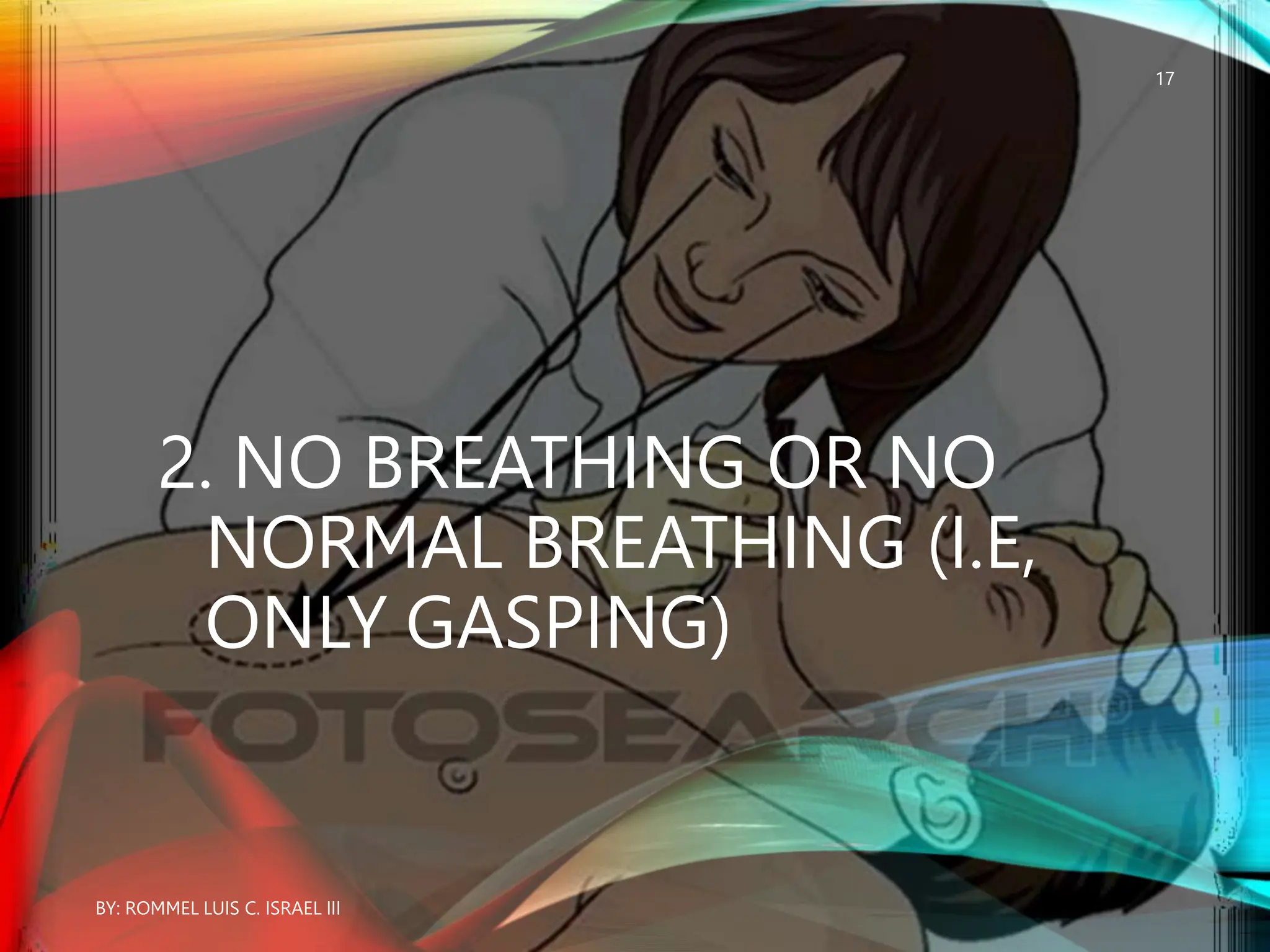
2. NO BREATHING OR NO
NORMAL BREATHING (I.E,
ONLY GASPING)
BY: ROMMEL LUIS C. ISRAEL III
17
3. NO PULSE FELT
WITHIN 30
SECONDS
BY: ROMMEL LUIS C. ISRAEL III
18
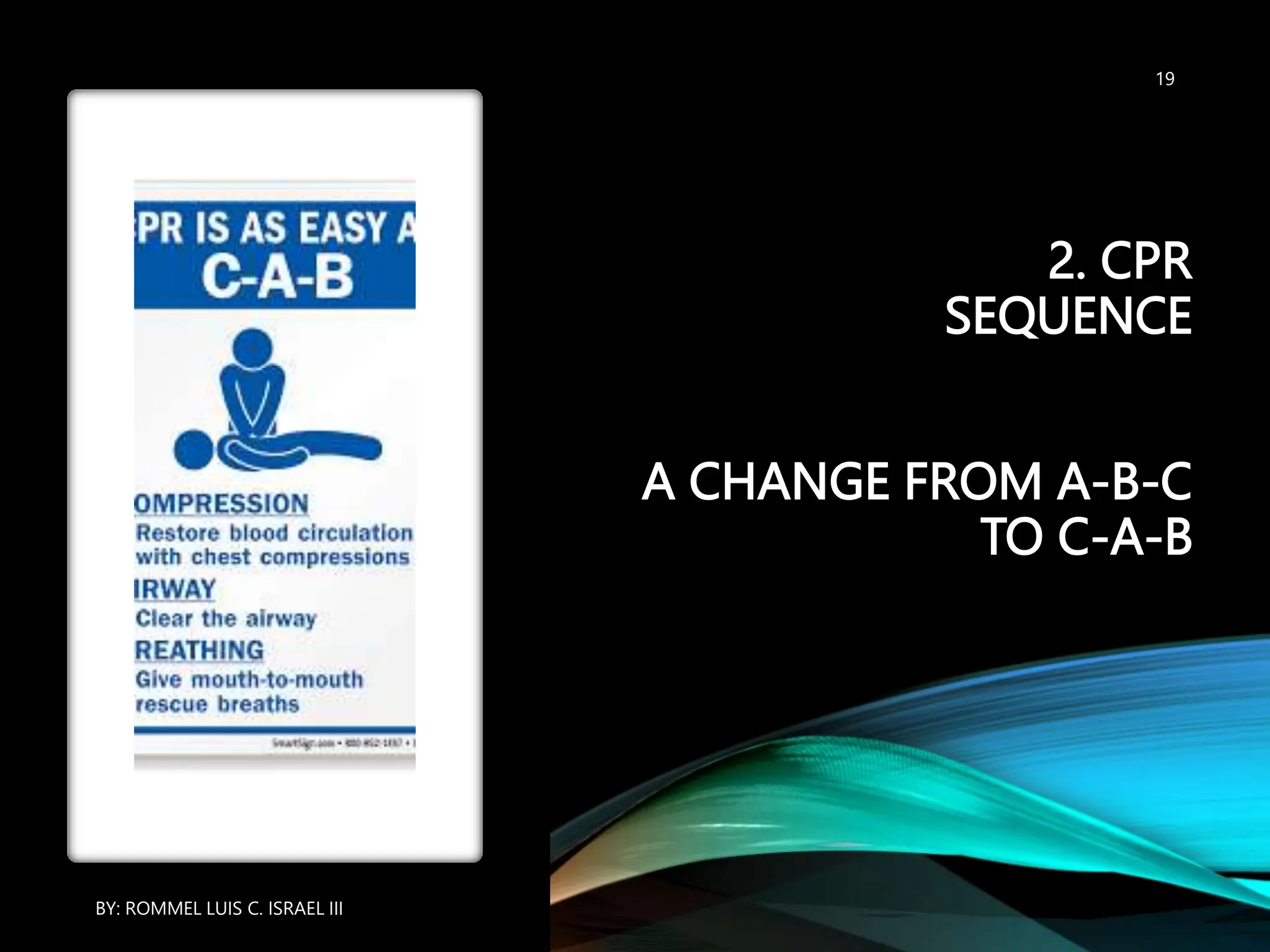
2. CPR
SEQUENCE
A CHANGE FROM A-B-C
TO C-A-B
BY: ROMMEL LUIS C. ISRAEL III
19
(A) CHEST COMPRESSION
(CARDIAC
MASSAGE)
• The human brain
cannot survive more
than 3 minutes with
lack of circulation. So
chest compressions
must be started
immediately for any
patient with absent
central pulsations.
BY: ROMMEL LUIS C. ISRAEL III
20
TECHNIQUE OF CHEST
COMPRESSION
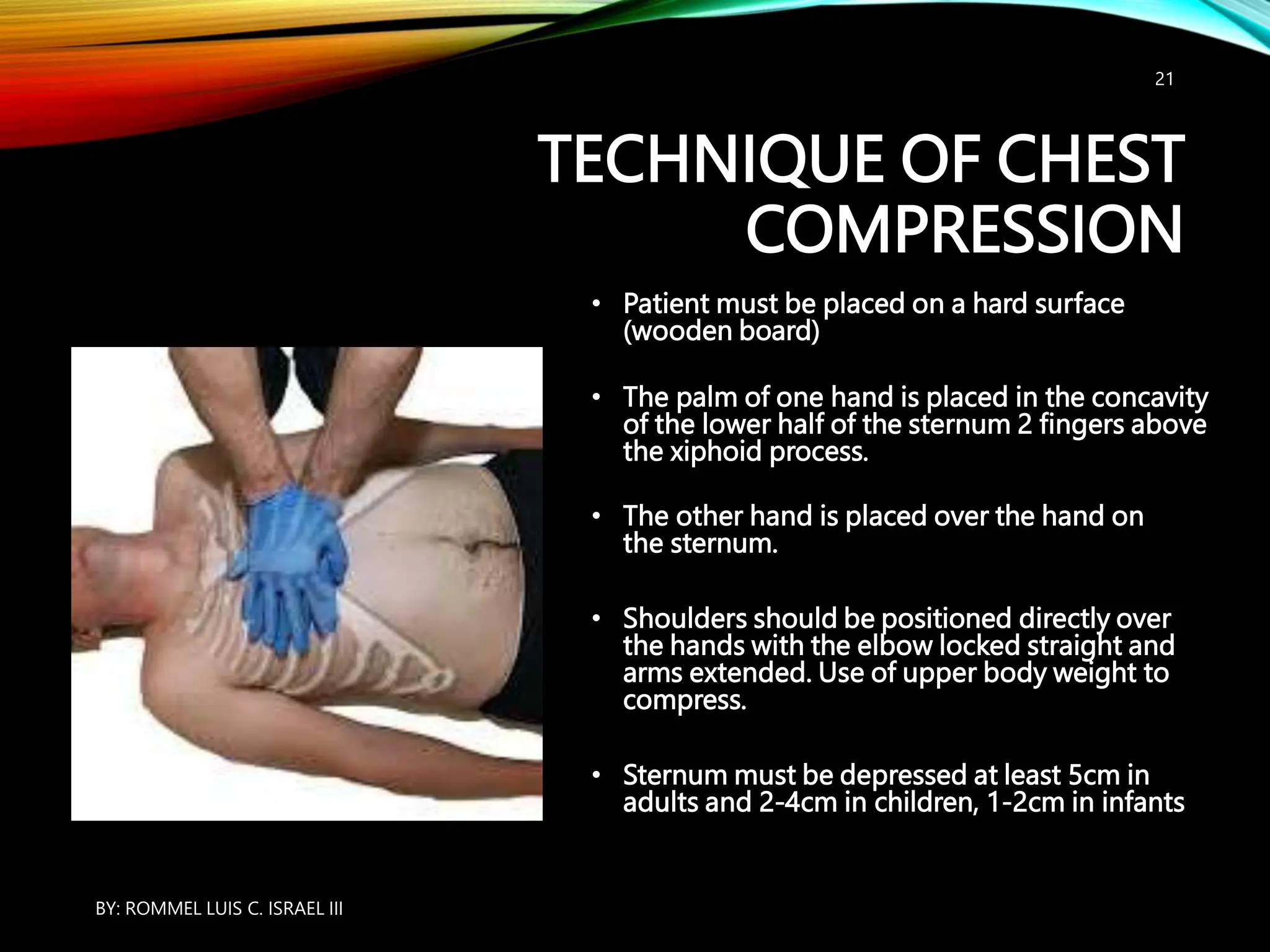
• Patient must be placed on a hard surface
(wooden board)
• The palm of one hand is placed in the concavity
of the lower half of the sternum 2 fingers above
the xiphoid process.
• The other hand is placed over the hand on
the sternum.
• Shoulders should be positioned directly over
the hands with the elbow locked straight and
arms extended. Use of upper body weight to
compress.
• Sternum must be depressed at least 5cm in
adults and 2-4cm in children, 1-2cm in infants
BY: ROMMEL LUIS C. ISRAEL III
21
PUSH HARD PUSH FAST
• Must be performed at
a rate of 100-120/min
During CPR the ratio of a
chest compressions to
ventilation should be as
follows:
• Single rescuer=30:2
• In the presence of 2
rescuers chest
compressions must not be
interrupted for ventilation
BY: ROMMEL LUIS C. ISRAEL III
22
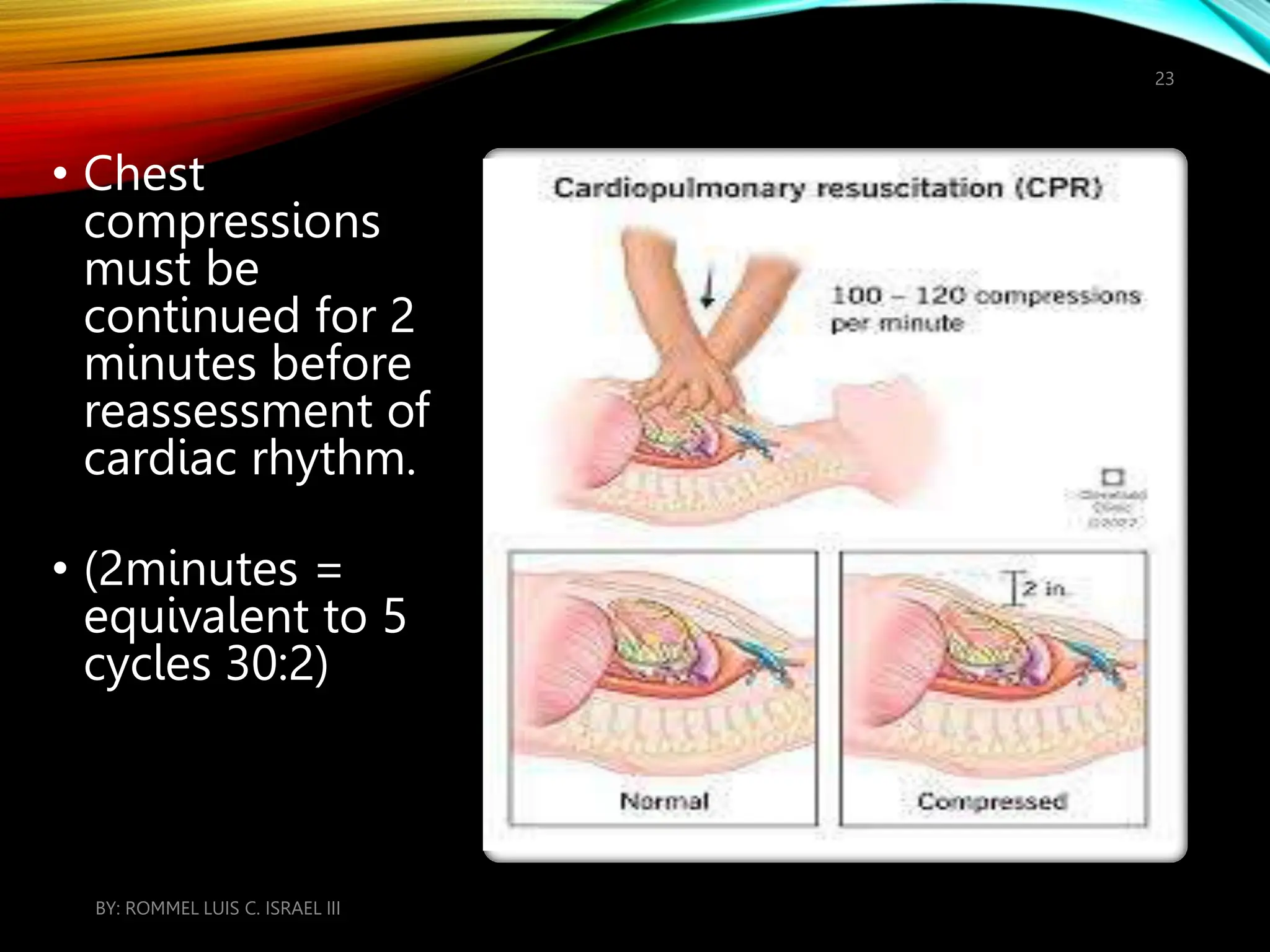
• Chest
compressions
must be
continued for 2
minutes before
reassessment of
cardiac rhythm.
• (2minutes =
equivalent to 5
cycles 30:2)
BY: ROMMEL LUIS C. ISRAEL III
23
Golden rules:
• Push hard push fast
• Allow maximum recoil
• Minimize the interruption
• Do not hyperventilate
• Early defibrillation of
shockable rhythm
BY: ROMMEL LUIS C. ISRAEL III
24
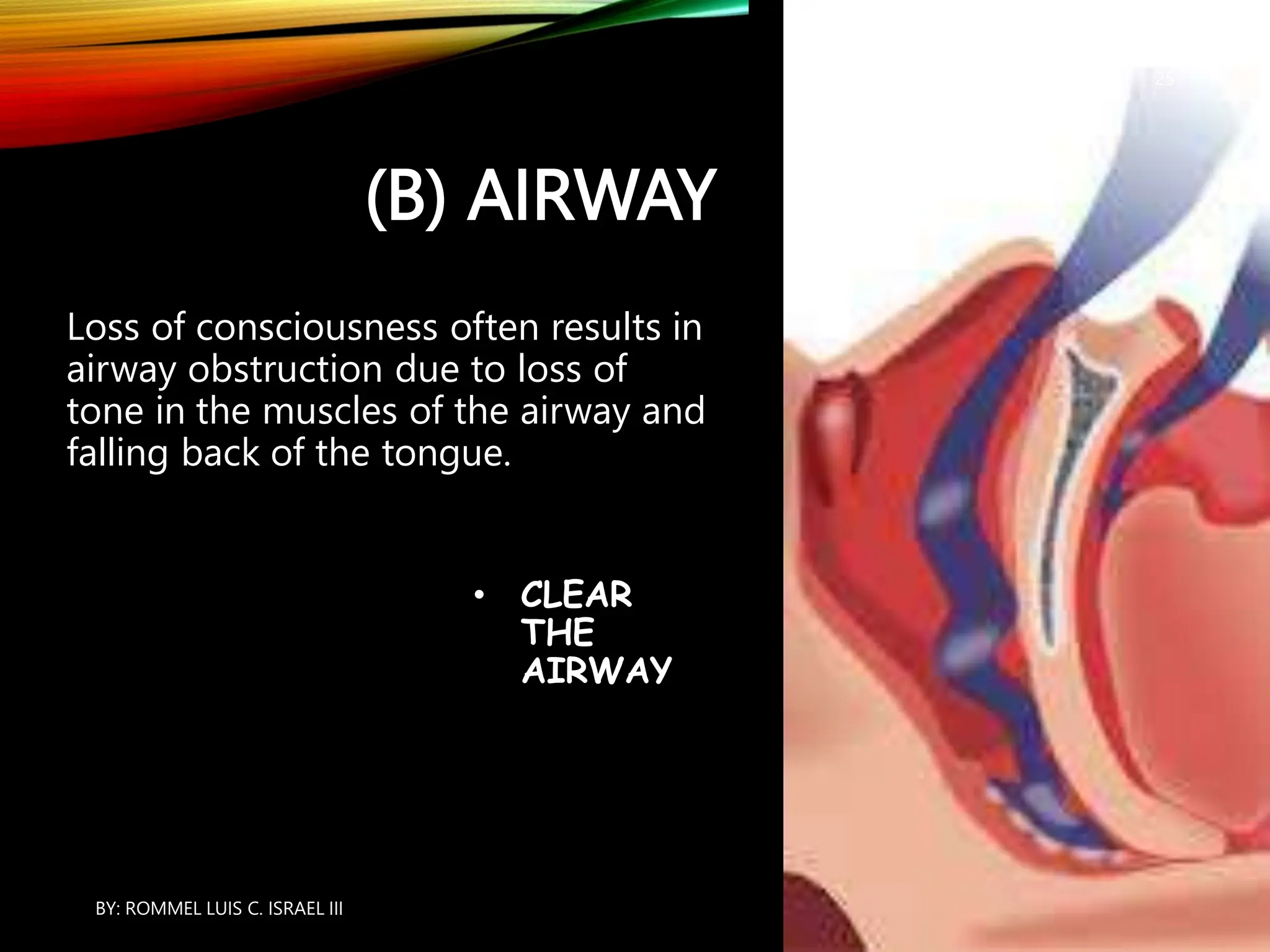
(B) AIRWAY
Loss of consciousness often results in
airway obstruction due to loss of
tone in the muscles of the airway and
falling back of the tongue.
• CLEAR
THE
AIRWAY
BY: ROMMEL LUIS C. ISRAEL III
25
BASIC TECHNIQUES FOR AIRWAY
PATENCY
HEAD TILT-CHIN LIFT JAW THRUST
BY: ROMMEL LUIS C. ISRAEL III
26
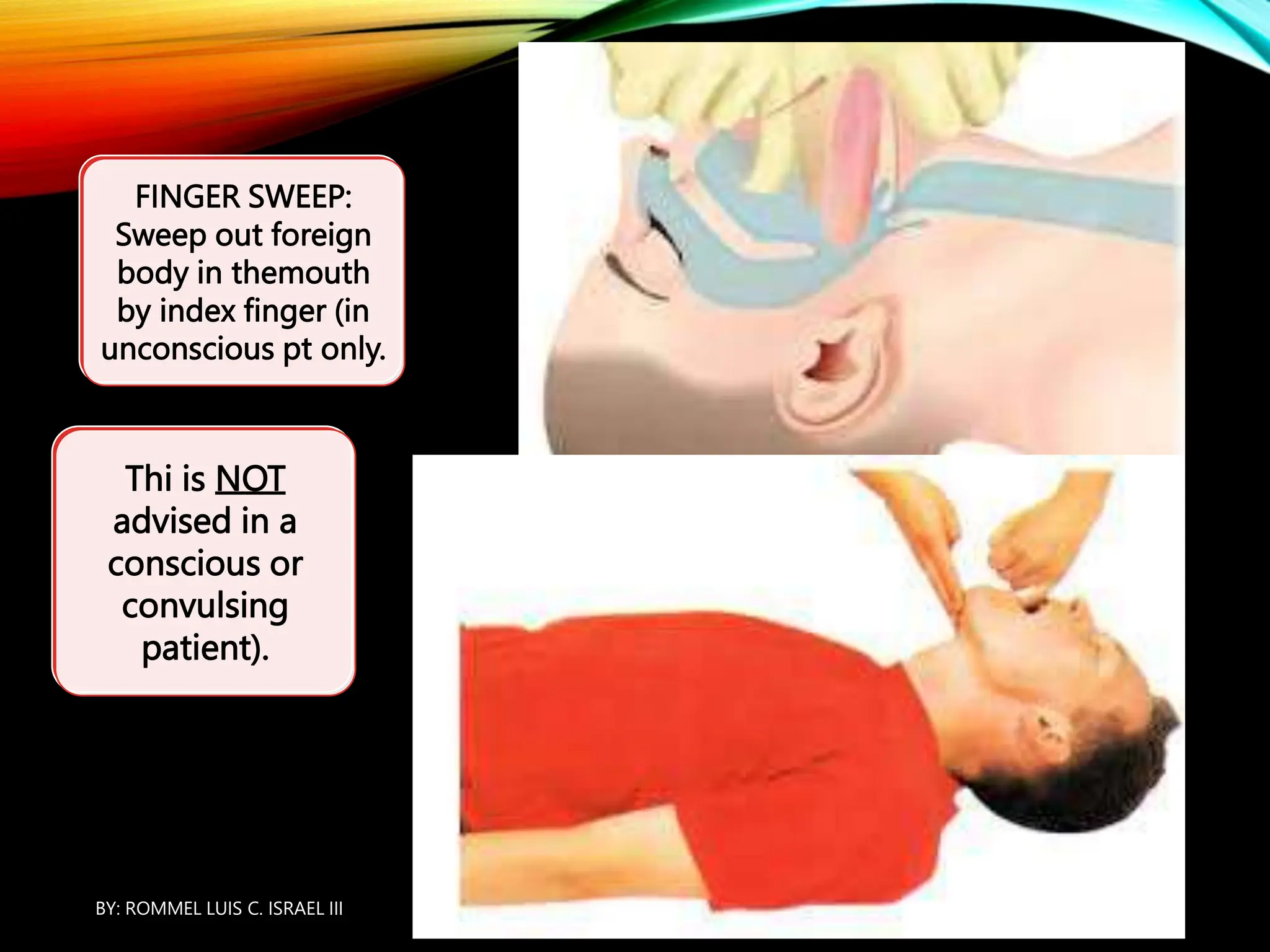
FINGER SWEEP:
Sweep out foreign
body in themouth
by index finger (in
unconscious pt only.
Thi is NOT
advised in a
conscious or
convulsing
patient).
BY: ROMMEL LUIS C. ISRAEL III
27
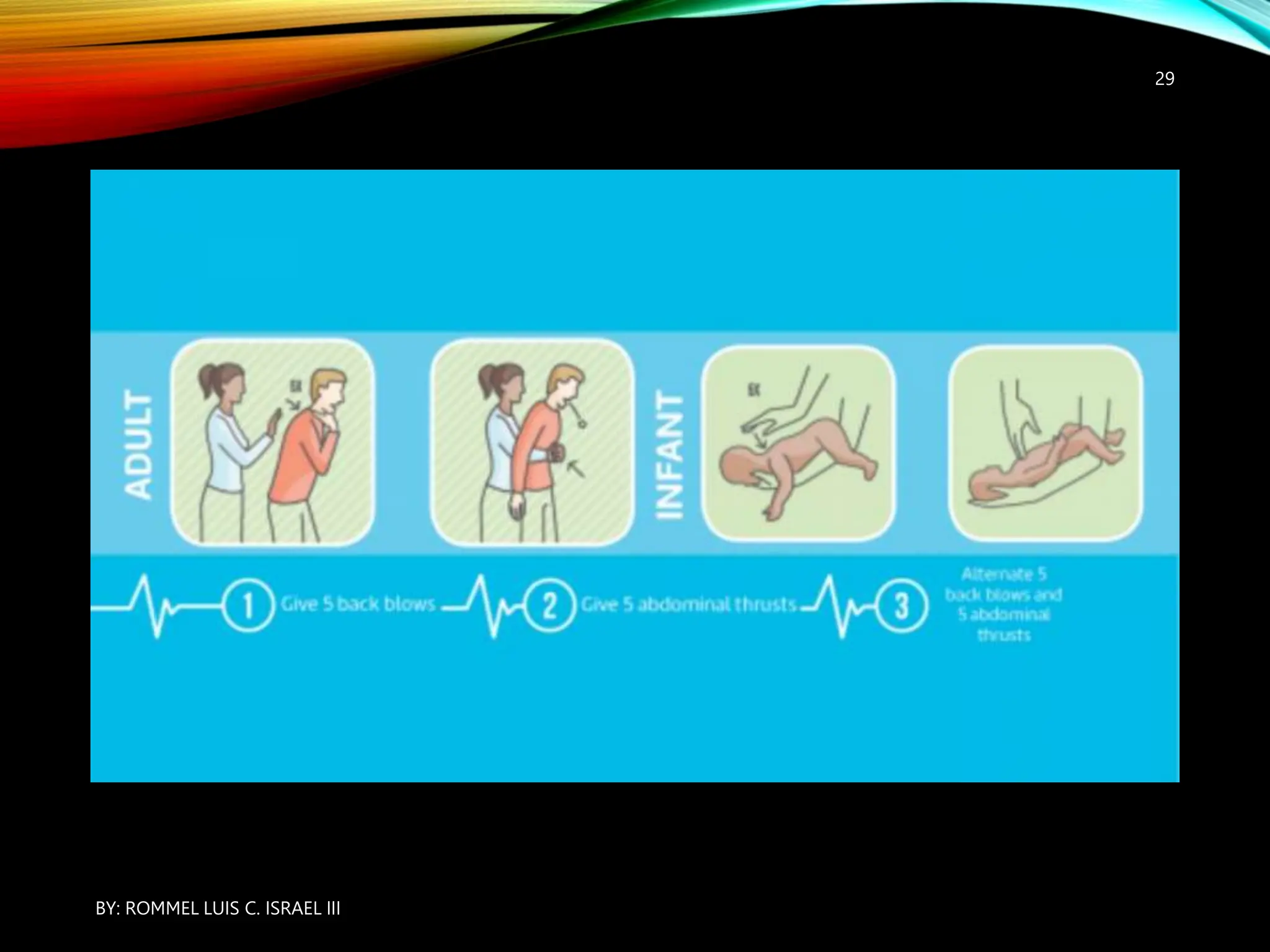
HEIMLICH MANOEUVRE:
if the pt is conscious or the foreign body cannot be
removed by a finger sweep.
It is done while the pt is standing up or lying down.
BY: ROMMEL LUIS C. ISRAEL III
28
BY: ROMMEL LUIS C. ISRAEL III
29
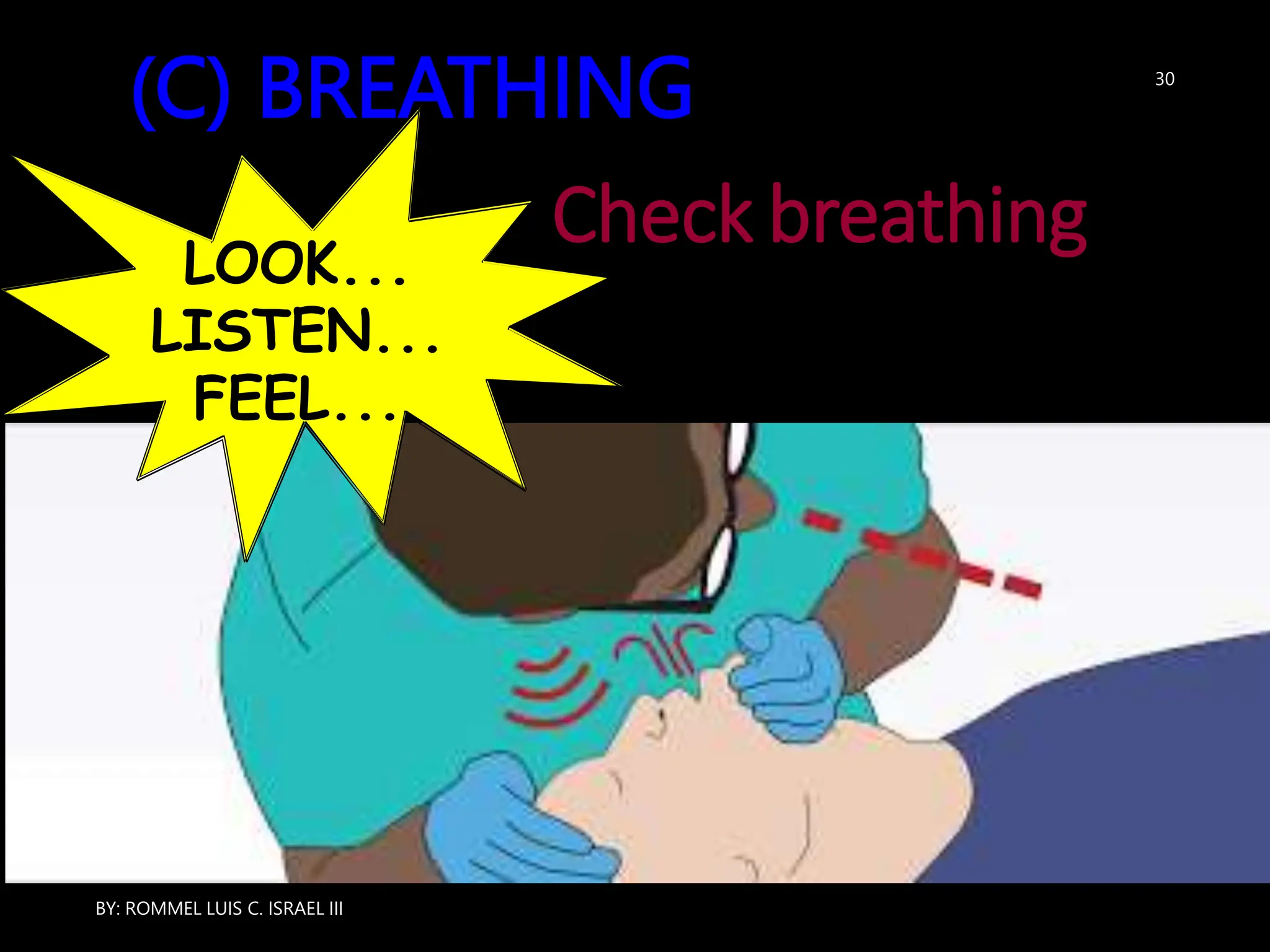
(C) BREATHING
Check breathing
LOOK...
LISTEN...
FEEL...
BY: ROMMEL LUIS C. ISRAEL III
30
• Look for chest movement
• Listen at the victim’s mouth for breath
sounds
• Feel for air on your cheek.
Look, Listen & Feel for breathing for
No longer than 10 seconds
After the first set of chest
compressions, the airway is opened
and the rescuer delivers 2 breaths
BY: ROMMEL LUIS C. ISRAEL III
31
• Rescue breathing can be mouth-to-mouth breathing or mouth-to-
nose breathing if the mouth is seriously injured or can’t be opened.
• With the airway open (using the head-tilt, chin-lift manueuver), pinch
the nostrils shut for mouth-to-mouth breathing and cover the
person’s mouth with yours, making a seal.
RESCUE BREATHING
BY: ROMMEL LUIS C. ISRAEL III
32
BASIC TECHNIQUES FOR BREATHING
1. Mouth to Mouth Breathing:
- with the airway held open, pinch the nostrils
closed, take a deep breath and seal your lips
over the patient’s mouth. Blow steadily into the
patient’s mouth watching the chest rise as if the
patient was taking a deep breath.
BY: ROMMEL LUIS C. ISRAEL III
33
• Mouth to Nose Breathing:-
seal the mouth shut and
breathe steadily though
the nose.
• Mouth to mouth and
nose: is used in infants
and small children.
BY: ROMMEL LUIS C. ISRAEL III
34
EARLY DEFIBRILLATION
AUTOMATIC
EXTERNAL
DEFIBRILLATOR
(AED)
BY: ROMMEL LUIS C. ISRAEL III
35
AUTOMATIC EXTERNAL
DEFIBRILLATOR (AED)
• A battery operated device
• On applying to victim detects and assesses cardiac
rhythm and prompts the user for further action
• AED BOX contains
• AED machine with battery and charger
• Two self sticking pads with cables and connectors
• One razor
BY: ROMMEL LUIS C. ISRAEL III
36
BY: ROMMEL LUIS C. ISRAEL III
37
• Give ONE shock each time AED advices
• “SHOCK”
• Resume CPR immediately – 5 cycles (2min) starting
with chest compressions
• After 2 minutes, AED will automatically start
analyzing again & prompt accordingly
• Non-Shockable rhythm – AED prompts to check
for “signs of circulation” – Check Pulse (<10sec)
• No pulse : continue CPR
• Pulse : discontinue CPR
BY: ROMMEL LUIS C. ISRAEL III
38
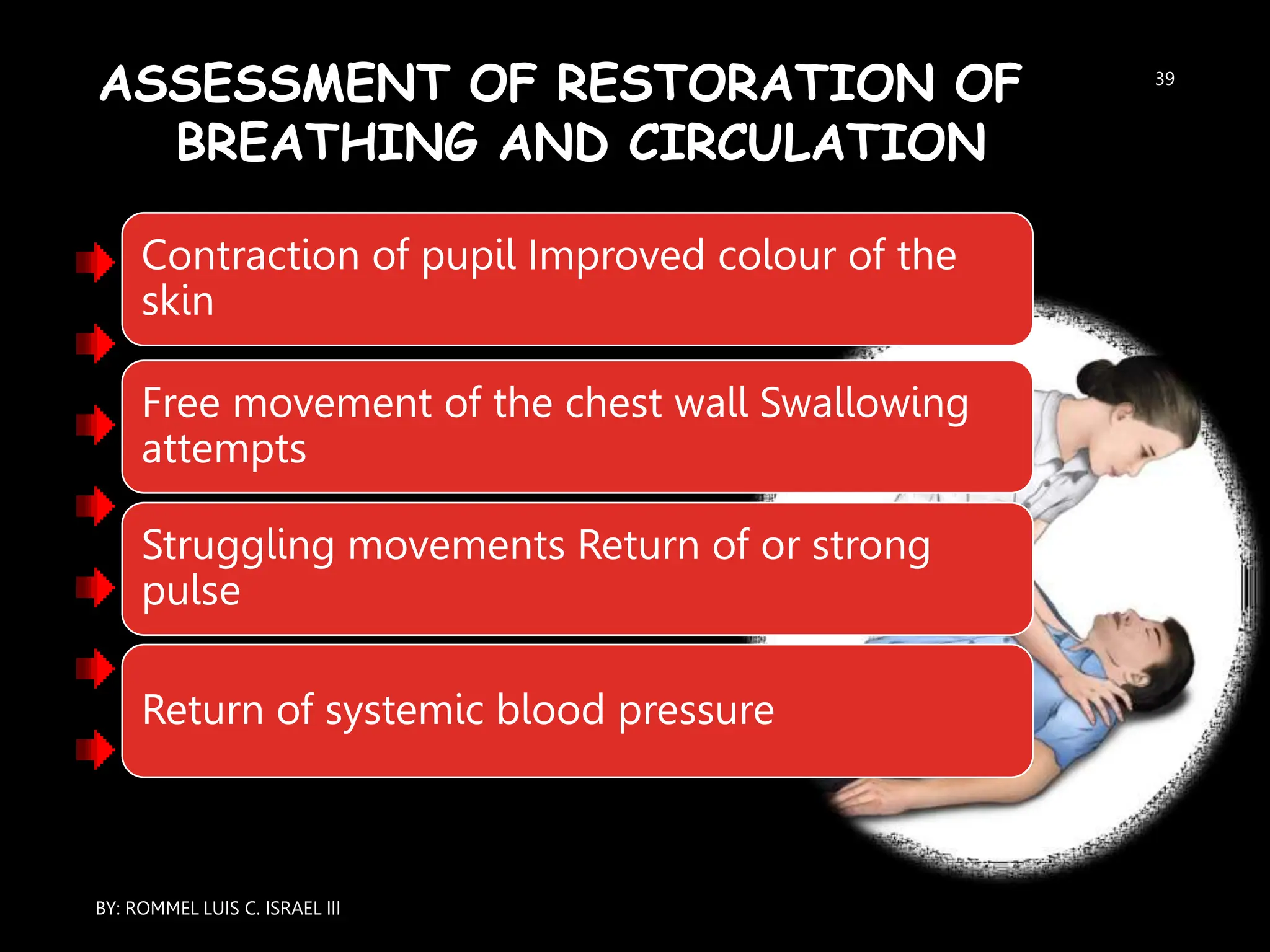
ASSESSMENT OF RESTORATION OF
BREATHING AND CIRCULATION
Contraction of pupil Improved colour of the
skin
Free movement of the chest wall Swallowing
attempts
Struggling movements Return of or strong
pulse
Return of systemic blood pressure
BY: ROMMEL LUIS C. ISRAEL III
39
BY: ROMMEL LUIS C. ISRAEL III
40
BY: ROMMEL LUIS C. ISRAEL III
41
RECOVERY POSITION
•If the victim responds, position
him in the recovery position and
monitor breathing until help
arrives
BY: ROMMEL LUIS C. ISRAEL III
42
BY: ROMMEL LUIS C. ISRAEL III
43
WHEN TO
TERMINATE
BLS
Pulse and respiration
returns
Emergency medical help
Physician declared patient is
deceased
In a non health setting ,another
to stop BLS would be that the rescuer
exhausted and physically unable to
continue to perform BLS.
BY: ROMMEL LUIS C. ISRAEL III
44
BY: ROMMEL LUIS C. ISRAEL III
45
ADVANCED
LIFE SUPPORT
Includes
Circulation by cardiac
massage
Airway management by
equipments
Breathing by advanced
techniques
Defibrillation by manual
defibrillator
drugs
BY: ROMMEL LUIS C. ISRAEL III
46
BY: ROMMEL LUIS C. ISRAEL III
47
A. CHEST
COMPRESSION
BY: ROMMEL LUIS C. ISRAEL III
48
B. ADVANCED
TECHNIQUES FOR
AIRWAY PATENCY:
• 1. FACE MASK
BY: ROMMEL LUIS C. ISRAEL III
49
2.
OROPHARYNGE
AL AIRWAY
BY: ROMMEL LUIS C. ISRAEL III
50
3. NASOPHARYNGEAL AIRWAY
BY: ROMMEL LUIS C. ISRAEL III
51
4. LARYNGEAL MASK AIRWAY(LMA)
BY: ROMMEL LUIS C. ISRAEL III
52
5. ENDOTRACHEAL TUBE
BY: ROMMEL LUIS C. ISRAEL III
53
6.
COMBI
TUBE
BY: ROMMEL LUIS C. ISRAEL III
54
BREATHING
BY: ROMMEL LUIS C. ISRAEL III
55
• Expired air contains 16% O2. So
supplemental 100%O2 should be used
as soon as possible.
• Successful breathing is achieved by
delivery of a tidal volume of 800-1200
ml in adults at a rate of 10-12
in adults.
Advanced techniques include:
1) Self-inflating resuscitation bag
(Ambubag)
2) Mechanical ventilator in OR or in ICU
BY: ROMMEL LUIS C. ISRAEL III
56
• Expired air = 16% O2
• Ambu Bag (room air) = 21% O2
• Ambu bag + O2 (10-15L) = 45% O2
• Ambu Bag + O2 + Reservoir bag = 85% O2
BY: ROMMEL LUIS C. ISRAEL III
57
DEFIBRILLATION
• Defibrillation consists of
delivering a therapeutic
dose of electrical energy
to the affected heart
with a device called a
defibrillator
BY: ROMMEL LUIS C. ISRAEL III
58
• In cardiac arrest,the associated heart
rhythms can be categorised into two
groups :
1) Shockable rhythm: VT/VF
2) Non shockable rhythm: asystole and PEA
BY: ROMMEL LUIS C. ISRAEL III
59
BY: ROMMEL LUIS C. ISRAEL III
60
DEFIBRILLATION
Position of Paddles:
• One paddle is placed in
the right infraclavicular
region, while the other is
placed in
the left 5th-6th
Intercostal space
anterior axillary l
ine.
BY: ROMMEL LUIS C. ISRAEL III
61
• Action Completely depolarize all
myocardial cells so SA node can re-
establish as pacemaker
• Voltage of electricity dischargeHigh
from 150 J to 360J(biphasic)
360 J(monophasic)
BY: ROMMEL LUIS C. ISRAEL III
62
DRUGS USED IN CPR
► Adrenaline:
- Given as a vasopressor α-1 effect (not as an
inotrope).
- Dose: 1 mg (0.01 mg/kg) IV every 4 minutes
• (alternating cycles) while continuing CPR.
- Given:
1) Immediately in non-shockable rhythm (non-
VT/VF).
2) In VF or VT given after the 3rd shock.
• -Repeated: in alternate cycles (every 3 minutes).
• -Once adrenaline → ALWAYS adrenaline.
BY: ROMMEL LUIS C. ISRAEL III
63
• Amiodarone:
- Dose: 300 mg IV bolus (5 mg/kg).
- Given: in shockable rhythm after
the 3rd shock.
•- If unavailable give lidocaine 100
mg IV (1-1.5 mg/kg).
• Vasopressin (ADH): 40 IU single
dose once.
BY: ROMMEL LUIS C. ISRAEL III
64
► Magnesium:
- Dose: 2 g IV.
- Given:
• 1- VF / VT with hypomagnesemia. 2- Torsade de
pointes.
• 3- Digoxin toxicity.
► Calcium:
– Dose: 10 ml of 10% Calcium chloride IV.
– Indications: PEA caused by: hyperkalemia,
hypocalcemia, hypermagnesemia, and overdose of
calcium channel blockers.
– Do NOT give calcium solutions and NaHCO3
simultaneously by the same route.
BY: ROMMEL LUIS C. ISRAEL III
65
► IV Fluids:
• Infuse fluids rapidly if hypovolemia is
suspected.
• Use normal saline (0.9% NaCl) or Ringer’s
• solution.
• Avoid dextrose which is redistributed away
from the intravascular space rapidly and
causes hyperglycemia which may worsen
neurological outcome after cardiac arrest.
• Dextrose is indicated only if there is
documented hypoglycemia.
BY: ROMMEL LUIS C. ISRAEL III
66
►Thrombolytics:
• Fibrinolytic therapy is considered
when cardiac arrest is caused by
proven or suspected acute pulmonary
embolism.
• If a fibrinolytic drug is used in these
circumstances consider performing CPR
for at least 60-90 minutes before
termination of resuscitation attempts.
• Eg: Alteplase, tenecteplase (old
generation: steptokinase).
BY: ROMMEL LUIS C. ISRAEL III
67
Sodium bicarbonate:
►Used in:
• 1- Severe metabolic acidosis (pH < 7.1)
2- Life-threatening hyperkalemia.
• 3- Tricyclic antidepressant overdose.
►Dose: (half correction)
• 1/2 Base Deficit × 1/3 Body weight.
BY: ROMMEL LUIS C. ISRAEL III
68
AVOID ITS ROUTINE
USE DUE TO ITS
COMPLICATIONS:
1. Increases CO2 load:
2. Inhibits release of O2 to tissues.
3. Impairs myocardial contractility.
4. Causes hypernatremia.
5. Adrenaline works better in acidic medium.
BY: ROMMEL LUIS C. ISRAEL III
69
• Atropine:
• Its routine use in PEA and asystole
is not beneficial and has become
obsolete.
• Indicated in: sinus bradycardia or AV
block causing hemodynamic instability.
• Dose: 0.5 mg IV. Repeated up to a
maximum of 3 mg (full atropinization).
BY: ROMMEL LUIS C. ISRAEL III
70
CONTRAINDICATIONS
FOR CPR
• Do not resuscitate when a decision not
to resuscitate has been noted in chart.
This order is often abbreviated to DNR
(do not resuscitate), is sometime
referred to as no code, and is now
discussed with the client on admission
and is referred to as an advanced
directive.
BY: ROMMEL LUIS C. ISRAEL III
71
SUMMARY OF STEPS OF CPR
COMPONENT RECOMMENDATIONS
Recognition unresponsi
ve
No breathing
or no normal
breathing(i.e
, only
gasping)
No pulse felt
within 10
seconds
CPR sequence Chest compression, airway, breathing (C-
A-B)
Compression
rate
At least 100 per min
BY: ROMMEL LUIS C. ISRAEL III
72
Compression depth At least 2 inches
(5cm)
At least 1/3 AP
diameter about 2
inches (5cm)
At least 1/3 AP
diameter about 1
and half inches
(4cm)
Chest wall recoil Allow complete recoil between compressions. Rotate
compression every 2 min
Compression
interruption
Minimize interruption in chest compressions. Attempt to limit
interruptions to <10 sec
Airway Head tilt-chin lift (if suspected trauma, jaw thrust)
Compression to
ventilation ratio
(until advanced
airway placed
30 : 2
Ventilations with
advanced airway
1 breath every 6-8 seconds (8-10 breaths/min)
Asynchronous with chest compressions about 1 sec per breath
visible chest rise.
defibrillation Minimize interruption in chest compressions before and after
shock, resume CPR beginning with compressions immediately
BY: ROMMEL LUIS C. ISRAEL III
73
POST RESUSCITATION
CARE
Maintain Airway and Breathing
Check for Circulation
Disability optimizing neurological recovery
Sedation
Control of seizure
Temperature control
Treatment of hyperpyrexia
Treatment of hypothermia
Blood glucose level
BY: ROMMEL LUIS C. ISRAEL III
74
SUMMARY
BY: ROMMEL LUIS C. ISRAEL III
75

CARDIOPULMONARY RESUSCITATION - BLS & ALS TECHNIQUES

  • 1.
    CARDIO PULMONARY RESUSCITATION BY: ROMMEL LUISC. ISRAEL III BY: ROMMEL LUIS C. ISRAEL III 1
  • 2.
    WHAT DOES CPRSTANDS FOR? C= Cardio (Heart) P = Pulmonary (Lungs) R = Resuscitation (Recover) BY: ROMMEL LUIS C. ISRAEL III 2
  • 3.
    DEFINITION • Cardiopulmonary resuscitation (CPR)is a technique of basic life support for the purpose of oxygenation to the heart, lungs and brain until and unless the appropriate medical treatment can come and restore the normal cardiopulmonary function. BY: ROMMEL LUIS C. ISRAEL III 3
  • 4.
    • Cardio pulmonary resuscitationis a series of steps used to establish artificial ventilation and circulation in the patient who is not breathing and has no pulse. BY: ROMMEL LUIS C. ISRAEL III 4
  • 5.
    PURPOSE Restore cardiopulmonary functioning Prevent irreversiblebrain damage from anoxia BY: ROMMEL LUIS C. ISRAEL III 5
  • 6.
    INDICATIONS • Cardiac arrest •Respiratory arrest • Combination of both BY: ROMMEL LUIS C. ISRAEL III 6
  • 7.
    WHAT IS CARDIACARREST? •It is loss of cardiac function, breathing and loss of consciousness. BY: ROMMEL LUIS C. ISRAEL III 7
  • 8.
    CAUSES OF CARDIAC ARREST(6H & 4T) Hypoxia Hypotension Hypothermia Hypoglycemia Hydrogen ion acidosis Hypokalemia/ Hyperkalemia Cardiac Temponade Tension Pneumot horax Thrombo embolism (Pulmonary/ coronary) Toxicity BY: ROMMEL LUIS C. ISRAEL III 8
  • 9.
    BY: ROMMEL LUISC. ISRAEL III 9
  • 10.
    DIAGNOSIS OF CARDIAC ARREST(TRIAD) Loss of consciousness Loss of apical & central pulsations (carotid & femoral) Apnea BY: ROMMEL LUIS C. ISRAEL III 10
  • 11.
    HOW CPR WORKS? Theair we breath in, travels to our lungs were oxygen is picked up our blood and then pumped by the heart to our tissue and organs. When a person experiences cardiac arrest- whether due to heart in adults or the elderly or an injury such as near drowning or trauma in a child- the heart goes from a normal arrhythmic called ventricular fibrillation, and eventually ceases to beat This prevents oxygen from circulating throughout the body, killing cells and tissue. BY: ROMMEL LUIS C. ISRAEL III 11
  • 12.
    In essence, cardio(heart) pulmonary (lung) resuscitation (revive) serves as an artificial heartbeat and an artificial respirator. CPR may not save the victim even when performed properly, but if started within 4 minutes of cardiac arrest and defibrillation is provided within 10 minutes, a person has a 40% chance of survival. BY: ROMMEL LUIS C. ISRAEL III 12
  • 13.
    PHASES OF THECPR PHASES STEPS Phase I Basic Life Support C= Circulation A= Airway B= Breathing Phase II Advance Cardiac Support D= Drugs E= ECG F= Fibrillation Phase III Prolonged Life Support Post Resuscitation Care BY: ROMMEL LUIS C. ISRAEL III 13
  • 14.
    What is BasicLife Support (BLS)? • It is life support without the use of special equipments. What is Advanced Life Support (ACLS)? • It is life support withthe use of special equipment (e.g.. Airway, endotracheal tube, defibrillation) BY: ROMMEL LUIS C. ISRAEL III 14
  • 15.
    CHAIN OF SURVIVAL BY:ROMMEL LUIS C. ISRAEL III 15
  • 16.
    1. EARLY RECOGNITION Assessment isof crucial importance. It includes 1. Unresponsiveness - Check the victim for a response. - Shake shoulders gently - Ask “Are you ok?”, “Are you fine”? BY: ROMMEL LUIS C. ISRAEL III 16
  • 17.
    2. NO BREATHINGOR NO NORMAL BREATHING (I.E, ONLY GASPING) BY: ROMMEL LUIS C. ISRAEL III 17
  • 18.
    3. NO PULSEFELT WITHIN 30 SECONDS BY: ROMMEL LUIS C. ISRAEL III 18
  • 19.
    2. CPR SEQUENCE A CHANGEFROM A-B-C TO C-A-B BY: ROMMEL LUIS C. ISRAEL III 19
  • 20.
    (A) CHEST COMPRESSION (CARDIAC MASSAGE) •The human brain cannot survive more than 3 minutes with lack of circulation. So chest compressions must be started immediately for any patient with absent central pulsations. BY: ROMMEL LUIS C. ISRAEL III 20
  • 21.
    TECHNIQUE OF CHEST COMPRESSION •Patient must be placed on a hard surface (wooden board) • The palm of one hand is placed in the concavity of the lower half of the sternum 2 fingers above the xiphoid process. • The other hand is placed over the hand on the sternum. • Shoulders should be positioned directly over the hands with the elbow locked straight and arms extended. Use of upper body weight to compress. • Sternum must be depressed at least 5cm in adults and 2-4cm in children, 1-2cm in infants BY: ROMMEL LUIS C. ISRAEL III 21
  • 22.
    PUSH HARD PUSHFAST • Must be performed at a rate of 100-120/min During CPR the ratio of a chest compressions to ventilation should be as follows: • Single rescuer=30:2 • In the presence of 2 rescuers chest compressions must not be interrupted for ventilation BY: ROMMEL LUIS C. ISRAEL III 22
  • 23.
    • Chest compressions must be continuedfor 2 minutes before reassessment of cardiac rhythm. • (2minutes = equivalent to 5 cycles 30:2) BY: ROMMEL LUIS C. ISRAEL III 23
  • 24.
    Golden rules: • Pushhard push fast • Allow maximum recoil • Minimize the interruption • Do not hyperventilate • Early defibrillation of shockable rhythm BY: ROMMEL LUIS C. ISRAEL III 24
  • 25.
    (B) AIRWAY Loss ofconsciousness often results in airway obstruction due to loss of tone in the muscles of the airway and falling back of the tongue. • CLEAR THE AIRWAY BY: ROMMEL LUIS C. ISRAEL III 25
  • 26.
    BASIC TECHNIQUES FORAIRWAY PATENCY HEAD TILT-CHIN LIFT JAW THRUST BY: ROMMEL LUIS C. ISRAEL III 26
  • 27.
    FINGER SWEEP: Sweep outforeign body in themouth by index finger (in unconscious pt only. Thi is NOT advised in a conscious or convulsing patient). BY: ROMMEL LUIS C. ISRAEL III 27
  • 28.
    HEIMLICH MANOEUVRE: if thept is conscious or the foreign body cannot be removed by a finger sweep. It is done while the pt is standing up or lying down. BY: ROMMEL LUIS C. ISRAEL III 28
  • 29.
    BY: ROMMEL LUISC. ISRAEL III 29
  • 30.
  • 31.
    • Look forchest movement • Listen at the victim’s mouth for breath sounds • Feel for air on your cheek. Look, Listen & Feel for breathing for No longer than 10 seconds After the first set of chest compressions, the airway is opened and the rescuer delivers 2 breaths BY: ROMMEL LUIS C. ISRAEL III 31
  • 32.
    • Rescue breathingcan be mouth-to-mouth breathing or mouth-to- nose breathing if the mouth is seriously injured or can’t be opened. • With the airway open (using the head-tilt, chin-lift manueuver), pinch the nostrils shut for mouth-to-mouth breathing and cover the person’s mouth with yours, making a seal. RESCUE BREATHING BY: ROMMEL LUIS C. ISRAEL III 32
  • 33.
    BASIC TECHNIQUES FORBREATHING 1. Mouth to Mouth Breathing: - with the airway held open, pinch the nostrils closed, take a deep breath and seal your lips over the patient’s mouth. Blow steadily into the patient’s mouth watching the chest rise as if the patient was taking a deep breath. BY: ROMMEL LUIS C. ISRAEL III 33
  • 34.
    • Mouth toNose Breathing:- seal the mouth shut and breathe steadily though the nose. • Mouth to mouth and nose: is used in infants and small children. BY: ROMMEL LUIS C. ISRAEL III 34
  • 35.
  • 36.
    AUTOMATIC EXTERNAL DEFIBRILLATOR (AED) •A battery operated device • On applying to victim detects and assesses cardiac rhythm and prompts the user for further action • AED BOX contains • AED machine with battery and charger • Two self sticking pads with cables and connectors • One razor BY: ROMMEL LUIS C. ISRAEL III 36
  • 37.
    BY: ROMMEL LUISC. ISRAEL III 37
  • 38.
    • Give ONEshock each time AED advices • “SHOCK” • Resume CPR immediately – 5 cycles (2min) starting with chest compressions • After 2 minutes, AED will automatically start analyzing again & prompt accordingly • Non-Shockable rhythm – AED prompts to check for “signs of circulation” – Check Pulse (<10sec) • No pulse : continue CPR • Pulse : discontinue CPR BY: ROMMEL LUIS C. ISRAEL III 38
  • 39.
    ASSESSMENT OF RESTORATIONOF BREATHING AND CIRCULATION Contraction of pupil Improved colour of the skin Free movement of the chest wall Swallowing attempts Struggling movements Return of or strong pulse Return of systemic blood pressure BY: ROMMEL LUIS C. ISRAEL III 39
  • 40.
    BY: ROMMEL LUISC. ISRAEL III 40
  • 41.
    BY: ROMMEL LUISC. ISRAEL III 41
  • 42.
    RECOVERY POSITION •If thevictim responds, position him in the recovery position and monitor breathing until help arrives BY: ROMMEL LUIS C. ISRAEL III 42
  • 43.
    BY: ROMMEL LUISC. ISRAEL III 43
  • 44.
    WHEN TO TERMINATE BLS Pulse andrespiration returns Emergency medical help Physician declared patient is deceased In a non health setting ,another to stop BLS would be that the rescuer exhausted and physically unable to continue to perform BLS. BY: ROMMEL LUIS C. ISRAEL III 44
  • 45.
    BY: ROMMEL LUISC. ISRAEL III 45
  • 46.
    ADVANCED LIFE SUPPORT Includes Circulation bycardiac massage Airway management by equipments Breathing by advanced techniques Defibrillation by manual defibrillator drugs BY: ROMMEL LUIS C. ISRAEL III 46
  • 47.
    BY: ROMMEL LUISC. ISRAEL III 47
  • 48.
    A. CHEST COMPRESSION BY: ROMMELLUIS C. ISRAEL III 48
  • 49.
    B. ADVANCED TECHNIQUES FOR AIRWAYPATENCY: • 1. FACE MASK BY: ROMMEL LUIS C. ISRAEL III 49
  • 50.
  • 51.
    3. NASOPHARYNGEAL AIRWAY BY:ROMMEL LUIS C. ISRAEL III 51
  • 52.
    4. LARYNGEAL MASKAIRWAY(LMA) BY: ROMMEL LUIS C. ISRAEL III 52
  • 53.
    5. ENDOTRACHEAL TUBE BY:ROMMEL LUIS C. ISRAEL III 53
  • 54.
  • 55.
    BREATHING BY: ROMMEL LUISC. ISRAEL III 55
  • 56.
    • Expired aircontains 16% O2. So supplemental 100%O2 should be used as soon as possible. • Successful breathing is achieved by delivery of a tidal volume of 800-1200 ml in adults at a rate of 10-12 in adults. Advanced techniques include: 1) Self-inflating resuscitation bag (Ambubag) 2) Mechanical ventilator in OR or in ICU BY: ROMMEL LUIS C. ISRAEL III 56
  • 57.
    • Expired air= 16% O2 • Ambu Bag (room air) = 21% O2 • Ambu bag + O2 (10-15L) = 45% O2 • Ambu Bag + O2 + Reservoir bag = 85% O2 BY: ROMMEL LUIS C. ISRAEL III 57
  • 58.
    DEFIBRILLATION • Defibrillation consistsof delivering a therapeutic dose of electrical energy to the affected heart with a device called a defibrillator BY: ROMMEL LUIS C. ISRAEL III 58
  • 59.
    • In cardiacarrest,the associated heart rhythms can be categorised into two groups : 1) Shockable rhythm: VT/VF 2) Non shockable rhythm: asystole and PEA BY: ROMMEL LUIS C. ISRAEL III 59
  • 60.
    BY: ROMMEL LUISC. ISRAEL III 60
  • 61.
    DEFIBRILLATION Position of Paddles: •One paddle is placed in the right infraclavicular region, while the other is placed in the left 5th-6th Intercostal space anterior axillary l ine. BY: ROMMEL LUIS C. ISRAEL III 61
  • 62.
    • Action Completelydepolarize all myocardial cells so SA node can re- establish as pacemaker • Voltage of electricity dischargeHigh from 150 J to 360J(biphasic) 360 J(monophasic) BY: ROMMEL LUIS C. ISRAEL III 62
  • 63.
    DRUGS USED INCPR ► Adrenaline: - Given as a vasopressor α-1 effect (not as an inotrope). - Dose: 1 mg (0.01 mg/kg) IV every 4 minutes • (alternating cycles) while continuing CPR. - Given: 1) Immediately in non-shockable rhythm (non- VT/VF). 2) In VF or VT given after the 3rd shock. • -Repeated: in alternate cycles (every 3 minutes). • -Once adrenaline → ALWAYS adrenaline. BY: ROMMEL LUIS C. ISRAEL III 63
  • 64.
    • Amiodarone: - Dose:300 mg IV bolus (5 mg/kg). - Given: in shockable rhythm after the 3rd shock. •- If unavailable give lidocaine 100 mg IV (1-1.5 mg/kg). • Vasopressin (ADH): 40 IU single dose once. BY: ROMMEL LUIS C. ISRAEL III 64
  • 65.
    ► Magnesium: - Dose:2 g IV. - Given: • 1- VF / VT with hypomagnesemia. 2- Torsade de pointes. • 3- Digoxin toxicity. ► Calcium: – Dose: 10 ml of 10% Calcium chloride IV. – Indications: PEA caused by: hyperkalemia, hypocalcemia, hypermagnesemia, and overdose of calcium channel blockers. – Do NOT give calcium solutions and NaHCO3 simultaneously by the same route. BY: ROMMEL LUIS C. ISRAEL III 65
  • 66.
    ► IV Fluids: •Infuse fluids rapidly if hypovolemia is suspected. • Use normal saline (0.9% NaCl) or Ringer’s • solution. • Avoid dextrose which is redistributed away from the intravascular space rapidly and causes hyperglycemia which may worsen neurological outcome after cardiac arrest. • Dextrose is indicated only if there is documented hypoglycemia. BY: ROMMEL LUIS C. ISRAEL III 66
  • 67.
    ►Thrombolytics: • Fibrinolytic therapyis considered when cardiac arrest is caused by proven or suspected acute pulmonary embolism. • If a fibrinolytic drug is used in these circumstances consider performing CPR for at least 60-90 minutes before termination of resuscitation attempts. • Eg: Alteplase, tenecteplase (old generation: steptokinase). BY: ROMMEL LUIS C. ISRAEL III 67
  • 68.
    Sodium bicarbonate: ►Used in: •1- Severe metabolic acidosis (pH < 7.1) 2- Life-threatening hyperkalemia. • 3- Tricyclic antidepressant overdose. ►Dose: (half correction) • 1/2 Base Deficit × 1/3 Body weight. BY: ROMMEL LUIS C. ISRAEL III 68
  • 69.
    AVOID ITS ROUTINE USEDUE TO ITS COMPLICATIONS: 1. Increases CO2 load: 2. Inhibits release of O2 to tissues. 3. Impairs myocardial contractility. 4. Causes hypernatremia. 5. Adrenaline works better in acidic medium. BY: ROMMEL LUIS C. ISRAEL III 69
  • 70.
    • Atropine: • Itsroutine use in PEA and asystole is not beneficial and has become obsolete. • Indicated in: sinus bradycardia or AV block causing hemodynamic instability. • Dose: 0.5 mg IV. Repeated up to a maximum of 3 mg (full atropinization). BY: ROMMEL LUIS C. ISRAEL III 70
  • 71.
    CONTRAINDICATIONS FOR CPR • Donot resuscitate when a decision not to resuscitate has been noted in chart. This order is often abbreviated to DNR (do not resuscitate), is sometime referred to as no code, and is now discussed with the client on admission and is referred to as an advanced directive. BY: ROMMEL LUIS C. ISRAEL III 71
  • 72.
    SUMMARY OF STEPSOF CPR COMPONENT RECOMMENDATIONS Recognition unresponsi ve No breathing or no normal breathing(i.e , only gasping) No pulse felt within 10 seconds CPR sequence Chest compression, airway, breathing (C- A-B) Compression rate At least 100 per min BY: ROMMEL LUIS C. ISRAEL III 72
  • 73.
    Compression depth Atleast 2 inches (5cm) At least 1/3 AP diameter about 2 inches (5cm) At least 1/3 AP diameter about 1 and half inches (4cm) Chest wall recoil Allow complete recoil between compressions. Rotate compression every 2 min Compression interruption Minimize interruption in chest compressions. Attempt to limit interruptions to <10 sec Airway Head tilt-chin lift (if suspected trauma, jaw thrust) Compression to ventilation ratio (until advanced airway placed 30 : 2 Ventilations with advanced airway 1 breath every 6-8 seconds (8-10 breaths/min) Asynchronous with chest compressions about 1 sec per breath visible chest rise. defibrillation Minimize interruption in chest compressions before and after shock, resume CPR beginning with compressions immediately BY: ROMMEL LUIS C. ISRAEL III 73
  • 74.
    POST RESUSCITATION CARE Maintain Airwayand Breathing Check for Circulation Disability optimizing neurological recovery Sedation Control of seizure Temperature control Treatment of hyperpyrexia Treatment of hypothermia Blood glucose level BY: ROMMEL LUIS C. ISRAEL III 74
  • 75.
    SUMMARY BY: ROMMEL LUISC. ISRAEL III 75