Dr Venkatagiri K.M, M.D.
PGDMLE, PGDHHM,PGCHM, PGCHFWM
Consultant: Anaesthesia,
Govt. Gen. Hosp.,Kasaragod
Vice President, ISA Kerala.
President, ISA Kasaragod City Branch
MEDICAL RECORD
 Clinical, Scientific, Administrative & Legal
document relating to patient care on
which is recorded sufficient data written in
sequence of events to justify the diagnosis
and warrant the treatment & end results
(Mc Gibony)
HISTORY OF MEDICAL
RECORDS
• 2500 B.C.: Surgical Notes on Walls of
Paleolithic caverns of Spain
• 3000 B.C.: Sx Records in Egypt
• 460 B.C. : Hippocrates Case reports of
Patients in Greek
• 160 A.D. Galen: Bedside records for
Teaching
• 865 – 925 Rhases : Medical records
Contd.
• 1137 St. Barthalomew’s Hosp. London
• 1667 1st MRD at St. Barthalomew’s Hosp.
London
• 1752 Pennsylvania Hosp. in US Pt. Regstr
• 1859 Massachusetts Gen. Hosp., Boston
Medical Record Library
• 1894 – 1st Anaesthesia Record
• Dr. Franklin H. Martin & Dr. Malcolm H.
Machan of ACS Improv in Qlt &Qnt of MR
Medical Records in India
• 1946 Bhore Committee
• 1962 Mudaliar Committee
• 1959 – 1961 Dr. M.C. Gibony Director of
Hosp. Admin. Prgm., Pittsburg Uni.
Consultant to GoI, MoH. Orientn prgm. for
Principals/ Deans & Spdt. of MC
• Jain Committee & Rao Committee
• MRD trng. JIPMER & CMC1962, Tvm
MCH 1964
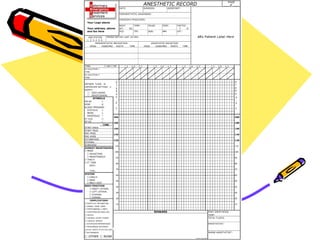
ANAESTHESIA RECORD
• Part of Medical Record
• Manual or Computer based
• Started from time immemorial
• Duty & responsibility of Anaesthesiologist
• Legible, comprehensive, accurate &
detailed
• Pre op – intra op – post op
• Describes events in a time scale
Need For Maintenance of
Record
• Part of Life.
• Anaesthesia – Critical period
– Dynamic process.
Game of “passing the
buck”.
• Conduct of Anaesthesia
• Patient & Anaesthesiologist safety
• Future conduct of Anaesthesia
Contd.
 Research & Study
 Statistics
 Medico legal
 Courts take serious note of poor record
 Require by law
 If you did it, you must record it
 Not recorded – not done
Types of Anaesthesia Record
• Manual
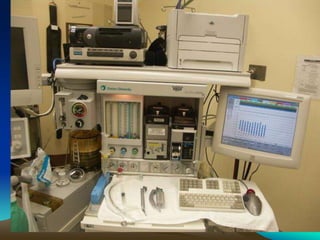
• Computer based connected to HIMS
• AAR- Automated Anaesthesia Record
• AIMS- Anaesthetic Information Management
System
• EAR- Electronic Anaesthesia Record
• CPRA- Computer Based Patient Record for
Anaesthesia
Pre op to post op period
Manual Anaesthesia
Record
• Leaves to Paper
• Observe, watch and write
• Record as soon as you do
• Delay will dilute / miss / forget
crucial points – credibility lost
• Adjust for convenience
• Smoothening / Normalize
• Spoilation
Contd.
 Consumes 15% - 20% of time
 Continuous watching / observing
 Patient & Monitors
 Record every drug / fluid &
event
 Record vitals every 5 min. – 15
min.
 Cumbersome but write legibly
 May not get time
 Patient care more important
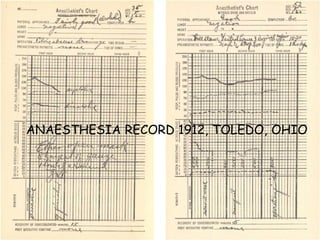
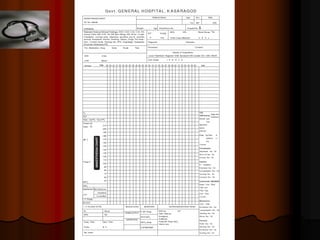
ANAESTHESIA RECORD 1912, TOLEDO, OHIO
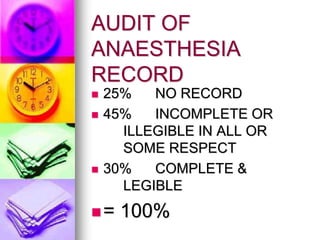
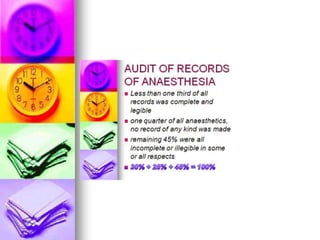
AUDIT OF
ANAESTHESIA
RECORD
 25% NO RECORD
 45% INCOMPLETE OR
ILLEGIBLE IN ALL OR
SOME RESPECT
 30% COMPLETE &
LEGIBLE
= 100%
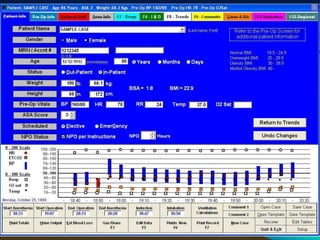
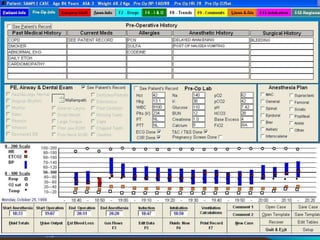
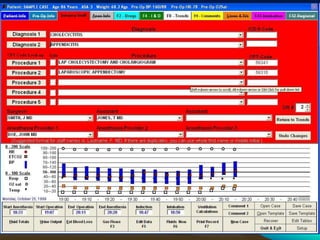
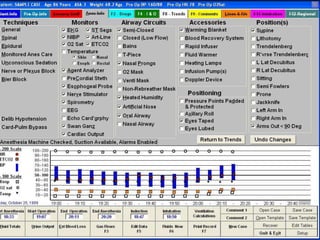
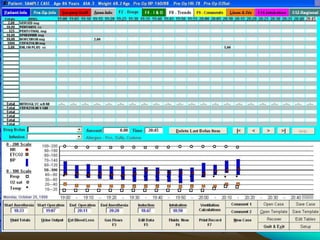
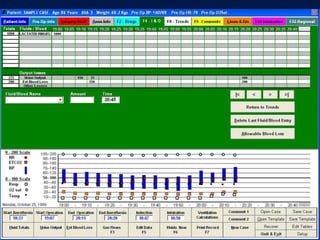
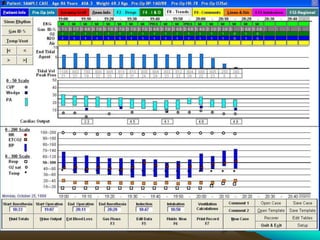
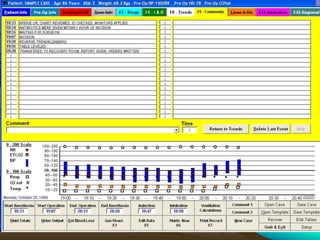
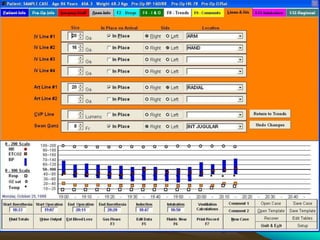
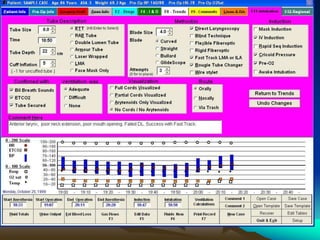
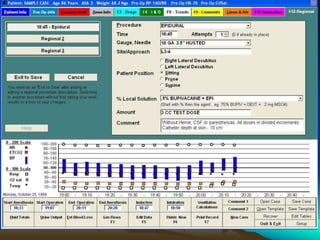
Computer Based Anae. Record
• Robust real time second to second
• Paperless Hospitals
• Advanced countries
• Saves time
• Full details from Pre Op to Post Op
• Online entries of drugs
• Automated recording of monitor data
Contd.
• More accurate
• More details & more reliable
• Easily retrievable
• Connected to HIMS
• Get access any where for any one
• Cannot change / alter entries
• Cannot normalize / smoothen
• BUT Spoilation: Intentional distruction
/ mutilation/ concedment / alteration
of evidence
Contd.
• AIMS Handles Record of All Patients.
• It can be used in ICU, PICU, Trauma Care
Centres, Labour Room, Etc.
• One can monitor many
Smooth transition to
• Recovery room
• Post op room
• Ward
• Needs knowledge of computer
• Cumbersome clumsy keys
High Cost of Hardware, Software.
Recent trends
• AARK used in more hospitals
• Connected to master server
• Real time transmission
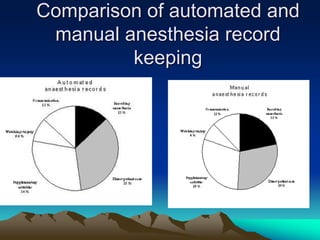
Comparison of automated and
manual anesthesia record
keeping
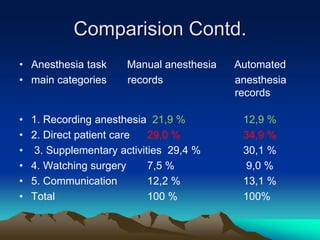
Comparision Contd.
• Anesthesia task Manual anesthesia Automated
• main categories records anesthesia
records
• 1. Recording anesthesia 21,9 % 12,9 %
• 2. Direct patient care 29,0 % 34,9 %
• 3. Supplementary activities 29,4 % 30,1 %
• 4. Watching surgery 7,5 % 9,0 %
• 5. Communication 12,2 % 13,1 %
• Total 100 % 100%
Future
• Bar Coded ETTs.
• Bar Coded pre filled Syringes for different
Medicines.
• Bar Coded I.V. Fluids.
• Specially Created Key Board
• Special Pencil
• Touch Screen
• Speech Recognising Computer
PREOPERTIVE INFORMATION
• Patient Identity
– Name / I.D No. / gender
– Demographic details
– Date of birth / Age
• Assessment and risk factors
– Date of assessment
– Assessor, where assessed
– Weight (kg), [height (m) optional]
– Basic vital signs (BP, HR)
– Medication, incl. contraceptive drugs
– Past History of Illness, Family History & Allergies
Contd.
– Other problems
– Addiction (alcohol, tobacco, drugs) & Habits
– Experience of Previous Anaesthesia
– Nature of Surgery
– Examination of Patient
– Potential airway problems
– Prostheses, teeth, crown, contact lens
– Examination of Patient
– Investigations
as per Protocol
– Cardio Respiratory fitness
• As per protocol & sos
– Optimise the Condition
– Categorise ASA risk grading
Contd.
– Informed Consent
• Separate for Anaesthesia
• Individualise
• Highlight Specific Problems & discuss plans, pros & cons
• Speak to Patient's Relative ASA Grading +/- comment
• Signature / Witness
– Plan for Anaesthesia Technique
– Order Pre-medication
• Urgency
– Scheduled-listed on routine list
– Urgent-resuscitated, not on a routine list
– Emergency-not fully resuscitated
In OT / Induction room
• Checks
– Nil by mouth
– Consent
– Premedication, type and effect
– Drugs including blood & fluids, accessories like ETT, Ambu, Laryngoscope
• Place and Time
– Place
– Date, start and end times
• Personnel
– All anaesthetists named
– Operating surgeon
– Qualified assistant present
– Duty consultant informed
In OT, before Sx Check
• Check the Anaesthesia Machine, Gas
Connections, Airway and breathing system,
Monitors – Record their proper working.
• Sx planned
• Vital signs recording/charting
• Drugs and Fluids
• Blood / Blood product availability
• Patient position and attachments
• Selection of Vein for I.V. Line – Record.
Intra Operative Record
• Most Important & Most Difficult.
• Record Position of Patient.
• Record Vital Signs Every 5 Minutes.
• Record Administration of Drugs.
• I.V. Fluids, Blood & Blood products.
• Record Batch No. Exp. Date &
Manufacturer of all Drugs.
• Mark Important Landmarks of Surgery
Contd.
• Difficult
- To Administer Anaesthesia.
- Keep Watch on Patient.
- Prepare Drugs.
- Keep Record Simultaneously.
• If Record Keeping Delayed -
-Facts Missed.
-Credibility Diluted.
POSTOPERATIVE
INSTRUCTIONS
• Drugs, fluids and doses
• Analgesic techniques
• Special airway instructions, incl. oxygen
• Monitoring
Summary
• Duty bound to care & record
• Pre op – intra op – post op
• Recording is mandatory
• Not recorded = not done
• Delay will miss & cost you & your pt. more
• Till AAR come do manual recording
Carry home message
• Keeping records is must.
• If you did it, write it down.
• If you don’t write it down, it didn’t happen.
• Courts believe more in what you have
written than what you Say.
• Keep Records for all the Cases.
• Only Detailed Record for case under
consideration = “Fabrication of Evidence”.
Anaesthesia file done Record keeping.ppt

Anaesthesia file done Record keeping.ppt

  • 2.
    Dr Venkatagiri K.M,M.D. PGDMLE, PGDHHM,PGCHM, PGCHFWM Consultant: Anaesthesia, Govt. Gen. Hosp.,Kasaragod Vice President, ISA Kerala. President, ISA Kasaragod City Branch
  • 3.
    MEDICAL RECORD  Clinical,Scientific, Administrative & Legal document relating to patient care on which is recorded sufficient data written in sequence of events to justify the diagnosis and warrant the treatment & end results (Mc Gibony)
  • 4.
    HISTORY OF MEDICAL RECORDS •2500 B.C.: Surgical Notes on Walls of Paleolithic caverns of Spain • 3000 B.C.: Sx Records in Egypt • 460 B.C. : Hippocrates Case reports of Patients in Greek • 160 A.D. Galen: Bedside records for Teaching • 865 – 925 Rhases : Medical records
  • 5.
    Contd. • 1137 St.Barthalomew’s Hosp. London • 1667 1st MRD at St. Barthalomew’s Hosp. London • 1752 Pennsylvania Hosp. in US Pt. Regstr • 1859 Massachusetts Gen. Hosp., Boston Medical Record Library • 1894 – 1st Anaesthesia Record • Dr. Franklin H. Martin & Dr. Malcolm H. Machan of ACS Improv in Qlt &Qnt of MR
  • 6.
    Medical Records inIndia • 1946 Bhore Committee • 1962 Mudaliar Committee • 1959 – 1961 Dr. M.C. Gibony Director of Hosp. Admin. Prgm., Pittsburg Uni. Consultant to GoI, MoH. Orientn prgm. for Principals/ Deans & Spdt. of MC • Jain Committee & Rao Committee • MRD trng. JIPMER & CMC1962, Tvm MCH 1964
  • 7.
    ANAESTHESIA RECORD • Partof Medical Record • Manual or Computer based • Started from time immemorial • Duty & responsibility of Anaesthesiologist • Legible, comprehensive, accurate & detailed • Pre op – intra op – post op • Describes events in a time scale
  • 8.
    Need For Maintenanceof Record • Part of Life. • Anaesthesia – Critical period – Dynamic process. Game of “passing the buck”. • Conduct of Anaesthesia • Patient & Anaesthesiologist safety • Future conduct of Anaesthesia
  • 9.
    Contd.  Research &Study  Statistics  Medico legal  Courts take serious note of poor record  Require by law  If you did it, you must record it  Not recorded – not done
  • 10.
    Types of AnaesthesiaRecord • Manual • Computer based connected to HIMS • AAR- Automated Anaesthesia Record • AIMS- Anaesthetic Information Management System • EAR- Electronic Anaesthesia Record • CPRA- Computer Based Patient Record for Anaesthesia Pre op to post op period
  • 11.
    Manual Anaesthesia Record • Leavesto Paper • Observe, watch and write • Record as soon as you do • Delay will dilute / miss / forget crucial points – credibility lost • Adjust for convenience • Smoothening / Normalize • Spoilation
  • 12.
    Contd.  Consumes 15%- 20% of time  Continuous watching / observing  Patient & Monitors  Record every drug / fluid & event  Record vitals every 5 min. – 15 min.  Cumbersome but write legibly  May not get time  Patient care more important
  • 13.
  • 17.
    AUDIT OF ANAESTHESIA RECORD  25%NO RECORD  45% INCOMPLETE OR ILLEGIBLE IN ALL OR SOME RESPECT  30% COMPLETE & LEGIBLE = 100%
  • 19.
    Computer Based Anae.Record • Robust real time second to second • Paperless Hospitals • Advanced countries • Saves time • Full details from Pre Op to Post Op • Online entries of drugs • Automated recording of monitor data
  • 21.
    Contd. • More accurate •More details & more reliable • Easily retrievable • Connected to HIMS • Get access any where for any one • Cannot change / alter entries • Cannot normalize / smoothen • BUT Spoilation: Intentional distruction / mutilation/ concedment / alteration of evidence
  • 22.
    Contd. • AIMS HandlesRecord of All Patients. • It can be used in ICU, PICU, Trauma Care Centres, Labour Room, Etc. • One can monitor many Smooth transition to • Recovery room • Post op room • Ward • Needs knowledge of computer • Cumbersome clumsy keys High Cost of Hardware, Software.
  • 23.
    Recent trends • AARKused in more hospitals • Connected to master server • Real time transmission
  • 35.
    Comparison of automatedand manual anesthesia record keeping
  • 36.
    Comparision Contd. • Anesthesiatask Manual anesthesia Automated • main categories records anesthesia records • 1. Recording anesthesia 21,9 % 12,9 % • 2. Direct patient care 29,0 % 34,9 % • 3. Supplementary activities 29,4 % 30,1 % • 4. Watching surgery 7,5 % 9,0 % • 5. Communication 12,2 % 13,1 % • Total 100 % 100%
  • 37.
    Future • Bar CodedETTs. • Bar Coded pre filled Syringes for different Medicines. • Bar Coded I.V. Fluids. • Specially Created Key Board • Special Pencil • Touch Screen • Speech Recognising Computer
  • 38.
    PREOPERTIVE INFORMATION • PatientIdentity – Name / I.D No. / gender – Demographic details – Date of birth / Age • Assessment and risk factors – Date of assessment – Assessor, where assessed – Weight (kg), [height (m) optional] – Basic vital signs (BP, HR) – Medication, incl. contraceptive drugs – Past History of Illness, Family History & Allergies
  • 39.
    Contd. – Other problems –Addiction (alcohol, tobacco, drugs) & Habits – Experience of Previous Anaesthesia – Nature of Surgery – Examination of Patient – Potential airway problems – Prostheses, teeth, crown, contact lens – Examination of Patient – Investigations as per Protocol – Cardio Respiratory fitness • As per protocol & sos – Optimise the Condition – Categorise ASA risk grading
  • 40.
    Contd. – Informed Consent •Separate for Anaesthesia • Individualise • Highlight Specific Problems & discuss plans, pros & cons • Speak to Patient's Relative ASA Grading +/- comment • Signature / Witness – Plan for Anaesthesia Technique – Order Pre-medication • Urgency – Scheduled-listed on routine list – Urgent-resuscitated, not on a routine list – Emergency-not fully resuscitated
  • 41.
    In OT /Induction room • Checks – Nil by mouth – Consent – Premedication, type and effect – Drugs including blood & fluids, accessories like ETT, Ambu, Laryngoscope • Place and Time – Place – Date, start and end times • Personnel – All anaesthetists named – Operating surgeon – Qualified assistant present – Duty consultant informed
  • 42.
    In OT, beforeSx Check • Check the Anaesthesia Machine, Gas Connections, Airway and breathing system, Monitors – Record their proper working. • Sx planned • Vital signs recording/charting • Drugs and Fluids • Blood / Blood product availability • Patient position and attachments • Selection of Vein for I.V. Line – Record.
  • 43.
    Intra Operative Record •Most Important & Most Difficult. • Record Position of Patient. • Record Vital Signs Every 5 Minutes. • Record Administration of Drugs. • I.V. Fluids, Blood & Blood products. • Record Batch No. Exp. Date & Manufacturer of all Drugs. • Mark Important Landmarks of Surgery
  • 44.
    Contd. • Difficult - ToAdminister Anaesthesia. - Keep Watch on Patient. - Prepare Drugs. - Keep Record Simultaneously. • If Record Keeping Delayed - -Facts Missed. -Credibility Diluted.
  • 45.
    POSTOPERATIVE INSTRUCTIONS • Drugs, fluidsand doses • Analgesic techniques • Special airway instructions, incl. oxygen • Monitoring
  • 46.
    Summary • Duty boundto care & record • Pre op – intra op – post op • Recording is mandatory • Not recorded = not done • Delay will miss & cost you & your pt. more • Till AAR come do manual recording
  • 47.
    Carry home message •Keeping records is must. • If you did it, write it down. • If you don’t write it down, it didn’t happen. • Courts believe more in what you have written than what you Say. • Keep Records for all the Cases. • Only Detailed Record for case under consideration = “Fabrication of Evidence”.