1
INDUCTION OF ANESTHESIA
Presented by humaira yaqoob
Presented to anesthesia specialty
Facilitator Ms. Irum yaqoob
II facilitator Ms. Saima mateen
Class BscN 1st year
2
OBJECTIVES
 At the end of this session the learner wil
be able to
 Define inhalation induction
 Define Intravenous induction
 Elaborate maintenance of anesthesia
 Describe tracheal intubation
 Describe Malampati scoring
 Enlist Neuromuscular agents
3
CONTINUE….
 Explain reversal agents
 Explain T.I.V.A
 Describe Extubation
 Review Emergence and recovery
 Summarization of topic
 References
4
DEFINITION OF INDUCTION
 Induction is a general anesthesia where a
patient slips from a conscious state to an
unconscious state
 Induction phase: transition from awake
state to full affect of anesthesia on CNS,
CVS, respiratory and muscle system
5
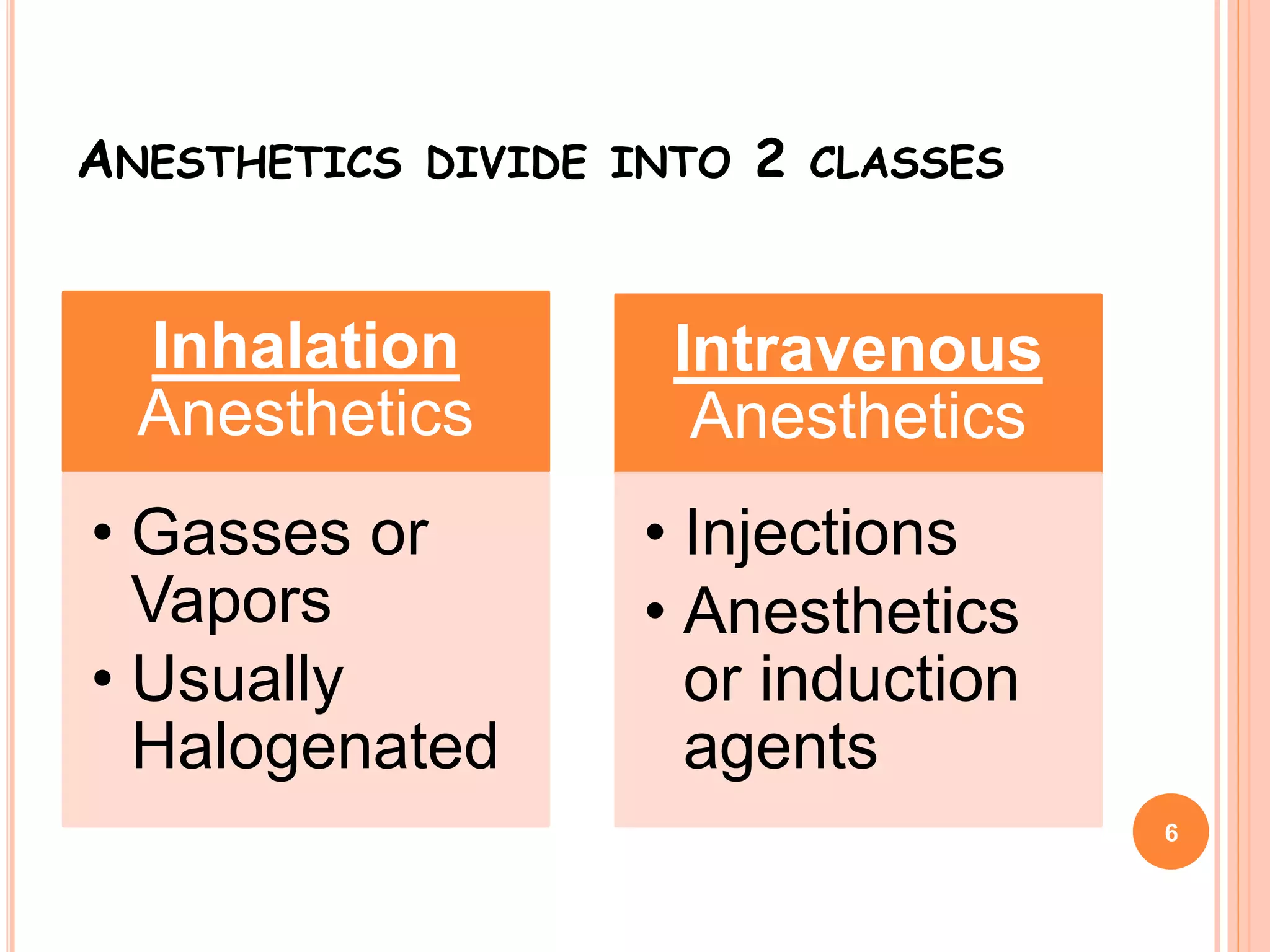
ANESTHETICS DIVIDE INTO 2 CLASSES
Inhalation
Anesthetics
• Gasses or
Vapors
• Usually
Halogenated
Intravenous
Anesthetics
• Injections
• Anesthetics
or induction
agents
6
DEFINITION OF INHALATION ANESTHESIA..
Inhalation anesthesia is a chemical compound
processing general anesthetic properties that can
be delivered via inhalation.
Currently used anesthetics
 Desflurane
 Isoflurane
 Sevoflurane
 Nitrous oxide
7
INHALATION INDUCTION
• Indications
– Difficult IV access
– Potential airway obstruction e.g. epiglottitis
– Thoracic diseases which preclude use of
IPPV, Mediastinal mass, foreign body in
airway, broncho-pleural fistula
– Patients unable to cooperate with awake
airway endoscopy 8
INHALATION INDUCTION
Describe steps briefly to patient. Emphasis on
deep breaths with maximal breath holding
interval.
 Best agents are sevoflurane, enflurane,
halothane.
 Desflurane and isoflurane are irritating to
airway.
 Avoid narcotics; give sedation with midazolam.
 Coach patient with calm, reassuring voice
 Choices of technique:
 Several deep breaths from a primed circuit
 Slow incremental doses with normal ventilation 9
CONTINUE….
 Contraindications:
 Aspiration risk
 Active bleeding in airway (risk of cough,
laryngospasm)
 Note profound changes in BP are unusual with
this as compared to rapid sequence with IV
drugs
 Controlled studies in this area of “right way to
do induction in this type of patient”
10
MONITOR DURING INHALATION ANAS..
 Pulse oximetry and end tidal volume CO2 are
observe critically
 Eyes and ears of the anesthesia person
 Experienced assistant is very important
 BP, EKG,spo2
 Prepare with plan B
11
DEFINITION OF INTRAVENOUS
ANESTHESIA
General anesthesia produced by injection of
central nervous system depressant into the venous
system
 Commonly used IV induction agents
 Propofol
 Thiopental sodium
 Ketamine
12
INTRAVENOUS INDUCTION
 Indications:
 Usual or default method of starting general
anesthesia
 Risk of aspiration (see rapid sequence)
 Standard method involves drug combination:
 Sedative in large dose (propofol) usually with
narcotic and/or anxiolytic (midazolam)
 Muscle relaxant if doing intubation
 Mask 100% O2 during process (before, during, after)
 Drug doses are initially based on weight and age of
patient. Extra doses as directed by response of
patient 13
INTRAVENOUS ANESTHESIA
 Contraindications:
 Lack of proper equipment for resuscitation (IPPV,
oxygen, airway devices, suction)
 Uncertainty about ability to ventilate or intubate
patient if they become apneic
 Patient with partial airway obstruction (avoid apnea)
14
INTRAVENOUS ANESTHESIA.
 Precautions:
Patient with limited or uncertain CVS reserve (hypovolemia,
CHF, valvular stenosis, sepsis)
Patients with poorly controlled CVS disease (high BP, angina,
disturbed heart rhythm)
Patients with risk of aspiration
Patients with respiratory failure
15
MAINTENANCE OF ANESTHESIA
 Further adjustment of anesthesia levels based
on
 Patient response
 Stage of surgery
 Trends of monitored variables
 Maintenance phase usually a stable period unless
 Changing level of surgical stress
 Impaired state of patient fitness
 Anesthesia gases form the major component
with some IV narcotics or relaxants as
background
16
CONTINUE….
 For supporting ventilation during general anaesthesia:
◦ Type of surgery:
 Operative site near the airway,
 Thoracic or abdominal surgery,
 Prone or lateral surgery,
 Long period of surgery
 Patient has risk of pulmonary aspiration
 Difficult mask ventilation
17
WHAT IS BALANCED ANESTHESIA?
 Use specific drugs for each component
1. Sensory
 N20, opioids, ketamine for analgesia
2. Cognitive
 Produce amnesia, and preferably unconsciousness
 inhaled agent
 IV hypnotic (propofol, midazolam, diazepam,
thiopental)
3. Motor
 Muscle relaxants
18
EMERGENCE FROM ANESTHESIA
 Slower version of induction phase in a reverse
order
 CNS wakes up in stages or by regions
 Brainstem or lower functions first (breathing, cough,
shivering)
 Cerebral cortex later (purposeful movements,
response to commands)
 Removal of supports at appropriate time
intervals
 Excitement aspects are common: limb
movement, restlessness, coughing.
 Potential for vomiting 19
TRACHEAL INTUBATION.
 Placement of a flexible plastic tube into
the trachea to:
 maintain an open airway,
 serve as a conduit through which to administer certain
drugs.
 Is performed in critically injured, ill or
anesthetized patients:
 to facilitate ventilation of the
lungs, including mechanical ventilation,
 to prevent the possibility of
asphyxiation or airway obstruction.
20
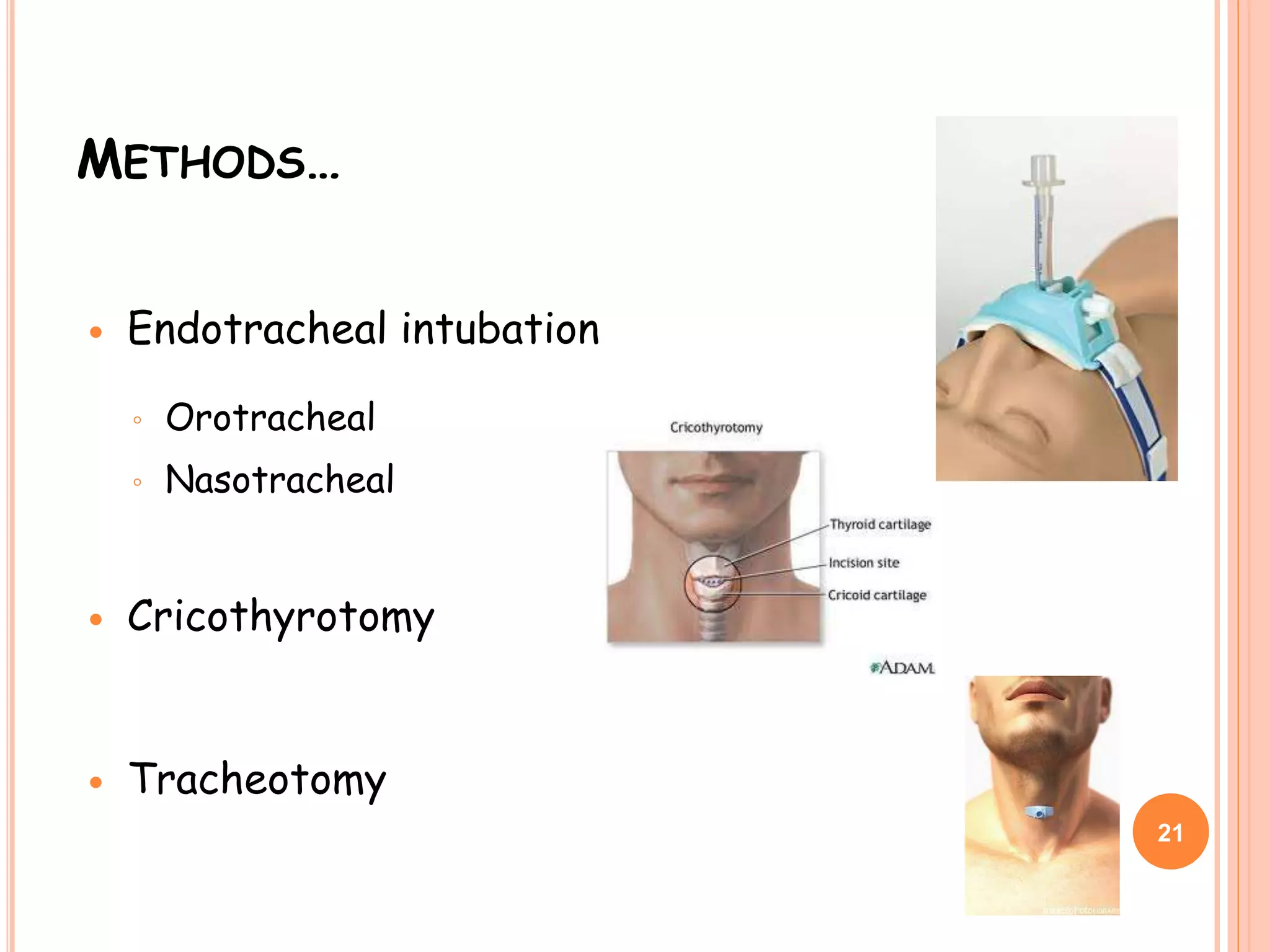
METHODS…
 Endotracheal intubation
◦ Orotracheal
◦ Nasotracheal
 Cricothyrotomy
 Tracheotomy
21
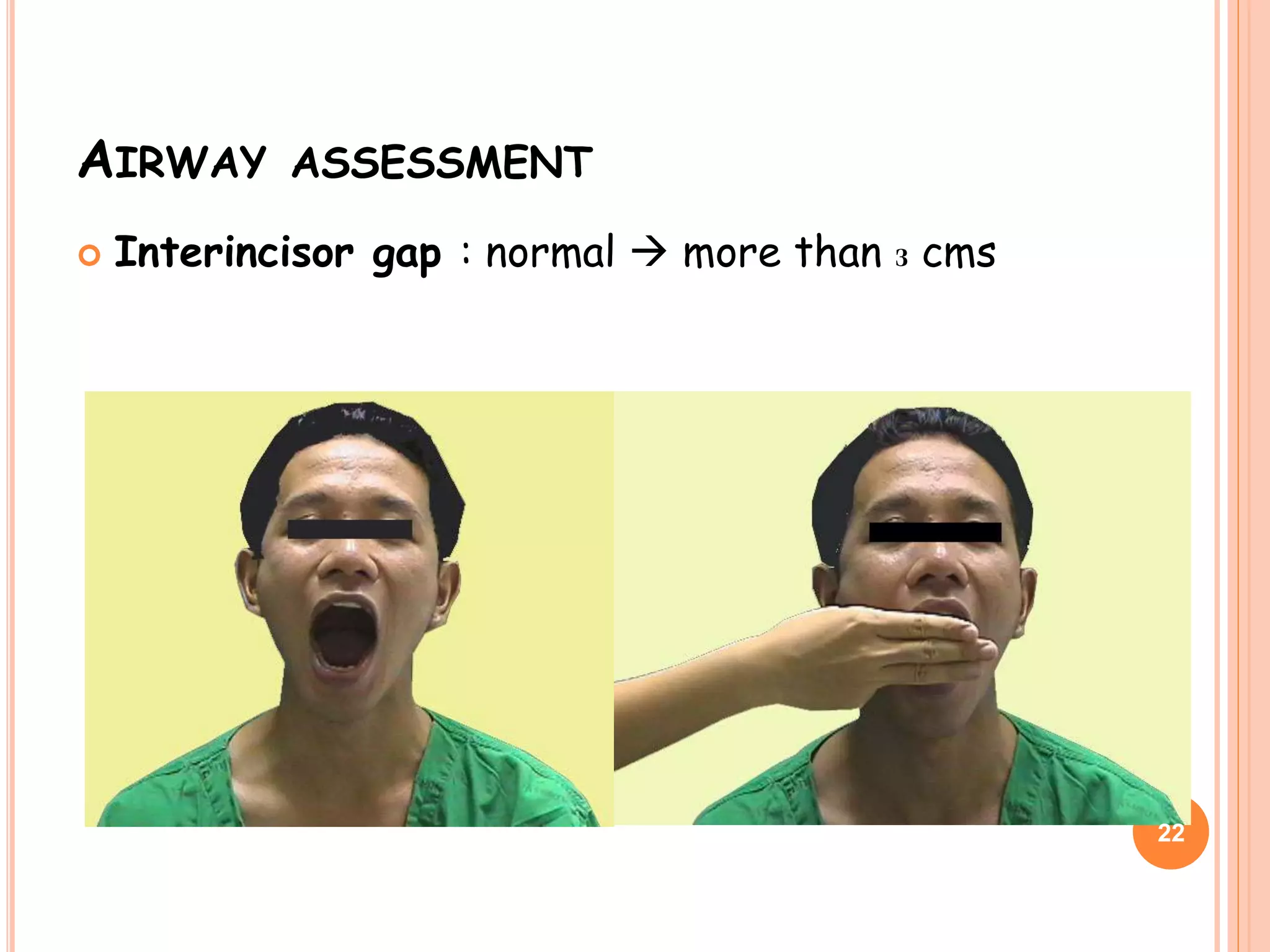
AIRWAY ASSESSMENT
 Interincisor gap : normal  more than 3 cms
22
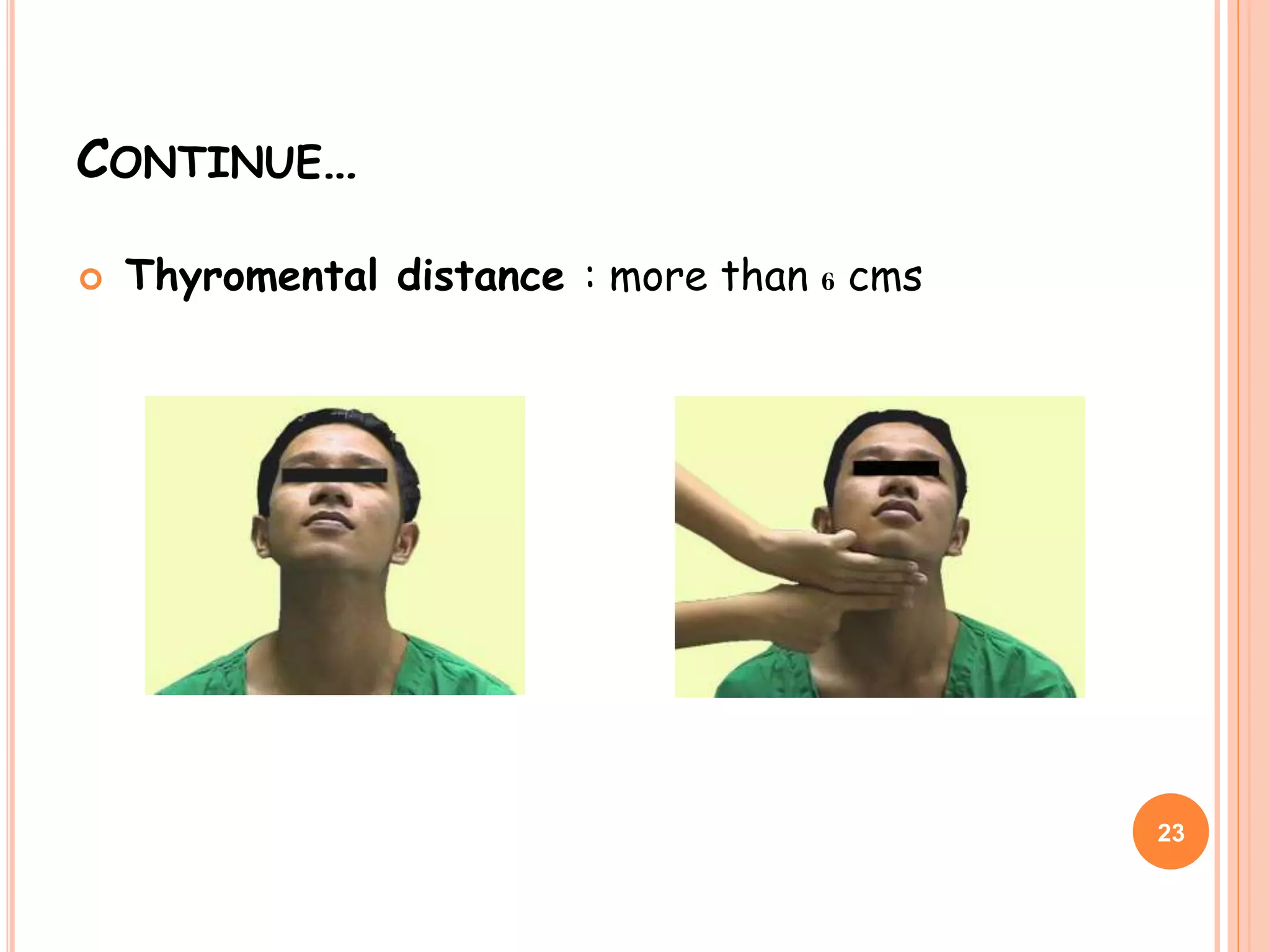
CONTINUE…
 Thyromental distance : more than 6 cms
23
CONTINUE.
 Flexion and extension of neck
24
MALAMPATI SCORING
Soft palate
Soft palate
Uvula
25
LARANGOSOPIC VIEW
Vocal cord..
• Grade 3,4 risk for difficult intubation!
26
DIFFICULT AIRWAY
 American society of Anesthesiologist
(ASA) suggested (difficult to ventilate)
that when sign of inadequate ventilation
could not be reversed by mask ventilation
or oxygen saturation could not be
maintained above 90% or (difficult to
intubate) if a trained Anaesthetist using
conventional laryngoscope take’s more
than 3 attempts or more than 10 minute
are required to complete tracheal
intubation
27
CAUSES OF DIFFICULT INTUBATION
 Anesthetist
1. Inadequate preoperative assessment.
2. Inadequate equipment's.
3. Experience not enough.
4. Poor technique.
5. Malfunctioning of equipment.
6. Inexperience assistance
 Patient
 1. Congenital causes
2. Acquired causes
28
TOTAL INTRAVENOUS ANESTHESIA
 Total intravenous anesthesia(T.I.V.A) can be
defined as a technique of general anesthesia
using combination of agents given solely by the
intravenous route and in the absence of all
inhalation agents including nitrous oxide.
It has also become widely used as a component of
TIVA
29
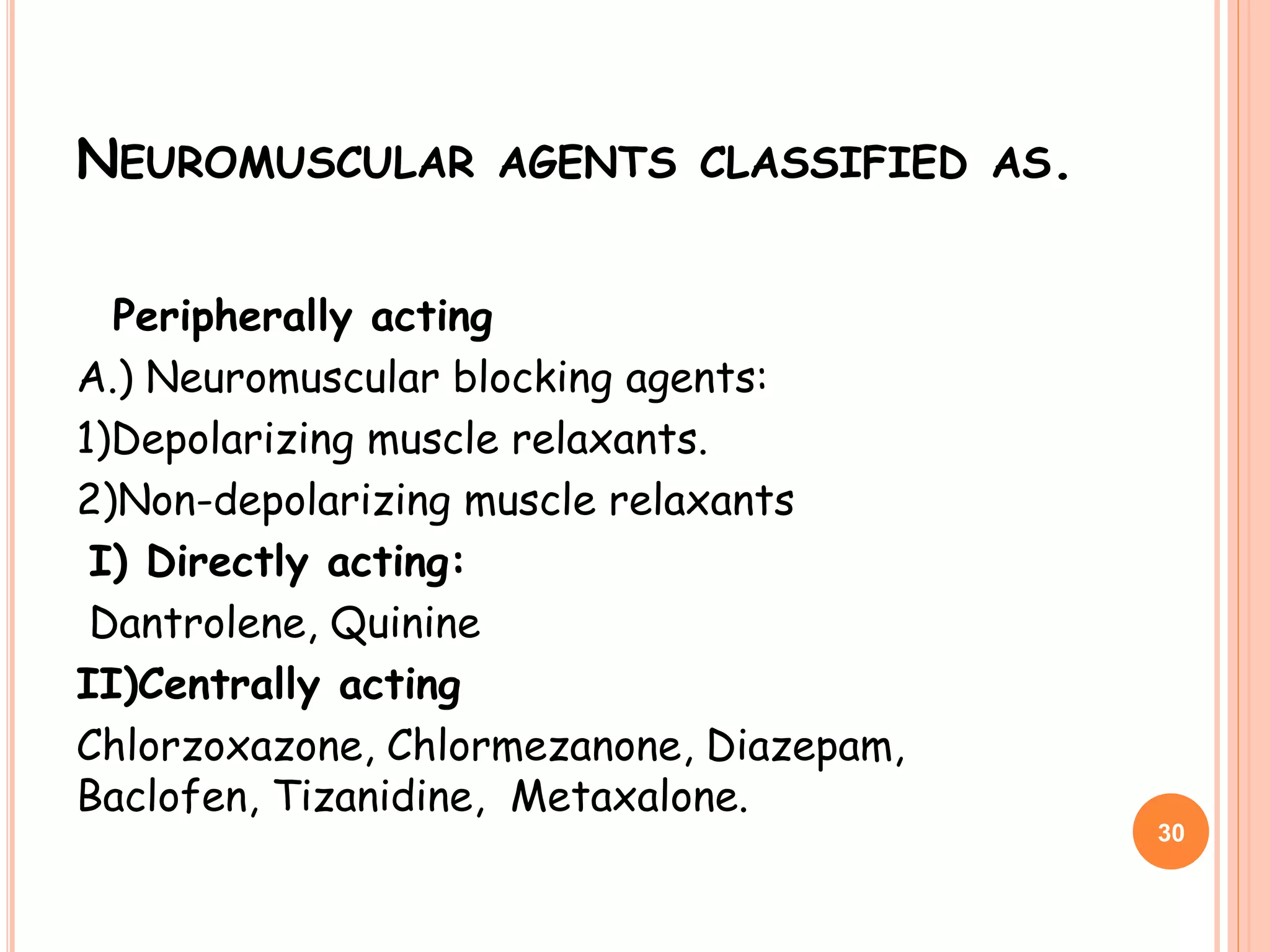
NEUROMUSCULAR AGENTS CLASSIFIED AS.
Peripherally acting
A.) Neuromuscular blocking agents:
1)Depolarizing muscle relaxants.
2)Non-depolarizing muscle relaxants
I) Directly acting:
Dantrolene, Quinine
II)Centrally acting
Chlorzoxazone, Chlormezanone, Diazepam,
Baclofen, Tizanidine, Metaxalone.
30
CONTINUE
 Depolarizing Muscle relaxants: Succinylcholine
(short acting)
 Non-depolarizing Muscle relaxants:
 Short acting: Mivacurium
 Intermediate –acting:
 Atracurium, Cisatracurium, Vecuronium,
Rocuronium
 Long acting : Doxacurium Pancuronium
Pipecuronium
31
EXTUBATION
 Extubation means removal of endotracheal tube
from trachea after achieving spontaneous
adequate breathing ,stable haemodynamics and
satisfactory recovery.
32
BEFORE EXTUBATION TRACHEA ONE
SHOULD ENSURE FOLLOWING:
 Patient should able to maintaining patent airway
and is able to generate adeqate ventilation.
 There should not any problem with central
inspiratory drive by drugs or CNS dysfunction
 Patient should have adequate respiratory
muscles strength
 Can clear secretions by coughing
 Adequate clearance of sedatives and
neuromuscular blocker
33
GENERAL CRITERIA FOR EXTUBATION
 Rapid shallow breathing index (f/vt)
 It is calculated by dividing spontaneous
breathing frequency per minute by average tidal
volume in liters. value less then 100/mint/L
predictive of successful Extubation outcome.
 Acceptable blood gases on fio2 less then 40%
 Spontaneous minute ventilation less then
10L/mint
34
COMPLICATION OF EXTUBATION
Immediate complications
 Upper airway obstruction
 Hypoventilation
 Aspiration
 Laryngospasms and bronchospasm
 Pulmonary edema
 Paradoxical ventilation
 Hoarseness
35
COMPLICATION OF EXTUBATION
 Later complications
 Tracheal inflammation
 Tracheal dilatation
 Tracheal stenosis
 Vocal cord paralysis
36
SUMMARY
 Anesthetics divided into intravenous anesthesia
and inhalation anesthesia. TIVA is total
intravenous anesthesia completely given by
intravenous route. anesthesia maintain according
to patient physical demands ,co morbids and
according to surgeries. before tracheal
intubation assess airway with the help of
intercisor gap, thyromental distance and
malampati scoring patients with difficult airway
difficult to ventilate. Neuromuscular agents are
classified as peripherally acting ,directly acting,
centrally acting. Extubation means removal of
tracheal tube from trachea.
37
REFERENCECES
 http://www.ncbi.nlm.nih.gov
 http;//www.open anesthesia.org
 Faculity washington
 Basic clinical anesthesia(paul k. sikka, james)
 Anesthesia comprehension review(brian A hall
robert C. chantigian)
38
THANKS FOR ATTENTION
39
ANY QUESTION
? 40
41

Induction of anesthesia

  • 1.
  • 2.
    INDUCTION OF ANESTHESIA Presentedby humaira yaqoob Presented to anesthesia specialty Facilitator Ms. Irum yaqoob II facilitator Ms. Saima mateen Class BscN 1st year 2
  • 3.
    OBJECTIVES  At theend of this session the learner wil be able to  Define inhalation induction  Define Intravenous induction  Elaborate maintenance of anesthesia  Describe tracheal intubation  Describe Malampati scoring  Enlist Neuromuscular agents 3
  • 4.
    CONTINUE….  Explain reversalagents  Explain T.I.V.A  Describe Extubation  Review Emergence and recovery  Summarization of topic  References 4
  • 5.
    DEFINITION OF INDUCTION Induction is a general anesthesia where a patient slips from a conscious state to an unconscious state  Induction phase: transition from awake state to full affect of anesthesia on CNS, CVS, respiratory and muscle system 5
  • 6.
    ANESTHETICS DIVIDE INTO2 CLASSES Inhalation Anesthetics • Gasses or Vapors • Usually Halogenated Intravenous Anesthetics • Injections • Anesthetics or induction agents 6
  • 7.
    DEFINITION OF INHALATIONANESTHESIA.. Inhalation anesthesia is a chemical compound processing general anesthetic properties that can be delivered via inhalation. Currently used anesthetics  Desflurane  Isoflurane  Sevoflurane  Nitrous oxide 7
  • 8.
    INHALATION INDUCTION • Indications –Difficult IV access – Potential airway obstruction e.g. epiglottitis – Thoracic diseases which preclude use of IPPV, Mediastinal mass, foreign body in airway, broncho-pleural fistula – Patients unable to cooperate with awake airway endoscopy 8
  • 9.
    INHALATION INDUCTION Describe stepsbriefly to patient. Emphasis on deep breaths with maximal breath holding interval.  Best agents are sevoflurane, enflurane, halothane.  Desflurane and isoflurane are irritating to airway.  Avoid narcotics; give sedation with midazolam.  Coach patient with calm, reassuring voice  Choices of technique:  Several deep breaths from a primed circuit  Slow incremental doses with normal ventilation 9
  • 10.
    CONTINUE….  Contraindications:  Aspirationrisk  Active bleeding in airway (risk of cough, laryngospasm)  Note profound changes in BP are unusual with this as compared to rapid sequence with IV drugs  Controlled studies in this area of “right way to do induction in this type of patient” 10
  • 11.
    MONITOR DURING INHALATIONANAS..  Pulse oximetry and end tidal volume CO2 are observe critically  Eyes and ears of the anesthesia person  Experienced assistant is very important  BP, EKG,spo2  Prepare with plan B 11
  • 12.
    DEFINITION OF INTRAVENOUS ANESTHESIA Generalanesthesia produced by injection of central nervous system depressant into the venous system  Commonly used IV induction agents  Propofol  Thiopental sodium  Ketamine 12
  • 13.
    INTRAVENOUS INDUCTION  Indications: Usual or default method of starting general anesthesia  Risk of aspiration (see rapid sequence)  Standard method involves drug combination:  Sedative in large dose (propofol) usually with narcotic and/or anxiolytic (midazolam)  Muscle relaxant if doing intubation  Mask 100% O2 during process (before, during, after)  Drug doses are initially based on weight and age of patient. Extra doses as directed by response of patient 13
  • 14.
    INTRAVENOUS ANESTHESIA  Contraindications: Lack of proper equipment for resuscitation (IPPV, oxygen, airway devices, suction)  Uncertainty about ability to ventilate or intubate patient if they become apneic  Patient with partial airway obstruction (avoid apnea) 14
  • 15.
    INTRAVENOUS ANESTHESIA.  Precautions: Patientwith limited or uncertain CVS reserve (hypovolemia, CHF, valvular stenosis, sepsis) Patients with poorly controlled CVS disease (high BP, angina, disturbed heart rhythm) Patients with risk of aspiration Patients with respiratory failure 15
  • 16.
    MAINTENANCE OF ANESTHESIA Further adjustment of anesthesia levels based on  Patient response  Stage of surgery  Trends of monitored variables  Maintenance phase usually a stable period unless  Changing level of surgical stress  Impaired state of patient fitness  Anesthesia gases form the major component with some IV narcotics or relaxants as background 16
  • 17.
    CONTINUE….  For supportingventilation during general anaesthesia: ◦ Type of surgery:  Operative site near the airway,  Thoracic or abdominal surgery,  Prone or lateral surgery,  Long period of surgery  Patient has risk of pulmonary aspiration  Difficult mask ventilation 17
  • 18.
    WHAT IS BALANCEDANESTHESIA?  Use specific drugs for each component 1. Sensory  N20, opioids, ketamine for analgesia 2. Cognitive  Produce amnesia, and preferably unconsciousness  inhaled agent  IV hypnotic (propofol, midazolam, diazepam, thiopental) 3. Motor  Muscle relaxants 18
  • 19.
    EMERGENCE FROM ANESTHESIA Slower version of induction phase in a reverse order  CNS wakes up in stages or by regions  Brainstem or lower functions first (breathing, cough, shivering)  Cerebral cortex later (purposeful movements, response to commands)  Removal of supports at appropriate time intervals  Excitement aspects are common: limb movement, restlessness, coughing.  Potential for vomiting 19
  • 20.
    TRACHEAL INTUBATION.  Placementof a flexible plastic tube into the trachea to:  maintain an open airway,  serve as a conduit through which to administer certain drugs.  Is performed in critically injured, ill or anesthetized patients:  to facilitate ventilation of the lungs, including mechanical ventilation,  to prevent the possibility of asphyxiation or airway obstruction. 20
  • 21.
    METHODS…  Endotracheal intubation ◦Orotracheal ◦ Nasotracheal  Cricothyrotomy  Tracheotomy 21
  • 22.
    AIRWAY ASSESSMENT  Interincisorgap : normal  more than 3 cms 22
  • 23.
  • 24.
    CONTINUE.  Flexion andextension of neck 24
  • 25.
  • 26.
    LARANGOSOPIC VIEW Vocal cord.. •Grade 3,4 risk for difficult intubation! 26
  • 27.
    DIFFICULT AIRWAY  Americansociety of Anesthesiologist (ASA) suggested (difficult to ventilate) that when sign of inadequate ventilation could not be reversed by mask ventilation or oxygen saturation could not be maintained above 90% or (difficult to intubate) if a trained Anaesthetist using conventional laryngoscope take’s more than 3 attempts or more than 10 minute are required to complete tracheal intubation 27
  • 28.
    CAUSES OF DIFFICULTINTUBATION  Anesthetist 1. Inadequate preoperative assessment. 2. Inadequate equipment's. 3. Experience not enough. 4. Poor technique. 5. Malfunctioning of equipment. 6. Inexperience assistance  Patient  1. Congenital causes 2. Acquired causes 28
  • 29.
    TOTAL INTRAVENOUS ANESTHESIA Total intravenous anesthesia(T.I.V.A) can be defined as a technique of general anesthesia using combination of agents given solely by the intravenous route and in the absence of all inhalation agents including nitrous oxide. It has also become widely used as a component of TIVA 29
  • 30.
    NEUROMUSCULAR AGENTS CLASSIFIEDAS. Peripherally acting A.) Neuromuscular blocking agents: 1)Depolarizing muscle relaxants. 2)Non-depolarizing muscle relaxants I) Directly acting: Dantrolene, Quinine II)Centrally acting Chlorzoxazone, Chlormezanone, Diazepam, Baclofen, Tizanidine, Metaxalone. 30
  • 31.
    CONTINUE  Depolarizing Musclerelaxants: Succinylcholine (short acting)  Non-depolarizing Muscle relaxants:  Short acting: Mivacurium  Intermediate –acting:  Atracurium, Cisatracurium, Vecuronium, Rocuronium  Long acting : Doxacurium Pancuronium Pipecuronium 31
  • 32.
    EXTUBATION  Extubation meansremoval of endotracheal tube from trachea after achieving spontaneous adequate breathing ,stable haemodynamics and satisfactory recovery. 32
  • 33.
    BEFORE EXTUBATION TRACHEAONE SHOULD ENSURE FOLLOWING:  Patient should able to maintaining patent airway and is able to generate adeqate ventilation.  There should not any problem with central inspiratory drive by drugs or CNS dysfunction  Patient should have adequate respiratory muscles strength  Can clear secretions by coughing  Adequate clearance of sedatives and neuromuscular blocker 33
  • 34.
    GENERAL CRITERIA FOREXTUBATION  Rapid shallow breathing index (f/vt)  It is calculated by dividing spontaneous breathing frequency per minute by average tidal volume in liters. value less then 100/mint/L predictive of successful Extubation outcome.  Acceptable blood gases on fio2 less then 40%  Spontaneous minute ventilation less then 10L/mint 34
  • 35.
    COMPLICATION OF EXTUBATION Immediatecomplications  Upper airway obstruction  Hypoventilation  Aspiration  Laryngospasms and bronchospasm  Pulmonary edema  Paradoxical ventilation  Hoarseness 35
  • 36.
    COMPLICATION OF EXTUBATION Later complications  Tracheal inflammation  Tracheal dilatation  Tracheal stenosis  Vocal cord paralysis 36
  • 37.
    SUMMARY  Anesthetics dividedinto intravenous anesthesia and inhalation anesthesia. TIVA is total intravenous anesthesia completely given by intravenous route. anesthesia maintain according to patient physical demands ,co morbids and according to surgeries. before tracheal intubation assess airway with the help of intercisor gap, thyromental distance and malampati scoring patients with difficult airway difficult to ventilate. Neuromuscular agents are classified as peripherally acting ,directly acting, centrally acting. Extubation means removal of tracheal tube from trachea. 37
  • 38.
    REFERENCECES  http://www.ncbi.nlm.nih.gov  http;//www.openanesthesia.org  Faculity washington  Basic clinical anesthesia(paul k. sikka, james)  Anesthesia comprehension review(brian A hall robert C. chantigian) 38
  • 39.
  • 40.
  • 41.