CARDIOMYOPATHIES
Dr. Partha Das
MEM, 2nd Year
Fortis Hospital, Kolkata
19/02/2016
Definition
• Cardiomyopathies are defined by
structural and functional abnormalities of
the ventricular myocardium that are
unexplained by flow-limiting coronary
artery disease or abnormal loading
conditions
European Heart Journal Advance Access published August 29, 2014
(http://eurheartj.oxfordjournals.org/)
2
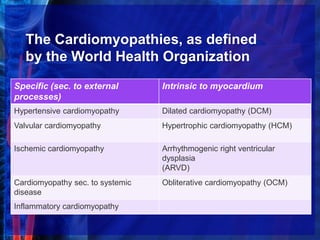
The Cardiomyopathies, as defined
by the World Health Organization
Specific (sec. to external
processes)
Intrinsic to myocardium
Hypertensive cardiomyopathy Dilated cardiomyopathy (DCM)
Valvular cardiomyopathy Hypertrophic cardiomyopathy (HCM)
Ischemic cardiomyopathy Arrhythmogenic right ventricular
dysplasia
(ARVD)
Cardiomyopathy sec. to systemic
disease
Obliterative cardiomyopathy (OCM)
Inflammatory cardiomyopathy
DILATED CARDIOMYOPATHY
4
DCM Pathophysiology
Each myocyte has a uniform pink cytoplasm owing to the majority of
the cell being filled by myofibrils
5
Contd…
• Depressed myocardial systolic function
↓
• LV contractile force is diminished
↓
• low cardiac output and increased end-systolic and end-
diastolic ventricular volumes
↓
• LV dilatation accompanied by compensatory hypertrophy
6
DCM : INFECTIONS
• M/c causative viruses :- Other causes :-
• Coxsackie (A,B) Bacteria (Diptheria)
• Epstein-Barr Rickettsia
• Adenovirus Mycobacteria
• CMV Fungal
• Rubella Parasitic(Toxoplasmosis)
• Rubeola
• Rabies
• Hep.B
• HIV
7
DCM : TOXINS
• Ethanol
• Chemotherapeutic Agents (Doxorubicin)
• Antiretroviral Rx
• Phenothiazines
• Cocaine
DCM : INHERITED
• Familial Cardiomyopathy
(Abnormality in specific genes coding for Myosin, Actin)
8
DCM : METABOLIC
• Nutritional deficiencies (Thiamine)
• Endocrine (Hypo or Hyperthyroidism, Cushing Disease)
• Electrolyte Disturbance (↓Ca2+, ↓PO4)
• DCM : RHEUMATIC DISORDERS
• SLE
• Dermatomyositis
• Scleroderma
• DCM : NEUROMUSCULAR DISORDERS
• Muscular Dystrophy, Friedrich’s Ataxia
9
DCM : C/F & DIAGNOSIS
• Dyspnoea on exertion
• Orhopnoea
• Paroxysmal nocturnal dyspnoea
• Pulsus alternans
• Chest pain with features of typical angina pectoris
• Manifestations of peripheral embolization
Acute neurologic deficit
Flank pain
Hamaturia
Cyanotic extremity
• F/S/O CHF – bibasal rales, dependent edema, ↑liver size
• ↑JVP (prominent a and v waves – TR)
• Auscultation : - Holosystolic regurgitant murmurs, Gallop
Ref – Tintinalli’s Emergency Medicine, 6th Ed
10
Contd…
CXR : - Enlarged cardiac silhouette (d/t biventricular enlargement)
-Kerley B lines, enlarged central pulmonary arteries, widened
right heart border ( E/o pulmonary venous HTN)
11
Contd…
• ECG : - LV hypertrophy and LA enlargement are the most common
findings
• AF & ventricular ectopy are common rhythm disturbances
• Poor R-wave progression
• Low QRS voltage +/-
• ECHO: - ↓ EF
↑ Systolic & Diastolic volumes
Ventricular & atrial enlargement
Stress test – Tachyarrhythmias
MR/TR on Doppler flow
Ref - www.echopedia.org
12
DCM : TREATMENT
• ACE Inhibitors (Enalapril, Ramipril)
• Angiotensin II Receptor Blockers (Valsartan, Losartan)
• ᵝ Blockers (Carvedilol, Metoprolol)
• Nesiritide (recombinant DNA form of human BNP that dilates veins
& arteries)
• Diuretics (Furosemide, Spironolactone)
• Antiarrhythmics
• I/v Nitroglycerin (Preload reduction with venodilators is thought to be
helpful in acute decompensated heart failure by reducing
congestions and minimizing cardiac O2 demand)
• Digoxin (cardiac glycoside with direct inotropic effects increasing
myocardial systolic contractions)
• Anticoagulants (in AF, with artificial valves, and with known mural
thrombus) 13
DCM : Treatment contd…
Patients refractory for pharmacological therapy for CHF:-
• Dual Chamber Pacing
• Cardiomyoplasty
• LV Assist Devices
• Cardiac Transplantation
14
HYPERTROPHIC CARDIOMYOPATHY
Subtypes :-
• i) Hypertrophic obstructive cardiomyopathy (HOCM)
• ii) Idiopathic hypertrophic subaortic stenosis (IHSS)
• Iii) Asymmetric septal hypertrophy
15
• HCM is characterized by LV and/or RV hypertrophy that
is usually asymmetrical and involves primarily the
interventricular septum
• Genetic basis : caused by a mutation in cardiac
sarcomere protein genes.
16
CLINICAL FEATURES:-
• Sudden cardiac death (most devastating presenting
manifestation)
• Dyspnoea on exertion (d/t exercise-induced sinus tachy,
which results in an abrupt ↑ LV diastolic pressure &
pulmonary venous HTN)
• Syncope & pre syncope
• Angina (d/t an imbalance between the O2 demand of the
hypertrophied LV & the available myocardial blood flow)
• Palpitations
• Orthopnoea & PND (early signs of CHF)
• A family h/o death d/t cardiac disease +
17
Contd…
• Normal S1; S2 is usually split but is paradoxically split in
some patients with severe outflow gradients; S3 gallop is
common in children but signifies decompensated CHF in
adults; S4 is frequently heard
• Systolic ejection crescendo-decrescendo murmur.
• Holosystolic murmur at the apex and axilla of MR
• Apical precordial impulse that is displaced laterally and
usually is abnormally forceful and enlarged
• Jugular venous pulse revealing a prominent ‘a’ wave
18
DIAGNOSIS:-
CXR –
Enlarged cardiac silhouette
ECG –
ST-T wave abnormalities and LVH (common)
Axis deviation (right or left)
Conduction abnormalities (PR ↑, BBB)
ECHO –
LVH
Left atrial enlargement
Small ventricular chamber size
Abnormal systolic anterior leaflet motion of the mitral valve
MVP & MR
Septal hypertrophy with septal-to-free wall ratio greater than 1.4:1
19
MANAGEMENT :-
Pharmacologic therapy for HCM may include the following:-
• ᵝ blockers
• CCB
• Diltiazem, Amiodarone (rate control)
• Avoid Digitalis & use diuretics with caution
Surgical & catheter-based therapeutic options include the
following:-
• MVR
• LV Myomectomy
• PPM implantation
• implantable cardioverter defibrillator
• Heart Transplantation 20
RESTRICTIVE CARDIOMYOPATHY :-
• defined as heart muscle disease that results in
"restricted" ventricular filling, with normal or decreased
diastolic volume of either or both ventricles.
• It is among the least common of the described
Cardiomyopathies. 21
CAUSES :-
• It may result from systemic diseases like :-
• Amyloidosis
• Sarcoidosis
• Hemochromatosis
• Progressive systemic sclerosis
• Carcinoid heart disease
• Endomyocardial fibrosis
• Hypereosinophilic syndrome
• Glycogen storage disease of the heart
• Metastatic malignancy
• Idiopathic 22
The hemodynamic hallmarks include :-
• i) Elevated LV and RV end-diastolic pressure
• ii) Normal LV systolic function (EF > 50 %)
• iii) marked ↓ followed by a rapid rise & plateau in early-
diastolic ventricular pressure
• The rapid rise and abrupt plateau in the early-diastolic
ventricular pressure trace produce a characteristic
"square-root sign" or "dip-and-plateau" filling pattern d/t ↑
myocardial stiffness
23
CLINICAL FEATURES :-
• Gradually worsening shortness of breath
• Progressive exercise intolerance
• Fatigue (d/t ↓ stroke volume and c.o.)
• Orthopnoea & PND
• Chest pain mimicking MI can be observed, primarily in
patients with Amyloidosis (possibly d/t myocardial
compression of small vessels)
• Palpitations (frequently d/t AF)
• Hepatomegaly, R upper quadrant pain, and ascites
(Right-sided manifestations)
24
Contd…
• An S3 is almost always present & an S4 is often heard if
the patient is in sinus rhythm
• Pulmonary rales
• Jugular venous distention
• Kussmaul sign (jugular venous pulse ↑ during inspiration
rather than falling)
• Murmurs d/t MR/TR may be heard
• Breath sounds are ↓ d/t pleural effusion (M/c present in
Amyloidosis – B/L & large)
• Hepatomegaly, pedal edema and ascites
25
DIAGNOSIS :-
• CXR – atrial dilatation causing ↑ cardio thoracic ratio, normal
ventricular size
• ECG – non specific changes.
AF or conduction abnormalities like AV block or intraventricular
conduction delays +/-
• ECHO - non-hypertrophied, non-dilated ventricle with preserved
systolic function and dilated atria
Doppler: restrictive filling dynamics of the L & of RV
26
MANAGEMENT :-
Medical Mx :-
• Diuretics
• Vasodilators
• ACE inhibitors
• Anticoagulation (if not contraindicated)
• Corticosteroid Tx (Sarcoidosis, Loeffler Endocarditis)
• Chelation Tx (Hemochromatosis)
• ChemoRx (Amyloidosis)
Surgical Mx:-
• Endocardiectomy for Endomyocardial fibrosis
• Permanent pacing
• Transplantation
27
ARRHYTHMOGENIC RV CARDIOMYOPATHY
28
Contd…
• Rarest of the cardiomyopathies, AD inheritance
• Characterized by progressive replacement of the RV
myocardium with fibrofatty tissue in an eventual global
distribution (LV & septum – usually spared)
• The typical presentation - sudden death/ventricular
dysrhythmia in a young or middle-aged patient
• The findings upon physical examination are normal. The
chest radiograph shows no specific findings, and the
heart size is not enlarged. The ECG may show a right
bundle branch pattern
• ECHO shows RV contraction abnormalities & RV
enlargement
29
Takotsubo Cardiomyopathy
• Transient cardiac syndrome that involves left ventricular apical
akinesis and mimics ACS
• Patients often present with chest pain, have ST-segment ↑ on ECG
& ↑ cardiac enzyme levels consistent with MI.
ECG of a patient with Takotsubo cardiomyopathy showing ST-
segment ↑ in anterior and inferior leads.
• Japanese word Takotsubo translates to "octopus pot," resembling
the shape of the LV during systole on imaging studies 30
Contd…
• Modified Mayo Clinic criteria for diagnosis of TCM can be
applied to a patient at the time of presentation and must
contain all 4 aspects :-
i) Transient hypokinesis, dyskinesis, or akinesis of the LV mid
segments, with or without apical involvement; the regional wall-
motion abnormalities extend beyond a single epicardial vascular
distribution, & a stressful trigger is often, but not always, present.
ii) Absence of obstructive coronary disease or angiographic evidence of
acute plaque rupture
iii) New ECG abnormalities (either ST-segment ↑ and/or T-wave
inversion) or modest ↑ in cardiac Troponin level
iv) Absence of Pheochromocytoma or Myocarditis 31
PERIPARTUM CARDIOMYOPATHY :-
• is defined as the onset of acute heart failure without
demonstrable cause in the last trimester of pregnancy or
within the first 5 months after delivery.
• A form of DCM.
32
Criteria for Peripartum Cardiomyopathy :-
1.Development of Cardiac failure in the last month of
pregnancy or within 5 month after delivery
2. Absence of an identifiable cause for the cardiac failure.
3.Absence of recognizable heart disease prior to the last
month of pregnancy.
4.Left ventricular systolic dysfunction demonstrated by
classic Echo Cardio Graphic criteria such as depressed
shortening fraction or ejection fraction.
33
Etiology :-
Still unknown
Probable causes :-
• Nutritional deficiencies
• Small vessel coronary artery abnormality
• Hormonal effects
• Toxemia
• Maternal immunologic response to fetal antigen
• Myocarditis
• Maternal age > 30 years
• Twinning
• HTN & eclamptic patients 34
Clinical Features :-
New or rapid onset of the following :-
• Cough
• Orthopnoea
• PND
• Palpitations
• Hemoptysis
• Unexplained abdominal pain
O/E :-
• enlarged heart, tachycardia, ↓ pulse oximetry,↑JVP, S3,
Worsening of peripheral oedema, ascites &
hepatomegaly, MR, TR, Pulmonary rales
35
Diagnosis :-
Echo remains the mainstay for diagnosis PPCM
• Findings :-
• ↓ in myocardial systolic function, as manifested by a ↓ in
LVEF or fractional shortening is essential to the
diagnosis
• LV dilatation is also frequently evident
• The most common alternative diagnosis is the occult
valvular heart disease which can be effectively ruled out
by transthoracic echocardiography. The finding of normal
systolic function excludes PPCM & should lead to an
evaluation for forms of high output failure such as
anaemia and thyrotoxicosis
36
MANAGEMENT :-
Mx of HF
During pregnancy :-
• ACE inhibitors & ARBs are C/I in pregnancy because
these can cause birth defects (fetal hypotension,
pulmonary hypoplasia)
• Digoxin (inotropic & rate ↓ effect), loop diuretics (preload
↓ along with salt restriction), Na+ restriction & Rx that ↓
afterload such as Hydralazine & Nitrates have been
proven to be safe
During post partum period :-
• ACE inhibitors and ARBs are useful
• Diuretics are given for symptomatic relief,
Spironolactone or Digoxin (NYHA III or IV symptoms)
37
Newer Treatment Modalities :-
• Pentoxifylline : Xanthine derived agent known to inhibit
the production of TNF α - improves functional class & LV
function in patients with idiopathic DCM
• Immune Modulating Therapy : Plasmapharesis has
also been utilized effectively & may be an alternative to
immune globulin therapy in PPCM
• AICD
• Cardiac transplantation : Patients with severe heart
failure who does not respond despite maximal drug
therapy may be considered for cardiac transplantation
38
ABBREVIATIONS USED :-
39
HCM Hypertrophic Cardiomyopathy
DCM
ARVD
Dilated Cardiomyopathy
Arrhythmogenic Right Ventricular
Dysplasia
CMV Cytomegalo Virus
LVEF Left Ventricular Ejection Fraction
BNP Brain Natriuretic Peptide
PND Paroxysmal Nocturnal Dyspnoea
AICD Automated Implantable
Cardioverter Defibrillator
REFERENCES
 Tintinalli’s Emergency Medicine e-Book 6th Edition
 Harrison’s Principles of Internal Medicine 18th Edition
 European Heart Journal, 2014
 Heart – BMJ Journals
 www.echopedia.org
 http://www.echojournal.org
 http://www.japi.org/
(Journal of Association of Physicians of India)
40
41

Cardiomyopathies

  • 1.
    CARDIOMYOPATHIES Dr. Partha Das MEM,2nd Year Fortis Hospital, Kolkata 19/02/2016
  • 2.
    Definition • Cardiomyopathies aredefined by structural and functional abnormalities of the ventricular myocardium that are unexplained by flow-limiting coronary artery disease or abnormal loading conditions European Heart Journal Advance Access published August 29, 2014 (http://eurheartj.oxfordjournals.org/) 2
  • 3.
    The Cardiomyopathies, asdefined by the World Health Organization Specific (sec. to external processes) Intrinsic to myocardium Hypertensive cardiomyopathy Dilated cardiomyopathy (DCM) Valvular cardiomyopathy Hypertrophic cardiomyopathy (HCM) Ischemic cardiomyopathy Arrhythmogenic right ventricular dysplasia (ARVD) Cardiomyopathy sec. to systemic disease Obliterative cardiomyopathy (OCM) Inflammatory cardiomyopathy
  • 4.
  • 5.
    DCM Pathophysiology Each myocytehas a uniform pink cytoplasm owing to the majority of the cell being filled by myofibrils 5
  • 6.
    Contd… • Depressed myocardialsystolic function ↓ • LV contractile force is diminished ↓ • low cardiac output and increased end-systolic and end- diastolic ventricular volumes ↓ • LV dilatation accompanied by compensatory hypertrophy 6
  • 7.
    DCM : INFECTIONS •M/c causative viruses :- Other causes :- • Coxsackie (A,B) Bacteria (Diptheria) • Epstein-Barr Rickettsia • Adenovirus Mycobacteria • CMV Fungal • Rubella Parasitic(Toxoplasmosis) • Rubeola • Rabies • Hep.B • HIV 7
  • 8.
    DCM : TOXINS •Ethanol • Chemotherapeutic Agents (Doxorubicin) • Antiretroviral Rx • Phenothiazines • Cocaine DCM : INHERITED • Familial Cardiomyopathy (Abnormality in specific genes coding for Myosin, Actin) 8
  • 9.
    DCM : METABOLIC •Nutritional deficiencies (Thiamine) • Endocrine (Hypo or Hyperthyroidism, Cushing Disease) • Electrolyte Disturbance (↓Ca2+, ↓PO4) • DCM : RHEUMATIC DISORDERS • SLE • Dermatomyositis • Scleroderma • DCM : NEUROMUSCULAR DISORDERS • Muscular Dystrophy, Friedrich’s Ataxia 9
  • 10.
    DCM : C/F& DIAGNOSIS • Dyspnoea on exertion • Orhopnoea • Paroxysmal nocturnal dyspnoea • Pulsus alternans • Chest pain with features of typical angina pectoris • Manifestations of peripheral embolization Acute neurologic deficit Flank pain Hamaturia Cyanotic extremity • F/S/O CHF – bibasal rales, dependent edema, ↑liver size • ↑JVP (prominent a and v waves – TR) • Auscultation : - Holosystolic regurgitant murmurs, Gallop Ref – Tintinalli’s Emergency Medicine, 6th Ed 10
  • 11.
    Contd… CXR : -Enlarged cardiac silhouette (d/t biventricular enlargement) -Kerley B lines, enlarged central pulmonary arteries, widened right heart border ( E/o pulmonary venous HTN) 11
  • 12.
    Contd… • ECG :- LV hypertrophy and LA enlargement are the most common findings • AF & ventricular ectopy are common rhythm disturbances • Poor R-wave progression • Low QRS voltage +/- • ECHO: - ↓ EF ↑ Systolic & Diastolic volumes Ventricular & atrial enlargement Stress test – Tachyarrhythmias MR/TR on Doppler flow Ref - www.echopedia.org 12
  • 13.
    DCM : TREATMENT •ACE Inhibitors (Enalapril, Ramipril) • Angiotensin II Receptor Blockers (Valsartan, Losartan) • ᵝ Blockers (Carvedilol, Metoprolol) • Nesiritide (recombinant DNA form of human BNP that dilates veins & arteries) • Diuretics (Furosemide, Spironolactone) • Antiarrhythmics • I/v Nitroglycerin (Preload reduction with venodilators is thought to be helpful in acute decompensated heart failure by reducing congestions and minimizing cardiac O2 demand) • Digoxin (cardiac glycoside with direct inotropic effects increasing myocardial systolic contractions) • Anticoagulants (in AF, with artificial valves, and with known mural thrombus) 13
  • 14.
    DCM : Treatmentcontd… Patients refractory for pharmacological therapy for CHF:- • Dual Chamber Pacing • Cardiomyoplasty • LV Assist Devices • Cardiac Transplantation 14
  • 15.
    HYPERTROPHIC CARDIOMYOPATHY Subtypes :- •i) Hypertrophic obstructive cardiomyopathy (HOCM) • ii) Idiopathic hypertrophic subaortic stenosis (IHSS) • Iii) Asymmetric septal hypertrophy 15
  • 16.
    • HCM ischaracterized by LV and/or RV hypertrophy that is usually asymmetrical and involves primarily the interventricular septum • Genetic basis : caused by a mutation in cardiac sarcomere protein genes. 16
  • 17.
    CLINICAL FEATURES:- • Suddencardiac death (most devastating presenting manifestation) • Dyspnoea on exertion (d/t exercise-induced sinus tachy, which results in an abrupt ↑ LV diastolic pressure & pulmonary venous HTN) • Syncope & pre syncope • Angina (d/t an imbalance between the O2 demand of the hypertrophied LV & the available myocardial blood flow) • Palpitations • Orthopnoea & PND (early signs of CHF) • A family h/o death d/t cardiac disease + 17
  • 18.
    Contd… • Normal S1;S2 is usually split but is paradoxically split in some patients with severe outflow gradients; S3 gallop is common in children but signifies decompensated CHF in adults; S4 is frequently heard • Systolic ejection crescendo-decrescendo murmur. • Holosystolic murmur at the apex and axilla of MR • Apical precordial impulse that is displaced laterally and usually is abnormally forceful and enlarged • Jugular venous pulse revealing a prominent ‘a’ wave 18
  • 19.
    DIAGNOSIS:- CXR – Enlarged cardiacsilhouette ECG – ST-T wave abnormalities and LVH (common) Axis deviation (right or left) Conduction abnormalities (PR ↑, BBB) ECHO – LVH Left atrial enlargement Small ventricular chamber size Abnormal systolic anterior leaflet motion of the mitral valve MVP & MR Septal hypertrophy with septal-to-free wall ratio greater than 1.4:1 19
  • 20.
    MANAGEMENT :- Pharmacologic therapyfor HCM may include the following:- • ᵝ blockers • CCB • Diltiazem, Amiodarone (rate control) • Avoid Digitalis & use diuretics with caution Surgical & catheter-based therapeutic options include the following:- • MVR • LV Myomectomy • PPM implantation • implantable cardioverter defibrillator • Heart Transplantation 20
  • 21.
    RESTRICTIVE CARDIOMYOPATHY :- •defined as heart muscle disease that results in "restricted" ventricular filling, with normal or decreased diastolic volume of either or both ventricles. • It is among the least common of the described Cardiomyopathies. 21
  • 22.
    CAUSES :- • Itmay result from systemic diseases like :- • Amyloidosis • Sarcoidosis • Hemochromatosis • Progressive systemic sclerosis • Carcinoid heart disease • Endomyocardial fibrosis • Hypereosinophilic syndrome • Glycogen storage disease of the heart • Metastatic malignancy • Idiopathic 22
  • 23.
    The hemodynamic hallmarksinclude :- • i) Elevated LV and RV end-diastolic pressure • ii) Normal LV systolic function (EF > 50 %) • iii) marked ↓ followed by a rapid rise & plateau in early- diastolic ventricular pressure • The rapid rise and abrupt plateau in the early-diastolic ventricular pressure trace produce a characteristic "square-root sign" or "dip-and-plateau" filling pattern d/t ↑ myocardial stiffness 23
  • 24.
    CLINICAL FEATURES :- •Gradually worsening shortness of breath • Progressive exercise intolerance • Fatigue (d/t ↓ stroke volume and c.o.) • Orthopnoea & PND • Chest pain mimicking MI can be observed, primarily in patients with Amyloidosis (possibly d/t myocardial compression of small vessels) • Palpitations (frequently d/t AF) • Hepatomegaly, R upper quadrant pain, and ascites (Right-sided manifestations) 24
  • 25.
    Contd… • An S3is almost always present & an S4 is often heard if the patient is in sinus rhythm • Pulmonary rales • Jugular venous distention • Kussmaul sign (jugular venous pulse ↑ during inspiration rather than falling) • Murmurs d/t MR/TR may be heard • Breath sounds are ↓ d/t pleural effusion (M/c present in Amyloidosis – B/L & large) • Hepatomegaly, pedal edema and ascites 25
  • 26.
    DIAGNOSIS :- • CXR– atrial dilatation causing ↑ cardio thoracic ratio, normal ventricular size • ECG – non specific changes. AF or conduction abnormalities like AV block or intraventricular conduction delays +/- • ECHO - non-hypertrophied, non-dilated ventricle with preserved systolic function and dilated atria Doppler: restrictive filling dynamics of the L & of RV 26
  • 27.
    MANAGEMENT :- Medical Mx:- • Diuretics • Vasodilators • ACE inhibitors • Anticoagulation (if not contraindicated) • Corticosteroid Tx (Sarcoidosis, Loeffler Endocarditis) • Chelation Tx (Hemochromatosis) • ChemoRx (Amyloidosis) Surgical Mx:- • Endocardiectomy for Endomyocardial fibrosis • Permanent pacing • Transplantation 27
  • 28.
  • 29.
    Contd… • Rarest ofthe cardiomyopathies, AD inheritance • Characterized by progressive replacement of the RV myocardium with fibrofatty tissue in an eventual global distribution (LV & septum – usually spared) • The typical presentation - sudden death/ventricular dysrhythmia in a young or middle-aged patient • The findings upon physical examination are normal. The chest radiograph shows no specific findings, and the heart size is not enlarged. The ECG may show a right bundle branch pattern • ECHO shows RV contraction abnormalities & RV enlargement 29
  • 30.
    Takotsubo Cardiomyopathy • Transientcardiac syndrome that involves left ventricular apical akinesis and mimics ACS • Patients often present with chest pain, have ST-segment ↑ on ECG & ↑ cardiac enzyme levels consistent with MI. ECG of a patient with Takotsubo cardiomyopathy showing ST- segment ↑ in anterior and inferior leads. • Japanese word Takotsubo translates to "octopus pot," resembling the shape of the LV during systole on imaging studies 30
  • 31.
    Contd… • Modified MayoClinic criteria for diagnosis of TCM can be applied to a patient at the time of presentation and must contain all 4 aspects :- i) Transient hypokinesis, dyskinesis, or akinesis of the LV mid segments, with or without apical involvement; the regional wall- motion abnormalities extend beyond a single epicardial vascular distribution, & a stressful trigger is often, but not always, present. ii) Absence of obstructive coronary disease or angiographic evidence of acute plaque rupture iii) New ECG abnormalities (either ST-segment ↑ and/or T-wave inversion) or modest ↑ in cardiac Troponin level iv) Absence of Pheochromocytoma or Myocarditis 31
  • 32.
    PERIPARTUM CARDIOMYOPATHY :- •is defined as the onset of acute heart failure without demonstrable cause in the last trimester of pregnancy or within the first 5 months after delivery. • A form of DCM. 32
  • 33.
    Criteria for PeripartumCardiomyopathy :- 1.Development of Cardiac failure in the last month of pregnancy or within 5 month after delivery 2. Absence of an identifiable cause for the cardiac failure. 3.Absence of recognizable heart disease prior to the last month of pregnancy. 4.Left ventricular systolic dysfunction demonstrated by classic Echo Cardio Graphic criteria such as depressed shortening fraction or ejection fraction. 33
  • 34.
    Etiology :- Still unknown Probablecauses :- • Nutritional deficiencies • Small vessel coronary artery abnormality • Hormonal effects • Toxemia • Maternal immunologic response to fetal antigen • Myocarditis • Maternal age > 30 years • Twinning • HTN & eclamptic patients 34
  • 35.
    Clinical Features :- Newor rapid onset of the following :- • Cough • Orthopnoea • PND • Palpitations • Hemoptysis • Unexplained abdominal pain O/E :- • enlarged heart, tachycardia, ↓ pulse oximetry,↑JVP, S3, Worsening of peripheral oedema, ascites & hepatomegaly, MR, TR, Pulmonary rales 35
  • 36.
    Diagnosis :- Echo remainsthe mainstay for diagnosis PPCM • Findings :- • ↓ in myocardial systolic function, as manifested by a ↓ in LVEF or fractional shortening is essential to the diagnosis • LV dilatation is also frequently evident • The most common alternative diagnosis is the occult valvular heart disease which can be effectively ruled out by transthoracic echocardiography. The finding of normal systolic function excludes PPCM & should lead to an evaluation for forms of high output failure such as anaemia and thyrotoxicosis 36
  • 37.
    MANAGEMENT :- Mx ofHF During pregnancy :- • ACE inhibitors & ARBs are C/I in pregnancy because these can cause birth defects (fetal hypotension, pulmonary hypoplasia) • Digoxin (inotropic & rate ↓ effect), loop diuretics (preload ↓ along with salt restriction), Na+ restriction & Rx that ↓ afterload such as Hydralazine & Nitrates have been proven to be safe During post partum period :- • ACE inhibitors and ARBs are useful • Diuretics are given for symptomatic relief, Spironolactone or Digoxin (NYHA III or IV symptoms) 37
  • 38.
    Newer Treatment Modalities:- • Pentoxifylline : Xanthine derived agent known to inhibit the production of TNF α - improves functional class & LV function in patients with idiopathic DCM • Immune Modulating Therapy : Plasmapharesis has also been utilized effectively & may be an alternative to immune globulin therapy in PPCM • AICD • Cardiac transplantation : Patients with severe heart failure who does not respond despite maximal drug therapy may be considered for cardiac transplantation 38
  • 39.
    ABBREVIATIONS USED :- 39 HCMHypertrophic Cardiomyopathy DCM ARVD Dilated Cardiomyopathy Arrhythmogenic Right Ventricular Dysplasia CMV Cytomegalo Virus LVEF Left Ventricular Ejection Fraction BNP Brain Natriuretic Peptide PND Paroxysmal Nocturnal Dyspnoea AICD Automated Implantable Cardioverter Defibrillator
  • 40.
    REFERENCES  Tintinalli’s EmergencyMedicine e-Book 6th Edition  Harrison’s Principles of Internal Medicine 18th Edition  European Heart Journal, 2014  Heart – BMJ Journals  www.echopedia.org  http://www.echojournal.org  http://www.japi.org/ (Journal of Association of Physicians of India) 40
  • 41.

Editor's Notes

  • #11 Murmurs of mitral and tricuspid valve origin are frequently heard at the apex or lower left sternal border in the patient with biventricular failure