Cardiomyopathies
For Medical Students
Objectives
• Discuss definition, etiologies and classification of
CMP
• Review current medical management of patients with
cardiomyopathy
Definition
 A group of diseases that primarily affect the heart
muscle.
(not the result of disease or dysfunction of other cardiac
structures (valvular, hypertensive, coronary arterial, or
pericardial abnormalities).
 It is estimated that cardiomyopathy accounts for 5–
10% of the heart failure
Classification on an etiologic basis
• Primary type
- Heart muscle disease of unknown cause
• Secondary type
– Myocardial disease of known cause
– Associated with a disease involving other organ
system
– Specific cardiomyopathy by WHO
Peripartum heart disease(D)
WHO Classification
• Unknown cause
(primary)
• Dilated
• Hypertrophic
• Restrictive
• unclassified
• Specific heart muscle disease
(secondary)
• Infective
• Metabolic
• Systemic disease
• Heredofamilial
• Sensitivity
• Toxic
GENERAL PRESENTATION
• The early symptoms of cardiomyopathy
• exertional intolerance with breathlessness or fatigue.
• As filling pressures become elevated at rest, shortness of
breath may occur during routine activity or when lying down
at night.
• NB: Peripheral edema may be absent despite severe fluid
retention, particularly in younger patients in whom
abdominal discomfort from hepato-splanchnic congestion
and ascites may dominate.
GENERAL PRESENTATION
• May also present
• Atypical chest pain,
• palpitations
• syncope related to associated rhythm disorders, or
• with an embolism from an intracardiac thrombus.
Dilated Cardiomyopathy
IDCM - Definition
• a disease of unknown etiology that principally affects the
myocardium.
• pathology
• increased heart size and weight
• ventricular dilatation, normal wall thickness
• heart dysfunction out of portion to fibrosis
Peripartum cardiomyopathy (PPCM) develops during the last trimester
or within the first 6 months after pregnancy,
Idiopathic DCM
• Idiopathic DCM is a diagnosis of exclusion.
• Approximately two-thirds of DCMs are still labeled as idiopathic;
• however, a substantial proportion of these may reflect unrecognized
genetic disease.
• LV and/or right ventricular (RV) systolic pump function is impaired, leading to
progressive cardiac dilatation (remodeling).
• Symptoms of heart failure (HF) typically appear only after remodeling has been
ongoing for some time (months or even years).
Incidence and Prognosis
• 3-10 cases per 100,000
• Age: may occur at any age
• most commonly becomes apparent clinically in the 3rd or 4th decades.
• Blacks 2x more frequent than whites
• Men 3x more frequent than women
• Symptoms may be gradual in onset
• death from progressive pump failure
1-year 25%
2-year 35-40%
5-year 40-80%
• stabilization observed in 20-50% of patient
• complete recovery is rare
History and Physical Examination
• Symptoms of heart failure
• pulmonary congestion (left HF)
dyspnea (rest, exertional, nocturnal), orthpnea
• systemic congestion (right HF)
edema, nausea, abdominal pain, nocturia
• low cardiac output
fatigue and weakness
• Hypotension, narrow pulse pressure, tachycardia,
tachypnea, JVD, S3,S4, MR/TR
Cardiac Imaging
• Chest radiogram:
• enlargement of the cardiac silhouette
• Pulmonary vascular redistribution and interstitial or, in advanced cases,
alveolar edema.
• Electrocardiogram:
• sinus tachycardia or atrial fibrillation, ventricular arrhythmias, left atrial
abnormality, low voltage, diffuse nonspecific ST-T-wave abnormalities, and
sometimes intraventricular and/or AV conduction defects.
• Echocardiography, computed tomographic imaging (CTI), and
cardiac magnetic resonance imaging (CMRI)
• Radionuclide ventriculography
• Cardiac catheterization and coronary angiography
• age >40, ischemic history, high risk profile, abnormal ECG
Management of DCM
• Supportive
• salt restriction of a 2-g Na+ (5g NaCl) diet
• Oxygen (if indicated)
• Activity (might be limited based on functional status, elevate head of bed)
• Pharmacologic treatment
• Decongest with Diuretics
• Based on Ejection Fraction and comorbidities
• MRA
• ARNI/ACEI/ARB
• ß-blocking agents
• SGLT2I
• Treat complication like arrhythmia
• Treat precipitants
Hypertrophic Cardiomyopathy
• A disorder caused by mutations in the genes that code for
various proteins within the sarcomere.
• uncommon with occurrence of 0.02 to 0.2%
• a hypertrophied and non-dilated left ventricle in the absence of
another disease
• small LV cavity, asymmetrical septal hypertrophy (ASH), systolic
anterior motion of the mitral valve leaflet (SAM)
Pathophysiology
• Systole
• dynamic outflow tract gradient
• Diastole
• impaired diastolic filling,  filling pressure
• Myocardial ischemia
•  muscle mass, filling pressure, O2 demand
•  vasodilator reserve, capillary density
• abnormal intramural coronary arteries
• systolic compression of arteries
Clinical Manifestation
• About half of all patients with HCM have a positive
family history compatible with autosomal dominant
transmission.
• Asymptomatic, echocardiographic finding
• Symptomatic
• dyspnea in 90%
• angina pectoris in 75%
• fatigue, pre-syncope, syncope
 risk of SCD in children and adolescents
• palpitation, PND, CHF, dizziness less frequent
Physical Examination
• Most patients demonstrate a double or triple apical precordial
impulse and a fourth heart sound.
• a rapidly rising arterial pulse: Those with intraventricular pressure
gradients.
• systolic murmur:
• the hallmark of obstructive HCM, which is typically harsh, diamond-
shaped, & usually begins well after 1st
heart sound.
Laboratory Evaluation
• ECG: LV hypertrophy and widespread deep, broad Q
waves, T wave inversions.
• Chest X-ray: may be normal, although a mild to moderate
increase in the cardiac silhouette is common.
• Echocardiogram: The mainstay of the diagnosis of HCM
• LV hypertrophy, often with the septum 1.3 times the
thickness of the posterior LV free wall.
• CMRI is superior to echocardiography in providing
accurate measurements of regional hypertrophy and in
identifying sites of regional fibrosis.
Natural History
• annual mortality 3% in referral centers probably
closer to 1% for all patients
• risk of SCD higher in children may be as high as 6%
per year majority have progressive hypertrophy
• clinical deterioration usually is slow
• progression to DCM occurs in 10-15%
Management
• Management focuses on treatment of symptoms and
prevention of sudden death and stroke.
• Left ventricular outflow tract obstruction can be
controlled medically in the majority of patients.
• β-Adrenergic blocking agents and L-type calcium
channel blockers (e.g., verapamil) are first-line agents
that reduce the severity of obstruction by slowing
heart rate, enhancing diastolic filling, and decreasing
contractility.
Recommendations for competitive
Activity
• Avoid most competitive sports (whether or not symptoms and/or outflow
gradient are present)
• Low-risk older patients (>30 yrs) may participate in athletic activity if all of the
following are absent
• ventricular tachycardia on Holter monitoring
• family history of sudden death due to HCM
• history of syncope or episode of impaired consciousness
• severe hemdynamic abnormalities, gradient 50 mmHg
• exercise induced hypotension
• moderate or sever mitral regurgitation
• enlarged left atrium (50 mm)
• paroxysmal atrial fibrillation
• abnormal myocardial perfusion
Restrictive Cardiomyopathy
Restrictive Cardiomyopathies
• Hallmark: abnormal diastolic function
• rigid ventricular wall with impaired ventricular filling
• bear some functional resemblance to constrictive
pericarditis
• importance lies in its differentiation from operable
constrictive pericarditis
Exclusion “Guidelines”
• LV end-diastolic dimensions  7 cm
• Myocardial wall thickness  1.7 cm
• LV end-diastolic volume  150 mL/m2
• LV ejection fraction < 20%
Clinical Manifestations
• The restrictive diseases often present with relatively
more right sided.
• Symptoms, such as edema, abdominal discomfort, and
ascites, although filling pressures are elevated in both
ventricles.
• The cardiac impulse is less displaced than in DCM and
less dynamic than HCM.
• S4 is more common than S3 in sinus rhythm, but atrial
fibrillation is common.
Clinical Manifestations
• Jugular venous pressures often show rapid Y descents
and may increase during inspiration (positive
Kussmaul’s sign).
• Jugular Venous Pulse
• prominent x and y descents
• Echo-Doppler
• abnormal mitral inflow pattern
• prominent E wave (rapid diastolic filling)
• reduced deceleration time ( LA pressure)
Causes of Restrictive
Cardiomyopathy
• Most restrictive cardiomyopathies are due to
infiltration of abnormal substances between
myocytes, storage of abnormal metabolic products
within myocytes, or fibrotic injury
• Amyloidosis is the most common cause of restrictive
cardiomyopathy.
Restriction vs Constriction
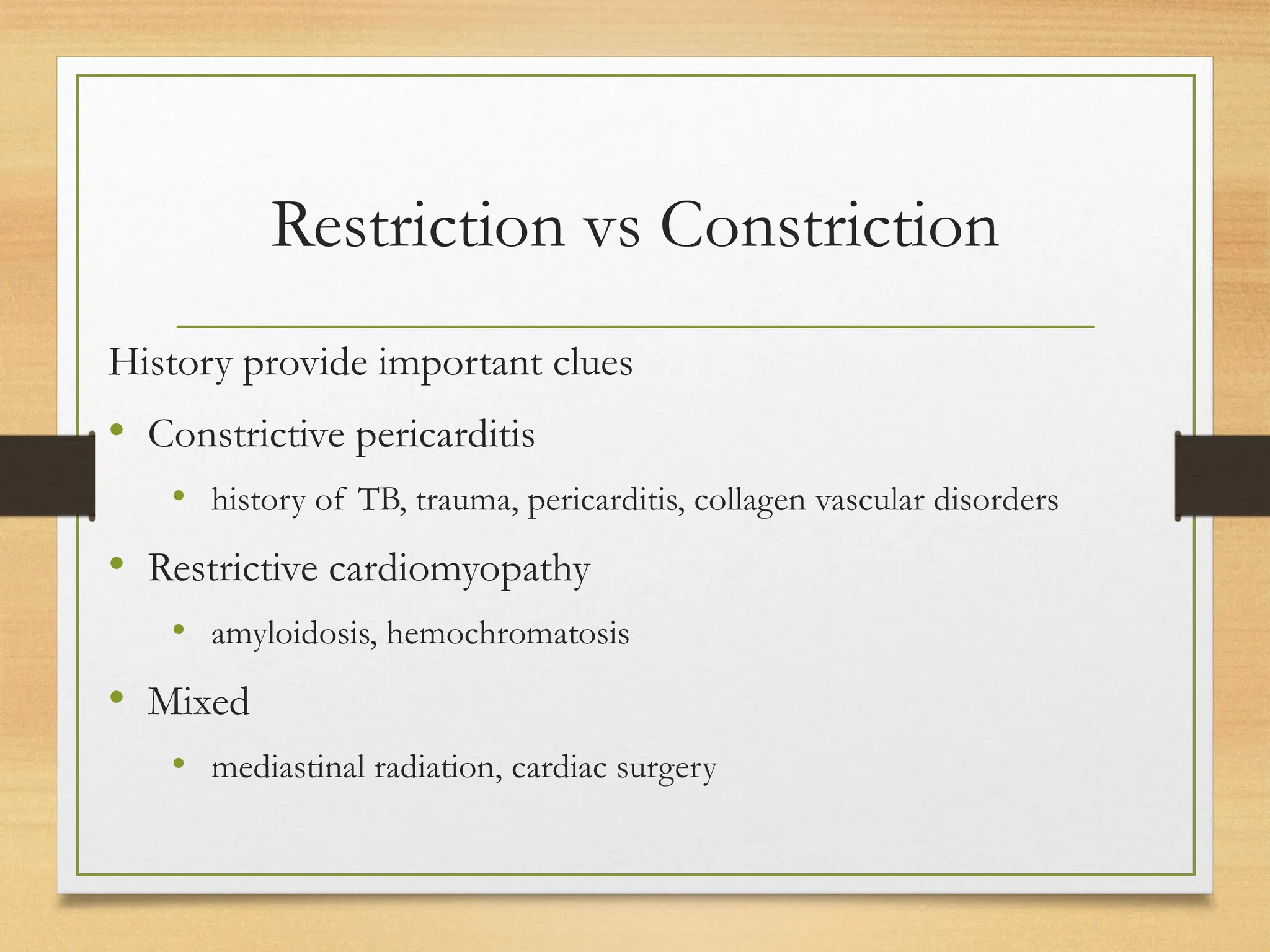
History provide important clues
• Constrictive pericarditis
• history of TB, trauma, pericarditis, collagen vascular disorders
• Restrictive cardiomyopathy
• amyloidosis, hemochromatosis
• Mixed
• mediastinal radiation, cardiac surgery
Laboratory Examinations
• ECG: low-voltage, nonspecific ST-T-wave abnormalities and
various arrhythmias.
• Chest x-ray: Pericardial calcification which occurs in
constrictive pericarditis, is absent.
• Echocardiography, CTI, and CMRI typically reveal
symmetrically thickened LV walls and normal or slightly reduced
ventricular volumes and systolic function; the atria are usually
dilated, sometimes massively.
Laboratory Examinations…
• Endomyocardial biopsy: reliable for the Dx of all amyloid due
to the characteristic birefringence pattern of Congo red staining
of the amyloid fibrils
• Doppler echocardiography typically shows diastolic
dysfunction.
• Cardiac catheterization shows a reduced CO, elevation of the RV
and LV end-diastolic pressures, and a dip-and-plateau
configuration (resembling constrictive pericarditis)
Treatment
• Medical therapy is not satisfactory
• Anticoagulation is recommended to reduce the risk of
embolization from the heart.
• Drug therapy must be used with caution
• diuretics for extremely high filling pressures
• vasodilators may decrease filling pressure
• ? Calcium channel blockers to improve diastolic compliance
• digitalis and other inotropic agents are not indicated
Cardiomyopathies can be dilated, restrictive or inflammatory

Cardiomyopathies can be dilated, restrictive or inflammatory

  • 1.
  • 2.
    Objectives • Discuss definition,etiologies and classification of CMP • Review current medical management of patients with cardiomyopathy
  • 3.
    Definition  A groupof diseases that primarily affect the heart muscle. (not the result of disease or dysfunction of other cardiac structures (valvular, hypertensive, coronary arterial, or pericardial abnormalities).  It is estimated that cardiomyopathy accounts for 5– 10% of the heart failure
  • 4.
    Classification on anetiologic basis • Primary type - Heart muscle disease of unknown cause • Secondary type – Myocardial disease of known cause – Associated with a disease involving other organ system – Specific cardiomyopathy by WHO
  • 5.
  • 8.
    WHO Classification • Unknowncause (primary) • Dilated • Hypertrophic • Restrictive • unclassified • Specific heart muscle disease (secondary) • Infective • Metabolic • Systemic disease • Heredofamilial • Sensitivity • Toxic
  • 9.
    GENERAL PRESENTATION • Theearly symptoms of cardiomyopathy • exertional intolerance with breathlessness or fatigue. • As filling pressures become elevated at rest, shortness of breath may occur during routine activity or when lying down at night. • NB: Peripheral edema may be absent despite severe fluid retention, particularly in younger patients in whom abdominal discomfort from hepato-splanchnic congestion and ascites may dominate.
  • 10.
    GENERAL PRESENTATION • Mayalso present • Atypical chest pain, • palpitations • syncope related to associated rhythm disorders, or • with an embolism from an intracardiac thrombus.
  • 11.
  • 12.
    IDCM - Definition •a disease of unknown etiology that principally affects the myocardium. • pathology • increased heart size and weight • ventricular dilatation, normal wall thickness • heart dysfunction out of portion to fibrosis
  • 13.
    Peripartum cardiomyopathy (PPCM)develops during the last trimester or within the first 6 months after pregnancy,
  • 15.
    Idiopathic DCM • IdiopathicDCM is a diagnosis of exclusion. • Approximately two-thirds of DCMs are still labeled as idiopathic; • however, a substantial proportion of these may reflect unrecognized genetic disease. • LV and/or right ventricular (RV) systolic pump function is impaired, leading to progressive cardiac dilatation (remodeling). • Symptoms of heart failure (HF) typically appear only after remodeling has been ongoing for some time (months or even years).
  • 16.
    Incidence and Prognosis •3-10 cases per 100,000 • Age: may occur at any age • most commonly becomes apparent clinically in the 3rd or 4th decades. • Blacks 2x more frequent than whites • Men 3x more frequent than women • Symptoms may be gradual in onset • death from progressive pump failure 1-year 25% 2-year 35-40% 5-year 40-80% • stabilization observed in 20-50% of patient • complete recovery is rare
  • 17.
    History and PhysicalExamination • Symptoms of heart failure • pulmonary congestion (left HF) dyspnea (rest, exertional, nocturnal), orthpnea • systemic congestion (right HF) edema, nausea, abdominal pain, nocturia • low cardiac output fatigue and weakness • Hypotension, narrow pulse pressure, tachycardia, tachypnea, JVD, S3,S4, MR/TR
  • 18.
    Cardiac Imaging • Chestradiogram: • enlargement of the cardiac silhouette • Pulmonary vascular redistribution and interstitial or, in advanced cases, alveolar edema. • Electrocardiogram: • sinus tachycardia or atrial fibrillation, ventricular arrhythmias, left atrial abnormality, low voltage, diffuse nonspecific ST-T-wave abnormalities, and sometimes intraventricular and/or AV conduction defects. • Echocardiography, computed tomographic imaging (CTI), and cardiac magnetic resonance imaging (CMRI) • Radionuclide ventriculography • Cardiac catheterization and coronary angiography • age >40, ischemic history, high risk profile, abnormal ECG
  • 19.
    Management of DCM •Supportive • salt restriction of a 2-g Na+ (5g NaCl) diet • Oxygen (if indicated) • Activity (might be limited based on functional status, elevate head of bed) • Pharmacologic treatment • Decongest with Diuretics • Based on Ejection Fraction and comorbidities • MRA • ARNI/ACEI/ARB • ß-blocking agents • SGLT2I • Treat complication like arrhythmia • Treat precipitants
  • 20.
  • 21.
    Hypertrophic Cardiomyopathy • Adisorder caused by mutations in the genes that code for various proteins within the sarcomere. • uncommon with occurrence of 0.02 to 0.2% • a hypertrophied and non-dilated left ventricle in the absence of another disease • small LV cavity, asymmetrical septal hypertrophy (ASH), systolic anterior motion of the mitral valve leaflet (SAM)
  • 22.
    Pathophysiology • Systole • dynamicoutflow tract gradient • Diastole • impaired diastolic filling,  filling pressure • Myocardial ischemia •  muscle mass, filling pressure, O2 demand •  vasodilator reserve, capillary density • abnormal intramural coronary arteries • systolic compression of arteries
  • 23.
    Clinical Manifestation • Abouthalf of all patients with HCM have a positive family history compatible with autosomal dominant transmission. • Asymptomatic, echocardiographic finding • Symptomatic • dyspnea in 90% • angina pectoris in 75% • fatigue, pre-syncope, syncope  risk of SCD in children and adolescents • palpitation, PND, CHF, dizziness less frequent
  • 24.
    Physical Examination • Mostpatients demonstrate a double or triple apical precordial impulse and a fourth heart sound. • a rapidly rising arterial pulse: Those with intraventricular pressure gradients. • systolic murmur: • the hallmark of obstructive HCM, which is typically harsh, diamond- shaped, & usually begins well after 1st heart sound.
  • 25.
    Laboratory Evaluation • ECG:LV hypertrophy and widespread deep, broad Q waves, T wave inversions. • Chest X-ray: may be normal, although a mild to moderate increase in the cardiac silhouette is common. • Echocardiogram: The mainstay of the diagnosis of HCM • LV hypertrophy, often with the septum 1.3 times the thickness of the posterior LV free wall. • CMRI is superior to echocardiography in providing accurate measurements of regional hypertrophy and in identifying sites of regional fibrosis.
  • 26.
    Natural History • annualmortality 3% in referral centers probably closer to 1% for all patients • risk of SCD higher in children may be as high as 6% per year majority have progressive hypertrophy • clinical deterioration usually is slow • progression to DCM occurs in 10-15%
  • 27.
    Management • Management focuseson treatment of symptoms and prevention of sudden death and stroke. • Left ventricular outflow tract obstruction can be controlled medically in the majority of patients. • β-Adrenergic blocking agents and L-type calcium channel blockers (e.g., verapamil) are first-line agents that reduce the severity of obstruction by slowing heart rate, enhancing diastolic filling, and decreasing contractility.
  • 30.
    Recommendations for competitive Activity •Avoid most competitive sports (whether or not symptoms and/or outflow gradient are present) • Low-risk older patients (>30 yrs) may participate in athletic activity if all of the following are absent • ventricular tachycardia on Holter monitoring • family history of sudden death due to HCM • history of syncope or episode of impaired consciousness • severe hemdynamic abnormalities, gradient 50 mmHg • exercise induced hypotension • moderate or sever mitral regurgitation • enlarged left atrium (50 mm) • paroxysmal atrial fibrillation • abnormal myocardial perfusion
  • 31.
  • 32.
    Restrictive Cardiomyopathies • Hallmark:abnormal diastolic function • rigid ventricular wall with impaired ventricular filling • bear some functional resemblance to constrictive pericarditis • importance lies in its differentiation from operable constrictive pericarditis
  • 33.
    Exclusion “Guidelines” • LVend-diastolic dimensions  7 cm • Myocardial wall thickness  1.7 cm • LV end-diastolic volume  150 mL/m2 • LV ejection fraction < 20%
  • 34.
    Clinical Manifestations • Therestrictive diseases often present with relatively more right sided. • Symptoms, such as edema, abdominal discomfort, and ascites, although filling pressures are elevated in both ventricles. • The cardiac impulse is less displaced than in DCM and less dynamic than HCM. • S4 is more common than S3 in sinus rhythm, but atrial fibrillation is common.
  • 35.
    Clinical Manifestations • Jugularvenous pressures often show rapid Y descents and may increase during inspiration (positive Kussmaul’s sign). • Jugular Venous Pulse • prominent x and y descents • Echo-Doppler • abnormal mitral inflow pattern • prominent E wave (rapid diastolic filling) • reduced deceleration time ( LA pressure)
  • 36.
    Causes of Restrictive Cardiomyopathy •Most restrictive cardiomyopathies are due to infiltration of abnormal substances between myocytes, storage of abnormal metabolic products within myocytes, or fibrotic injury • Amyloidosis is the most common cause of restrictive cardiomyopathy.
  • 38.
    Restriction vs Constriction Historyprovide important clues • Constrictive pericarditis • history of TB, trauma, pericarditis, collagen vascular disorders • Restrictive cardiomyopathy • amyloidosis, hemochromatosis • Mixed • mediastinal radiation, cardiac surgery
  • 39.
    Laboratory Examinations • ECG:low-voltage, nonspecific ST-T-wave abnormalities and various arrhythmias. • Chest x-ray: Pericardial calcification which occurs in constrictive pericarditis, is absent. • Echocardiography, CTI, and CMRI typically reveal symmetrically thickened LV walls and normal or slightly reduced ventricular volumes and systolic function; the atria are usually dilated, sometimes massively.
  • 40.
    Laboratory Examinations… • Endomyocardialbiopsy: reliable for the Dx of all amyloid due to the characteristic birefringence pattern of Congo red staining of the amyloid fibrils • Doppler echocardiography typically shows diastolic dysfunction. • Cardiac catheterization shows a reduced CO, elevation of the RV and LV end-diastolic pressures, and a dip-and-plateau configuration (resembling constrictive pericarditis)
  • 41.
    Treatment • Medical therapyis not satisfactory • Anticoagulation is recommended to reduce the risk of embolization from the heart. • Drug therapy must be used with caution • diuretics for extremely high filling pressures • vasodilators may decrease filling pressure • ? Calcium channel blockers to improve diastolic compliance • digitalis and other inotropic agents are not indicated

Editor's Notes

  • #15 Continued reconsideration of etiology during chronic heart failure management often reveals specific causes later in a patient’s course.