CARDIAC GLYCOSIDES
• Cardiac glycosides or digitalis essentially refer to a
group of chemically and pharmacologically related
drugs, that act on the heart by causing
atrioventricular conduction and vagal tone.
• They are invariably employed to slow the heart rate in
atrial fibrillation and also administered in congestive
heart failure.
• A large number of ‘drug substances’ are able to
enhance the force of contraction of the heart. It is,
however, pertinent to state here that this ionotropic
activity may be specifically of great utility and
importance in the ultimate treatment of congestive
heart failure
Cardiac Glycosides
• Drugs originally obtained from plant source, Digitalis
purpurea and Digitalis lanata
• Digoxin and digitoxin are the only cardiac glycosides
currently available
• Main pharmacologic effect of cardiac glycosides is to
increase the contractile force of myocardial
contraction
• Cardiac glycosides also decrease heart rate and
atrioventricular conduction
Digoxin
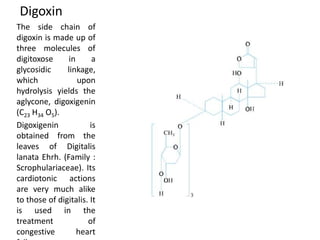
The side chain of
digoxin is made up of
three molecules of
digitoxose in a
glycosidic linkage,
which upon
hydrolysis yields the
aglycone, digoxigenin
(C23 H34 O5).
Digoxigenin is
obtained from the
leaves of Digitalis
lanata Ehrh. (Family :
Scrophulariaceae). Its
cardiotonic actions
are very much alike
to those of digitalis. It
is used in the
treatment of
congestive heart
Digitoxin
Digitoxin is obtained from
Digitalis purpurea Linne,
Digitalis lanata Ehrh, and
other suitable species of
Digitalis.
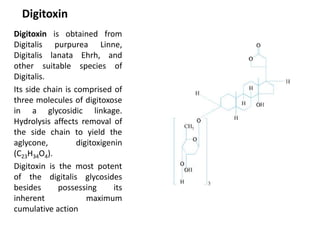
Its side chain is comprised of
three molecules of digitoxose
in a glycosidic linkage.
Hydrolysis affects removal of
the side chain to yield the
aglycone, digitoxigenin
(C23H34O4).
Digitoxin is the most potent
of the digitalis glycosides
besides possessing its
inherent maximum
cumulative action
Mechanism of Action
• Cardiac glycosides inhibit Na/K adenosine
triphosphatase, the “sodium pump” which causes
more Na to remain inside myocardial cells
• Increased intracellular Na stimulates Na/Ca exchange
that brings more Ca inside heart cells to increase the
force of contraction
• Cardiac glycosides also stimulate the vagus nerve
which decreases heart rate
Pharmacokinetics and Dosing
• Digoxin is water soluble and eliminated mostly
unmetabolized by the urinary tract
• Digitoxin is more lipid soluble, requires metabolism,
and has a longer half-life
• In acute CHF, initial “digitalization” doses are
administered to rapidly attain effective therapeutic
concentration
• Lower daily maintenance doses are then given to
maintain desired therapeutic concentrations
Electrolyte and Cardiac Glycoside
Interactions
• Low serum potassium (K) levels “hypokalemia”
increase drug toxicity and can cause cardiac
arrhythmias
• High serum potassium levels “hyperkalemia”
decrease the actions of the cardiac glycosides
• Increased serum calcium levels “hypercalcemia”
can increase the actions and toxicity of the
cardiac glycosides
Adverse Effects
• Common complaints include headache,
dizziness, nausea, and vomiting
• Visual disturbances “halo effect” around lights
often signals overdosage
• Bradycardia, ectopic beats, and a variety of
other cardiac arrhythmias can occur and can
be life-threatening
Diuretic Therapy of CHF
• Diuretic drugs are used to eliminate excess
sodium and fluid retention
• Elimination of excess fluid allows the heart to
function more efficiently
• Diuretics can be administered with cardiac
glycosides and other drugs used to treat CHF
Vasodilator Therapy of CHF
• Vasodilator drugs relax and dilate blood
vessels
• Vasodilation decreases peripheral resistance,
allows more efficient blood flow, and usually
increases cardiac output
• Angiotensin-converting enzyme inhibitors and
angiotensin receptor blocking drugs are
particularly useful in CHF

Cardiac glycosides final

  • 1.
    CARDIAC GLYCOSIDES • Cardiacglycosides or digitalis essentially refer to a group of chemically and pharmacologically related drugs, that act on the heart by causing atrioventricular conduction and vagal tone. • They are invariably employed to slow the heart rate in atrial fibrillation and also administered in congestive heart failure. • A large number of ‘drug substances’ are able to enhance the force of contraction of the heart. It is, however, pertinent to state here that this ionotropic activity may be specifically of great utility and importance in the ultimate treatment of congestive heart failure
  • 2.
    Cardiac Glycosides • Drugsoriginally obtained from plant source, Digitalis purpurea and Digitalis lanata • Digoxin and digitoxin are the only cardiac glycosides currently available • Main pharmacologic effect of cardiac glycosides is to increase the contractile force of myocardial contraction • Cardiac glycosides also decrease heart rate and atrioventricular conduction
  • 3.
    Digoxin The side chainof digoxin is made up of three molecules of digitoxose in a glycosidic linkage, which upon hydrolysis yields the aglycone, digoxigenin (C23 H34 O5). Digoxigenin is obtained from the leaves of Digitalis lanata Ehrh. (Family : Scrophulariaceae). Its cardiotonic actions are very much alike to those of digitalis. It is used in the treatment of congestive heart
  • 4.
    Digitoxin Digitoxin is obtainedfrom Digitalis purpurea Linne, Digitalis lanata Ehrh, and other suitable species of Digitalis. Its side chain is comprised of three molecules of digitoxose in a glycosidic linkage. Hydrolysis affects removal of the side chain to yield the aglycone, digitoxigenin (C23H34O4). Digitoxin is the most potent of the digitalis glycosides besides possessing its inherent maximum cumulative action
  • 5.
    Mechanism of Action •Cardiac glycosides inhibit Na/K adenosine triphosphatase, the “sodium pump” which causes more Na to remain inside myocardial cells • Increased intracellular Na stimulates Na/Ca exchange that brings more Ca inside heart cells to increase the force of contraction • Cardiac glycosides also stimulate the vagus nerve which decreases heart rate
  • 6.
    Pharmacokinetics and Dosing •Digoxin is water soluble and eliminated mostly unmetabolized by the urinary tract • Digitoxin is more lipid soluble, requires metabolism, and has a longer half-life • In acute CHF, initial “digitalization” doses are administered to rapidly attain effective therapeutic concentration • Lower daily maintenance doses are then given to maintain desired therapeutic concentrations
  • 7.
    Electrolyte and CardiacGlycoside Interactions • Low serum potassium (K) levels “hypokalemia” increase drug toxicity and can cause cardiac arrhythmias • High serum potassium levels “hyperkalemia” decrease the actions of the cardiac glycosides • Increased serum calcium levels “hypercalcemia” can increase the actions and toxicity of the cardiac glycosides
  • 8.
    Adverse Effects • Commoncomplaints include headache, dizziness, nausea, and vomiting • Visual disturbances “halo effect” around lights often signals overdosage • Bradycardia, ectopic beats, and a variety of other cardiac arrhythmias can occur and can be life-threatening
  • 9.
    Diuretic Therapy ofCHF • Diuretic drugs are used to eliminate excess sodium and fluid retention • Elimination of excess fluid allows the heart to function more efficiently • Diuretics can be administered with cardiac glycosides and other drugs used to treat CHF
  • 10.
    Vasodilator Therapy ofCHF • Vasodilator drugs relax and dilate blood vessels • Vasodilation decreases peripheral resistance, allows more efficient blood flow, and usually increases cardiac output • Angiotensin-converting enzyme inhibitors and angiotensin receptor blocking drugs are particularly useful in CHF