Definition: Heart failureis a clinical syndrome caused by the
inability of the heart to pump sufficient blood to meet the
metabolic needs of the body.
Causes: Heart failure can result from any disorder that reduces
1. Ventricular filling (diastolic dysfunction)
2. Myocardial contractility (systolic dysfunction).
3. Coronary artery disease and hypertension.
3.
Drug therapy forCHF or CCF
A) Relief of congestive/low output symptoms and restoration of
cardiac performance
Inotropic drugs: Digoxin, Dobutamine/ Dopamine,
Amrinone/Milirinone
Diuretics: Furosemide, Thiazides
Vasodilators: Hydralazine, Nitrate, Nitroprusside
ACE inhibitors (Captopril, Enalapril )/AT1 antagonists (Losartan)
β- blockers: Metoprolol, Bisoprolol, Carvedilol, Nabivolol
B) Arrest/reversal of disease progression and prolongation of
survival
ACE inhibitors (Captopril, Enalapril )/AT1 antagonists
(ARBs)(Losartan)
β- blockers: Metoprolol, Bisoprolol, Carvedilol
Aldostreone antagonist: Spiranolactone, Eplerenone
4.
Pharmacology of Digoxin
Pharmacokinetics
Absorption:Food delays absorption of digoxin tablet.
Distribution: Volume of distribution is 6- 8 L/kg. Digoxin is
concentrated in heart, Skeletal muscle, liver and kidney.
Metabolism: Metabolized in liver. Cumulative drug plasma t1/2 is
40 hrs.
Excretion: It kidney through glomerular filtration.
Dose: Digitalization 1- 1.5mg, oral
Maintenance dose 0.25-0.75 mg, oral
5.
Pharmacology of Digoxin
1.Heart
a) Force of contraction
i) Digoxin gives positive inotropic action in failing heart
ii) Increases velocity of tension development.
iii) Increases capacity to contract more forcefully when subjected
to increased resistance to ejection.
b) Tone
Maximum length of the fiber at a given filling pressure. Decrease
end diastolic size of a failing heart.
c) Heart rate
i) HR is decreased , bradycardia in CCF.
ii) Improved circulation
iii) Restores diminished vagal tone and abolish sympathetic over
activity.
iv) Slows down the heart
6.
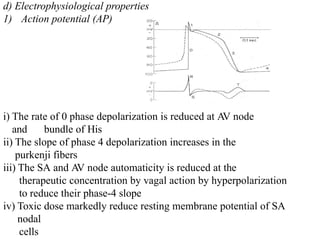
d) Electrophysiological properties
1)Action potential (AP)
i) The rate of 0 phase depolarization is reduced at A
V node
and bundle of His
ii) The slope of phase 4 depolarization increases in the
purkenji fibers
iii) The SA and A
V node automaticity is reduced at the
therapeutic concentration by vagal action by hyperpolarization
to reduce their phase-4 slope
iv) Toxic dose markedly reduce resting membrane potential of SA
nodal
cells
7.
2) Effective refractoryperiod (ERP)
i) In atrium ERP is decreased by vagal action and increased by
indirect action.
ii) In AV nodeand bundle of His ERP is increased
by
vagomimetic and antiadrenergic actions.
iii) In ventricle ERP is increased by direct action.
c) Excitability: It increased by low dose and decreased by high
dose
d) Conduction: A
V conduction is slowed at therapeutic dose
by decrease in rate of phase 0 depolarization.
8.
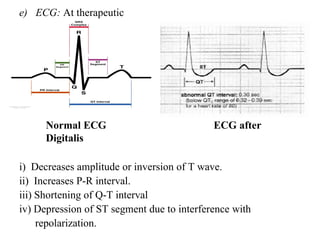
e) ECG: Attherapeutic
doses
Normal ECG ECG after
Digitalis
i) Decreases amplitude or inversion of T wave.
ii) Increases P-R interval.
iii) Shortening of Q-T interval
iv) Depression of ST segment due to interference with
repolarization.
9.
Mechanism of action
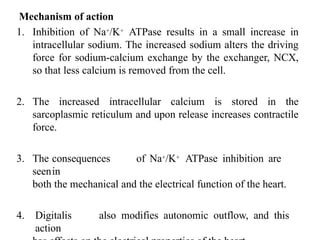
1.Inhibition of Na+/K+ ATPase results in a small increase in
intracellular sodium. The increased sodium alters the driving
force for sodium-calcium exchange by the exchanger, NCX,
so that less calcium is removed from the cell.
2. The increased intracellular calcium is stored in the
sarcoplasmic reticulum and upon release increases contractile
force.
3. The consequences of Na+/K+ ATPase inhibition are
seenin
both the mechanical and the electrical function of the heart.
4. Digitalis also modifies autonomic outflow, and this
action
10.
Adverse effects
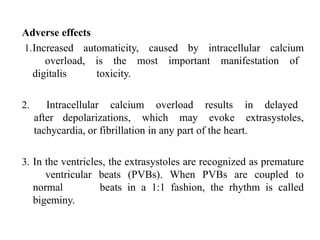
1.Increased automaticity,caused by intracellular calcium
overload, is the most important manifestation of
digitalis toxicity.
2. Intracellular calcium overload results in delayed
after depolarizations, which may evoke extrasystoles,
tachycardia, or fibrillation in any part of the heart.
3. In the ventricles, the extrasystoles are recognized as premature
ventricular beats (PVBs). When PVBs are coupled to
normal beats in a 1:1 fashion, the rhythm is called
bigeminy.
11.
Digitalis toxicity
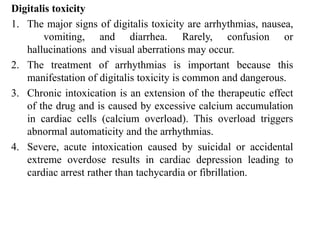
1. Themajor signs of digitalis toxicity are arrhythmias, nausea,
vomiting, and diarrhea. Rarely, confusion or
hallucinations and visual aberrations may occur.
2. The treatment of arrhythmias is important because this
manifestation of digitalis toxicity is common and dangerous.
3. Chronic intoxication is an extension of the therapeutic effect
of the drug and is caused by excessive calcium accumulation
in cardiac cells (calcium overload). This overload triggers
abnormal automaticity and the arrhythmias.
4. Severe, acute intoxication caused by suicidal or accidental
extreme overdose results in cardiac depression leading to
cardiac arrest rather than tachycardia or fibrillation.
12.
Treatment of digitalistoxicity includes several steps, as follows.
1.Further dose must be stopped
2. For tachyarrhythmias: Correction of Potassium or
Magnesium Deficiency
3. For ventricular arrhythmias: Antiarrhythmic Drugs eg,
lidocaine or phenytoin.
4. For supraventricular arrhythmias: Propranolol i.v may me given
5. For A-V block and bradycardia: Atropine 0.6-1.2mg i.m;
otherwise cardiac pacing is recommended.
6. Digoxin Antibodies: Digoxin antibodies (Fab fragments;
Digibind) are extremely effective and should always be used if
other therapies appear to be failing.
13.
Drug interaction
1.Quinidine
causes awell-
documented
reduction in
digoxin
clearance and
can increase the
serum digoxin
level if digoxin
dosage is not
adjusted
2.Digitalis
toxicity,
especially
arrhythmogenes
is, is
increased by
hypokalemia,
14.
Other Drugs Usedin Congestive Cardiac Failure
The other major agents used in heart failure include
I) Diuretics
1. Diuretics are the first-line therapy for both systolic
and diastolic failure and are used in heart failure before
digitalis and other drugs are considered.
2. Furosemide is a very useful agent for immediate
reduction of the pulmonary congestion and severe edema
associated with acute heart failure and for moderate or severe
chronic failure.
3. Thiazides such as hydrochlorothiazide are
sometimes sufficient for mild chronic failure.
4. Clinical studies suggest that spironolactone and
eplerenone (aldosterone antagonist diuretics) have
significant long-term benefits and can reduce mortality in
chronic failure.
15.
II)Angiotensin Antagonists
1. Theseagents have been shown to reduce morbidity and
mortality in chronic heart failure.
2. Angiotensin antagonists reduce aldosterone secretion, salt and
water retention, and vascular resistance. They are now
considered, along with diuretics, to be first-line drugs for
chronic heart failure.
3. The angiotensin receptor blockers (ARBs, eg. losartan ) appear
to have the same benefits as ACE inhibitors (eg. captopril)
III) Beta1-Adrenoceptor Agonists
1. Dobutamine (β1selective) and dopamine are often
useful in
acute failure in which systolic function is markedly depressed.
2. However, they are not appropriate for chronic failure because of
tolerance, lack of oral efficacy, and significant
arrhythmogenic effects.
16.
IV) Beta-Adrenoceptor Antagonists
1.Several β- blockers (carvedilol, labetalol, metoprolol) have
been shown in long-term studies to reduce progression of
chronic heart failure.
2. This benefit of β-blockers had long been recognized in
patients with hypertrophic cardiomyopathy but has now been
shown to occur also in patients without cardiomyopathy.
3. Nebivolol, a newer β-blocker with vasodilator effects, is
investigational in heart failure. Beta blockers are not of
value in acute failure and may be detrimental if systolic
dysfunction is marked.
17.
V) Phosphodiesterase Inhibitors
1.Amrinone and milrinone are the major representatives of
this infrequently used group.
2. These drugs increase cyclic adenosine
monophosphate (cAMP) by inhibiting its breakdown by
phosphodiesterase and cause an increase in cardiac
intracellular calcium similar to that produced by α-
adrenoceptor agonists.
3. Phosphodiesterase inhibitors also cause vasodilation,
which may be responsible for a major part of their beneficial
effect.
4. At sufficiently high concentrations, these agents may increase
the sensitivity of the contractile protein system to calcium.
5. These agents should not be used in chronic failure because
18.
Vasodilators
1. Vasodilator therapywith nitroprusside or nitroglycerin is
often
used for acute severe failure with congestion.
2. The use of these vasodilator drugs is based on the reduction in
cardiac size and improved efficiency that can be realized with
proper adjustment of venous return (preload) and reduction of
resistance to ventricular ejection (afterload).
3. Vasodilator therapy can be dramatically effective, especially in
cases in which increased afterload is a major factor in
causing the failure. The natriuretic peptide nesiritide acts
chiefly by causing vasodilation, although it does have
natriuretic effects as well. It is given by IV infusion for
acute failure only.
4.
Chronic heart failure sometimes responds favorably to oral
vasodilators such as hydralazine or isosorbide dinitrate (or both),
and the combination has been shown to reduce mortality in
19.
Nonpharmacologic Therapy
1. Avariety of surgical procedures to remove nonfunctional
regions of damaged myocardium have been attempted
with mixed results.
2. Resynchronization of right and left ventricular contraction
by means of a pacemaker has been beneficial in patients with
long QRS (indicating conduction abnormalities).
3. Patients with coronary artery disease and heart failure
may have improved systolic function after coronary
revascularization.



![2.Drug used in CHF [Recovered] [Autosaved].pdf](https://cdn.slidesharecdn.com/ss_thumbnails/2-240116072622-68f62ceb-thumbnail.jpg?width=640&height=640&fit=bounds)


![PERI-PROSTHETIC FRACTURE NAIL-PLATE CONSTRUCT [NPC].pptx](https://cdn.slidesharecdn.com/ss_thumbnails/drarunkumardrmohamedashrafperiprostheticfrasturenail-plateconstructnpc-260209164459-7e9d15a1-thumbnail.jpg?width=640&height=640&fit=bounds)
