Cardio Vascular System Nursing 330 Shirley Comer
Pertinent History Chest Pain Edema Known disease Dyspnea Nocturia Family Hx Orthopnea Diet Smoking Cough Obesity Diabetes Mellitus Fatigue ETOH use Exercise Cyanosis or pallor Past Hx ie Rheumatic fever, recent dental work
Neck Vessels Keep neck in a neutral position Locate and Palpate Carotid Arteries One at a time Rate amplitude 1+ to 4 +
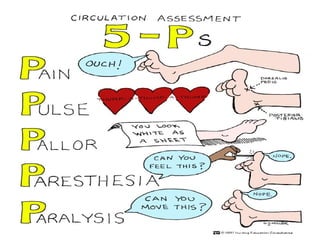
5 p of circulation
Neck Vessels  cont Auscultate the Carotid-normally no sound Bruit - blowing or swishing sound indicating turbulent blood flow Use bell of stethoscope Auscultate at 3 positions Thrill –  Palpable vibration accompanying bruit A loud aortic heart murmur may radiate to neck
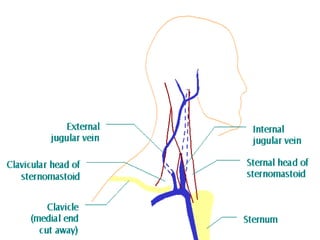
Jugular Venous Assessment Position client supine at 30 to 45 degree angle Always be aware of client comfort Turn client’s head slightly away Note the external and internal Jugular vein distention (if any) and record the level in relation to the clavicle(normal less than 2 cm) Observe for pulsations (if any) Unilateral distension=kinking or aneurysm Bilateral distension=increased CVP
Jugular Vein Drawing
The Precordium (chest wall) Inspect Heave(lift)=sustained forceful thrust of ventricle against chest wall=ventricular hypertrophy Apical pulse may be visible in thin adults and children Palpate the Apical Pulse Sometimes called PMI (point of maximum impulse) Note Location should be at or near 5 th  intercostals space LV dilatation (fluid overload) displaces down and to the left and increases size
Apical Pulse  cont Size  Amplitude- 1+ to 4+ Increased in LV hypertrophy (pressure overload) Rate and Rhythm Regular irregularity or irregular irregularity Compare irregular apical pulse to radial Sinus arrhythmia common in children and young adults related to the respiratory cycle Premature Beat- more common in elderly Palpate the Precordium Use palm Normally thrill or mass not felt
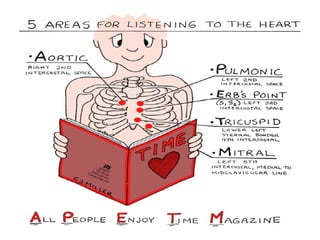
5 areas for listening to the heart
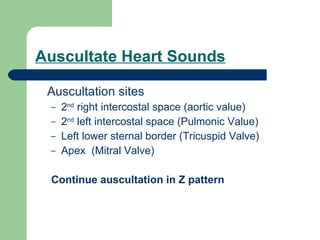
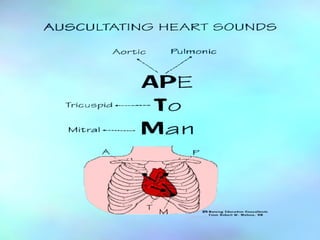
Auscultate Heart Sounds Auscultation sites 2 nd  right intercostal space (aortic value) 2 nd  left intercostal space (Pulmonic Value) Left lower sternal border (Tricuspid Valve) Apex  (Mitral Valve) Continue auscultation in Z pattern
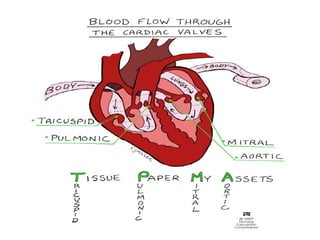
Blood Flow through Cardiac Valves
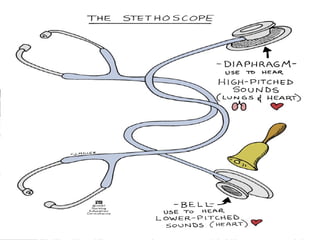
The Stethoscope
Auscultation Heart sounds
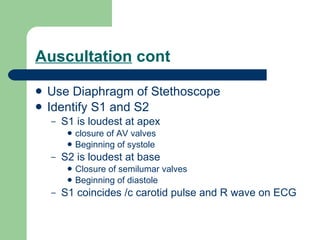
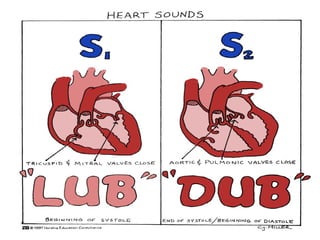
Auscultation  cont Use Diaphragm of Stethoscope Identify S1 and S2 S1 is loudest at apex closure of AV valves Beginning of systole S2 is loudest at base Closure of semilumar valves Beginning of diastole S1 coincides /c carotid pulse and R wave on ECG
S1, S2
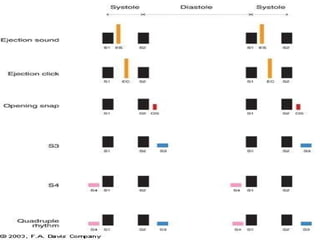
Extra Heart Sounds Split S2 Normal phenomenon Occurs at end of inspiration Semilumar valves don’t close at the same time Heard best at left 2 nd  ICS Can be fixed or paradoxical
Extra Heart sounds  cont S3  – Ventricular Gallop Early in diastole during rapid filling Heard best at apex using bell of stethoscope Doesn’t vary /c resp like Split S2 Indicates decreased ventricular compliance In children and young adult may be innocent and disappear when pt sits May be earliest sign of heart failure Heard /c increased CO ie hyperthyroidism,
Extra Heart Sounds   cont S4-  Atrial Gallop Ventricular filling sound Occurs late in diastole immediately before S1 Heard when atria contract Very soft, low pitched sound Heard best at apex /c pt in left lateral position /c bell Can occur /p exercise at 40 yr old Occurs /c systolic overload, hypertension and aortic stenosis
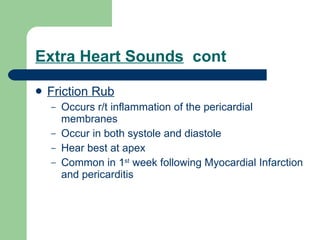
Extra Heart Sounds   cont Friction Rub Occurs r/t inflammation of the pericardial membranes Occur in both systole and diastole Hear best at apex  Common in 1 st  week following Myocardial Infarction and pericarditis
 
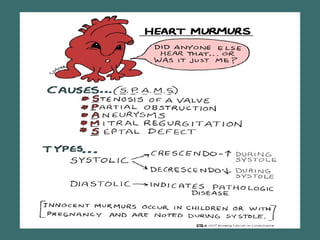
Heart Murmurs
Murmurs Blowing, swooshing sound  Indicates abnormal turbulent blood flow A murmur outside the heart is called a bruit Are either systolic or diastolic Systolic murmur may occur innocently in children and young adults r/t increased force of contraction
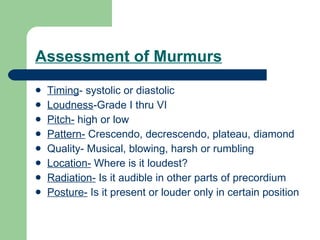
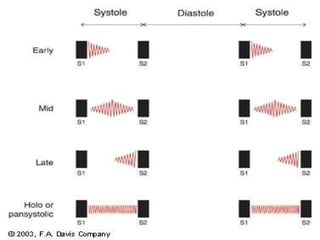
Assessment of Murmurs Timing - systolic or diastolic Loudness -Grade I thru VI Pitch-  high or low Pattern-  Crescendo, decrescendo, plateau, diamond Quality- Musical, blowing, harsh or rumbling Location-  Where is it loudest? Radiation-  Is it audible in other parts of precordium Posture-  Is it present or louder only in certain position
 
Age Specific Considerations Infants Use appropriate size stethoscope May be irregular Murmurs may be present r/t congenital fetal circulation remnants Children May have visible apical pulses r/t thin chest wall May have innocent murmurs-always note presence of murmur
Age Specific Consideration  cont Pregnancy Increased pulse rate Exaggerated S2 splitting Easily heard S3 Systolic murmur may be present-should disappear /p delivery Elderly S4 even /s Hx of CAD Irregular pulse more common
Practice Exam Question You are assessing a 7 year old child upon admission to the pediatric unit.  The child has a soft systolic murmur. His Mother states he has always had this murmur and the doctor is aware of it.  How should you document your finding? A. No need to document it as it is an innocent murmur. B. Describe murmur location, pitch and loudness in the nurses notes but no need to mention it to the Doctor. C. Document your finding in the nurses notes and mention your finding to the Doctor. D. Document you findings on the graphic sheet.
Rationale C is the correct answer as the murmur is an abnormal finding A is incorrect because you always document an abnormal finding B is incorrect because the Physician should be aware of all abnormal findings D is the wrong form
Peripheral Vascular system and Lymphatics Nursing 330 Governors State University Shirley Comer
Anatomy in Peripheral Vascular  Arteries-  carry oxygenated blood to tissues Thick muscular walled Veins - carry deoxygenated blood to tissues Thin walled Lymphatics-  separate vessel system which retrieves excess fluid and plasma proteins and returns them to blood stream Major player in immune system Contains nodes that drain body areas
Assess Arms Note color of skin and nails, temperature, texture, turgor, hair distrubuiton Note lesions, edema or clubbing Assess capillary refill Assess radial and antecubital pulse (0 to 4+) Palpate antecubital and axillary lymph nodes All finding should be bilateral Edema indicates lymphatic obstruction (lymphedema)
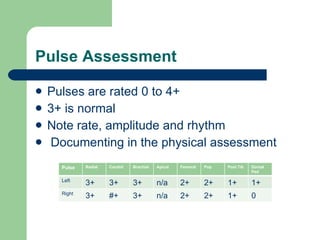
Pulse Assessment Pulses are rated 0 to 4+ 3+ is normal Note rate, amplitude and rhythm Documenting in the physical assessment Pulse Radial Carotid Brachial Apical Femoral Pop Post Tib Dorsal Ped Left 3+ 3+ 3+ n/a 2+ 2+ 1+ 1+ Right 3+ #+ 3+ n/a 2+ 2+ 1+ 0
Assess the legs Inspect skin  Note: color, hair distribution, venous pattern, size, edema, lesions, temperature, turgor, texture Should be symmetrical Venous pattern Normally flat and barely visible Vericose vein-enlarged surface vein, tortuous, prone to clots Note angiomas, petichia, purpuras, brusing ect
Assess the Legs cont Palpate Inguinal lymph nodes Palpate Peripheral pedal pulses- use doppler if unable to find Femoral pulse Popliteal pulse-can be difficult to locate Posterior Tibial pulse- behind medial malleolus Dorsal pedis pulse- lateral to extensor tendon of great toe- use light touch
Edema Pretibial-  Firmly press over skin of tibia or medial malleolus for 5 seconds and release.  If indentations are left pt has pitting edema.  Scale 0 to 4+ Unilateral edema may indicate venous thrombosis, lymph obstruction, injury or dependant positioning
Practice Exam Question Your patient has a history of a mastectomy on the right side. You note her right arm is twice the size of the left. What nursing intervention would you use to decrease the size of this arm? A. elevate arm on pillow B. encourage ROM exercises C. discouarage constricting clothing D. all of the above
Rationale D is the correct answer.  The pt is experiencing lymphedema as a result of her mastectomy and all the interventions listed are appropriate.

Cardiovascular.330.Ss.09

  • 1.
    Cardio Vascular SystemNursing 330 Shirley Comer
  • 2.
    Pertinent History ChestPain Edema Known disease Dyspnea Nocturia Family Hx Orthopnea Diet Smoking Cough Obesity Diabetes Mellitus Fatigue ETOH use Exercise Cyanosis or pallor Past Hx ie Rheumatic fever, recent dental work
  • 3.
    Neck Vessels Keepneck in a neutral position Locate and Palpate Carotid Arteries One at a time Rate amplitude 1+ to 4 +
  • 4.
    5 p ofcirculation
  • 5.
    Neck Vessels cont Auscultate the Carotid-normally no sound Bruit - blowing or swishing sound indicating turbulent blood flow Use bell of stethoscope Auscultate at 3 positions Thrill – Palpable vibration accompanying bruit A loud aortic heart murmur may radiate to neck
  • 6.
    Jugular Venous AssessmentPosition client supine at 30 to 45 degree angle Always be aware of client comfort Turn client’s head slightly away Note the external and internal Jugular vein distention (if any) and record the level in relation to the clavicle(normal less than 2 cm) Observe for pulsations (if any) Unilateral distension=kinking or aneurysm Bilateral distension=increased CVP
  • 7.
  • 8.
    The Precordium (chestwall) Inspect Heave(lift)=sustained forceful thrust of ventricle against chest wall=ventricular hypertrophy Apical pulse may be visible in thin adults and children Palpate the Apical Pulse Sometimes called PMI (point of maximum impulse) Note Location should be at or near 5 th intercostals space LV dilatation (fluid overload) displaces down and to the left and increases size
  • 9.
    Apical Pulse cont Size Amplitude- 1+ to 4+ Increased in LV hypertrophy (pressure overload) Rate and Rhythm Regular irregularity or irregular irregularity Compare irregular apical pulse to radial Sinus arrhythmia common in children and young adults related to the respiratory cycle Premature Beat- more common in elderly Palpate the Precordium Use palm Normally thrill or mass not felt
  • 10.
    5 areas forlistening to the heart
  • 11.
    Auscultate Heart SoundsAuscultation sites 2 nd right intercostal space (aortic value) 2 nd left intercostal space (Pulmonic Value) Left lower sternal border (Tricuspid Valve) Apex (Mitral Valve) Continue auscultation in Z pattern
  • 12.
    Blood Flow throughCardiac Valves
  • 13.
  • 14.
  • 15.
    Auscultation contUse Diaphragm of Stethoscope Identify S1 and S2 S1 is loudest at apex closure of AV valves Beginning of systole S2 is loudest at base Closure of semilumar valves Beginning of diastole S1 coincides /c carotid pulse and R wave on ECG
  • 16.
  • 17.
    Extra Heart SoundsSplit S2 Normal phenomenon Occurs at end of inspiration Semilumar valves don’t close at the same time Heard best at left 2 nd ICS Can be fixed or paradoxical
  • 18.
    Extra Heart sounds cont S3 – Ventricular Gallop Early in diastole during rapid filling Heard best at apex using bell of stethoscope Doesn’t vary /c resp like Split S2 Indicates decreased ventricular compliance In children and young adult may be innocent and disappear when pt sits May be earliest sign of heart failure Heard /c increased CO ie hyperthyroidism,
  • 19.
    Extra Heart Sounds cont S4- Atrial Gallop Ventricular filling sound Occurs late in diastole immediately before S1 Heard when atria contract Very soft, low pitched sound Heard best at apex /c pt in left lateral position /c bell Can occur /p exercise at 40 yr old Occurs /c systolic overload, hypertension and aortic stenosis
  • 20.
    Extra Heart Sounds cont Friction Rub Occurs r/t inflammation of the pericardial membranes Occur in both systole and diastole Hear best at apex Common in 1 st week following Myocardial Infarction and pericarditis
  • 21.
  • 22.
  • 23.
    Murmurs Blowing, swooshingsound Indicates abnormal turbulent blood flow A murmur outside the heart is called a bruit Are either systolic or diastolic Systolic murmur may occur innocently in children and young adults r/t increased force of contraction
  • 24.
    Assessment of MurmursTiming - systolic or diastolic Loudness -Grade I thru VI Pitch- high or low Pattern- Crescendo, decrescendo, plateau, diamond Quality- Musical, blowing, harsh or rumbling Location- Where is it loudest? Radiation- Is it audible in other parts of precordium Posture- Is it present or louder only in certain position
  • 25.
  • 26.
    Age Specific ConsiderationsInfants Use appropriate size stethoscope May be irregular Murmurs may be present r/t congenital fetal circulation remnants Children May have visible apical pulses r/t thin chest wall May have innocent murmurs-always note presence of murmur
  • 27.
    Age Specific Consideration cont Pregnancy Increased pulse rate Exaggerated S2 splitting Easily heard S3 Systolic murmur may be present-should disappear /p delivery Elderly S4 even /s Hx of CAD Irregular pulse more common
  • 28.
    Practice Exam QuestionYou are assessing a 7 year old child upon admission to the pediatric unit. The child has a soft systolic murmur. His Mother states he has always had this murmur and the doctor is aware of it. How should you document your finding? A. No need to document it as it is an innocent murmur. B. Describe murmur location, pitch and loudness in the nurses notes but no need to mention it to the Doctor. C. Document your finding in the nurses notes and mention your finding to the Doctor. D. Document you findings on the graphic sheet.
  • 29.
    Rationale C isthe correct answer as the murmur is an abnormal finding A is incorrect because you always document an abnormal finding B is incorrect because the Physician should be aware of all abnormal findings D is the wrong form
  • 30.
    Peripheral Vascular systemand Lymphatics Nursing 330 Governors State University Shirley Comer
  • 31.
    Anatomy in PeripheralVascular Arteries- carry oxygenated blood to tissues Thick muscular walled Veins - carry deoxygenated blood to tissues Thin walled Lymphatics- separate vessel system which retrieves excess fluid and plasma proteins and returns them to blood stream Major player in immune system Contains nodes that drain body areas
  • 32.
    Assess Arms Notecolor of skin and nails, temperature, texture, turgor, hair distrubuiton Note lesions, edema or clubbing Assess capillary refill Assess radial and antecubital pulse (0 to 4+) Palpate antecubital and axillary lymph nodes All finding should be bilateral Edema indicates lymphatic obstruction (lymphedema)
  • 33.
    Pulse Assessment Pulsesare rated 0 to 4+ 3+ is normal Note rate, amplitude and rhythm Documenting in the physical assessment Pulse Radial Carotid Brachial Apical Femoral Pop Post Tib Dorsal Ped Left 3+ 3+ 3+ n/a 2+ 2+ 1+ 1+ Right 3+ #+ 3+ n/a 2+ 2+ 1+ 0
  • 34.
    Assess the legsInspect skin Note: color, hair distribution, venous pattern, size, edema, lesions, temperature, turgor, texture Should be symmetrical Venous pattern Normally flat and barely visible Vericose vein-enlarged surface vein, tortuous, prone to clots Note angiomas, petichia, purpuras, brusing ect
  • 35.
    Assess the Legscont Palpate Inguinal lymph nodes Palpate Peripheral pedal pulses- use doppler if unable to find Femoral pulse Popliteal pulse-can be difficult to locate Posterior Tibial pulse- behind medial malleolus Dorsal pedis pulse- lateral to extensor tendon of great toe- use light touch
  • 36.
    Edema Pretibial- Firmly press over skin of tibia or medial malleolus for 5 seconds and release. If indentations are left pt has pitting edema. Scale 0 to 4+ Unilateral edema may indicate venous thrombosis, lymph obstruction, injury or dependant positioning
  • 37.
    Practice Exam QuestionYour patient has a history of a mastectomy on the right side. You note her right arm is twice the size of the left. What nursing intervention would you use to decrease the size of this arm? A. elevate arm on pillow B. encourage ROM exercises C. discouarage constricting clothing D. all of the above
  • 38.
    Rationale D isthe correct answer. The pt is experiencing lymphedema as a result of her mastectomy and all the interventions listed are appropriate.