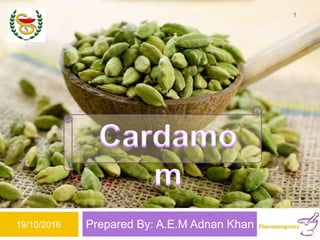
Prepared By: A.E.M Adnan Khan19/10/2016
1
 Definition
 Pharmacognostic features
 Morphology
 History
 Chemical constituents
 Common Usable Part & Traditional Uses
 Extraction Process
 Therapeutic & Medicinal Uses
 Drug Interaction
 Dosage & Caution
 Side Effects
 Contraindication
 References
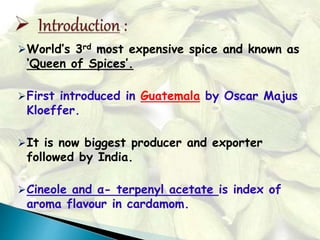
World’s 3rd most expensive spice and known as
‘Queen of Spices’.
First introduced in Guatemala by Oscar Majus
Kloeffer.
It is now biggest producer and exporter
followed by India.
Cineole and α- terpenyl acetate is index of
aroma flavour in cardamom.
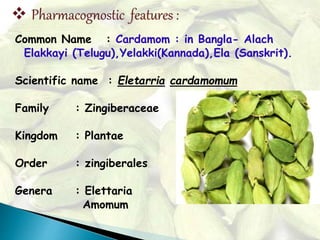
Common Name : Cardamom : in Bangla- Alach
Elakkayi (Telugu),Yelakki(Kannada),Ela (Sanskrit).
Scientific name : Eletarria cardamomum
Family : Zingiberaceae
Kingdom : Plantae
Order : zingiberales
Genera : Elettaria
Amomum
Origin : Western Ghats of South India
It is a Shade bearer species.
 Grows well in well distributed rainfall areas
(1500-3000 mm in western Ghats.)
 Temperature required 10˚- 35˚C.
 Suitable soils – sandy clay to sandy clay loam
texture, acidic (pH 4.5-5.8)
 Raised by suckers or seedlings of high yielding
varieties.
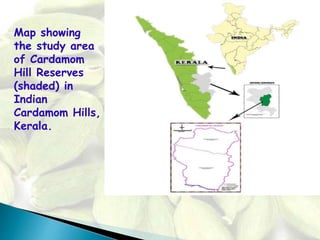
Map showing
the study area
of Cardamom
Hill Reserves
(shaded) in
Indian
Cardamom Hills,
Kerala.
The world doesn’t know the actual time period when
cardamom originated but it is considered that the cardamom
plants firstly came into existence in the monsoon forests of
western ghats in southern India as wild herbs.
 A medicinal literature summary written in between 2nd
century BC to 2nd century AD in India named Charak Samhita
provides us with the first ever written inscriptions about
cardamom. . .
Cardamom was written in an article of Greek trade during
the 4th century B.C.
 Assyrians and Babylonians were also familiar with the
uses of cardamom.
 In the 11th century in Indian cardamom was included in
the list of ingredients for panchasugandha-thambula.
 The cultivation of cardamom in India was actively taken
up by the Travancore Government in 1823 A.D.
 Till 19th century, cardamom grew wild and was searched
in the monsoon forests.
 Nowadays it is grown as a secondary crop with the
coffee plantations.
9
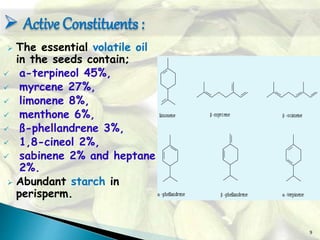
 The essential volatile oil
in the seeds contain;
 a-terpineol 45%,
 myrcene 27%,
 limonene 8%,
 menthone 6%,
 ß-phellandrene 3%,
 1,8-cineol 2%,
 sabinene 2% and heptane
2%.
 Abundant starch in
perisperm.
 Active Constituents :
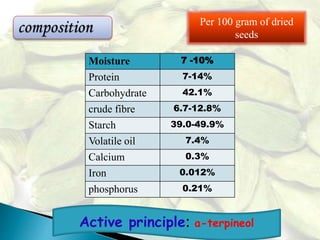
Moisture 7 -10%
Protein 7-14%
Carbohydrate 42.1%
crude fibre 6.7-12.8%
Starch 39.0-49.9%
Volatile oil 7.4%
Calcium 0.3%
Iron 0.012%
phosphorus 0.21%
Per 100 gram of dried
seeds
Active principle: a-terpineol
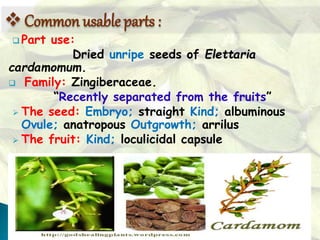
 Part use:
Dried unripe seeds of Elettaria
cardamomum.
 Family: Zingiberaceae.
“Recently separated from the fruits”
 The seed: Embryo; straight Kind; albuminous
Ovule; anatropous Outgrowth; arrilus
 The fruit: Kind; loculicidal capsule
11
Common usable parts :
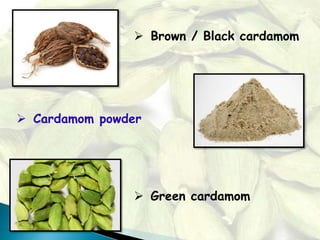
 Brown / Black cardamom
 Cardamom powder
 Green cardamom
13
 Traditional Uses :
 The leaves are cooked and eaten as greens and the
roots are said to be sweet succulent and delicious
when boiled like potatoes.
 Flowers are a sweet addition to salads or as a
garnish and young seedpods are steamed.
 It is used in pickles, especially pickled herring and
flavors custard.
 It is often used in baking in Scandinavia and in
Danish pastries.
 Uses :
14
 Traditional Uses :
Throughout the Arab world, Cardamom is one of the
most popular spices, with Cardamom coffee being a
symbol of hospitality and prestige.
In Sri Lanka, the pods are added to fiery beef or
chicken curries.
A small amount of Cardamom will add a tempting
flavor to coffee cake.
Add whole cardamoms to flavour tea drunk with
milk.
 Uses :
Extraction
process
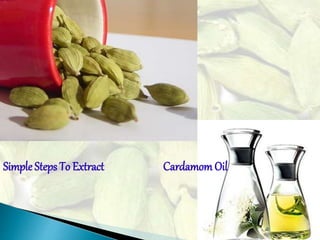
Simple Steps To Extract CardamomOil
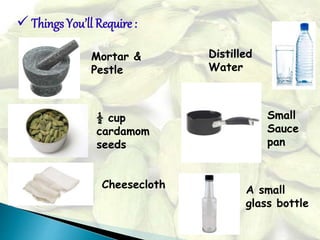
 Things You’ll Require :
Mortar &
Pestle
½ cup
cardamom
seeds
Cheesecloth
Distilled
Water
Small
Sauce
pan
A small
glass bottle
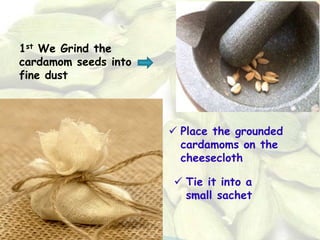
1st We Grind the
cardamom seeds into
fine dust
 Place the grounded
cardamoms on the
cheesecloth
 Tie it into a
small sachet
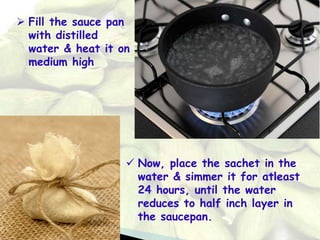
 Fill the sauce pan
with distilled
water & heat it on
medium high
 Now, place the sachet in the
water & simmer it for atleast
24 hours, until the water
reduces to half inch layer in
the saucepan.
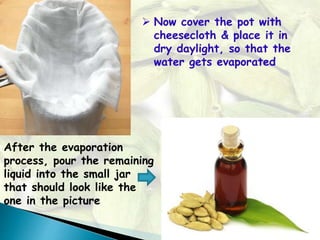
 Now cover the pot with
cheesecloth & place it in
dry daylight, so that the
water gets evaporated
After the evaporation
process, pour the remaining
liquid into the small jar
that should look like the
one in the picture
21
 Medical uses :
 A stimulant and carminative, it is used for
indigestion and flatulence
 In India, green cardamom (A. subulatum) is broadly
used to treat infections in teeth and gums.
 It is used to prevent and treat throat troubles,
congestion of the lungs and pulmonary tuberculosis.
 Used in inflammation of eyelids and also digestive
disorders.
 It is also reportedly used as an antidote for both
snake and scorpion venom.
 Indians regarded it as a cure for obesity.
 Cardamom is used as a breath-freshener, but it is
said that excessive use thins the blood.
Uses :
The appropriate dose of cardamom for use as
treatment depends on several factors such as
the user's age, health, and several other
conditions.
At this time there is not enough scientific
information to determine an appropriate
range of doses for cardamom.
Keep in mind that natural products are not
always necessarily safe and dosages can be
important.
23
 Cardamom is LIKELY SAFE for most people when
taken by mouth , but the potential side effects of
cardamom are :
Bowel disorder
Biliary colic
Contact dermatitis
Vomiting, nausea and diarrhea
 Special Precautions & Warnings:
Gallstones: Do not take cardamom in amounts
greater than those typically found in food if you
have gallstones. The cardamom seed can trigger
gallstone colic (spasmodic pain).
 Side Effects :
24
 Ulcer
 People with diverticulitis
 Intestinal diseases
 Gallstones and colic “but it is recommended
in flatulence colic.”
Endometriosis
Pregnant woman
Essential oil shouldn’t be given to children
under 6 years
Contraindication :
25
http://www.ncbi.nlm.nih.gov/pubmed/25410063
www.medicationdaily.com
www.diethealthclub.com
www.rxlist.com
Pharmacognosy by William C Evans
Textbook of pharmacognosy and phytochemistry
 References :
Cardamom.

Cardamom.

  • 1.
    Prepared By: A.E.MAdnan Khan19/10/2016 1
  • 2.
     Definition  Pharmacognosticfeatures  Morphology  History  Chemical constituents  Common Usable Part & Traditional Uses  Extraction Process  Therapeutic & Medicinal Uses  Drug Interaction  Dosage & Caution  Side Effects  Contraindication  References
  • 3.
    World’s 3rd mostexpensive spice and known as ‘Queen of Spices’. First introduced in Guatemala by Oscar Majus Kloeffer. It is now biggest producer and exporter followed by India. Cineole and α- terpenyl acetate is index of aroma flavour in cardamom.
  • 4.
    Common Name :Cardamom : in Bangla- Alach Elakkayi (Telugu),Yelakki(Kannada),Ela (Sanskrit). Scientific name : Eletarria cardamomum Family : Zingiberaceae Kingdom : Plantae Order : zingiberales Genera : Elettaria Amomum
  • 5.
    Origin : WesternGhats of South India It is a Shade bearer species.  Grows well in well distributed rainfall areas (1500-3000 mm in western Ghats.)  Temperature required 10˚- 35˚C.  Suitable soils – sandy clay to sandy clay loam texture, acidic (pH 4.5-5.8)  Raised by suckers or seedlings of high yielding varieties.
  • 6.
    Map showing the studyarea of Cardamom Hill Reserves (shaded) in Indian Cardamom Hills, Kerala.
  • 7.
    The world doesn’tknow the actual time period when cardamom originated but it is considered that the cardamom plants firstly came into existence in the monsoon forests of western ghats in southern India as wild herbs.  A medicinal literature summary written in between 2nd century BC to 2nd century AD in India named Charak Samhita provides us with the first ever written inscriptions about cardamom. . . Cardamom was written in an article of Greek trade during the 4th century B.C.
  • 8.
     Assyrians andBabylonians were also familiar with the uses of cardamom.  In the 11th century in Indian cardamom was included in the list of ingredients for panchasugandha-thambula.  The cultivation of cardamom in India was actively taken up by the Travancore Government in 1823 A.D.  Till 19th century, cardamom grew wild and was searched in the monsoon forests.  Nowadays it is grown as a secondary crop with the coffee plantations.
  • 9.
    9  The essentialvolatile oil in the seeds contain;  a-terpineol 45%,  myrcene 27%,  limonene 8%,  menthone 6%,  ß-phellandrene 3%,  1,8-cineol 2%,  sabinene 2% and heptane 2%.  Abundant starch in perisperm.  Active Constituents :
  • 10.
    Moisture 7 -10% Protein7-14% Carbohydrate 42.1% crude fibre 6.7-12.8% Starch 39.0-49.9% Volatile oil 7.4% Calcium 0.3% Iron 0.012% phosphorus 0.21% Per 100 gram of dried seeds Active principle: a-terpineol
  • 11.
     Part use: Driedunripe seeds of Elettaria cardamomum.  Family: Zingiberaceae. “Recently separated from the fruits”  The seed: Embryo; straight Kind; albuminous Ovule; anatropous Outgrowth; arrilus  The fruit: Kind; loculicidal capsule 11 Common usable parts :
  • 12.
     Brown /Black cardamom  Cardamom powder  Green cardamom
  • 13.
    13  Traditional Uses:  The leaves are cooked and eaten as greens and the roots are said to be sweet succulent and delicious when boiled like potatoes.  Flowers are a sweet addition to salads or as a garnish and young seedpods are steamed.  It is used in pickles, especially pickled herring and flavors custard.  It is often used in baking in Scandinavia and in Danish pastries.  Uses :
  • 14.
    14  Traditional Uses: Throughout the Arab world, Cardamom is one of the most popular spices, with Cardamom coffee being a symbol of hospitality and prestige. In Sri Lanka, the pods are added to fiery beef or chicken curries. A small amount of Cardamom will add a tempting flavor to coffee cake. Add whole cardamoms to flavour tea drunk with milk.  Uses :
  • 15.
  • 16.
    Simple Steps ToExtract CardamomOil
  • 17.
     Things You’llRequire : Mortar & Pestle ½ cup cardamom seeds Cheesecloth Distilled Water Small Sauce pan A small glass bottle
  • 18.
    1st We Grindthe cardamom seeds into fine dust  Place the grounded cardamoms on the cheesecloth  Tie it into a small sachet
  • 19.
     Fill thesauce pan with distilled water & heat it on medium high  Now, place the sachet in the water & simmer it for atleast 24 hours, until the water reduces to half inch layer in the saucepan.
  • 20.
     Now coverthe pot with cheesecloth & place it in dry daylight, so that the water gets evaporated After the evaporation process, pour the remaining liquid into the small jar that should look like the one in the picture
  • 21.
    21  Medical uses:  A stimulant and carminative, it is used for indigestion and flatulence  In India, green cardamom (A. subulatum) is broadly used to treat infections in teeth and gums.  It is used to prevent and treat throat troubles, congestion of the lungs and pulmonary tuberculosis.  Used in inflammation of eyelids and also digestive disorders.  It is also reportedly used as an antidote for both snake and scorpion venom.  Indians regarded it as a cure for obesity.  Cardamom is used as a breath-freshener, but it is said that excessive use thins the blood. Uses :
  • 22.
    The appropriate doseof cardamom for use as treatment depends on several factors such as the user's age, health, and several other conditions. At this time there is not enough scientific information to determine an appropriate range of doses for cardamom. Keep in mind that natural products are not always necessarily safe and dosages can be important.
  • 23.
    23  Cardamom isLIKELY SAFE for most people when taken by mouth , but the potential side effects of cardamom are : Bowel disorder Biliary colic Contact dermatitis Vomiting, nausea and diarrhea  Special Precautions & Warnings: Gallstones: Do not take cardamom in amounts greater than those typically found in food if you have gallstones. The cardamom seed can trigger gallstone colic (spasmodic pain).  Side Effects :
  • 24.
    24  Ulcer  Peoplewith diverticulitis  Intestinal diseases  Gallstones and colic “but it is recommended in flatulence colic.” Endometriosis Pregnant woman Essential oil shouldn’t be given to children under 6 years Contraindication :
  • 25.