Presenting by :- Gaurav kr. Singh
Submitted to:- Rakesh Yadav Sir
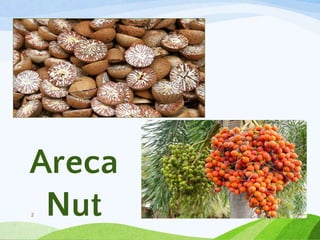
Topic :- Areca Nut
Bachelor of Pharmacy
7th semester
Areca
Nut2
Introduction:
• Areca nut production in India is dominant in the coastal
region within 400 kilometres (250 mi) from the coast
line, and also in some other non-coastal states of India.
• Areca nut (Areca catechu), a tropical crop, is popularly
known as betel nut, as its common usage in the country
is for mastication with betel leaves. It is a palm tree
species under the family of Arecaceae. It has commercial
and economic importance not only in India but also in
China and Southeast Asia.
• Areca nut is derived from the alkaloid Pyridine-
piperidine.
3
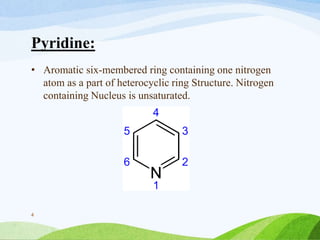
Pyridine:
• Aromatic six-membered ring containing one nitrogen
atom as a part of heterocyclic ring Structure. Nitrogen
containing Nucleus is unsaturated.
4
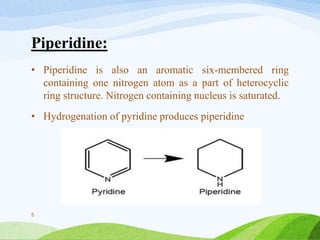
Piperidine:
• Piperidine is also an aromatic six-membered ring
containing one nitrogen atom as a part of heterocyclic
ring structure. Nitrogen containing nucleus is saturated.
• Hydrogenation of pyridine produces piperidine
5
History:
• Areca nut is not a native crop of India. Areca is a Malayan
language word which means "cluster of nuts". It is generally
believed to be native to Malaysia or Philippines where it is
grown in many varieties. It is a tropical crop which grows
from West Indies to the East Coast of Africa, and in
Bangladesh, China, Sri Lanka and Malaya.
• The practice of chewing the areca nuts is attributed to
Vietnam and Malaysia. It was from Southeast Asia that the
crop spread to Asia and India where it is cultivated as a cash
crop. It is conjectured that ancient Indian literature provide
information on betel nut and its mastication. The
Indian Ayurveda texts also refer to the areca nuts as a
traditional medicine.
6
Continue:
• Its use in India is also noted from the pre-vedic period
and was described by the word tambula in ancient Indian
civilization. It is extensively used in Hindu religious rites
of birth, marriage, nuptial and is also offered to guests as
a mark of hospitality. It is offered to gods in veneration
in the form of tambula, which consists of one areca nut
placed over two betel leaves.
7
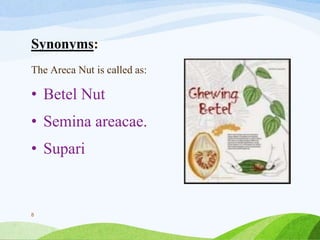
Synonyms:
The Areca Nut is called as:
• Betel Nut
• Semina areacae.
• Supari
8
Biological Source
• The areca nuts are obtained from the seeds of the
plant which is called as Areca Catehcu linn.
• Belonging to Family: Palmaceae
9
Geographical Source
• The tree of the Areca is cultivated in
tropical India, Sri lanka, Malay states,
South China.
• In India the areca tree is cultivated in the
coastal regions of southern Mumbai and
Chennai, Bengal and Assam.
10
Cultivation collection and processing:
• Generally the areca palm is propagated by the use of its
seed.
• The areca palm requires a moist tropical climate for
proper growth. The common problem of the areca palm
is that it is very sensitive towards the drought and hence
it grow properly in the areas receiving heavy rainfall and
having a temperature of about 15 to 38°C.
• The areca palm can be cultivated in plains, hills-slopes
and also in the low lying valleys.
11
12
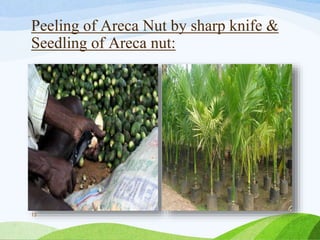
Peeling of Areca Nut by sharp knife &
Seedling of Areca nut:
13
Continue:
• The areca palm is propagated from areca seeds, and
these seeds are generally taken out from those tree
which are of about 20 to 25 years old.
• Each areca tree gives about 100 fruits per year and
these fruits are detached by the help of bamboo
poles. And from these fruits the seeds are
withdrawn.
• Peeling of Areca nut is very difficult by hand.
However it is being done manually by using sharp
knife with a production rate of 3kg/hr.
14
Macroscopic Characters:
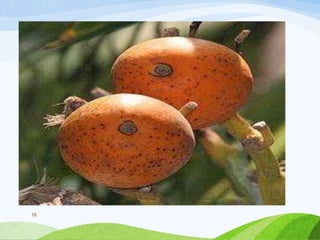
1) Colour: Yellowish to light brown
2) Odour: Odourless
3) Size: Areca nuts are about 2.5cm in length and 2-3 cm
wide at the base.
4) Shape: Blunty rounded, conical in shape
15
16
Microscopic characters:
• The length of the areca is about of 2.5 cm while the
width of the nut is 2-3 cm at the base and the shape of
the areca nut is conical.
• Testa :- The testa of the areca nut is brown in colour and
contain a network of (so many) small depressed lines
• (the color of Testa is brown because of the presence of
tannins).
• The seed of the areca or the areca nut is very hard and
have an astringent and acrid taste while the odour of
areca nut is faint cheese.
17
Chemical constituents:
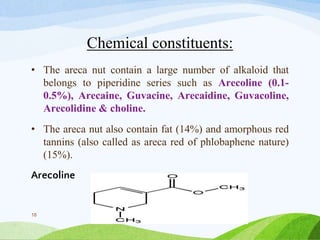
• The areca nut contain a large number of alkaloid that
belongs to piperidine series such as Arecoline (0.1-
0.5%), Arecaine, Guvacine, Arecaidine, Guvacoline,
Arecolidine & choline.
• The areca nut also contain fat (14%) and amorphous red
tannins (also called as areca red of phlobaphene nature)
(15%).
Arecoline
18
Continue:
• The fats mainly consits of :-
• Glycerides of lauric acid.
• Glycerides of myristic acid
• And glycerides of oleic acids.
19
Uses of areca nut:
1. It is used as anthelminitic.
2. As nervine tonic
3. As vermifuge for dogs
20
Disadvantage of Areca Nut:
• Toxicities
Areca nut and the betel leaf have caused DNA damage and
cancer in cells and in animal experiments. There is a dose-
and duration-dependent association of betel quid chewing
with precancerous changes in the mouth as well as mouth,
throat, laryngeal, and esophageal cancer.
• oral submucous fibrosis
• oral cancer
• addiction
• reproductive issues, including low birth weight in newborns
21
Acute toxicity:
• Reports are available that areca nut can cause acute toxic
symptoms if taken in increased quantites, leading to
dyspnea, tachypnea, tachycardia, palpitations,
hypotension, chest tightness, nausea, vomiting, dizziness,
abdominal colic and even myocardial infarction and
coma, but, in the majority of the cases, the effects are
transient and the patients have timely recovery.
22
Substituents and adulterants.
• The nuts from the other plants such as Areca Caliso,
Areca Ipot, Areca laxa etc., are used as substituents for
areca nuts.
• While the potato slices, sago palm nuts are the
adulterants by which the slices of areca nuts are
adulterated.
(adulteration of areca nut increase the fiber content up
to 10% by which it is identified that the sample is
adulterated)
23
Commercial varieties of areca nut:
• Shriwardha
• Hirehalli
• Mangala
• SAS-1
• Sagar
24
Conclusion:
• Areca nut is an addictive substance consumed in many
parts of the world by people of all the age groups. Apart
from being carcinogenic to the oral cavity, pharynx,
esophagus, liver and uterus, it has many diverse effects
on the human body affecting almost all the organs.
• The systemic effects of areca nut are mainly due to the
principle alkaloid arecoline.
• Areca nut causes euphoria, increase in heart rate,
increased blood pressure, GABA inhibition and damage
to neurons, but has no effect on concentration and
memory.
25
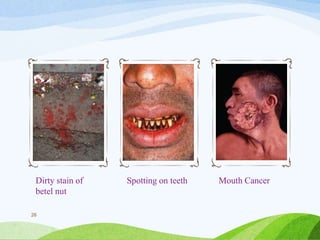
Dirty stain of
betel nut
Spotting on teeth Mouth Cancer
26
Continue..
• Areca nut causes :
• hyperlipidemia,
• vasospasm
• and cardiac arrhythmias leading to an increased risk of
myocardial ischemia.
• Areca nut interferes with the immune system by interfering
with the activation of T-cells and production of cytokines.
• Areca nut chewers are predisposed to asthma as it causes
bronchoconstriction and decreased FEV1.
27
Continue..
• Women who consume areca nut regularly have more
incidences of low birth weight and preterm deliveries.
• Thus, it is evident that areca nut is a harmful and
addictive substance that affects the whole human body,
and its use must be tightly regulated for the welfare of
the society.
28
Thank You

Areca nut ppt by gaurav

  • 1.
    Presenting by :-Gaurav kr. Singh Submitted to:- Rakesh Yadav Sir Topic :- Areca Nut Bachelor of Pharmacy 7th semester
  • 2.
  • 3.
    Introduction: • Areca nutproduction in India is dominant in the coastal region within 400 kilometres (250 mi) from the coast line, and also in some other non-coastal states of India. • Areca nut (Areca catechu), a tropical crop, is popularly known as betel nut, as its common usage in the country is for mastication with betel leaves. It is a palm tree species under the family of Arecaceae. It has commercial and economic importance not only in India but also in China and Southeast Asia. • Areca nut is derived from the alkaloid Pyridine- piperidine. 3
  • 4.
    Pyridine: • Aromatic six-memberedring containing one nitrogen atom as a part of heterocyclic ring Structure. Nitrogen containing Nucleus is unsaturated. 4
  • 5.
    Piperidine: • Piperidine isalso an aromatic six-membered ring containing one nitrogen atom as a part of heterocyclic ring structure. Nitrogen containing nucleus is saturated. • Hydrogenation of pyridine produces piperidine 5
  • 6.
    History: • Areca nutis not a native crop of India. Areca is a Malayan language word which means "cluster of nuts". It is generally believed to be native to Malaysia or Philippines where it is grown in many varieties. It is a tropical crop which grows from West Indies to the East Coast of Africa, and in Bangladesh, China, Sri Lanka and Malaya. • The practice of chewing the areca nuts is attributed to Vietnam and Malaysia. It was from Southeast Asia that the crop spread to Asia and India where it is cultivated as a cash crop. It is conjectured that ancient Indian literature provide information on betel nut and its mastication. The Indian Ayurveda texts also refer to the areca nuts as a traditional medicine. 6
  • 7.
    Continue: • Its usein India is also noted from the pre-vedic period and was described by the word tambula in ancient Indian civilization. It is extensively used in Hindu religious rites of birth, marriage, nuptial and is also offered to guests as a mark of hospitality. It is offered to gods in veneration in the form of tambula, which consists of one areca nut placed over two betel leaves. 7
  • 8.
    Synonyms: The Areca Nutis called as: • Betel Nut • Semina areacae. • Supari 8
  • 9.
    Biological Source • Theareca nuts are obtained from the seeds of the plant which is called as Areca Catehcu linn. • Belonging to Family: Palmaceae 9
  • 10.
    Geographical Source • Thetree of the Areca is cultivated in tropical India, Sri lanka, Malay states, South China. • In India the areca tree is cultivated in the coastal regions of southern Mumbai and Chennai, Bengal and Assam. 10
  • 11.
    Cultivation collection andprocessing: • Generally the areca palm is propagated by the use of its seed. • The areca palm requires a moist tropical climate for proper growth. The common problem of the areca palm is that it is very sensitive towards the drought and hence it grow properly in the areas receiving heavy rainfall and having a temperature of about 15 to 38°C. • The areca palm can be cultivated in plains, hills-slopes and also in the low lying valleys. 11
  • 12.
  • 13.
    Peeling of ArecaNut by sharp knife & Seedling of Areca nut: 13
  • 14.
    Continue: • The arecapalm is propagated from areca seeds, and these seeds are generally taken out from those tree which are of about 20 to 25 years old. • Each areca tree gives about 100 fruits per year and these fruits are detached by the help of bamboo poles. And from these fruits the seeds are withdrawn. • Peeling of Areca nut is very difficult by hand. However it is being done manually by using sharp knife with a production rate of 3kg/hr. 14
  • 15.
    Macroscopic Characters: 1) Colour:Yellowish to light brown 2) Odour: Odourless 3) Size: Areca nuts are about 2.5cm in length and 2-3 cm wide at the base. 4) Shape: Blunty rounded, conical in shape 15
  • 16.
  • 17.
    Microscopic characters: • Thelength of the areca is about of 2.5 cm while the width of the nut is 2-3 cm at the base and the shape of the areca nut is conical. • Testa :- The testa of the areca nut is brown in colour and contain a network of (so many) small depressed lines • (the color of Testa is brown because of the presence of tannins). • The seed of the areca or the areca nut is very hard and have an astringent and acrid taste while the odour of areca nut is faint cheese. 17
  • 18.
    Chemical constituents: • Theareca nut contain a large number of alkaloid that belongs to piperidine series such as Arecoline (0.1- 0.5%), Arecaine, Guvacine, Arecaidine, Guvacoline, Arecolidine & choline. • The areca nut also contain fat (14%) and amorphous red tannins (also called as areca red of phlobaphene nature) (15%). Arecoline 18
  • 19.
    Continue: • The fatsmainly consits of :- • Glycerides of lauric acid. • Glycerides of myristic acid • And glycerides of oleic acids. 19
  • 20.
    Uses of arecanut: 1. It is used as anthelminitic. 2. As nervine tonic 3. As vermifuge for dogs 20
  • 21.
    Disadvantage of ArecaNut: • Toxicities Areca nut and the betel leaf have caused DNA damage and cancer in cells and in animal experiments. There is a dose- and duration-dependent association of betel quid chewing with precancerous changes in the mouth as well as mouth, throat, laryngeal, and esophageal cancer. • oral submucous fibrosis • oral cancer • addiction • reproductive issues, including low birth weight in newborns 21
  • 22.
    Acute toxicity: • Reportsare available that areca nut can cause acute toxic symptoms if taken in increased quantites, leading to dyspnea, tachypnea, tachycardia, palpitations, hypotension, chest tightness, nausea, vomiting, dizziness, abdominal colic and even myocardial infarction and coma, but, in the majority of the cases, the effects are transient and the patients have timely recovery. 22
  • 23.
    Substituents and adulterants. •The nuts from the other plants such as Areca Caliso, Areca Ipot, Areca laxa etc., are used as substituents for areca nuts. • While the potato slices, sago palm nuts are the adulterants by which the slices of areca nuts are adulterated. (adulteration of areca nut increase the fiber content up to 10% by which it is identified that the sample is adulterated) 23
  • 24.
    Commercial varieties ofareca nut: • Shriwardha • Hirehalli • Mangala • SAS-1 • Sagar 24
  • 25.
    Conclusion: • Areca nutis an addictive substance consumed in many parts of the world by people of all the age groups. Apart from being carcinogenic to the oral cavity, pharynx, esophagus, liver and uterus, it has many diverse effects on the human body affecting almost all the organs. • The systemic effects of areca nut are mainly due to the principle alkaloid arecoline. • Areca nut causes euphoria, increase in heart rate, increased blood pressure, GABA inhibition and damage to neurons, but has no effect on concentration and memory. 25
  • 26.
    Dirty stain of betelnut Spotting on teeth Mouth Cancer 26
  • 27.
    Continue.. • Areca nutcauses : • hyperlipidemia, • vasospasm • and cardiac arrhythmias leading to an increased risk of myocardial ischemia. • Areca nut interferes with the immune system by interfering with the activation of T-cells and production of cytokines. • Areca nut chewers are predisposed to asthma as it causes bronchoconstriction and decreased FEV1. 27
  • 28.
    Continue.. • Women whoconsume areca nut regularly have more incidences of low birth weight and preterm deliveries. • Thus, it is evident that areca nut is a harmful and addictive substance that affects the whole human body, and its use must be tightly regulated for the welfare of the society. 28
  • 29.