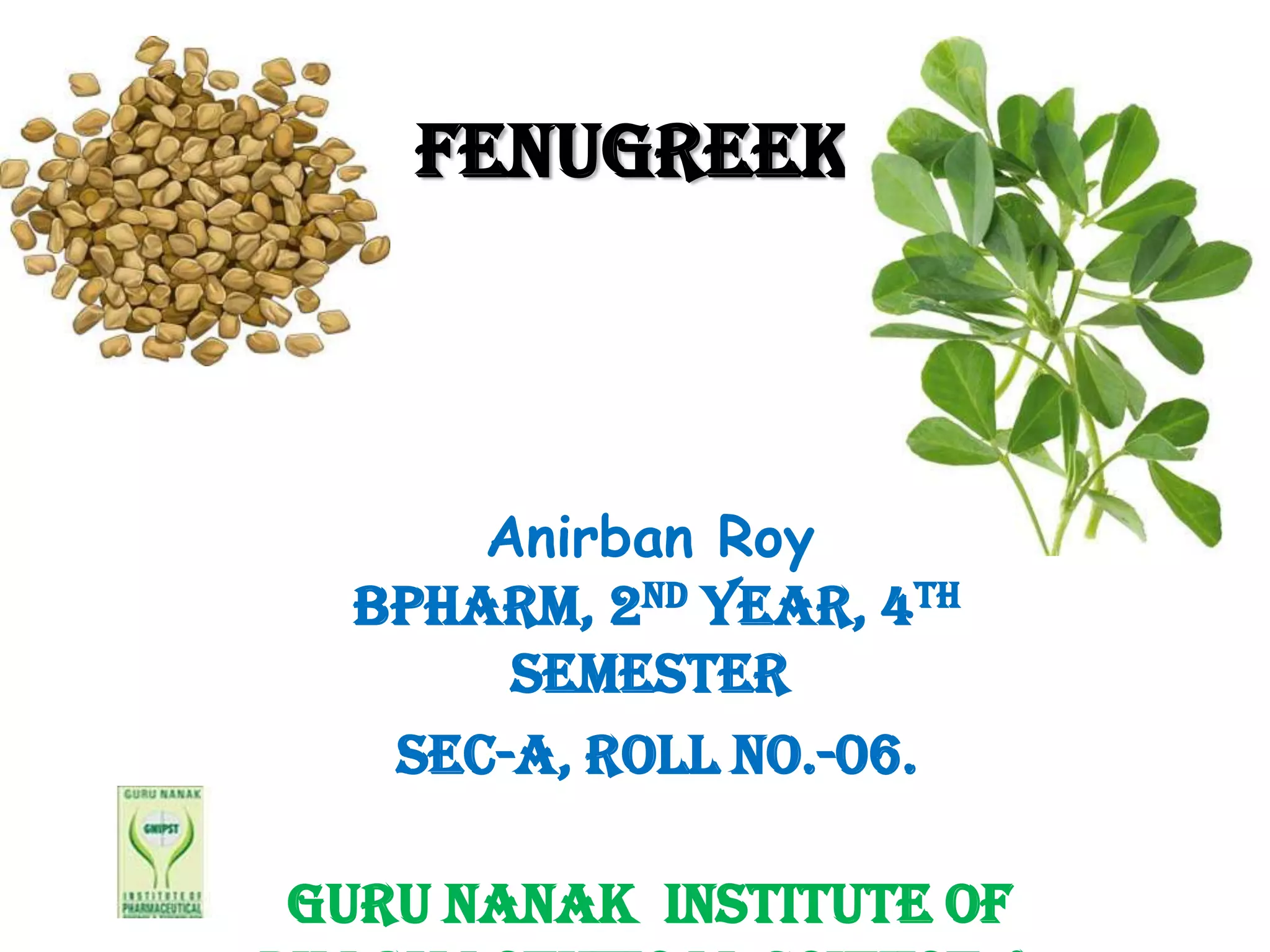
FENUGREEK

Anirban Roy
BPHARM, 2nd Year, 4th
semester
Sec-A, Roll No.-06.

GURU NANAK INSTITUTE OF
CONTENTS
•
•
•
•
•

Pharmacogonistic Profile
Macroscopic characters
Microscopic Characters of Seeds
Chemical Constituents
Pharmacological Profile
PHARMACOGONISTIC PROFILE
•
•
•
•

BOTANICAL NAME
Trigonella foenum graecum
Fabaceae
FAMILY
PLANT PART USED
Seeds as well as the dried leaves
The Latin name for Fenugreek:
Trigonella, means "triangle shaped pale yellow flower", and
"foenum graecum" means "Greek hay".
• HABITAT
Indigenous to the countries on the
eastern shores of the Mediterranean. Cultivated in India,
Africa, Egypt, Morocco, and occasionally in England.
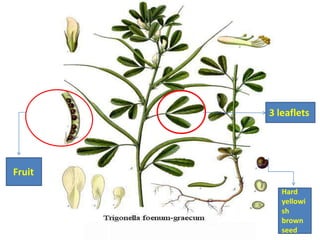
3 leaflets

Fruit
Hard
yellowi
sh
brown
seed
MACROSCOPIC CHARACTERS
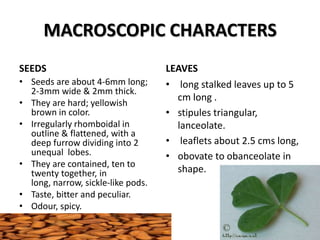
SEEDS
• Seeds are about 4-6mm long;
2-3mm wide & 2mm thick.
• They are hard; yellowish
brown in color.
• Irregularly rhomboidal in
outline & flattened, with a
deep furrow dividing into 2
unequal lobes.
• They are contained, ten to
twenty together, in
long, narrow, sickle-like pods.
• Taste, bitter and peculiar.
• Odour, spicy.

LEAVES
• long stalked leaves up to 5
cm long .
• stipules triangular,
lanceolate.
• leaflets about 2.5 cms long,
• obovate to obanceolate in
shape.
MICROSCOPIC CHARACTERS OF SEEDS
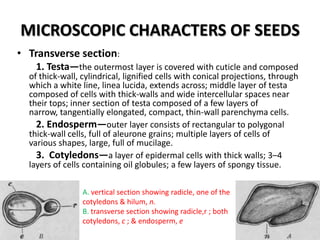
• Transverse section:
1. Testa—the outermost layer is covered with cuticle and composed

of thick-wall, cylindrical, lignified cells with conical projections, through
which a white line, linea lucida, extends across; middle layer of testa
composed of cells with thick-walls and wide intercellular spaces near
their tops; inner section of testa composed of a few layers of
narrow, tangentially elongated, compact, thin-wall parenchyma cells.
2. Endosperm—outer layer consists of rectangular to polygonal
thick-wall cells, full of aleurone grains; multiple layers of cells of
various shapes, large, full of mucilage.
3. Cotyledons—a layer of epidermal cells with thick walls; 3–4
layers of cells containing oil globules; a few layers of spongy tissue.
A. vertical section showing radicle, one of the
cotyledons & hilum, n.
B. transverse section showing radicle,r ; both
cotyledons, c ; & endosperm, e
CHEMICAL CONSTITUENTS
• Amino acids: 4-Hydroxyisoleucine, 4hydroxyisoleucine
lactone, arginine, histidine, and lysine.
• Steroidal saponins: Trigoneoside IIa, Ib;
graecunins H, I, J, K, L, M, N; trigofoenosides
A, D,F, G; protogracillin; protodioscin; and
diosgenin
• Alkaloids: Trigonelline, gentianine, and carpaine
• Flavonoids:
Apigenin, luteolin, orientin, quercetin, vitexin, an
d isovitexin
• Carbohydrates: Mainly mucilage
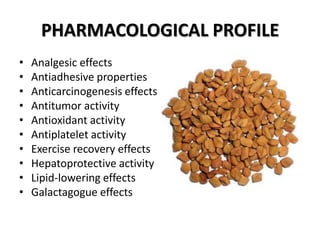
PHARMACOLOGICAL PROFILE
•
•
•
•
•
•
•
•
•
•

Analgesic effects
Antiadhesive properties
Anticarcinogenesis effects
Antitumor activity
Antioxidant activity
Antiplatelet activity
Exercise recovery effects
Hepatoprotective activity
Lipid-lowering effects
Galactagogue effects
REFERENCES
• 1. Kirtikar and Basu; “Indian Medicinal plants” International
Book Distributors, 9/3, Rajpur Road (Ist floor) Dehradun248001, India, Vol. I, Page. No.700-701.
• 2. “The Ayurvedic Pharmacopoeia of India”, Part- I, volume
II, First edition , Govt. of India Ministry of health
Education, Page No. 107-108.
• 3. Prajapati, Purohit, Sharma and Kumar; “A Handbook of
Medicinal Plants- A Complete Source Book”, Published by
Agrobios (India), 2003, Page No.523.
• 4. Rastogi & Mehrotra, B.N.; “Compendium of Indian
Medicinal Plants”, PID, New Delhi, 1990, volume II, Page
No. 422.
THANK YOU

Fenugreek (methi)

  • 1.
    FENUGREEK Anirban Roy BPHARM, 2ndYear, 4th semester Sec-A, Roll No.-06. GURU NANAK INSTITUTE OF
  • 2.
    CONTENTS • • • • • Pharmacogonistic Profile Macroscopic characters MicroscopicCharacters of Seeds Chemical Constituents Pharmacological Profile
  • 3.
    PHARMACOGONISTIC PROFILE • • • • BOTANICAL NAME Trigonellafoenum graecum Fabaceae FAMILY PLANT PART USED Seeds as well as the dried leaves The Latin name for Fenugreek: Trigonella, means "triangle shaped pale yellow flower", and "foenum graecum" means "Greek hay". • HABITAT Indigenous to the countries on the eastern shores of the Mediterranean. Cultivated in India, Africa, Egypt, Morocco, and occasionally in England.
  • 4.
  • 5.
    MACROSCOPIC CHARACTERS SEEDS • Seedsare about 4-6mm long; 2-3mm wide & 2mm thick. • They are hard; yellowish brown in color. • Irregularly rhomboidal in outline & flattened, with a deep furrow dividing into 2 unequal lobes. • They are contained, ten to twenty together, in long, narrow, sickle-like pods. • Taste, bitter and peculiar. • Odour, spicy. LEAVES • long stalked leaves up to 5 cm long . • stipules triangular, lanceolate. • leaflets about 2.5 cms long, • obovate to obanceolate in shape.
  • 6.
    MICROSCOPIC CHARACTERS OFSEEDS • Transverse section: 1. Testa—the outermost layer is covered with cuticle and composed of thick-wall, cylindrical, lignified cells with conical projections, through which a white line, linea lucida, extends across; middle layer of testa composed of cells with thick-walls and wide intercellular spaces near their tops; inner section of testa composed of a few layers of narrow, tangentially elongated, compact, thin-wall parenchyma cells. 2. Endosperm—outer layer consists of rectangular to polygonal thick-wall cells, full of aleurone grains; multiple layers of cells of various shapes, large, full of mucilage. 3. Cotyledons—a layer of epidermal cells with thick walls; 3–4 layers of cells containing oil globules; a few layers of spongy tissue. A. vertical section showing radicle, one of the cotyledons & hilum, n. B. transverse section showing radicle,r ; both cotyledons, c ; & endosperm, e
  • 7.
    CHEMICAL CONSTITUENTS • Aminoacids: 4-Hydroxyisoleucine, 4hydroxyisoleucine lactone, arginine, histidine, and lysine. • Steroidal saponins: Trigoneoside IIa, Ib; graecunins H, I, J, K, L, M, N; trigofoenosides A, D,F, G; protogracillin; protodioscin; and diosgenin • Alkaloids: Trigonelline, gentianine, and carpaine • Flavonoids: Apigenin, luteolin, orientin, quercetin, vitexin, an d isovitexin • Carbohydrates: Mainly mucilage
  • 8.
    PHARMACOLOGICAL PROFILE • • • • • • • • • • Analgesic effects Antiadhesiveproperties Anticarcinogenesis effects Antitumor activity Antioxidant activity Antiplatelet activity Exercise recovery effects Hepatoprotective activity Lipid-lowering effects Galactagogue effects
  • 9.
    REFERENCES • 1. Kirtikarand Basu; “Indian Medicinal plants” International Book Distributors, 9/3, Rajpur Road (Ist floor) Dehradun248001, India, Vol. I, Page. No.700-701. • 2. “The Ayurvedic Pharmacopoeia of India”, Part- I, volume II, First edition , Govt. of India Ministry of health Education, Page No. 107-108. • 3. Prajapati, Purohit, Sharma and Kumar; “A Handbook of Medicinal Plants- A Complete Source Book”, Published by Agrobios (India), 2003, Page No.523. • 4. Rastogi & Mehrotra, B.N.; “Compendium of Indian Medicinal Plants”, PID, New Delhi, 1990, volume II, Page No. 422.
  • 10.