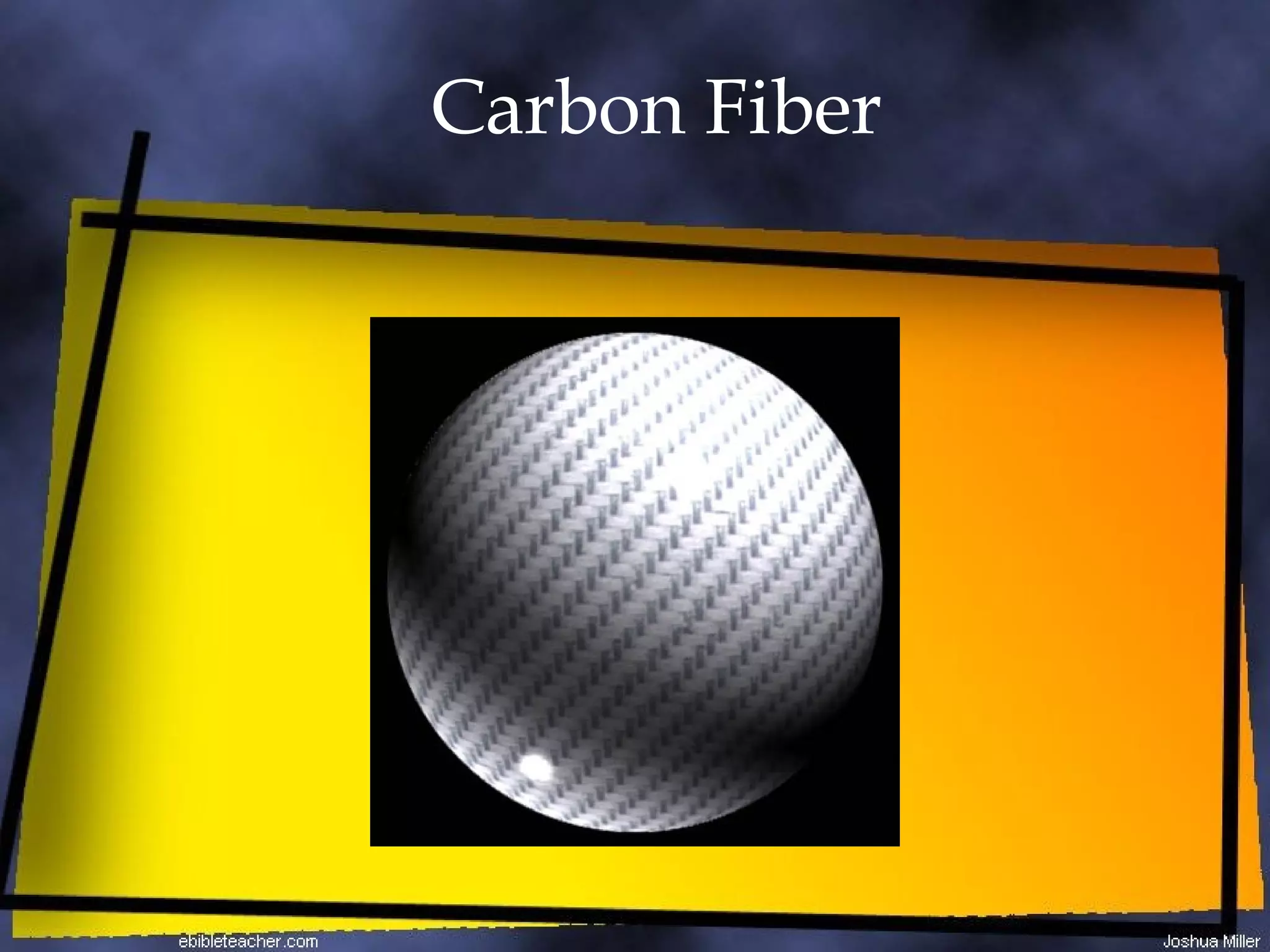
Carbon Fiber
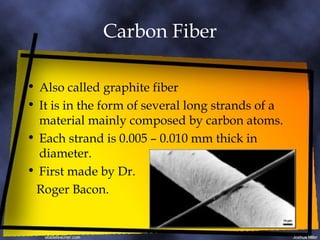
Carbon Fiber Also called graphite fiber It is in the form of several long strands of a material mainly composed by carbon atoms. Each strand is 0.005 – 0.010 mm thick in diameter. First made by Dr. Roger Bacon.
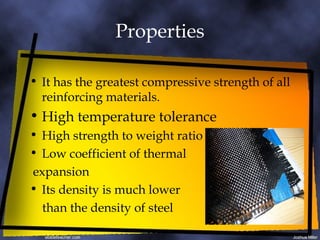
Properties It has the greatest compressive strength of all reinforcing materials. High temperature tolerance High strength to weight ratio Low coefficient of thermal expansion Its density is much lower  than the density of steel
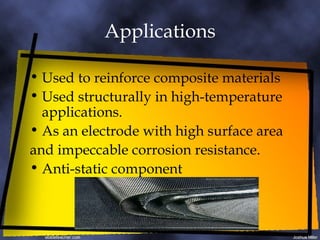
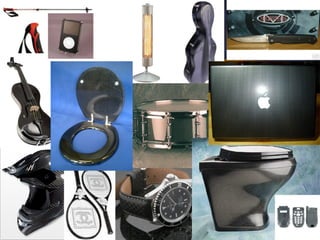
Applications Used to reinforce composite materials Used structurally in high-temperature applications. As an electrode with high surface area  and impeccable corrosion resistance. Anti-static component
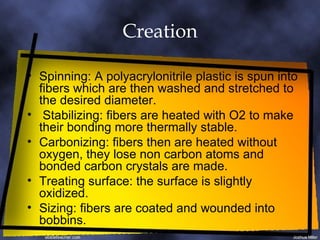
Creation Spinning: A polyacrylonitrile plastic is spun into fibers which are then washed and stretched to the desired diameter. Stabilizing: fibers are heated with O2 to make their bonding more thermally stable. Carbonizing: fibers then are heated without oxygen, they lose non carbon atoms and bonded carbon crystals are made. Treating surface: the surface is slightly oxidized. Sizing: fibers are coated and wounded into bobbins.
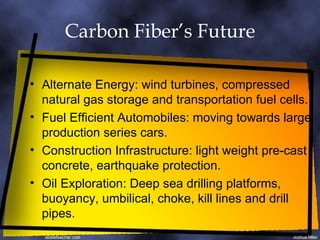
Carbon Fiber’s Future Alternate Energy: wind turbines, compressed natural gas storage and transportation fuel cells. Fuel Efficient Automobiles: moving towards large production series cars. Construction Infrastructure: light weight pre-cast concrete, earthquake protection. Oil Exploration: Deep sea drilling platforms, buoyancy, umbilical, choke, kill lines and drill pipes.
 

Carbon fiber

  • 1.
  • 2.
    Carbon Fiber Alsocalled graphite fiber It is in the form of several long strands of a material mainly composed by carbon atoms. Each strand is 0.005 – 0.010 mm thick in diameter. First made by Dr. Roger Bacon.
  • 3.
    Properties It hasthe greatest compressive strength of all reinforcing materials. High temperature tolerance High strength to weight ratio Low coefficient of thermal expansion Its density is much lower than the density of steel
  • 4.
    Applications Used toreinforce composite materials Used structurally in high-temperature applications. As an electrode with high surface area and impeccable corrosion resistance. Anti-static component
  • 5.
    Creation Spinning: Apolyacrylonitrile plastic is spun into fibers which are then washed and stretched to the desired diameter. Stabilizing: fibers are heated with O2 to make their bonding more thermally stable. Carbonizing: fibers then are heated without oxygen, they lose non carbon atoms and bonded carbon crystals are made. Treating surface: the surface is slightly oxidized. Sizing: fibers are coated and wounded into bobbins.
  • 6.
    Carbon Fiber’s FutureAlternate Energy: wind turbines, compressed natural gas storage and transportation fuel cells. Fuel Efficient Automobiles: moving towards large production series cars. Construction Infrastructure: light weight pre-cast concrete, earthquake protection. Oil Exploration: Deep sea drilling platforms, buoyancy, umbilical, choke, kill lines and drill pipes.
  • 7.