Government engineering college – bhavnagar (021)
Vala vivek Suva ramesh
(150210119123) (150210119123)
And
(2131904)
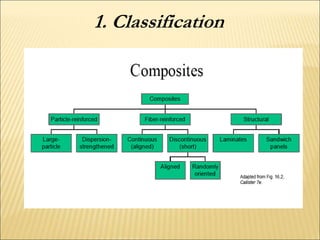
1. Classification
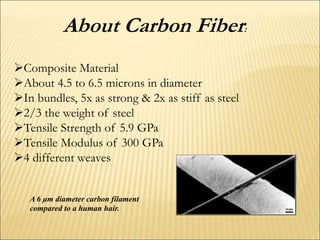
A 6 μm diameter carbon filament
compared to a human hair.
Composite Material
About 4.5 to 6.5 microns in diameter
In bundles, 5x as strong & 2x as stiff as steel
2/3 the weight of steel
Tensile Strength of 5.9 GPa
Tensile Modulus of 300 GPa
4 different weaves
About Carbon Fiber:
History of Carbon Fiber
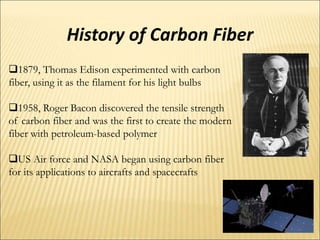
1879, Thomas Edison experimented with carbon
fiber, using it as the filament for his light bulbs
1958, Roger Bacon discovered the tensile strength
of carbon fiber and was the first to create the modern
fiber with petroleum-based polymer
US Air force and NASA began using carbon fiber
for its applications to aircrafts and spacecrafts
Properties of CF
C fibers are close to asbestos in a number of properties
C fibers are made from many filaments a filament is a thin tube with a
diameter of 5–8 micrometers and consists almost exclusively of carbon
The atomic structure of carbon fiber is similar to that of graphite
carbon fiber may be turbostratic or graphitic, or have a hybrid
structure
carbon fibers derived from mesophase pitch are graphitic after heat
treatment at temperatures exceeding 2200 C
Turbostratic carbon fibers tend to have high tensile strength, whereas
heat-treated mesophase-pitch-derived carbon fibers have high Young's
modulus and high thermal conductivity.
Tensile strength (820,000 psi).
Modulus of elasticity (77,000,000 psi).
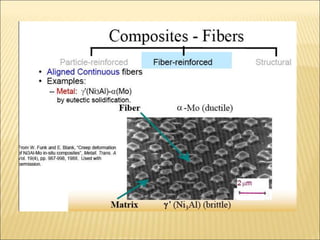
 Fiber materials in fiber-reinforced
composites:
 Glass – most widely used filament
 Carbon – high elastic modulus
 Boron – very high elastic modulus
 Polymers - Kevlar
 Ceramics – SiC and Al2O3
 Metals - steel
 The most important commercial use of
fibers is in polymer composites
 High strength
 High stiffness
 Withstand temperatures to >2500oC
 High strength/weight ratio
 Tensile moduli range from 4x10⁶ psi to 100x106 psi
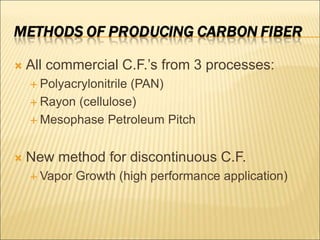
 All commercial C.F.’s from 3 processes:
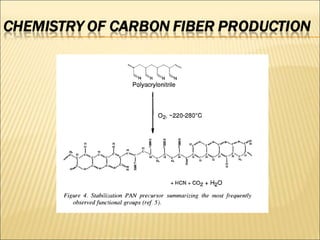
 Polyacrylonitrile (PAN)
 Rayon (cellulose)
 Mesophase Petroleum Pitch
 New method for discontinuous C.F.
 Vapor Growth (high performance application)
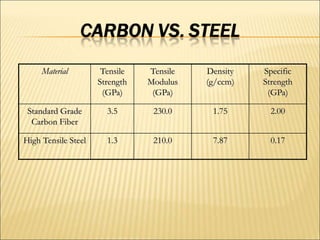
Material Tensile
Strength
(GPa)
Tensile
Modulus
(GPa)
Density
(g/ccm)
Specific
Strength
(GPa)
Standard Grade
Carbon Fiber
3.5 230.0 1.75 2.00
High Tensile Steel 1.3 210.0 7.87 0.17
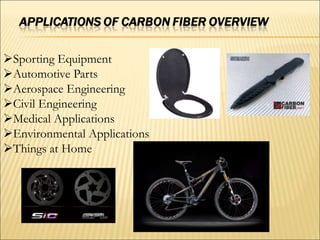
Sporting Equipment
Automotive Parts
Aerospace Engineering
Civil Engineering
Medical Applications
Environmental Applications
Things at Home
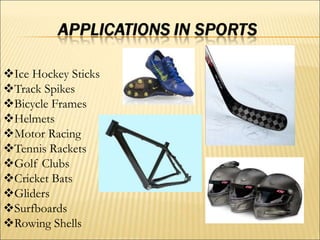
Ice Hockey Sticks
Track Spikes
Bicycle Frames
Helmets
Motor Racing
Tennis Rackets
Golf Clubs
Cricket Bats
Gliders
Surfboards
Rowing Shells
Racing car chassis
Hoods
Car emblems
Mufflers
Interior panels of a car
Steering wheels
Parts and parts and
more parts
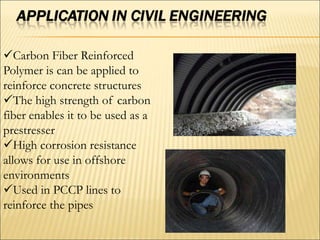
Carbon Fiber Reinforced
Polymer is can be applied to
reinforce concrete structures
The high strength of carbon
fiber enables it to be used as a
prestresser
High corrosion resistance
allows for use in offshore
environments
Used in PCCP lines to
reinforce the pipes
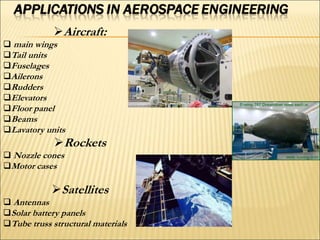
Aircraft:
 main wings
Tail units
Fuselages
Ailerons
Rudders
Elevators
Floor panel
Beams
Lavatory units
Rockets
 Nozzle cones
Motor cases
Satellites
 Antennas
Solar battery panels
Tube truss structural materials
Radiographic imaging
table tops, cradles, couches,
and pallet
Table top extensions &
accessories
Oncology treatment
overlays
Positioning products
Surgical table
components
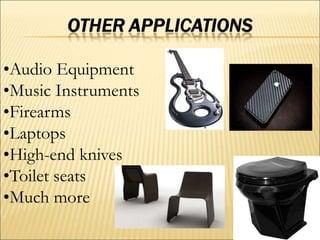
•Audio Equipment
•Music Instruments
•Firearms
•Laptops
•High-end knives
•Toilet seats
•Much more
CF in different aspects of
Engineering
 Aerospace Engineering
 Mechanical Engineering
 Civil Engineering
Reinforcing steel, cast iron, timber, and concrete to make
them stronger instead of retrofitting or destroying old
structures.
Wrapping it around columns will make the structure more
stronger with its tensile strengths. The less likely to collapse
because of the carbon fiber tightly holds the columns in
place.
Cost
From Tap Plastics
Epoxy : $25.95 for one pint
Carbon Fiber: $45/yard^2
Dragon plate online: 1/32” x 6” x 18”- $44.25
USD
Reasons for being so expensive
Not mass produced
Not enough demand
Every part needs to be customized
Where to buy it ?
Store in Santa Rosa
Tap Plastics on Santa Rosa Ave
•Online: Google carbon fiber
Safety Issues
Small pieces of carbon fibers can circulate in the air in the form
of a fine dust.
Industrial health studies have shown that, unlike some asbestos
fibers, carbon fibers are too large to be a health hazard when
inhaled.
They can be an irritant, however, and people working in the
area should wear protective masks.
Recycling
Milled Carbon was established in 2003 and Based in the U.K.
developed a system using pyrolysis, a method of incineration
that chemically decomposes materials by heating them in a near
oxygen-free atmosphere
In Milled Carbon’s process, incineration burns off all the resin
and additives, freeing the fiber reinforcement making it possible
to recover materials in substantially the same condition
the reclaimed carbon fibers are 99.9 percent pure
single fiber tests were conducted to compare virgin carbon-
fiber fabric with reclaimed fibers. Results indicate average
reduction in tensile strength of only 8.6 percent
carbon fiber
carbon fiber

carbon fiber

  • 1.
    Government engineering college– bhavnagar (021) Vala vivek Suva ramesh (150210119123) (150210119123) And (2131904)
  • 2.
  • 3.
    A 6 μmdiameter carbon filament compared to a human hair. Composite Material About 4.5 to 6.5 microns in diameter In bundles, 5x as strong & 2x as stiff as steel 2/3 the weight of steel Tensile Strength of 5.9 GPa Tensile Modulus of 300 GPa 4 different weaves About Carbon Fiber:
  • 4.
    History of CarbonFiber 1879, Thomas Edison experimented with carbon fiber, using it as the filament for his light bulbs 1958, Roger Bacon discovered the tensile strength of carbon fiber and was the first to create the modern fiber with petroleum-based polymer US Air force and NASA began using carbon fiber for its applications to aircrafts and spacecrafts
  • 5.
    Properties of CF Cfibers are close to asbestos in a number of properties C fibers are made from many filaments a filament is a thin tube with a diameter of 5–8 micrometers and consists almost exclusively of carbon The atomic structure of carbon fiber is similar to that of graphite carbon fiber may be turbostratic or graphitic, or have a hybrid structure carbon fibers derived from mesophase pitch are graphitic after heat treatment at temperatures exceeding 2200 C Turbostratic carbon fibers tend to have high tensile strength, whereas heat-treated mesophase-pitch-derived carbon fibers have high Young's modulus and high thermal conductivity. Tensile strength (820,000 psi). Modulus of elasticity (77,000,000 psi).
  • 6.
     Fiber materialsin fiber-reinforced composites:  Glass – most widely used filament  Carbon – high elastic modulus  Boron – very high elastic modulus  Polymers - Kevlar  Ceramics – SiC and Al2O3  Metals - steel  The most important commercial use of fibers is in polymer composites
  • 7.
     High strength High stiffness  Withstand temperatures to >2500oC  High strength/weight ratio  Tensile moduli range from 4x10⁶ psi to 100x106 psi
  • 9.
     All commercialC.F.’s from 3 processes:  Polyacrylonitrile (PAN)  Rayon (cellulose)  Mesophase Petroleum Pitch  New method for discontinuous C.F.  Vapor Growth (high performance application)
  • 12.
  • 13.
    Sporting Equipment Automotive Parts AerospaceEngineering Civil Engineering Medical Applications Environmental Applications Things at Home
  • 14.
    Ice Hockey Sticks TrackSpikes Bicycle Frames Helmets Motor Racing Tennis Rackets Golf Clubs Cricket Bats Gliders Surfboards Rowing Shells
  • 15.
    Racing car chassis Hoods Caremblems Mufflers Interior panels of a car Steering wheels Parts and parts and more parts
  • 16.
    Carbon Fiber Reinforced Polymeris can be applied to reinforce concrete structures The high strength of carbon fiber enables it to be used as a prestresser High corrosion resistance allows for use in offshore environments Used in PCCP lines to reinforce the pipes
  • 17.
    Aircraft:  main wings Tailunits Fuselages Ailerons Rudders Elevators Floor panel Beams Lavatory units Rockets  Nozzle cones Motor cases Satellites  Antennas Solar battery panels Tube truss structural materials
  • 18.
    Radiographic imaging table tops,cradles, couches, and pallet Table top extensions & accessories Oncology treatment overlays Positioning products Surgical table components
  • 19.
  • 20.
    CF in differentaspects of Engineering  Aerospace Engineering  Mechanical Engineering  Civil Engineering Reinforcing steel, cast iron, timber, and concrete to make them stronger instead of retrofitting or destroying old structures. Wrapping it around columns will make the structure more stronger with its tensile strengths. The less likely to collapse because of the carbon fiber tightly holds the columns in place.
  • 21.
    Cost From Tap Plastics Epoxy: $25.95 for one pint Carbon Fiber: $45/yard^2 Dragon plate online: 1/32” x 6” x 18”- $44.25 USD Reasons for being so expensive Not mass produced Not enough demand Every part needs to be customized
  • 22.
    Where to buyit ? Store in Santa Rosa Tap Plastics on Santa Rosa Ave •Online: Google carbon fiber
  • 23.
    Safety Issues Small piecesof carbon fibers can circulate in the air in the form of a fine dust. Industrial health studies have shown that, unlike some asbestos fibers, carbon fibers are too large to be a health hazard when inhaled. They can be an irritant, however, and people working in the area should wear protective masks.
  • 24.
    Recycling Milled Carbon wasestablished in 2003 and Based in the U.K. developed a system using pyrolysis, a method of incineration that chemically decomposes materials by heating them in a near oxygen-free atmosphere In Milled Carbon’s process, incineration burns off all the resin and additives, freeing the fiber reinforcement making it possible to recover materials in substantially the same condition the reclaimed carbon fibers are 99.9 percent pure single fiber tests were conducted to compare virgin carbon- fiber fabric with reclaimed fibers. Results indicate average reduction in tensile strength of only 8.6 percent