1
CLASS 10 SCIENCE
CARBON
AND
ITS COMPOUNDS
[ CHAPTER:1]
2
Q. What is covalent bond?
A. The chemical bond formed by sharing of electrons between two
atoms is known as covalent bond.
Q. Why does carbon form only covalent bond?
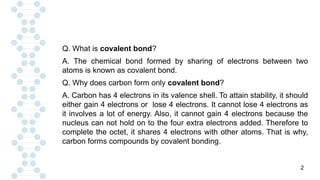
A. Carbon has 4 electrons in its valence shell. To attain stability, it should
either gain 4 electrons or lose 4 electrons. It cannot lose 4 electrons as
it involves a lot of energy. Also, it cannot gain 4 electrons because the
nucleus can not hold on to the four extra electrons added. Therefore to
complete the octet, it shares 4 electrons with other atoms. That is why,
carbon forms compounds by covalent bonding.
3
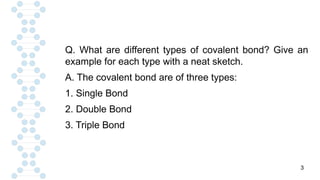
Q. What are different types of covalent bond? Give an
example for each type with a neat sketch.
A. The covalent bond are of three types:
1. Single Bond
2. Double Bond
3. Triple Bond
4
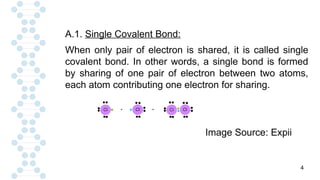
A.1. Single Covalent Bond:
When only pair of electron is shared, it is called single
covalent bond. In other words, a single bond is formed
by sharing of one pair of electron between two atoms,
each atom contributing one electron for sharing.
Image Source: Expii
5
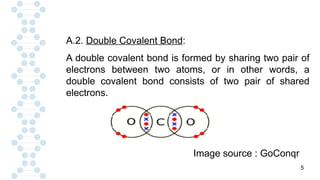
A.2. Double Covalent Bond:
A double covalent bond is formed by sharing two pair of
electrons between two atoms, or in other words, a
double covalent bond consists of two pair of shared
electrons.
Image source : GoConqr
6
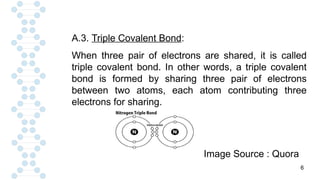
A.3. Triple Covalent Bond:
When three pair of electrons are shared, it is called
triple covalent bond. In other words, a triple covalent
bond is formed by sharing three pair of electrons
between two atoms, each atom contributing three
electrons for sharing.
Image Source : Quora
7
Q. What are homoatomic and heteroatomic
molecules?
A. If the atoms participating in the covalent bond
formation are the same, then the molecules are
called homoatomic molecules.
If the atoms participating in the covalent bond
formation are different, then the molecules are
called heteroatomic molecules.
8
Q. Diagrammatically represent the formation of hydrogen
molecules.
A. Each molecule of hydrogen contains two atoms of hydrogen.
The atomic number of hydrogen is 1, so it’s electronic
configuration is 1. It has seen that it has 1 electron in it’s
outermost shell and thus it needs only one electron to complete
its octet to nearest helium gas configuration. It gets one electron
by sharing its electron with another hydrogen atom. Hence, two
hydrogen atoms share one electron each to form hydrogen
molecule. Thus, two hydrogen atoms share one pair of electron,
to form hydrogen molecule.
9
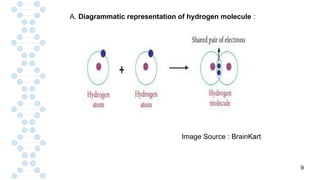
A. Diagrammatic representation of hydrogen molecule :
Image Source : BrainKart
10
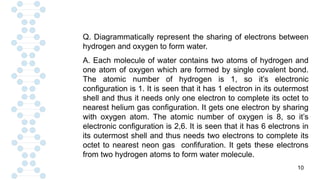
Q. Diagrammatically represent the sharing of electrons between
hydrogen and oxygen to form water.
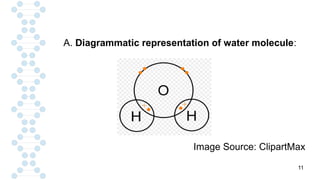
A. Each molecule of water contains two atoms of hydrogen and
one atom of oxygen which are formed by single covalent bond.
The atomic number of hydrogen is 1, so it’s electronic
configuration is 1. It is seen that it has 1 electron in its outermost
shell and thus it needs only one electron to complete its octet to
nearest helium gas configuration. It gets one electron by sharing
with oxygen atom. The atomic number of oxygen is 8, so it’s
electronic configuration is 2,6. It is seen that it has 6 electrons in
its outermost shell and thus needs two electrons to complete its
octet to nearest neon gas confifuration. It gets these electrons
from two hydrogen atoms to form water molecule.
11
A. Diagrammatic representation of water molecule:
Image Source: ClipartMax
12
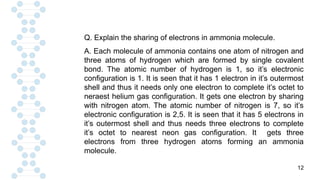
Q. Explain the sharing of electrons in ammonia molecule.
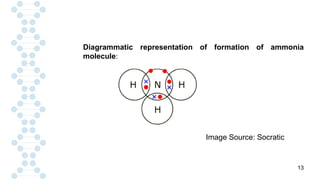
A. Each molecule of ammonia contains one atom of nitrogen and
three atoms of hydrogen which are formed by single covalent
bond. The atomic number of hydrogen is 1, so it’s electronic
configuration is 1. It is seen that it has 1 electron in it’s outermost
shell and thus it needs only one electron to complete it’s octet to
neraest helium gas configuration. It gets one electron by sharing
with nitrogen atom. The atomic number of nitrogen is 7, so it’s
electronic configuration is 2,5. It is seen that it has 5 electrons in
it’s outermost shell and thus needs three electrons to complete
it’s octet to nearest neon gas configuration. It gets three
electrons from three hydrogen atoms forming an ammonia
molecule.
13
Diagrammatic representation of formation of ammonia
molecule:
Image Source: Socratic
14
Q. How would you test the presence of carbon in a
substance?
A. To test the presence of carbon in a substance, we
need to burn the substance in air. If it produces a
colourless and odourless gas which turns the lime
water milky, the gas so obtained is known as carbon
dioxide and the substance is said to be made up of
carbon.
15
Q. Define covalency.
A. Covalency of an element may be defined as “the
number of electrons which an element shares with other
atoms in the formation of covalent molecule.”
Q. Why is carbon tetravalent in nature?
A. Electronic configuration of carbon is 2,4. So, it requires
four more electrons to attain the stable electronic
configuration. Carbon gets these four electrons by mutual
sharing. Therefore carbon atoms form four covalent
bonds. In other words, carbon is tetravalent.
16
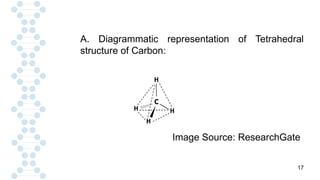
Q. Represent a tetrahedral structure of carbon with
neat sketch and give the bond angle.
A. The four valencies of carbon do not lie in a plane,
but are directed towards the four corners of a
regular tetrahedron. This shows that carbon is
tetrahedral. The angle between two adjacent
valencies is 1090
28’
.
17
A. Diagrammatic representation of Tetrahedral
structure of Carbon:
Image Source: ResearchGate
18
Q. Give examples in which carbon occurs in free state.
A. Free state occurrence of carbon:
1. Diamond, 2.Graphite, 3.Buckminster Fullerene.
Q. How does carbon occur in combined state?
A. Carbon occurs in combined state in the following form:
1.Carbon dioxide gas, 2.Carbonates such as chalk, limestone,
marble etc., 3.Fossil fuels such as coal, natural gas and
petroleum.
19
Q. Define catenation. What is the result of this property?
A. The existence of number of organic compounds is due
to the self-linking of carbon atoms which makes it
versatile in nature. The process of self-linking is called
catenation.
C – C – C – C – C
[Self-linking of carbon atoms]
As a result, the catenation property of carbon makes it
versatile in nature.The catenation results in the formation
of long chains of carbon atoms which may be branched
or straight in nature.
20
Q. Define allotropy.
A. The phenomenon of existence of element in two or more
forms having same chemical properties but different
physical properties is defined as allotropy. The different
forms are called allotrope.
Q. What are the allotropes of carbon?
A. The allotropes of carbon are:
1. Diamond
2. Graphite
3. Buckminster fullerene
21
Q. What is common among all allotropes of carbon?
A. All the three allotropes of carbon are the purest
forms of carbon and all possess same chemical
properties. For example, when all the allotropes of
carbon are burnt in air, a colourless and odourless
carbon dioxide gas is produced. But the physical
properties of these three allotropes are different due to
the different arrangement of carbon atoms in them.
22
Q. Comment: “Diamonds are used in cutting marbles
and granites.”
A. Diamond is one of the hardest substance which
occurs naturally. The atoms in diamond are organised
in a rigid three-dimensional structure and are tightly
bonded to each other. The absence of large empty
spaces in the diamond structure makes it an
extremely hard substance which compels to use in
marbles and granites.
23
Q. Explain the structure of diamond.
A. Diamond is a giant molecule of carbon atoms. In the
structure of diamond, each carbon atom is found to be
attached to four other carbon atoms by single strong covalent
bond of 1.54A0
long. The surrounding four carbon atoms lie at
the four corners of a regular tetrahedron. The angle formed
between two adjacent carbon atoms is 1090
28/
,which is the
tetrahedral angle. Due to this tetrahedral arrangement of
carbon atoms, diamond shows a rigid three dimensional
network structure. Thus, it is obvious that diamond consists of
only carbon atoms.
24
Q. Why diamond has high density?
A. Due to the three-dimensional network of carbon atoms in
diamond, the carbon atoms are closely packed and hence it has
high density of about 3.51gm/cm3
.
Q. Why diamond is a good conductor of heat?
A. In the structure of diamond, each carbon atom is bonded to
four other carbon atoms, forming rigid three-dimensional
structure. Carbon atoms are very closely packed in diamond due
to the presence of strong covalent bonds. We know that
conduction of heat requires the vibration of the atom which
passes from one atom to the other. Since in diamond, the motion
of the atoms are strongly coupled, it can effectively conduct heat.
25
Q. Justify:“Diamonds are used in making jewellery”?
A. Diamond is used in making jewellery because it has a
sparkling surface due to high refractive index. Besides this,
diamond is durable, and can be cut and polished as well.
Q. Give any three uses of diamond.
A. Uses of diamond are as follows:
1. Used in ornaments.
2. Used in glass cutting and rock drilling machines.
3. Diamond knives are used in eye surgery.
26
Q. Why diamond does not conduct electricity?
A. In a diamond crystal, each carbon atom is linked to four
other carbon atoms by single covalent bonds and there are
no free electrons. Thus, it does not conduct electricity.
Q. Why diamond has a high melting point?
A. Since large amount of energy is required to break the
three-dimensional network structures of diamond, it is said
to have high melting point of about 39300
C OR 4230K.
27
Q. Explain the structure of graphite.
A. Graphite is a sheet or layer of carbon atoms. In the
structure of graphite, each of carbon atoms is bonded with
three other carbon atoms in the same plane to form
hexagonal rings. Each hexagonal ring has has three
alternate single and double bonds to satisfy the fourth
valency of carbon. Thus, graphite has two-dimensional
sheets like structure consisting of number of rings fused
together. These sheets or layers are held together by weak
Vander Waals forces of attraction. The distance between
two successive layers is 340pm.
28
Q. Why does graphite possess low density?
A. Graphite is a sheet or layer of carbon atoms. These
sheet or layers are held together by weak Vander
Waals forces of attraction. The distance between two
successive layers is 340pm. Due to wide spacing
between the two layers, the carbon atoms in graphite
are less closely packed and hence the density of
graphite is low, varying from 2.0 to 2.25 gm/cm3
.
29
Q. Why graphite is soft?
A. The various layers of carbon atoms in graphite are held
together by weak Vander Waals forces of attraction. Therefore,
one layer can easily slide over the other making graphite soft.
Q. Why graphite is used as a lubricant?
A. Due to its softness, powdered graphite is used either as a
solid, dry lubricant or mixed with petroleum jelly as graphite
grease. Since graphite is non-volatile, it can also be used as a
lubricant for heavy machinery, operating at very high
temperature.
30
Q. Why graphite is used for making electrodes in dry
cells?
A. Carbon has four valence electrons. But in a graphite
crystal, each carbon atom is joined to three other carbon
atoms by covalent bonds to form hexagonal rings. Thus,
only three valence electrons are used for bond formation
and hence the fourth valence electron is free to move. As
a result, graphite is a good conductor of heat and
electricity. Hence, due to it’s capacity to conduct electricity,
graphite is used for making electrodes in dry cells.
31
Q. What do you understand by the term fullerene?
A. A fullerene is an allotrope of carbon whose molecule
consists of carbon atoms connected by single and
double bonds so as to form a closed or partially closed
mesh, with fused rings of five to seven atoms. The
molecule may be a hollow sphere, ellipsoid, tube, or
many other shapes and sizes. Fullerenes with a closed
mesh technology are informally denoted by their
empirical formula Cn, where n is the number of carbon
atoms.
32
Q. Why is the allotrope of fullerene called Buckminster fullerene?
A. The structure of C60 fullerene was discovered by an architect
Buckminster and so this allotrope was called Buckminster
fullerene.
Q. Give any three uses of fullerene.
A. Three uses of fullerene are as follows:
1. Used as catalyst in petrochemical refining in industry.
2. Due it’s ability to trap different atoms, it is used in the field of
medicine.
3. It helps in improving anti-friction properties of lubricating oils.
33
Q. Explain the structure of bucky ball.
A. The 60 carbon atoms in C60 fullerene are
arranged in the shape of a football or a soccer ball.
Therefore, it is also called bucky ball. It contains 20
six-membered rings and 12 five-membered rings. In
other words, the 60 carbon atoms are arranged in
interlocking hexagonal and pentagonal rings of
carbon atoms.
34
Q. Differentiate between diamond and graphite based
on their structure, nature, density, conduction and
melting point.
A.1.Structure:
Diamonds have a strong three-dimensional network
structure.
Graphite have a two-dimensional sheet-like structure.
35
2.Nature:
Diamonds are hard in nature.
Graphites are soft in nature.
3.Density:
Diamond molecules are closely packed, as a result, they have
high density.
There is a large gap between graphite molecules. Therefore,
they have low density.
36
4.Conduction:
There is no free carbon atoms in diamond, therefore diamonds do
not conduct electricity.
There is presence of no free carbon atoms in graphite, hence
graphite conducts electricity.
5.Melting point:
In diamond each carbon atom is linked to four other carbon atoms
by covalent bond. Since large amount of energy is required to
break the three of-dimensional network structures, diamond is said
to have high melting point of about 39300
C OR 4203K.
37
5. Graphite is a sheet or layer of carbon atoms,
which are held together by weak Vander Walls
forces of attraction, which is relatively weak in
comparison to covalent bond. Hence, graphite has
a lower melting point(about 1800K) compared to
diamond.
38
Q. What is meant by hydrocarbon?
A. Hydrocarbons are the compounds that contain
hydrogen and carbon and their derivatives(alcohols,
aldehydes etc.).
Q. Name the most important natural source of
hydrocarbons.
A. The most important natural source of hydrocarbons
is petroleum.
39
Q. Classify organic compounds.
A. Based on the types of chains formed during self-
linkage of carbon atoms, organic compounds are
classified into:
1. Open chain compounds(acyclic)
2. Closed chain compounds(cyclic)
40
Q. What are acyclic compounds?
A. Acyclic compounds are chemical compounds,
which have basic linear structure. These are also
known as open-chain compounds. They have linear
structures rather than cyclic structures. The linking
may be straight or branched chain. These
compounds are also called aliphatic compounds.
41
Q. Give examples of straight chain and branched chain
compounds.
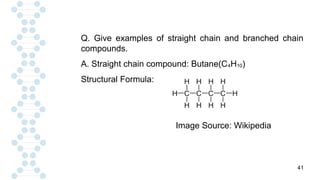
A. Straight chain compound: Butane(C4H10)
Structural Formula:
Image Source: Wikipedia
42
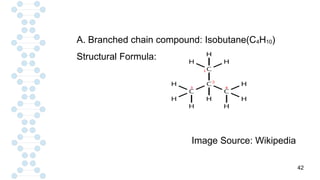
A. Branched chain compound: Isobutane(C4H10)
Structural Formula:
Image Source: Wikipedia
43
Q. What are different types of hydrocarbons?
A. Based on the number of covalent bonds formed,
hydrocarbons are classified into two types namely,
1. Saturated hydrocarbons
2. Unsaturated hydrocarbons
1. Saturated hydrocarbons:
The hydrocarbons in which the carbon atoms are connected
by single covalent bonds are called the saturated
hydrocarbons. Examples: Methane, ethane, propane etc.
44
A. Unsaturated hydrocarbons:
The compounds of carbon which contain double or triple
bond are called unsaturated compounds. It includes ethene,
propene, ethyne etc.
Q. What is the general formula of alkanes, alkenes and
alkynes?
A.1 .Alkanes have the general formula: CnH2n+2, where n is
the number of carbon atoms.
2. Alkenes have the general formula: CnH2n
3. Alkynes have the general formula: CnH2n-2
45
Q. What is the cause of catenation in carbon?
A. Catenation is the linkage of atoms of the same
element into longer chains. Catenation occurs most
readily in carbon to form straight chains, branched chains
and rings of various sizes. The high tendency of carbon
to catenate is because of high C-C bond strength.
Q. Name the element other than carbon which shows
catenation property.
A. Silicon exhibits the property of catenation.
46
Q. Why are the compounds formed by silicon are
unstable?
A. The compounds formed by silicon are unstable
due to the formation of weak bonds. The bigger size
of silicon atom causes a reduced forces of attraction
between electrons and the nucleus and lesser
strength of the bond.
47
Q. Which among the following is strong? Alkane or Alkene?
A. Since carbon-carbon(C-C) single bonds are very strong, alkane is
stronger than alkene.
Q. Derive the structure of propane.
A. Propane has the prefix of: ‘prop’ and suffix of: ‘ane’. ‘Prop’ refers
to 3 carbon atoms and ‘ane’ refers to a single bond. For this
molecule, the number of carbon atoms are 3. The terminal carbons in
-C-C-C- are able to bond with 3 hydrogens each, the carbon in the
center is able to bond with two hydrogen atoms. So, the total number
of hydrogen is equal to eight. Hence, the propane formula can be
written as CH3CH2CH3, which can be condensed to C3H8.
48
Q. Differentiate between alkenes and alkynes.
A.1. Alkenes have a general formula of CnH2n.
Alkynes have a general formula CnH2n-2.
2. Alkenes contain double bonds between carbon atoms.
Alkynes contain triple bond between carbon atoms.
3. Alkenes are reactive in nature and are called unsaturated hydrocarbons.
Alkynes are more reactive than alkenes and they are also unsaturated
hydrocarbons.
49
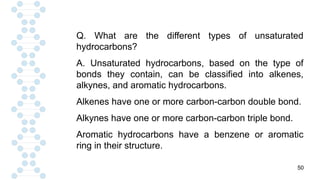
Q. Give the electron dot structure of ethene.
A.
Image Source: Flash Education
50
Q. What are the different types of unsaturated
hydrocarbons?
A. Unsaturated hydrocarbons, based on the type of
bonds they contain, can be classified into alkenes,
alkynes, and aromatic hydrocarbons.
Alkenes have one or more carbon-carbon double bond.
Alkynes have one or more carbon-carbon triple bond.
Aromatic hydrocarbons have a benzene or aromatic
ring in their structure.
51
Q. Define cracking.
A. Cracking can be defined as a process used in oil
refineries, to break down large and complex hydrocarbon
molecules into lighter, smaller hydrocarbon molecules. A
crucial step in the refinement of crude oil is cracking.
Cracking is done by by breaking the carbon-carbon single
bonds present in long-chain hydrocarbons (alkanes) and
usually produces smaller alkanes and alkenes. The
product may vary depending on temperature and
catalysts. Although a high temperature is very essential.
52
THANK YOU
FOR
WATCHING!!

CARBON AND IT'S COMPOUNDS[CHAPTER 1], CLASS 10, SCIENCE

  • 1.
    1 CLASS 10 SCIENCE CARBON AND ITSCOMPOUNDS [ CHAPTER:1]
  • 2.
    2 Q. What iscovalent bond? A. The chemical bond formed by sharing of electrons between two atoms is known as covalent bond. Q. Why does carbon form only covalent bond? A. Carbon has 4 electrons in its valence shell. To attain stability, it should either gain 4 electrons or lose 4 electrons. It cannot lose 4 electrons as it involves a lot of energy. Also, it cannot gain 4 electrons because the nucleus can not hold on to the four extra electrons added. Therefore to complete the octet, it shares 4 electrons with other atoms. That is why, carbon forms compounds by covalent bonding.
  • 3.
    3 Q. What aredifferent types of covalent bond? Give an example for each type with a neat sketch. A. The covalent bond are of three types: 1. Single Bond 2. Double Bond 3. Triple Bond
  • 4.
    4 A.1. Single CovalentBond: When only pair of electron is shared, it is called single covalent bond. In other words, a single bond is formed by sharing of one pair of electron between two atoms, each atom contributing one electron for sharing. Image Source: Expii
  • 5.
    5 A.2. Double CovalentBond: A double covalent bond is formed by sharing two pair of electrons between two atoms, or in other words, a double covalent bond consists of two pair of shared electrons. Image source : GoConqr
  • 6.
    6 A.3. Triple CovalentBond: When three pair of electrons are shared, it is called triple covalent bond. In other words, a triple covalent bond is formed by sharing three pair of electrons between two atoms, each atom contributing three electrons for sharing. Image Source : Quora
  • 7.
    7 Q. What arehomoatomic and heteroatomic molecules? A. If the atoms participating in the covalent bond formation are the same, then the molecules are called homoatomic molecules. If the atoms participating in the covalent bond formation are different, then the molecules are called heteroatomic molecules.
  • 8.
    8 Q. Diagrammatically representthe formation of hydrogen molecules. A. Each molecule of hydrogen contains two atoms of hydrogen. The atomic number of hydrogen is 1, so it’s electronic configuration is 1. It has seen that it has 1 electron in it’s outermost shell and thus it needs only one electron to complete its octet to nearest helium gas configuration. It gets one electron by sharing its electron with another hydrogen atom. Hence, two hydrogen atoms share one electron each to form hydrogen molecule. Thus, two hydrogen atoms share one pair of electron, to form hydrogen molecule.
  • 9.
    9 A. Diagrammatic representationof hydrogen molecule : Image Source : BrainKart
  • 10.
    10 Q. Diagrammatically representthe sharing of electrons between hydrogen and oxygen to form water. A. Each molecule of water contains two atoms of hydrogen and one atom of oxygen which are formed by single covalent bond. The atomic number of hydrogen is 1, so it’s electronic configuration is 1. It is seen that it has 1 electron in its outermost shell and thus it needs only one electron to complete its octet to nearest helium gas configuration. It gets one electron by sharing with oxygen atom. The atomic number of oxygen is 8, so it’s electronic configuration is 2,6. It is seen that it has 6 electrons in its outermost shell and thus needs two electrons to complete its octet to nearest neon gas confifuration. It gets these electrons from two hydrogen atoms to form water molecule.
  • 11.
    11 A. Diagrammatic representationof water molecule: Image Source: ClipartMax
  • 12.
    12 Q. Explain thesharing of electrons in ammonia molecule. A. Each molecule of ammonia contains one atom of nitrogen and three atoms of hydrogen which are formed by single covalent bond. The atomic number of hydrogen is 1, so it’s electronic configuration is 1. It is seen that it has 1 electron in it’s outermost shell and thus it needs only one electron to complete it’s octet to neraest helium gas configuration. It gets one electron by sharing with nitrogen atom. The atomic number of nitrogen is 7, so it’s electronic configuration is 2,5. It is seen that it has 5 electrons in it’s outermost shell and thus needs three electrons to complete it’s octet to nearest neon gas configuration. It gets three electrons from three hydrogen atoms forming an ammonia molecule.
  • 13.
    13 Diagrammatic representation offormation of ammonia molecule: Image Source: Socratic
  • 14.
    14 Q. How wouldyou test the presence of carbon in a substance? A. To test the presence of carbon in a substance, we need to burn the substance in air. If it produces a colourless and odourless gas which turns the lime water milky, the gas so obtained is known as carbon dioxide and the substance is said to be made up of carbon.
  • 15.
    15 Q. Define covalency. A.Covalency of an element may be defined as “the number of electrons which an element shares with other atoms in the formation of covalent molecule.” Q. Why is carbon tetravalent in nature? A. Electronic configuration of carbon is 2,4. So, it requires four more electrons to attain the stable electronic configuration. Carbon gets these four electrons by mutual sharing. Therefore carbon atoms form four covalent bonds. In other words, carbon is tetravalent.
  • 16.
    16 Q. Represent atetrahedral structure of carbon with neat sketch and give the bond angle. A. The four valencies of carbon do not lie in a plane, but are directed towards the four corners of a regular tetrahedron. This shows that carbon is tetrahedral. The angle between two adjacent valencies is 1090 28’ .
  • 17.
    17 A. Diagrammatic representationof Tetrahedral structure of Carbon: Image Source: ResearchGate
  • 18.
    18 Q. Give examplesin which carbon occurs in free state. A. Free state occurrence of carbon: 1. Diamond, 2.Graphite, 3.Buckminster Fullerene. Q. How does carbon occur in combined state? A. Carbon occurs in combined state in the following form: 1.Carbon dioxide gas, 2.Carbonates such as chalk, limestone, marble etc., 3.Fossil fuels such as coal, natural gas and petroleum.
  • 19.
    19 Q. Define catenation.What is the result of this property? A. The existence of number of organic compounds is due to the self-linking of carbon atoms which makes it versatile in nature. The process of self-linking is called catenation. C – C – C – C – C [Self-linking of carbon atoms] As a result, the catenation property of carbon makes it versatile in nature.The catenation results in the formation of long chains of carbon atoms which may be branched or straight in nature.
  • 20.
    20 Q. Define allotropy. A.The phenomenon of existence of element in two or more forms having same chemical properties but different physical properties is defined as allotropy. The different forms are called allotrope. Q. What are the allotropes of carbon? A. The allotropes of carbon are: 1. Diamond 2. Graphite 3. Buckminster fullerene
  • 21.
    21 Q. What iscommon among all allotropes of carbon? A. All the three allotropes of carbon are the purest forms of carbon and all possess same chemical properties. For example, when all the allotropes of carbon are burnt in air, a colourless and odourless carbon dioxide gas is produced. But the physical properties of these three allotropes are different due to the different arrangement of carbon atoms in them.
  • 22.
    22 Q. Comment: “Diamondsare used in cutting marbles and granites.” A. Diamond is one of the hardest substance which occurs naturally. The atoms in diamond are organised in a rigid three-dimensional structure and are tightly bonded to each other. The absence of large empty spaces in the diamond structure makes it an extremely hard substance which compels to use in marbles and granites.
  • 23.
    23 Q. Explain thestructure of diamond. A. Diamond is a giant molecule of carbon atoms. In the structure of diamond, each carbon atom is found to be attached to four other carbon atoms by single strong covalent bond of 1.54A0 long. The surrounding four carbon atoms lie at the four corners of a regular tetrahedron. The angle formed between two adjacent carbon atoms is 1090 28/ ,which is the tetrahedral angle. Due to this tetrahedral arrangement of carbon atoms, diamond shows a rigid three dimensional network structure. Thus, it is obvious that diamond consists of only carbon atoms.
  • 24.
    24 Q. Why diamondhas high density? A. Due to the three-dimensional network of carbon atoms in diamond, the carbon atoms are closely packed and hence it has high density of about 3.51gm/cm3 . Q. Why diamond is a good conductor of heat? A. In the structure of diamond, each carbon atom is bonded to four other carbon atoms, forming rigid three-dimensional structure. Carbon atoms are very closely packed in diamond due to the presence of strong covalent bonds. We know that conduction of heat requires the vibration of the atom which passes from one atom to the other. Since in diamond, the motion of the atoms are strongly coupled, it can effectively conduct heat.
  • 25.
    25 Q. Justify:“Diamonds areused in making jewellery”? A. Diamond is used in making jewellery because it has a sparkling surface due to high refractive index. Besides this, diamond is durable, and can be cut and polished as well. Q. Give any three uses of diamond. A. Uses of diamond are as follows: 1. Used in ornaments. 2. Used in glass cutting and rock drilling machines. 3. Diamond knives are used in eye surgery.
  • 26.
    26 Q. Why diamonddoes not conduct electricity? A. In a diamond crystal, each carbon atom is linked to four other carbon atoms by single covalent bonds and there are no free electrons. Thus, it does not conduct electricity. Q. Why diamond has a high melting point? A. Since large amount of energy is required to break the three-dimensional network structures of diamond, it is said to have high melting point of about 39300 C OR 4230K.
  • 27.
    27 Q. Explain thestructure of graphite. A. Graphite is a sheet or layer of carbon atoms. In the structure of graphite, each of carbon atoms is bonded with three other carbon atoms in the same plane to form hexagonal rings. Each hexagonal ring has has three alternate single and double bonds to satisfy the fourth valency of carbon. Thus, graphite has two-dimensional sheets like structure consisting of number of rings fused together. These sheets or layers are held together by weak Vander Waals forces of attraction. The distance between two successive layers is 340pm.
  • 28.
    28 Q. Why doesgraphite possess low density? A. Graphite is a sheet or layer of carbon atoms. These sheet or layers are held together by weak Vander Waals forces of attraction. The distance between two successive layers is 340pm. Due to wide spacing between the two layers, the carbon atoms in graphite are less closely packed and hence the density of graphite is low, varying from 2.0 to 2.25 gm/cm3 .
  • 29.
    29 Q. Why graphiteis soft? A. The various layers of carbon atoms in graphite are held together by weak Vander Waals forces of attraction. Therefore, one layer can easily slide over the other making graphite soft. Q. Why graphite is used as a lubricant? A. Due to its softness, powdered graphite is used either as a solid, dry lubricant or mixed with petroleum jelly as graphite grease. Since graphite is non-volatile, it can also be used as a lubricant for heavy machinery, operating at very high temperature.
  • 30.
    30 Q. Why graphiteis used for making electrodes in dry cells? A. Carbon has four valence electrons. But in a graphite crystal, each carbon atom is joined to three other carbon atoms by covalent bonds to form hexagonal rings. Thus, only three valence electrons are used for bond formation and hence the fourth valence electron is free to move. As a result, graphite is a good conductor of heat and electricity. Hence, due to it’s capacity to conduct electricity, graphite is used for making electrodes in dry cells.
  • 31.
    31 Q. What doyou understand by the term fullerene? A. A fullerene is an allotrope of carbon whose molecule consists of carbon atoms connected by single and double bonds so as to form a closed or partially closed mesh, with fused rings of five to seven atoms. The molecule may be a hollow sphere, ellipsoid, tube, or many other shapes and sizes. Fullerenes with a closed mesh technology are informally denoted by their empirical formula Cn, where n is the number of carbon atoms.
  • 32.
    32 Q. Why isthe allotrope of fullerene called Buckminster fullerene? A. The structure of C60 fullerene was discovered by an architect Buckminster and so this allotrope was called Buckminster fullerene. Q. Give any three uses of fullerene. A. Three uses of fullerene are as follows: 1. Used as catalyst in petrochemical refining in industry. 2. Due it’s ability to trap different atoms, it is used in the field of medicine. 3. It helps in improving anti-friction properties of lubricating oils.
  • 33.
    33 Q. Explain thestructure of bucky ball. A. The 60 carbon atoms in C60 fullerene are arranged in the shape of a football or a soccer ball. Therefore, it is also called bucky ball. It contains 20 six-membered rings and 12 five-membered rings. In other words, the 60 carbon atoms are arranged in interlocking hexagonal and pentagonal rings of carbon atoms.
  • 34.
    34 Q. Differentiate betweendiamond and graphite based on their structure, nature, density, conduction and melting point. A.1.Structure: Diamonds have a strong three-dimensional network structure. Graphite have a two-dimensional sheet-like structure.
  • 35.
    35 2.Nature: Diamonds are hardin nature. Graphites are soft in nature. 3.Density: Diamond molecules are closely packed, as a result, they have high density. There is a large gap between graphite molecules. Therefore, they have low density.
  • 36.
    36 4.Conduction: There is nofree carbon atoms in diamond, therefore diamonds do not conduct electricity. There is presence of no free carbon atoms in graphite, hence graphite conducts electricity. 5.Melting point: In diamond each carbon atom is linked to four other carbon atoms by covalent bond. Since large amount of energy is required to break the three of-dimensional network structures, diamond is said to have high melting point of about 39300 C OR 4203K.
  • 37.
    37 5. Graphite isa sheet or layer of carbon atoms, which are held together by weak Vander Walls forces of attraction, which is relatively weak in comparison to covalent bond. Hence, graphite has a lower melting point(about 1800K) compared to diamond.
  • 38.
    38 Q. What ismeant by hydrocarbon? A. Hydrocarbons are the compounds that contain hydrogen and carbon and their derivatives(alcohols, aldehydes etc.). Q. Name the most important natural source of hydrocarbons. A. The most important natural source of hydrocarbons is petroleum.
  • 39.
    39 Q. Classify organiccompounds. A. Based on the types of chains formed during self- linkage of carbon atoms, organic compounds are classified into: 1. Open chain compounds(acyclic) 2. Closed chain compounds(cyclic)
  • 40.
    40 Q. What areacyclic compounds? A. Acyclic compounds are chemical compounds, which have basic linear structure. These are also known as open-chain compounds. They have linear structures rather than cyclic structures. The linking may be straight or branched chain. These compounds are also called aliphatic compounds.
  • 41.
    41 Q. Give examplesof straight chain and branched chain compounds. A. Straight chain compound: Butane(C4H10) Structural Formula: Image Source: Wikipedia
  • 42.
    42 A. Branched chaincompound: Isobutane(C4H10) Structural Formula: Image Source: Wikipedia
  • 43.
    43 Q. What aredifferent types of hydrocarbons? A. Based on the number of covalent bonds formed, hydrocarbons are classified into two types namely, 1. Saturated hydrocarbons 2. Unsaturated hydrocarbons 1. Saturated hydrocarbons: The hydrocarbons in which the carbon atoms are connected by single covalent bonds are called the saturated hydrocarbons. Examples: Methane, ethane, propane etc.
  • 44.
    44 A. Unsaturated hydrocarbons: Thecompounds of carbon which contain double or triple bond are called unsaturated compounds. It includes ethene, propene, ethyne etc. Q. What is the general formula of alkanes, alkenes and alkynes? A.1 .Alkanes have the general formula: CnH2n+2, where n is the number of carbon atoms. 2. Alkenes have the general formula: CnH2n 3. Alkynes have the general formula: CnH2n-2
  • 45.
    45 Q. What isthe cause of catenation in carbon? A. Catenation is the linkage of atoms of the same element into longer chains. Catenation occurs most readily in carbon to form straight chains, branched chains and rings of various sizes. The high tendency of carbon to catenate is because of high C-C bond strength. Q. Name the element other than carbon which shows catenation property. A. Silicon exhibits the property of catenation.
  • 46.
    46 Q. Why arethe compounds formed by silicon are unstable? A. The compounds formed by silicon are unstable due to the formation of weak bonds. The bigger size of silicon atom causes a reduced forces of attraction between electrons and the nucleus and lesser strength of the bond.
  • 47.
    47 Q. Which amongthe following is strong? Alkane or Alkene? A. Since carbon-carbon(C-C) single bonds are very strong, alkane is stronger than alkene. Q. Derive the structure of propane. A. Propane has the prefix of: ‘prop’ and suffix of: ‘ane’. ‘Prop’ refers to 3 carbon atoms and ‘ane’ refers to a single bond. For this molecule, the number of carbon atoms are 3. The terminal carbons in -C-C-C- are able to bond with 3 hydrogens each, the carbon in the center is able to bond with two hydrogen atoms. So, the total number of hydrogen is equal to eight. Hence, the propane formula can be written as CH3CH2CH3, which can be condensed to C3H8.
  • 48.
    48 Q. Differentiate betweenalkenes and alkynes. A.1. Alkenes have a general formula of CnH2n. Alkynes have a general formula CnH2n-2. 2. Alkenes contain double bonds between carbon atoms. Alkynes contain triple bond between carbon atoms. 3. Alkenes are reactive in nature and are called unsaturated hydrocarbons. Alkynes are more reactive than alkenes and they are also unsaturated hydrocarbons.
  • 49.
    49 Q. Give theelectron dot structure of ethene. A. Image Source: Flash Education
  • 50.
    50 Q. What arethe different types of unsaturated hydrocarbons? A. Unsaturated hydrocarbons, based on the type of bonds they contain, can be classified into alkenes, alkynes, and aromatic hydrocarbons. Alkenes have one or more carbon-carbon double bond. Alkynes have one or more carbon-carbon triple bond. Aromatic hydrocarbons have a benzene or aromatic ring in their structure.
  • 51.
    51 Q. Define cracking. A.Cracking can be defined as a process used in oil refineries, to break down large and complex hydrocarbon molecules into lighter, smaller hydrocarbon molecules. A crucial step in the refinement of crude oil is cracking. Cracking is done by by breaking the carbon-carbon single bonds present in long-chain hydrocarbons (alkanes) and usually produces smaller alkanes and alkenes. The product may vary depending on temperature and catalysts. Although a high temperature is very essential.
  • 52.