
Omer Shafiq   FA09-BCS-098
Ihsan Ullah   FA09-BCS-153
Adnan Bajwa   FA09-BCS-163
Brief Description
• Captcha Cracking System cracks the captcha
  images intelligently and then make the
  knowledge-base of the policy of cracking
  captcha images and reflexly learn this
  knowledge to crack the another captcha
  images
• Enables the system to implement the online
  learning through which we can achieve the
  optimal solution
• Our System depends on multiple phases,
  which are explained below that how each of
  them works and integrate to make this
  System.
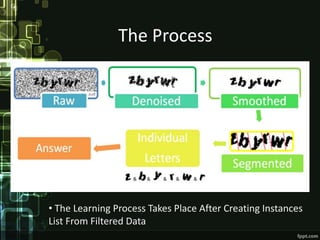
The Process


• The Learning Process Takes Place After Creating Instances
List From Filtered Data
Analysis
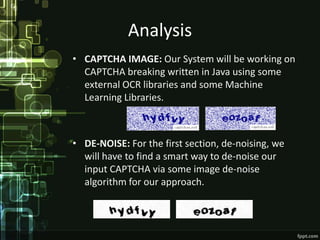
• CAPTCHA IMAGE: Our System will be working on
  CAPTCHA breaking written in Java using some
  external OCR libraries and some Machine
  Learning Libraries.


• DE-NOISE: For the first section, de-noising, we
  will have to find a smart way to de-noise our
  input CAPTCHA via some image de-noise
  algorithm for our approach.
Analysis
• SEMENTATION: For the segmentation stage, we need
  to split the image of string in characters via different
  segmentation algorithms.


• BINARY BIT STREAM: Segmentation gives us the
  different segmented images.
Analysis

• DATASET: Data Set contains the instances includes the
  feature vectors and desired target output value which
  will be predict through applying desired Classifier.
Architecture
Intelligence Aspect
• Project Intelligently Recognizes The
  Pattern of the image to classify

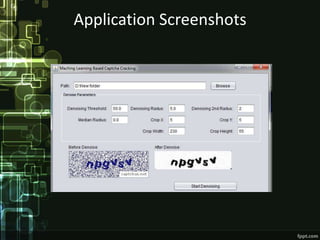
• Project can simultaneously denoise
  and segment captchas parallel

• Classification depend upon the model
  you have trained
Application Screenshots

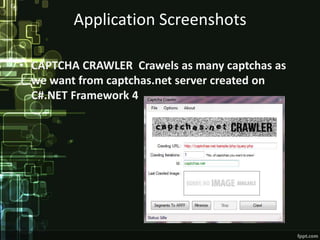
• CAPTCHA CRAWLER Crawels as many captchas as
  we want from captchas.net server created on
  C#.NET Framework 4
Application Screenshots
Results and conclusion
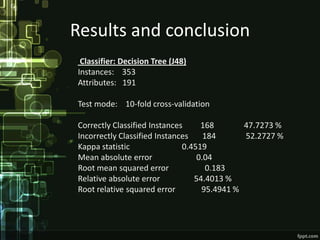
 Classifier: Decision Tree (J48)
Instances: 353
Attributes: 191

Test mode: 10-fold cross-validation

Correctly Classified Instances     168       47.7273 %
Incorrectly Classified Instances    184      52.2727 %
Kappa statistic               0.4519
Mean absolute error               0.04
Root mean squared error              0.183
Relative absolute error          54.4013 %
Root relative squared error        95.4941 %
Results and conclusion
 Classifier: Artificial Neural-Net (MultiLayer-Preceptron)
Instances: 353
Attributes: 191

Test mode: 10-fold cross-validation

Correctly Classified Instances     295       83.8068 %
Incorrectly Classified Instances    57       16.1932 %
Kappa statistic               0.8301
Mean absolute error               0.0171
Root mean squared error             0.0966
Relative absolute error          23.2233 %
Root relative squared error        50.4266 %
Results and conclusion
 Classifier: Support Vector Machine(SVM)
Instances: 353
Attributes: 191

Test mode: 10-fold cross-validation

Correctly Classified Instances     304       86.3636 %
Incorrectly Classified Instances    48       13.6364 %
Kappa statistic               0.8569
Mean absolute error               0.0711
Root mean squared error             0.1861
Relative absolute error          96.8087 %
Root relative squared error        97.1338 %
Results and conclusion
 Classifier: Naive Bayes (NaiveBayesin)
Instances: 353
Attributes: 191

Test mode: 10-fold cross-validation

Correctly Classified Instances     268       76.1364 %
Incorrectly Classified Instances    84       23.8636 %
Kappa statistic               0.7499
Mean absolute error               0.018
Root mean squared error             0.1282
Relative absolute error          24.5384 %
Root relative squared error        66.9059 %
Visual Results and Conclusion
            Results and conclusion
100
 90
 80
 70
 60
 50                                            Correct Classification
                                               Missclassification
 40
 30
 20
 10
  0
      Decision Tree   SVM   ANN   NaïveBayes

CAPTCHA Cracking System

  • 1.
    Omer Shafiq FA09-BCS-098 Ihsan Ullah FA09-BCS-153 Adnan Bajwa FA09-BCS-163
  • 2.
    Brief Description • CaptchaCracking System cracks the captcha images intelligently and then make the knowledge-base of the policy of cracking captcha images and reflexly learn this knowledge to crack the another captcha images • Enables the system to implement the online learning through which we can achieve the optimal solution • Our System depends on multiple phases, which are explained below that how each of them works and integrate to make this System.
  • 3.
    The Process • TheLearning Process Takes Place After Creating Instances List From Filtered Data
  • 4.
    Analysis • CAPTCHA IMAGE:Our System will be working on CAPTCHA breaking written in Java using some external OCR libraries and some Machine Learning Libraries. • DE-NOISE: For the first section, de-noising, we will have to find a smart way to de-noise our input CAPTCHA via some image de-noise algorithm for our approach.
  • 5.
    Analysis • SEMENTATION: Forthe segmentation stage, we need to split the image of string in characters via different segmentation algorithms. • BINARY BIT STREAM: Segmentation gives us the different segmented images.
  • 6.
    Analysis • DATASET: DataSet contains the instances includes the feature vectors and desired target output value which will be predict through applying desired Classifier.
  • 7.
  • 8.
    Intelligence Aspect • ProjectIntelligently Recognizes The Pattern of the image to classify • Project can simultaneously denoise and segment captchas parallel • Classification depend upon the model you have trained
  • 9.
    Application Screenshots • CAPTCHACRAWLER Crawels as many captchas as we want from captchas.net server created on C#.NET Framework 4
  • 10.
  • 11.
  • 12.
  • 13.
    Results and conclusion Classifier: Decision Tree (J48) Instances: 353 Attributes: 191 Test mode: 10-fold cross-validation Correctly Classified Instances 168 47.7273 % Incorrectly Classified Instances 184 52.2727 % Kappa statistic 0.4519 Mean absolute error 0.04 Root mean squared error 0.183 Relative absolute error 54.4013 % Root relative squared error 95.4941 %
  • 14.
    Results and conclusion Classifier: Artificial Neural-Net (MultiLayer-Preceptron) Instances: 353 Attributes: 191 Test mode: 10-fold cross-validation Correctly Classified Instances 295 83.8068 % Incorrectly Classified Instances 57 16.1932 % Kappa statistic 0.8301 Mean absolute error 0.0171 Root mean squared error 0.0966 Relative absolute error 23.2233 % Root relative squared error 50.4266 %
  • 15.
    Results and conclusion Classifier: Support Vector Machine(SVM) Instances: 353 Attributes: 191 Test mode: 10-fold cross-validation Correctly Classified Instances 304 86.3636 % Incorrectly Classified Instances 48 13.6364 % Kappa statistic 0.8569 Mean absolute error 0.0711 Root mean squared error 0.1861 Relative absolute error 96.8087 % Root relative squared error 97.1338 %
  • 16.
    Results and conclusion Classifier: Naive Bayes (NaiveBayesin) Instances: 353 Attributes: 191 Test mode: 10-fold cross-validation Correctly Classified Instances 268 76.1364 % Incorrectly Classified Instances 84 23.8636 % Kappa statistic 0.7499 Mean absolute error 0.018 Root mean squared error 0.1282 Relative absolute error 24.5384 % Root relative squared error 66.9059 %
  • 17.
    Visual Results andConclusion Results and conclusion 100 90 80 70 60 50 Correct Classification Missclassification 40 30 20 10 0 Decision Tree SVM ANN NaïveBayes