CAPTCHA Recognition
with Active Deep
Learning
Group 26
N96041119 陳柏皓
N96041101 黃偉鑫
Directory
• Introduction
• A Deep CNN for CAPTCHA Recognition
• Active Learning
• Experimental Evaluation
• Conclusion
Introduction
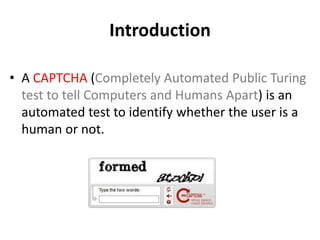
• A CAPTCHA (Completely Automated PublicTuring test
to tell Computers and Humans Apart) is an automated
test to identify whether the user is a human or not.
Introduction
• Recently, researchers have started investigating
automated methods to solve CAPTCHAs.
• Many of these existing solutions first perform
character segmentation and then recognition.
Introduction
• However, they can not solve newer, more
challenging CAPTCHAs, where the letters are
skewed so that they can not be separated by
vertical lines.
Introduction
• One successful approach proposed recently by
Goodfellow et al. uses a deep Convolutional
Neural Network (CNN).
• However, a major requirement for training a deep
CNN is a very large training data set , and for
CAPTCHA recognition, there is usually only a
small annotated training data set available.
Introduction
• To address these problems, we propose in this
paper an approach that is based on Active
Learning.
• The idea here is to start learning with a
comparably small training set and to add new
training samples in every subsequent learning
round.
Introduction
• We do not need a human supervisor to acquire
the ground truth labels for training.
• If the CAPTCHA is not solved we don't have that
information, but we will show how learning can
be done from the correctly predicted samples
only.
A Deep CNN for CAPTCHA
Recognition
• We focus on CAPTCHAs with 6 digits. Each digit is
represented by 62 neurons in the output layer.
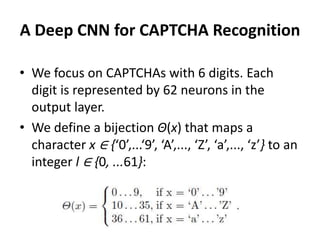
• We define a bijection Θ(x) that maps a character x ∈ {‘0’,...‘9’,
‘A’,..., ‘Z’, ‘a’,..., ‘z’} to an integer l ∈ {0, ...61}:
A Deep CNN for CAPTCHA
Recognition
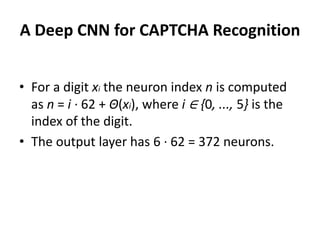
• For a digit xi the neuron index n is computed as n
= i · 62 + Θ(xi), where i ∈ {0, ..., 5} is the index of
the digit.
• The output layer has 6 · 62 = 372 neurons.
A Deep CNN for CAPTCHA
Recognition
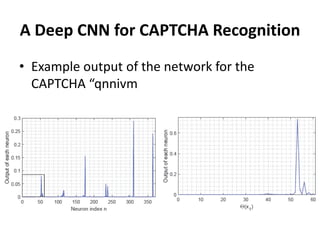
• Example output of the network for the CAPTCHA
“qnnivm
A Deep CNN for CAPTCHA
Recognition
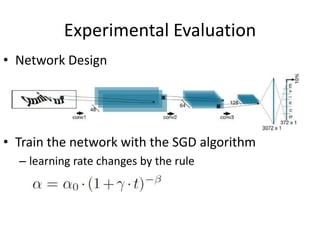
• Network Design
• Train the network with the SGD algorithm
• learning rate changes by the rule
Active Learning
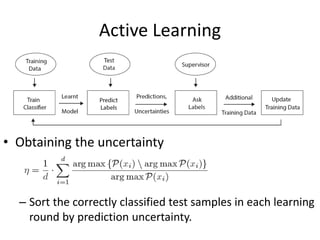
• Obtaining the uncertainty
• Sort the correctly classified test samples in each learning round by predicti
uncertainty.
Experimental Evaluation
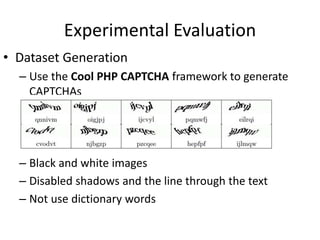
• Dataset Generation
• Use the Cool PHP CAPTCHA framework to generate CAPTCHAs
• Black and white images
• Disabled shadows and the line through the text
• Not use dictionary words
Experimental Evaluation
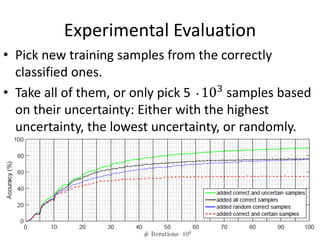
• Pick new training samples from the correctly classified ones.
• Take all of them, or only pick 5 ·103 samples based on their
uncertainty: Either with the highest uncertainty, the lowest
uncertainty, or randomly.
Experimental Evaluation
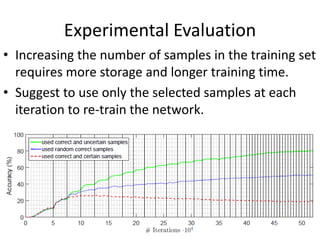
• Increasing the number of samples in the training set requires
more storage and longer training time.
• Suggest to use only the selected samples at each iteration to
re-train the network.
Conclusion
• Uses initially a very small set of images to train a deep
CNN.
• Significantly improved with the correctly classified but
uncertain test samples.
• Learning with misclassified samples should yield better
results, however not possible in practice.

Captcha-recognition-with-active-deep-learning

  • 1.
    CAPTCHA Recognition with ActiveDeep Learning Group 26 N96041119 陳柏皓 N96041101 黃偉鑫
  • 2.
    Directory • Introduction • ADeep CNN for CAPTCHA Recognition • Active Learning • Experimental Evaluation • Conclusion
  • 3.
    Introduction • A CAPTCHA(Completely Automated PublicTuring test to tell Computers and Humans Apart) is an automated test to identify whether the user is a human or not.
  • 4.
    Introduction • Recently, researchershave started investigating automated methods to solve CAPTCHAs. • Many of these existing solutions first perform character segmentation and then recognition.
  • 5.
    Introduction • However, theycan not solve newer, more challenging CAPTCHAs, where the letters are skewed so that they can not be separated by vertical lines.
  • 6.
    Introduction • One successfulapproach proposed recently by Goodfellow et al. uses a deep Convolutional Neural Network (CNN). • However, a major requirement for training a deep CNN is a very large training data set , and for CAPTCHA recognition, there is usually only a small annotated training data set available.
  • 7.
    Introduction • To addressthese problems, we propose in this paper an approach that is based on Active Learning. • The idea here is to start learning with a comparably small training set and to add new training samples in every subsequent learning round.
  • 8.
    Introduction • We donot need a human supervisor to acquire the ground truth labels for training. • If the CAPTCHA is not solved we don't have that information, but we will show how learning can be done from the correctly predicted samples only.
  • 9.
    A Deep CNNfor CAPTCHA Recognition • We focus on CAPTCHAs with 6 digits. Each digit is represented by 62 neurons in the output layer. • We define a bijection Θ(x) that maps a character x ∈ {‘0’,...‘9’, ‘A’,..., ‘Z’, ‘a’,..., ‘z’} to an integer l ∈ {0, ...61}:
  • 10.
    A Deep CNNfor CAPTCHA Recognition • For a digit xi the neuron index n is computed as n = i · 62 + Θ(xi), where i ∈ {0, ..., 5} is the index of the digit. • The output layer has 6 · 62 = 372 neurons.
  • 11.
    A Deep CNNfor CAPTCHA Recognition • Example output of the network for the CAPTCHA “qnnivm
  • 12.
    A Deep CNNfor CAPTCHA Recognition • Network Design • Train the network with the SGD algorithm • learning rate changes by the rule
  • 13.
    Active Learning • Obtainingthe uncertainty • Sort the correctly classified test samples in each learning round by predicti uncertainty.
  • 14.
    Experimental Evaluation • DatasetGeneration • Use the Cool PHP CAPTCHA framework to generate CAPTCHAs • Black and white images • Disabled shadows and the line through the text • Not use dictionary words
  • 15.
    Experimental Evaluation • Picknew training samples from the correctly classified ones. • Take all of them, or only pick 5 ·103 samples based on their uncertainty: Either with the highest uncertainty, the lowest uncertainty, or randomly.
  • 16.
    Experimental Evaluation • Increasingthe number of samples in the training set requires more storage and longer training time. • Suggest to use only the selected samples at each iteration to re-train the network.
  • 17.
    Conclusion • Uses initiallya very small set of images to train a deep CNN. • Significantly improved with the correctly classified but uncertain test samples. • Learning with misclassified samples should yield better results, however not possible in practice.