
CAPTCHA
Prepared By:
Hardik Shah
Dhruv Patel
CAPTCHA
• C : COMPELELY
• A : AUTOMATIC
• P : PUBLIC
• T : TURING TEST TO TELL
• C : COMPUTER
• H : HUMAN
• A : APART
• Completely - Whole
• Automated - Made by machine
• Public - Universally known also easy for
hackers to break it
• Turing Test to Tell - Test presented by Alan
Turing
• Computers and
• Humans
• Apart
CAPTCHA: Origins
• The term "CAPTCHA" was coined in 2000 by
Luis von Ann, Manuel Blum, Nicholas J.
Hopper, and John Langford (all of Carnegie
Mellon University). It is an acronym based on the
word "capture" and standing for "Completely
Automated Public Turing test to tell
Computers and Humans Apart".
• CAPTCHAs are automated tests designed to tell
computers and humans apart by presenting users
with a problem that humans can solve but current
computer programs cannot
• The process usually involves one computer (a
server) asking a user to complete a simple test
which the computer is able to generate and grade.
An example of Gmail, where CAPTCHA is use
TYPES OF CAPTCHA
• VISUAL CAPTCHA:
Visual CAPTCHAs consist of distorted
images, text, for which a user must provide some
description.
• AUDIO CAPTCHA:
Audio CAPTCHAs consist of a string of
spoken characters, typically masked and distorted
by a form of background noise.
TEXT BASED CAPTCHA
IMAGE(GRAPHIC)BASED
CAPTCHA
TEXT BASED CAPTCHA
• These are simple to implement.
• Novel approach is to present the user with some
questions which only a human user can solve.
• Examples of such questions are:
 What are twenty minus three?
 What is the third letter in UNIVERSITY?
 Which of Yellow, Thursday and Richard is a
colour?
 If yesterday was a Sunday, what is today?
• Other text CAPTCHAs involves text distortions
and the user is asked to identify the text hidden.
The various implementations are:
GIMPY
EZ-GIMPY
BAFFLE TEXT
MSN CAPTCHA
VARIOUS TYPE TEXT
BASED CAPTCHA
1. GIMPY: Works by choosing ten words
randomly from a dictionary, and displaying
them in a distorted and overlapped manner.
CONTINUE…
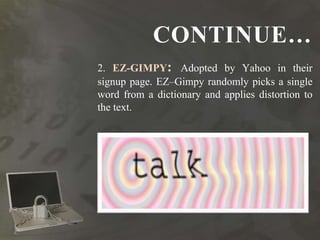
2. EZ-GIMPY: Adopted by Yahoo in their
signup page. EZ–Gimpy randomly picks a single
word from a dictionary and applies distortion to
the text.
CONTINUE…
3. BAFFLE TEXT : Doesn’t contain dictionary
words, but it picks up random alphabets to create a
meaningless but pronounceable text. Distortions are
then added to this text and the user is challenged to
guess the right word.
CONTINUE…
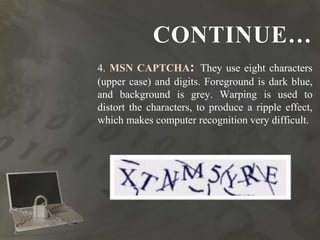
4. MSN CAPTCHA: They use eight characters
(upper case) and digits. Foreground is dark blue,
and background is grey. Warping is used to
distort the characters, to produce a ripple effect,
which makes computer recognition very difficult.
IMAGE(GRAPHIC)BASED
CAPTCHA
• Computer-based recognition algorithms require
the extraction of colour, texture, shape, or
special point features, which cannot be
correctly extracted after the designed
distortions.
• Humans can recognize the original concept
depicted in the images even with these
distortions.
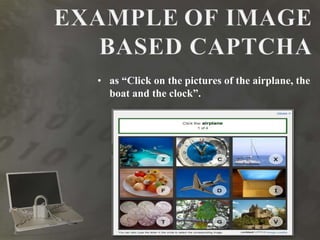
• as “Click on the pictures of the airplane, the
boat and the clock”.
Type of image based
CAPTCHA
•BONGO: Bongo is a program that
asks the user to solve a visual pattern
recognition problem.
CONTINUE…
• KittenAuth: Developed by programmer Oli
Warner, the KittenAuth system presents a
series of pictures of cute animals, and asks the
user to click on all the kittens.
• In audio CAPTCHAs, text is synthesized and
mixed in with background noise, such as music
or unidentifiable chatter.
• Solving audio CAPTCHAs is difficult.
• Usability issues with text based CAPTCHAs:
Sometimes the text is distorted to such an extent, that
even humans have difficulty in understanding it.
Usability issues in text based CAPTCHAs
Distortion becomes a problem when it is done in a very haphazard
way. Some characters like‘d’ can be confused for ‘cl’ or ‘m’ with
‘rn’.
Content is an issue when the string length becomes too long or
when the string is not a dictionary word.
Presentation should be in such a way as to not confuse the users.
The font and colour.
 Online Polls
 Protecting Web Registration
 Preventing comment spam
 Email spam
• Distinguishes between a human and a machine
• Makes online polls more legitimate
• Reduces spam and viruses
• Diminishes abuse of free email account
services
• Sometimes very difficult to read
• Are not compatible with users with disabilities
• Time-consuming to decipher
• Technical difficulties with certain internet
browsers
END

CAPTCHA

  • 1.
  • 2.
    CAPTCHA • C :COMPELELY • A : AUTOMATIC • P : PUBLIC • T : TURING TEST TO TELL • C : COMPUTER • H : HUMAN • A : APART
  • 3.
    • Completely -Whole • Automated - Made by machine • Public - Universally known also easy for hackers to break it • Turing Test to Tell - Test presented by Alan Turing • Computers and • Humans • Apart
  • 4.
    CAPTCHA: Origins • Theterm "CAPTCHA" was coined in 2000 by Luis von Ann, Manuel Blum, Nicholas J. Hopper, and John Langford (all of Carnegie Mellon University). It is an acronym based on the word "capture" and standing for "Completely Automated Public Turing test to tell Computers and Humans Apart".
  • 5.
    • CAPTCHAs areautomated tests designed to tell computers and humans apart by presenting users with a problem that humans can solve but current computer programs cannot • The process usually involves one computer (a server) asking a user to complete a simple test which the computer is able to generate and grade.
  • 6.
    An example ofGmail, where CAPTCHA is use
  • 7.
    TYPES OF CAPTCHA •VISUAL CAPTCHA: Visual CAPTCHAs consist of distorted images, text, for which a user must provide some description. • AUDIO CAPTCHA: Audio CAPTCHAs consist of a string of spoken characters, typically masked and distorted by a form of background noise.
  • 8.
  • 9.
    TEXT BASED CAPTCHA •These are simple to implement. • Novel approach is to present the user with some questions which only a human user can solve. • Examples of such questions are:  What are twenty minus three?  What is the third letter in UNIVERSITY?  Which of Yellow, Thursday and Richard is a colour?  If yesterday was a Sunday, what is today?
  • 10.
    • Other textCAPTCHAs involves text distortions and the user is asked to identify the text hidden. The various implementations are: GIMPY EZ-GIMPY BAFFLE TEXT MSN CAPTCHA
  • 11.
    VARIOUS TYPE TEXT BASEDCAPTCHA 1. GIMPY: Works by choosing ten words randomly from a dictionary, and displaying them in a distorted and overlapped manner.
  • 12.
    CONTINUE… 2. EZ-GIMPY: Adoptedby Yahoo in their signup page. EZ–Gimpy randomly picks a single word from a dictionary and applies distortion to the text.
  • 13.
    CONTINUE… 3. BAFFLE TEXT: Doesn’t contain dictionary words, but it picks up random alphabets to create a meaningless but pronounceable text. Distortions are then added to this text and the user is challenged to guess the right word.
  • 14.
    CONTINUE… 4. MSN CAPTCHA:They use eight characters (upper case) and digits. Foreground is dark blue, and background is grey. Warping is used to distort the characters, to produce a ripple effect, which makes computer recognition very difficult.
  • 15.
    IMAGE(GRAPHIC)BASED CAPTCHA • Computer-based recognitionalgorithms require the extraction of colour, texture, shape, or special point features, which cannot be correctly extracted after the designed distortions. • Humans can recognize the original concept depicted in the images even with these distortions.
  • 16.
    • as “Clickon the pictures of the airplane, the boat and the clock”.
  • 17.
    Type of imagebased CAPTCHA •BONGO: Bongo is a program that asks the user to solve a visual pattern recognition problem.
  • 18.
    CONTINUE… • KittenAuth: Developedby programmer Oli Warner, the KittenAuth system presents a series of pictures of cute animals, and asks the user to click on all the kittens.
  • 19.
    • In audioCAPTCHAs, text is synthesized and mixed in with background noise, such as music or unidentifiable chatter. • Solving audio CAPTCHAs is difficult.
  • 20.
    • Usability issueswith text based CAPTCHAs: Sometimes the text is distorted to such an extent, that even humans have difficulty in understanding it.
  • 21.
    Usability issues intext based CAPTCHAs
  • 22.
    Distortion becomes aproblem when it is done in a very haphazard way. Some characters like‘d’ can be confused for ‘cl’ or ‘m’ with ‘rn’. Content is an issue when the string length becomes too long or when the string is not a dictionary word. Presentation should be in such a way as to not confuse the users. The font and colour.
  • 23.
     Online Polls Protecting Web Registration  Preventing comment spam  Email spam
  • 24.
    • Distinguishes betweena human and a machine • Makes online polls more legitimate • Reduces spam and viruses • Diminishes abuse of free email account services
  • 25.
    • Sometimes verydifficult to read • Are not compatible with users with disabilities • Time-consuming to decipher • Technical difficulties with certain internet browsers
  • 26.