



CAPITAL MARKET
Presented by:
Sneha J Chouhan (B111207)
CAPITAL MARKET
Thus,
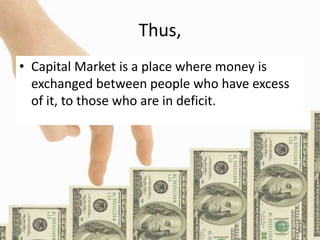
• Capital Market is a place where money is
exchanged between people who have excess
of it, to those who are in deficit.
EXAMPLE
Wants to
expand
business
ACE Textiles PVT. Ltd.
Mr. Ace
Makes a Business Deal with GUCCI
brand to export textile cloth to their
manufacturing unit
Where can he get the money from?
1. From Banks
Mr. Ace can approach banks, but it will
not prove to be a healthy option because:
-Bank will charge him High rate of
interest.
- Lending of loans is a very tedious task.
Bank first scrutinizes the papers/
documents, verifies them.
- Very time Consuming Process.
Thus, this idea is not an effective one.
2. Can Go Public and
get listed on the
stock companies.
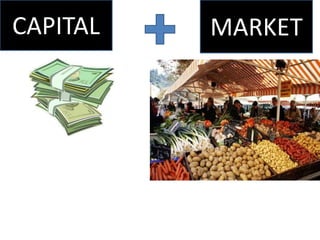
Meaning of Capital Market
• Capital Market is the part of financial
system which is concerned with raising
capital funds by dealing in Shares, Bonds,
and other long-term investments.
• The market where Investment instruments
like bonds, equities and mortgages are
traded is known as the capital market.
• The different types of financial instruments that
are traded in the capital markets are:
1. equity instruments
2. credit market instruments,
3. insurance instruments,
4. foreign exchange instruments,
5. hybrid instruments.
Significance ,Role or functions of
Capital Market
• Mobilization of Savings
• Capital Formation
• Provision of Investment Avenue
• Speed up Economic Growth and Development
• Proper Regulation of Funds
• Service Provision
MAJOR SUPPLIERS OF FUNDS
IN THE CAPITAL MARKET
1. COMMERCIAL BANKS.
2. INSURANCE COMPANIES.
3. BUSINESS CORPORATIONS.
4. RETREMENT FUNDS.
MAJOR BORROWERS IN THE CAPITAL
MARKET
1. TREASURY DEPARTMENTS.
2. CORPORATIONS.
3. SECURITIES DEALERS.
Types of capital market
There are two types of capital market:
 Primary market,
 Secondary market
Primary Market
 It is that market in which shares,
debentures and other securities are sold
for the first time for collecting long-term
capital.
 This market is concerned with new
issues. Therefore, the primary market is
also called NEW ISSUE MARKET.
Secondary Market
The secondary market is that
market in which the buying and
selling of the previously issued
securities is done.
CAPITAL MARKET INVESTMENT
 Capital market investment takes place through
the bond market and the stock market.
 The capital market is basically the financial
pool in which different companies as well as
the government can raise long term funds.
Capital market investments in the
stock market
 The stock market is basically the trading
ground capital market investment in the
following:
i) Company’s stocks
ii) Derivatives
iii) Other securities
 The capital market investments in the stock
market take place by:
1) Small individual stock investors
2) Large hedge fund traders.
STOCK EXCHANGE COMPANIES
• If an individual has some financial security and
he wills to sell it, he can approach the Stock
Exchange Companies which will help him to
sell or purchase his security by the means of a
Broker.
• There are 23 stock exchanges in India.
• In India we have Bombay stock exchange ,
National stock exchange and the rest 21 are
Regional stock exchanges.
STOCK EXCHANGE PLATFORM
• There are three types of exchange platforms in
India:
1. Domestic Exchanges;
2. Regulatory Based.
3. International Exchanges;
Domestic Exchanges
• Indian equities are traded on three
major national exchanges:
1. MCX Stock Exchange Limited (MCX-
SX),
2. Bombay Stock Exchange Limited
(BSE) and
3. National Stock Exchange of India
Limited (NSE).
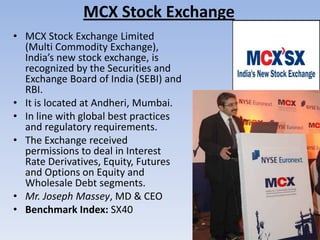
MCX Stock Exchange
• MCX Stock Exchange Limited
(Multi Commodity Exchange),
India’s new stock exchange, is
recognized by the Securities and
Exchange Board of India (SEBI) and
RBI.
• It is located at Andheri, Mumbai.
• In line with global best practices
and regulatory requirements.
• The Exchange received
permissions to deal in Interest
Rate Derivatives, Equity, Futures
and Options on Equity and
Wholesale Debt segments.
• Mr. Joseph Massey, MD & CEO
• Benchmark Index: SX40
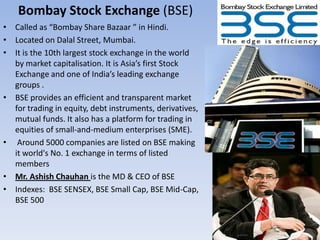
Bombay Stock Exchange (BSE)
• Called as “Bombay Share Bazaar ” in Hindi.
• Located on Dalal Street, Mumbai.
• It is the 10th largest stock exchange in the world
by market capitalisation. It is Asia’s first Stock
Exchange and one of India’s leading exchange
groups .
• BSE provides an efficient and transparent market
for trading in equity, debt instruments, derivatives,
mutual funds. It also has a platform for trading in
equities of small-and-medium enterprises (SME).
• Around 5000 companies are listed on BSE making
it world's No. 1 exchange in terms of listed
members
• Mr. Ashish Chauhan is the MD & CEO of BSE
• Indexes: BSE SENSEX, BSE Small Cap, BSE Mid-Cap,
BSE 500
National Stock Exchange (NSE)
• NSE is called as “Rashtriya Share
Bazaar” in hindi & is Located in
Mumbai.
• It is the 11th largest stock
exchange in the world.
• NSE is mutually owned by a set of
leading financial institutions, banks,
insurance companies and other
financial intermediaries in India.
• The NSE's key index is the S&P CNX
Nifty, known as the
NSE NIFTY (National Stock Exchange
Fifty), an index of fifty major stocks
weighted by market capitalisation.
• Chitra Ramakrishna is the Managing
Director and CEO of National Stock
Exchange of India (NSE).
Other 21 Regional Stock Exchanges in India
• Bombay Stock Exchange
• National Stock Exchange
• Ahmedabad Stock Exchange
• Bangalore Stock Exchange
• Bhubaneshwar Stock Exchange
• Calcutta Stock Exchange
• Cochin Stock Exchange
• Coimbatore Stock Exchange
• Delhi Stock Exchange
• Guwahati Stock Exchange
• Hyderabad Stock Exchange
• Jaipur Stock Exchange
• Ludhiana Stock Exchange
• Madhya Pradesh Stock
Exchange
• Madras Stock Exchange
• Magadh Stock Exchange
• Mangalore Stock Exchange
• Meerut Stock Exchange
• OTC Exchange Of India
• Pune Stock Exchange
• Saurashtra Kutch Stock
Exchange
• Uttar Pradesh Stock Exchange
• Vadodara Stock Exchange
REGULATORY AUTHORITY
• Regulatory authority is the one which is under
the government surveillance.
• A few Stock Exchange companies follow the
rules which are laid down by the government
of India.
• Example:
1) SEBI:- (Securities Exchange Board of India)
2) RBI:- (Reserve Bank of India)
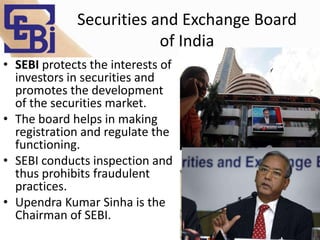
Securities and Exchange Board
of India
• SEBI protects the interests of
investors in securities and
promotes the development
of the securities market.
• The board helps in making
registration and regulate the
functioning.
• SEBI conducts inspection and
thus prohibits fraudulent
practices.
• Upendra Kumar Sinha is the
Chairman of SEBI.
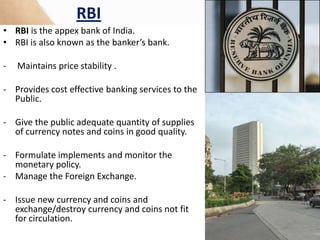
RBI
• RBI is the appex bank of India.
• RBI is also known as the banker’s bank.
- Maintains price stability .
- Provides cost effective banking services to the
Public.
- Give the public adequate quantity of supplies
of currency notes and coins in good quality.
- Formulate implements and monitor the
monetary policy.
- Manage the Foreign Exchange.
- Issue new currency and coins and
exchange/destroy currency and coins not fit
for circulation.
International Exchanges
• Due to increasing globalization, There is a rising
competition amongst various countries to keep their
market stable.
• Therefore, it is important to keep track of international
financial markets for better perspective and intelligent
investment.
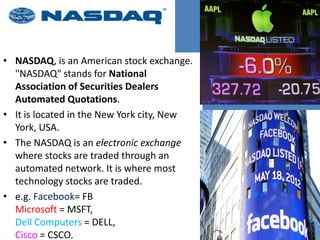
• NASDAQ, is an American stock exchange.
"NASDAQ" stands for National
Association of Securities Dealers
Automated Quotations.
• It is located in the New York city, New
York, USA.
• The NASDAQ is an electronic exchange
where stocks are traded through an
automated network. It is where most
technology stocks are traded.
• e.g. Facebook= FB
Microsoft = MSFT,
Dell Computers = DELL,
Cisco = CSCO.
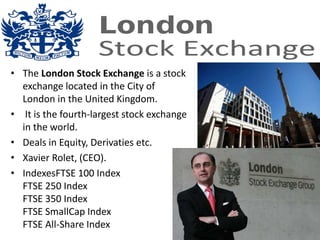
• The London Stock Exchange is a stock
exchange located in the City of
London in the United Kingdom.
• It is the fourth-largest stock exchange
in the world.
• Deals in Equity, Derivaties etc.
• Xavier Rolet, (CEO).
• IndexesFTSE 100 Index
FTSE 250 Index
FTSE 350 Index
FTSE SmallCap Index
FTSE All-Share Index
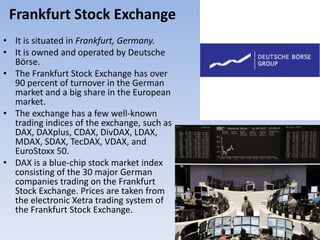
Frankfurt Stock Exchange
• It is situated in Frankfurt, Germany.
• It is owned and operated by Deutsche
Börse.
• The Frankfurt Stock Exchange has over
90 percent of turnover in the German
market and a big share in the European
market.
• The exchange has a few well-known
trading indices of the exchange, such as
DAX, DAXplus, CDAX, DivDAX, LDAX,
MDAX, SDAX, TecDAX, VDAX, and
EuroStoxx 50.
• DAX is a blue-chip stock market index
consisting of the 30 major German
companies trading on the Frankfurt
Stock Exchange. Prices are taken from
the electronic Xetra trading system of
the Frankfurt Stock Exchange.
Various NEWS Channels which telecast the
Stock Prices on television.
CONCLUSION
• The lack of an advanced and vibrant capital
market can lead to underutilization of
financial resources. The developed capital
market also provides access to the foreign
capital for domestic industry. Thus capital
market definitely plays a constructive role in
the over all development of an economy.
Capital Market

Capital Market

  • 1.
  • 2.
  • 3.
    Thus, • Capital Marketis a place where money is exchanged between people who have excess of it, to those who are in deficit.
  • 4.
  • 5.
  • 6.
    Makes a BusinessDeal with GUCCI brand to export textile cloth to their manufacturing unit
  • 7.
    Where can heget the money from?
  • 8.
    1. From Banks Mr.Ace can approach banks, but it will not prove to be a healthy option because: -Bank will charge him High rate of interest. - Lending of loans is a very tedious task. Bank first scrutinizes the papers/ documents, verifies them. - Very time Consuming Process. Thus, this idea is not an effective one.
  • 9.
    2. Can GoPublic and get listed on the stock companies.
  • 10.
    Meaning of CapitalMarket • Capital Market is the part of financial system which is concerned with raising capital funds by dealing in Shares, Bonds, and other long-term investments. • The market where Investment instruments like bonds, equities and mortgages are traded is known as the capital market.
  • 11.
    • The differenttypes of financial instruments that are traded in the capital markets are: 1. equity instruments 2. credit market instruments, 3. insurance instruments, 4. foreign exchange instruments, 5. hybrid instruments.
  • 12.
    Significance ,Role orfunctions of Capital Market • Mobilization of Savings • Capital Formation • Provision of Investment Avenue • Speed up Economic Growth and Development • Proper Regulation of Funds • Service Provision
  • 13.
    MAJOR SUPPLIERS OFFUNDS IN THE CAPITAL MARKET 1. COMMERCIAL BANKS. 2. INSURANCE COMPANIES. 3. BUSINESS CORPORATIONS. 4. RETREMENT FUNDS.
  • 14.
    MAJOR BORROWERS INTHE CAPITAL MARKET 1. TREASURY DEPARTMENTS. 2. CORPORATIONS. 3. SECURITIES DEALERS.
  • 15.
    Types of capitalmarket There are two types of capital market:  Primary market,  Secondary market
  • 16.
    Primary Market  Itis that market in which shares, debentures and other securities are sold for the first time for collecting long-term capital.  This market is concerned with new issues. Therefore, the primary market is also called NEW ISSUE MARKET.
  • 17.
    Secondary Market The secondarymarket is that market in which the buying and selling of the previously issued securities is done.
  • 18.
    CAPITAL MARKET INVESTMENT Capital market investment takes place through the bond market and the stock market.  The capital market is basically the financial pool in which different companies as well as the government can raise long term funds.
  • 19.
    Capital market investmentsin the stock market  The stock market is basically the trading ground capital market investment in the following: i) Company’s stocks ii) Derivatives iii) Other securities  The capital market investments in the stock market take place by: 1) Small individual stock investors 2) Large hedge fund traders.
  • 20.
    STOCK EXCHANGE COMPANIES •If an individual has some financial security and he wills to sell it, he can approach the Stock Exchange Companies which will help him to sell or purchase his security by the means of a Broker. • There are 23 stock exchanges in India. • In India we have Bombay stock exchange , National stock exchange and the rest 21 are Regional stock exchanges.
  • 21.
    STOCK EXCHANGE PLATFORM •There are three types of exchange platforms in India: 1. Domestic Exchanges; 2. Regulatory Based. 3. International Exchanges;
  • 22.
    Domestic Exchanges • Indianequities are traded on three major national exchanges: 1. MCX Stock Exchange Limited (MCX- SX), 2. Bombay Stock Exchange Limited (BSE) and 3. National Stock Exchange of India Limited (NSE).
  • 23.
    MCX Stock Exchange •MCX Stock Exchange Limited (Multi Commodity Exchange), India’s new stock exchange, is recognized by the Securities and Exchange Board of India (SEBI) and RBI. • It is located at Andheri, Mumbai. • In line with global best practices and regulatory requirements. • The Exchange received permissions to deal in Interest Rate Derivatives, Equity, Futures and Options on Equity and Wholesale Debt segments. • Mr. Joseph Massey, MD & CEO • Benchmark Index: SX40
  • 24.
    Bombay Stock Exchange(BSE) • Called as “Bombay Share Bazaar ” in Hindi. • Located on Dalal Street, Mumbai. • It is the 10th largest stock exchange in the world by market capitalisation. It is Asia’s first Stock Exchange and one of India’s leading exchange groups . • BSE provides an efficient and transparent market for trading in equity, debt instruments, derivatives, mutual funds. It also has a platform for trading in equities of small-and-medium enterprises (SME). • Around 5000 companies are listed on BSE making it world's No. 1 exchange in terms of listed members • Mr. Ashish Chauhan is the MD & CEO of BSE • Indexes: BSE SENSEX, BSE Small Cap, BSE Mid-Cap, BSE 500
  • 25.
    National Stock Exchange(NSE) • NSE is called as “Rashtriya Share Bazaar” in hindi & is Located in Mumbai. • It is the 11th largest stock exchange in the world. • NSE is mutually owned by a set of leading financial institutions, banks, insurance companies and other financial intermediaries in India. • The NSE's key index is the S&P CNX Nifty, known as the NSE NIFTY (National Stock Exchange Fifty), an index of fifty major stocks weighted by market capitalisation. • Chitra Ramakrishna is the Managing Director and CEO of National Stock Exchange of India (NSE).
  • 26.
    Other 21 RegionalStock Exchanges in India • Bombay Stock Exchange • National Stock Exchange • Ahmedabad Stock Exchange • Bangalore Stock Exchange • Bhubaneshwar Stock Exchange • Calcutta Stock Exchange • Cochin Stock Exchange • Coimbatore Stock Exchange • Delhi Stock Exchange • Guwahati Stock Exchange • Hyderabad Stock Exchange • Jaipur Stock Exchange • Ludhiana Stock Exchange • Madhya Pradesh Stock Exchange • Madras Stock Exchange • Magadh Stock Exchange • Mangalore Stock Exchange • Meerut Stock Exchange • OTC Exchange Of India • Pune Stock Exchange • Saurashtra Kutch Stock Exchange • Uttar Pradesh Stock Exchange • Vadodara Stock Exchange
  • 27.
    REGULATORY AUTHORITY • Regulatoryauthority is the one which is under the government surveillance. • A few Stock Exchange companies follow the rules which are laid down by the government of India. • Example: 1) SEBI:- (Securities Exchange Board of India) 2) RBI:- (Reserve Bank of India)
  • 28.
    Securities and ExchangeBoard of India • SEBI protects the interests of investors in securities and promotes the development of the securities market. • The board helps in making registration and regulate the functioning. • SEBI conducts inspection and thus prohibits fraudulent practices. • Upendra Kumar Sinha is the Chairman of SEBI.
  • 29.
    RBI • RBI isthe appex bank of India. • RBI is also known as the banker’s bank. - Maintains price stability . - Provides cost effective banking services to the Public. - Give the public adequate quantity of supplies of currency notes and coins in good quality. - Formulate implements and monitor the monetary policy. - Manage the Foreign Exchange. - Issue new currency and coins and exchange/destroy currency and coins not fit for circulation.
  • 30.
    International Exchanges • Dueto increasing globalization, There is a rising competition amongst various countries to keep their market stable. • Therefore, it is important to keep track of international financial markets for better perspective and intelligent investment.
  • 31.
    • NASDAQ, isan American stock exchange. "NASDAQ" stands for National Association of Securities Dealers Automated Quotations. • It is located in the New York city, New York, USA. • The NASDAQ is an electronic exchange where stocks are traded through an automated network. It is where most technology stocks are traded. • e.g. Facebook= FB Microsoft = MSFT, Dell Computers = DELL, Cisco = CSCO.
  • 32.
    • The LondonStock Exchange is a stock exchange located in the City of London in the United Kingdom. • It is the fourth-largest stock exchange in the world. • Deals in Equity, Derivaties etc. • Xavier Rolet, (CEO). • IndexesFTSE 100 Index FTSE 250 Index FTSE 350 Index FTSE SmallCap Index FTSE All-Share Index
  • 33.
    Frankfurt Stock Exchange •It is situated in Frankfurt, Germany. • It is owned and operated by Deutsche Börse. • The Frankfurt Stock Exchange has over 90 percent of turnover in the German market and a big share in the European market. • The exchange has a few well-known trading indices of the exchange, such as DAX, DAXplus, CDAX, DivDAX, LDAX, MDAX, SDAX, TecDAX, VDAX, and EuroStoxx 50. • DAX is a blue-chip stock market index consisting of the 30 major German companies trading on the Frankfurt Stock Exchange. Prices are taken from the electronic Xetra trading system of the Frankfurt Stock Exchange.
  • 34.
    Various NEWS Channelswhich telecast the Stock Prices on television.
  • 35.
    CONCLUSION • The lackof an advanced and vibrant capital market can lead to underutilization of financial resources. The developed capital market also provides access to the foreign capital for domestic industry. Thus capital market definitely plays a constructive role in the over all development of an economy.