Conventional Sources of Long Term Finance
Prepared By:
Mohammed Jasir PV
Assist. Professor
MIIMS, Puthanangadi
Contact: 9605 69 32 66
Topics
• Sources of long term finance
– Conventional Sources
Introduction
 Finance is defined as the provision of money at the time when
it is required
 Various sources
 Big, medium or small business needs finance
 Capital required for a business - two categories
 Fixed Capital
 Working capital
Why Finance is required?
 To Start a business
 To Expansions to production capacity
 To develop and market new products
 To enter new markets
 To pay for the day to day running of business
Sources of Finance
• Short Term Finance
• Long Term Finance
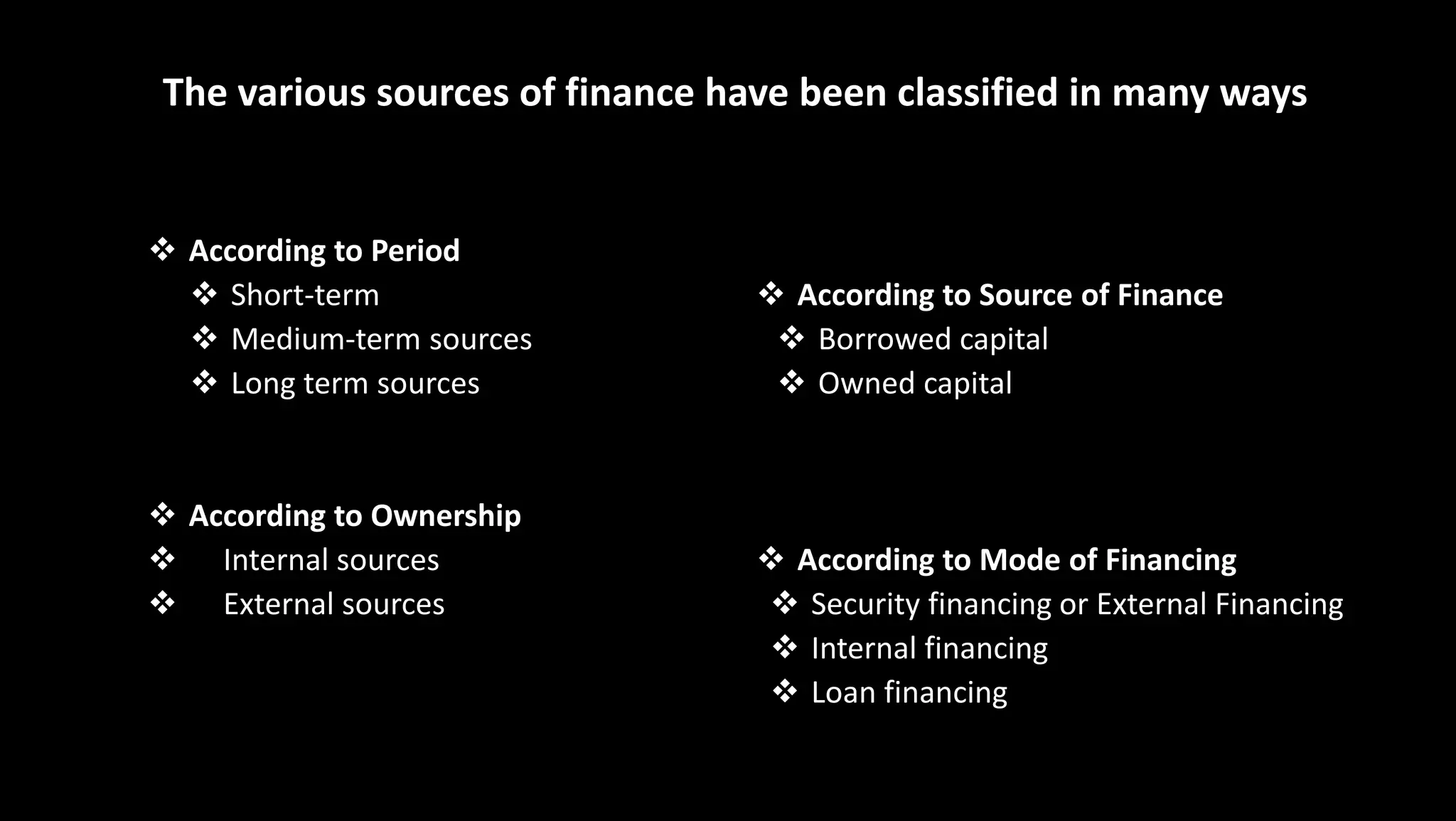
The various sources of finance have been classified in many ways
 According to Period
 Short-term
 Medium-term sources
 Long term sources
 According to Ownership
 Internal sources
 External sources
 According to Source of Finance
 Borrowed capital
 Owned capital
 According to Mode of Financing
 Security financing or External Financing
 Internal financing
 Loan financing
Purpose of long term finance
1. Finance fixed assets
2. To finance the permanent part of working capital
3. To finance growth and expansion of business
Factors determining long-term financial requirements
• Nature of Business
• Nature of goods produced
• Technology used
Major Source of Long Term Finance
 Shares
 Debentures
 Retain Earning
 Deferred Credit
 Term Loans
Shares
 Issue of shares is the main source of long term finance
 Shares are issued to the public
 A company divides its capital into units of a definite face value
 Each unit is called a share
 A person holding shares is called a shareholder
 A company may issue different types of shares
 These may be of two types
= Equity
= Preference
Characteristics of shares
1. It is a unit of capital of the company
2. Each share is a definite face value
3. Shares are transferable units
4. Share certificate is issued to a shareholder
5. The face value of a share indicates the interest of a person in the
company and the extent of his liability
Two types of shares
1. Preference Shares
2. Equity Shares
Preference Shares
• These shares carry preferential rights over the equity shares
• These rights are
• Receiving dividends at a fixed rate
• Getting back the capital in case the company is wound-up
• Investment in these shares are safe
• A preference shareholder also gets dividend regularly
• Less Risky
Types of Preference Shares
• Cumulative or non- cumulative
• Redeemable or irredeemable
• Participating or non- participating
• Convertible or non- convertible
• Cumulative & Non- Cumulative
The holder of cumulative preference shares are entitled to recover the arrears of
preference dividend before any dividend is paid on equity shares.
• In case of non- cumulative preference shares, arrears of dividend do not
accumulate and hence, if dividend is to be paid on equity shareholders in any
year, dividend at the fixed rate for only one year will have to be paid to
preference shareholders before equity dividend is paid.
Redeemable & Irredeemable
• Redeemable preference shares are those preference shares whose
amount can be returned by the company to their holder within the life
time of the company subject to the terms of the issue and the fulfillment
of certain legal conditions
• The amount of irredeemable preference shares can be returned only
when the company is wound up.
Participating & Nonparticipating
• Participating preference shares are entitled not only to fixed rate of
dividend but also to a share in surplus profits which remain after dividend
has been paid at a certain rate to equity shareholders
• The surplus profits are distributed in a certain agreed ratio between the
participating preference shareholder and equity shareholder
• Non- participating preference shares are entitled to only the fixed rate of
dividend.
Convertible & Non- convertible
• The holder of convertible preference shares enjoy the right to get the
preference shares converted into equity shares according to the terms of issue.
• The holder of non- convertible preference share do not enjoy this right.
Equity Shares
• Shares do not enjoy any preferential right (Dividend or Capital)
• There is no fixed rate of dividend
• The rate of dividend depends upon the surplus profits
• Gets dividend only after the payment of dividends to the preference shares
• In case of winding up of a company, the equity share capital is refunded
only after refunding the preference share capital.
• High Risk
• Voting rate
• Managerial roles
Merits : To the shareholders
1. High profit – High return
2. The value of equity shares goes up in the stock market with the
increase in profits of the concern
3. Easily trade in the stock market
4. Greater role in the management
5. Voting rights
To the Management
 Creating no charges on its fixed assets
 No pay back during the life time of the company
 No liability on payment of dividend
 Leads to greater confidence among the investors and creditors
To the Management
 Raise fixed capital without creating any charge on its fixed assets
 Not required to be paid back during the life time of the company. It will be
paid back only if the company is wound up
 There is no liability on the company regarding payment of dividend on
equity shares. The company may declare dividend only if there are
enough profits
 If a company raises more capital by issuing equity shares, it leads to
greater confidence among the investors and creditors
Debentures
Debenture
• It’s a medium to long-term debt instrument used by a large
companies to borrow money, at a fixed rate of interest
• Issue of Loan Certificate given to public
• Issued under the common seal of the company
• It is a written acknowledgement of money borrowed
Debentures
• Whenever a company wants to borrow a large amount of fund for a long but fixed
period, it can borrow from the general public by issuing loan certificates called
Debentures.
• It is a written acknowledgement of money borrowed.
• It specifies the terms and conditions, such as rate of interest, time repayment,
security offered, etc.
• The total amount to be borrowed is divided into units of fixed amount. these units
are called Debentures.
• These are offered to the public to subscribe in the same manner as is done in the
case of shares.
• A debenture is issued under the common seal of the company.
Characteristics of Debenture
 Holders are the creditors of the company
 Holders do not carry voting rights
 Debentures are secured
 Debentures are repayable after a fixed period of time
Types of Debenture
 Redeemable Debentures
 Irredeemable Debentures
 Convertible Debentures
 Non-convertible Debentures
 Secured or Mortgaged Debentures
 Simple, Naked or Unsecured Debentures
Types of Debentures
a) Redeemable Debentures and Irredeemable Debentures
b) Convertible Debentures and Non-convertible Debentures.
• Redeemable Debentures :
These are debentures repayable on a pre-determined date or at any time prior to
their maturity, provided the company so desires and gives a notice to that effect.
• Irredeemable Debentures :
These are also called perpetual debentures. Accompany is not bound to repay the
amount during its life time. If the issuing company fails to pay the interest, it has
to redeem such debentures.
Contd.
Convertible Debentures :
The holders of these debentures are given the option to convert their
debentures into equity shares at a time and in a ratio as decided by the
company.
Non-convertible Debentures:
These debentures cannot be converted into shares.
Other types
– (a) Simple, Naked or Unsecured Debentures. These debentures are not given any
security on assets. They have no priority as compared to other creditors.
– (b) Secured or Mortgaged Debentures. These debentures are given security on
assets of the company. In case of default in the payment of interest or principal
amount, debenture holders can sell the assets in order to satisfy their claims.
Retained Earnings
Retained Earnings
• The undistributed profit is called retained earnings
• The portion of the profits which is not distributed among the
shareholders but is retained and is used in business is called
retained earnings
• In simple “Ploughing back of profits”
• This is called internal financing
• As per Indian Companies Act., companies are required to transfer a
part of their profits in reserves
• The amount so kept in reserve may be used to buy fixed assets
Retained Earnings
• Like an individual, companies also set aside a part of their profits to meet
future requirements of capital.
• Companies keep these savings in various accounts such as General Reserve,
Debenture Redemption Reserve and Dividend Equalization Reserve etc.
• These reserves can be used to meet long term financial requirements.
• The portion of the profits which is not distributed among the shareholders but
is retained and is used in business is called retained earnings or ploughing back
of profits.
Benefits and Limitation of Retained Earnings
Benefits
• Cheap Source of Capital
• Financial stability
• Benefits to the shareholders
Limitation
• Only when having huge profit
• Dissatisfaction among shareholders
• Fear of monopoly
• Mismanagement of funds
Merits
• 1. Cheap Source of Capital : No expenses are incurred when capital is
available from this source. There is no obligation on the part of the company
either to pay interest or pay back the money. It can safely be used for
expansion and modernization of business.
• 2. Financial stability : A company which has enough reserves can face ups
and downs in business. Such companies can continue with their business
even in depression, thus building up its goodwill.
3. Benefits to the shareholders
Shareholders may get dividend from reserves even if the company does
not earn enough profit.
Due to reserves, there is capital appreciation, i.e. the value of shares go
up in the share market .
Limitation
1. Huge Profit : This method of financing is possible only when there are
huge profits and that too for many years.
2.Dissatisfaction among shareholders : When funds accumulate in
reserves, bonus shares are issued to the shareholders to capitalize
such funds.
Hence the company has to pay more dividends.
In case bonus shares are not issued, it may create a situation of under
– capitalisation because the rate of dividend will be much higher as
compared to other companies.
3. Fear of monopoly : Through ploughing back of profits, companies increase
their financial strength. Companies may throw out their competitors from
the market and monopolize their position.
4. Mismanagement of funds : Capital accumulated through retained earnings
encourages management to spend carelessly.
Deferred Credit
Deferred Credit
• Small and easy source
• A deferred credit could mean money received in advance of it
being earned
• Eg. Deferred revenue, unearned revenue, or customer advances
Term Loans
Term Loans
• It’s a loan made by bank/financial institution to a business having
an initial maturity of more than one year
• A term loan is a monetary loan that is repaid in regular payments
over a set period of time
• Term loans usually last between one and ten years, but may last as
long as 30 years in some cases
Thank You

Conventional sources of long term finance

  • 1.
    Conventional Sources ofLong Term Finance Prepared By: Mohammed Jasir PV Assist. Professor MIIMS, Puthanangadi Contact: 9605 69 32 66
  • 2.
    Topics • Sources oflong term finance – Conventional Sources
  • 3.
    Introduction  Finance isdefined as the provision of money at the time when it is required  Various sources  Big, medium or small business needs finance  Capital required for a business - two categories  Fixed Capital  Working capital
  • 4.
    Why Finance isrequired?  To Start a business  To Expansions to production capacity  To develop and market new products  To enter new markets  To pay for the day to day running of business
  • 5.
    Sources of Finance •Short Term Finance • Long Term Finance
  • 6.
    The various sourcesof finance have been classified in many ways  According to Period  Short-term  Medium-term sources  Long term sources  According to Ownership  Internal sources  External sources  According to Source of Finance  Borrowed capital  Owned capital  According to Mode of Financing  Security financing or External Financing  Internal financing  Loan financing
  • 7.
    Purpose of longterm finance 1. Finance fixed assets 2. To finance the permanent part of working capital 3. To finance growth and expansion of business
  • 8.
    Factors determining long-termfinancial requirements • Nature of Business • Nature of goods produced • Technology used
  • 9.
    Major Source ofLong Term Finance  Shares  Debentures  Retain Earning  Deferred Credit  Term Loans
  • 10.
    Shares  Issue ofshares is the main source of long term finance  Shares are issued to the public  A company divides its capital into units of a definite face value  Each unit is called a share  A person holding shares is called a shareholder  A company may issue different types of shares  These may be of two types = Equity = Preference
  • 11.
    Characteristics of shares 1.It is a unit of capital of the company 2. Each share is a definite face value 3. Shares are transferable units 4. Share certificate is issued to a shareholder 5. The face value of a share indicates the interest of a person in the company and the extent of his liability
  • 12.
    Two types ofshares 1. Preference Shares 2. Equity Shares
  • 13.
    Preference Shares • Theseshares carry preferential rights over the equity shares • These rights are • Receiving dividends at a fixed rate • Getting back the capital in case the company is wound-up • Investment in these shares are safe • A preference shareholder also gets dividend regularly • Less Risky
  • 14.
    Types of PreferenceShares • Cumulative or non- cumulative • Redeemable or irredeemable • Participating or non- participating • Convertible or non- convertible
  • 15.
    • Cumulative &Non- Cumulative The holder of cumulative preference shares are entitled to recover the arrears of preference dividend before any dividend is paid on equity shares. • In case of non- cumulative preference shares, arrears of dividend do not accumulate and hence, if dividend is to be paid on equity shareholders in any year, dividend at the fixed rate for only one year will have to be paid to preference shareholders before equity dividend is paid.
  • 16.
    Redeemable & Irredeemable •Redeemable preference shares are those preference shares whose amount can be returned by the company to their holder within the life time of the company subject to the terms of the issue and the fulfillment of certain legal conditions • The amount of irredeemable preference shares can be returned only when the company is wound up.
  • 17.
    Participating & Nonparticipating •Participating preference shares are entitled not only to fixed rate of dividend but also to a share in surplus profits which remain after dividend has been paid at a certain rate to equity shareholders • The surplus profits are distributed in a certain agreed ratio between the participating preference shareholder and equity shareholder • Non- participating preference shares are entitled to only the fixed rate of dividend.
  • 18.
    Convertible & Non-convertible • The holder of convertible preference shares enjoy the right to get the preference shares converted into equity shares according to the terms of issue. • The holder of non- convertible preference share do not enjoy this right.
  • 19.
    Equity Shares • Sharesdo not enjoy any preferential right (Dividend or Capital) • There is no fixed rate of dividend • The rate of dividend depends upon the surplus profits • Gets dividend only after the payment of dividends to the preference shares • In case of winding up of a company, the equity share capital is refunded only after refunding the preference share capital. • High Risk • Voting rate • Managerial roles
  • 20.
    Merits : Tothe shareholders 1. High profit – High return 2. The value of equity shares goes up in the stock market with the increase in profits of the concern 3. Easily trade in the stock market 4. Greater role in the management 5. Voting rights
  • 21.
    To the Management Creating no charges on its fixed assets  No pay back during the life time of the company  No liability on payment of dividend  Leads to greater confidence among the investors and creditors
  • 22.
    To the Management Raise fixed capital without creating any charge on its fixed assets  Not required to be paid back during the life time of the company. It will be paid back only if the company is wound up  There is no liability on the company regarding payment of dividend on equity shares. The company may declare dividend only if there are enough profits  If a company raises more capital by issuing equity shares, it leads to greater confidence among the investors and creditors
  • 23.
  • 24.
    Debenture • It’s amedium to long-term debt instrument used by a large companies to borrow money, at a fixed rate of interest • Issue of Loan Certificate given to public • Issued under the common seal of the company • It is a written acknowledgement of money borrowed
  • 26.
    Debentures • Whenever acompany wants to borrow a large amount of fund for a long but fixed period, it can borrow from the general public by issuing loan certificates called Debentures. • It is a written acknowledgement of money borrowed. • It specifies the terms and conditions, such as rate of interest, time repayment, security offered, etc. • The total amount to be borrowed is divided into units of fixed amount. these units are called Debentures. • These are offered to the public to subscribe in the same manner as is done in the case of shares. • A debenture is issued under the common seal of the company.
  • 27.
    Characteristics of Debenture Holders are the creditors of the company  Holders do not carry voting rights  Debentures are secured  Debentures are repayable after a fixed period of time
  • 28.
    Types of Debenture Redeemable Debentures  Irredeemable Debentures  Convertible Debentures  Non-convertible Debentures  Secured or Mortgaged Debentures  Simple, Naked or Unsecured Debentures
  • 29.
    Types of Debentures a)Redeemable Debentures and Irredeemable Debentures b) Convertible Debentures and Non-convertible Debentures. • Redeemable Debentures : These are debentures repayable on a pre-determined date or at any time prior to their maturity, provided the company so desires and gives a notice to that effect. • Irredeemable Debentures : These are also called perpetual debentures. Accompany is not bound to repay the amount during its life time. If the issuing company fails to pay the interest, it has to redeem such debentures.
  • 30.
    Contd. Convertible Debentures : Theholders of these debentures are given the option to convert their debentures into equity shares at a time and in a ratio as decided by the company. Non-convertible Debentures: These debentures cannot be converted into shares.
  • 31.
    Other types – (a)Simple, Naked or Unsecured Debentures. These debentures are not given any security on assets. They have no priority as compared to other creditors. – (b) Secured or Mortgaged Debentures. These debentures are given security on assets of the company. In case of default in the payment of interest or principal amount, debenture holders can sell the assets in order to satisfy their claims.
  • 32.
  • 33.
    Retained Earnings • Theundistributed profit is called retained earnings • The portion of the profits which is not distributed among the shareholders but is retained and is used in business is called retained earnings • In simple “Ploughing back of profits” • This is called internal financing • As per Indian Companies Act., companies are required to transfer a part of their profits in reserves • The amount so kept in reserve may be used to buy fixed assets
  • 34.
    Retained Earnings • Likean individual, companies also set aside a part of their profits to meet future requirements of capital. • Companies keep these savings in various accounts such as General Reserve, Debenture Redemption Reserve and Dividend Equalization Reserve etc. • These reserves can be used to meet long term financial requirements. • The portion of the profits which is not distributed among the shareholders but is retained and is used in business is called retained earnings or ploughing back of profits.
  • 35.
    Benefits and Limitationof Retained Earnings Benefits • Cheap Source of Capital • Financial stability • Benefits to the shareholders Limitation • Only when having huge profit • Dissatisfaction among shareholders • Fear of monopoly • Mismanagement of funds
  • 36.
    Merits • 1. CheapSource of Capital : No expenses are incurred when capital is available from this source. There is no obligation on the part of the company either to pay interest or pay back the money. It can safely be used for expansion and modernization of business. • 2. Financial stability : A company which has enough reserves can face ups and downs in business. Such companies can continue with their business even in depression, thus building up its goodwill.
  • 37.
    3. Benefits tothe shareholders Shareholders may get dividend from reserves even if the company does not earn enough profit. Due to reserves, there is capital appreciation, i.e. the value of shares go up in the share market .
  • 38.
    Limitation 1. Huge Profit: This method of financing is possible only when there are huge profits and that too for many years. 2.Dissatisfaction among shareholders : When funds accumulate in reserves, bonus shares are issued to the shareholders to capitalize such funds. Hence the company has to pay more dividends. In case bonus shares are not issued, it may create a situation of under – capitalisation because the rate of dividend will be much higher as compared to other companies.
  • 39.
    3. Fear ofmonopoly : Through ploughing back of profits, companies increase their financial strength. Companies may throw out their competitors from the market and monopolize their position. 4. Mismanagement of funds : Capital accumulated through retained earnings encourages management to spend carelessly.
  • 40.
  • 41.
    Deferred Credit • Smalland easy source • A deferred credit could mean money received in advance of it being earned • Eg. Deferred revenue, unearned revenue, or customer advances
  • 42.
  • 43.
    Term Loans • It’sa loan made by bank/financial institution to a business having an initial maturity of more than one year • A term loan is a monetary loan that is repaid in regular payments over a set period of time • Term loans usually last between one and ten years, but may last as long as 30 years in some cases
  • 44.