Meaning of Capital market:
• The term 'capital market' refers to the
institutional arrangements for facilitating
the borrowing and lending of long-term
funds.
Example: Equity share, Debenture, Bond etc
Definition of capital market:
• According to M.Y. Khan, "It is a
market for long-term funds. Its focus is
on financing of fixed investments in
contrast to money market which is the
institutional source of working capital
finance".
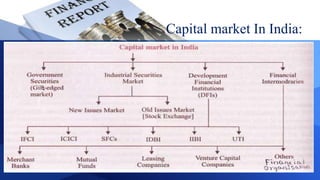
Capital market In India:
What are the Features of Indian Capital
Market?
• Securities Market
• Security Prices
• Participants
• Location
What are the functions of Capital Market?
• Liquidity Function
• Allocation Function
• Merger Function
• Transfer Function
• Indicative Function
• Savings and Investment Function
Primary Market:
• The primary market represents the new issue
market where new securities, i.e. shares or
bonds that have-never been previously issued,
are offered. Both the new companies and the
existing ones can raise capital on the new issue
market.
Secondary Market:
• The secondary market, also known as the 'aftermarket', is the
financial market where previously issued securities and
financial instruments such as stock, bonds, options and futures
are bought and sold. The term "secondary market" is also used
to refer to refer to the market for any used goods or assets or
an alternative use for an existing product or asset where the
customer base is the second market.
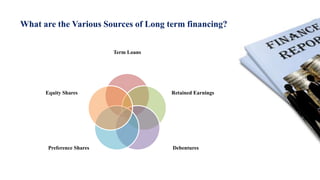
What are the Various Sources of Long term financing?
Term Loans
Retained Earnings
Debentures
Preference Shares
Equity Shares
What do you mean by shares?
• The capital of a company is divided into different units called Shares. A share
is the movable property of a shareholder and he has a liberty to transfer his share in
the manner prescribed by the Articles of the company. Its distinct number
distinguishes each share of a company.
Equity Shares
• Equity shares are, earlier, known as ordinary
shares or common shares. Equity shareholders
are the real owners of the company as they
have the voting rights and enjoy decision-
making authority on important matters, related
to the company.
What are the characteristics of equity shares?
• Maturity
• Claims / rights to income
• Claim on assets
• Right to control / voting rights
• Pre-emptive rights
• Limited liability
Advantages of equity shares:
• Advantage to investors
• Capital profit
• Interest in the company’s activities
• Best for investment
• More income
• Right to interfere in management
• Advantage to company
• No fixed burden of dividend
• No outflow of cash
Cont…
• Bear the risk
• Simple and cheap source
• Availability of fixed capital
Disadvantages of equity shares:
• Disadvantage to investors
• Uncertainty of income
• Irregular income
• Capital loss
• Less attractive to moderate investors
• Loss in the case of liquidation
• Disadvantage to company
• Difficult to remove over capitalization
• Centralization of control
Cont…
• Change in management policy
• Speculation
What do you mean be preference shares?
• The parts of corporate securities are called as
preference shares. It is the shares, which have
preferential right to get dividend and get back the
initial investment at the time of winding up of the
company. Preference shareholders are eligible to get
fixed rate of dividend and they do not have voting
rights.
Types of preference shares:
• Cumulative preference shares
• Non-cumulative preference shares
• Redeemable preference shares
• Irredeemable Preference Shares
• Participating Preference Shares
• Non-Participating Preference Shares
• Convertible Preference Shares
• Non-convertible Preference Shares
Advantages of Preference Shares
• Fixed dividend
• Cumulative dividends
• Redemption
• Participation
• Convertibility
Disadvantages of Preference Shares
• Expensive sources of finance
• No voting right
• Fixed dividend only
• Permanent burden
• Taxation
DEBENTURES
• A Debenture is a document issued
by the company. It is a certificate
issued by the company under its
seal acknowledging a debt.
Define debentures?
• According to the Companies Act 1956, “debenture
includes debenture stock, bonds and any other
securities of a company whether constituting a charge
of the assets of the company or not.”
What are the types of Debentures?
• Unsecured debentures
• Secured debentures
• Redeemable debentures
• Irredeemable debentures
• Convertible debentures
Advantages of Debenture
• Long-term sources
• Fixed rate of interest
• Trade on equity
• Income tax deduction
• Protection
Disadvantages of Debenture
• Fixed rate of interest
• No voting rights
• Creditors of the company
• High risk
• Restrictions of further issues
TERM LOANS
• Term loans, also referred to as term finance; represent a
source of debt finance which is generally repayable in
more than one year but less than 10 years. They are
employed to finance acquisition of fixed assets and
working capital margin. Term loans differ from short-term
bank loans which are employed to finance short-term
working capital need and tend to be self-liquidating over a
period of time, usually less than one year.
Features of Term Loan
• Security
• Interest Payment and Principal Repayment
• Restrictive Covenants
Retained earnings:
• Retained earnings refer to the percentage of
netearnings not paid out as dividends,
but retained by the company to be reinvested in its
core business, or to pay debt. It is recorded under
shareholders' equity on the balance sheet.
Constituents of Indian Capital Market
• New Issue Market
• Stock Market
Meaning of New Issue Market
• The primary market represents the
new issue market where new securities,
i.e. shares or bonds that have never been
previously issued, are offered. Both the
new companies and the existing ones
can raise capital on the new issue
market.
Functions of New Issue Market
• Origination
• Time of Floating of an Issue
• Type of Issue
• Price
• Underwriting
• Distribution
New Issue Market Activities
• Public Issue
• Rights Issue
• Private Placement
• Preferential Allotment
Meaning of Stock Market
• The secondary market, also known as the 'aftermarket', is the
financial market where previously issued securities and financial
instruments such as stock, bonds, options and futures are bought and
sold. The term "secondary market" is also used to refer to the market
for any used goods or assets or an alternative use for an existing
product or asset where the customer base is the second market (e.g.,
corn has been traditionally used primarily for food production and
feedstock, but a second - or third - market has developed for use in
ethanol production).
Functions of Stock Market
• Ensure Liquidity of Capital
• Continuous Market for Securities
• Evaluation of Securities
• Mobilizing Surplus Savings
• Helpful in Raising New Capital
• Safety in Dealings
• Listing of Securities
• Platform for Public Debt
• Clearing House of Business Information
Weaknesses of Stock Market
• Rampant Speculation
• Insider Trading
• Oligopolistic
• Limited Forward Trading
• Outdated Share Trading System
• Lack of a Single Market
• Problem of Interface between the Primary and Secondary Markets
• Inadequacy of Investor Service
LEASING
• Lease financing is one of the popular and common methods
of assets based finance, which is the alternative to the loan
finance. Lease is a contract. A contract under which one party,
the leaser (owner) of an asset agrees to grant the use of that
asset to another leaser, in exchange for periodic rental
payments.
• Lease is contractual agreement between the owner of the
assets and user of the assets for a specific period by a
periodical rent.
What are the elements of Leasing?
• Parties
• Leaser
• Lease
• Lease broker
• Lease assets
Explain the classification or types of
Leasing?
(A) Lease based on the term of lease
1. Finance Lease
2. Operating Lease
(A) ( Lease based on the method of lease
1. Sale and lease back
2. Direct lease
• (C) Lease based in the parties involved
• 1. Single investor lease
• 2. Leveraged lease
• (D) Lease based in the area
• 1. Domestic lease
• 2. International lease
What are the advantages of Leasing?
• Financing of fixed asset
• Assets based finance
• Convenient
• Low rate of interest
• Simplicity
• Transaction cost
• Reduce risk
• Better alternative
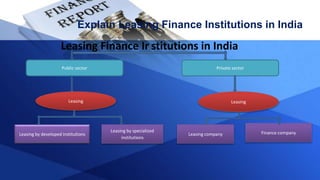
Explain Leasing Finance Institutions in India
Leasing Finance Institutions in India
Public sector Private sector
Leasing Leasing
Leasing by developed institutions
Leasing by specialized
institutions
Leasing company Finance company
What is Hire Purchase?
• Hire purchase means hiring of an asset for
a period of time and at the end of the
period, purchasing the same. Actually, this
is time sharing of the asset - the person
hiring the asset acquires its possession and
the right to use it. As a legal device it is
being used for financing of capital goods
such as industrial finance, financing of
consumer goods and for selling consumer
good on hire purchase.
Advantages of Hire Purchase
• Higher Realized Income
• Low NPAs
• Fewer Defaulters
• Recycle Recovered Funds
Disadvantages of Hire Purchase
• Encourages Lavish Expenditure
• Future Income is Mortgaged
• Higher Installment Price
• Difficulty in Re-sale of Goods
What is Venture Capital?
• Venture capital refers to an
equity/equity-related investment in a
growth-oriented small/medium business
to enable the investors to accomplish
corporate objectives, in return for
monetary shareholding in the business
or the irrevocable right to acquire it.
Venture capital is a typical 'private
equity investment'.
Features of Venture Capital Financing
• New Ventures
• Continuous Involvement
• Mode of Investment
• Objective
• Hands-On Approach
• High Risk-Return Ventures
• Nature of Firms
• Liquidity
PRIVATE EQUITY
• Equity capital that is not quoted on a public exchange is called
private equity. Private equity consists of investors and funds
that make investments directly into private companies or
conduct buyouts of public companies that result in a delisting
of public equity. Capital for private equity is raised from retail
and institutional investors, and can be used to fund new
technologies, expand working capital within an owned
company, make acquisitions, or to strengthen a balance sheet.
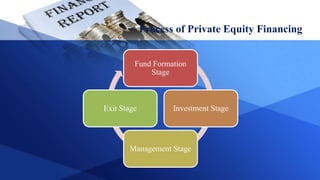
Process of Private Equity Financing
Fund Formation
Stage
Investment Stage
Management Stage
Exit Stage
Advantages of Private Equity
• Substantial Liquidity
• Growth Capital
• Eliminate Personal Guarantees and Retain Operational
Control
• Obtain a Strong Partner with Aligned Goals
• "Second Bite at the Apple"
Disadvantages of Private Equity
• Debt Burden
• Board Seats
• Required Exit Strategy

Fin Mgmt.pptx

  • 1.
    Meaning of Capitalmarket: • The term 'capital market' refers to the institutional arrangements for facilitating the borrowing and lending of long-term funds. Example: Equity share, Debenture, Bond etc
  • 2.
    Definition of capitalmarket: • According to M.Y. Khan, "It is a market for long-term funds. Its focus is on financing of fixed investments in contrast to money market which is the institutional source of working capital finance".
  • 3.
  • 4.
    What are theFeatures of Indian Capital Market? • Securities Market • Security Prices • Participants • Location
  • 5.
    What are thefunctions of Capital Market? • Liquidity Function • Allocation Function • Merger Function • Transfer Function • Indicative Function • Savings and Investment Function
  • 6.
    Primary Market: • Theprimary market represents the new issue market where new securities, i.e. shares or bonds that have-never been previously issued, are offered. Both the new companies and the existing ones can raise capital on the new issue market.
  • 7.
    Secondary Market: • Thesecondary market, also known as the 'aftermarket', is the financial market where previously issued securities and financial instruments such as stock, bonds, options and futures are bought and sold. The term "secondary market" is also used to refer to refer to the market for any used goods or assets or an alternative use for an existing product or asset where the customer base is the second market.
  • 8.
    What are theVarious Sources of Long term financing? Term Loans Retained Earnings Debentures Preference Shares Equity Shares
  • 9.
    What do youmean by shares? • The capital of a company is divided into different units called Shares. A share is the movable property of a shareholder and he has a liberty to transfer his share in the manner prescribed by the Articles of the company. Its distinct number distinguishes each share of a company.
  • 10.
    Equity Shares • Equityshares are, earlier, known as ordinary shares or common shares. Equity shareholders are the real owners of the company as they have the voting rights and enjoy decision- making authority on important matters, related to the company.
  • 11.
    What are thecharacteristics of equity shares? • Maturity • Claims / rights to income • Claim on assets • Right to control / voting rights • Pre-emptive rights • Limited liability
  • 12.
    Advantages of equityshares: • Advantage to investors • Capital profit • Interest in the company’s activities • Best for investment • More income • Right to interfere in management • Advantage to company • No fixed burden of dividend • No outflow of cash
  • 13.
    Cont… • Bear therisk • Simple and cheap source • Availability of fixed capital
  • 14.
    Disadvantages of equityshares: • Disadvantage to investors • Uncertainty of income • Irregular income • Capital loss • Less attractive to moderate investors • Loss in the case of liquidation • Disadvantage to company • Difficult to remove over capitalization • Centralization of control
  • 15.
    Cont… • Change inmanagement policy • Speculation
  • 16.
    What do youmean be preference shares? • The parts of corporate securities are called as preference shares. It is the shares, which have preferential right to get dividend and get back the initial investment at the time of winding up of the company. Preference shareholders are eligible to get fixed rate of dividend and they do not have voting rights.
  • 17.
    Types of preferenceshares: • Cumulative preference shares • Non-cumulative preference shares • Redeemable preference shares • Irredeemable Preference Shares • Participating Preference Shares • Non-Participating Preference Shares • Convertible Preference Shares • Non-convertible Preference Shares
  • 18.
    Advantages of PreferenceShares • Fixed dividend • Cumulative dividends • Redemption • Participation • Convertibility
  • 19.
    Disadvantages of PreferenceShares • Expensive sources of finance • No voting right • Fixed dividend only • Permanent burden • Taxation
  • 20.
    DEBENTURES • A Debentureis a document issued by the company. It is a certificate issued by the company under its seal acknowledging a debt.
  • 21.
    Define debentures? • Accordingto the Companies Act 1956, “debenture includes debenture stock, bonds and any other securities of a company whether constituting a charge of the assets of the company or not.”
  • 22.
    What are thetypes of Debentures? • Unsecured debentures • Secured debentures • Redeemable debentures • Irredeemable debentures • Convertible debentures
  • 23.
    Advantages of Debenture •Long-term sources • Fixed rate of interest • Trade on equity • Income tax deduction • Protection
  • 24.
    Disadvantages of Debenture •Fixed rate of interest • No voting rights • Creditors of the company • High risk • Restrictions of further issues
  • 25.
    TERM LOANS • Termloans, also referred to as term finance; represent a source of debt finance which is generally repayable in more than one year but less than 10 years. They are employed to finance acquisition of fixed assets and working capital margin. Term loans differ from short-term bank loans which are employed to finance short-term working capital need and tend to be self-liquidating over a period of time, usually less than one year.
  • 26.
    Features of TermLoan • Security • Interest Payment and Principal Repayment • Restrictive Covenants
  • 27.
    Retained earnings: • Retainedearnings refer to the percentage of netearnings not paid out as dividends, but retained by the company to be reinvested in its core business, or to pay debt. It is recorded under shareholders' equity on the balance sheet.
  • 28.
    Constituents of IndianCapital Market • New Issue Market • Stock Market
  • 29.
    Meaning of NewIssue Market • The primary market represents the new issue market where new securities, i.e. shares or bonds that have never been previously issued, are offered. Both the new companies and the existing ones can raise capital on the new issue market.
  • 30.
    Functions of NewIssue Market • Origination • Time of Floating of an Issue • Type of Issue • Price • Underwriting • Distribution
  • 31.
    New Issue MarketActivities • Public Issue • Rights Issue • Private Placement • Preferential Allotment
  • 32.
    Meaning of StockMarket • The secondary market, also known as the 'aftermarket', is the financial market where previously issued securities and financial instruments such as stock, bonds, options and futures are bought and sold. The term "secondary market" is also used to refer to the market for any used goods or assets or an alternative use for an existing product or asset where the customer base is the second market (e.g., corn has been traditionally used primarily for food production and feedstock, but a second - or third - market has developed for use in ethanol production).
  • 33.
    Functions of StockMarket • Ensure Liquidity of Capital • Continuous Market for Securities • Evaluation of Securities • Mobilizing Surplus Savings • Helpful in Raising New Capital • Safety in Dealings • Listing of Securities • Platform for Public Debt • Clearing House of Business Information
  • 34.
    Weaknesses of StockMarket • Rampant Speculation • Insider Trading • Oligopolistic • Limited Forward Trading • Outdated Share Trading System • Lack of a Single Market • Problem of Interface between the Primary and Secondary Markets • Inadequacy of Investor Service
  • 35.
    LEASING • Lease financingis one of the popular and common methods of assets based finance, which is the alternative to the loan finance. Lease is a contract. A contract under which one party, the leaser (owner) of an asset agrees to grant the use of that asset to another leaser, in exchange for periodic rental payments. • Lease is contractual agreement between the owner of the assets and user of the assets for a specific period by a periodical rent.
  • 36.
    What are theelements of Leasing? • Parties • Leaser • Lease • Lease broker • Lease assets
  • 37.
    Explain the classificationor types of Leasing? (A) Lease based on the term of lease 1. Finance Lease 2. Operating Lease (A) ( Lease based on the method of lease 1. Sale and lease back 2. Direct lease • (C) Lease based in the parties involved • 1. Single investor lease • 2. Leveraged lease • (D) Lease based in the area • 1. Domestic lease • 2. International lease
  • 38.
    What are theadvantages of Leasing? • Financing of fixed asset • Assets based finance • Convenient • Low rate of interest • Simplicity • Transaction cost • Reduce risk • Better alternative
  • 39.
    Explain Leasing FinanceInstitutions in India Leasing Finance Institutions in India Public sector Private sector Leasing Leasing Leasing by developed institutions Leasing by specialized institutions Leasing company Finance company
  • 40.
    What is HirePurchase? • Hire purchase means hiring of an asset for a period of time and at the end of the period, purchasing the same. Actually, this is time sharing of the asset - the person hiring the asset acquires its possession and the right to use it. As a legal device it is being used for financing of capital goods such as industrial finance, financing of consumer goods and for selling consumer good on hire purchase.
  • 41.
    Advantages of HirePurchase • Higher Realized Income • Low NPAs • Fewer Defaulters • Recycle Recovered Funds
  • 42.
    Disadvantages of HirePurchase • Encourages Lavish Expenditure • Future Income is Mortgaged • Higher Installment Price • Difficulty in Re-sale of Goods
  • 43.
    What is VentureCapital? • Venture capital refers to an equity/equity-related investment in a growth-oriented small/medium business to enable the investors to accomplish corporate objectives, in return for monetary shareholding in the business or the irrevocable right to acquire it. Venture capital is a typical 'private equity investment'.
  • 44.
    Features of VentureCapital Financing • New Ventures • Continuous Involvement • Mode of Investment • Objective • Hands-On Approach • High Risk-Return Ventures • Nature of Firms • Liquidity
  • 45.
    PRIVATE EQUITY • Equitycapital that is not quoted on a public exchange is called private equity. Private equity consists of investors and funds that make investments directly into private companies or conduct buyouts of public companies that result in a delisting of public equity. Capital for private equity is raised from retail and institutional investors, and can be used to fund new technologies, expand working capital within an owned company, make acquisitions, or to strengthen a balance sheet.
  • 46.
    Process of PrivateEquity Financing Fund Formation Stage Investment Stage Management Stage Exit Stage
  • 47.
    Advantages of PrivateEquity • Substantial Liquidity • Growth Capital • Eliminate Personal Guarantees and Retain Operational Control • Obtain a Strong Partner with Aligned Goals • "Second Bite at the Apple"
  • 48.
    Disadvantages of PrivateEquity • Debt Burden • Board Seats • Required Exit Strategy