Presented by,
11 :- Kartik Ganga
12 :- Vishal Gawde
13 :- Ashish Gohil
14 :- Akshay Gujar
15 :- Rahul Hadkar
Foreign Direct Investment
Foreign direct investment (FDI) happens when a firm invests directly in facilities in a foreign
country
A firm that engages in FDI becomes a multinational enterprise (MNE)
Multinational = “more than one country”

Factors which influence FDI are related to factors that stimulate trade across national borders
Involves ownership of entity abroad for
Production
Marketing/service
R&D
Raw materials or other resource access
Parent has direct managerial control
The degree of direct managerial control depends on the extent of ownership of the
foreign entity and on other contractual terms of the FDI
No managerial involvement = portfolio investment
Key Issues
 Why is FDI increasing?
 Why do firms choose FDI over exporting or licensing to enter a
foreign market?
 Why are certain locations attractive for FDI?
 How does political ideology influence government policy over
FDI?

 From a host or source country perspective, what are FDI’s costs
and benefits?
 How can governments restrict/encourage FDI?
ADVANTAGES OF INDIA
•

Stable democratic environment over 60 years of independence

•

Large and growing market

•

World class scientific, technical and managerial manpower

•

Cost-effective and highly skilled labor

•

Abundance of natural resources

•

Well-established legal system with independent judiciary.

•

Developed banking system and vibrant capital market

•

India among the top three investment hot spots and one of the
fastest growing economies in the world.

•

Large English speaking population
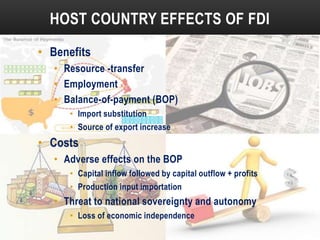
HOST COUNTRY EFFECTS OF FDI
• Benefits
• Resource -transfer
• Employment
• Balance-of-payment (BOP)
• Import substitution
• Source of export increase

• Costs
• Adverse effects on the BOP
• Capital inflow followed by capital outflow + profits
• Production input importation

• Threat to national sovereignty and autonomy
• Loss of economic independence
GOVERNMENT POLICY AND FDI
• Home country
• Outward FDI encouragement
• Risk reduction policies (financing, insurance, tax incentives)

• Outward FDI restrictions
• National security, BOP

• Host country
• Inward FDI encouragement
• Investment incentives
• Job creation incentives

• Inward FDI restrictions
• Ownership extent restrictions (national security; local nationals can
safeguard host country’s interests
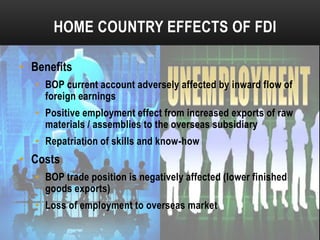
HOME COUNTRY EFFECTS OF FDI
• Benefits
• BOP current account adversely affected by inward flow of
foreign earnings
• Positive employment effect from increased exports of raw
materials / assemblies to the overseas subsidiary
• Repatriation of skills and know-how

• Costs
• BOP trade position is negatively affected (lower finished
goods exports)
• Loss of employment to overseas market
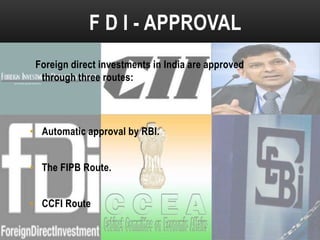
F D I - APPROVAL
Foreign direct investments in India are approved
through three routes:

• Automatic approval by RBI.
• The FIPB Route.
• CCFI Route
AUTOMATIC ROUTE
• No need of Prior Approval From FIPB,RBI,GOI.
BUT
The investors are only required to notify the Regional Office
concerned of the Reserve Bank of India within 30 days of receipt
of inward remittances.
AND
File the required documents with that Office within 30 days of
issue of shares to the non-resident investors.
AUTOMATIC ROUTE
The Reserve Bank of India accords automatic approval within a
period of two weeks (provided certain parameters are met) to all
proposals involving:

• Foreign equity up to 50% in 3 categories relating
to mining activities .
• Foreign equity up to 51% in 48 specified industries.
• Foreign equity up to 74% in 9 categories .
THE FIPB ROUTE

• FDI in activities not covered under the automatic route require
prior government approval.
• Approvals of all such proposals including composite proposals
involving foreign investment/foreign technical collaboration is
granted on the recommendations of FIPB.
• Application for all FDI cases, except NRI investments and
100% EOUs, should be submitted to the FIPB Unit , DEA,
Ministry of Finance.
• Application for NRI and 100% EOU cases should be presented
to SIA in Department of Industrial Policy and Promotion (DIPP).
• Application can be made in Form FC-IL. Plain paper
applications carrying all relevant details are also accepted.
•

No fee is payable.
CCFI ROUTE
• Investment proposals falling outside the automatic route.
And
• Having a project cost of Rs. 6,000 million or more would require
prior approval of Cabinet Committee of Foreign Investment
(“CCFI”).
• Decision of CCFI usually conveyed in 8-10 weeks. Thereafter,
filings have to be made by the Indian company with the RBI.
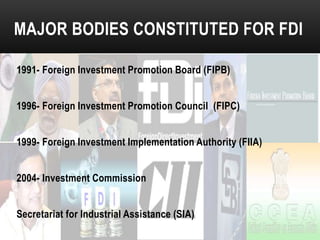
MAJOR BODIES CONSTITUTED FOR FDI
1991- Foreign Investment Promotion Board (FIPB)
1996- Foreign Investment Promotion Council (FIPC)
1999- Foreign Investment Implementation Authority (FIIA)

2004- Investment Commission
Secretariat for Industrial Assistance (SIA)
FDI
SECTORAL GUIDELINES
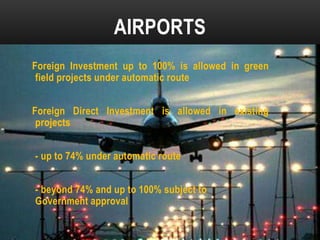
AIRPORTS
Foreign Investment up to 100% is allowed in green
field projects under automatic route
Foreign Direct Investment is allowed in existing
projects
- up to 74% under automatic route
- beyond 74% and up to 100% subject to
Government approval
TELECOM
•

FDI in basic and cellular, unified access services,
national/ international long distance , V-Sat, public
mobile radio trunk services , global mobile
personal communications services

- Automatic up to 49%
- FIPB beyond 49% but up to 74%
Manufacture of telecom equipments - Automatic up
to 100%.
DOMESTIC AIRLINES
•

FDI up to 49% (40%) permitted under automatic
route

•

Automatic Route is not available

•

However, a foreign airlines are not allowed to
have any direct or indirect equity participation

•

100% investment by NRIs/OCB’s
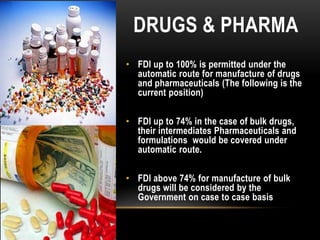
DRUGS & PHARMA
• FDI up to 100% is permitted under the
automatic route for manufacture of drugs
and pharmaceuticals (The following is the
current position)
• FDI up to 74% in the case of bulk drugs,
their intermediates Pharmaceuticals and
formulations would be covered under
automatic route.
• FDI above 74% for manufacture of bulk
drugs will be considered by the
Government on case to case basis
INSURANCE
•

FDI up to 26% allowed on the automatic route

•

However, license from the Insurance Regulatory &
Development Authority (IRDA) has to be obtained

•

There is a proposal to increase this limit to 49%
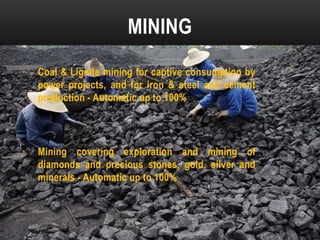
MINING
•

Coal & Lignite mining for captive consumption by
power projects, and for iron & steel and cement
production - Automatic up to 100%

•

Mining covering exploration and mining of
diamonds and precious stones, gold, silver and
minerals - Automatic up to 100%
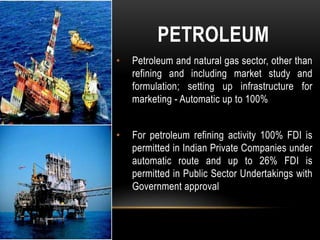
PETROLEUM
•

Petroleum and natural gas sector, other than
refining and including market study and
formulation; setting up infrastructure for
marketing - Automatic up to 100%

•

For petroleum refining activity 100% FDI is
permitted in Indian Private Companies under
automatic route and up to 26% FDI is
permitted in Public Sector Undertakings with
Government approval


PRIVATE SECTOR BANKING

Foreign Investment up to 74% is permitted from all sources under
the automatic route subject to guidelines for setting up of
branches/subsidiaries of foreign banks issued by RBI from time to
time.
PRINT MEDIA
•

FDI up to 100% in publishing/printing scientific &
technical magazines, periodicals & journals

•

FDI up to 26% in publishing news papers and
periodicals dealing in news and current affairs.

•

All investments are subject to the guidelines
issued by the Ministry of Information and
Broadcasting
TRADING
•

Wholesale / cash & carry trading - Automatic upto
100%

•

Trading for exports - Automatic upto 100%

•

Trading of items sourced from small scale sector 100% with Government approval

•

Single Brand product
Government approval

retailing

-

51%

with
BROADCASTING
•

FDI permitted for setting up hardware facilities such
as up-linking, HUB, etc up to 49% under Government
approval route

•

FDI permitted in Cable Network up to 49% under
Government approval route

•

Foreign Investment (FDI/FII) up to 49% allowed under
Government approval route in Direct to Home Service
Providers. FDI limited to 20%
•

FDI permitted in FM radio up to 20% under
Government approval route
INFRASTRUCTURE
•

100% FDI is permitted for the following activities:
•
•
•
•
•
•
•
•
•

Electricity Generation (except Atomic energy)
Electricity Transmission
Electricity Distribution
Mass Rapid Transport System
Roads & Highways
Toll Roads
Vehicular Bridges
Ports & Harbors
Hotel & Tourism
FORBIDDEN TERRITORIES
FDI is not permitted in the following industrial sectors :
 Arms and ammunition.
 Atomic Energy.
 Railway Transport.
 Coal and lignite.
 Mining of iron, manganese, chrome, gypsum, sulphur, gold, diamonds, copper,
zinc.
 Lottery Business
 Agricultural or plantation activities

 Housing and Real Estate Business (except development of townships,
construction of residential/commercial premises, roads or bridges to the
extent specified in Notification No. FEMA 136/2005-RB dated July 19, 2005).
ADVANTAGES OF FDI
• Increase in Domestic Employment/Drop in unemployment
• Investment in Needed Infrastructure.
• Positive Influence on the Balance of Payments.
• New Technology and “Know How” Transfer.
• Increased Capital Investment.
• Targeted Regional and Sectoral Development.
DISADVANTAGES OF FDI
• Industrial Sector Dominance in the Domestic Market.
• Technological Dependence on Foreign Technology
Sources.
• Disturbance of Domestic Economic Plans in Favor of
FDI-Directed Activities.
• “Cultural Change” Created by “Ethnocentric
Staffing” The Infusion of Foreign Culture , and
Foreign Business Practices
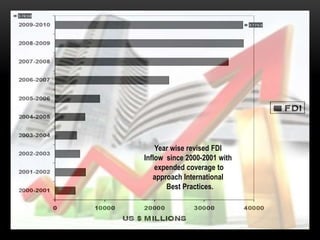
Year wise revised FDI
Inflow since 2000-2001 with
expended coverage to
approach International
Best Practices.
er
s

ce

2

Ot
h

Fr
an

4

m
an
y

4

Cy
pr
us

pa
n

nd
s

5

Ja

er
la

5

Ge
r

Ne
th

U.
K

10

U.
S.
A.

ap
or
e

rit
iu
s

45

Si
ng

M
au

%age to total Inflows (in terms of US $)

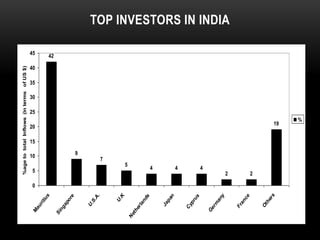
TOP INVESTORS IN INDIA

42

40

35

30

25

20
19

15

9
7
4
2

0
%
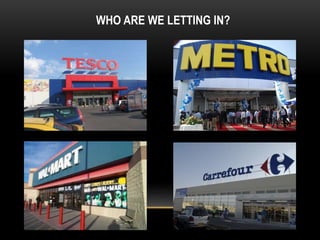
WHO ARE WE LETTING IN?
website
www.globaljurix.com/foreign-direct-investment.php.
Scrib.com
wikipedia.org/wiki/Foreign_direct_investment
investorpadia.com
News Paper

Economic Time
Business Line
Prajavani
Consider these all aspect finally I conclude
that FDI more boon than bane because foreign
direct investment has more advantages than this
disadvantages.
Foreign direct investment(fdi)

Foreign direct investment(fdi)

  • 3.
    Presented by, 11 :-Kartik Ganga 12 :- Vishal Gawde 13 :- Ashish Gohil 14 :- Akshay Gujar 15 :- Rahul Hadkar
  • 4.
    Foreign Direct Investment Foreigndirect investment (FDI) happens when a firm invests directly in facilities in a foreign country A firm that engages in FDI becomes a multinational enterprise (MNE) Multinational = “more than one country” Factors which influence FDI are related to factors that stimulate trade across national borders Involves ownership of entity abroad for Production Marketing/service R&D Raw materials or other resource access Parent has direct managerial control The degree of direct managerial control depends on the extent of ownership of the foreign entity and on other contractual terms of the FDI No managerial involvement = portfolio investment
  • 5.
    Key Issues  Whyis FDI increasing?  Why do firms choose FDI over exporting or licensing to enter a foreign market?  Why are certain locations attractive for FDI?  How does political ideology influence government policy over FDI?  From a host or source country perspective, what are FDI’s costs and benefits?  How can governments restrict/encourage FDI?
  • 6.
    ADVANTAGES OF INDIA • Stabledemocratic environment over 60 years of independence • Large and growing market • World class scientific, technical and managerial manpower • Cost-effective and highly skilled labor • Abundance of natural resources • Well-established legal system with independent judiciary. • Developed banking system and vibrant capital market • India among the top three investment hot spots and one of the fastest growing economies in the world. • Large English speaking population
  • 7.
    HOST COUNTRY EFFECTSOF FDI • Benefits • Resource -transfer • Employment • Balance-of-payment (BOP) • Import substitution • Source of export increase • Costs • Adverse effects on the BOP • Capital inflow followed by capital outflow + profits • Production input importation • Threat to national sovereignty and autonomy • Loss of economic independence
  • 8.
    GOVERNMENT POLICY ANDFDI • Home country • Outward FDI encouragement • Risk reduction policies (financing, insurance, tax incentives) • Outward FDI restrictions • National security, BOP • Host country • Inward FDI encouragement • Investment incentives • Job creation incentives • Inward FDI restrictions • Ownership extent restrictions (national security; local nationals can safeguard host country’s interests
  • 9.
    HOME COUNTRY EFFECTSOF FDI • Benefits • BOP current account adversely affected by inward flow of foreign earnings • Positive employment effect from increased exports of raw materials / assemblies to the overseas subsidiary • Repatriation of skills and know-how • Costs • BOP trade position is negatively affected (lower finished goods exports) • Loss of employment to overseas market
  • 11.
    F D I- APPROVAL Foreign direct investments in India are approved through three routes: • Automatic approval by RBI. • The FIPB Route. • CCFI Route
  • 12.
    AUTOMATIC ROUTE • Noneed of Prior Approval From FIPB,RBI,GOI. BUT The investors are only required to notify the Regional Office concerned of the Reserve Bank of India within 30 days of receipt of inward remittances. AND File the required documents with that Office within 30 days of issue of shares to the non-resident investors.
  • 13.
    AUTOMATIC ROUTE The ReserveBank of India accords automatic approval within a period of two weeks (provided certain parameters are met) to all proposals involving: • Foreign equity up to 50% in 3 categories relating to mining activities . • Foreign equity up to 51% in 48 specified industries. • Foreign equity up to 74% in 9 categories .
  • 14.
    THE FIPB ROUTE •FDI in activities not covered under the automatic route require prior government approval. • Approvals of all such proposals including composite proposals involving foreign investment/foreign technical collaboration is granted on the recommendations of FIPB.
  • 15.
    • Application forall FDI cases, except NRI investments and 100% EOUs, should be submitted to the FIPB Unit , DEA, Ministry of Finance. • Application for NRI and 100% EOU cases should be presented to SIA in Department of Industrial Policy and Promotion (DIPP). • Application can be made in Form FC-IL. Plain paper applications carrying all relevant details are also accepted. • No fee is payable.
  • 16.
    CCFI ROUTE • Investmentproposals falling outside the automatic route. And • Having a project cost of Rs. 6,000 million or more would require prior approval of Cabinet Committee of Foreign Investment (“CCFI”). • Decision of CCFI usually conveyed in 8-10 weeks. Thereafter, filings have to be made by the Indian company with the RBI.
  • 17.
    MAJOR BODIES CONSTITUTEDFOR FDI 1991- Foreign Investment Promotion Board (FIPB) 1996- Foreign Investment Promotion Council (FIPC) 1999- Foreign Investment Implementation Authority (FIIA) 2004- Investment Commission Secretariat for Industrial Assistance (SIA)
  • 18.
  • 19.
    AIRPORTS Foreign Investment upto 100% is allowed in green field projects under automatic route Foreign Direct Investment is allowed in existing projects - up to 74% under automatic route - beyond 74% and up to 100% subject to Government approval
  • 20.
    TELECOM • FDI in basicand cellular, unified access services, national/ international long distance , V-Sat, public mobile radio trunk services , global mobile personal communications services - Automatic up to 49% - FIPB beyond 49% but up to 74% Manufacture of telecom equipments - Automatic up to 100%.
  • 21.
    DOMESTIC AIRLINES • FDI upto 49% (40%) permitted under automatic route • Automatic Route is not available • However, a foreign airlines are not allowed to have any direct or indirect equity participation • 100% investment by NRIs/OCB’s
  • 22.
    DRUGS & PHARMA •FDI up to 100% is permitted under the automatic route for manufacture of drugs and pharmaceuticals (The following is the current position) • FDI up to 74% in the case of bulk drugs, their intermediates Pharmaceuticals and formulations would be covered under automatic route. • FDI above 74% for manufacture of bulk drugs will be considered by the Government on case to case basis
  • 23.
    INSURANCE • FDI up to26% allowed on the automatic route • However, license from the Insurance Regulatory & Development Authority (IRDA) has to be obtained • There is a proposal to increase this limit to 49%
  • 24.
    MINING • Coal & Lignitemining for captive consumption by power projects, and for iron & steel and cement production - Automatic up to 100% • Mining covering exploration and mining of diamonds and precious stones, gold, silver and minerals - Automatic up to 100%
  • 25.
    PETROLEUM • Petroleum and naturalgas sector, other than refining and including market study and formulation; setting up infrastructure for marketing - Automatic up to 100% • For petroleum refining activity 100% FDI is permitted in Indian Private Companies under automatic route and up to 26% FDI is permitted in Public Sector Undertakings with Government approval
  • 26.
     PRIVATE SECTOR BANKING ForeignInvestment up to 74% is permitted from all sources under the automatic route subject to guidelines for setting up of branches/subsidiaries of foreign banks issued by RBI from time to time.
  • 27.
    PRINT MEDIA • FDI upto 100% in publishing/printing scientific & technical magazines, periodicals & journals • FDI up to 26% in publishing news papers and periodicals dealing in news and current affairs. • All investments are subject to the guidelines issued by the Ministry of Information and Broadcasting
  • 28.
    TRADING • Wholesale / cash& carry trading - Automatic upto 100% • Trading for exports - Automatic upto 100% • Trading of items sourced from small scale sector 100% with Government approval • Single Brand product Government approval retailing - 51% with
  • 29.
    BROADCASTING • FDI permitted forsetting up hardware facilities such as up-linking, HUB, etc up to 49% under Government approval route • FDI permitted in Cable Network up to 49% under Government approval route • Foreign Investment (FDI/FII) up to 49% allowed under Government approval route in Direct to Home Service Providers. FDI limited to 20% • FDI permitted in FM radio up to 20% under Government approval route
  • 30.
    INFRASTRUCTURE • 100% FDI ispermitted for the following activities: • • • • • • • • • Electricity Generation (except Atomic energy) Electricity Transmission Electricity Distribution Mass Rapid Transport System Roads & Highways Toll Roads Vehicular Bridges Ports & Harbors Hotel & Tourism
  • 31.
    FORBIDDEN TERRITORIES FDI isnot permitted in the following industrial sectors :  Arms and ammunition.  Atomic Energy.  Railway Transport.  Coal and lignite.  Mining of iron, manganese, chrome, gypsum, sulphur, gold, diamonds, copper, zinc.  Lottery Business  Agricultural or plantation activities  Housing and Real Estate Business (except development of townships, construction of residential/commercial premises, roads or bridges to the extent specified in Notification No. FEMA 136/2005-RB dated July 19, 2005).
  • 32.
    ADVANTAGES OF FDI •Increase in Domestic Employment/Drop in unemployment • Investment in Needed Infrastructure. • Positive Influence on the Balance of Payments. • New Technology and “Know How” Transfer. • Increased Capital Investment. • Targeted Regional and Sectoral Development.
  • 33.
    DISADVANTAGES OF FDI •Industrial Sector Dominance in the Domestic Market. • Technological Dependence on Foreign Technology Sources. • Disturbance of Domestic Economic Plans in Favor of FDI-Directed Activities. • “Cultural Change” Created by “Ethnocentric Staffing” The Infusion of Foreign Culture , and Foreign Business Practices
  • 34.
    Year wise revisedFDI Inflow since 2000-2001 with expended coverage to approach International Best Practices.
  • 35.
  • 36.
    WHO ARE WELETTING IN?
  • 39.
  • 40.
    Consider these allaspect finally I conclude that FDI more boon than bane because foreign direct investment has more advantages than this disadvantages.