Illustration 1 :
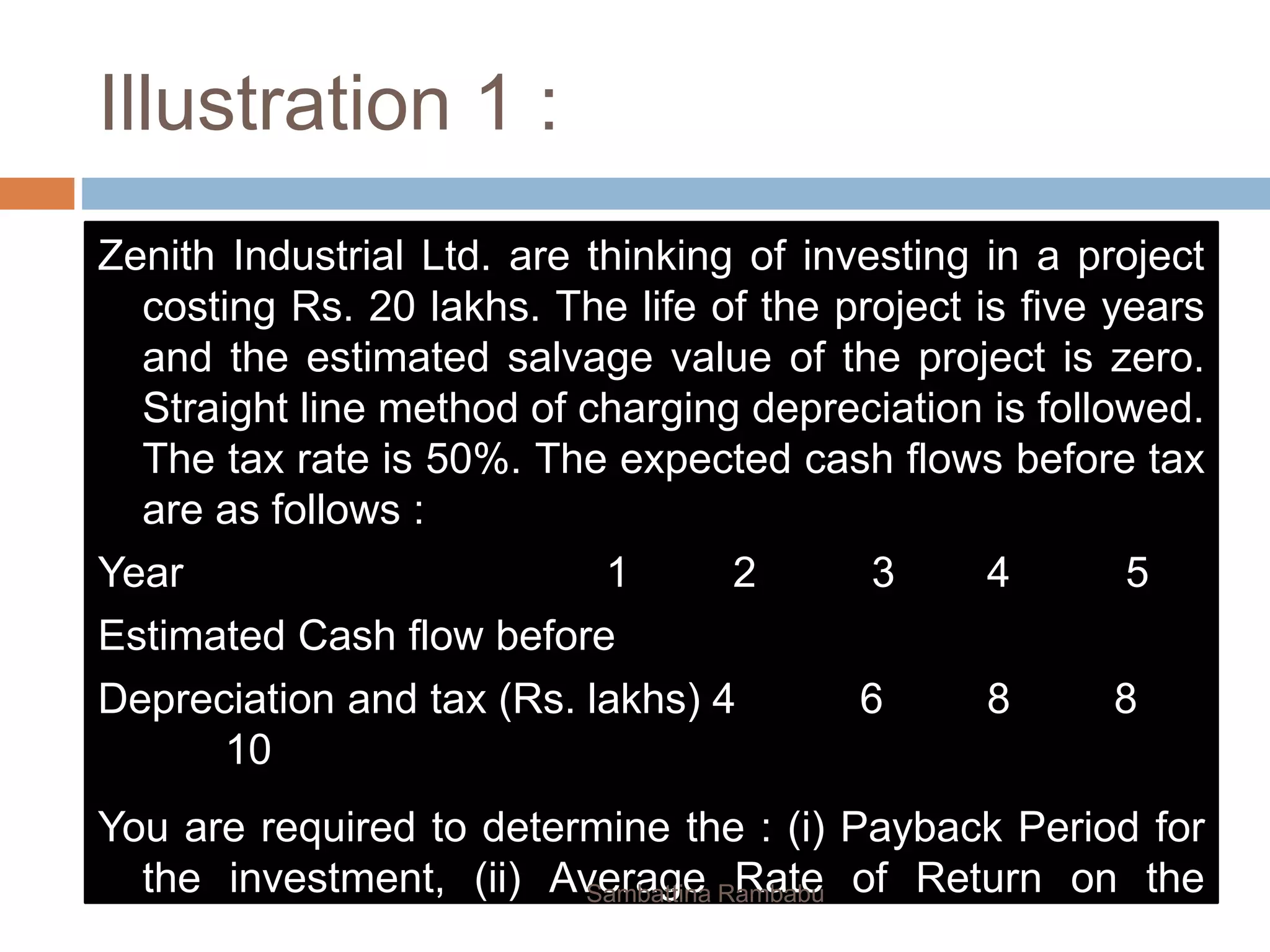
Zenith Industrial Ltd. are thinking of investing in a project
costing Rs. 20 lakhs. The life of the project is five years
and the estimated salvage value of the project is zero.
Straight line method of charging depreciation is followed.
The tax rate is 50%. The expected cash flows before tax
are as follows :
Year 1 2 3 4 5
Estimated Cash flow before
Depreciation and tax (Rs. lakhs) 4 6 8 8
10
You are required to determine the : (i) Payback Period for
the investment, (ii) Average Rate of Return on the
investment, (iii) Net Present Value at 10% Cost of
Sambattina Rambabu
Illustration 2 :
The relevant information for two alternative systems of internal transportation
are given below :
(Rs.)
Particulars System 1
System 2
Initial investment 60,00,000 40,00,000
Annual operating costs 10,00,000 900,000
Life 6 years 4 years
Salvage value at the end 20,00,000 15,00,000
Which system would you prefer if the cost of capital is 6%? Justify your
recommendation
with appropriate analysis.
[Present value of annuity at 6% for 6 years = 4.917 and for 4 years = 3.465.
Present value of
Rs. 1.00 at 6% at the end of 6the year 0.705 and that at the end of 4th year
0.792].
Sambattina Rambabu
Capital rationing
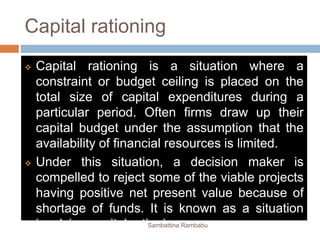
 Capital rationing is a situation where a
constraint or budget ceiling is placed on the
total size of capital expenditures during a
particular period. Often firms draw up their
capital budget under the assumption that the
availability of financial resources is limited.
 Under this situation, a decision maker is
compelled to reject some of the viable projects
having positive net present value because of
shortage of funds. It is known as a situation
involving capital rationingSambattina Rambabu
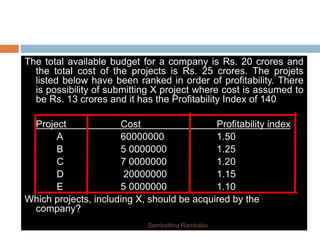
The total available budget for a company is Rs. 20 crores and
the total cost of the projects is Rs. 25 crores. The projets
listed below have been ranked in order of profitability. There
is possibility of submitting X project where cost is assumed to
be Rs. 13 crores and it has the Profitability Index of 140
Project Cost Profitability index
A 60000000 1.50
B 5 0000000 1.25
C 7 0000000 1.20
D 20000000 1.15
E 5 0000000 1.10
Which projects, including X, should be acquired by the
company?
Sambattina Rambabu
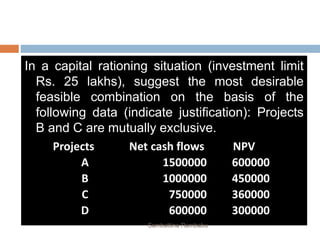
In a capital rationing situation (investment limit
Rs. 25 lakhs), suggest the most desirable
feasible combination on the basis of the
following data (indicate justification): Projects
B and C are mutually exclusive.
Projects Net cash flows NPV
A 1500000 600000
B 1000000 450000
C 750000 360000
D 600000 300000
Sambattina Rambabu
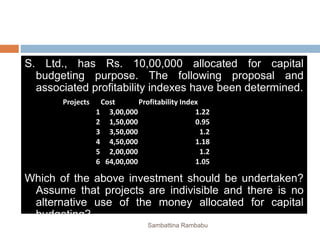
S. Ltd., has Rs. 10,00,000 allocated for capital
budgeting purpose. The following proposal and
associated profitability indexes have been determined.
Which of the above investment should be undertaken?
Assume that projects are indivisible and there is no
alternative use of the money allocated for capital
budgeting?
Projects Cost Profitability Index
1 3,00,000 1.22
2 1,50,000 0.95
3 3,50,000 1.2
4 4,50,000 1.18
5 2,00,000 1.2
6 64,00,000 1.05
Sambattina Rambabu
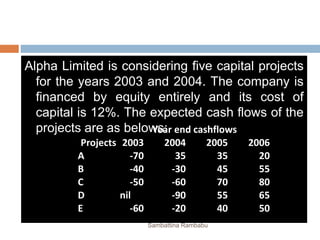
Alpha Limited is considering five capital projects
for the years 2003 and 2004. The company is
financed by equity entirely and its cost of
capital is 12%. The expected cash flows of the
projects are as belows:
Projects
Year end cashflows
2003 2004 2005 2006
A -70 35 35 20
B -40 -30 45 55
C -50 -60 70 80
D nil -90 55 65
E -60 -20 40 50
Sambattina Rambabu
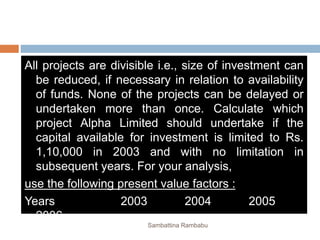
All projects are divisible i.e., size of investment can
be reduced, if necessary in relation to availability
of funds. None of the projects can be delayed or
undertaken more than once. Calculate which
project Alpha Limited should undertake if the
capital available for investment is limited to Rs.
1,10,000 in 2003 and with no limitation in
subsequent years. For your analysis,
use the following present value factors :
Years 2003 2004 2005
2006
Factors 1.00 0.89 0.80 0.71
Sambattina Rambabu
Sambattina Rambabu
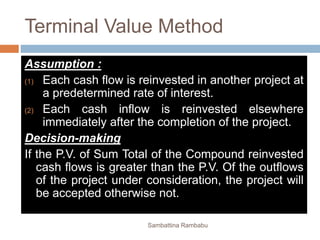
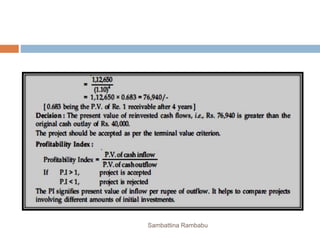
Terminal Value Method
Assumption :
(1) Each cash flow is reinvested in another project at
a predetermined rate of interest.
(2) Each cash inflow is reinvested elsewhere
immediately after the completion of the project.
Decision-making
If the P.V. of Sum Total of the Compound reinvested
cash flows is greater than the P.V. Of the outflows
of the project under consideration, the project will
be accepted otherwise not.
Sambattina Rambabu
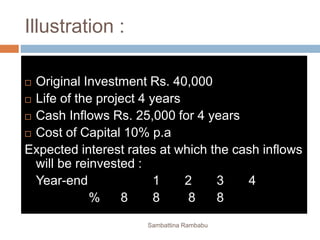
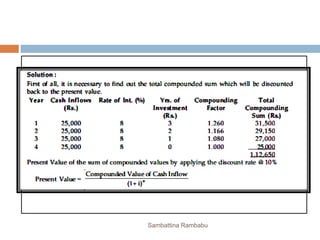
Illustration :
 Original Investment Rs. 40,000
 Life of the project 4 years
 Cash Inflows Rs. 25,000 for 4 years
 Cost of Capital 10% p.a
Expected interest rates at which the cash inflows
will be reinvested :
Year-end 1 2 3 4
% 8 8 8 8
Sambattina Rambabu
Sambattina Rambabu
Sambattina Rambabu
RISK AND UNCERTAINLY IN CAPITAL
BUDGETING
Capital budgeting requires the projection of cash
inflow and outflow of the future. The future in
always uncertain, estimate of demand,
production, selling price, cost etc., cannot be
exact.
For example: The product at any time it become
obsolete therefore, the future in unexpected.
The following methods for considering the
accounting of risk in capital budgeting. Various
evaluation methods are used for risk and
uncertainty in capital budgeting are as follows:Sambattina Rambabu
(i) Risk-adjusted cut off rate (or method of
varying discount rate)
(ii) Certainly equivalent method.
(iii) Sensitivity technique.
(iv) Probability technique
(v) Standard deviation method.
(vi) Co-efficient of variation method.
(vii) Decision tree analysis.
Sambattina Rambabu
(i) Risk-adjusted cutoff rate
(or Method of varying)
This is one of the simplest method while
calculating the risk in capital budgeting increase
cut of rate or discount factor by certain
percentage an account of risk.
Sambattina Rambabu
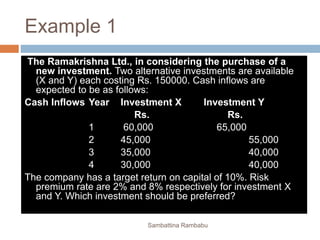
Example 1
The Ramakrishna Ltd., in considering the purchase of a
new investment. Two alternative investments are available
(X and Y) each costing Rs. 150000. Cash inflows are
expected to be as follows:
Cash Inflows Year Investment X Investment Y
Rs. Rs.
1 60,000 65,000
2 45,000 55,000
3 35,000 40,000
4 30,000 40,000
The company has a target return on capital of 10%. Risk
premium rate are 2% and 8% respectively for investment X
and Y. Which investment should be preferred?
Sambattina Rambabu
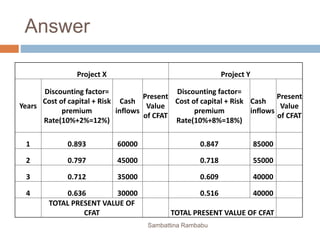
Answer
Project X Project Y
Years
Discounting factor=
Cost of capital + Risk
premium
Rate(10%+2%=12%)
Cash
inflows
Present
Value
of CFAT
Discounting factor=
Cost of capital + Risk
premium
Rate(10%+8%=18%)
Cash
inflows
Present
Value
of CFAT
1 0.893 60000 0.847 85000
2 0.797 45000 0.718 55000
3 0.712 35000 0.609 40000
4 0.636 30000 0.516 40000
TOTAL PRESENT VALUE OF
CFAT TOTAL PRESENT VALUE OF CFAT
Sambattina Rambabu
(ii) Certainly equivalent
method
It is also another simplest method for calculating
risk in capital budgeting. It reduces expected
cash inflows by certain amounts. it can be
calculated by multiplying the expected cash
inflows by certainly equivalent co-efficient in
order to convert the uncertain cash inflow to
certain cash inflows.
Sambattina Rambabu
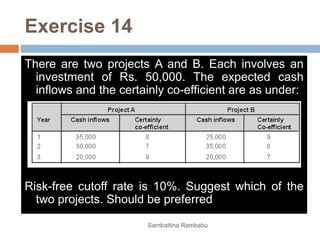
Exercise 14
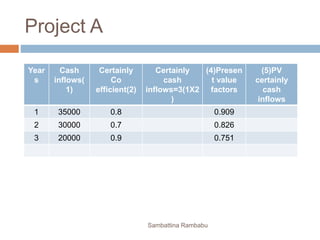
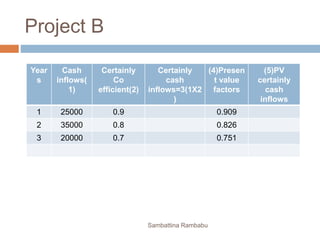
There are two projects A and B. Each involves an
investment of Rs. 50,000. The expected cash
inflows and the certainly co-efficient are as under:
Risk-free cutoff rate is 10%. Suggest which of the
two projects. Should be preferred
Sambattina Rambabu
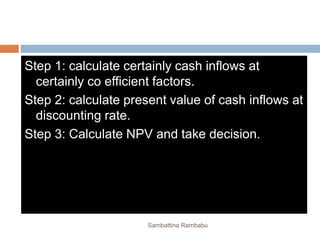
Step 1: calculate certainly cash inflows at
certainly co efficient factors.
Step 2: calculate present value of cash inflows at
discounting rate.
Step 3: Calculate NPV and take decision.
Sambattina Rambabu
Project A
Year
s
Cash
inflows(
1)
Certainly
Co
efficient(2)
Certainly
cash
inflows=3(1X2
)
(4)Presen
t value
factors
(5)PV
certainly
cash
inflows
1 35000 0.8 0.909
2 30000 0.7 0.826
3 20000 0.9 0.751
Sambattina Rambabu
Project B
Year
s
Cash
inflows(
1)
Certainly
Co
efficient(2)
Certainly
cash
inflows=3(1X2
)
(4)Presen
t value
factors
(5)PV
certainly
cash
inflows
1 25000 0.9 0.909
2 35000 0.8 0.826
3 20000 0.7 0.751
Sambattina Rambabu
(iii) Sensitivity technique
When cash inflows are sensitive under different
circumstances more than one forecast of the
future cash inflows may be made. These inflows
may be regarded on ‘Optimistic’, ‘most likely’ and
‘pessimistic’. Further cash inflows may be
discounted to find out the net present values
under these three different situations.
If the net present values under the three situations
differ widely it implies that there is a great risk in
the project and the investor’s is decision to accept
or reject a project will depend upon his risk
bearing activities. Sambattina Rambabu
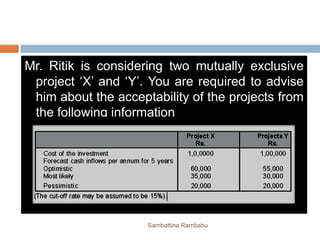
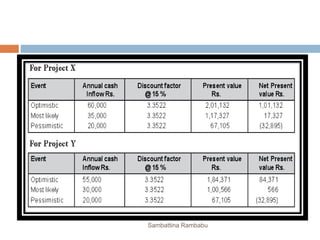
Mr. Ritik is considering two mutually exclusive
project ‘X’ and ‘Y’. You are required to advise
him about the acceptability of the projects from
the following information
Sambattina Rambabu
Sambattina Rambabu
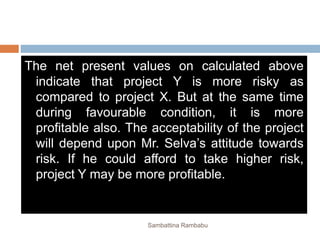
The net present values on calculated above
indicate that project Y is more risky as
compared to project X. But at the same time
during favourable condition, it is more
profitable also. The acceptability of the project
will depend upon Mr. Selva’s attitude towards
risk. If he could afford to take higher risk,
project Y may be more profitable.
Sambattina Rambabu
(iv) Probability technique
Probability technique refers to the each event of
future happenings are assigned with relative
frequency probability. Probability means the
likelihood of future event. The cash inflows of
the future years further discounted with the
probability. The higher present value may be
accepted.
Sambattina Rambabu
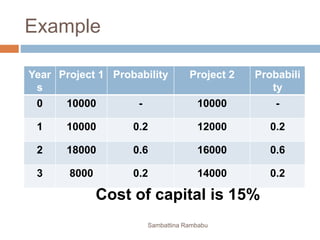
Example
Year
s
Project 1 Probability Project 2 Probabili
ty
0 10000 - 10000 -
1 10000 0.2 12000 0.2
2 18000 0.6 16000 0.6
3 8000 0.2 14000 0.2
Cost of capital is 15%
Sambattina Rambabu
(v) Standard deviation
method
Two Projects have the same cash outflow and
their net values are also the same, standard
durations of the expected cash inflows of the
two Projects may be calculated to measure the
comparative and risk of the Projects. The
project having a higher standard deviation in
said to be more risky as compared to the
other.
Sambattina Rambabu
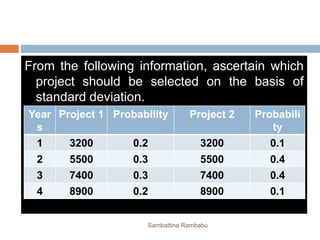
From the following information, ascertain which
project should be selected on the basis of
standard deviation.
Year
s
Project 1 Probability Project 2 Probabili
ty
1 3200 0.2 3200 0.1
2 5500 0.3 5500 0.4
3 7400 0.3 7400 0.4
4 8900 0.2 8900 0.1
Sambattina Rambabu
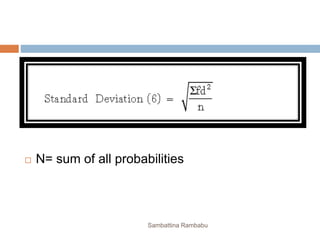
 N= sum of all probabilities
Sambattina Rambabu
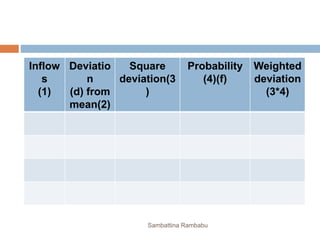
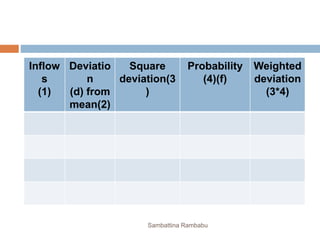
Inflow
s
(1)
Deviatio
n
(d) from
mean(2)
Square
deviation(3
)
Probability
(4)(f)
Weighted
deviation
(3*4)
Sambattina Rambabu
Inflow
s
(1)
Deviatio
n
(d) from
mean(2)
Square
deviation(3
)
Probability
(4)(f)
Weighted
deviation
(3*4)
Sambattina Rambabu
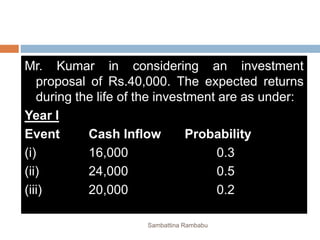
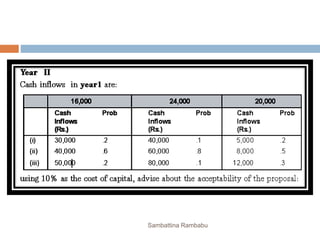
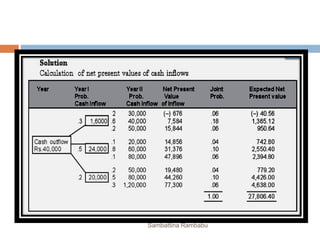
Mr. Kumar in considering an investment
proposal of Rs.40,000. The expected returns
during the life of the investment are as under:
Year I
Event Cash Inflow Probability
(i) 16,000 0.3
(ii) 24,000 0.5
(iii) 20,000 0.2
Sambattina Rambabu
Sambattina Rambabu
Sambattina Rambabu
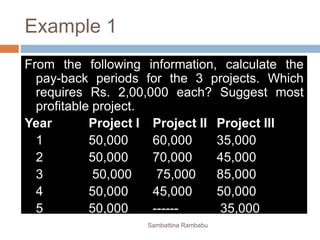
Example 1
From the following information, calculate the
pay-back periods for the 3 projects. Which
requires Rs. 2,00,000 each? Suggest most
profitable project.
Year Project I Project II Project III
1 50,000 60,000 35,000
2 50,000 70,000 45,000
3 50,000 75,000 85,000
4 50,000 45,000 50,000
5 50,000 ------ 35,000
Sambattina Rambabu
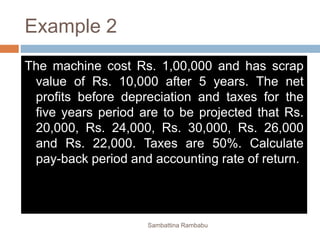
Example 2
The machine cost Rs. 1,00,000 and has scrap
value of Rs. 10,000 after 5 years. The net
profits before depreciation and taxes for the
five years period are to be projected that Rs.
20,000, Rs. 24,000, Rs. 30,000, Rs. 26,000
and Rs. 22,000. Taxes are 50%. Calculate
pay-back period and accounting rate of return.
Sambattina Rambabu
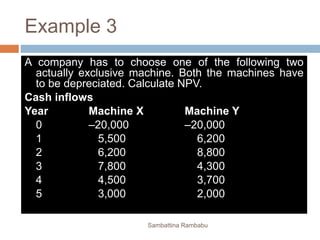
Example 3
A company has to choose one of the following two
actually exclusive machine. Both the machines have
to be depreciated. Calculate NPV.
Cash inflows
Year Machine X Machine Y
0 –20,000 –20,000
1 5,500 6,200
2 6,200 8,800
3 7,800 4,300
4 4,500 3,700
5 3,000 2,000
Sambattina Rambabu
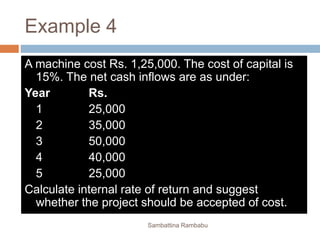
Example 4
A machine cost Rs. 1,25,000. The cost of capital is
15%. The net cash inflows are as under:
Year Rs.
1 25,000
2 35,000
3 50,000
4 40,000
5 25,000
Calculate internal rate of return and suggest
whether the project should be accepted of cost.
Sambattina Rambabu
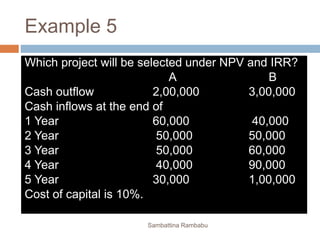
Example 5
Which project will be selected under NPV and IRR?
A B
Cash outflow 2,00,000 3,00,000
Cash inflows at the end of
1 Year 60,000 40,000
2 Year 50,000 50,000
3 Year 50,000 60,000
4 Year 40,000 90,000
5 Year 30,000 1,00,000
Cost of capital is 10%.
Sambattina Rambabu
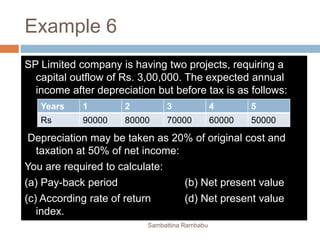
Example 6
SP Limited company is having two projects, requiring a
capital outflow of Rs. 3,00,000. The expected annual
income after depreciation but before tax is as follows:
Depreciation may be taken as 20% of original cost and
taxation at 50% of net income:
You are required to calculate:
(a) Pay-back period (b) Net present value
(c) According rate of return (d) Net present value
index.
(e) Internal rate of return.
Years 1 2 3 4 5
Rs 90000 80000 70000 60000 50000
Sambattina Rambabu
Example
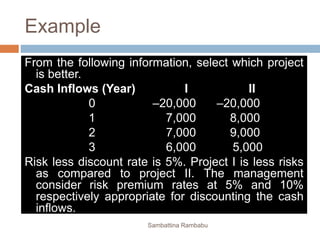
From the following information, select which project
is better.
Cash Inflows (Year) I II
0 –20,000 –20,000
1 7,000 8,000
2 7,000 9,000
3 6,000 5,000
Risk less discount rate is 5%. Project I is less risks
as compared to project II. The management
consider risk premium rates at 5% and 10%
respectively appropriate for discounting the cash
inflows.
Sambattina Rambabu
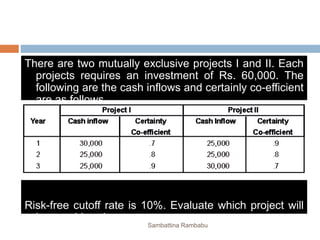
There are two mutually exclusive projects I and II. Each
projects requires an investment of Rs. 60,000. The
following are the cash inflows and certainly co-efficient
are as follows.
Risk-free cutoff rate is 10%. Evaluate which project will
be considered
Sambattina Rambabu

Capital budgeting practice

  • 1.
    Illustration 1 : ZenithIndustrial Ltd. are thinking of investing in a project costing Rs. 20 lakhs. The life of the project is five years and the estimated salvage value of the project is zero. Straight line method of charging depreciation is followed. The tax rate is 50%. The expected cash flows before tax are as follows : Year 1 2 3 4 5 Estimated Cash flow before Depreciation and tax (Rs. lakhs) 4 6 8 8 10 You are required to determine the : (i) Payback Period for the investment, (ii) Average Rate of Return on the investment, (iii) Net Present Value at 10% Cost of Sambattina Rambabu
  • 2.
    Illustration 2 : Therelevant information for two alternative systems of internal transportation are given below : (Rs.) Particulars System 1 System 2 Initial investment 60,00,000 40,00,000 Annual operating costs 10,00,000 900,000 Life 6 years 4 years Salvage value at the end 20,00,000 15,00,000 Which system would you prefer if the cost of capital is 6%? Justify your recommendation with appropriate analysis. [Present value of annuity at 6% for 6 years = 4.917 and for 4 years = 3.465. Present value of Rs. 1.00 at 6% at the end of 6the year 0.705 and that at the end of 4th year 0.792]. Sambattina Rambabu
  • 3.
    Capital rationing  Capitalrationing is a situation where a constraint or budget ceiling is placed on the total size of capital expenditures during a particular period. Often firms draw up their capital budget under the assumption that the availability of financial resources is limited.  Under this situation, a decision maker is compelled to reject some of the viable projects having positive net present value because of shortage of funds. It is known as a situation involving capital rationingSambattina Rambabu
  • 4.
    The total availablebudget for a company is Rs. 20 crores and the total cost of the projects is Rs. 25 crores. The projets listed below have been ranked in order of profitability. There is possibility of submitting X project where cost is assumed to be Rs. 13 crores and it has the Profitability Index of 140 Project Cost Profitability index A 60000000 1.50 B 5 0000000 1.25 C 7 0000000 1.20 D 20000000 1.15 E 5 0000000 1.10 Which projects, including X, should be acquired by the company? Sambattina Rambabu
  • 5.
    In a capitalrationing situation (investment limit Rs. 25 lakhs), suggest the most desirable feasible combination on the basis of the following data (indicate justification): Projects B and C are mutually exclusive. Projects Net cash flows NPV A 1500000 600000 B 1000000 450000 C 750000 360000 D 600000 300000 Sambattina Rambabu
  • 6.
    S. Ltd., hasRs. 10,00,000 allocated for capital budgeting purpose. The following proposal and associated profitability indexes have been determined. Which of the above investment should be undertaken? Assume that projects are indivisible and there is no alternative use of the money allocated for capital budgeting? Projects Cost Profitability Index 1 3,00,000 1.22 2 1,50,000 0.95 3 3,50,000 1.2 4 4,50,000 1.18 5 2,00,000 1.2 6 64,00,000 1.05 Sambattina Rambabu
  • 7.
    Alpha Limited isconsidering five capital projects for the years 2003 and 2004. The company is financed by equity entirely and its cost of capital is 12%. The expected cash flows of the projects are as belows: Projects Year end cashflows 2003 2004 2005 2006 A -70 35 35 20 B -40 -30 45 55 C -50 -60 70 80 D nil -90 55 65 E -60 -20 40 50 Sambattina Rambabu
  • 8.
    All projects aredivisible i.e., size of investment can be reduced, if necessary in relation to availability of funds. None of the projects can be delayed or undertaken more than once. Calculate which project Alpha Limited should undertake if the capital available for investment is limited to Rs. 1,10,000 in 2003 and with no limitation in subsequent years. For your analysis, use the following present value factors : Years 2003 2004 2005 2006 Factors 1.00 0.89 0.80 0.71 Sambattina Rambabu
  • 9.
  • 10.
    Terminal Value Method Assumption: (1) Each cash flow is reinvested in another project at a predetermined rate of interest. (2) Each cash inflow is reinvested elsewhere immediately after the completion of the project. Decision-making If the P.V. of Sum Total of the Compound reinvested cash flows is greater than the P.V. Of the outflows of the project under consideration, the project will be accepted otherwise not. Sambattina Rambabu
  • 11.
    Illustration :  OriginalInvestment Rs. 40,000  Life of the project 4 years  Cash Inflows Rs. 25,000 for 4 years  Cost of Capital 10% p.a Expected interest rates at which the cash inflows will be reinvested : Year-end 1 2 3 4 % 8 8 8 8 Sambattina Rambabu
  • 12.
  • 13.
  • 14.
    RISK AND UNCERTAINLYIN CAPITAL BUDGETING Capital budgeting requires the projection of cash inflow and outflow of the future. The future in always uncertain, estimate of demand, production, selling price, cost etc., cannot be exact. For example: The product at any time it become obsolete therefore, the future in unexpected. The following methods for considering the accounting of risk in capital budgeting. Various evaluation methods are used for risk and uncertainty in capital budgeting are as follows:Sambattina Rambabu
  • 15.
    (i) Risk-adjusted cutoff rate (or method of varying discount rate) (ii) Certainly equivalent method. (iii) Sensitivity technique. (iv) Probability technique (v) Standard deviation method. (vi) Co-efficient of variation method. (vii) Decision tree analysis. Sambattina Rambabu
  • 16.
    (i) Risk-adjusted cutoffrate (or Method of varying) This is one of the simplest method while calculating the risk in capital budgeting increase cut of rate or discount factor by certain percentage an account of risk. Sambattina Rambabu
  • 17.
    Example 1 The RamakrishnaLtd., in considering the purchase of a new investment. Two alternative investments are available (X and Y) each costing Rs. 150000. Cash inflows are expected to be as follows: Cash Inflows Year Investment X Investment Y Rs. Rs. 1 60,000 65,000 2 45,000 55,000 3 35,000 40,000 4 30,000 40,000 The company has a target return on capital of 10%. Risk premium rate are 2% and 8% respectively for investment X and Y. Which investment should be preferred? Sambattina Rambabu
  • 18.
    Answer Project X ProjectY Years Discounting factor= Cost of capital + Risk premium Rate(10%+2%=12%) Cash inflows Present Value of CFAT Discounting factor= Cost of capital + Risk premium Rate(10%+8%=18%) Cash inflows Present Value of CFAT 1 0.893 60000 0.847 85000 2 0.797 45000 0.718 55000 3 0.712 35000 0.609 40000 4 0.636 30000 0.516 40000 TOTAL PRESENT VALUE OF CFAT TOTAL PRESENT VALUE OF CFAT Sambattina Rambabu
  • 19.
    (ii) Certainly equivalent method Itis also another simplest method for calculating risk in capital budgeting. It reduces expected cash inflows by certain amounts. it can be calculated by multiplying the expected cash inflows by certainly equivalent co-efficient in order to convert the uncertain cash inflow to certain cash inflows. Sambattina Rambabu
  • 20.
    Exercise 14 There aretwo projects A and B. Each involves an investment of Rs. 50,000. The expected cash inflows and the certainly co-efficient are as under: Risk-free cutoff rate is 10%. Suggest which of the two projects. Should be preferred Sambattina Rambabu
  • 21.
    Step 1: calculatecertainly cash inflows at certainly co efficient factors. Step 2: calculate present value of cash inflows at discounting rate. Step 3: Calculate NPV and take decision. Sambattina Rambabu
  • 22.
  • 23.
  • 24.
    (iii) Sensitivity technique Whencash inflows are sensitive under different circumstances more than one forecast of the future cash inflows may be made. These inflows may be regarded on ‘Optimistic’, ‘most likely’ and ‘pessimistic’. Further cash inflows may be discounted to find out the net present values under these three different situations. If the net present values under the three situations differ widely it implies that there is a great risk in the project and the investor’s is decision to accept or reject a project will depend upon his risk bearing activities. Sambattina Rambabu
  • 25.
    Mr. Ritik isconsidering two mutually exclusive project ‘X’ and ‘Y’. You are required to advise him about the acceptability of the projects from the following information Sambattina Rambabu
  • 26.
  • 27.
    The net presentvalues on calculated above indicate that project Y is more risky as compared to project X. But at the same time during favourable condition, it is more profitable also. The acceptability of the project will depend upon Mr. Selva’s attitude towards risk. If he could afford to take higher risk, project Y may be more profitable. Sambattina Rambabu
  • 28.
    (iv) Probability technique Probabilitytechnique refers to the each event of future happenings are assigned with relative frequency probability. Probability means the likelihood of future event. The cash inflows of the future years further discounted with the probability. The higher present value may be accepted. Sambattina Rambabu
  • 29.
    Example Year s Project 1 ProbabilityProject 2 Probabili ty 0 10000 - 10000 - 1 10000 0.2 12000 0.2 2 18000 0.6 16000 0.6 3 8000 0.2 14000 0.2 Cost of capital is 15% Sambattina Rambabu
  • 30.
    (v) Standard deviation method TwoProjects have the same cash outflow and their net values are also the same, standard durations of the expected cash inflows of the two Projects may be calculated to measure the comparative and risk of the Projects. The project having a higher standard deviation in said to be more risky as compared to the other. Sambattina Rambabu
  • 31.
    From the followinginformation, ascertain which project should be selected on the basis of standard deviation. Year s Project 1 Probability Project 2 Probabili ty 1 3200 0.2 3200 0.1 2 5500 0.3 5500 0.4 3 7400 0.3 7400 0.4 4 8900 0.2 8900 0.1 Sambattina Rambabu
  • 32.
     N= sumof all probabilities Sambattina Rambabu
  • 33.
  • 34.
  • 35.
    Mr. Kumar inconsidering an investment proposal of Rs.40,000. The expected returns during the life of the investment are as under: Year I Event Cash Inflow Probability (i) 16,000 0.3 (ii) 24,000 0.5 (iii) 20,000 0.2 Sambattina Rambabu
  • 36.
  • 37.
  • 38.
    Example 1 From thefollowing information, calculate the pay-back periods for the 3 projects. Which requires Rs. 2,00,000 each? Suggest most profitable project. Year Project I Project II Project III 1 50,000 60,000 35,000 2 50,000 70,000 45,000 3 50,000 75,000 85,000 4 50,000 45,000 50,000 5 50,000 ------ 35,000 Sambattina Rambabu
  • 39.
    Example 2 The machinecost Rs. 1,00,000 and has scrap value of Rs. 10,000 after 5 years. The net profits before depreciation and taxes for the five years period are to be projected that Rs. 20,000, Rs. 24,000, Rs. 30,000, Rs. 26,000 and Rs. 22,000. Taxes are 50%. Calculate pay-back period and accounting rate of return. Sambattina Rambabu
  • 40.
    Example 3 A companyhas to choose one of the following two actually exclusive machine. Both the machines have to be depreciated. Calculate NPV. Cash inflows Year Machine X Machine Y 0 –20,000 –20,000 1 5,500 6,200 2 6,200 8,800 3 7,800 4,300 4 4,500 3,700 5 3,000 2,000 Sambattina Rambabu
  • 41.
    Example 4 A machinecost Rs. 1,25,000. The cost of capital is 15%. The net cash inflows are as under: Year Rs. 1 25,000 2 35,000 3 50,000 4 40,000 5 25,000 Calculate internal rate of return and suggest whether the project should be accepted of cost. Sambattina Rambabu
  • 42.
    Example 5 Which projectwill be selected under NPV and IRR? A B Cash outflow 2,00,000 3,00,000 Cash inflows at the end of 1 Year 60,000 40,000 2 Year 50,000 50,000 3 Year 50,000 60,000 4 Year 40,000 90,000 5 Year 30,000 1,00,000 Cost of capital is 10%. Sambattina Rambabu
  • 43.
    Example 6 SP Limitedcompany is having two projects, requiring a capital outflow of Rs. 3,00,000. The expected annual income after depreciation but before tax is as follows: Depreciation may be taken as 20% of original cost and taxation at 50% of net income: You are required to calculate: (a) Pay-back period (b) Net present value (c) According rate of return (d) Net present value index. (e) Internal rate of return. Years 1 2 3 4 5 Rs 90000 80000 70000 60000 50000 Sambattina Rambabu
  • 44.
    Example From the followinginformation, select which project is better. Cash Inflows (Year) I II 0 –20,000 –20,000 1 7,000 8,000 2 7,000 9,000 3 6,000 5,000 Risk less discount rate is 5%. Project I is less risks as compared to project II. The management consider risk premium rates at 5% and 10% respectively appropriate for discounting the cash inflows. Sambattina Rambabu
  • 45.
    There are twomutually exclusive projects I and II. Each projects requires an investment of Rs. 60,000. The following are the cash inflows and certainly co-efficient are as follows. Risk-free cutoff rate is 10%. Evaluate which project will be considered Sambattina Rambabu