
Measures of Cost of Capital
S.P.K. Iresha
SH/2807
2
Cost of Capital
 The cost of capital is the cost of obtaining funds, through debt or
equity, in order to finance an investment.
 The cost of capital represents the overall cost of financing to the
firm.
Basic costs of capital
1. Cost of debt-capital
2. Cost of preferred stock
3. Cost of equity
4. Cost of retained earning
5. Weighted Cost of Capital
3
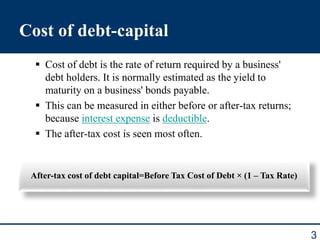
Cost of debt-capital
 Cost of debt is the rate of return required by a business'
debt holders. It is normally estimated as the yield to
maturity on a business' bonds payable.
 This can be measured in either before or after-tax returns;
because interest expense is deductible.
 The after-tax cost is seen most often.
After-tax cost of debt capital=Before Tax Cost of Debt × (1 – Tax Rate)
4
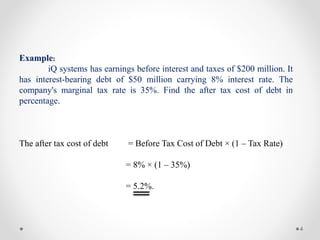
Example:
iQ systems has earnings before interest and taxes of $200 million. It
has interest-bearing debt of $50 million carrying 8% interest rate. The
company's marginal tax rate is 35%. Find the after tax cost of debt in
percentage.
The after tax cost of debt = Before Tax Cost of Debt × (1 – Tax Rate)
= 8% × (1 – 35%)
= 5.2%.
5
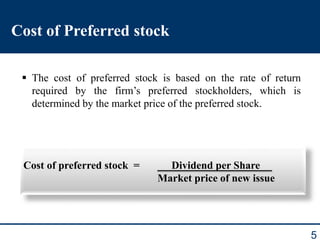
Cost of Preferred stock
 The cost of preferred stock is based on the rate of return
required by the firm’s preferred stockholders, which is
determined by the market price of the preferred stock.
Cost of preferred stock = Dividend per Share
Market price of new issue
6
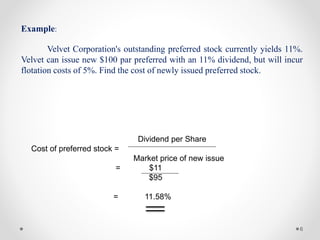
Example:
Velvet Corporation's outstanding preferred stock currently yields 11%.
Velvet can issue new $100 par preferred with an 11% dividend, but will incur
flotation costs of 5%. Find the cost of newly issued preferred stock.
Dividend per Share
Cost of preferred stock =
Market price of new issue
= $11
$95
= 11.58%
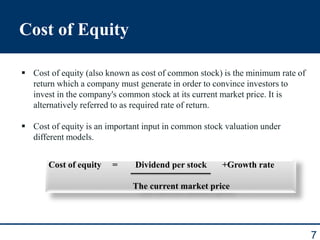
Cost of Equity
7
 Cost of equity (also known as cost of common stock) is the minimum rate of
return which a company must generate in order to convince investors to
invest in the company's common stock at its current market price. It is
alternatively referred to as required rate of return.
 Cost of equity is an important input in common stock valuation under
different models.
Cost of equity = Dividend per stock +Growth rate
The current market price
8
Example:
Suppose a firm’s share is traded at 120$ and the current dividend is $4 and
a growth rate is6%.
Dividend per stock = 4 * (1+6%) = $4.24
The current market price = $120
Growth rate = 6%
Therefore,
Cost of equity = Dividend per stock +Growth rate
The current market price
= 4.24 / 120 + 6%
= 9.53%
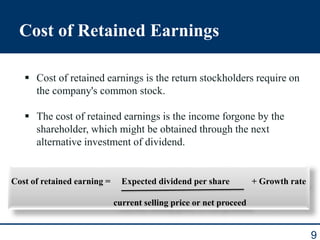
Cost of Retained Earnings
9
 Cost of retained earnings is the return stockholders require on
the company's common stock.
 The cost of retained earnings is the income forgone by the
shareholder, which might be obtained through the next
alternative investment of dividend.
Cost of retained earning = Expected dividend per share + Growth rate
current selling price or net proceed
10
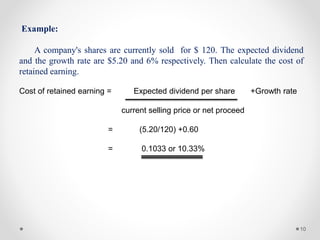
Example:
A company's shares are currently sold for $ 120. The expected dividend
and the growth rate are $5.20 and 6% respectively. Then calculate the cost of
retained earning.
Cost of retained earning = Expected dividend per share +Growth rate
current selling price or net proceed
= (5.20/120) +0.60
= 0.1033 or 10.33%
11
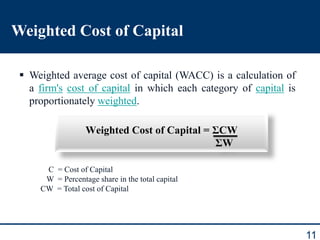
Weighted Cost of Capital
 Weighted average cost of capital (WACC) is a calculation of
a firm's cost of capital in which each category of capital is
proportionately weighted.
Weighted Cost of Capital = ƩCW
ƩW
C = Cost of Capital
W = Percentage share in the total capital
CW = Total cost of Capital
12
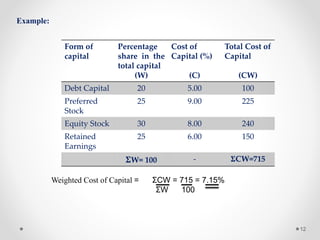
Example:
Form of
capital
Percentage
share in the
total capital
(W)
Cost of
Capital (%)
(C)
Total Cost of
Capital
(CW)
Debt Capital 20 5.00 100
Preferred
Stock
25 9.00 225
Equity Stock 30 8.00 240
Retained
Earnings
25 6.00 150
ƩW= 100 - ƩCW=715
Weighted Cost of Capital = ƩCW = 715 = 7.15%
ƩW 100
Factors affecting the Cost of Capital
13
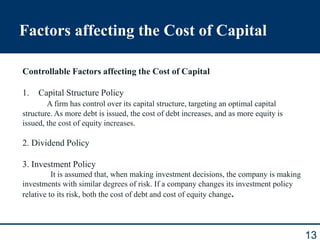
Controllable Factors affecting the Cost of Capital
1. Capital Structure Policy
A firm has control over its capital structure, targeting an optimal capital
structure. As more debt is issued, the cost of debt increases, and as more equity is
issued, the cost of equity increases.
2. Dividend Policy
3. Investment Policy
It is assumed that, when making investment decisions, the company is making
investments with similar degrees of risk. If a company changes its investment policy
relative to its risk, both the cost of debt and cost of equity change.
3/25/2017 14
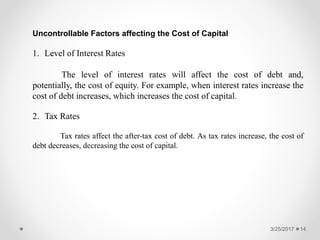
Uncontrollable Factors affecting the Cost of Capital
1. Level of Interest Rates
The level of interest rates will affect the cost of debt and,
potentially, the cost of equity. For example, when interest rates increase the
cost of debt increases, which increases the cost of capital.
2. Tax Rates
Tax rates affect the after-tax cost of debt. As tax rates increase, the cost of
debt decreases, decreasing the cost of capital.
15
Thank You

Measures of Cost of Capital

  • 1.
    Measures of Costof Capital S.P.K. Iresha SH/2807
  • 2.
    2 Cost of Capital The cost of capital is the cost of obtaining funds, through debt or equity, in order to finance an investment.  The cost of capital represents the overall cost of financing to the firm. Basic costs of capital 1. Cost of debt-capital 2. Cost of preferred stock 3. Cost of equity 4. Cost of retained earning 5. Weighted Cost of Capital
  • 3.
    3 Cost of debt-capital Cost of debt is the rate of return required by a business' debt holders. It is normally estimated as the yield to maturity on a business' bonds payable.  This can be measured in either before or after-tax returns; because interest expense is deductible.  The after-tax cost is seen most often. After-tax cost of debt capital=Before Tax Cost of Debt × (1 – Tax Rate)
  • 4.
    4 Example: iQ systems hasearnings before interest and taxes of $200 million. It has interest-bearing debt of $50 million carrying 8% interest rate. The company's marginal tax rate is 35%. Find the after tax cost of debt in percentage. The after tax cost of debt = Before Tax Cost of Debt × (1 – Tax Rate) = 8% × (1 – 35%) = 5.2%.
  • 5.
    5 Cost of Preferredstock  The cost of preferred stock is based on the rate of return required by the firm’s preferred stockholders, which is determined by the market price of the preferred stock. Cost of preferred stock = Dividend per Share Market price of new issue
  • 6.
    6 Example: Velvet Corporation's outstandingpreferred stock currently yields 11%. Velvet can issue new $100 par preferred with an 11% dividend, but will incur flotation costs of 5%. Find the cost of newly issued preferred stock. Dividend per Share Cost of preferred stock = Market price of new issue = $11 $95 = 11.58%
  • 7.
    Cost of Equity 7 Cost of equity (also known as cost of common stock) is the minimum rate of return which a company must generate in order to convince investors to invest in the company's common stock at its current market price. It is alternatively referred to as required rate of return.  Cost of equity is an important input in common stock valuation under different models. Cost of equity = Dividend per stock +Growth rate The current market price
  • 8.
    8 Example: Suppose a firm’sshare is traded at 120$ and the current dividend is $4 and a growth rate is6%. Dividend per stock = 4 * (1+6%) = $4.24 The current market price = $120 Growth rate = 6% Therefore, Cost of equity = Dividend per stock +Growth rate The current market price = 4.24 / 120 + 6% = 9.53%
  • 9.
    Cost of RetainedEarnings 9  Cost of retained earnings is the return stockholders require on the company's common stock.  The cost of retained earnings is the income forgone by the shareholder, which might be obtained through the next alternative investment of dividend. Cost of retained earning = Expected dividend per share + Growth rate current selling price or net proceed
  • 10.
    10 Example: A company's sharesare currently sold for $ 120. The expected dividend and the growth rate are $5.20 and 6% respectively. Then calculate the cost of retained earning. Cost of retained earning = Expected dividend per share +Growth rate current selling price or net proceed = (5.20/120) +0.60 = 0.1033 or 10.33%
  • 11.
    11 Weighted Cost ofCapital  Weighted average cost of capital (WACC) is a calculation of a firm's cost of capital in which each category of capital is proportionately weighted. Weighted Cost of Capital = ƩCW ƩW C = Cost of Capital W = Percentage share in the total capital CW = Total cost of Capital
  • 12.
    12 Example: Form of capital Percentage share inthe total capital (W) Cost of Capital (%) (C) Total Cost of Capital (CW) Debt Capital 20 5.00 100 Preferred Stock 25 9.00 225 Equity Stock 30 8.00 240 Retained Earnings 25 6.00 150 ƩW= 100 - ƩCW=715 Weighted Cost of Capital = ƩCW = 715 = 7.15% ƩW 100
  • 13.
    Factors affecting theCost of Capital 13 Controllable Factors affecting the Cost of Capital 1. Capital Structure Policy A firm has control over its capital structure, targeting an optimal capital structure. As more debt is issued, the cost of debt increases, and as more equity is issued, the cost of equity increases. 2. Dividend Policy 3. Investment Policy It is assumed that, when making investment decisions, the company is making investments with similar degrees of risk. If a company changes its investment policy relative to its risk, both the cost of debt and cost of equity change.
  • 14.
    3/25/2017 14 Uncontrollable Factorsaffecting the Cost of Capital 1. Level of Interest Rates The level of interest rates will affect the cost of debt and, potentially, the cost of equity. For example, when interest rates increase the cost of debt increases, which increases the cost of capital. 2. Tax Rates Tax rates affect the after-tax cost of debt. As tax rates increase, the cost of debt decreases, decreasing the cost of capital.
  • 15.