Chapter-6: Capacitors and Inductors
6.1 Introduction
• So far our circuit analysis pursuit has been limited to resistive circuits.
• Practical applications of resistive circuits are quite limited.
• Other important passive linear circuit elements of circuit are the
capacitor and inductor that unlike resistor do not dissipate energy.
• Introduction of capacitors and inductors will enable us to analyze
more important and practical electrical circuits.
• Capacitors and inductors are called energy storage elements (ESL) as
they store energy which can be retrieved at later stage.
• Circuit analysis techniques covered in Chapters 3 and 4 are equally
applicable to circuits with capacitors and inductors.
• Let’s begin by introducing capacitors.
6.2: Capacitors
• A capacitor is a passive element designed to store energy in its electric
field and it does so by accumulating charge.
• Besides resistors; capacitors are the most common electrical
components that are used extensively in electronics, communications,
computers, and power systems.
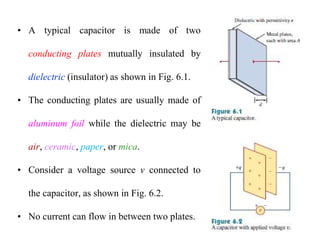
• A typical capacitor is made of two
conducting plates mutually insulated by
dielectric (insulator) as shown in Fig. 6.1.
• The conducting plates are usually made of
aluminum foil while the dielectric may be
air, ceramic, paper, or mica.
• Consider a voltage source v connected to
the capacitor, as shown in Fig. 6.2.
• No current can flow in between two plates.
• Source connected across a capacitor deposits a positive charge q on
one plate and a negative charge – q on the other.
• The capacitor stores energy by accumulating electric charge.
• The amount of charge stored, is directly proportional to the applied
voltage i.e. q = Cv (6.1).
• C in eq. 6.1 is the constant of proportionality, is known as the
capacitance of the capacitor and measured in farad (F); 1 F = 1 C/V.
• Capacitance is the ratio of the charge on one plate of a capacitor to the
voltage difference between the two plates i.e. C = q/v.
• Although the capacitance C of a capacitor is the ratio of the charge q
per plate to the applied voltage it does not depend on q or v.
• Capacitance depends on the physical dimensions of the capacitor.
• For example, for the parallel-plate capacitor shown in Fig. 6.1, the
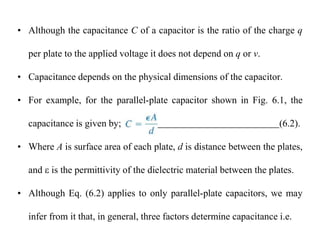
capacitance is given by; (6.2).
• Where A is surface area of each plate, d is distance between the plates,
and  is the permittivity of the dielectric material between the plates.
• Although Eq. (6.2) applies to only parallel-plate capacitors, we may
infer from it that, in general, three factors determine capacitance i.e.
1. Larger the surface area of the plates, greater the capacitance.
2. Smaller the spacing between plates, greater the capacitance.
3. Higher the dielectric Permittivity, greater the capacitance.
• Capacitors are commercially available in different values and types.
• They are described by the dielectric material they are made of and by
whether they are of fixed or variable type.
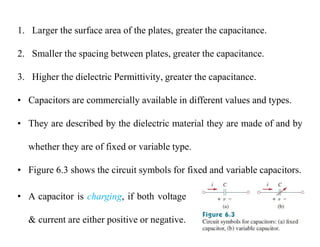
• Figure 6.3 shows the circuit symbols for fixed and variable capacitors.
• A capacitor is charging, if both voltage
& current are either positive or negative.
• Conversely if either of current or voltage is negative then capacitor is
being discharged, which is interpretation of passive sign convention.
• Introduction to some of the common types of fixed-value and variable
capacitors is left for the student’s lab session.
• Since i = dq/dt, and q = Cv (Eq. 6.1), therefore,
• i = C(dv/dt) (6.4).
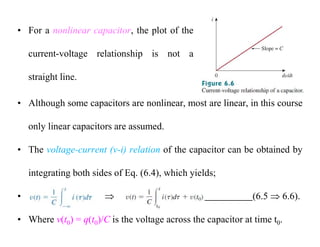
• This current-voltage (i-v) relationship is illustrated in Fig. 6.6 for a
capacitor whose capacitance is independent of voltage.
• Capacitors that satisfy Eq. (6.4) are said to be linear.
• For a nonlinear capacitor, the plot of the
current-voltage relationship is not a
straight line.
• Although some capacitors are nonlinear, most are linear, in this course
only linear capacitors are assumed.
• The voltage-current (v-i) relation of the capacitor can be obtained by
integrating both sides of Eq. (6.4), which yields;
•  (6.5  6.6).
• Where v(t0) = q(t0)/C is the voltage across the capacitor at time t0.
• Equation (6.6) shows that capacitor voltage depends on the past
history of the capacitor current i.e. the capacitor has memory.
• Instantaneous power delivered to capacitor,
• Therefore, energy stored in the capacitor can be computed by,
•
• Note that v(– ) = 0,because the capacitor was uncharged at t = – .
• Thus,
• This represents the energy stored in the electric field that exists
between the plates of the capacitor.
• This stored energy can be retrieved, as and when required.
• Important capacitor properties include :
1. A capacitor is an open circuit to dc, because i = C(dv/dt) and if the
voltage across a capacitor is not changing with time (i.e. dc
voltage), the current through the capacitor is zero.
2. The voltage on the capacitor must be continuous, i.e. the voltage on
a capacitor cannot change abruptly. The capacitor resists an abrupt
change in the voltage across it. Why?
• According to i = C(dv/dt), a discontinuous change in voltage requires
an infinite current, which is physically impossible.
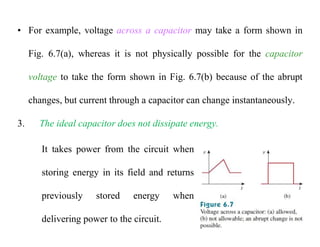
• For example, voltage across a capacitor may take a form shown in
Fig. 6.7(a), whereas it is not physically possible for the capacitor
voltage to take the form shown in Fig. 6.7(b) because of the abrupt
changes, but current through a capacitor can change instantaneously.
3. The ideal capacitor does not dissipate energy.
It takes power from the circuit when
storing energy in its field and returns
previously stored energy when
delivering power to the circuit.
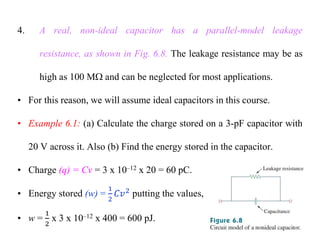
4. A real, non-ideal capacitor has a parallel-model leakage
resistance, as shown in Fig. 6.8. The leakage resistance may be as
high as 100 M and can be neglected for most applications.
• For this reason, we will assume ideal capacitors in this course.
• Example 6.1: (a) Calculate the charge stored on a 3-pF capacitor with
20 V across it. Also (b) Find the energy stored in the capacitor.
• Charge (q) = Cv = 3 x 10–12 x 20 = 60 pC.
• Energy stored (w) = putting the values,
• w = x 3 x 10–12 x 400 = 600 pJ.
• Home Work; P_Problem 6.1 & review question 6.1.
• Example 6.2; Find the current through a 5 µF capacitor when the
voltage across it is v(t) = 10 cos 6000t V?
• In a capacitor current (i) = C = 5 x 10–6 x (10 cos 6000t).
• Solved (i) = – 5 x 10–6 x 6000 x 10 sin 6000t = – 0.3 sin 6000t A.
• Home Work; P_Problem 6.2 and Problem 6.1.
• Example 6.3; Determine the voltage across a 2 µF capacitor if the
current through it is i(t) = 6 mA.
• Assume that the initial capacitor voltage is zero.
• Since;
• Therefore;
• v =
• Home Work; P_Problrm 6.3 and problem 6.4.
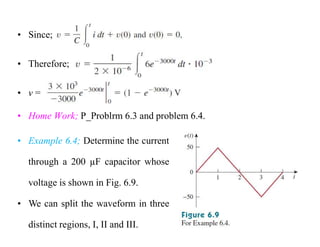
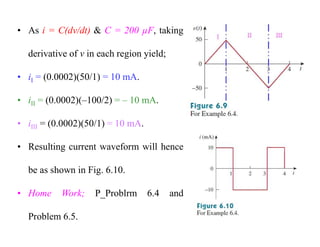
• Example 6.4; Determine the current
through a 200 µF capacitor whose
voltage is shown in Fig. 6.9.
• We can split the waveform in three
distinct regions, I, II and III.
• As i = C(dv/dt) & C = 200 µF, taking
derivative of v in each region yield;
• iI = (0.0002)(50/1) = 10 mA.
• iII = (0.0002)(–100/2) = – 10 mA.
• iIII = (0.0002)(50/1) = 10 mA.
• Resulting current waveform will hence
be as shown in Fig. 6.10.
• Home Work; P_Problrm 6.4 and
Problem 6.5.
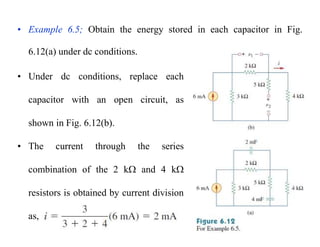
• Example 6.5; Obtain the energy stored in each capacitor in Fig.
6.12(a) under dc conditions.
• Under dc conditions, replace each
capacitor with an open circuit, as
shown in Fig. 6.12(b).
• The current through the series
combination of the 2 k and 4 k
resistors is obtained by current division
as,
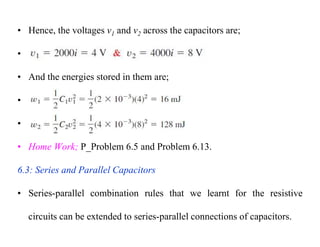
• Hence, the voltages v1 and v2 across the capacitors are;
•
• And the energies stored in them are;
•
•
• Home Work; P_Problem 6.5 and Problem 6.13.
6.3: Series and Parallel Capacitors
• Series-parallel combination rules that we learnt for the resistive
circuits can be extended to series-parallel connections of capacitors.
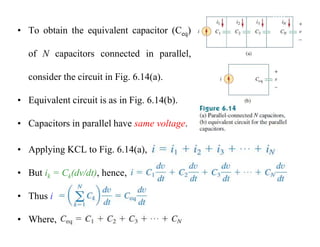
• To obtain the equivalent capacitor (Ceq)
of N capacitors connected in parallel,
consider the circuit in Fig. 6.14(a).
• Equivalent circuit is as in Fig. 6.14(b).
• Capacitors in parallel have same voltage.
• Applying KCL to Fig. 6.14(a),
• But ik = Ck(dv/dt), hence,
• Thus i
• Where,
• Thus equivalent capacitance of N parallel connected capacitors is the
sum of the individual capacitances.
• Note that capacitors in parallel combine in the same manner as
resistors in series.
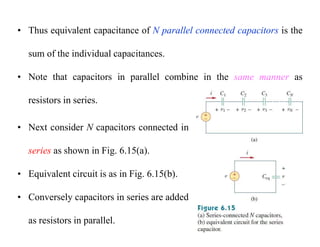
• Next consider N capacitors connected in
series as shown in Fig. 6.15(a).
• Equivalent circuit is as in Fig. 6.15(b).
• Conversely capacitors in series are added
as resistors in parallel.
• Thus a reciprocal formula must be employed to add capacitors in
parallel i.e.
• Proof can be established applying KVL to single loop and applying
voltage-current relationship to every voltage in v = v1 + v2 + …+ vN.
• Interested students can go through the proof given in the book.
• For N = 2 (i.e., two capacitors in series), the reciprocal formula
becomes; OR
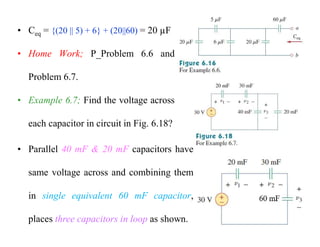
• Example 6.6: Find the equivalent capacitance seen between terminals
a and b of the circuit in Fig. 6.16.
• Ceq = {(20 || 5) + 6} + (20||60) = 20 µF
• Home Work; P_Problem 6.6 and
Problem 6.7.
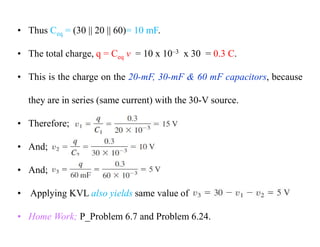
• Example 6.7; Find the voltage across
each capacitor in circuit in Fig. 6.18?
• Parallel 40 mF & 20 mF capacitors have
same voltage across and combining them
in single equivalent 60 mF capacitor,
places three capacitors in loop as shown.
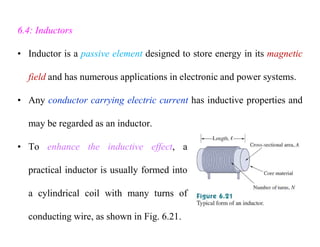
• Thus Ceq = (30 || 20 || 60)= 10 mF.
• The total charge, q = Ceq v = 10 x 10–3 x 30 = 0.3 C.
• This is the charge on the 20-mF, 30-mF & 60 mF capacitors, because
they are in series (same current) with the 30-V source.
• Therefore;
• And;
• And;
• Applying KVL also yields same value of
• Home Work; P_Problem 6.7 and Problem 6.24.
6.4: Inductors
• Inductor is a passive element designed to store energy in its magnetic
field and has numerous applications in electronic and power systems.
• Any conductor carrying electric current has inductive properties and
may be regarded as an inductor.
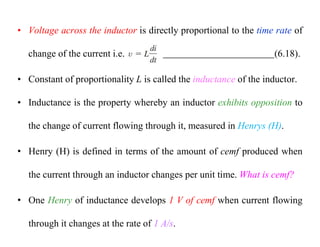
• To enhance the inductive effect, a
practical inductor is usually formed into
a cylindrical coil with many turns of
conducting wire, as shown in Fig. 6.21.
• Voltage across the inductor is directly proportional to the time rate of
change of the current i.e. (6.18).
• Constant of proportionality L is called the inductance of the inductor.
• Inductance is the property whereby an inductor exhibits opposition to
the change of current flowing through it, measured in Henrys (H).
• Henry (H) is defined in terms of the amount of cemf produced when
the current through an inductor changes per unit time. What is cemf?
• One Henry of inductance develops 1 V of cemf when current flowing
through it changes at the rate of 1 A/s.
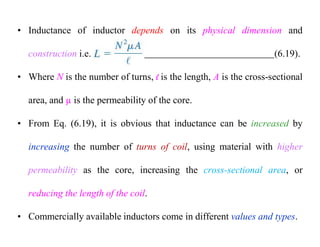
• Inductance of inductor depends on its physical dimension and
construction i.e. (6.19).
• Where N is the number of turns, l is the length, A is the cross-sectional
area, and µ is the permeability of the core.
• From Eq. (6.19), it is obvious that inductance can be increased by
increasing the number of turns of coil, using material with higher
permeability as the core, increasing the cross-sectional area, or
reducing the length of the coil.
• Commercially available inductors come in different values and types.
• Inductors may be fixed or variable, with
core made of iron, steel, plastic, or air.
• Terms coil & choke are also used for
inductors as per their application.
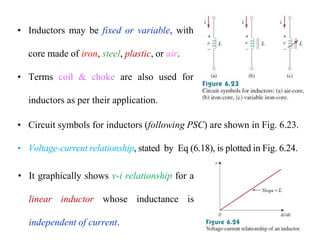
• Circuit symbols for inductors (following PSC) are shown in Fig. 6.23.
• Voltage-current relationship, stated by Eq (6.18), is plotted in Fig. 6.24.
• It graphically shows v-i relationship for a
linear inductor whose inductance is
independent of current.
• For a nonlinear inductor, the plot of Eq. (6.18) will not be a straight
line because its inductance varies with current.
• Only assume linear inductors in this course, unless stated otherwise.
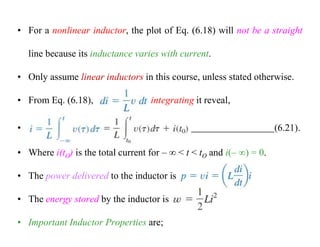
• From Eq. (6.18), integrating it reveal,
• (6.21).
• Where i(tO) is the total current for –  < t < tO and i(– ) = 0.
• The power delivered to the inductor is
• The energy stored by the inductor is
• Important Inductor Properties are;
• First; Voltage across an inductor is zero when the current is constant,
(Eq. 6.18), thus inductor acts like a short circuit to direct current (dc).
• Second; Inductor opposes the change in current flowing through it,
thus current through an inductor cannot change instantaneously. Why?
• A discontinuous change in the current through an inductor requires an
infinite voltage, (Eq. 6.18), which is not physically possible.
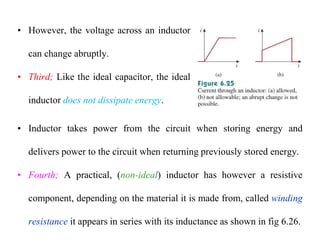
• For example, the current through an inductor may take the form as
shown in Fig. 6.25(a), but inductor current cannot take the form
shown in Fig. 6.25(b) in real-life situations due to the discontinuities.
• However, the voltage across an inductor
can change abruptly.
• Third; Like the ideal capacitor, the ideal
inductor does not dissipate energy.
• Inductor takes power from the circuit when storing energy and
delivers power to the circuit when returning previously stored energy.
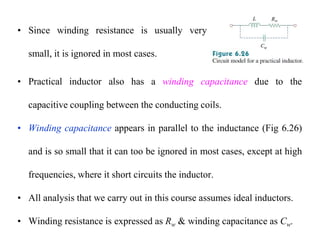
• Fourth; A practical, (non-ideal) inductor has however a resistive
component, depending on the material it is made from, called winding
resistance it appears in series with its inductance as shown in fig 6.26.
• Since winding resistance is usually very
small, it is ignored in most cases.
• Practical inductor also has a winding capacitance due to the
capacitive coupling between the conducting coils.
• Winding capacitance appears in parallel to the inductance (Fig 6.26)
and is so small that it can too be ignored in most cases, except at high
frequencies, where it short circuits the inductor.
• All analysis that we carry out in this course assumes ideal inductors.
• Winding resistance is expressed as Rw & winding capacitance as Cw.
• Example 6.8: Current through a 0.1-H inductor is i(t) = 10te–5t A. Find
the voltage across the inductor and the energy stored in it.
• Putting values of “L & i” in v = L , yield, v = 0.1 (10t ).
• And once solved v =
• Therefore, the energy stored
• Home Work; P_Problem 6.8 and Problem 6.34.
• Example 6.9; Find the current through a 5-H inductor if the voltage
across it is
• Also, find the energy stored at t = 5 s. (Assume i(v) > 0)?
• Since , putting the values reveal;
•
• Energy stored at t = 5 s can be determined applying Eq. (6.24) i.e.
•
• Energy can also be found applying relationship w =
• As power p = vi = 30t2 x 2t3 = 60t5, the energy stored is then,
• w = dt = 60 = 156.25 kJ, same answer.
• Home Work; P_Problem 6.9 and Problem 6.38.
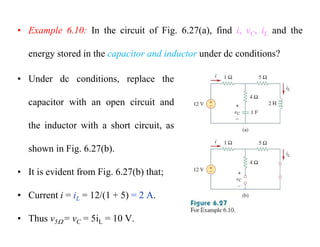
• Example 6.10: In the circuit of Fig. 6.27(a), find i, vC, iL and the
energy stored in the capacitor and inductor under dc conditions?
• Under dc conditions, replace the
capacitor with an open circuit and
the inductor with a short circuit, as
shown in Fig. 6.27(b).
• It is evident from Fig. 6.27(b) that;
• Current i = iL = 12/(1 + 5) = 2 A.
• Thus v5 = vC = 5iL = 10 V.
• Energy stored by the capacitor is given by;
•
• Similarly the energy stored by the inductor will be;
•
• Home Work; P_Problem 6.10 and problem 6.48.
• 6.5: Series and Parallel Inductors
• Rules for adding inductors in series/parallel are same as for resistors
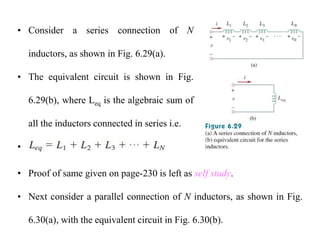
• Consider a series connection of N
inductors, as shown in Fig. 6.29(a).
• The equivalent circuit is shown in Fig.
6.29(b), where Leq is the algebraic sum of
all the inductors connected in series i.e.
•
• Proof of same given on page-230 is left as self study.
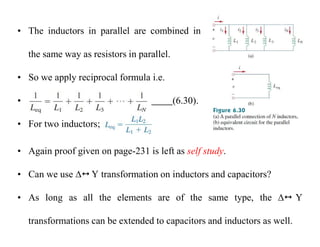
• Next consider a parallel connection of N inductors, as shown in Fig.
6.30(a), with the equivalent circuit in Fig. 6.30(b).
• The inductors in parallel are combined in
the same way as resistors in parallel.
• So we apply reciprocal formula i.e.
• (6.30).
• For two inductors;
• Again proof given on page-231 is left as self study.
• Can we use  Y transformation on inductors and capacitors?
• As long as all the elements are of the same type, the  Y
transformations can be extended to capacitors and inductors as well.
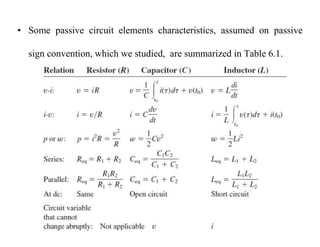
• Some passive circuit elements characteristics, assumed on passive
sign convention, which we studied, are summarized in Table 6.1.
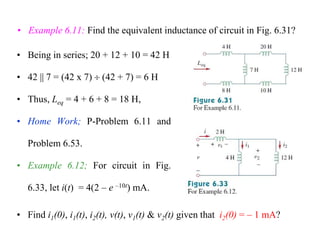
• Example 6.11: Find the equivalent inductance of circuit in Fig. 6.31?
• Being in series; 20 + 12 + 10 = 42 H
• 42 || 7 = (42 x 7)  (42 + 7) = 6 H
• Thus, Leq = 4 + 6 + 8 = 18 H,
• Home Work; P-Problem 6.11 and
Problem 6.53.
• Example 6.12; For circuit in Fig.
6.33, let i(t) = 4(2 – e –10t) mA.
• Find i1(0), i1(t), i2(t), v(t), v1(t) & v2(t) given that i2(0) = – 1 mA?
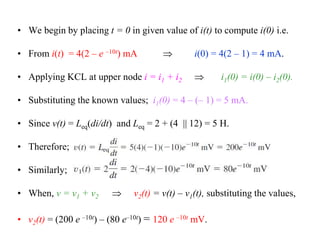
• We begin by placing t = 0 in given value of i(t) to compute i(0) i.e.
• From i(t) = 4(2 – e –10t) mA  i(0) = 4(2 – 1) = 4 mA.
• Applying KCL at upper node i = i1 + i2  i1(0) = i(0) – i2(0).
• Substituting the known values; i1(0) = 4 – (– 1) = 5 mA.
• Since v(t) = Leq(di/dt) and Leq = 2 + (4 || 12) = 5 H.
• Therefore;
• Similarly;
• When, v = v1 + v2  v2(t) = v(t) – v1(t), substituting the values,
• v2(t) = (200 e –10t) – (80 e–10t) = 120 e –10t mV.
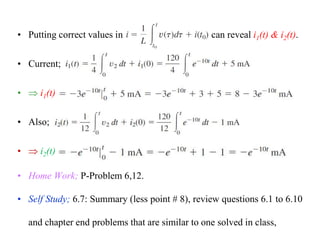
• Putting correct values in can reveal i1(t) & i2(t).
• Current;
•  i1(t)
• Also;
•  i2(t)
• Home Work; P-Problem 6,12.
• Self Study; 6.7: Summary (less point # 8), review questions 6.1 to 6.10
and chapter end problems that are similar to one solved in class,

Capacitors and inductors linear circuit analysis
  • 1.
    Chapter-6: Capacitors andInductors 6.1 Introduction • So far our circuit analysis pursuit has been limited to resistive circuits. • Practical applications of resistive circuits are quite limited. • Other important passive linear circuit elements of circuit are the capacitor and inductor that unlike resistor do not dissipate energy. • Introduction of capacitors and inductors will enable us to analyze more important and practical electrical circuits. • Capacitors and inductors are called energy storage elements (ESL) as they store energy which can be retrieved at later stage.
  • 2.
    • Circuit analysistechniques covered in Chapters 3 and 4 are equally applicable to circuits with capacitors and inductors. • Let’s begin by introducing capacitors. 6.2: Capacitors • A capacitor is a passive element designed to store energy in its electric field and it does so by accumulating charge. • Besides resistors; capacitors are the most common electrical components that are used extensively in electronics, communications, computers, and power systems.
  • 3.
    • A typicalcapacitor is made of two conducting plates mutually insulated by dielectric (insulator) as shown in Fig. 6.1. • The conducting plates are usually made of aluminum foil while the dielectric may be air, ceramic, paper, or mica. • Consider a voltage source v connected to the capacitor, as shown in Fig. 6.2. • No current can flow in between two plates.
  • 4.
    • Source connectedacross a capacitor deposits a positive charge q on one plate and a negative charge – q on the other. • The capacitor stores energy by accumulating electric charge. • The amount of charge stored, is directly proportional to the applied voltage i.e. q = Cv (6.1). • C in eq. 6.1 is the constant of proportionality, is known as the capacitance of the capacitor and measured in farad (F); 1 F = 1 C/V. • Capacitance is the ratio of the charge on one plate of a capacitor to the voltage difference between the two plates i.e. C = q/v.
  • 5.
    • Although thecapacitance C of a capacitor is the ratio of the charge q per plate to the applied voltage it does not depend on q or v. • Capacitance depends on the physical dimensions of the capacitor. • For example, for the parallel-plate capacitor shown in Fig. 6.1, the capacitance is given by; (6.2). • Where A is surface area of each plate, d is distance between the plates, and  is the permittivity of the dielectric material between the plates. • Although Eq. (6.2) applies to only parallel-plate capacitors, we may infer from it that, in general, three factors determine capacitance i.e.
  • 6.
    1. Larger thesurface area of the plates, greater the capacitance. 2. Smaller the spacing between plates, greater the capacitance. 3. Higher the dielectric Permittivity, greater the capacitance. • Capacitors are commercially available in different values and types. • They are described by the dielectric material they are made of and by whether they are of fixed or variable type. • Figure 6.3 shows the circuit symbols for fixed and variable capacitors. • A capacitor is charging, if both voltage & current are either positive or negative.
  • 7.
    • Conversely ifeither of current or voltage is negative then capacitor is being discharged, which is interpretation of passive sign convention. • Introduction to some of the common types of fixed-value and variable capacitors is left for the student’s lab session. • Since i = dq/dt, and q = Cv (Eq. 6.1), therefore, • i = C(dv/dt) (6.4). • This current-voltage (i-v) relationship is illustrated in Fig. 6.6 for a capacitor whose capacitance is independent of voltage. • Capacitors that satisfy Eq. (6.4) are said to be linear.
  • 8.
    • For anonlinear capacitor, the plot of the current-voltage relationship is not a straight line. • Although some capacitors are nonlinear, most are linear, in this course only linear capacitors are assumed. • The voltage-current (v-i) relation of the capacitor can be obtained by integrating both sides of Eq. (6.4), which yields; •  (6.5  6.6). • Where v(t0) = q(t0)/C is the voltage across the capacitor at time t0.
  • 9.
    • Equation (6.6)shows that capacitor voltage depends on the past history of the capacitor current i.e. the capacitor has memory. • Instantaneous power delivered to capacitor, • Therefore, energy stored in the capacitor can be computed by, • • Note that v(– ) = 0,because the capacitor was uncharged at t = – . • Thus, • This represents the energy stored in the electric field that exists between the plates of the capacitor.
  • 10.
    • This storedenergy can be retrieved, as and when required. • Important capacitor properties include : 1. A capacitor is an open circuit to dc, because i = C(dv/dt) and if the voltage across a capacitor is not changing with time (i.e. dc voltage), the current through the capacitor is zero. 2. The voltage on the capacitor must be continuous, i.e. the voltage on a capacitor cannot change abruptly. The capacitor resists an abrupt change in the voltage across it. Why? • According to i = C(dv/dt), a discontinuous change in voltage requires an infinite current, which is physically impossible.
  • 11.
    • For example,voltage across a capacitor may take a form shown in Fig. 6.7(a), whereas it is not physically possible for the capacitor voltage to take the form shown in Fig. 6.7(b) because of the abrupt changes, but current through a capacitor can change instantaneously. 3. The ideal capacitor does not dissipate energy. It takes power from the circuit when storing energy in its field and returns previously stored energy when delivering power to the circuit.
  • 12.
    4. A real,non-ideal capacitor has a parallel-model leakage resistance, as shown in Fig. 6.8. The leakage resistance may be as high as 100 M and can be neglected for most applications. • For this reason, we will assume ideal capacitors in this course. • Example 6.1: (a) Calculate the charge stored on a 3-pF capacitor with 20 V across it. Also (b) Find the energy stored in the capacitor. • Charge (q) = Cv = 3 x 10–12 x 20 = 60 pC. • Energy stored (w) = putting the values, • w = x 3 x 10–12 x 400 = 600 pJ.
  • 13.
    • Home Work;P_Problem 6.1 & review question 6.1. • Example 6.2; Find the current through a 5 µF capacitor when the voltage across it is v(t) = 10 cos 6000t V? • In a capacitor current (i) = C = 5 x 10–6 x (10 cos 6000t). • Solved (i) = – 5 x 10–6 x 6000 x 10 sin 6000t = – 0.3 sin 6000t A. • Home Work; P_Problem 6.2 and Problem 6.1. • Example 6.3; Determine the voltage across a 2 µF capacitor if the current through it is i(t) = 6 mA. • Assume that the initial capacitor voltage is zero.
  • 14.
    • Since; • Therefore; •v = • Home Work; P_Problrm 6.3 and problem 6.4. • Example 6.4; Determine the current through a 200 µF capacitor whose voltage is shown in Fig. 6.9. • We can split the waveform in three distinct regions, I, II and III.
  • 15.
    • As i= C(dv/dt) & C = 200 µF, taking derivative of v in each region yield; • iI = (0.0002)(50/1) = 10 mA. • iII = (0.0002)(–100/2) = – 10 mA. • iIII = (0.0002)(50/1) = 10 mA. • Resulting current waveform will hence be as shown in Fig. 6.10. • Home Work; P_Problrm 6.4 and Problem 6.5.
  • 16.
    • Example 6.5;Obtain the energy stored in each capacitor in Fig. 6.12(a) under dc conditions. • Under dc conditions, replace each capacitor with an open circuit, as shown in Fig. 6.12(b). • The current through the series combination of the 2 k and 4 k resistors is obtained by current division as,
  • 17.
    • Hence, thevoltages v1 and v2 across the capacitors are; • • And the energies stored in them are; • • • Home Work; P_Problem 6.5 and Problem 6.13. 6.3: Series and Parallel Capacitors • Series-parallel combination rules that we learnt for the resistive circuits can be extended to series-parallel connections of capacitors.
  • 18.
    • To obtainthe equivalent capacitor (Ceq) of N capacitors connected in parallel, consider the circuit in Fig. 6.14(a). • Equivalent circuit is as in Fig. 6.14(b). • Capacitors in parallel have same voltage. • Applying KCL to Fig. 6.14(a), • But ik = Ck(dv/dt), hence, • Thus i • Where,
  • 19.
    • Thus equivalentcapacitance of N parallel connected capacitors is the sum of the individual capacitances. • Note that capacitors in parallel combine in the same manner as resistors in series. • Next consider N capacitors connected in series as shown in Fig. 6.15(a). • Equivalent circuit is as in Fig. 6.15(b). • Conversely capacitors in series are added as resistors in parallel.
  • 20.
    • Thus areciprocal formula must be employed to add capacitors in parallel i.e. • Proof can be established applying KVL to single loop and applying voltage-current relationship to every voltage in v = v1 + v2 + …+ vN. • Interested students can go through the proof given in the book. • For N = 2 (i.e., two capacitors in series), the reciprocal formula becomes; OR • Example 6.6: Find the equivalent capacitance seen between terminals a and b of the circuit in Fig. 6.16.
  • 21.
    • Ceq ={(20 || 5) + 6} + (20||60) = 20 µF • Home Work; P_Problem 6.6 and Problem 6.7. • Example 6.7; Find the voltage across each capacitor in circuit in Fig. 6.18? • Parallel 40 mF & 20 mF capacitors have same voltage across and combining them in single equivalent 60 mF capacitor, places three capacitors in loop as shown.
  • 22.
    • Thus Ceq= (30 || 20 || 60)= 10 mF. • The total charge, q = Ceq v = 10 x 10–3 x 30 = 0.3 C. • This is the charge on the 20-mF, 30-mF & 60 mF capacitors, because they are in series (same current) with the 30-V source. • Therefore; • And; • And; • Applying KVL also yields same value of • Home Work; P_Problem 6.7 and Problem 6.24.
  • 23.
    6.4: Inductors • Inductoris a passive element designed to store energy in its magnetic field and has numerous applications in electronic and power systems. • Any conductor carrying electric current has inductive properties and may be regarded as an inductor. • To enhance the inductive effect, a practical inductor is usually formed into a cylindrical coil with many turns of conducting wire, as shown in Fig. 6.21.
  • 24.
    • Voltage acrossthe inductor is directly proportional to the time rate of change of the current i.e. (6.18). • Constant of proportionality L is called the inductance of the inductor. • Inductance is the property whereby an inductor exhibits opposition to the change of current flowing through it, measured in Henrys (H). • Henry (H) is defined in terms of the amount of cemf produced when the current through an inductor changes per unit time. What is cemf? • One Henry of inductance develops 1 V of cemf when current flowing through it changes at the rate of 1 A/s.
  • 25.
    • Inductance ofinductor depends on its physical dimension and construction i.e. (6.19). • Where N is the number of turns, l is the length, A is the cross-sectional area, and µ is the permeability of the core. • From Eq. (6.19), it is obvious that inductance can be increased by increasing the number of turns of coil, using material with higher permeability as the core, increasing the cross-sectional area, or reducing the length of the coil. • Commercially available inductors come in different values and types.
  • 26.
    • Inductors maybe fixed or variable, with core made of iron, steel, plastic, or air. • Terms coil & choke are also used for inductors as per their application. • Circuit symbols for inductors (following PSC) are shown in Fig. 6.23. • Voltage-current relationship, stated by Eq (6.18), is plotted in Fig. 6.24. • It graphically shows v-i relationship for a linear inductor whose inductance is independent of current.
  • 27.
    • For anonlinear inductor, the plot of Eq. (6.18) will not be a straight line because its inductance varies with current. • Only assume linear inductors in this course, unless stated otherwise. • From Eq. (6.18), integrating it reveal, • (6.21). • Where i(tO) is the total current for –  < t < tO and i(– ) = 0. • The power delivered to the inductor is • The energy stored by the inductor is • Important Inductor Properties are;
  • 28.
    • First; Voltageacross an inductor is zero when the current is constant, (Eq. 6.18), thus inductor acts like a short circuit to direct current (dc). • Second; Inductor opposes the change in current flowing through it, thus current through an inductor cannot change instantaneously. Why? • A discontinuous change in the current through an inductor requires an infinite voltage, (Eq. 6.18), which is not physically possible. • For example, the current through an inductor may take the form as shown in Fig. 6.25(a), but inductor current cannot take the form shown in Fig. 6.25(b) in real-life situations due to the discontinuities.
  • 29.
    • However, thevoltage across an inductor can change abruptly. • Third; Like the ideal capacitor, the ideal inductor does not dissipate energy. • Inductor takes power from the circuit when storing energy and delivers power to the circuit when returning previously stored energy. • Fourth; A practical, (non-ideal) inductor has however a resistive component, depending on the material it is made from, called winding resistance it appears in series with its inductance as shown in fig 6.26.
  • 30.
    • Since windingresistance is usually very small, it is ignored in most cases. • Practical inductor also has a winding capacitance due to the capacitive coupling between the conducting coils. • Winding capacitance appears in parallel to the inductance (Fig 6.26) and is so small that it can too be ignored in most cases, except at high frequencies, where it short circuits the inductor. • All analysis that we carry out in this course assumes ideal inductors. • Winding resistance is expressed as Rw & winding capacitance as Cw.
  • 31.
    • Example 6.8:Current through a 0.1-H inductor is i(t) = 10te–5t A. Find the voltage across the inductor and the energy stored in it. • Putting values of “L & i” in v = L , yield, v = 0.1 (10t ). • And once solved v = • Therefore, the energy stored • Home Work; P_Problem 6.8 and Problem 6.34. • Example 6.9; Find the current through a 5-H inductor if the voltage across it is • Also, find the energy stored at t = 5 s. (Assume i(v) > 0)?
  • 32.
    • Since ,putting the values reveal; • • Energy stored at t = 5 s can be determined applying Eq. (6.24) i.e. • • Energy can also be found applying relationship w = • As power p = vi = 30t2 x 2t3 = 60t5, the energy stored is then, • w = dt = 60 = 156.25 kJ, same answer. • Home Work; P_Problem 6.9 and Problem 6.38.
  • 33.
    • Example 6.10:In the circuit of Fig. 6.27(a), find i, vC, iL and the energy stored in the capacitor and inductor under dc conditions? • Under dc conditions, replace the capacitor with an open circuit and the inductor with a short circuit, as shown in Fig. 6.27(b). • It is evident from Fig. 6.27(b) that; • Current i = iL = 12/(1 + 5) = 2 A. • Thus v5 = vC = 5iL = 10 V.
  • 34.
    • Energy storedby the capacitor is given by; • • Similarly the energy stored by the inductor will be; • • Home Work; P_Problem 6.10 and problem 6.48. • 6.5: Series and Parallel Inductors • Rules for adding inductors in series/parallel are same as for resistors
  • 35.
    • Consider aseries connection of N inductors, as shown in Fig. 6.29(a). • The equivalent circuit is shown in Fig. 6.29(b), where Leq is the algebraic sum of all the inductors connected in series i.e. • • Proof of same given on page-230 is left as self study. • Next consider a parallel connection of N inductors, as shown in Fig. 6.30(a), with the equivalent circuit in Fig. 6.30(b).
  • 36.
    • The inductorsin parallel are combined in the same way as resistors in parallel. • So we apply reciprocal formula i.e. • (6.30). • For two inductors; • Again proof given on page-231 is left as self study. • Can we use  Y transformation on inductors and capacitors? • As long as all the elements are of the same type, the  Y transformations can be extended to capacitors and inductors as well.
  • 37.
    • Some passivecircuit elements characteristics, assumed on passive sign convention, which we studied, are summarized in Table 6.1.
  • 38.
    • Example 6.11:Find the equivalent inductance of circuit in Fig. 6.31? • Being in series; 20 + 12 + 10 = 42 H • 42 || 7 = (42 x 7)  (42 + 7) = 6 H • Thus, Leq = 4 + 6 + 8 = 18 H, • Home Work; P-Problem 6.11 and Problem 6.53. • Example 6.12; For circuit in Fig. 6.33, let i(t) = 4(2 – e –10t) mA. • Find i1(0), i1(t), i2(t), v(t), v1(t) & v2(t) given that i2(0) = – 1 mA?
  • 39.
    • We beginby placing t = 0 in given value of i(t) to compute i(0) i.e. • From i(t) = 4(2 – e –10t) mA  i(0) = 4(2 – 1) = 4 mA. • Applying KCL at upper node i = i1 + i2  i1(0) = i(0) – i2(0). • Substituting the known values; i1(0) = 4 – (– 1) = 5 mA. • Since v(t) = Leq(di/dt) and Leq = 2 + (4 || 12) = 5 H. • Therefore; • Similarly; • When, v = v1 + v2  v2(t) = v(t) – v1(t), substituting the values, • v2(t) = (200 e –10t) – (80 e–10t) = 120 e –10t mV.
  • 40.
    • Putting correctvalues in can reveal i1(t) & i2(t). • Current; •  i1(t) • Also; •  i2(t) • Home Work; P-Problem 6,12. • Self Study; 6.7: Summary (less point # 8), review questions 6.1 to 6.10 and chapter end problems that are similar to one solved in class,