chapter26 sciences physics capacitance and dielectric
1.
CAPACITANCE AND
DIELECTRICS
Chapter 26
CHAPTEROUTLINE
26.1 Definition of Capacitance
26.2 Calculating Capacitance
26.3 Combinations of Capacitors
26.4 Energy Stored in a Charged
Capacitor
26.5 Capacitors with Dielectrics
2.
26.1 Definition ofCapacitance
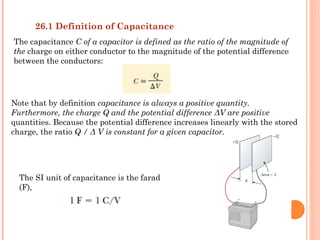
The capacitance C of a capacitor is defined as the ratio of the magnitude of
the charge on either conductor to the magnitude of the potential difference
between the conductors:
The SI unit of capacitance is the farad
(F),
Note that by definition capacitance is always a positive quantity.
Furthermore, the charge Q and the potential difference ΔV are positive
quantities. Because the potential difference increases linearly with the stored
charge, the ratio Q / Δ V is constant for a given capacitor.
3.
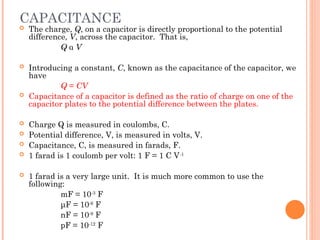
CAPACITANCE
The charge,Q, on a capacitor is directly proportional to the potential
difference, V, across the capacitor. That is,
Q α V
Introducing a constant, C, known as the capacitance of the capacitor, we
have
Q = CV
Capacitance of a capacitor is defined as the ratio of charge on one of the
capacitor plates to the potential difference between the plates.
Charge Q is measured in coulombs, C.
Potential difference, V, is measured in volts, V.
Capacitance, C, is measured in farads, F.
1 farad is 1 coulomb per volt: 1 F = 1 C V-1
1 farad is a very large unit. It is much more common to use the
following:
mF = 10-3
F
μF = 10-6
F
nF = 10-9
F
pF = 10-12
F
4.
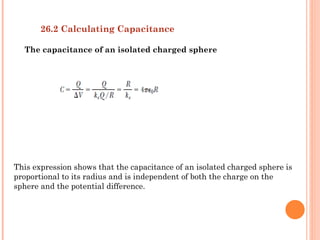
The capacitance ofan isolated charged sphere
26.2 Calculating Capacitance
This expression shows that the capacitance of an isolated charged sphere is
proportional to its radius and is independent of both the charge on the
sphere and the potential difference.
5.
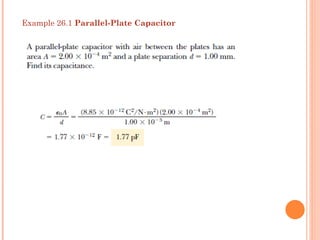
Parallel-Plate Capacitors
Two parallelmetallic plates of equal area A are separated by a distance
d, One plate carries a charge Q , and the other carries a charge -Q .
That is, the capacitance of a parallel-plate
capacitor is proportional to the area of its
plates and inversely proportional to the plate
separation
26.3 Combinations ofCapacitors
Parallel Combination
• The individual potential differences across capacitors
connected in parallel are the same and are equal to the
potential difference applied across the combination.
• The total charge on capacitors connected in parallel is the
sum of the charges on the individual capacitors
for the equivalent capacitor
8.
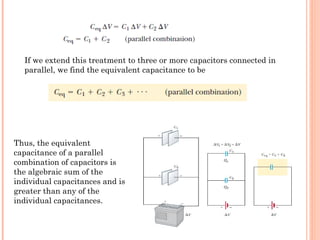
If we extendthis treatment to three or more capacitors connected in
parallel, we find the equivalent capacitance to be
Thus, the equivalent
capacitance of a parallel
combination of capacitors is
the algebraic sum of the
individual capacitances and is
greater than any of the
individual capacitances.
9.
Series Combination
• Thecharges on capacitors connected in series are the
same.
• The total potential difference across any number of capacitors connected
in series is the sum of the potential differences across the individual
capacitors.
10.
When this analysisis applied to three or more capacitors connected in
series, the relationship for the equivalent capacitance is
the inverse of the
equivalent capacitance
is the algebraic sum of
the inverses of the
individual capacitances
and the equivalent
capacitance of a series
combination is always
less than any individual
capacitance in the
combination.
12.
Question: A anda capacitor are connected in parallel, and this pair of capacitors is
then connected in series with a capacitor, as shown in the diagram. What is the equivalent
capacitance of the whole combination? What is the charge on the capacitor if the whole
combination is connected across the terminals of a V battery? Likewise, what are the charges
on the and capacitors?
The equivalent capacitance of the and
capacitors connected in parallel is
When a capacitor is combined in series with a capacitor, the
equivalent capacitance of the whole combination is given by
Solution:
13.
and so
The chargedelivered by the V battery is
This is the charge on the capacitor, since one of the terminals of the battery is connected
directly to one of the plates of this capacitor.
The voltage drop across the capacitor is
15.
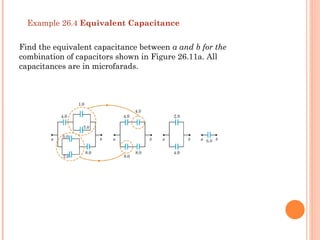
Example 26.4 EquivalentCapacitance
Find the equivalent capacitance between a and b for the
combination of capacitors shown in Figure 26.11a. All
capacitances are in microfarads.
16.
ENERGY STORED INAN ELECTRIC FIELD
Suppose that, at a given instant, a charge q′
has been transferred from one plate of a
capacitor to the other. The potential difference
V′ between the plates at that instant will be q
′/C. If an extra increment of charge dq′ is then
transferred, the increment of work required
will be,
The work required to bring the total capacitor charge up to a final value q
is
This work is stored as potential energy U in the capacitor, so
that
or
The potential energy of a charged capacitor may be viewed
as being stored in the electric field between its plates.
17.
ENERGY DENSITY
The potentialenergy per unit volume between parallel-
plate capacitor is
V/d equals the electric field magnitude E due to
18.
Example:
A 10 000μFcapacitor is described as having a maximum
working voltage of 25 V. Calculate the energy stored by the
capacitor.
E = ½ CV2
= ½ x 10,000 x 10-6
x 252
= 3.125 J
19.
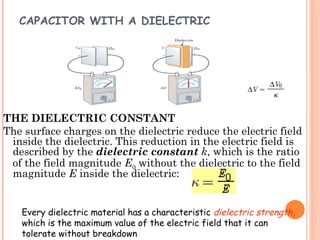
CAPACITOR WITH ADIELECTRIC
THE DIELECTRIC CONSTANT
The surface charges on the dielectric reduce the electric field
inside the dielectric. This reduction in the electric field is
described by the dielectric constant k, which is the ratio
of the field magnitude E0 without the dielectric to the field
magnitude E inside the dielectric:
Every dielectric material has a characteristic dielectric strength,
which is the maximum value of the electric field that it can
tolerate without breakdown
20.
SOME PROPERTIES OFDIELECTRICS
Material Dielectric Constant Dielectric Strength (kV/mm)
Air (1 atm) 1.00054 3
Polystyrene 2.6 24
Paper 3.5 16
Transformer
oil 4.5
Pyrex 4.7 14
Ruby mica 5.4
Porcelain 6.5
Silicon 12
Germanium 16
Ethanol 25
Water (20°C) 80.4
Water (25°C) 78.5
Titania
ceramic 130
Strontium
titanate 310 8
For a vacuum, .
21.
CAPACITANCE WITH ADIELECTRIC
0
air
q q
C
V E d
0
air
q q
C
V E d
0 /
E E
0
1
( )
air
q q q C
C
E d Ed Ed
air
C C
The capacitance with the dielectric present is increased
by a factor of k over the capacitance without the
dielectric.
22.
Energy Stored Beforethe dielectric is inserted:
Energy Stored After the dielectric is inserted:
23.
Example 26.6 APaper-Filled Capacitor
A parallel-plate capacitor has plates of dimensions 2.0 cm by
3.0 cm separated by a 1.0-mm thickness of paper.
Find its capacitance.
24.
1/31/07 184 Lecture14 24
CAPACITOR WITH DIELECTRIC
Question 1:
Consider a parallel plate capacitor with
capacitance C = 2.00 F connected to a
battery with voltage V = 12.0 V as shown.
What is the charge stored in the capacitor?
q CV 2.00
10 6
F
12.0 V
2.40
10 5
C
Question 2:
Now insert a dielectric with dielectric constant = 2.5
between the plates of the capacitor. What is the charge
on the capacitor?
C Cair The capacitance of the capacitor is increased
C
10
0
.
6
V
0
.
12
F
10
0
.
2
50
.
2 5
6
CV
q
The additional charge is provided by the battery.
25.
CAPACITOR WITH DIELECTRIC(2)
Question 3:
We isolate the charged capacitor with a dielectric by
disconnecting it from the battery. We remove the dielectric,
keeping the capacitor isolated.
What happens to the charge and voltage on the capacitor?
The charge on the isolated capacitor cannot change because there is
nowhere for the charge to flow. Q remains constant.
The voltage on the capacitor will be
The voltage went up because removing the dielectric increased the electric
field and the resulting potential difference between the plates.
V
q
C
6.00
10 5
C
2.00
10 6
F
30.0 V V increases
26.
CAPACITOR WITH DIELECTRIC(3)
Question 4:
Does removing the dielectric from the isolated
capacitor change the energy stored in the capacitor?
The energy stored in the capacitor before the dielectric was
removed was
After the dielectric is removed, the energy is
The energy increases --- we must add energy to pull out the
dielectric. [Or, the polarized dielectric is sucked into the E.]
U
1
2
CV2
1
2
CairV2
1
2
2.50
2.00
10 6
F
12 V
2
3.60
10 4
J
U
1
2
CairV2
1
2
2.00
10 6
F
30 V
2
9.00
10 4
J
27.
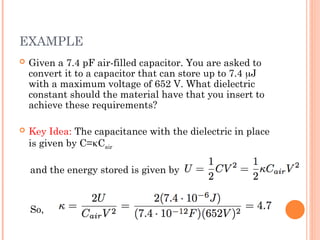
EXAMPLE
Given a7.4 pF air-filled capacitor. You are asked to
convert it to a capacitor that can store up to 7.4 J
with a maximum voltage of 652 V. What dielectric
constant should the material have that you insert to
achieve these requirements?
Key Idea: The capacitance with the dielectric in place
is given by C=Cair
and the energy stored is given by
So,
28.
1/31/07
28
CLICKER QUESTION -PART 1
A parallel-plate air-filled capacitor has a
capacitance of 50 pF.
(a) If each of the plates has an area of A=0.35 m2
,
what is the separation?
A) 12.5 10-1
m
B) 6.2 10-2
m
C) 1.3 m
0=8.85 10-12
C2
/Nm2
29.
1/31/07
29
CLICKER QUESTION -PART 1
A parallel-plate air-filled capacitor has a
capacitance of 50 pF.
(a) If each of the plates has an area of A=0.35 m2
,
what is the separation?
B) 6.2 10-2
m
Use to solve for d:
30.
184
Lect
ure
14
CLICKER QUESTION -PART 2
An air-filled parallel plate capacitor has a
capacitance of 50pF.
(b) If the region between the plates is now filled
with material having a dielectric constant of =2,
what is the capacitance?
A) the same
B) 25 pF
C) 100 pF
31.
CLICKER QUESTION -PART 2
A air-filled parallel plate capacitor has a
capacitance of 50 pF.
(b) If the region between the plates is now filled
with material having a dielectric constant of =2,
what is the capacitance?
C) 100 pF








![CAPACITOR WITH DIELECTRIC (3)
Question 4:
Does removing the dielectric from the isolated
capacitor change the energy stored in the capacitor?
The energy stored in the capacitor before the dielectric was
removed was
After the dielectric is removed, the energy is
The energy increases --- we must add energy to pull out the
dielectric. [Or, the polarized dielectric is sucked into the E.]
U
1
2
CV2
1
2
CairV2
1
2
2.50
2.00
10 6
F
12 V
2
3.60
10 4
J
U
1
2
CairV2
1
2
2.00
10 6
F
30 V
2
9.00
10 4
J](https://image.slidesharecdn.com/chapter26-250309032204-bff98408/85/chapter26-sciences-physics-capacitance-and-dielectric-26-320.jpg)