

 The division of normal cells is precisely controlled. New
cells are only formed for growth or to replace dead ones.
 Cancerous cells divide repeatedly out of control even though
they are not needed, they crowd out other normal cells and
function abnormally. They can also destroy the correct
functioning of major organs.
 Cancer arises from the mutation of a normal gene.
 Mutated genes that cause cancer are called oncogene.
 It is thought that several mutations need to occur to give rise
to cancer
 Cells that are old or not functioning properly normally self
destruct and are replaced by new cells.
 Any agent that causes cancer is called a carcinogen and is
described as carcinogenic.
 So some mutagens are carcinogenic.
SARCOMAS
 Develop in the connective and supporting tissue e.g. muscle, cartilage, bones , fatty
tissues.
 Often very malignant increasing rapidly in size and invading neighboring tissues.
 Can develop in children. under 20 approximately.
MELANOMAS;
 Type of skin cancer often occurring on legs , neck , head.
 Often spread rapidly.
 It can develop from abnormal moles.
 Melanomas are usually brown or black, but can appear pink, tan, or even white.
Teratomas
 Arise from the embryonic cell that may be present in the
ovary , testicles and other areas.
Leukemias or Cancer of blood
 In this bone marrow produce too many white blood cells
that do not die off in this way that normal aging blood
cells do . instead they keep dividing and ultimately take
over healthy red blood cell, which our body depend on for
the normal oxygen and nutrient transport.
Carcinomas
 Develop from the epithelial cell , such as inside of the
cheek or lining of the intestine.
 Can occur in many regions of the body glands , ducts
,mucous membrane.
 (esophagus , colon , stomach , intestine)
Lymphomas
 cancers of the lymphatic system.
 Proto-oncogene; It is a normal gene which regulate
programmed cell death and give signal that lead to cell
division.
 Proto-oncogene is converted to oncogene (the gene that
has potential to cause cancer) by
• Mutation
• Chromosomal translocation
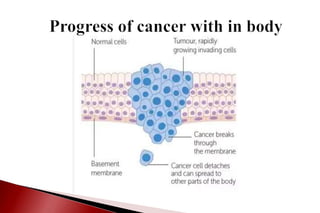
 Cancer cell continue to divide and accumulate form a
tumor
 Some cell from primary cancer break through and travel to
distant sites by mean of :
-invasion
-blood circulation
-Lymphatic system
 Cancer cell spread to other parts of body called metastasis.
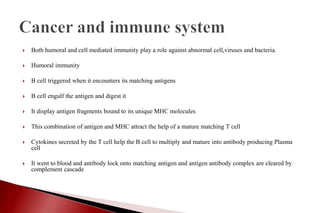
 Both humoral and cell mediated immunity play a role against abnormal cell,viruses and bacteria.
 Humoral immunity
 B cell triggered when it encounters its matching antigens
 B cell engulf the antigen and digest it
 It display antigen fragments bound to its unique MHC molecules
 This combination of antigen and MHC attract the help of a mature matching T cell
 Cytokines secreted by the T cell help the B cell to multiply and mature into antibody producing Plasma
cell
 It went to blood and antibody lock onto matching antigen and antigen antibody complex are cleared by
complement cascade
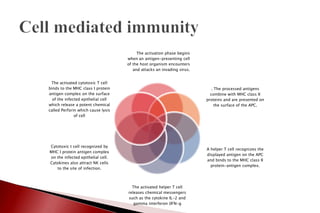
The activation phase begins
when an antigen-presenting cell
of the host organism encounters
and attacks an invading virus.
. The processed antigens
combine with MHC class II
proteins and are presented on
the surface of the APC.
A helper T cell recognizes the
displayed antigen on the APC
and binds to the MHC class II
protein-antigen complex.
The activated helper T cell
releases chemical messengers
such as the cytokine IL-2 and
gamma interferon (IFN-g
Cytotoxic t cell recognized by
MHC I protein antigen complex
on the infected epithelial cell.
Cytokines also attract NK cells
to the site of infection.
The activated cytotoxic T cell
binds to the MHC class I protein
antigen complex on the surface
of the infected epithelial cell
which release a potent chemical
called Perforin which cause lysis
of cell
 The immune system recognizes and destroys tumor cells
that are constantly arising during the life of the individual
 IFN-gamma and lymphocytes prevent primary tumor
development and shape tumor immunogenicity
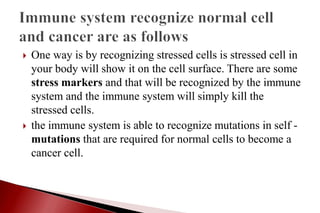
 One way is by recognizing stressed cells is stressed cell in
your body will show it on the cell surface. There are some
stress markers and that will be recognized by the immune
system and the immune system will simply kill the
stressed cells.
 the immune system is able to recognize mutations in self -
mutations that are required for normal cells to become a
cancer cell.
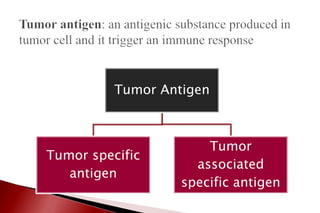
Tumor Antigen
Tumor specific
antigen
Tumor
associated
specific antigen
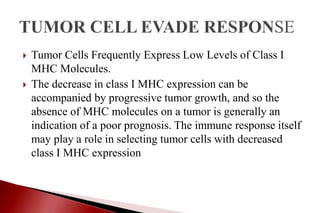
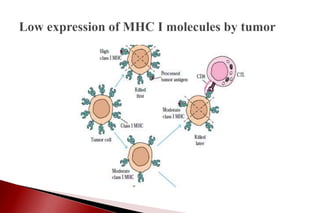
 Tumor Cells Frequently Express Low Levels of Class I
MHC Molecules.
 The decrease in class I MHC expression can be
accompanied by progressive tumor growth, and so the
absence of MHC molecules on a tumor is generally an
indication of a poor prognosis. The immune response itself
may play a role in selecting tumor cells with decreased
class I MHC expression
 Antitumor antibody itself acts as a blocking factor.
Presumably the antibody binds to tumor-specific antigens
and masks the antigens from cytotoxic T cells
 Immune complexes have been shown to block the CTL
response
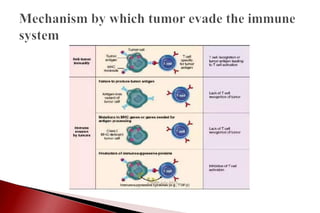
 Without sufficient numbers of antigen-presenting
cells in the immediate vicinity of a tumor, the T
cells will receive only a partial activating signal
 Loss of Antigen Variant: Loss of Antigen Variant result
in that the T cell did not recognize Tumor.
 Production of immunosuppressive protein: result in
inhibition of T cell activation
» Treatment that uses certain parts of the immune system to fight
diseases such as cancer.
» Stimulating your own immune system to work harder or smarter to
attack cancer cells.
» In late 1800s, Dr William Coley treated cancer patients by
infecting them with certain kinds of bacteria, which came to be
known as Coley toxins.
» Giving you immune system components, such as man-made
immune system proteins.
» Immunotherapy is a type of cancer treatment which helps to boost
body’s natural defenses to fight the cancer, infection, and other
diseases or can be defined as the treatment of disease by stimulating
the body's production of antibodies; it is also known as biological
therapy.
Different forms of immunotherapy may be given in different ways.
These include:
 Intravenous: The immunotherapy goes directly into a vein.
 Oral: The immunotherapy comes in pills or capsules that you swallow.
 Topical: The immunotherapy comes in a cream that you rub onto your skin. This
type of immunotherapy can be used for very early skin cancer.
 Intravesical: The immunotherapy goes directly into the bladder.
 Non specific immunotherapies
 Immune checkpoint inhibitors
 Specific immunotherapy
 Tumor vaccines
 Also called biological response modifiers.
 Treatments to stimulate the immune system in a general way to increase
activity against cancer cells
 stimulate immune system in a general way but still can be good response
against cancer cells
 Some examples include man-made versions of cytokines, a chemical in
immune cells, such as interleukins and interferon’s.
» Injected either under skin, muscle or intravenous. cytokines are
divide into name of two chemicals named interleukins and
interferons
» Interleukins helps the cells to divide rapidly. they are made in laboratory
called interleukin-2, or aldesleukin.and used for treatment of kidney and
skin cancer. it can be combined with chemotherapy such as interferon-
Alfa. Other interleukins, such as IL-7, IL-12, and IL-21, are now being
studied for use against cancer.
» Interferons help to fight cancer and may help to slow the growth of
cancer cells. An interferon is made in laboratory, named as IFN-Alfa,
IFN-beta, and IFN-gamma
 Immune system depends on multiple check points or immunological
brakes to avoid over activation of the immune system on healthy cell.
 Tumor cells target molecules like PD-1, PD-L1, and CTLA-4. PD-1 is a
checkpoint protein on T cells. It normally acts as a type of “off switch”
that helps keep the T cells from attacking other cells in the body. It does
this when it attaches to PD-L1, a protein on some normal cells. When
PD-1 binds to PD-L1, it basically tells the T cell to leave the other cell
alone. Some cancer cells have large amounts of PD-L1, which helps them
evade immune attack
 These inhibitors target either PD-1 or PD-L1 can boost the immune
response against cancer cells and have shown a great deal of promise in
treating certain cancers.
 Thalidomide, lenalidomide, and pomalidomide, they are known as
immunomodulating drugs (or IMiDs). These drugs are used to
treat multiple myeloma and some other cancers.
 Certain bacteria's called Bacille Calmette-Guerin is a germ that
helps activate immune system. BCG was one of the earliest
immunotherapies used against cancer. BCG used to treat bladder
cancer and some melanoma skin cancers by injecting it directly into
the tumors
 One more drug named Imiquimod used as a cream on skin. It
stimulates immune response against skin cancer cells and is used to
treat some early stage skin cancers (or pre-cancers)
 The actual transfer of components of immune system which
are already capable of directing an immune response.
 Antibody therapy: MAB's constitute of pure population of
immune system proteins that attack specific molecular targets.
 When tipped with radioactive isotopes can home in on tumor
cells and deliver quick results.
 Work by activation of compliment system.
 To mark cells fir destruction.
 Cause an anti-proliferative effect by attaching to the
target tumor cells.
 Useful in causing apoptosis of the tumor cells too.
 Large population if MAB 's can be created in order to
specifically attain a target response against the tumor cells.
 Transfer of antigen specific T-cells
 After isolation from a cancer patient
 Expansion in test tube
 Re infusion back into patient
 Draw back : short life span
 Whole tumor cells extracted from patient.
 Blasted with radiations to weaken them.
 Adjuvants added to cause friendly environment within
patient for representation of antigen to immune system.
Cancer immuno therapy

Cancer immuno therapy

  • 2.
     The divisionof normal cells is precisely controlled. New cells are only formed for growth or to replace dead ones.  Cancerous cells divide repeatedly out of control even though they are not needed, they crowd out other normal cells and function abnormally. They can also destroy the correct functioning of major organs.
  • 3.
     Cancer arisesfrom the mutation of a normal gene.  Mutated genes that cause cancer are called oncogene.  It is thought that several mutations need to occur to give rise to cancer  Cells that are old or not functioning properly normally self destruct and are replaced by new cells.  Any agent that causes cancer is called a carcinogen and is described as carcinogenic.  So some mutagens are carcinogenic.
  • 4.
    SARCOMAS  Develop inthe connective and supporting tissue e.g. muscle, cartilage, bones , fatty tissues.  Often very malignant increasing rapidly in size and invading neighboring tissues.  Can develop in children. under 20 approximately. MELANOMAS;  Type of skin cancer often occurring on legs , neck , head.  Often spread rapidly.  It can develop from abnormal moles.  Melanomas are usually brown or black, but can appear pink, tan, or even white.
  • 5.
    Teratomas  Arise fromthe embryonic cell that may be present in the ovary , testicles and other areas. Leukemias or Cancer of blood  In this bone marrow produce too many white blood cells that do not die off in this way that normal aging blood cells do . instead they keep dividing and ultimately take over healthy red blood cell, which our body depend on for the normal oxygen and nutrient transport.
  • 6.
    Carcinomas  Develop fromthe epithelial cell , such as inside of the cheek or lining of the intestine.  Can occur in many regions of the body glands , ducts ,mucous membrane.  (esophagus , colon , stomach , intestine) Lymphomas  cancers of the lymphatic system.
  • 8.
     Proto-oncogene; Itis a normal gene which regulate programmed cell death and give signal that lead to cell division.  Proto-oncogene is converted to oncogene (the gene that has potential to cause cancer) by • Mutation • Chromosomal translocation
  • 9.
     Cancer cellcontinue to divide and accumulate form a tumor  Some cell from primary cancer break through and travel to distant sites by mean of : -invasion -blood circulation -Lymphatic system  Cancer cell spread to other parts of body called metastasis.
  • 11.
     Both humoraland cell mediated immunity play a role against abnormal cell,viruses and bacteria.  Humoral immunity  B cell triggered when it encounters its matching antigens  B cell engulf the antigen and digest it  It display antigen fragments bound to its unique MHC molecules  This combination of antigen and MHC attract the help of a mature matching T cell  Cytokines secreted by the T cell help the B cell to multiply and mature into antibody producing Plasma cell  It went to blood and antibody lock onto matching antigen and antigen antibody complex are cleared by complement cascade
  • 12.
    The activation phasebegins when an antigen-presenting cell of the host organism encounters and attacks an invading virus. . The processed antigens combine with MHC class II proteins and are presented on the surface of the APC. A helper T cell recognizes the displayed antigen on the APC and binds to the MHC class II protein-antigen complex. The activated helper T cell releases chemical messengers such as the cytokine IL-2 and gamma interferon (IFN-g Cytotoxic t cell recognized by MHC I protein antigen complex on the infected epithelial cell. Cytokines also attract NK cells to the site of infection. The activated cytotoxic T cell binds to the MHC class I protein antigen complex on the surface of the infected epithelial cell which release a potent chemical called Perforin which cause lysis of cell
  • 13.
     The immunesystem recognizes and destroys tumor cells that are constantly arising during the life of the individual  IFN-gamma and lymphocytes prevent primary tumor development and shape tumor immunogenicity
  • 15.
     One wayis by recognizing stressed cells is stressed cell in your body will show it on the cell surface. There are some stress markers and that will be recognized by the immune system and the immune system will simply kill the stressed cells.  the immune system is able to recognize mutations in self - mutations that are required for normal cells to become a cancer cell.
  • 16.
  • 17.
     Tumor CellsFrequently Express Low Levels of Class I MHC Molecules.  The decrease in class I MHC expression can be accompanied by progressive tumor growth, and so the absence of MHC molecules on a tumor is generally an indication of a poor prognosis. The immune response itself may play a role in selecting tumor cells with decreased class I MHC expression
  • 19.
     Antitumor antibodyitself acts as a blocking factor. Presumably the antibody binds to tumor-specific antigens and masks the antigens from cytotoxic T cells  Immune complexes have been shown to block the CTL response
  • 20.
     Without sufficientnumbers of antigen-presenting cells in the immediate vicinity of a tumor, the T cells will receive only a partial activating signal
  • 21.
     Loss ofAntigen Variant: Loss of Antigen Variant result in that the T cell did not recognize Tumor.  Production of immunosuppressive protein: result in inhibition of T cell activation
  • 24.
    » Treatment thatuses certain parts of the immune system to fight diseases such as cancer. » Stimulating your own immune system to work harder or smarter to attack cancer cells. » In late 1800s, Dr William Coley treated cancer patients by infecting them with certain kinds of bacteria, which came to be known as Coley toxins. » Giving you immune system components, such as man-made immune system proteins. » Immunotherapy is a type of cancer treatment which helps to boost body’s natural defenses to fight the cancer, infection, and other diseases or can be defined as the treatment of disease by stimulating the body's production of antibodies; it is also known as biological therapy.
  • 25.
    Different forms ofimmunotherapy may be given in different ways. These include:  Intravenous: The immunotherapy goes directly into a vein.  Oral: The immunotherapy comes in pills or capsules that you swallow.  Topical: The immunotherapy comes in a cream that you rub onto your skin. This type of immunotherapy can be used for very early skin cancer.  Intravesical: The immunotherapy goes directly into the bladder.
  • 26.
     Non specificimmunotherapies  Immune checkpoint inhibitors  Specific immunotherapy  Tumor vaccines
  • 27.
     Also calledbiological response modifiers.  Treatments to stimulate the immune system in a general way to increase activity against cancer cells  stimulate immune system in a general way but still can be good response against cancer cells  Some examples include man-made versions of cytokines, a chemical in immune cells, such as interleukins and interferon’s.
  • 28.
    » Injected eitherunder skin, muscle or intravenous. cytokines are divide into name of two chemicals named interleukins and interferons » Interleukins helps the cells to divide rapidly. they are made in laboratory called interleukin-2, or aldesleukin.and used for treatment of kidney and skin cancer. it can be combined with chemotherapy such as interferon- Alfa. Other interleukins, such as IL-7, IL-12, and IL-21, are now being studied for use against cancer. » Interferons help to fight cancer and may help to slow the growth of cancer cells. An interferon is made in laboratory, named as IFN-Alfa, IFN-beta, and IFN-gamma
  • 29.
     Immune systemdepends on multiple check points or immunological brakes to avoid over activation of the immune system on healthy cell.  Tumor cells target molecules like PD-1, PD-L1, and CTLA-4. PD-1 is a checkpoint protein on T cells. It normally acts as a type of “off switch” that helps keep the T cells from attacking other cells in the body. It does this when it attaches to PD-L1, a protein on some normal cells. When PD-1 binds to PD-L1, it basically tells the T cell to leave the other cell alone. Some cancer cells have large amounts of PD-L1, which helps them evade immune attack  These inhibitors target either PD-1 or PD-L1 can boost the immune response against cancer cells and have shown a great deal of promise in treating certain cancers.
  • 30.
     Thalidomide, lenalidomide,and pomalidomide, they are known as immunomodulating drugs (or IMiDs). These drugs are used to treat multiple myeloma and some other cancers.  Certain bacteria's called Bacille Calmette-Guerin is a germ that helps activate immune system. BCG was one of the earliest immunotherapies used against cancer. BCG used to treat bladder cancer and some melanoma skin cancers by injecting it directly into the tumors  One more drug named Imiquimod used as a cream on skin. It stimulates immune response against skin cancer cells and is used to treat some early stage skin cancers (or pre-cancers)
  • 32.
     The actualtransfer of components of immune system which are already capable of directing an immune response.  Antibody therapy: MAB's constitute of pure population of immune system proteins that attack specific molecular targets.  When tipped with radioactive isotopes can home in on tumor cells and deliver quick results.  Work by activation of compliment system.  To mark cells fir destruction.
  • 33.
     Cause ananti-proliferative effect by attaching to the target tumor cells.  Useful in causing apoptosis of the tumor cells too.  Large population if MAB 's can be created in order to specifically attain a target response against the tumor cells.
  • 34.
     Transfer ofantigen specific T-cells  After isolation from a cancer patient  Expansion in test tube  Re infusion back into patient  Draw back : short life span
  • 35.
     Whole tumorcells extracted from patient.  Blasted with radiations to weaken them.  Adjuvants added to cause friendly environment within patient for representation of antigen to immune system.