MONOCLONAL ANTIBODIES
RESIDENT: Fariha Fatima
MODERATOR: Dr. Mohammad
Tariq Salman
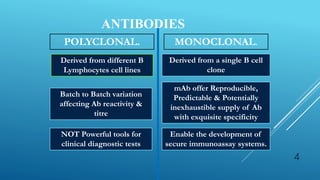
ANTIBODIES
Derived from different B
Lymphocytes cell lines
POLYCLONAL. MONOCLONAL.
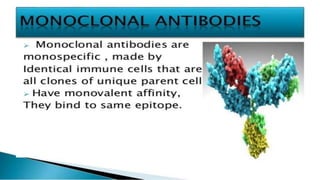
Derived from a single B cell
clone
Batch to Batch variation
affecting Ab reactivity &
titre
mAb offer Reproducible,
Predictable & Potentially
inexhaustible supply of Ab
with exquisite specificity
Enable the development of
secure immunoassay systems.
NOT Powerful tools for
clinical diagnostic tests
4
The idea of a "magic bullet"
was first proposed by Paul
Ehrlich who at the beginning
of the 20th century postulated
that if a compound could be
made to selectively target a
disease-causing organism, then
a toxin for that organism could
be delivered along with the
agent of selectivity.
Discovery
5
CLASSIFICATION OF MONOCLONAL ANTIBODIES:
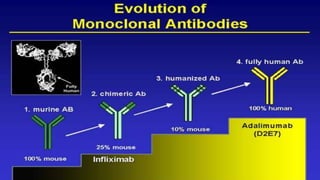
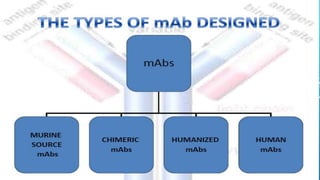
I. First generation monoclonal antibodies
II. Second generation monoclonal antibodies
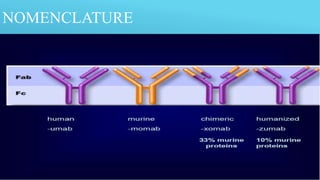
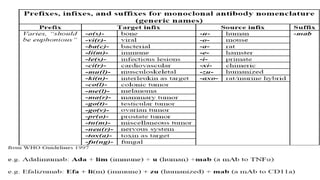
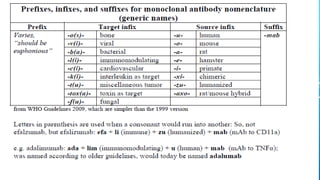
NOMENCLATURE
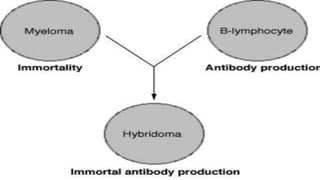
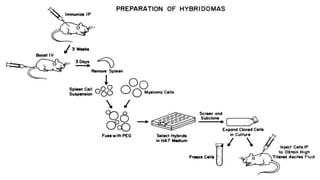
Georges Köhler César Milstein, and
Niels Kaj Jerne in 1975 who shared the
Nobel Prize in Physiology or Medicine
in 1984 for the discovery hybridoma
technology
14
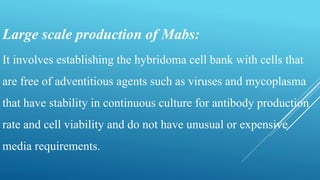
Large scale production of Mabs:
It involves establishing the hybridoma cell bank with cells that
are free of adventitious agents such as viruses and mycoplasma
that have stability in continuous culture for antibody production
rate and cell viability and do not have unusual or expensive
media requirements.
Cell ,cell debris ,lipids,
clotted materials are first
removed by
Charged impurities such
nucleic acids and endotoxins
separated by
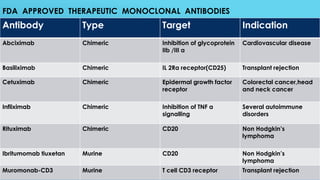
Antibody Type Target Indication
Abciximab Chimeric Inhibition of glycoprotein
IIb /III a
Cardiovascular disease
Basiliximab Chimeric IL 2Rα receptor(CD25) Transplant rejection
Cetuximab Chimeric Epidermal growth factor
receptor
Colorectal cancer,head
and neck cancer
Infliximab Chimeric Inhibition of TNF α
signalling
Several autoimmune
disorders
Rituximab Chimeric CD20 Non Hodgkin’s
lymphoma
Ibritumomab tiuxetan Murine CD20 Non Hodgkin’s
lymphoma
Muromonab-CD3 Murine T cell CD3 receptor Transplant rejection
FDA APPROVED THERAPEUTIC MONOCLONAL ANTIBODIES
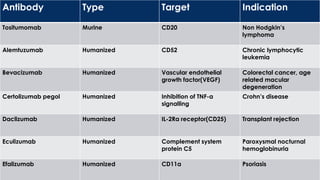
Antibody Type Target Indication
Tositumomab Murine CD20 Non Hodgkin’s
lymphoma
Alemtuzumab Humanized CD52 Chronic lymphocytic
leukemia
Bevacizumab Humanized Vascular endothelial
growth factor(VEGF)
Colorectal cancer, age
related macular
degeneration
Certolizumab pegol Humanized Inhibition of TNF-α
signalling
Crohn’s disease
Daclizumab Humanized IL-2Rα receptor(CD25) Transplant rejection
Eculizumab Humanized Complement system
protein C5
Paroxysmal nocturnal
hemoglobinuria
Efalizumab Humanized CD11a Psoriasis
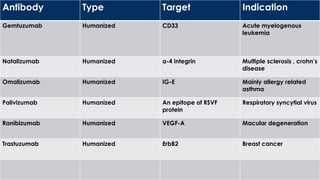
Antibody Type Target Indication
Gemtuzumab Humanized CD33 Acute myelogenous
leukemia
Natalizumab Humanized α-4 integrin Multiple sclerosis , crohn’s
disease
Omalizumab Humanized IG-E Mainly allergy related
asthma
Palivizumab Humanized An epitope of RSVF
protein
Respiratory syncytial virus
Ranibizumab Humanized VEGF-A Macular degeneration
Trastuzumab Humanized ErbB2 Breast cancer
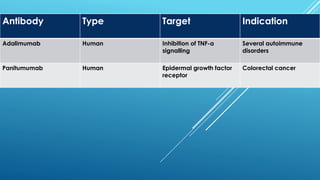
Antibody Type Target Indication
Adalimumab Human Inhibition of TNF-α
signalling
Several autoimmune
disorders
Panitumumab Human Epidermal growth factor
receptor
Colorectal cancer
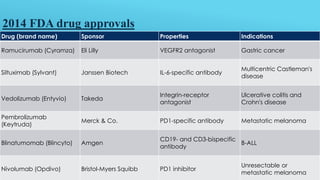
Drug (brand name) Sponsor Properties Indications
Ramucirumab (Cyramza) Eli Lilly VEGFR2 antagonist Gastric cancer
Siltuximab (Sylvant) Janssen Biotech IL-6-specific antibody
Multicentric Castleman's
disease
Vedolizumab (Entyvio) Takeda
Integrin-receptor
antagonist
Ulcerative colitis and
Crohn's disease
Pembrolizumab
(Keytruda)
Merck & Co. PD1-specific antibody Metastatic melanoma
Blinatumomab (Blincyto) Amgen
CD19- and CD3-bispecific
antibody
B-ALL
Nivolumab (Opdivo) Bristol-Myers Squibb PD1 inhibitor
Unresectable or
metastatic melanoma
2014 FDA drug approvals
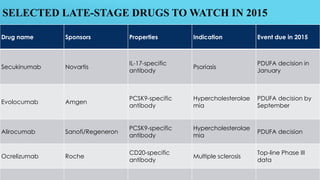
SELECTED LATE-STAGE DRUGS TO WATCH IN 2015
Drug name Sponsors Properties Indication Event due in 2015
Secukinumab Novartis
IL-17-specific
antibody
Psoriasis
PDUFA decision in
January
Evolocumab Amgen
PCSK9-specific
antibody
Hypercholesterolae
mia
PDUFA decision by
September
Alirocumab Sanofi/Regeneron
PCSK9-specific
antibody
Hypercholesterolae
mia
PDUFA decision
Ocrelizumab Roche
CD20-specific
antibody
Multiple sclerosis
Top-line Phase III
data
TYPES OF MABS THAT ARE USED IN TREATMENT:
 Naked MAbs:
These are without any drug or radioactive material
attached to them.
They attach themselves to specific Ag on cells, eg.
Cancer cells.
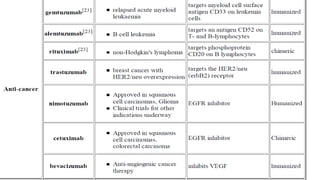
1. Trastuzumab :for advanced breast cancer
2. Rituximab : for B cell non-Hodgkin’s lymphoma
3. Cituximab :for advanced colorectal cancer
4. Bevacizumab :for metastatic colorectal cancer
5. Alemtuzumab :for B cell chronic lymphocytic leukemia
 Conjugated Mabs:
They can be used to deliver radionuclides , toxins or
cytotoxic drugs to a specific tissue or malignant cell
population.
These are attached to drugs, toxins or radioactive atoms.
They are also referred to “tagged” “labelled” or “loaded”
antibodies.
1. Ibritumomab tiuxetin: radiolabelled Mab to treat B cell
non-Hodgkin’s lymphoma.
2. Tositumomab : radiolabelled Mab for non-Hodgkin’s
lymphoma
3. Gemtuzumab ozogamicin (Mylotarg): immunotoxin Mab
for AML
o Blocking or steric hindrance of the function of target antigen
i.e., T-lymphocytes, B lymphocytes, tumour necrosis factor-a
(TNFa) and interleukin (IL) which are capable of transducing
intracellular signals.
Cytotoxicity to the cell expressing target AG by ADCC or
CDC.
MECHANISM OF ACTION OF Mabs :
o Inhibition of growth factors: Epidermal growth factor
receptor (EGFR) is a cell surface receptor involved in
regulation of cell proliferation and survival. Also new
vessels grow to feed the cancer cells through this factor.
These factors can be inhibited to arrest growth of cancer
cells e.g., cetuximab act as EGFR inhibitor.
PHARMACOKINETICS
 Mabs are used by intravascular route.
 They have small volume of distribution and limited tissue
penetration.
 They remain in circulation from 2days to 2 weeks.
 Hour long infusions require a hospital environment and are
often associated with mild to very severe side effects.
SIDE EFFECTS:
More common side effects
Allergic reactions, such as hives or itching
Flu-like symptoms, including chills, fatigue, fever, and muscle aches
and pains
Nausea
Diarrhea
Infusion reactions. Severe allergy-like reactions can occur and, in very few
cases, lead to death
Dangerously low blood cell counts. Decreased red blood cells, white blood cells
and platelets
Cardiac complications Certain monoclonal antibodies may cause heart failure
and a small risk of MI
Bleeding. Some of the monoclonal antibody drugs are designed to stop cancer
from forming new blood vessels. There have been reports that these medications
can cause bleeding
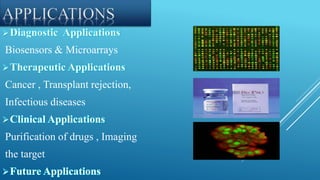
Biosensors & Microarrays
Cancer , Transplant rejection,
Infectious diseases
Purification of drugs , Imaging
the target
When monoclonal antibody attaches to cancer cell :
Rituximab drug attaches to specific protein CD20 found on B cells
makes cell more visible to immune system
Cetuximab attaches to growth factor receptors , blocking its signal
and suppress cancer growth
Bevacizumab blocks growth signal which attract blood vessels then
tumor shrinks.
By combining radioactive particle with monoclonal antibodies,
radiation are deliver to cancer cells only , cancer cell dies.
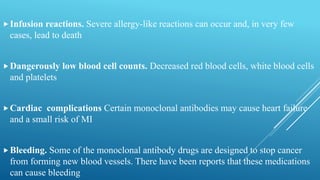
RADIOIMMUNOTHERAPY
Involves the use of radioactively
conjugated Murine antibodies
against cellular antigens
 Ex; Tositumomab ----- non-
Hodgkins lymphoma.
CONCLUSION
 Monoclonal antibodies are new biological agents that have good
clinical effects and an extended choice in the treatment spectrum to the
patients who were not responding to the existent treatments.
 New therapeutic approaches are rapidly emerging and further studies
may help in designing more specific MAbs that would spare the
normal tissue, have less adverse effects and improve the patient’s
quality of life.
Monoclonal  antibodies [autosaved]

Monoclonal antibodies [autosaved]

  • 1.
    MONOCLONAL ANTIBODIES RESIDENT: FarihaFatima MODERATOR: Dr. Mohammad Tariq Salman
  • 4.
    ANTIBODIES Derived from differentB Lymphocytes cell lines POLYCLONAL. MONOCLONAL. Derived from a single B cell clone Batch to Batch variation affecting Ab reactivity & titre mAb offer Reproducible, Predictable & Potentially inexhaustible supply of Ab with exquisite specificity Enable the development of secure immunoassay systems. NOT Powerful tools for clinical diagnostic tests 4
  • 5.
    The idea ofa "magic bullet" was first proposed by Paul Ehrlich who at the beginning of the 20th century postulated that if a compound could be made to selectively target a disease-causing organism, then a toxin for that organism could be delivered along with the agent of selectivity. Discovery 5
  • 8.
    CLASSIFICATION OF MONOCLONALANTIBODIES: I. First generation monoclonal antibodies II. Second generation monoclonal antibodies
  • 11.
  • 14.
    Georges Köhler CésarMilstein, and Niels Kaj Jerne in 1975 who shared the Nobel Prize in Physiology or Medicine in 1984 for the discovery hybridoma technology 14
  • 17.
    Large scale productionof Mabs: It involves establishing the hybridoma cell bank with cells that are free of adventitious agents such as viruses and mycoplasma that have stability in continuous culture for antibody production rate and cell viability and do not have unusual or expensive media requirements.
  • 19.
    Cell ,cell debris,lipids, clotted materials are first removed by Charged impurities such nucleic acids and endotoxins separated by
  • 20.
    Antibody Type TargetIndication Abciximab Chimeric Inhibition of glycoprotein IIb /III a Cardiovascular disease Basiliximab Chimeric IL 2Rα receptor(CD25) Transplant rejection Cetuximab Chimeric Epidermal growth factor receptor Colorectal cancer,head and neck cancer Infliximab Chimeric Inhibition of TNF α signalling Several autoimmune disorders Rituximab Chimeric CD20 Non Hodgkin’s lymphoma Ibritumomab tiuxetan Murine CD20 Non Hodgkin’s lymphoma Muromonab-CD3 Murine T cell CD3 receptor Transplant rejection FDA APPROVED THERAPEUTIC MONOCLONAL ANTIBODIES
  • 21.
    Antibody Type TargetIndication Tositumomab Murine CD20 Non Hodgkin’s lymphoma Alemtuzumab Humanized CD52 Chronic lymphocytic leukemia Bevacizumab Humanized Vascular endothelial growth factor(VEGF) Colorectal cancer, age related macular degeneration Certolizumab pegol Humanized Inhibition of TNF-α signalling Crohn’s disease Daclizumab Humanized IL-2Rα receptor(CD25) Transplant rejection Eculizumab Humanized Complement system protein C5 Paroxysmal nocturnal hemoglobinuria Efalizumab Humanized CD11a Psoriasis
  • 22.
    Antibody Type TargetIndication Gemtuzumab Humanized CD33 Acute myelogenous leukemia Natalizumab Humanized α-4 integrin Multiple sclerosis , crohn’s disease Omalizumab Humanized IG-E Mainly allergy related asthma Palivizumab Humanized An epitope of RSVF protein Respiratory syncytial virus Ranibizumab Humanized VEGF-A Macular degeneration Trastuzumab Humanized ErbB2 Breast cancer
  • 23.
    Antibody Type TargetIndication Adalimumab Human Inhibition of TNF-α signalling Several autoimmune disorders Panitumumab Human Epidermal growth factor receptor Colorectal cancer
  • 24.
    Drug (brand name)Sponsor Properties Indications Ramucirumab (Cyramza) Eli Lilly VEGFR2 antagonist Gastric cancer Siltuximab (Sylvant) Janssen Biotech IL-6-specific antibody Multicentric Castleman's disease Vedolizumab (Entyvio) Takeda Integrin-receptor antagonist Ulcerative colitis and Crohn's disease Pembrolizumab (Keytruda) Merck & Co. PD1-specific antibody Metastatic melanoma Blinatumomab (Blincyto) Amgen CD19- and CD3-bispecific antibody B-ALL Nivolumab (Opdivo) Bristol-Myers Squibb PD1 inhibitor Unresectable or metastatic melanoma 2014 FDA drug approvals
  • 25.
    SELECTED LATE-STAGE DRUGSTO WATCH IN 2015 Drug name Sponsors Properties Indication Event due in 2015 Secukinumab Novartis IL-17-specific antibody Psoriasis PDUFA decision in January Evolocumab Amgen PCSK9-specific antibody Hypercholesterolae mia PDUFA decision by September Alirocumab Sanofi/Regeneron PCSK9-specific antibody Hypercholesterolae mia PDUFA decision Ocrelizumab Roche CD20-specific antibody Multiple sclerosis Top-line Phase III data
  • 26.
    TYPES OF MABSTHAT ARE USED IN TREATMENT:  Naked MAbs: These are without any drug or radioactive material attached to them. They attach themselves to specific Ag on cells, eg. Cancer cells.
  • 27.
    1. Trastuzumab :foradvanced breast cancer 2. Rituximab : for B cell non-Hodgkin’s lymphoma 3. Cituximab :for advanced colorectal cancer 4. Bevacizumab :for metastatic colorectal cancer 5. Alemtuzumab :for B cell chronic lymphocytic leukemia
  • 28.
     Conjugated Mabs: Theycan be used to deliver radionuclides , toxins or cytotoxic drugs to a specific tissue or malignant cell population. These are attached to drugs, toxins or radioactive atoms. They are also referred to “tagged” “labelled” or “loaded” antibodies.
  • 29.
    1. Ibritumomab tiuxetin:radiolabelled Mab to treat B cell non-Hodgkin’s lymphoma. 2. Tositumomab : radiolabelled Mab for non-Hodgkin’s lymphoma 3. Gemtuzumab ozogamicin (Mylotarg): immunotoxin Mab for AML
  • 30.
    o Blocking orsteric hindrance of the function of target antigen i.e., T-lymphocytes, B lymphocytes, tumour necrosis factor-a (TNFa) and interleukin (IL) which are capable of transducing intracellular signals. Cytotoxicity to the cell expressing target AG by ADCC or CDC. MECHANISM OF ACTION OF Mabs :
  • 31.
    o Inhibition ofgrowth factors: Epidermal growth factor receptor (EGFR) is a cell surface receptor involved in regulation of cell proliferation and survival. Also new vessels grow to feed the cancer cells through this factor. These factors can be inhibited to arrest growth of cancer cells e.g., cetuximab act as EGFR inhibitor.
  • 32.
    PHARMACOKINETICS  Mabs areused by intravascular route.  They have small volume of distribution and limited tissue penetration.  They remain in circulation from 2days to 2 weeks.  Hour long infusions require a hospital environment and are often associated with mild to very severe side effects.
  • 33.
    SIDE EFFECTS: More commonside effects Allergic reactions, such as hives or itching Flu-like symptoms, including chills, fatigue, fever, and muscle aches and pains Nausea Diarrhea
  • 34.
    Infusion reactions. Severeallergy-like reactions can occur and, in very few cases, lead to death Dangerously low blood cell counts. Decreased red blood cells, white blood cells and platelets Cardiac complications Certain monoclonal antibodies may cause heart failure and a small risk of MI Bleeding. Some of the monoclonal antibody drugs are designed to stop cancer from forming new blood vessels. There have been reports that these medications can cause bleeding
  • 35.
    Biosensors & Microarrays Cancer, Transplant rejection, Infectious diseases Purification of drugs , Imaging the target
  • 36.
    When monoclonal antibodyattaches to cancer cell : Rituximab drug attaches to specific protein CD20 found on B cells makes cell more visible to immune system Cetuximab attaches to growth factor receptors , blocking its signal and suppress cancer growth
  • 37.
    Bevacizumab blocks growthsignal which attract blood vessels then tumor shrinks. By combining radioactive particle with monoclonal antibodies, radiation are deliver to cancer cells only , cancer cell dies.
  • 39.
    RADIOIMMUNOTHERAPY Involves the useof radioactively conjugated Murine antibodies against cellular antigens  Ex; Tositumomab ----- non- Hodgkins lymphoma.
  • 40.
    CONCLUSION  Monoclonal antibodiesare new biological agents that have good clinical effects and an extended choice in the treatment spectrum to the patients who were not responding to the existent treatments.  New therapeutic approaches are rapidly emerging and further studies may help in designing more specific MAbs that would spare the normal tissue, have less adverse effects and improve the patient’s quality of life.