The United States and WWI
Before you begin… Make sure you remember to have your PowerPoint note packet, textbook, and paper to answer additional questions you will see throughout the presentation. There will be length requirements under each question to help guide your writing.  (Ex: 2 sentences, 3 paragraphs) View the presentation in  slideshow mode  to catch animation and hidden information!!! Read carefully and take good notes. Enjoy.
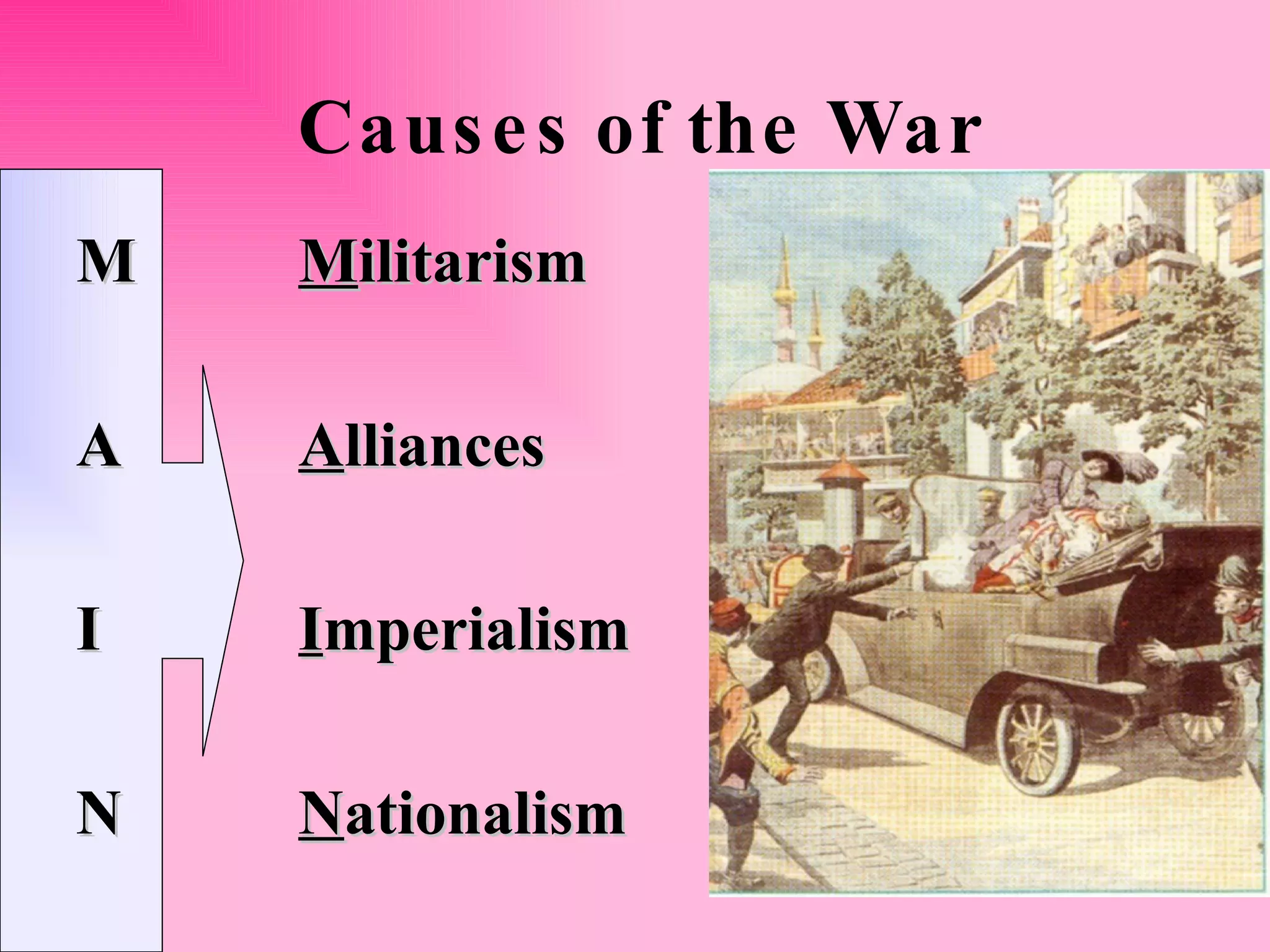
Causes of the War M    M ilitarism A   A lliances I   I mperialism N   N ationalism
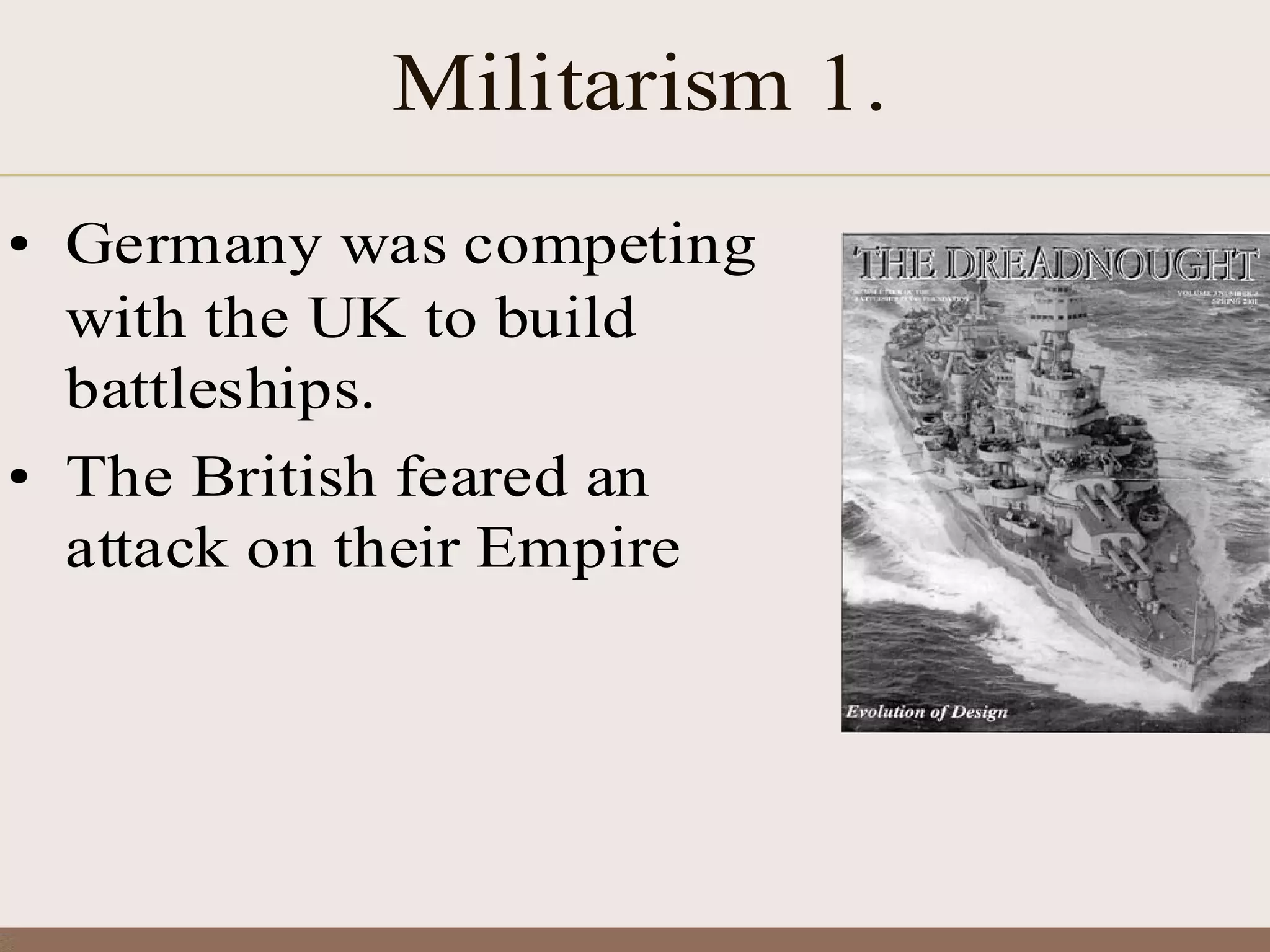
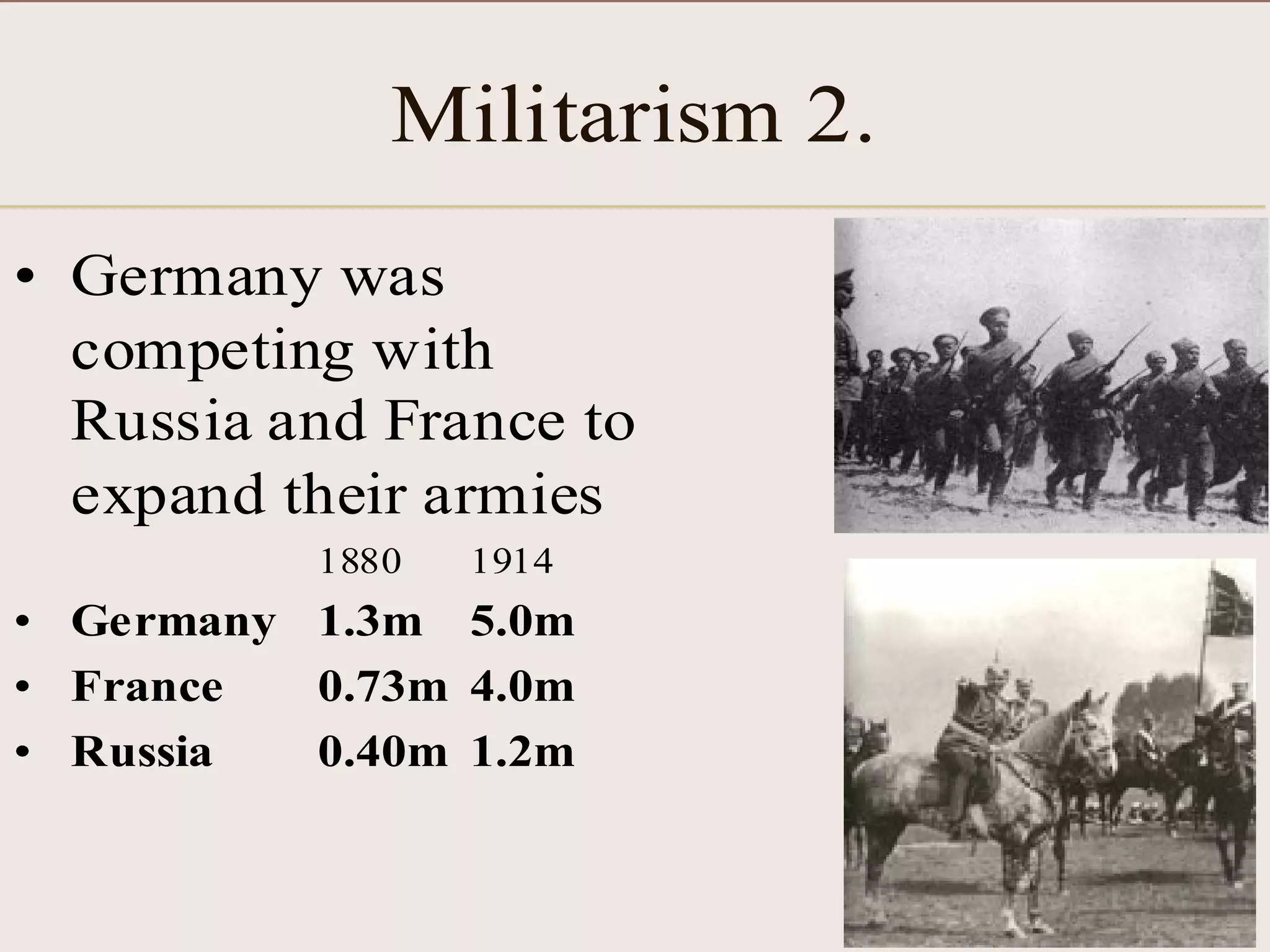
Militarism
 
What  is an  alliance? A close association  of nations or other groups,  formed to advance common interests or causes. Alliances By 1914 all the major powers were linked by a system of alliances. The alliances made it more likely that a war would start. Once started, the alliances made it more likely that it would spread .
Alliances Germany Italy Austria-Hungary Great Britain France  Russia Triple Entente Triple Alliance
Imperialism All the great powers were competing for colonies/territories around the world to claim as their own. The British feared that Germany would expand into Africa. The Austrians feared Serbia and Russia would expand into the Balkans.
Nationalism Defined as... Devotion to the interests or culture of one's nation.  The belief that nations will benefit from acting independently rather than collectively, emphasizing national rather than international goals.  Political or social philosophy in which the welfare of the nation-state is considered paramount. A collective state of mind or consciousness in which people believe their primary duty and loyalty is to the nation-state. Often nationalism implies national superiority and glorifies various national virtues. Thus love of nation may be overemphasized; concern with national self-interest to the exclusion of the rights of other nations may lead to international conflict.
Question 1 If so many nations are connected through alliances in Europe at this time, what do you think will happen if there is a conflict between any two nations?  How could the other causes intensify this conflict? (2 paragraphs)
The  Spark The SPARK of WAR (June 28, 1914) Assassination of Archduke Franz Ferdinand Next in line for the throne of Austria Hungary is killed by a Serbian terrorist group known as the Black Hand. Group sought to reunite Bosnia with the independent nation of Serbia to form a large Slavic state on the southern border of Austria-Hungary.
On the Way to World War Once Austria-Hungary had assurance of German support, it made HARSH demands on Serbia. Austria Serbia Russia and France Austria Hungary Germany Russia and France Germany Belgium Britain Germany Declares War Invades Declares War Declares War Declares War
The Start of WWI
 
Failure of the Schlieffen Plan ASSUMPTIONS WERE WRONG...DEAD WRONG! 1.  Resistance in Belgium  Invasion of Belgium 2. France holds line near Paris 3. Russians mobilized QUICKLY! 4. Britain declares war on Germany
Invasion of Belgium German generals planned to move west to defeat the French before the Russians could move to attack from the east. The quickest way to do this was to march THROUGH Belgium. Belgium refused Belgium was a neutral nation (not allied to either side) “ Belgium is a nation, not a road” Germany invaded Belgium and Britain declared war on Germany. Tiny Belgium could not defend itself against Germany, but did manage to fight for long enough to allow the Allies to prepare to fight. Despite heavy casualties, Germany was halted in France by late 1914.  Back to Failures of the Plan
Question 2 What German assumptions caused the Schlieffen Plan to fail? (1 paragraph)
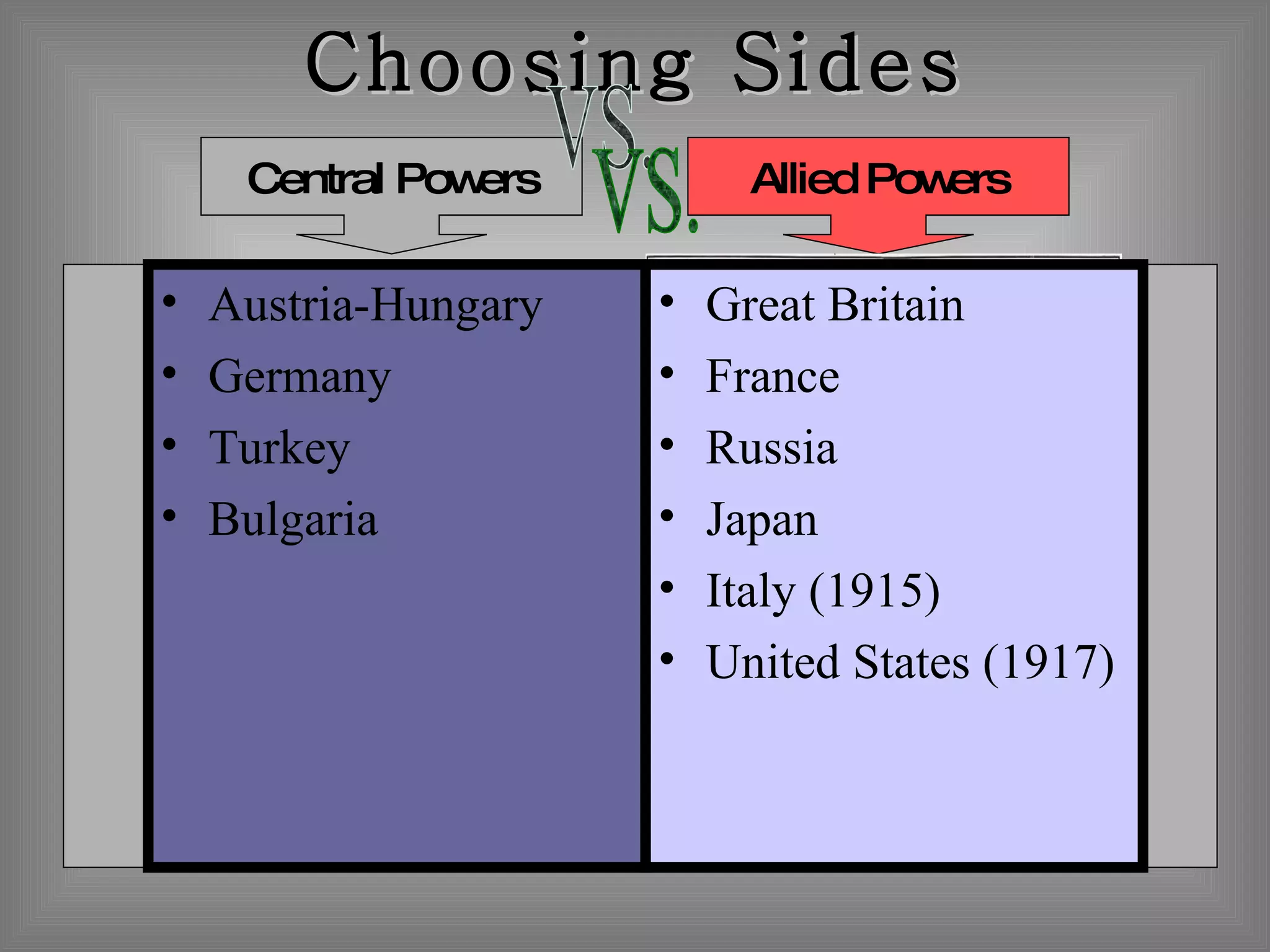
Choosing Sides Austria-Hungary Germany Turkey Bulgaria Great Britain France Russia Japan Italy (1915) United States (1917) As alliances begin to  call nations to war,  each nation must decide  which side it will  support or declare  neutrality. Central Powers Allied Powers VS.
 
Question 3 What do you notice about the location of the Axis Powers in reference to the Allied Powers? (1 or 2 sentences)
Neutral, But Not Impartial Wilson called for the US to be “Neutral in facts as well as in name, impartial in thought as well as in action”. Americans were unable to “be” neutral and in fact did select a side to support.  Most Americans favored the Allies over the Central Powers. Propaganda was used by both sides to influence public opinion. Allied propaganda was more effective because it convinced Americans that the Allies were fighting to defend more than politics, but civilization itself.
Supplying  the Allies Neutrality stopped when $$$ came into the picture!!  Although the US supplied materials to both sides, it supplied MUCH more to the Allies.  Overall the increase in trade greatly helped “neutral” America. This is a  $4 BILLION  increase 4.88 billion 856 million Total 280 million 187 million Neutral 1.1 billion 169 million Germany 3.5 billion 500 million Allies 1917 1914 Trading Countries
Question 4 How was trade a telling sign for whom the United States would support in the Great War, while staying officially, “neutral?” (1 paragraph)
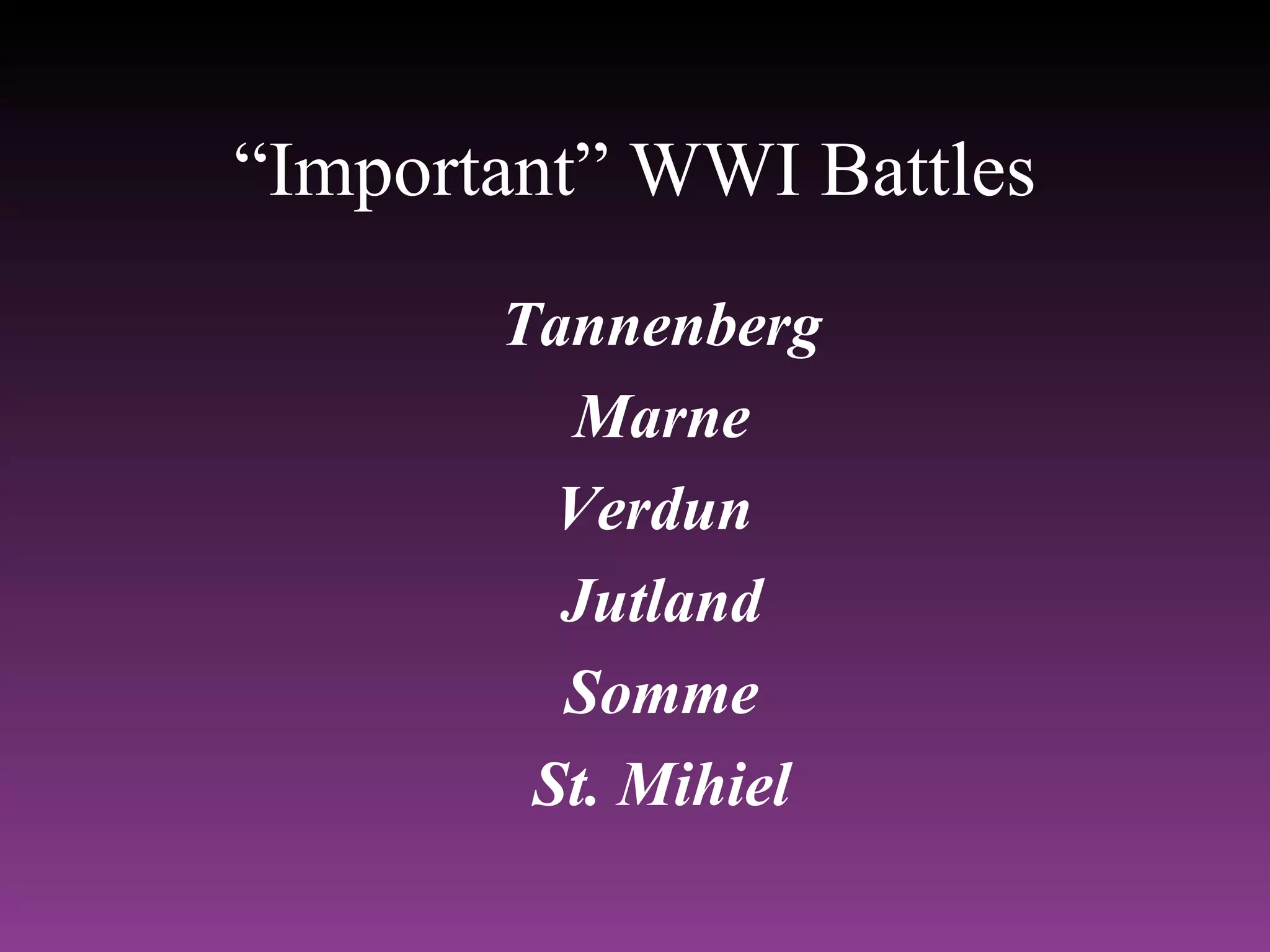
“ Important” WWI Battles Tannenberg Marne Verdun  Jutland Somme St. Mihiel
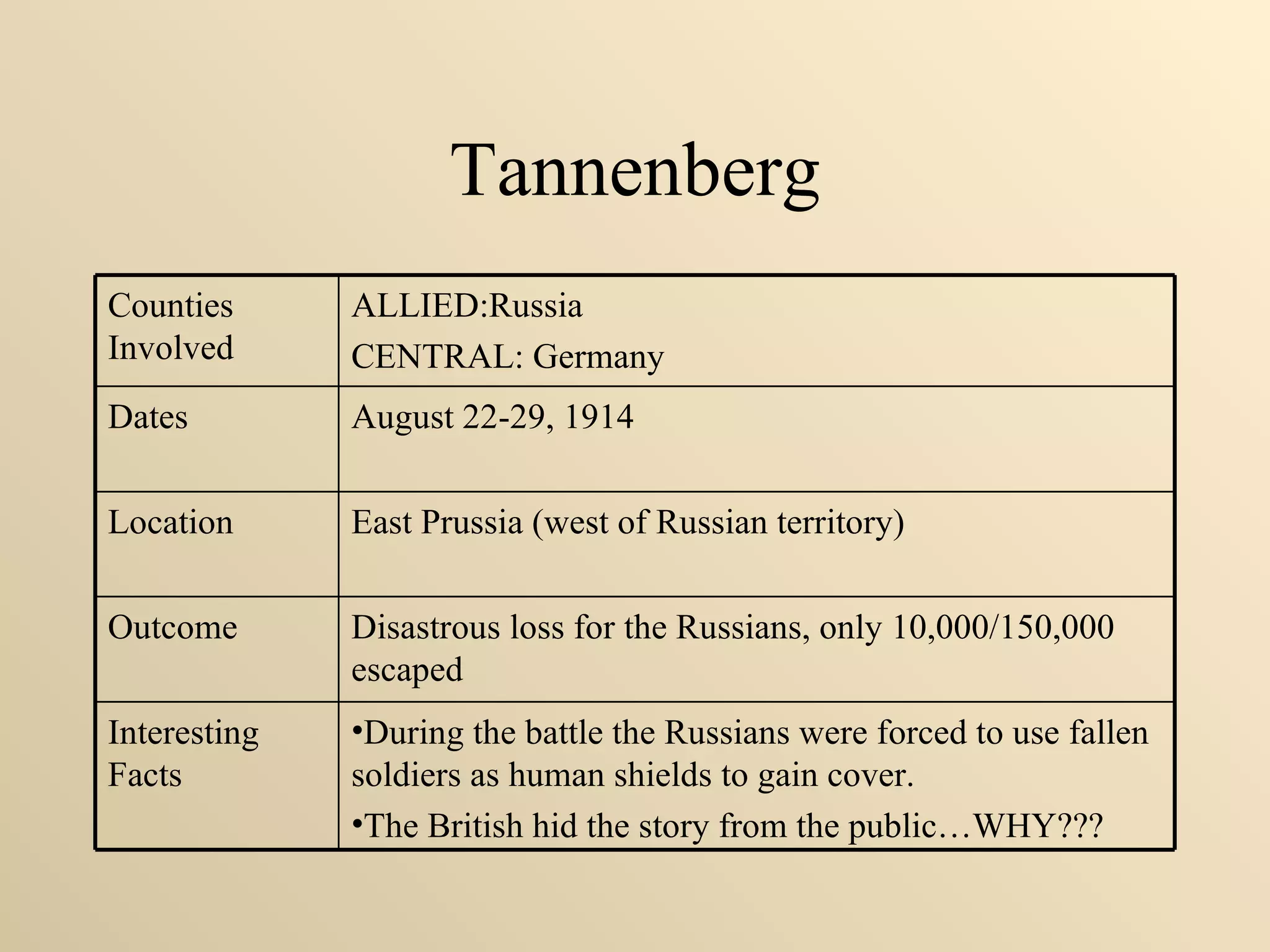
Tannenberg During the battle the Russians were forced to use fallen soldiers as human shields to gain cover.  The British hid the story from the public…WHY??? Interesting Facts Disastrous loss for the Russians, only 10,000/150,000 escaped  Outcome  East Prussia (west of Russian territory) Location August 22-29, 1914 Dates ALLIED:Russia CENTRAL: Germany Counties Involved
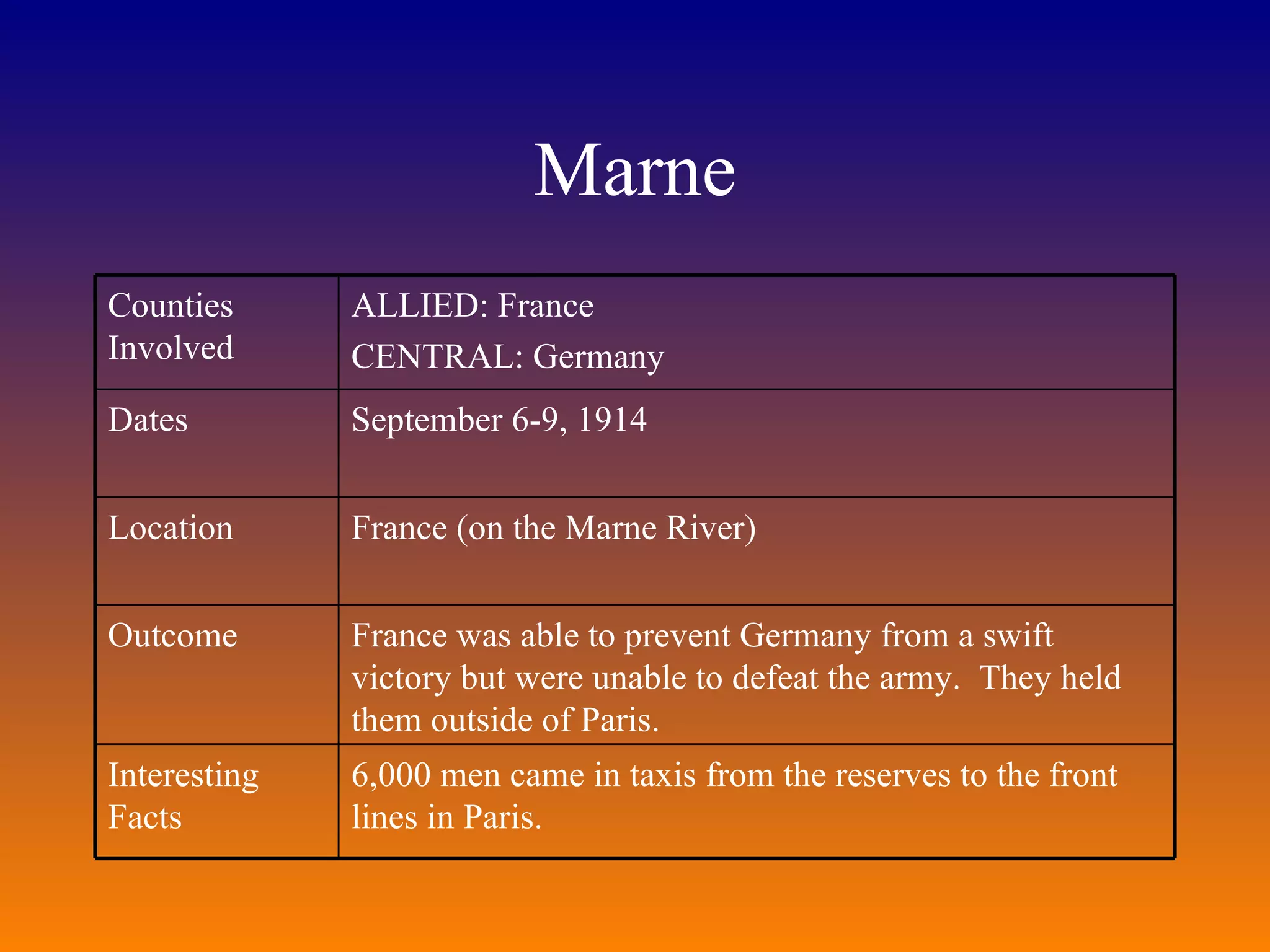
Marne 6,000 men came in taxis from the reserves to the front lines in Paris. Interesting Facts France was able to prevent Germany from a swift victory but were unable to defeat the army.  They held them outside of Paris. Outcome  France (on the Marne River) Location September 6-9, 1914 Dates ALLIED: France  CENTRAL: Germany Counties Involved
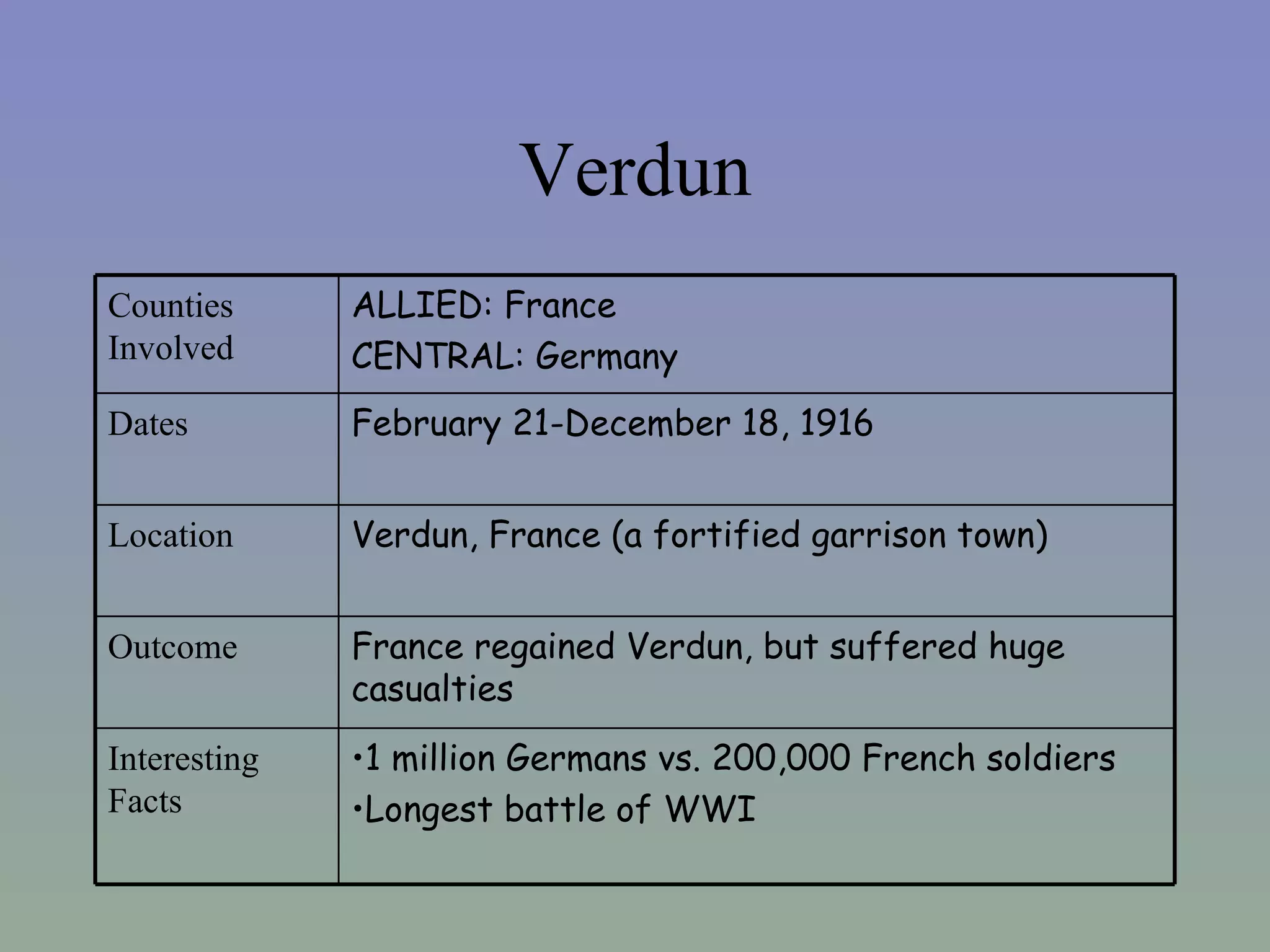
Verdun 1 million Germans vs. 200,000 French soldiers Longest battle of WWI Interesting Facts France regained Verdun, but suffered huge casualties Outcome  Verdun, France (a fortified garrison town) Location February 21-December 18, 1916 Dates ALLIED: France CENTRAL: Germany Counties Involved
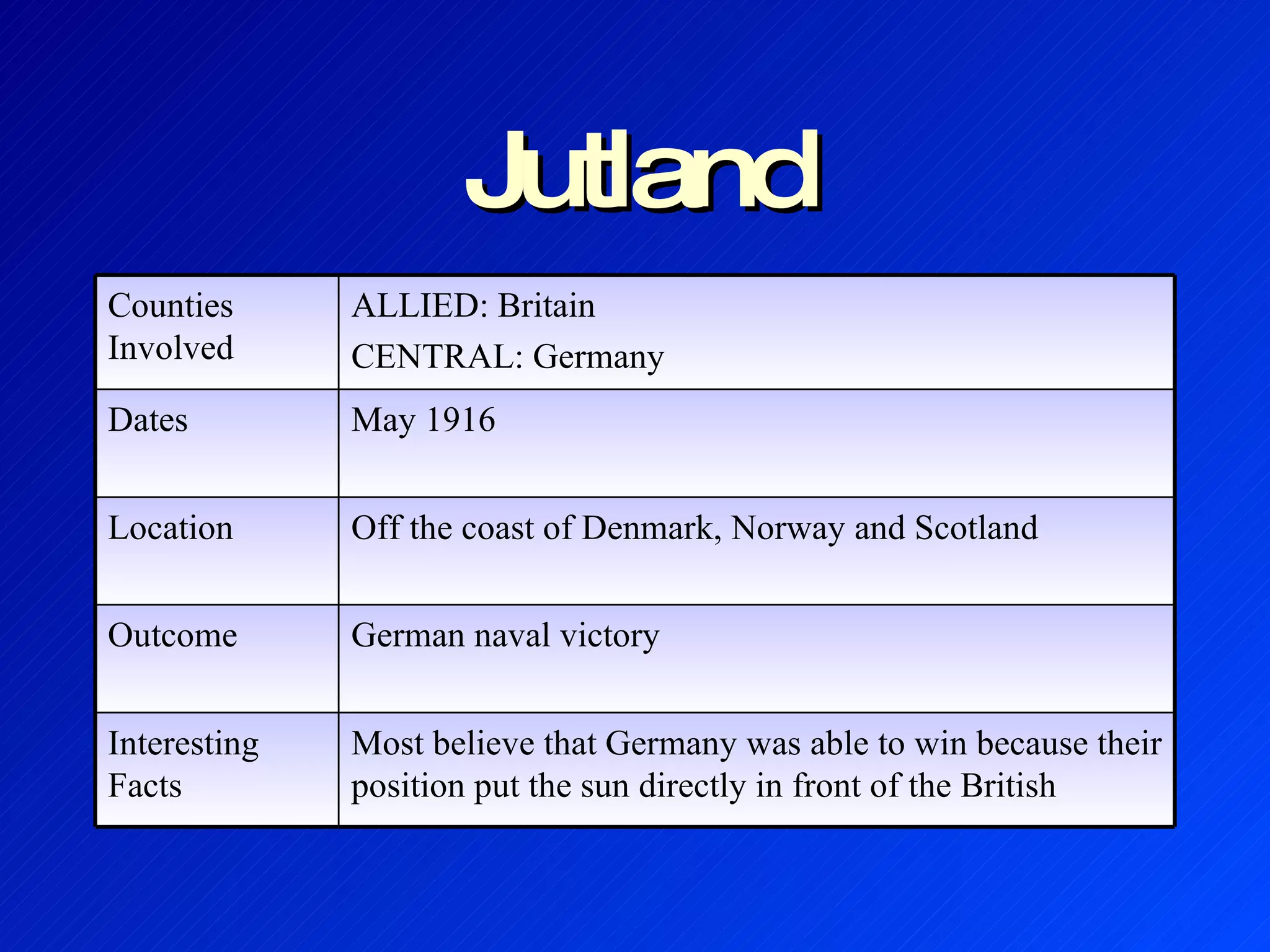
Jutland Most believe that Germany was able to win because their position put the sun directly in front of the British Interesting Facts German naval victory  Outcome  Off the coast of Denmark, Norway and Scotland Location May 1916 Dates ALLIED: Britain  CENTRAL: Germany Counties Involved
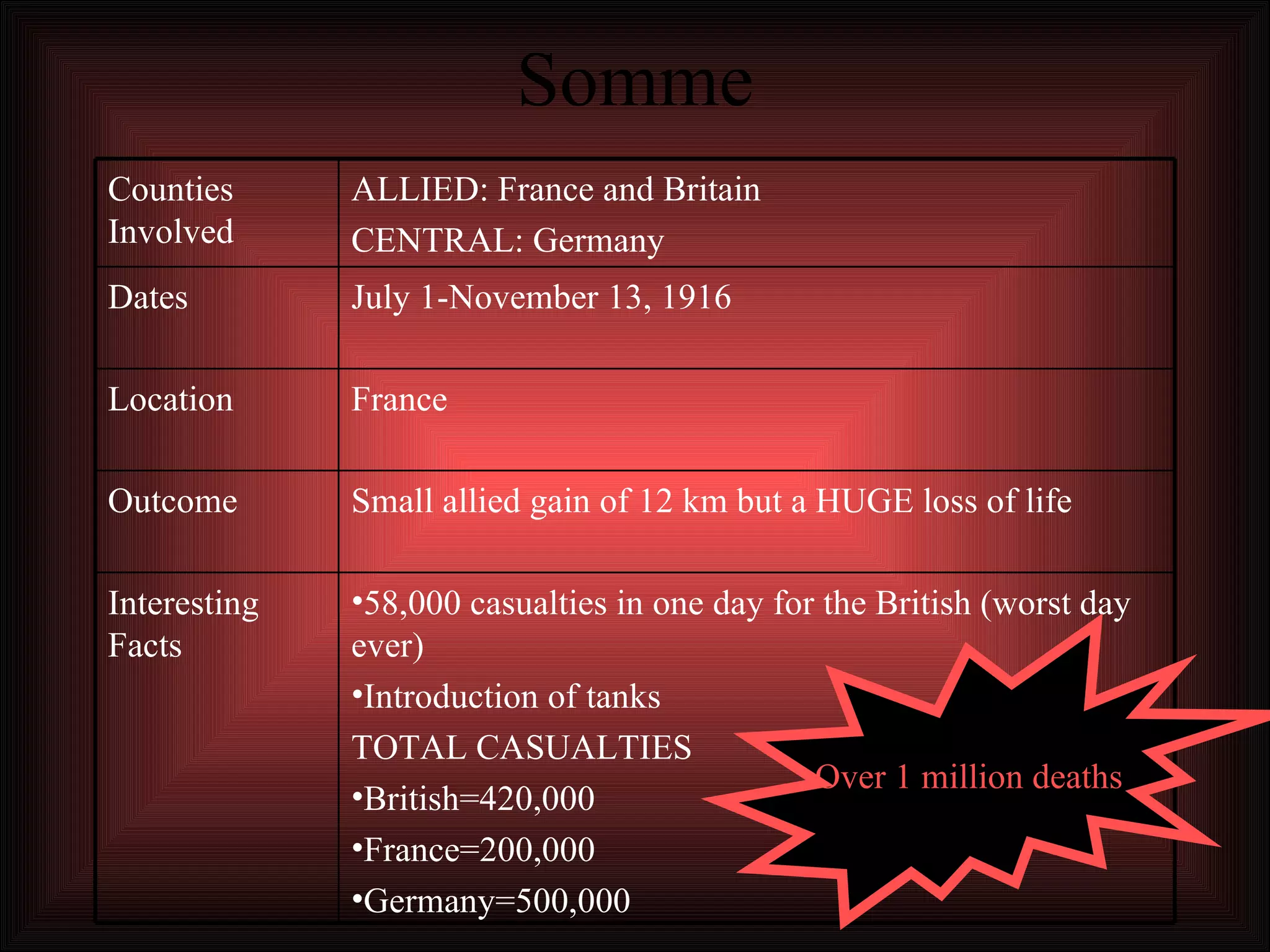
Somme Over 1 million deaths 58,000 casualties in one day for the British (worst day ever) Introduction of tanks TOTAL CASUALTIES  British=420,000 France=200,000 Germany=500,000 Interesting Facts Small allied gain of 12 km but a HUGE loss of life Outcome  France  Location July 1-November 13, 1916 Dates ALLIED: France and Britain CENTRAL: Germany Counties Involved
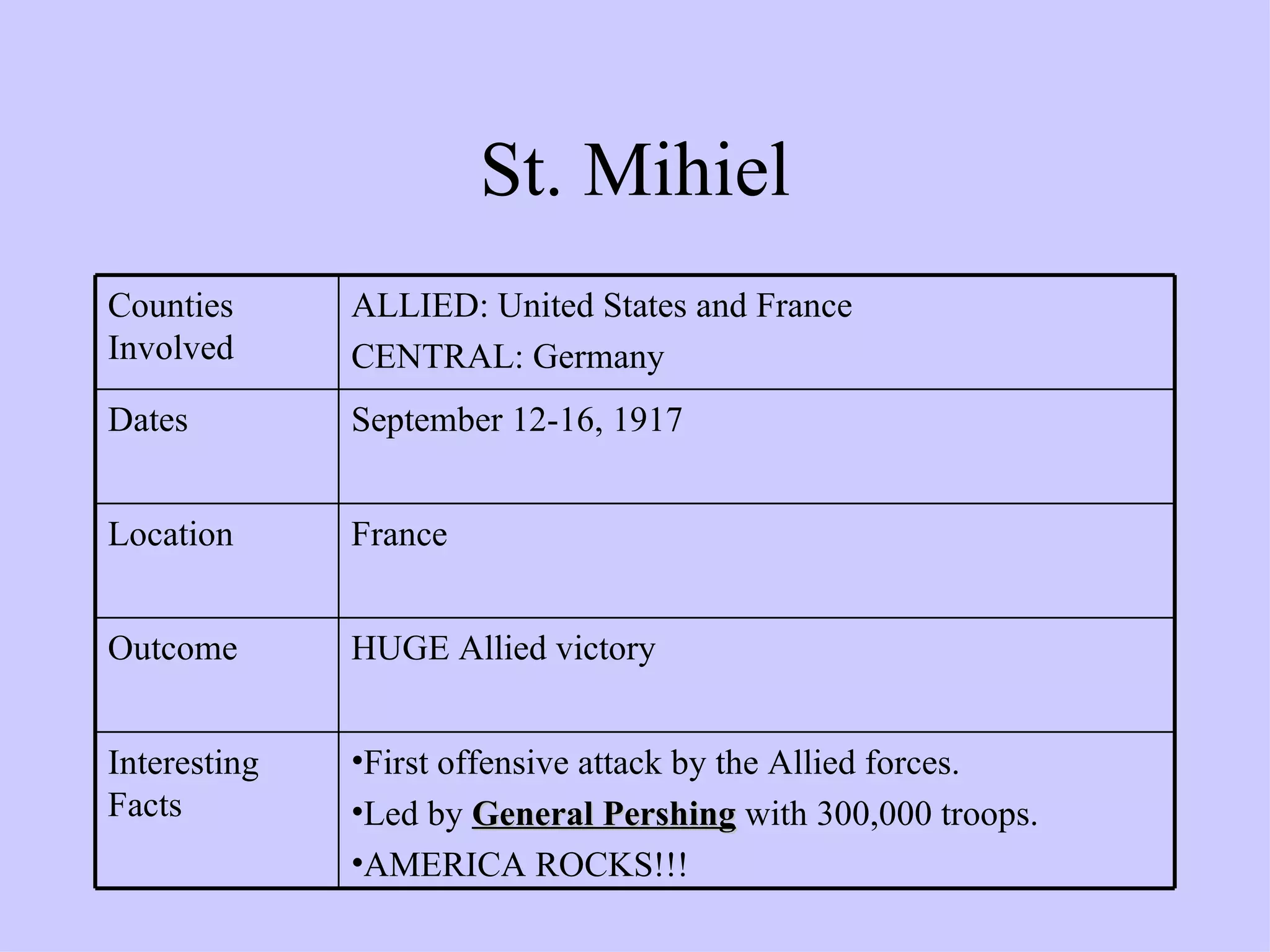
St. Mihiel First offensive attack by the Allied forces.  Led by  General Pershing  with 300,000 troops.  AMERICA ROCKS!!! Interesting Facts HUGE Allied victory Outcome  France Location September 12-16, 1917 Dates ALLIED: United States and France CENTRAL: Germany  Counties Involved
A New Type of Combat:  The Cause and Effect of  Technological Innovations
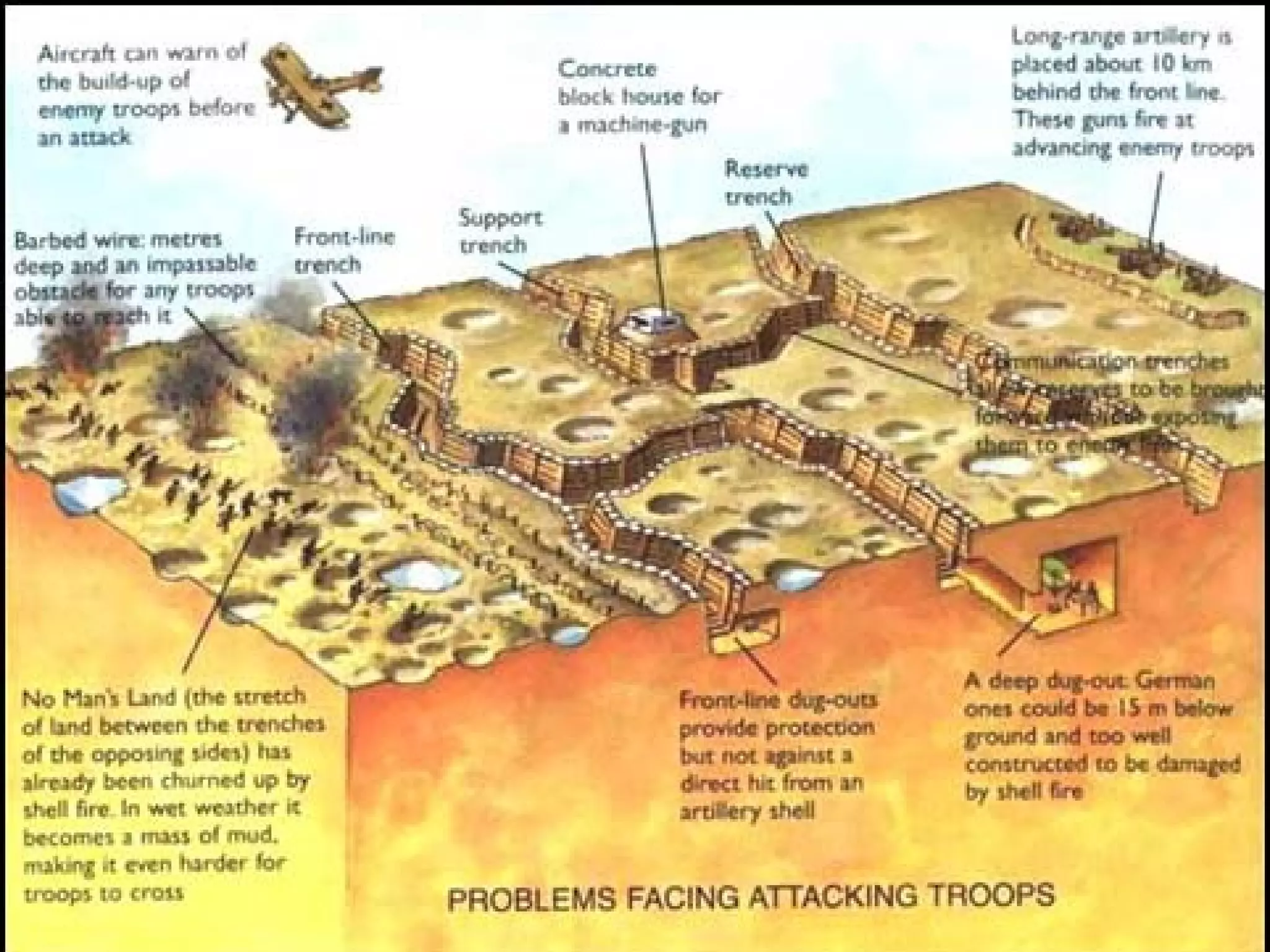
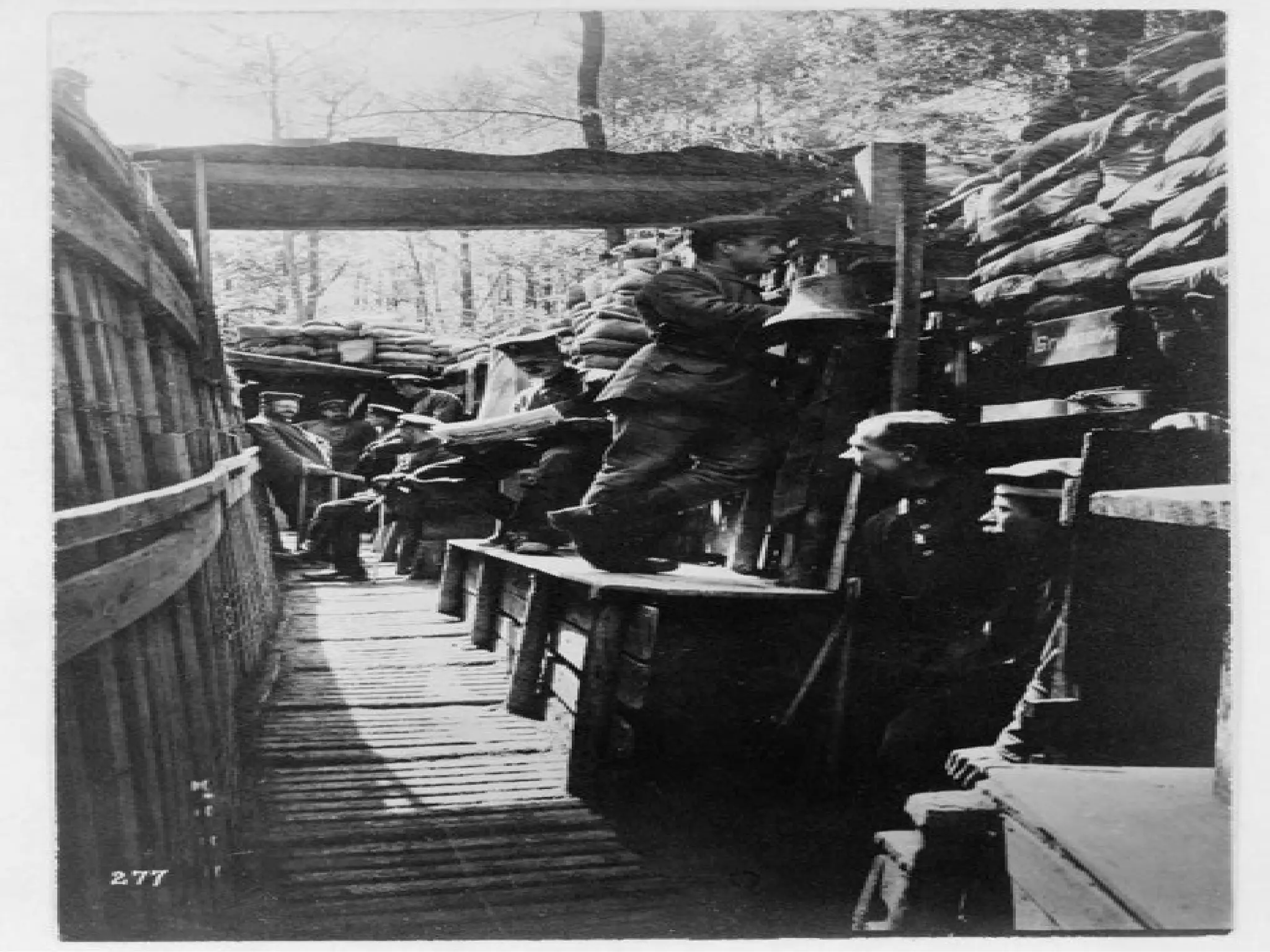
Question 5 Advancements in technology and trench warfare created what effects during the Great War? (1 paragraph)
Trench Warfare


TRENCH FOOT
Poison Gas
Why does the US stop being neutral? Zimmerman Telegram Lusitania Ties to Britain
Zimmerman Telegram


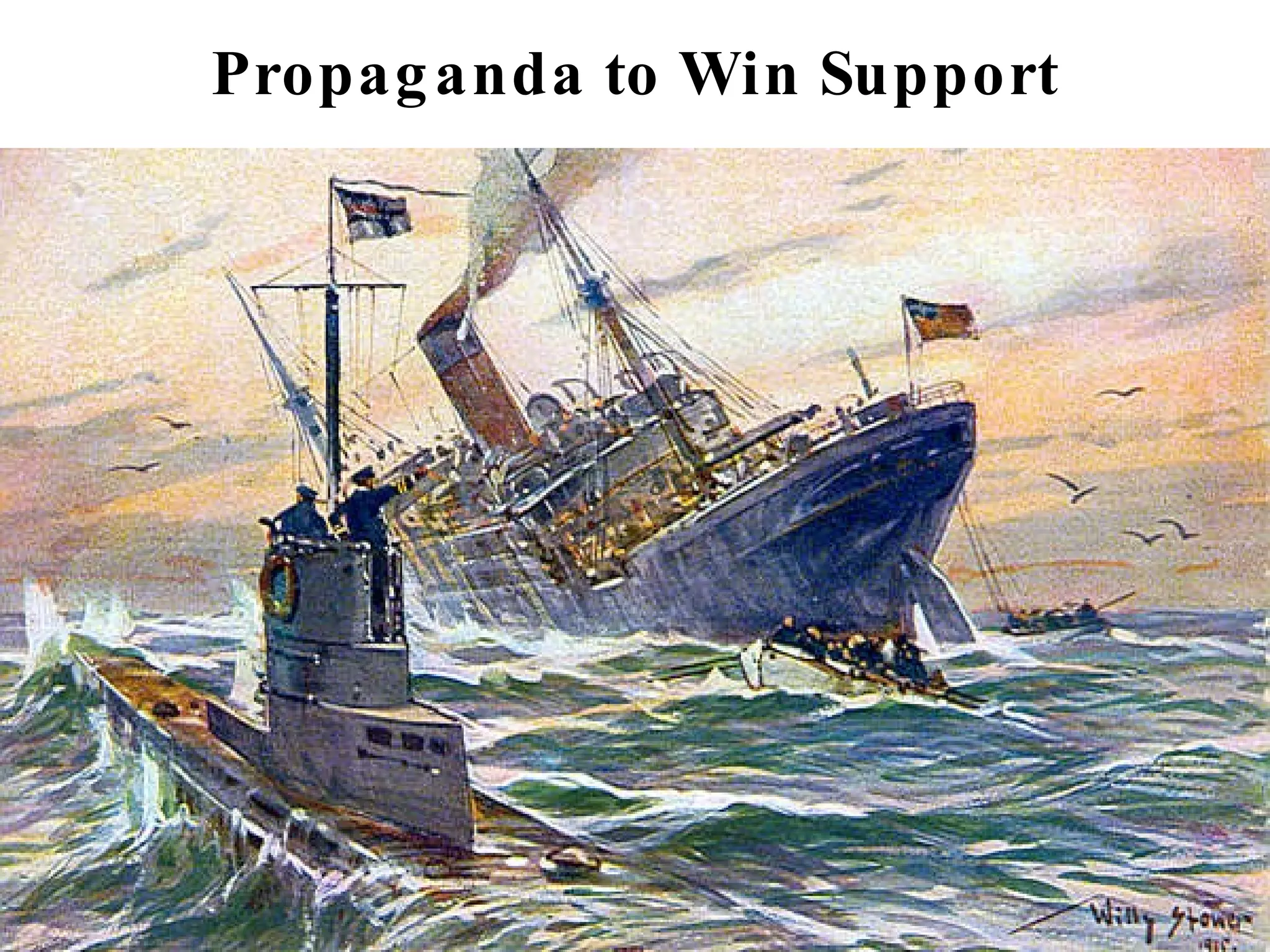
Propaganda to Win Support
The US entry into WWI
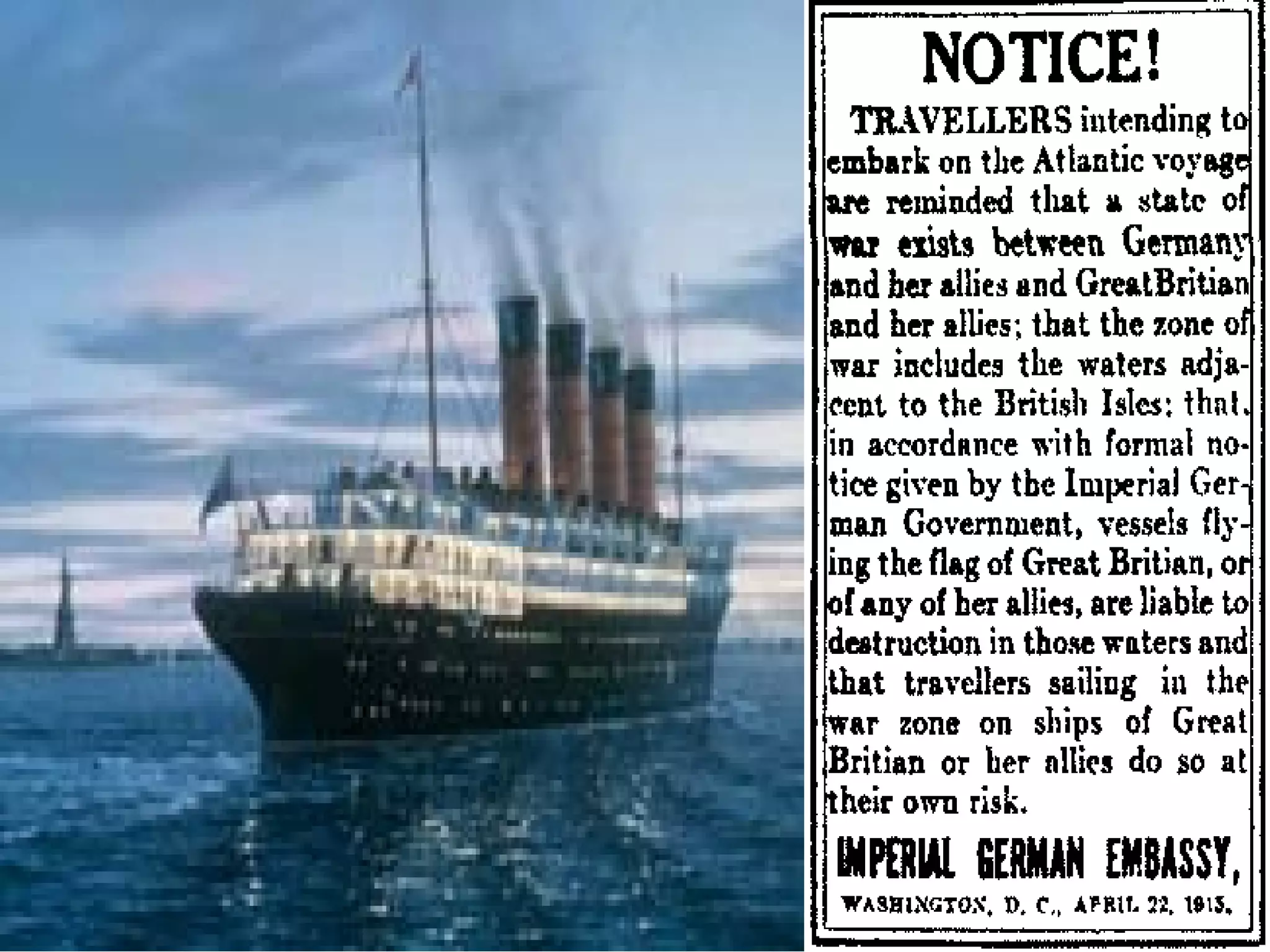
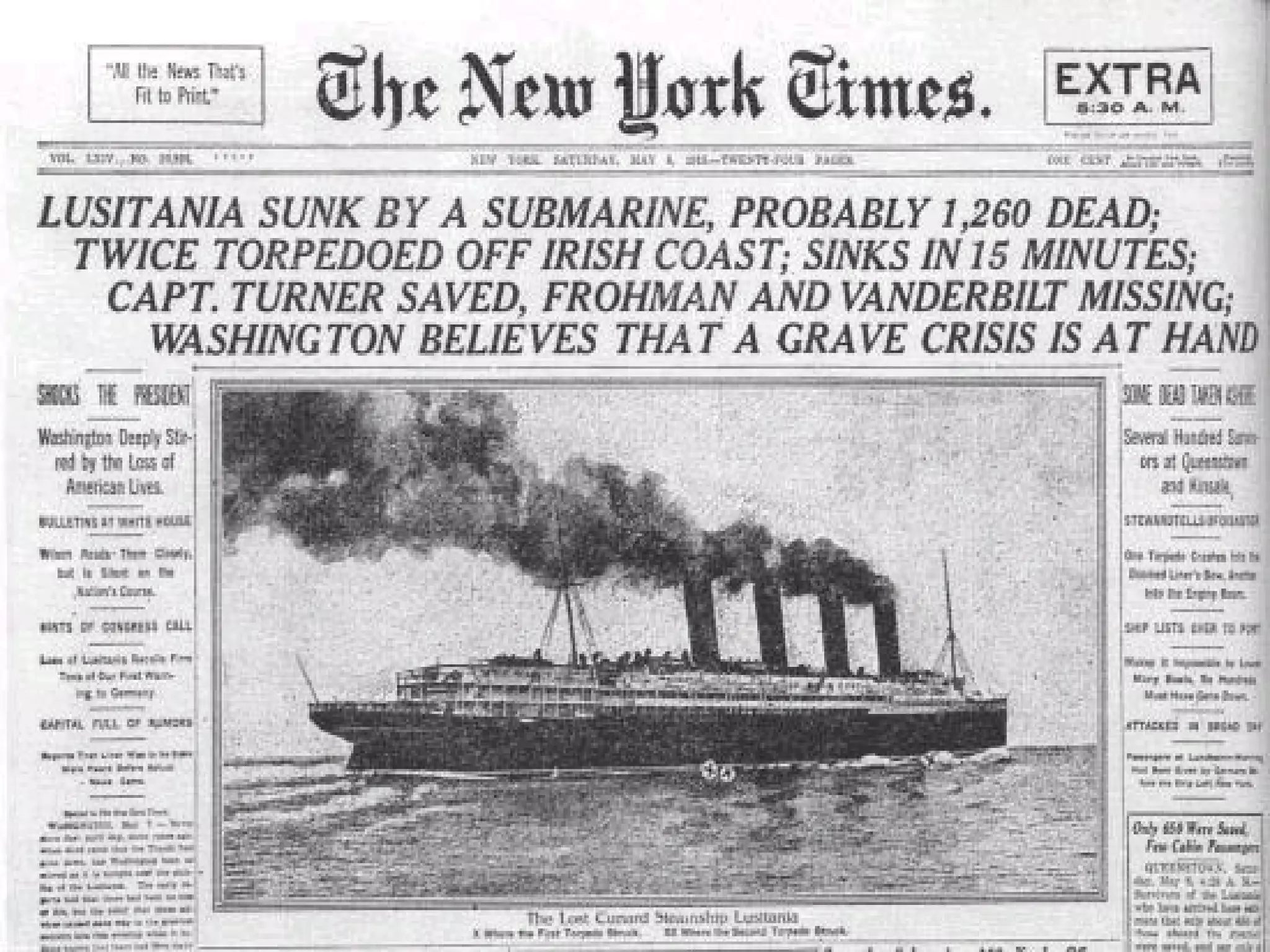
Question 6 Using the powerpoint presentation, textbook, or internet:Describe the events of the Lusitania and Zimmerman Telegram, and the effect they had on US opinion of entering the war. (3-5 paragraphs)
On the Home Front In order to collect a large fighting force, Congress passed Selective Service Act in 1917.  Men between 21-31 must register for military.  (24 million total) 3  million called, by 1918, 4.8 million in services
The Cost of War The cost of war was pushed to the taxpayer. 1.  Increase in taxes 2.  Liberty and Victory loans (Government Bonds)
Government taking control at home Government takes over the  RR, telegraph, telephone.. War Industries Board Bernard Baruch decide what goods  to be produced Council of Defense Food Administration Herbert Hoover “War gardens”
Effects on the  Work Force Women African-Americans Farmers Unions
Question 7 Using your text: What effects did the war bring to the following groups: African Americans, women, farmers, unions (3-4 paragraphs)
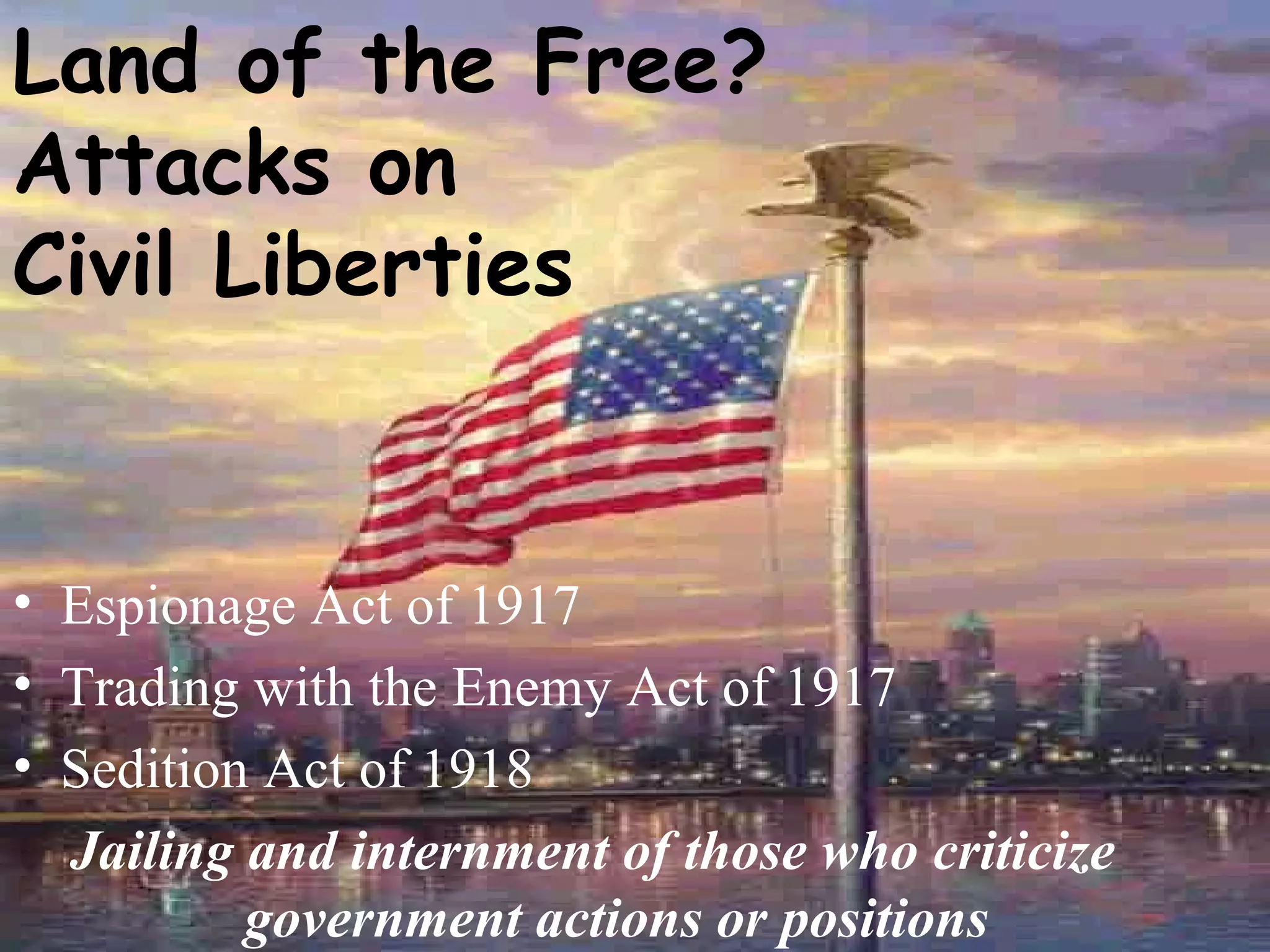
Land of the Free?  Attacks on  Civil Liberties Espionage Act of 1917 Trading with the Enemy Act of 1917 Sedition Act of 1918 Jailing and internment of those who criticize government actions or positions
Suspending Civil Liberties
 
Outcome of the War Allied victory but at a large cost! Casualties British, French, and Russian 4 million United States  50,280
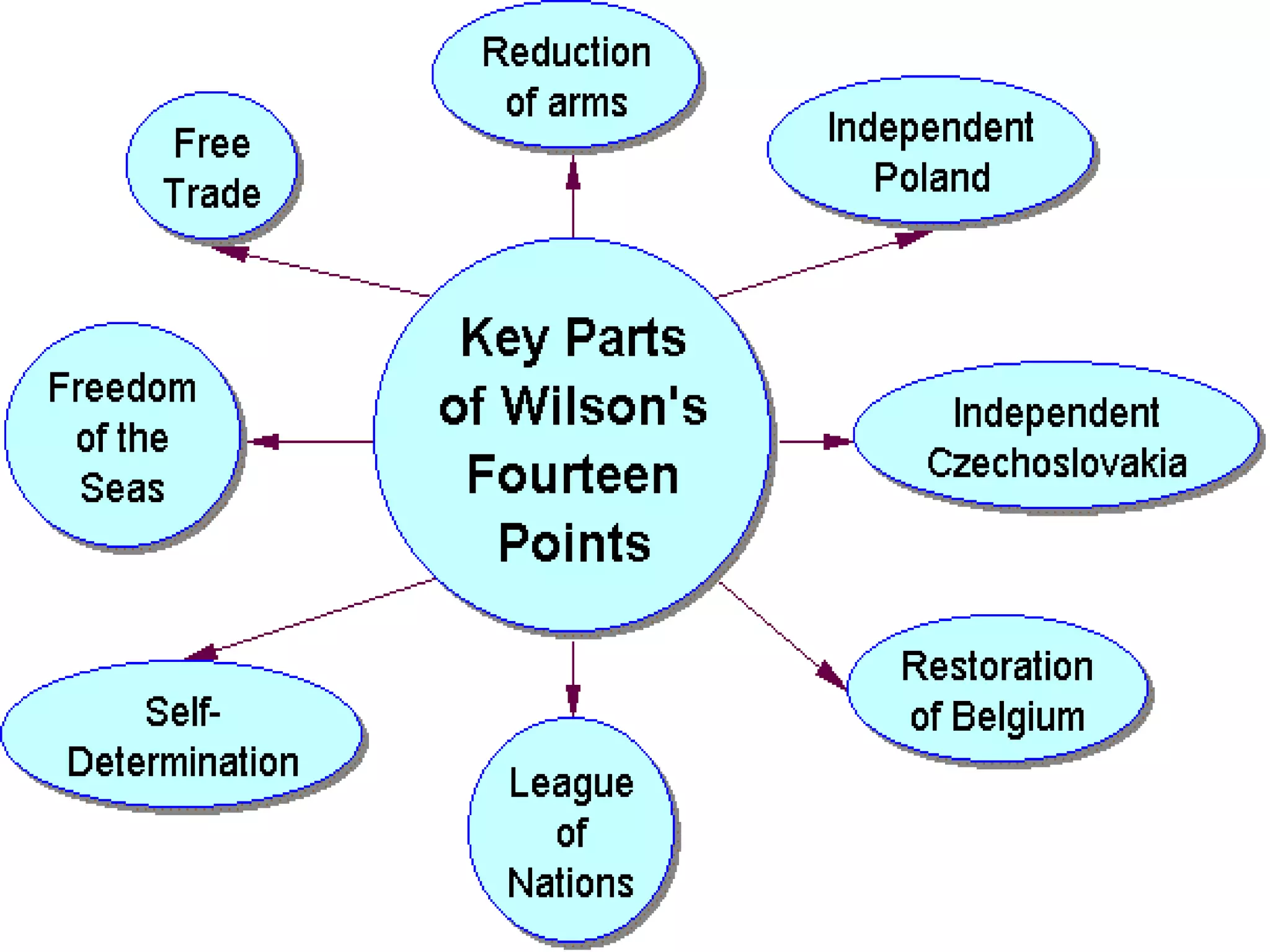
THE END OF WWI January 8, 1918- Wilson delivers his 14 Points Speech to Congress and calls for a “League of Nations” to prevent future wars in the world.  Fourteen Points  October 5, 1918-  Germans send a note of peace to Wilson November 11, 1918-  Germany signs an armistice and World War I ends
Fourteen Points Wilson snubs Senate in picking Peace Commission League of Nations Article 10 - obligated all nations to defend each other! William E. Borah/ Henry C. Lodge oppose and stand on independence Wilson appeals to the public for support Falls ill with a stroke Refuses to compromise with Lodge Loses election of 1920 to anti-League Warren G. Harding
 
 
BACK TO THE END OF WWI
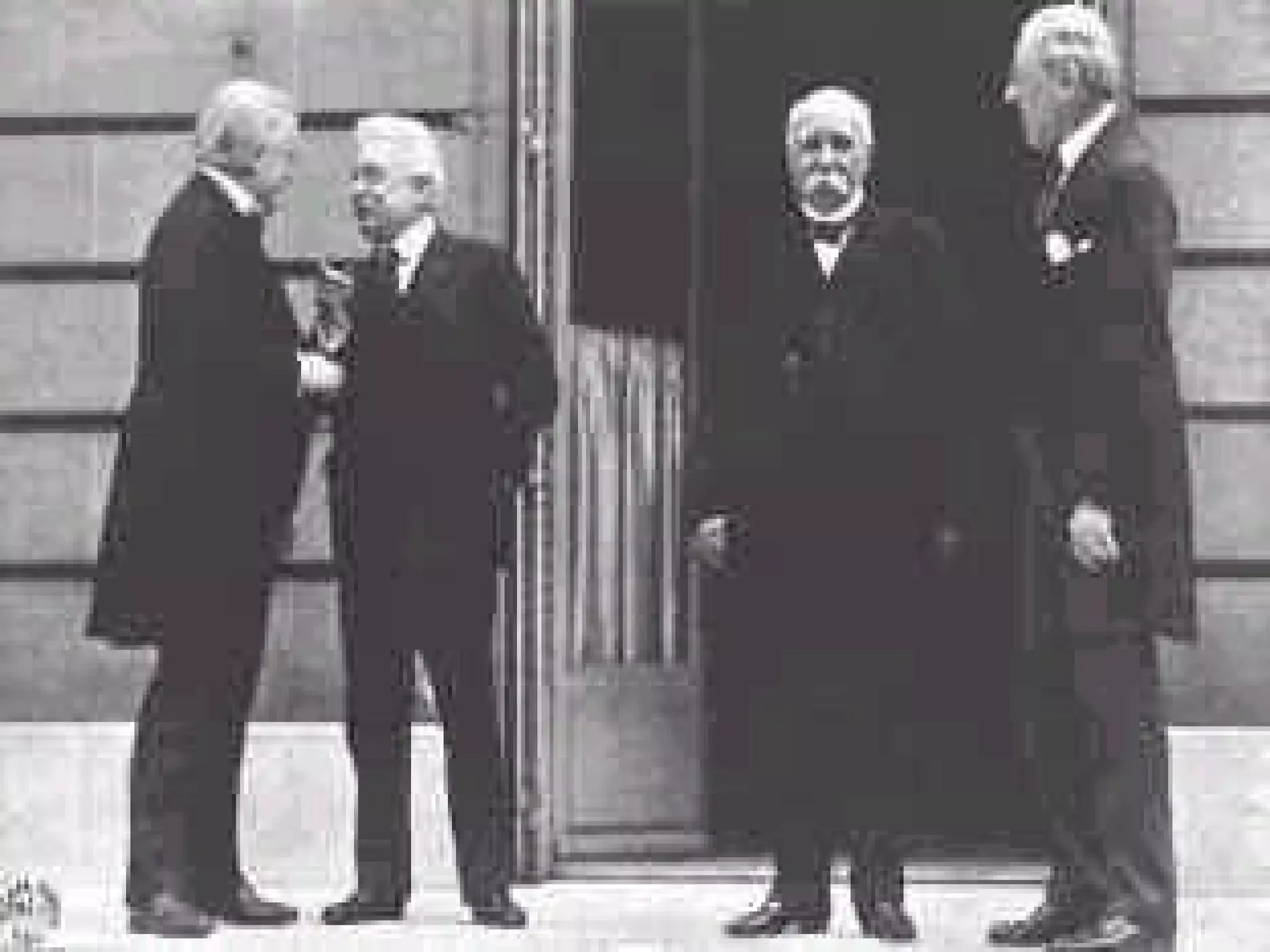
In attendance... the  BIG  four France (Premier Georges Clemenceau) Britain (PM David Lloyd George) Italy (Premier Vottorio Orlando) US (President Woodrow Wilson)
Question 8 Beyond peace, Wilson sought what at the end of the war?  What was the name of the proposal “package”?  What about this lofty idea made it problematic for the US? (5-6 sentences)
Signing for Peace in Europe:  The Treaty of Versailles
Outcomes for Germany Accept responsibility for starting the war Abolish mandatory military service and cut army to 100,000 Demilitarize French/German border No colonial expansion Pay $33 billion in reparations German leaders forced to sign document
 
New countries are formed in Europe out of warring nations Poland (independence) Lithuania Finland Estonia Latvia Romania Czechoslovakia Yugoslavia
Problems with ratification of the Treaty of Versailles Wilson only took Democrats to negotiate treaty Congress opposed Article 10 (League of Nations) Public opinion turned against involvement in foreign affairs Ratification fails in Congress and the US never becomes a permanent part of the League of Nations
 
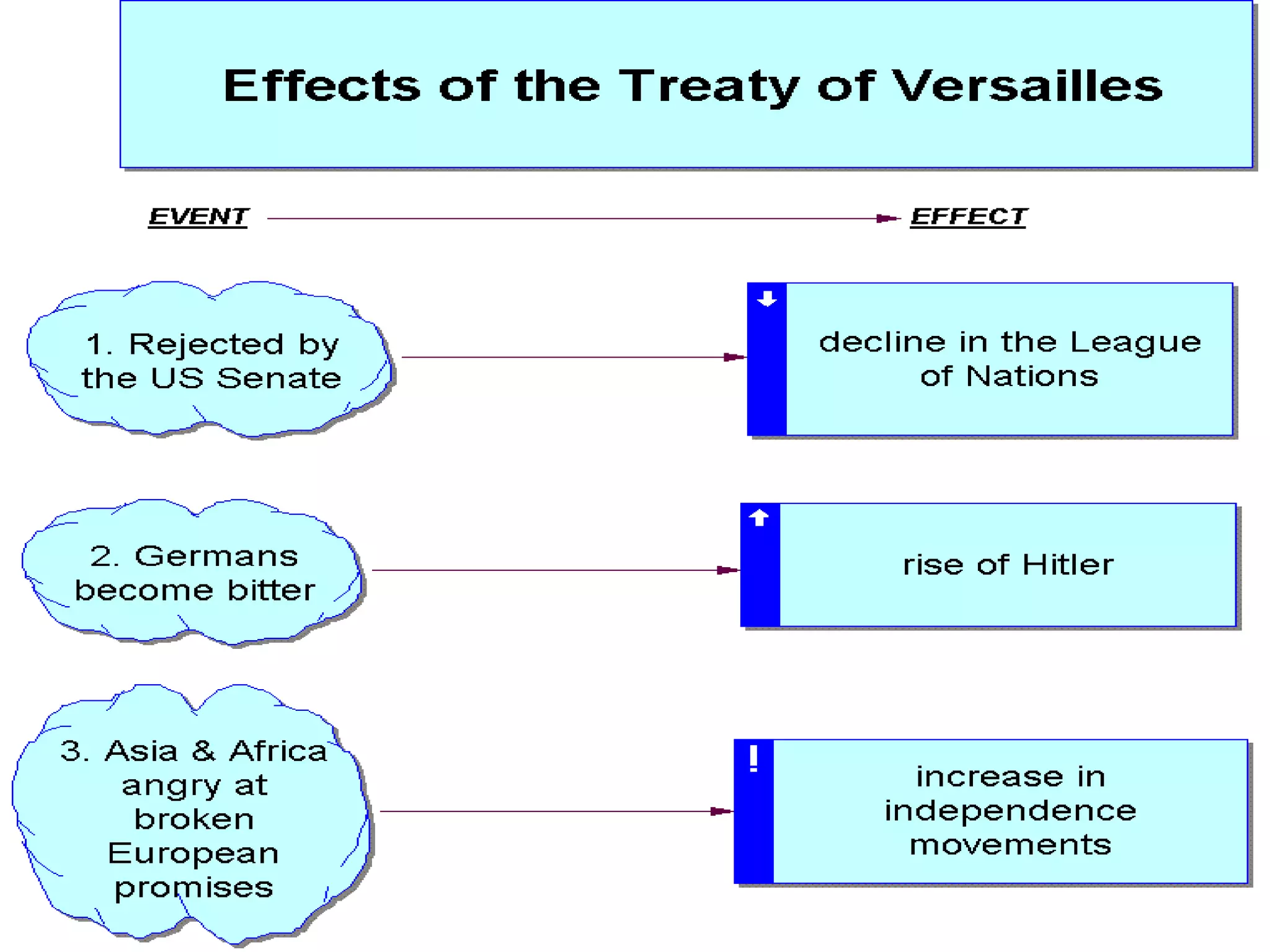
Question 9 What effect did the treaty of Versailles have upon Germany? (2 paragraphs)
The End of WWI

Wwi Ppt07

  • 1.
  • 2.
    Before you begin…Make sure you remember to have your PowerPoint note packet, textbook, and paper to answer additional questions you will see throughout the presentation. There will be length requirements under each question to help guide your writing. (Ex: 2 sentences, 3 paragraphs) View the presentation in slideshow mode to catch animation and hidden information!!! Read carefully and take good notes. Enjoy.
  • 3.
    Causes of theWar M M ilitarism A A lliances I I mperialism N N ationalism
  • 4.
  • 5.
  • 6.
    What isan alliance? A close association of nations or other groups, formed to advance common interests or causes. Alliances By 1914 all the major powers were linked by a system of alliances. The alliances made it more likely that a war would start. Once started, the alliances made it more likely that it would spread .
  • 7.
    Alliances Germany ItalyAustria-Hungary Great Britain France Russia Triple Entente Triple Alliance
  • 8.
    Imperialism All thegreat powers were competing for colonies/territories around the world to claim as their own. The British feared that Germany would expand into Africa. The Austrians feared Serbia and Russia would expand into the Balkans.
  • 9.
    Nationalism Defined as...Devotion to the interests or culture of one's nation. The belief that nations will benefit from acting independently rather than collectively, emphasizing national rather than international goals. Political or social philosophy in which the welfare of the nation-state is considered paramount. A collective state of mind or consciousness in which people believe their primary duty and loyalty is to the nation-state. Often nationalism implies national superiority and glorifies various national virtues. Thus love of nation may be overemphasized; concern with national self-interest to the exclusion of the rights of other nations may lead to international conflict.
  • 10.
    Question 1 Ifso many nations are connected through alliances in Europe at this time, what do you think will happen if there is a conflict between any two nations? How could the other causes intensify this conflict? (2 paragraphs)
  • 11.
    The SparkThe SPARK of WAR (June 28, 1914) Assassination of Archduke Franz Ferdinand Next in line for the throne of Austria Hungary is killed by a Serbian terrorist group known as the Black Hand. Group sought to reunite Bosnia with the independent nation of Serbia to form a large Slavic state on the southern border of Austria-Hungary.
  • 12.
    On the Wayto World War Once Austria-Hungary had assurance of German support, it made HARSH demands on Serbia. Austria Serbia Russia and France Austria Hungary Germany Russia and France Germany Belgium Britain Germany Declares War Invades Declares War Declares War Declares War
  • 13.
  • 14.
  • 15.
    Failure of theSchlieffen Plan ASSUMPTIONS WERE WRONG...DEAD WRONG! 1. Resistance in Belgium Invasion of Belgium 2. France holds line near Paris 3. Russians mobilized QUICKLY! 4. Britain declares war on Germany
  • 16.
    Invasion of BelgiumGerman generals planned to move west to defeat the French before the Russians could move to attack from the east. The quickest way to do this was to march THROUGH Belgium. Belgium refused Belgium was a neutral nation (not allied to either side) “ Belgium is a nation, not a road” Germany invaded Belgium and Britain declared war on Germany. Tiny Belgium could not defend itself against Germany, but did manage to fight for long enough to allow the Allies to prepare to fight. Despite heavy casualties, Germany was halted in France by late 1914. Back to Failures of the Plan
  • 17.
    Question 2 WhatGerman assumptions caused the Schlieffen Plan to fail? (1 paragraph)
  • 18.
    Choosing Sides Austria-HungaryGermany Turkey Bulgaria Great Britain France Russia Japan Italy (1915) United States (1917) As alliances begin to call nations to war, each nation must decide which side it will support or declare neutrality. Central Powers Allied Powers VS.
  • 19.
  • 20.
    Question 3 Whatdo you notice about the location of the Axis Powers in reference to the Allied Powers? (1 or 2 sentences)
  • 21.
    Neutral, But NotImpartial Wilson called for the US to be “Neutral in facts as well as in name, impartial in thought as well as in action”. Americans were unable to “be” neutral and in fact did select a side to support. Most Americans favored the Allies over the Central Powers. Propaganda was used by both sides to influence public opinion. Allied propaganda was more effective because it convinced Americans that the Allies were fighting to defend more than politics, but civilization itself.
  • 22.
    Supplying theAllies Neutrality stopped when $$$ came into the picture!! Although the US supplied materials to both sides, it supplied MUCH more to the Allies. Overall the increase in trade greatly helped “neutral” America. This is a $4 BILLION increase 4.88 billion 856 million Total 280 million 187 million Neutral 1.1 billion 169 million Germany 3.5 billion 500 million Allies 1917 1914 Trading Countries
  • 23.
    Question 4 Howwas trade a telling sign for whom the United States would support in the Great War, while staying officially, “neutral?” (1 paragraph)
  • 24.
    “ Important” WWIBattles Tannenberg Marne Verdun Jutland Somme St. Mihiel
  • 25.
    Tannenberg During thebattle the Russians were forced to use fallen soldiers as human shields to gain cover. The British hid the story from the public…WHY??? Interesting Facts Disastrous loss for the Russians, only 10,000/150,000 escaped Outcome East Prussia (west of Russian territory) Location August 22-29, 1914 Dates ALLIED:Russia CENTRAL: Germany Counties Involved
  • 26.
    Marne 6,000 mencame in taxis from the reserves to the front lines in Paris. Interesting Facts France was able to prevent Germany from a swift victory but were unable to defeat the army. They held them outside of Paris. Outcome France (on the Marne River) Location September 6-9, 1914 Dates ALLIED: France CENTRAL: Germany Counties Involved
  • 27.
    Verdun 1 millionGermans vs. 200,000 French soldiers Longest battle of WWI Interesting Facts France regained Verdun, but suffered huge casualties Outcome Verdun, France (a fortified garrison town) Location February 21-December 18, 1916 Dates ALLIED: France CENTRAL: Germany Counties Involved
  • 28.
    Jutland Most believethat Germany was able to win because their position put the sun directly in front of the British Interesting Facts German naval victory Outcome Off the coast of Denmark, Norway and Scotland Location May 1916 Dates ALLIED: Britain CENTRAL: Germany Counties Involved
  • 29.
    Somme Over 1million deaths 58,000 casualties in one day for the British (worst day ever) Introduction of tanks TOTAL CASUALTIES British=420,000 France=200,000 Germany=500,000 Interesting Facts Small allied gain of 12 km but a HUGE loss of life Outcome France Location July 1-November 13, 1916 Dates ALLIED: France and Britain CENTRAL: Germany Counties Involved
  • 30.
    St. Mihiel Firstoffensive attack by the Allied forces. Led by General Pershing with 300,000 troops. AMERICA ROCKS!!! Interesting Facts HUGE Allied victory Outcome France Location September 12-16, 1917 Dates ALLIED: United States and France CENTRAL: Germany Counties Involved
  • 31.
    A New Typeof Combat: The Cause and Effect of Technological Innovations
  • 32.
    Question 5 Advancementsin technology and trench warfare created what effects during the Great War? (1 paragraph)
  • 33.
  • 34.
  • 35.
  • 36.
  • 37.
  • 38.
  • 39.
    Why does theUS stop being neutral? Zimmerman Telegram Lusitania Ties to Britain
  • 40.
  • 41.
  • 42.
  • 43.
  • 44.
  • 45.
    The US entryinto WWI
  • 46.
    Question 6 Usingthe powerpoint presentation, textbook, or internet:Describe the events of the Lusitania and Zimmerman Telegram, and the effect they had on US opinion of entering the war. (3-5 paragraphs)
  • 47.
    On the HomeFront In order to collect a large fighting force, Congress passed Selective Service Act in 1917. Men between 21-31 must register for military. (24 million total) 3 million called, by 1918, 4.8 million in services
  • 48.
    The Cost ofWar The cost of war was pushed to the taxpayer. 1. Increase in taxes 2. Liberty and Victory loans (Government Bonds)
  • 49.
    Government taking controlat home Government takes over the RR, telegraph, telephone.. War Industries Board Bernard Baruch decide what goods to be produced Council of Defense Food Administration Herbert Hoover “War gardens”
  • 50.
    Effects on the Work Force Women African-Americans Farmers Unions
  • 51.
    Question 7 Usingyour text: What effects did the war bring to the following groups: African Americans, women, farmers, unions (3-4 paragraphs)
  • 52.
    Land of theFree? Attacks on Civil Liberties Espionage Act of 1917 Trading with the Enemy Act of 1917 Sedition Act of 1918 Jailing and internment of those who criticize government actions or positions
  • 53.
  • 54.
  • 55.
    Outcome of theWar Allied victory but at a large cost! Casualties British, French, and Russian 4 million United States 50,280
  • 56.
    THE END OFWWI January 8, 1918- Wilson delivers his 14 Points Speech to Congress and calls for a “League of Nations” to prevent future wars in the world. Fourteen Points October 5, 1918- Germans send a note of peace to Wilson November 11, 1918- Germany signs an armistice and World War I ends
  • 57.
    Fourteen Points Wilsonsnubs Senate in picking Peace Commission League of Nations Article 10 - obligated all nations to defend each other! William E. Borah/ Henry C. Lodge oppose and stand on independence Wilson appeals to the public for support Falls ill with a stroke Refuses to compromise with Lodge Loses election of 1920 to anti-League Warren G. Harding
  • 58.
  • 59.
  • 60.
    BACK TO THEEND OF WWI
  • 61.
    In attendance... the BIG four France (Premier Georges Clemenceau) Britain (PM David Lloyd George) Italy (Premier Vottorio Orlando) US (President Woodrow Wilson)
  • 62.
    Question 8 Beyondpeace, Wilson sought what at the end of the war? What was the name of the proposal “package”? What about this lofty idea made it problematic for the US? (5-6 sentences)
  • 63.
    Signing for Peacein Europe: The Treaty of Versailles
  • 64.
    Outcomes for GermanyAccept responsibility for starting the war Abolish mandatory military service and cut army to 100,000 Demilitarize French/German border No colonial expansion Pay $33 billion in reparations German leaders forced to sign document
  • 65.
  • 66.
    New countries areformed in Europe out of warring nations Poland (independence) Lithuania Finland Estonia Latvia Romania Czechoslovakia Yugoslavia
  • 67.
    Problems with ratificationof the Treaty of Versailles Wilson only took Democrats to negotiate treaty Congress opposed Article 10 (League of Nations) Public opinion turned against involvement in foreign affairs Ratification fails in Congress and the US never becomes a permanent part of the League of Nations
  • 68.
  • 69.
    Question 9 Whateffect did the treaty of Versailles have upon Germany? (2 paragraphs)
  • 70.