D-Day June 6, 1944 …  The turning point in WWII …  The largest *seaborne invasion in history  …  The beginning of the end of German control over Europe …  Only the beginning of a bitter battle as the Allies    finally reach Paris and eventually Germany itself
Prior Events Germany Invades Poland on September 1, 1944 This causes Britain, France, and Canada to declare war on Germany, *commencing WWII. Invasion of France Germany invades France in June of 1941 Pearl Harbor  Japan, an ally to Germany (Axis Powers), attacks US naval base on  December 7, 1941. US joins the Allies the following day. Major Allies Major Axis . United States . Germany . Great Britain . Italy . France . Japan . Soviet Union
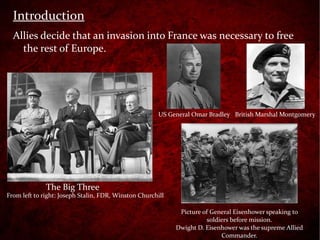
Introduction   Allies decide that an invasion into France was necessary to free the rest of Europe.  Picture of General Eisenhower speaking to soldiers before mission. Dwight D. Eisenhower was the supreme Allied Commander. US General Omar Bradley British Marshal Montgomery The Big Three From left to right: Joseph Stalin, FDR, Winston Churchill
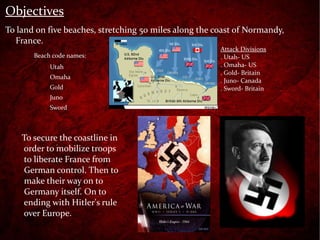
Objectives To land on five beaches, stretching 50 miles along the coast of Normandy, France.  Beach code names: Utah
Omaha
Gold
Juno
Sword To secure the coastline in  order to  mobilize troops  to liberate France from  German control. Then to  make their way on to  Germany itself. On to  ending with Hitler's rule  over Europe. Attack Divisions . Utah- US . Omaha- US . Gold- Britain . Juno- Canada . Sword- Britain * * *
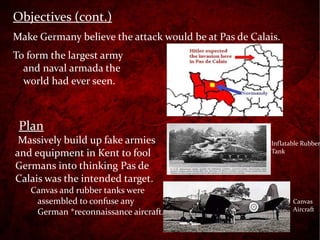
Objectives (cont.) Make Germany believe the attack would be at Pas de Calais.
To form the largest army  and naval armada the  world had ever seen. Plan Massively build up fake armies  and equipment in Kent to fool  Germans into thinking Pas de  Calais was the intended target. Canvas and rubber tanks were assembled to confuse any German *reconnaissance aircraft. Inflatable Rubber Tank Canvas Aircraft