CAN B S
Idea by
Ahmad
In The Name Of Allah
1
History
The abbreviation “CAN” stands for
“Controller Area Network”.
This bus:
• Introduced by Robert Bosch in 1986.
• Developed for automotive applications
• Standardized in 1993 as ISO11898-1
• CAN Standards :
• CAN 2.0A
• CAN 2.0B
2
BUS topology
 What is a Network Topology
 It is the arrangement of various elements [Links, Nodes,
Etc.] for a Network [a telecommunication n/w] to
exchange Data
3
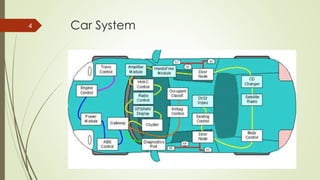
Car System4
Before CAN!
Windows Power
& Control
System :
Different
Speed
5
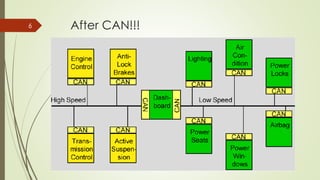
After CAN!!!6
Serial vs. Parrallel
Why Serial Communication
A few advantages
 A serial connection requires fewer interconnecting cables (e.g.,
wires/ fibers) and hence occupies less space.
 The extra space allows for better isolation of the channel from its
surroundings.
 Serial is a better option because it is cheaper to implement
7
CAN vs. MultiWire Network
 Physical medium – two wires terminated at both ends by resistors.
 Differential signal - better noise immunity.
 Benefits:
 Reduced weight, Reduced cost
 Fewer wires = Increased reliability
8
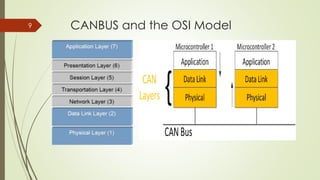
CANBUS and the OSI Model9
Summary10
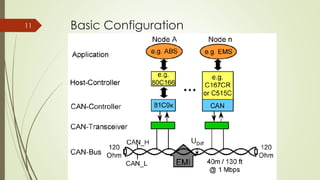
Basic Configuration11
Transmission Characteristics
 Up to 1 Mbit/sec.
 Common baud rates: 1 MHz, 500 KHz and 125 KHz
 All nodes – same baud rate
 Max length:120’ to 15000’ (rate dependent)
12
Message Oriented Transmission
Protocol
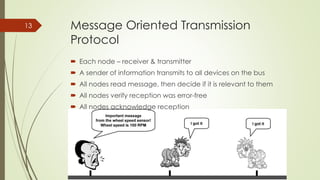
 Each node – receiver & transmitter
 A sender of information transmits to all devices on the bus
 All nodes read message, then decide if it is relevant to them
 All nodes verify reception was error-free
 All nodes acknowledge reception
13
Message Format14
Message Format15
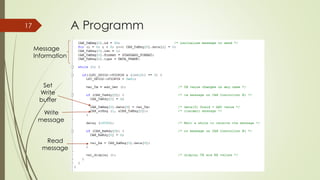
A Programm
A message frame information :
16
A Programm
Message
Information
Write
message
Read
message
Set
Write
buffer
17
Bus Arbitration
 Arbitration – needed when multiple nodes try to transmit at the
same time
 Only one transmitter is allowed to transmit at a time.
 A node waits for bus to become idle
 Nodes with more important messages continue transmitting
18
Bus Arbitration(2)
 Message importance is encoded in message ID.
Lower value = More important
 As a node transmits each bit, it verifies that it sees the same bit
value on the bus that it transmitted.
 A “0” on the bus wins over a “1” on the bus.
 Losing node stops transmitting, winner continues.
19
Bus Arbitration(3)
 Wired AND
20
Bus Levels according to ISO-IS 11898
Logic 1 Logic 0
21
CAN and EMI22
A Basic CAN controller
Cheap CAN controller – CPU could get overrun with messages
even if it didn’t need them.
23
Full CAN Controller
Hardware message filters sort & filter messages without interrupting CPU
24
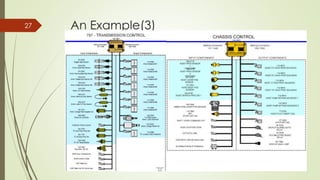
An Example
Caterpillar 797
25
An Example(2)26
An Example(3)27
A CAN Controller Circuit
28
CAN
Controller
& Host
Standard
CAN Port
CAN
Transiver
29
30
Refrence
 NXP LPC176x5x User manual
 Ducati North America
 Pedro Campana Antenna Control Specialist
 Introduction to CANBUS : Marek Hajek
31

Can bus m.n.r