SIDDAGANGA INSTITUTE OF TECHNOLOGY
“CAN (Controller Area Network )
Protocol”
Technical seminar
on
Darshan K S
1SI12EC129
VII sem, EC ‘A’
Guided by
Dr. R.KUMARASWAMY
Professor & Head,
Dept. of E&C
6/10/2015 CAN (Controller Area Network) Protocol 1
Outline
1. What/Why CAN ?
2. CAN bus introduction
3. Overview of CAN
4. CAN Application / Bus level
5. Message Frames
6. Error Handling / Fault confinement
7. Bit Stuffing
8. References
6/10/2015 CAN (Controller Area Network) Protocol 2
Why CAN ?
6/10/2015 CAN (Controller Area Network) Protocol 3
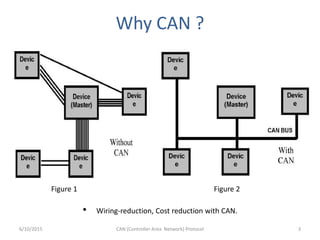
• Wiring-reduction, Cost reduction with CAN.
Figure 1 Figure 2
What CAN ?
6/10/2015 CAN (Controller Area Network) Protocol 4
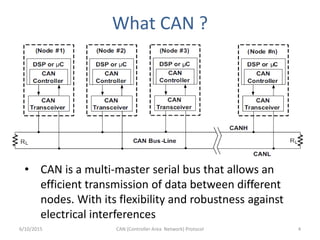
• CAN is a multi-master serial bus that allows an
efficient transmission of data between different
nodes. With its flexibility and robustness against
electrical interferences
CAN Node Consists of …
6/10/2015 CAN (Controller Area Network) Protocol 5
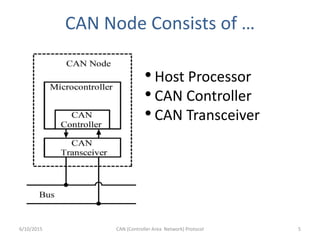
• Host Processor
• CAN Controller
• CAN Transceiver
CAN bus introduction
• Controller Area Network (CAN)
• Originally developed by Robert Bosch for
automobile in- vehicle network
• CAN bus provides communication between
controllers, sensors, and actuators.
• Very reliable and robust well proven
technology
6/10/2015 CAN (Controller Area Network) Protocol 6
Overview of CAN
• Multi drop, multi-Master Bus Access
• Message Broadcasting
• Message Priority (No Node IDs)
• Limited Data Length (0…8 bytes)
• 1 Mbit/sec Data Rate
• Excellent Error Detection & Fault
Confinement
6/10/2015 CAN (Controller Area Network) Protocol 7
CAN Application
• Automotive
• Military vehicles
• Industrial machinery
• Medical systems
• Agricultural machinery
• Marine control and navigation
• Elevator control systems
6/10/2015 CAN (Controller Area Network) Protocol 8
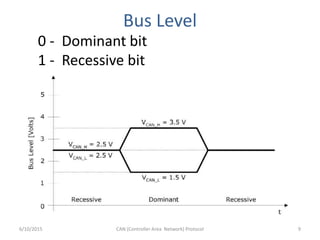
Bus Level
6/10/2015 CAN (Controller Area Network) Protocol 9
0 - Dominant bit
1 - Recessive bit
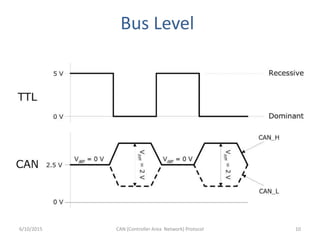
Bus Level
6/10/2015 CAN (Controller Area Network) Protocol 10
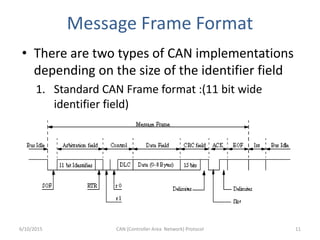
Message Frame Format
• There are two types of CAN implementations
depending on the size of the identifier field
1. Standard CAN Frame format :(11 bit wide
identifier field)
6/10/2015 CAN (Controller Area Network) Protocol 11
Message Frame Format
2. Extended CAN Frame format : (29-bit wide
identifier field)
6/10/2015 CAN (Controller Area Network) Protocol 12
CAN Base frame format with the addition of :
• Substitute remote request (SRR)
• Identifier extension (IDE)
• r1 – reserve bit
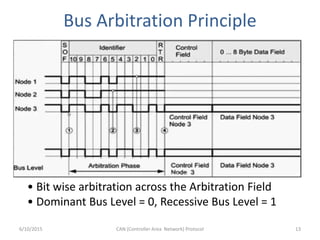
Bus Arbitration Principle
6/10/2015 CAN (Controller Area Network) Protocol 13
• Bit wise arbitration across the Arbitration Field
• Dominant Bus Level = 0, Recessive Bus Level = 1
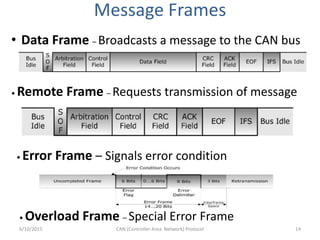
Message Frames
6/10/2015 CAN (Controller Area Network) Protocol 14
• Data Frame – Broadcasts a message to the CAN bus
• Remote Frame – Requests transmission of message
• Error Frame – Signals error condition
• Overload Frame – Special Error Frame
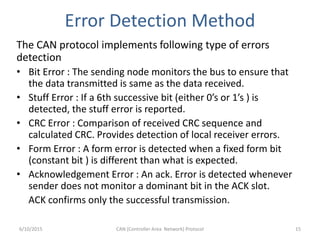
Error Detection Method
The CAN protocol implements following type of errors
detection
• Bit Error : The sending node monitors the bus to ensure that
the data transmitted is same as the data received.
• Stuff Error : If a 6th successive bit (either 0’s or 1’s ) is
detected, the stuff error is reported.
• CRC Error : Comparison of received CRC sequence and
calculated CRC. Provides detection of local receiver errors.
• Form Error : A form error is detected when a fixed form bit
(constant bit ) is different than what is expected.
• Acknowledgement Error : An ack. Error is detected whenever
sender does not monitor a dominant bit in the ACK slot.
ACK confirms only the successful transmission.
6/10/2015 CAN (Controller Area Network) Protocol 15
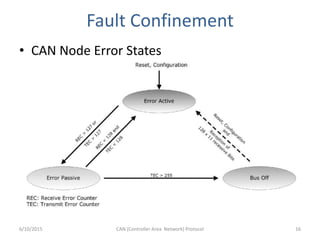
Fault Confinement
• CAN Node Error States
6/10/2015 CAN (Controller Area Network) Protocol 16
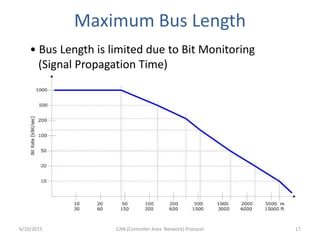
Maximum Bus Length
6/10/2015 CAN (Controller Area Network) Protocol 17
• Bus Length is limited due to Bit Monitoring
(Signal Propagation Time)
Conclusion
• Controller Area Networks applications are
emerging and gaining high ground in many
applications from automobile industry to
automation and factory industries.
• CAN is ideally suited in applications requiring a
large number of short messages with high
reliability in rugged operating environments
• it is especially well suited when data is needed by
more than one location and system-wide data
consistency is mandatory.
6/10/2015 CAN (Controller Area Network) Protocol 18
References
[1] Othman, H.F.; Aji, Y.R.; Fakhreddin, F.T.; Al-Ali, A.R. Controller
Area Networks: Evolution and Applications, 2nd Information and
Communication Technologies, 2006,vol. 2, pp. 3088 - 3093.
[2] Robert Bosch GmbH, “CAN Specification”, Version 2.0, 1991.
[3] Pazul, K. Controller Area Network (CAN) Basics, Microchip
Technology Inc, 1999.
[4] Steve Corrigan, Introduction to the Controller Area Network
(CAN), Texas Instrument, Application Report, 2008.
[5] Controller Area Network (CAN), LAN in vehicle communications
protocol, SAE JI583 Mar90, SEA Information Report, pg, 20, 226-248
6/10/2015 CAN (Controller Area Network) Protocol 19
THANK YOU
6/10/2015 CAN (Controller Area Network) Protocol 20

Ca npp t

  • 1.
    SIDDAGANGA INSTITUTE OFTECHNOLOGY “CAN (Controller Area Network ) Protocol” Technical seminar on Darshan K S 1SI12EC129 VII sem, EC ‘A’ Guided by Dr. R.KUMARASWAMY Professor & Head, Dept. of E&C 6/10/2015 CAN (Controller Area Network) Protocol 1
  • 2.
    Outline 1. What/Why CAN? 2. CAN bus introduction 3. Overview of CAN 4. CAN Application / Bus level 5. Message Frames 6. Error Handling / Fault confinement 7. Bit Stuffing 8. References 6/10/2015 CAN (Controller Area Network) Protocol 2
  • 3.
    Why CAN ? 6/10/2015CAN (Controller Area Network) Protocol 3 • Wiring-reduction, Cost reduction with CAN. Figure 1 Figure 2
  • 4.
    What CAN ? 6/10/2015CAN (Controller Area Network) Protocol 4 • CAN is a multi-master serial bus that allows an efficient transmission of data between different nodes. With its flexibility and robustness against electrical interferences
  • 5.
    CAN Node Consistsof … 6/10/2015 CAN (Controller Area Network) Protocol 5 • Host Processor • CAN Controller • CAN Transceiver
  • 6.
    CAN bus introduction •Controller Area Network (CAN) • Originally developed by Robert Bosch for automobile in- vehicle network • CAN bus provides communication between controllers, sensors, and actuators. • Very reliable and robust well proven technology 6/10/2015 CAN (Controller Area Network) Protocol 6
  • 7.
    Overview of CAN •Multi drop, multi-Master Bus Access • Message Broadcasting • Message Priority (No Node IDs) • Limited Data Length (0…8 bytes) • 1 Mbit/sec Data Rate • Excellent Error Detection & Fault Confinement 6/10/2015 CAN (Controller Area Network) Protocol 7
  • 8.
    CAN Application • Automotive •Military vehicles • Industrial machinery • Medical systems • Agricultural machinery • Marine control and navigation • Elevator control systems 6/10/2015 CAN (Controller Area Network) Protocol 8
  • 9.
    Bus Level 6/10/2015 CAN(Controller Area Network) Protocol 9 0 - Dominant bit 1 - Recessive bit
  • 10.
    Bus Level 6/10/2015 CAN(Controller Area Network) Protocol 10
  • 11.
    Message Frame Format •There are two types of CAN implementations depending on the size of the identifier field 1. Standard CAN Frame format :(11 bit wide identifier field) 6/10/2015 CAN (Controller Area Network) Protocol 11
  • 12.
    Message Frame Format 2.Extended CAN Frame format : (29-bit wide identifier field) 6/10/2015 CAN (Controller Area Network) Protocol 12 CAN Base frame format with the addition of : • Substitute remote request (SRR) • Identifier extension (IDE) • r1 – reserve bit
  • 13.
    Bus Arbitration Principle 6/10/2015CAN (Controller Area Network) Protocol 13 • Bit wise arbitration across the Arbitration Field • Dominant Bus Level = 0, Recessive Bus Level = 1
  • 14.
    Message Frames 6/10/2015 CAN(Controller Area Network) Protocol 14 • Data Frame – Broadcasts a message to the CAN bus • Remote Frame – Requests transmission of message • Error Frame – Signals error condition • Overload Frame – Special Error Frame
  • 15.
    Error Detection Method TheCAN protocol implements following type of errors detection • Bit Error : The sending node monitors the bus to ensure that the data transmitted is same as the data received. • Stuff Error : If a 6th successive bit (either 0’s or 1’s ) is detected, the stuff error is reported. • CRC Error : Comparison of received CRC sequence and calculated CRC. Provides detection of local receiver errors. • Form Error : A form error is detected when a fixed form bit (constant bit ) is different than what is expected. • Acknowledgement Error : An ack. Error is detected whenever sender does not monitor a dominant bit in the ACK slot. ACK confirms only the successful transmission. 6/10/2015 CAN (Controller Area Network) Protocol 15
  • 16.
    Fault Confinement • CANNode Error States 6/10/2015 CAN (Controller Area Network) Protocol 16
  • 17.
    Maximum Bus Length 6/10/2015CAN (Controller Area Network) Protocol 17 • Bus Length is limited due to Bit Monitoring (Signal Propagation Time)
  • 18.
    Conclusion • Controller AreaNetworks applications are emerging and gaining high ground in many applications from automobile industry to automation and factory industries. • CAN is ideally suited in applications requiring a large number of short messages with high reliability in rugged operating environments • it is especially well suited when data is needed by more than one location and system-wide data consistency is mandatory. 6/10/2015 CAN (Controller Area Network) Protocol 18
  • 19.
    References [1] Othman, H.F.;Aji, Y.R.; Fakhreddin, F.T.; Al-Ali, A.R. Controller Area Networks: Evolution and Applications, 2nd Information and Communication Technologies, 2006,vol. 2, pp. 3088 - 3093. [2] Robert Bosch GmbH, “CAN Specification”, Version 2.0, 1991. [3] Pazul, K. Controller Area Network (CAN) Basics, Microchip Technology Inc, 1999. [4] Steve Corrigan, Introduction to the Controller Area Network (CAN), Texas Instrument, Application Report, 2008. [5] Controller Area Network (CAN), LAN in vehicle communications protocol, SAE JI583 Mar90, SEA Information Report, pg, 20, 226-248 6/10/2015 CAN (Controller Area Network) Protocol 19
  • 20.
    THANK YOU 6/10/2015 CAN(Controller Area Network) Protocol 20