8
 Functions of Several Variables
 Partial Derivatives
 Maxima and Minima of Functions of
Several Variables
 The Method of Least Squares
 Constrained Maxima and Minima and
the Method of Lagrange Multipliers
 Double Integrals
Calculus of Several Variables
8.1
Functions of Several Variables
z
y
x
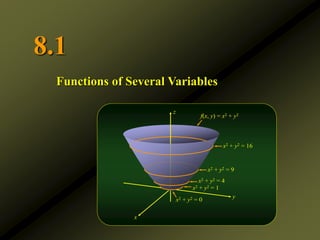
f(x, y) = x2 + y2
x2 + y2 = 0
x2 + y2 = 1
x2 + y2 = 4
x2 + y2 = 9
x2 + y2 = 16
Functions of Two Variables
A real-valued function of two variables f, consists of
1. A set A of ordered pairs of real numbers (x, y)
called the domain of the function.
2. A rule that associates with each ordered pair in
the domain of f one and only one real number,
denoted by z = f(x, y).
Examples
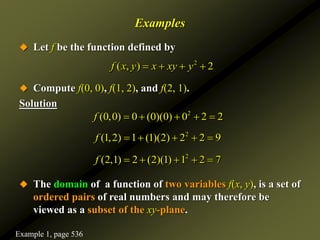
 Let f be the function defined by
 Compute f(0, 0), f(1, 2), and f(2, 1).
Solution
 The domain of a function of two variables f(x, y), is a set of
ordered pairs of real numbers and may therefore be
viewed as a subset of the xy-plane.
2
( , ) 2
f x y x xy y
   
2
(0,0) 0 (0)(0) 0 2 2
f     
2
(1,2) 1 (1)(2) 2 2 9
f     
2
(2,1) 2 (2)(1) 1 2 7
f     
Example 1, page 536
Examples
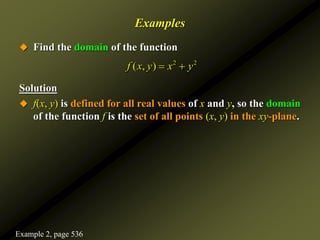
 Find the domain of the function
Solution
 f(x, y) is defined for all real values of x and y, so the domain
of the function f is the set of all points (x, y) in the xy-plane.
2 2
( , )
f x y x y
 
Example 2, page 536
Examples
 Find the domain of the function
Solution
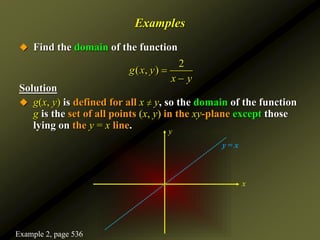
 g(x, y) is defined for all x ≠ y, so the domain of the function
g is the set of all points (x, y) in the xy-plane except those
lying on the y = x line.
2
( , )
g x y
x y


x
y
y = x
Example 2, page 536
Examples
 Find the domain of the function
Solution
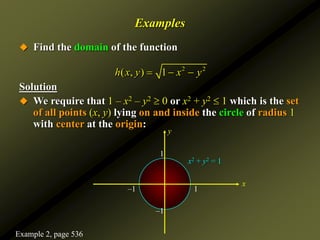
 We require that 1 – x2 – y2  0 or x2 + y2  1 which is the set
of all points (x, y) lying on and inside the circle of radius 1
with center at the origin:
2 2
( , ) 1
h x y x y
  
x
y
x2 + y2 = 1
–1 1
1
–1
Example 2, page 536
Applied Example: Revenue Functions
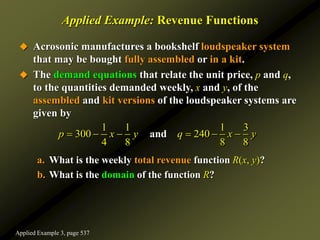
 Acrosonic manufactures a bookshelf loudspeaker system
that may be bought fully assembled or in a kit.
 The demand equations that relate the unit price, p and q,
to the quantities demanded weekly, x and y, of the
assembled and kit versions of the loudspeaker systems are
given by
a. What is the weekly total revenue function R(x, y)?
b. What is the domain of the function R?
1 1 1 3
300 240
4 8 8 8
and
p x y q x y
     
Applied Example 3, page 537
Applied Example: Revenue Functions
Solution
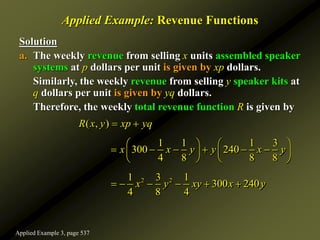
a. The weekly revenue from selling x units assembled speaker
systems at p dollars per unit is given by xp dollars.
Similarly, the weekly revenue from selling y speaker kits at
q dollars per unit is given by yq dollars.
Therefore, the weekly total revenue function R is given by
( , )
R x y xp yq
 
1 1 1 3
300 240
4 8 8 8
x x y y x y
   
     
   
   
2 2
1 3 1
300 240
4 8 4
x y xy x y
     
Applied Example 3, page 537
1000 2000
Applied Example: Revenue Functions
Solution
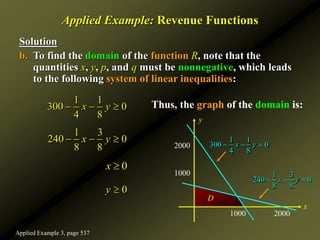
b. To find the domain of the function R, note that the
quantities x, y, p, and q must be nonnegative, which leads
to the following system of linear inequalities:
1 1
300 0
4 8
x y
  
1 3
240 0
8 8
x y
  
0
y 
0
x 
Thus, the graph of the domain is:
x
y
2000
1000
1 1
300 0
4 8
x y
  
1 3
240 0
8 8
x y
  
D
Applied Example 3, page 537
P(1, 2, 3)
Graphs of Functions of Two Variables
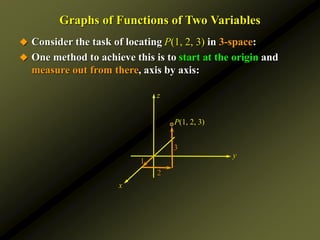
 Consider the task of locating P(1, 2, 3) in 3-space:
 One method to achieve this is to start at the origin and
measure out from there, axis by axis:
y
x
1
2
3
z
P(1, 2, 3)
Graphs of Functions of Two Variables
(1, 2)
y
z
x
1
2
3
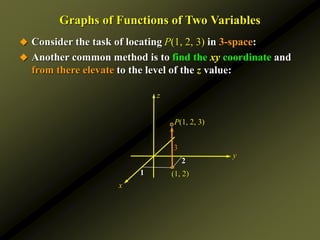
 Consider the task of locating P(1, 2, 3) in 3-space:
 Another common method is to find the xy coordinate and
from there elevate to the level of the z value:
Q(–1, 2, 3)
Graphs of Functions of Two Variables
y
x
3
R(1, 2, –2)
–2
S(1, –1, 0)
z
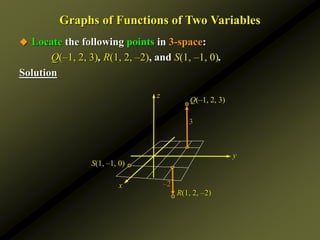
 Locate the following points in 3-space:
Q(–1, 2, 3), R(1, 2, –2), and S(1, –1, 0).
Solution
Graphs of Functions of Two Variables
(x, y)
(x, y, z)
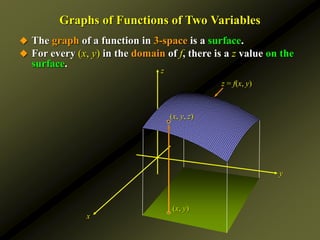
 The graph of a function in 3-space is a surface.
 For every (x, y) in the domain of f, there is a z value on the
surface.
z
y
x
z = f(x, y)
Level Curves
 The graph of a function of two variables is often difficult
to sketch.
 It can therefore be useful to apply the method used to
construct topographic maps.
 This method is relatively easy to apply and conveys
sufficient information to enable one to obtain a feel for the
graph of the function.
z
y
x
 In the 3-space graph we just saw, we can delineate the
contour of the graph as it is cut by a z = c plane:
Level Curves
z = c
f(x, y) = c
z = f(x, y)
z
y
x
Examples
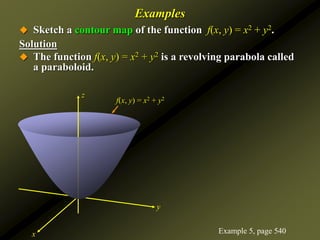
 Sketch a contour map of the function f(x, y) = x2 + y2.
Solution
 The function f(x, y) = x2 + y2 is a revolving parabola called
a paraboloid.
f(x, y) = x2 + y2
Example 5, page 540
– 4 – 2 2 4
4
2
– 2
– 4
z
y
x
Examples
 Sketch a contour map of the function f(x, y) = x2 + y2.
Solution
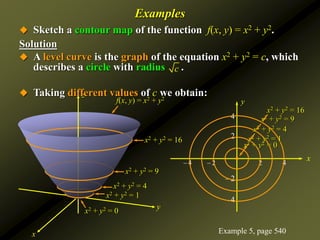
 A level curve is the graph of the equation x2 + y2 = c, which
describes a circle with radius .
 Taking different values of c we obtain:
y
x
f(x, y) = x2 + y2
x2 + y2 = 0
x2 + y2 = 1
x2 + y2 = 4
x2 + y2 = 9
x2 + y2 = 16
x2 + y2 = 0
x2 + y2 = 1
x2 + y2 = 4
x2 + y2 = 9
x2 + y2 = 16
c
Example 5, page 540
– 2 – 1 1 2
4
3
2
1
0
– 1
– 2
Examples
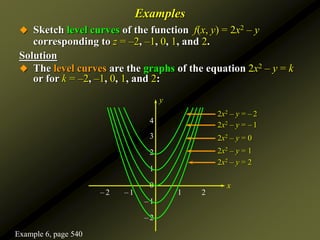
 Sketch level curves of the function f(x, y) = 2x2 – y
corresponding to z = –2, –1, 0, 1, and 2.
Solution
 The level curves are the graphs of the equation 2x2 – y = k
or for k = –2, –1, 0, 1, and 2:
y
x
2x2 – y = – 2
2x2 – y = – 1
2x2 – y = 0
2x2 – y = 1
2x2 – y = 2
Example 6, page 540
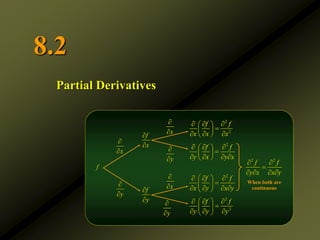
8.2
Partial Derivatives
f
f
x

x


y

y


f
x


f
x


f
y


f
y


x

x


y

y


2
f f
x y x y
 
  

 
   
 
2
f f
x y x y
 
  

 
   
 
2
2
f f
y y y
 
  

 
  
 
2
2
f f
y y y
 
  

 
  
 
x

x


y

y


2
2
f f
x x x
  
 

 
  
 
2
2
f f
x x x
  
 

 
  
 
2
f f
y x y x
  
 

 
   
 
2
f f
y x y x
  
 

 
   
  2 2
f f
y x x y
 

   
2 2
f f
y x x y
 

   
When both are
continuous
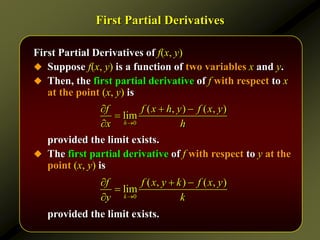
First Partial Derivatives
First Partial Derivatives of f(x, y)
 Suppose f(x, y) is a function of two variables x and y.
 Then, the first partial derivative of f with respect to x
at the point (x, y) is
provided the limit exists.
 The first partial derivative of f with respect to y at the
point (x, y) is
provided the limit exists.
0
( , ) ( , )
lim
h
f f x h y f x y
x h

  


0
( , ) ( , )
lim
k
f f x y k f x y
y k

  


x
y
f
x


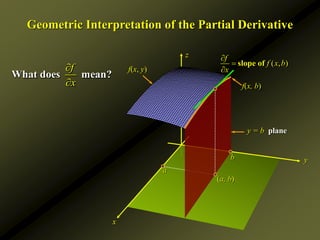
What does mean?
Geometric Interpretation of the Partial Derivative
z
f(x, y)
z
Geometric Interpretation of the Partial Derivative
f(x, y)
y = b plane
a
x
y
b
(a, b)
( , )
f
f x b
x



slope of
f(x, b)
f
x


What does mean?
z
x
y
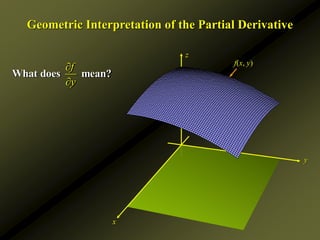
What does ean?
m
f
y


Geometric Interpretation of the Partial Derivative
f(x, y)
x
y
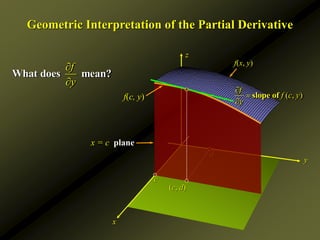
Geometric Interpretation of the Partial Derivative
f(x, y)
c
(c, d)
x = c plane
f(c, y) ( , )
slope of
f
f c y
y



What does ean?
m
f
y


z
d
Examples
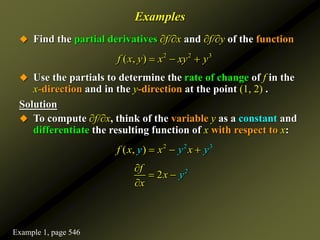
 Find the partial derivatives ∂f/∂x and ∂f/∂y of the function
 Use the partials to determine the rate of change of f in the
x-direction and in the y-direction at the point (1, 2) .
Solution
 To compute ∂f/∂x, think of the variable y as a constant and
differentiate the resulting function of x with respect to x:
2 2 3
( , )
f x y x xy y
  
2 2 3
( , )
f y
x y y
x x
  
2
2
f
x
y
x

 

Example 1, page 546
Examples
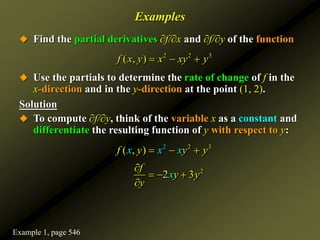
 Find the partial derivatives ∂f/∂x and ∂f/∂y of the function
 Use the partials to determine the rate of change of f in the
x-direction and in the y-direction at the point (1, 2).
Solution
 To compute ∂f/∂y, think of the variable x as a constant and
differentiate the resulting function of y with respect to y:
2 2 3
( , )
f x y x xy y
  
2 2 3
( , )
f y y y
x x x
  
2
2 3
x
f
y y
y

  

Example 1, page 546
Examples
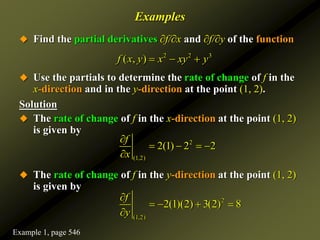
 Find the partial derivatives ∂f/∂x and ∂f/∂y of the function
 Use the partials to determine the rate of change of f in the
x-direction and in the y-direction at the point (1, 2).
Solution
 The rate of change of f in the x-direction at the point (1, 2)
is given by
 The rate of change of f in the y-direction at the point (1, 2)
is given by
2 2 3
( , )
f x y x xy y
  
2
(1,2)
2(1) 2 2
f
x

   

2
(1,2)
2(1)(2) 3(2) 8
f
y

   

Example 1, page 546
Examples
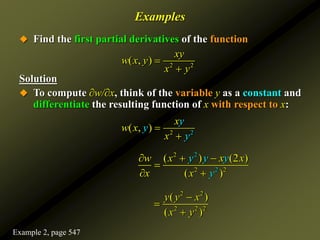
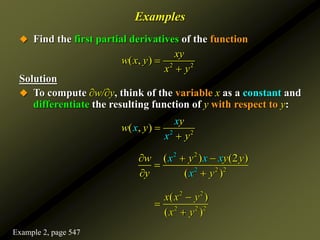
 Find the first partial derivatives of the function
Solution
 To compute ∂w/∂x, think of the variable y as a constant and
differentiate the resulting function of x with respect to x:
2 2
( , )
xy
w x y
x y


2 2
( , )
x
y
w
y
x
y
x 

2
2 2
2
2
( ) (2 )
( )
w x x x
x x
y y y
y
  

 
2 2
2 2 2
( )
( )
y y x
x y



Example 2, page 547
Examples
 Find the first partial derivatives of the function
Solution
 To compute ∂w/∂y, think of the variable x as a constant and
differentiate the resulting function of y with respect to y:
2 2
( , )
xy
w x y
x y


2 2
( , )
xy
w
y
x
y
x 

2 2
2 2
2
( ) (2 )
( )
x x x
x
w y y y
y y
  

 
2 2
2 2 2
( )
( )
x x y
x y



Example 2, page 547
Examples
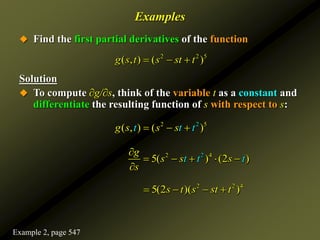
 Find the first partial derivatives of the function
Solution
 To compute ∂g/∂s, think of the variable t as a constant and
differentiate the resulting function of s with respect to s:
2 2 5
( , ) ( )
g s t s st t
  
2 2 5
( , ) ( )
g s t st
s t
  
2
2 4
5( ) (2 )
g
s st t t
s
s

    

2 2 4
5(2 )( )
s t s st t
   
Example 2, page 547
Examples
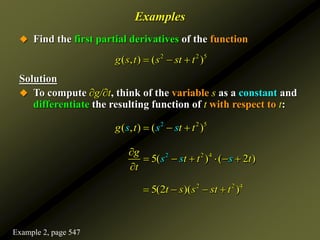
 Find the first partial derivatives of the function
Solution
 To compute ∂g/∂t, think of the variable s as a constant and
differentiate the resulting function of t with respect to t:
2 2 5
( , ) ( )
g s t s st t
  
2 2 5
( , ) ( )
g s t st
s t
  
4
2 2
5( ) ( 2 )
s s
g
t t
s
t
t

     

2 2 4
5(2 )( )
t s s st t
   
Example 2, page 547
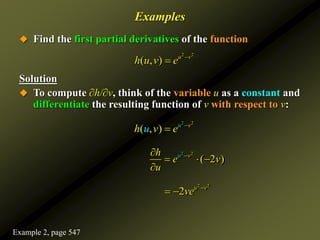
Examples
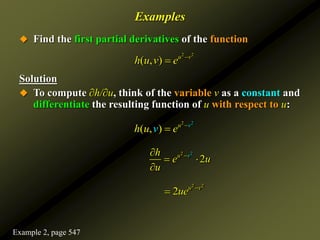
 Find the first partial derivatives of the function
Solution
 To compute ∂h/∂u, think of the variable v as a constant and
differentiate the resulting function of u with respect to u:
2 2
( , ) u v
h u v e 

2 2
( , ) u v
h e
v
u 

2 2
2
u v
h
e u
u


 

2 2
2 u v
ue 

Example 2, page 547
Examples
 Find the first partial derivatives of the function
Solution
 To compute ∂h/∂v, think of the variable u as a constant and
differentiate the resulting function of v with respect to v:
2 2
( , ) u v
h u v e 

2 2
( , ) u v
h v e
u 

2
2
( 2 )
v
u
h
e v
u


  

2 2
2 u v
ve 
 
Example 2, page 547
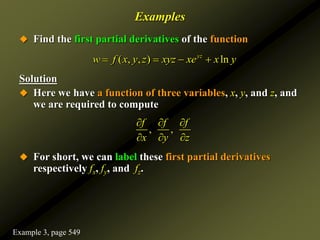
Examples
 Find the first partial derivatives of the function
Solution
 Here we have a function of three variables, x, y, and z, and
we are required to compute
 For short, we can label these first partial derivatives
respectively fx, fy, and fz.
( , , ) ln
yz
w f x y z xyz xe x y
   
, ,
f f f
x y z
  
  
Example 3, page 549
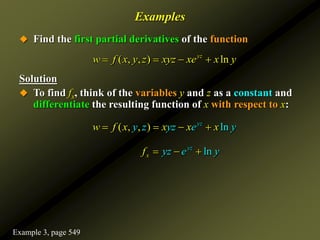
Examples
 Find the first partial derivatives of the function
Solution
 To find fx, think of the variables y and z as a constant and
differentiate the resulting function of x with respect to x:
( , , ) ln
yz
w f x y z xyz xe x y
   
( , ln
, ) yz
y z yz e
w y
f x x x x
   
ln
y
x
z
yz e
f y
  
Example 3, page 549
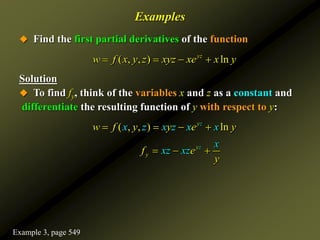
Examples
 Find the first partial derivatives of the function
Solution
 To find fy, think of the variables x and z as a constant and
differentiate the resulting function of y with respect to y:
( , , ) ln
yz
w f x y z xyz xe x y
   
( , , ) ln
yz
w f y y
x z x xe
z y
x
   
y
y
z x
xz xz
f e
y
  
Example 3, page 549
Examples
 Find the first partial derivatives of the function
Solution
 To find fz, think of the variables x and y as a constant and
differentiate the resulting function of z with respect to z:
( , , ) ln
yz
w f x y z xyz xe x y
   
( , ) ln
, z
y
x y xy
w f z y
z e
x x
   
z
y
z
f xy xye
 
Example 3, page 549
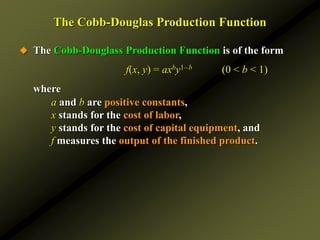
The Cobb-Douglas Production Function
 The Cobb-Douglass Production Function is of the form
f(x, y) = axby1–b (0 < b < 1)
where
a and b are positive constants,
x stands for the cost of labor,
y stands for the cost of capital equipment, and
f measures the output of the finished product.
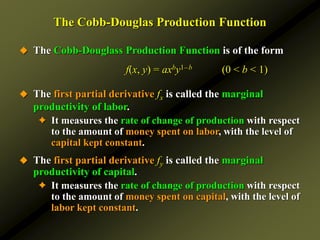
The Cobb-Douglas Production Function
 The Cobb-Douglass Production Function is of the form
f(x, y) = axby1–b (0 < b < 1)
 The first partial derivative fx is called the marginal
productivity of labor.
✦ It measures the rate of change of production with respect
to the amount of money spent on labor, with the level of
capital kept constant.
 The first partial derivative fy is called the marginal
productivity of capital.
✦ It measures the rate of change of production with respect
to the amount of money spent on capital, with the level of
labor kept constant.
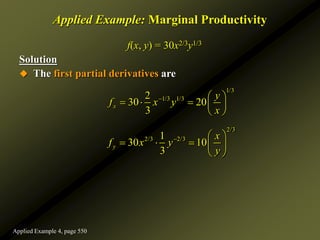
Applied Example: Marginal Productivity
 A certain country’s production in the early years following
World War II is described by the function
f(x, y) = 30x2/3y1/3
when x units of labor and y units of capital were used.
 Compute fx and fy.
 Find the marginal productivity of labor and the marginal
productivity of capital when the amount expended on
labor and capital was 125 units and 27 units, respectively.
 Should the government have encouraged capital
investment rather than increase expenditure on labor to
increase the country’s productivity?
Applied Example 4, page 550
Applied Example: Marginal Productivity
f(x, y) = 30x2/3y1/3
Solution
 The first partial derivatives are
1/3
1/3 1/3
2
30 20
3
x
y
f x y
x
  
    
 
2/3
2/3 2/3
1
30 10
3
y
x
f x y
y
  
    
 
Applied Example 4, page 550
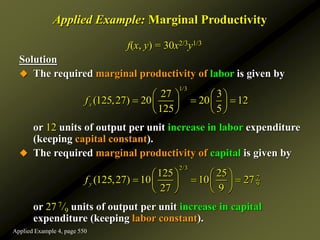
Applied Example: Marginal Productivity
f(x, y) = 30x2/3y1/3
Solution
 The required marginal productivity of labor is given by
or 12 units of output per unit increase in labor expenditure
(keeping capital constant).
 The required marginal productivity of capital is given by
or 27 7/9 units of output per unit increase in capital
expenditure (keeping labor constant).
1/3
27 3
(125,27) 20 20 12
125 5
x
f
   
  
   
   
2/3
7
9
125 25
(125,27) 10 10 27
27 9
y
f
   
  
   
   
Applied Example 4, page 550
Applied Example: Marginal Productivity
f(x, y) = 30x2/3y1/3
Solution
 The government should definitely have encouraged capital
investment.
 A unit increase in capital expenditure resulted in a much
faster increase in productivity than a unit increase in labor:
27 7/9 versus 12 per unit of investment, respectively.
Applied Example 4, page 550
Second Order Partial Derivatives
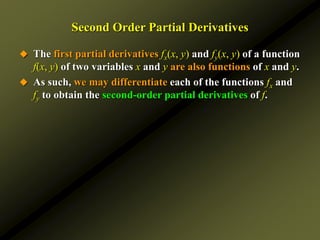
 The first partial derivatives fx(x, y) and fy(x, y) of a function
f(x, y) of two variables x and y are also functions of x and y.
 As such, we may differentiate each of the functions fx and
fy to obtain the second-order partial derivatives of f.
Second Order Partial Derivatives
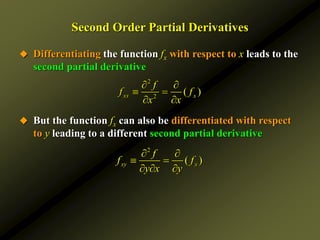
 Differentiating the function fx with respect to x leads to the
second partial derivative
 But the function fx can also be differentiated with respect
to y leading to a different second partial derivative
2
2
( )
xx x
f
f f
x x
 
 
 
2
( )
xy x
f
f f
y x y
 
 
  
Second Order Partial Derivatives
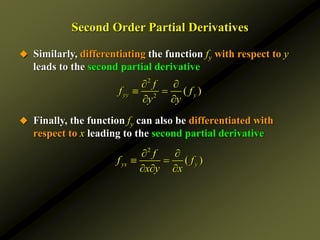
 Similarly, differentiating the function fy with respect to y
leads to the second partial derivative
 Finally, the function fy can also be differentiated with
respect to x leading to the second partial derivative
2
2
( )
yy y
f
f f
y y
 
 
 
2
( )
yx y
f
f f
x y x
 
 
  
Second Order Partial Derivatives
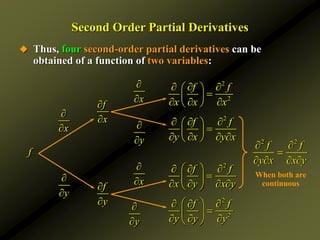
 Thus, four second-order partial derivatives can be
obtained of a function of two variables:
f
x


y


f
x


f
y


x


y


2
f f
x y x y
 
  

 
   
 
2
2
f f
y y y
 
  

 
  
 
x


y


2
2
f f
x x x
  
 

 
  
 
2
f f
y x y x
  
 

 
   
  2 2
f f
y x x y
 

   
When both are
continuous
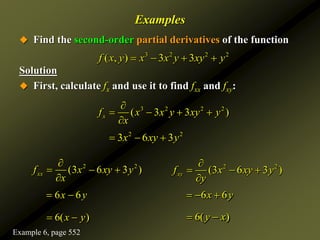
Examples
 Find the second-order partial derivatives of the function
Solution
 First, calculate fx and use it to find fxx and fxy:
3 2 2 2
( , ) 3 3
f x y x x y xy y
   
2 2
3 6 3
x xy y
  
3 2 2 2
( 3 3 )
x
f x x y xy y
x

   

2 2
(3 6 3 )
xx
f x xy y
x

  

6 6
x y
 
2 2
(3 6 3 )
xy
f x xy y
y

  

6 6
x y
  
6( )
x y
  6( )
y x
 
Example 6, page 552
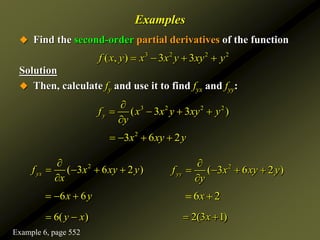
Examples
 Find the second-order partial derivatives of the function
Solution
 Then, calculate fy and use it to find fyx and fyy:
3 2 2 2
( , ) 3 3
f x y x x y xy y
   
2
3 6 2
x xy y
   
3 2 2 2
( 3 3 )
y
f x x y xy y
y

   

2
( 3 6 2 )
yx
f x xy y
x

   

6 6
x y
  
2
( 3 6 2 )
yy
f x xy y
y

   

6 2
x
 
6( )
y x
  2(3 1)
x
 
Example 6, page 552
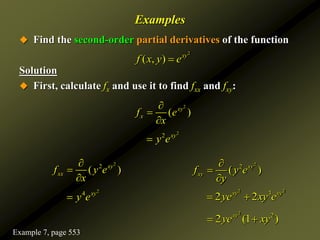
Examples
 Find the second-order partial derivatives of the function
Solution
 First, calculate fx and use it to find fxx and fxy:
2
( , ) xy
f x y e

2
2 xy
y e

2
( )
xy
x
f e
x



2
2
( )
xy
xx
f y e
x



2
4 xy
y e

2
2
( )
xy
xy
f y e
y



2 2
3
2 2
xy xy
ye xy e
 
2
2
2 (1 )
xy
ye xy
 
Example 7, page 553
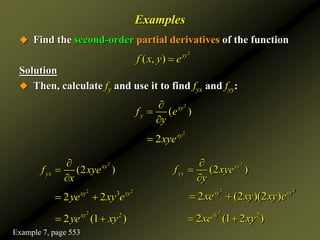
Examples
 Find the second-order partial derivatives of the function
Solution
 Then, calculate fy and use it to find fyx and fyy:
2
( , ) xy
f x y e

2
2 xy
xye

2
( )
xy
y
f e
y



2
(2 )
xy
yx
f xye
x



2 2
3
2 2
xy xy
ye xy e
 
2
(2 )
xy
yy
f xye
y



2 2
2 (2 )(2 )
xy xy
xe xy xy e
 
2
2
2 (1 2 )
xy
xe xy
 
2
2
2 (1 )
xy
ye xy
 
Example 7, page 553
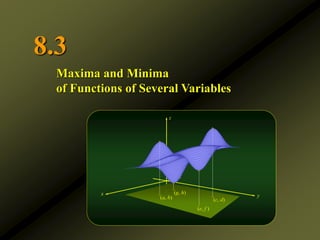
8.3
Maxima and Minima
of Functions of Several Variables
y
x
z
(a, b) (c, d)
(e, f )
(g, h)
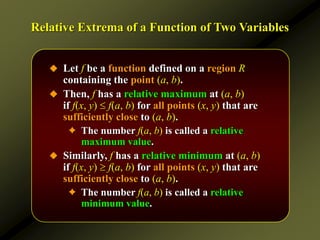
Relative Extrema of a Function of Two Variables
 Let f be a function defined on a region R
containing the point (a, b).
 Then, f has a relative maximum at (a, b)
if f(x, y)  f(a, b) for all points (x, y) that are
sufficiently close to (a, b).
✦ The number f(a, b) is called a relative
maximum value.
 Similarly, f has a relative minimum at (a, b)
if f(x, y)  f(a, b) for all points (x, y) that are
sufficiently close to (a, b).
✦ The number f(a, b) is called a relative
minimum value.
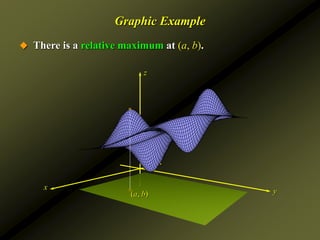
y
x
z
(a, b)
 There is a relative maximum at (a, b).
Graphic Example
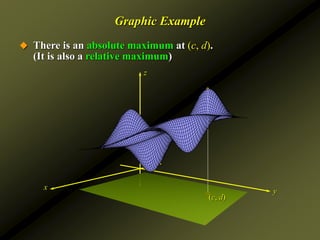
y
x
z
(c, d)
 There is an absolute maximum at (c, d).
(It is also a relative maximum)
Graphic Example
y
x
z
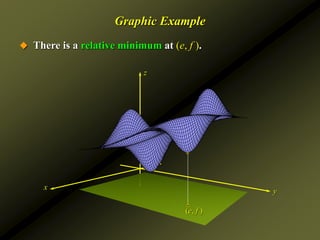
(e, f )
 There is a relative minimum at (e, f ).
Graphic Example
y
x
z
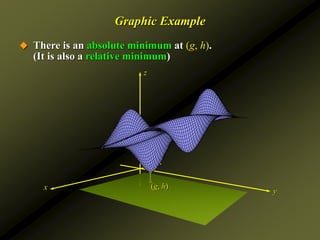
(g, h)
 There is an absolute minimum at (g, h).
(It is also a relative minimum)
Graphic Example
z
y
x
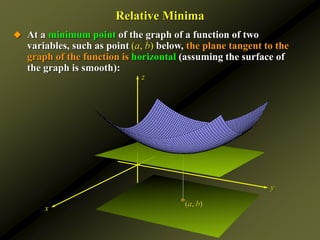
 At a minimum point of the graph of a function of two
variables, such as point (a, b) below, the plane tangent to the
graph of the function is horizontal (assuming the surface of
the graph is smooth):
Relative Minima
(a, b)
z
y
x
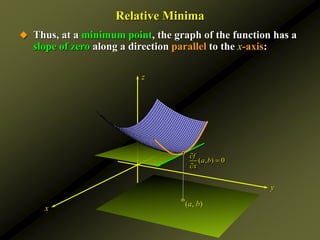
 Thus, at a minimum point, the graph of the function has a
slope of zero along a direction parallel to the x-axis:
Relative Minima
( , ) 0
f
a b
x



(a, b)
z
y
x
( , ) 0
f
a b
y



(a, b)
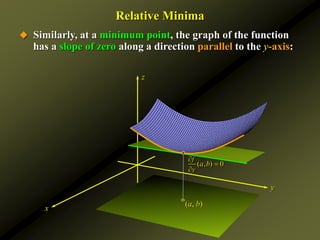
 Similarly, at a minimum point, the graph of the function
has a slope of zero along a direction parallel to the y-axis:
Relative Minima
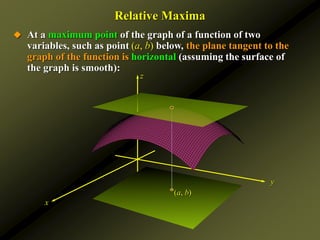
 At a maximum point of the graph of a function of two
variables, such as point (a, b) below, the plane tangent to the
graph of the function is horizontal (assuming the surface of
the graph is smooth):
y
x
Relative Maxima
z
(a, b)
z
y
x
Relative Maxima
(a, b)
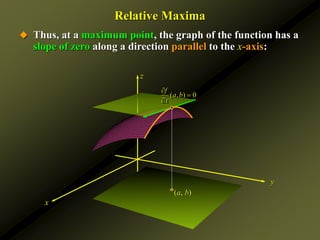
 Thus, at a maximum point, the graph of the function has a
slope of zero along a direction parallel to the x-axis:
( , ) 0
f
a b
x



z
y
x
Relative Maxima
(a, b)
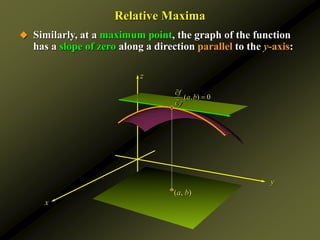
 Similarly, at a maximum point, the graph of the function
has a slope of zero along a direction parallel to the y-axis:
( , ) 0
f
a b
y



x
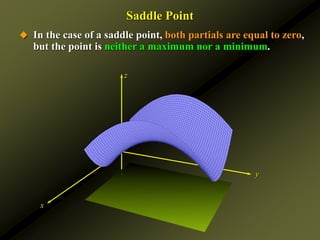
Saddle Point
 In the case of a saddle point, both partials are equal to zero,
but the point is neither a maximum nor a minimum.
y
z
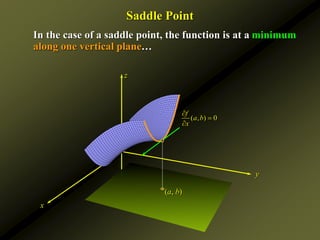
In the case of a saddle point, the function is at a minimum
along one vertical plane…
x
Saddle Point
y
z
(a, b)
( , ) 0
f
a b
x



z
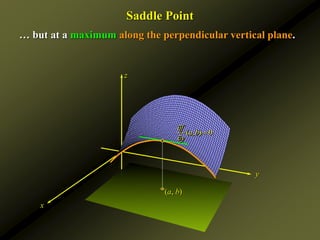
… but at a maximum along the perpendicular vertical plane.
x
Saddle Point
y
(a, b)
( , ) 0
f
a b
y



(a, b)
z
y
x
(a, b, f(a, b))
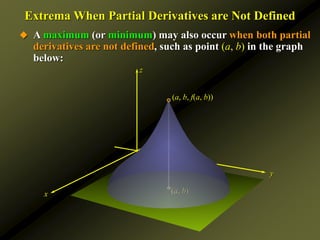
Extrema When Partial Derivatives are Not Defined
 A maximum (or minimum) may also occur when both partial
derivatives are not defined, such as point (a, b) in the graph
below:
Critical Point of a Function
 A critical point of f is a point (a, b) in the domain of f
such that both
or at least one of the partial derivatives does not exist.
( , ) 0 ( , ) 0
and
f f
a b a b
x y
 
 
 
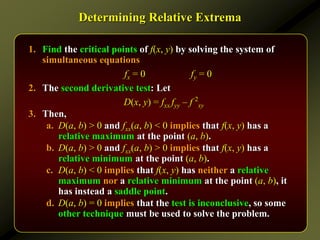
Determining Relative Extrema
1. Find the critical points of f(x, y) by solving the system of
simultaneous equations
fx = 0 fy = 0
2. The second derivative test: Let
D(x, y) = fxx fyy – f 2
xy
3. Then,
a. D(a, b) > 0 and fxx(a, b) < 0 implies that f(x, y) has a
relative maximum at the point (a, b).
b. D(a, b) > 0 and fxx(a, b) > 0 implies that f(x, y) has a
relative minimum at the point (a, b).
c. D(a, b) < 0 implies that f(x, y) has neither a relative
maximum nor a relative minimum at the point (a, b), it
has instead a saddle point.
d. D(a, b) = 0 implies that the test is inconclusive, so some
other technique must be used to solve the problem.
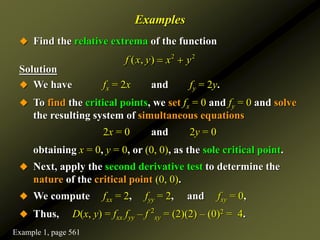
Examples
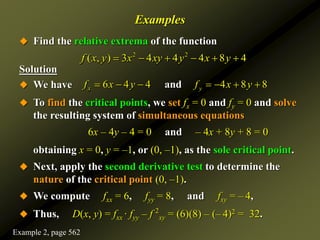
 Find the relative extrema of the function
Solution
 We have fx = 2x and fy = 2y.
 To find the critical points, we set fx = 0 and fy = 0 and solve
the resulting system of simultaneous equations
2x = 0 and 2y = 0
obtaining x = 0, y = 0, or (0, 0), as the sole critical point.
 Next, apply the second derivative test to determine the
nature of the critical point (0, 0).
 We compute fxx = 2, fyy = 2, and fxy = 0,
 Thus, D(x, y) = fxx fyy – f 2
xy = (2)(2) – (0)2 = 4.
2 2
( , )
f x y x y
 
Example 1, page 561
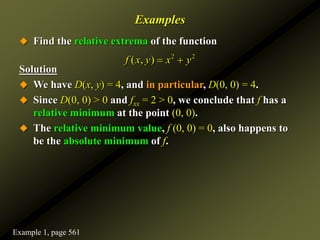
Examples
 Find the relative extrema of the function
Solution
 We have D(x, y) = 4, and in particular, D(0, 0) = 4.
 Since D(0, 0) > 0 and fxx = 2 > 0, we conclude that f has a
relative minimum at the point (0, 0).
 The relative minimum value, f (0, 0) = 0, also happens to
be the absolute minimum of f.
2 2
( , )
f x y x y
 
Example 1, page 561
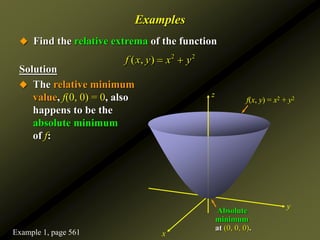
Examples
 Find the relative extrema of the function
Solution
2 2
( , )
f x y x y
 
 The relative minimum
value, f(0, 0) = 0, also
happens to be the
absolute minimum
of f:
z
y
x
f(x, y) = x2 + y2
Absolute
minimum
at (0, 0, 0).
Example 1, page 561
Examples
 Find the relative extrema of the function
Solution
 We have
 To find the critical points, we set fx = 0 and fy = 0 and solve
the resulting system of simultaneous equations
6x – 4y – 4 = 0 and – 4x + 8y + 8 = 0
obtaining x = 0, y = –1, or (0, –1), as the sole critical point.
 Next, apply the second derivative test to determine the
nature of the critical point (0, –1).
 We compute fxx = 6, fyy = 8, and fxy = – 4,
 Thus, D(x, y) = fxx · fyy – f 2
xy = (6)(8) – (– 4)2 = 32.
2 2
( , ) 3 4 4 4 8 4
f x y x xy y x y
     
6 4 4 4 8 8
and
x y
f x y f x y
      
Example 2, page 562
Examples
 Find the relative extrema of the function
Solution
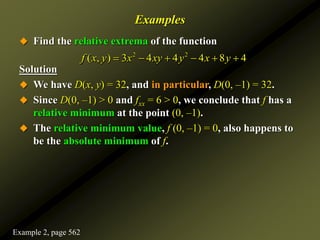
 We have D(x, y) = 32, and in particular, D(0, –1) = 32.
 Since D(0, –1) > 0 and fxx = 6 > 0, we conclude that f has a
relative minimum at the point (0, –1).
 The relative minimum value, f (0, –1) = 0, also happens to
be the absolute minimum of f.
2 2
( , ) 3 4 4 4 8 4
f x y x xy y x y
     
Example 2, page 562
Examples
 Find the relative extrema of the function
Solution
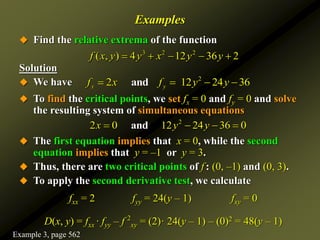
 We have
 To find the critical points, we set fx = 0 and fy = 0 and solve
the resulting system of simultaneous equations
 The first equation implies that x = 0, while the second
equation implies that y = –1 or y = 3.
 Thus, there are two critical points of f : (0, –1) and (0, 3).
 To apply the second derivative test, we calculate
fxx = 2 fyy = 24(y – 1) fxy = 0
D(x, y) = fxx · fyy – f 2
xy = (2)· 24(y – 1) – (0)2 = 48(y – 1)
3 2 2
( , ) 4 12 36 2
f x y y x y y
    
2
2 12 24 36
and
x y
f x f y y
   
2
2 0 12 24 36 0
nd
a
x y y
   
Example 3, page 562
Examples
 Find the relative extrema of the function
Solution
 Apply the second derivative test to the critical point (0, –1):
 We have D(x, y) = 48(y – 1).
 In particular, D(0, –1) = 48[(–1) – 1] = – 96.
 Since D(0, –1) = – 96 < 0 we conclude that f has a saddle
point at (0, –1).
 The saddle point value is f (0, –1) = 22, so there is a saddle
point at (0, –1, 22).
3 2 2
( , ) 4 12 36 2
f x y y x y y
    
Example 3, page 562
Examples
 Find the relative extrema of the function
Solution
 Apply the second derivative test to the critical point (0, 3):
 We have D(x, y) = 48(y – 1).
 In particular, D(0, 3) = 48[(3) – 1] = 96.
 Since D(0, –1) = 96 > 0 and fxx (0, 3) = 2 > 0, we conclude that
f has a relative minimum at the point (0, 3).
 The relative minimum value, f (0, 3) = –106, so there is a
relative minimum at (0, 3, –106).
3 2 2
( , ) 4 12 36 2
f x y y x y y
    
Example 3, page 562
Applied Example: Maximizing Profit
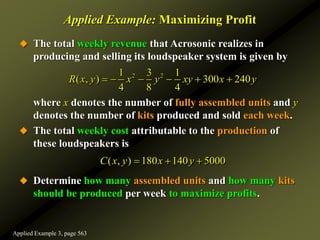
 The total weekly revenue that Acrosonic realizes in
producing and selling its loudspeaker system is given by
where x denotes the number of fully assembled units and y
denotes the number of kits produced and sold each week.
 The total weekly cost attributable to the production of
these loudspeakers is
 Determine how many assembled units and how many kits
should be produced per week to maximize profits.
2 2
1 3 1
( , ) 300 240
4 8 4
R x y x y xy x y
     
( , ) 180 140 5000
C x y x y
  
Applied Example 3, page 563
Applied Example: Maximizing Profit
Solution
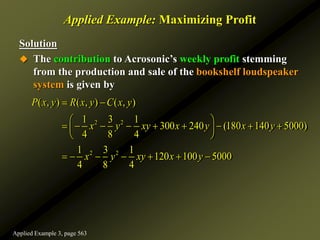
 The contribution to Acrosonic’s weekly profit stemming
from the production and sale of the bookshelf loudspeaker
system is given by
2 2
2 2
( , ) ( , ) ( , )
1 3 1
300 240 (180 140 5000)
4 8 4
1 3 1
120 100 5000
4 8 4
P x y R x y C x y
x y xy x y x y
x y xy x y
 
 
        
 
 
      
Applied Example 3, page 563
Applied Example: Maximizing Profit
Solution
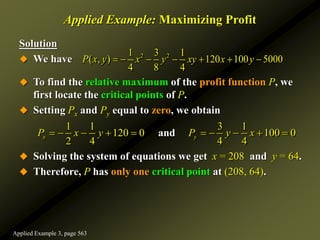
 We have
 To find the relative maximum of the profit function P, we
first locate the critical points of P.
 Setting Px and Py equal to zero, we obtain
 Solving the system of equations we get x = 208 and y = 64.
 Therefore, P has only one critical point at (208, 64).
2 2
1 3 1
( , ) 120 100 5000
4 8 4
P x y x y xy x y
      
1 1 3 1
120 0 100 0
2 4 4 4
and
x y
P x y P y x
         
Applied Example 3, page 563
Applied Example: Maximizing Profit
Solution
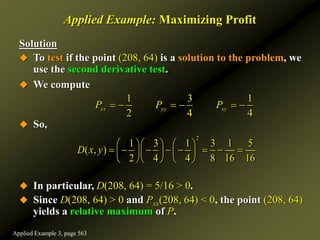
 To test if the point (208, 64) is a solution to the problem, we
use the second derivative test.
 We compute
 So,
 In particular, D(208, 64) = 5/16 > 0.
 Since D(208, 64) > 0 and Pxx(208, 64) < 0, the point (208, 64)
yields a relative maximum of P.
2
1 3 1 3 1 5
( , )
2 4 4 8 16 16
D x y
    
       
    
    
1 3 1
2 4 4
xx yy xy
P P P
     
Applied Example 3, page 563
Applied Example: Maximizing Profit
Solution
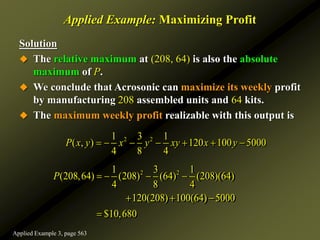
 The relative maximum at (208, 64) is also the absolute
maximum of P.
 We conclude that Acrosonic can maximize its weekly profit
by manufacturing 208 assembled units and 64 kits.
 The maximum weekly profit realizable with this output is
2 2
1 3 1
(208,64) (208) (64) (208)(64)
4 8 4
120(208) 100(64) 5000
$10,680
P    
  

2 2
1 3 1
( , ) 120 100 5000
4 8 4
P x y x y xy x y
      
Applied Example 3, page 563
8.4
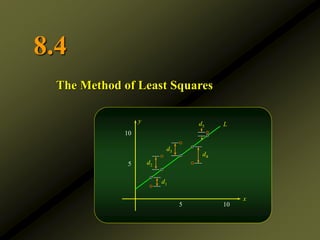
The Method of Least Squares
10
5
5 10
x
y
d4
d5
d3
d2
d1
L
10
5
5 10
The Method of Least Squares
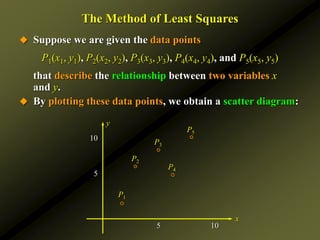
 Suppose we are given the data points
P1(x1, y1), P2(x2, y2), P3(x3, y3), P4(x4, y4), and P5(x5, y5)
that describe the relationship between two variables x
and y.
 By plotting these data points, we obtain a scatter diagram:
x
y
P1
P2
P3
P4
P5
10
5
5 10
The Method of Least Squares
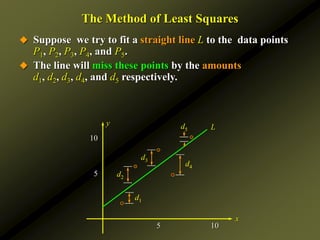
 Suppose we try to fit a straight line L to the data points
P1, P2, P3, P4, and P5.
 The line will miss these points by the amounts
d1, d2, d3, d4, and d5 respectively.
x
y L
d4
d5
d3
d2
d1
10
5
5 10
The Method of Least Squares
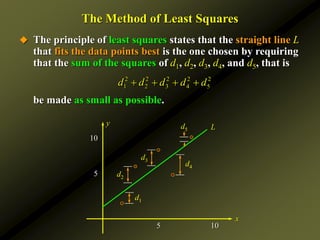
 The principle of least squares states that the straight line L
that fits the data points best is the one chosen by requiring
that the sum of the squares of d1, d2, d3, d4, and d5, that is
be made as small as possible.
x
y
2 2 2 2 2
1 2 3 4 5
d d d d d
   
L
d4
d5
d3
d2
d1
10
5
5 10
The Method of Least Squares
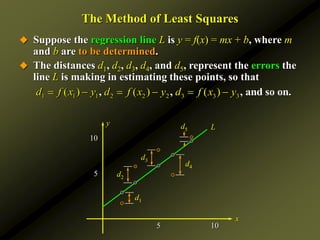
 Suppose the regression line L is y = f(x) = mx + b, where m
and b are to be determined.
 The distances d1, d2, d3, d4, and d5, represent the errors the
line L is making in estimating these points, so that
x
y
d4
d5
d3
d2
d1
L
1 1 1 2 2 2 3 3 3
( ) ( ) ( )
, , , and so on.
d f x y d f x y d f x y
     
The Method of Least Squares
 Observe that
 This may be viewed as a function of two variables m and b.
 Thus, the least-squares criterion is equivalent to minimizing
the function
2 2 2 2 2
1 2 3 4 5
d d d d d
   
2 2 2
1 1 2 2 3 3
2 2
4 4 5 5
[ ( ) ] [ ( ) ] [ ( ) ]
[ ( ) ] [ ( ) ]
f x y f x y f x y
f x y f x y
     
   
2 2 2
1 1 2 2 3 3
2 2
4 4 5 5
[ ] [ ] [ ]
[ ] [ ]
mx b y mx b y mx b y
mx b y mx b y
        
     
2 2 2
1 1 2 2 3 3
2 2
4 4 5 5
( , ) ( ) ( ) ( )
( ) ( )
f m b mx b y mx b y mx b y
mx b y mx b y
        
     
The Method of Least Squares
 We want to minimize
 We first find the partial derivative with respect to m:
1 1 1 2 2 2 3 3 3
4 4 4 5 5 5
2( ) 2( ) 2( )
2( ) 2( )
f
mx b y x mx b y x mx b y x
m
mx b y x mx b y x

        

     
2 2 2
1 1 1 1 2 2 2 2 3 3 3 3
2 2
4 4 4 4 5 5 5 5
2[
]
mx bx y x mx bx y x mx bx y x
mx bx y x mx bx y x
        
     
2 2 2 2 2
1 2 3 4 5 1 2 3 4 5
1 1 2 2 3 3 4 4 5 5
2[( ) ( )
( )]
x x x x x m x x x x x b
y x y x y x y x y x
         
    
2 2 2
1 1 2 2 3 3
2 2
4 4 5 5
( , ) ( ) ( ) ( )
( ) ( )
f m b mx b y mx b y mx b y
mx b y mx b y
        
     
The Method of Least Squares
 We want to minimize
 We now find the partial derivative with respect to b:
1 1 2 2 3 3
4 4 5 5
2( ) 2( ) 2( )
2( ) 2( )
f
mx b y mx b y mx b y
b
mx b y mx b y

        

     
1 2 3 4 5 1 2 3 4 5
2[( ) 5 ( )]
x x x x x m b y y y y y
          
2 2 2
1 1 2 2 3 3
2 2
4 4 5 5
( , ) ( ) ( ) ( )
( ) ( )
f m b mx b y mx b y mx b y
mx b y mx b y
        
     
The Method of Least Squares
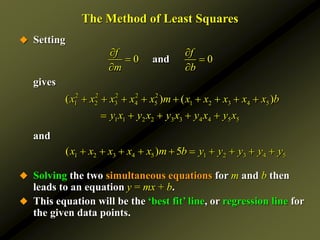
 Setting
gives
and
 Solving the two simultaneous equations for m and b then
leads to an equation y = mx + b.
 This equation will be the ‘best fit’ line, or regression line for
the given data points.
1 2 3 4 5 1 2 3 4 5
( ) 5
x x x x x m b y y y y y
         
0 0
and
f f
m b
 
 
 
2 2 2 2 2
1 2 3 4 5 1 2 3 4 5
1 1 2 2 3 3 4 4 5 5
( ) ( )
x x x x x m x x x x x b
y x y x y x y x y x
        
    
The Method of Least Squares
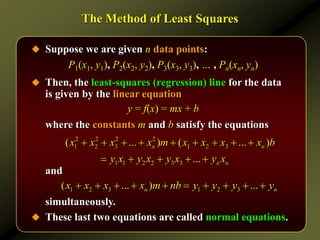
 Suppose we are given n data points:
P1(x1, y1), P2(x2, y2), P3(x3, y3), … , Pn(xn, yn)
 Then, the least-squares (regression) line for the data
is given by the linear equation
y = f(x) = mx + b
where the constants m and b satisfy the equations
and
simultaneously.
 These last two equations are called normal equations.
1 2 3 1 2 3
( ... ) ...
n n
x x x x m nb y y y y
         
2 2 2 2
1 2 3 1 2 3
1 1 2 2 3 3
( ... ) ( ... )
...
n n
n n
x x x x m x x x x b
y x y x y x y x
        
    
Example
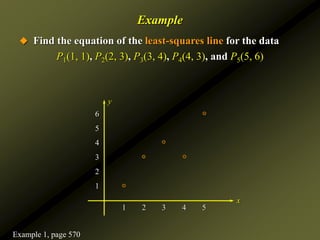
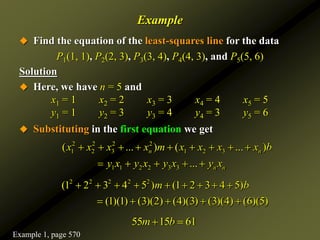
 Find the equation of the least-squares line for the data
P1(1, 1), P2(2, 3), P3(3, 4), P4(4, 3), and P5(5, 6)
6
5
4
3
2
1
1 2 3 4 5
x
y
Example 1, page 570
Example
 Find the equation of the least-squares line for the data
P1(1, 1), P2(2, 3), P3(3, 4), P4(4, 3), and P5(5, 6)
Solution
 Here, we have n = 5 and
x1 = 1 x2 = 2 x3 = 3 x4 = 4 x5 = 5
y1 = 1 y2 = 3 y3 = 4 y4 = 3 y5 = 6
 Substituting in the first equation we get
2 2 2 2
1 2 3 1 2 3
1 1 2 2 3 3
( ... ) ( ... )
...
n n
n n
x x x x m x x x x b
y x y x y x y x
        
    
2 2 2 2 2
(1 2 3 4 5 ) (1 2 3 4 5)
(1)(1) (3)(2) (4)(3) (3)(4) (6)(5)
m b
        
    
55 15 61
m b
 
Example 1, page 570
Example
 Find the equation of the least-squares line for the data
P1(1, 1), P2(2, 3), P3(3, 4), P4(4, 3), and P5(5, 6)
Solution
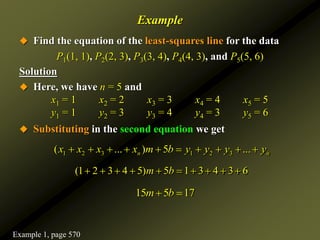
 Here, we have n = 5 and
x1 = 1 x2 = 2 x3 = 3 x4 = 4 x5 = 5
y1 = 1 y2 = 3 y3 = 4 y4 = 3 y5 = 6
 Substituting in the second equation we get
15 5 17
m b
 
1 2 3 1 2 3
( ... ) 5 ...
n n
x x x x m b y y y y
         
(1 2 3 4 5) 5 1 3 4 3 6
m b
         
Example 1, page 570
Example
 Find the equation of the least-squares line for the data
P1(1, 1), P2(2, 3), P3(3, 4), P4(4, 3), and P5(5, 6)
Solution
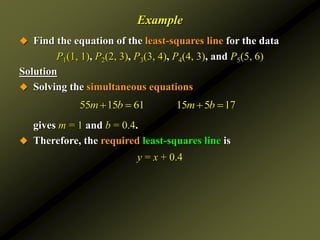
 Solving the simultaneous equations
gives m = 1 and b = 0.4.
 Therefore, the required least-squares line is
y = x + 0.4
15 5 17
m b
 
55 15 61
m b
 
Example
 Find the equation of the least-squares line for the data
P1(1, 1), P2(2, 3), P3(3, 4), P4(4, 3), and P5(5, 6)
Solution
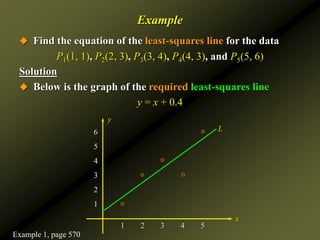
 Below is the graph of the required least-squares line
y = x + 0.4
6
5
4
3
2
1
1 2 3 4 5
x
y
L
Example 1, page 570
Applied Example: Maximizing Profit
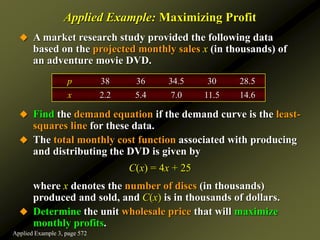
 A market research study provided the following data
based on the projected monthly sales x (in thousands) of
an adventure movie DVD.
 Find the demand equation if the demand curve is the least-
squares line for these data.
 The total monthly cost function associated with producing
and distributing the DVD is given by
C(x) = 4x + 25
where x denotes the number of discs (in thousands)
produced and sold, and C(x) is in thousands of dollars.
 Determine the unit wholesale price that will maximize
monthly profits.
p 38 36 34.5 30 28.5
x 2.2 5.4 7.0 11.5 14.6
Applied Example 3, page 572
Solution
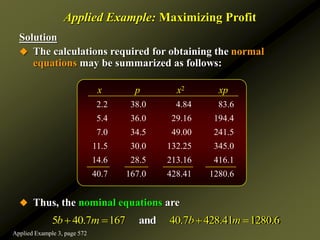
 The calculations required for obtaining the normal
equations may be summarized as follows:
 Thus, the nominal equations are
Applied Example: Maximizing Profit
x p x2 xp
2.2 38.0 4.84 83.6
5.4 36.0 29.16 194.4
7.0 34.5 49.00 241.5
11.5 30.0 132.25 345.0
14.6 28.5 213.16 416.1
40.7 167.0 428.41 1280.6
5 40.7 167 40.7 428.41 1280.6
and
b m b m
   
Applied Example 3, page 572
Solution
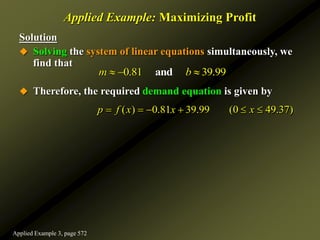
 Solving the system of linear equations simultaneously, we
find that
 Therefore, the required demand equation is given by
Applied Example: Maximizing Profit
0.81 39.99
and
m b
  
( ) 0.81 39.99 (0 49.37)
p f x x x
     
Applied Example 3, page 572
Solution
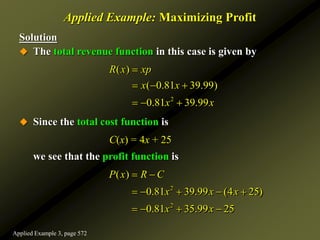
 The total revenue function in this case is given by
 Since the total cost function is
C(x) = 4x + 25
we see that the profit function is
Applied Example: Maximizing Profit
2
( )
( 0.81 39.99)
0.81 39.99
R x xp
x x
x x

  
  
2
2
( )
0.81 39.99 (4 25)
0.81 35.99 25
P x R C
x x x
x x
 
    
   
Applied Example 3, page 572
Solution
 To find the absolute maximum of P(x) over the closed
interval [0, 49.37], we compute
 Since P(x) = 0 , we find that x ≈ 22.22 as the only critical
point of P.
 Finally, from the table
we see that the optimal wholesale price is
or $21.99 per disc.
Applied Example: Maximizing Profit
( ) 1.62 35.99
P x x
   
x 0 22.22 49.37
P(x) –25 374.78 – 222.47
0.81(22.22) 39.99 21.99
p    
Applied Example 3, page 572
8.5
Constrained Maxima and Minima and
the Method of Lagrange Multipliers
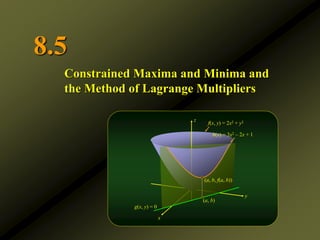
z
y
x
f(x, y) = 2x2 + y2
g(x, y) = 0
h(x) = 3x2 – 2x + 1
(a, b)
(a, b, f(a, b))
Constrained Maxima and Minima
 In many practical optimization problems, we must
maximize or minimize a function in which the independent
variables are subjected to certain further constraints.
 We shall discuss a powerful method for determining
relative extrema of a function f(x, y) whose independent
variables x and y are required to satisfy one or more
constraints of the form g(x, y) = 0.
Example
 Find the relative minimum of f(x, y) = 2x2 +y2 subject to
the constraint g(x, y) = x + y – 1 = 0.
Solution
 Solving the constraint equation for y explicitly in terms
of x, we obtain
y = – x + 1
 Substituting this value of y into f(x, y) results in a
function of x,
2 2 2
( ) 2 ( 1) 3 2 1
h x x x x x
      
Example 1, page 580
Example
 Find the relative minimum of f(x, y) = 2x2 +y2 subject to
the constraint g(x, y) = x + y – 1 = 0.
Solution
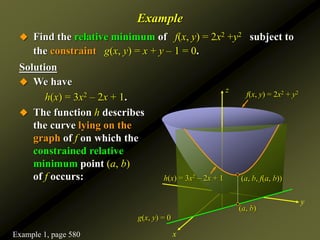
z
y
x
f(x, y) = 2x2 + y2
 We have
h(x) = 3x2 – 2x + 1.
 The function h describes
the curve lying on the
graph of f on which the
constrained relative
minimum point (a, b)
of f occurs:
g(x, y) = 0
h(x) = 3x2 – 2x + 1
(a, b)
(a, b, f(a, b))
Example 1, page 580
Example
 Find the relative minimum of f(x, y) = 2x2 +y2 subject to
the constraint g(x, y) = x + y – 1 = 0.
Solution
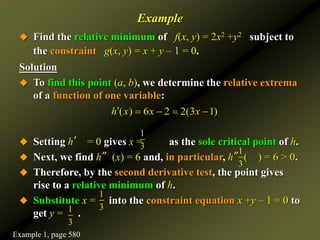
 To find this point (a, b), we determine the relative extrema
of a function of one variable:
 Setting h′ = 0 gives x = as the sole critical point of h.
 Next, we find h″(x) = 6 and, in particular, h″( ) = 6 > 0.
 Therefore, by the second derivative test, the point gives
rise to a relative minimum of h.
 Substitute x = into the constraint equation x +y – 1 = 0 to
get y = .
( ) 6 2 2(3 1)
h x x x
    
1
3
1
3
1
3
1
3
Example 1, page 580
Example
 Find the relative minimum of f(x, y) = 2x2 +y2 subject to
the constraint g(x, y) = x + y – 1 = 0.
Solution
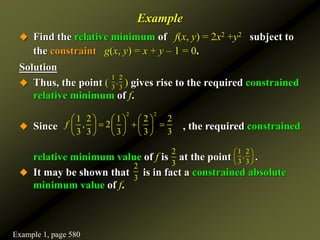
 Thus, the point ( ) gives rise to the required constrained
relative minimum of f.
 Since , the required constrained
relative minimum value of f is at the point .
 It may be shown that is in fact a constrained absolute
minimum value of f.
1 2
,
3 3
2 2
1 2 1 2 2
, 2
3 3 3 3 3
f
     
  
     
     
2
3
1 2
,
3 3
 
 
 
2
3
Example 1, page 580
The Method of Lagrange Multipliers
To find the relative extrema of the function f(x, y)
subject to the constraint g(x, y) = 0 (assuming that
these extreme values exist),
1. Form an auxiliary function
called the Lagrangian function (the variable λ is
called the Lagrange multiplier).
2. Solve the system that consists of the equations
Fx = 0 Fy = 0 Fλ = 0
for all values of x, y, and λ.
3. The solutions found in step 2 are candidates for
the extrema of f.
( , , ) ( , ) ( , )
F x y f x y g x y
 
 
Example
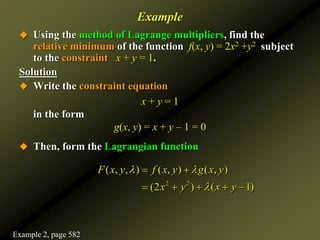
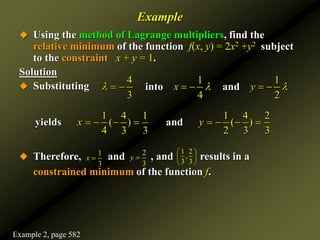
 Using the method of Lagrange multipliers, find the
relative minimum of the function f(x, y) = 2x2 +y2 subject
to the constraint x + y = 1.
Solution
 Write the constraint equation
x + y = 1
in the form
g(x, y) = x + y – 1 = 0
 Then, form the Lagrangian function
2 2
( , , ) ( , ) ( , )
(2 ) ( 1)
F x y f x y g x y
x y x y
 

 
    
Example 2, page 582
Example
 Using the method of Lagrange multipliers, find the
relative minimum of the function f(x, y) = 2x2 +y2 subject
to the constraint x + y = 1.
Solution
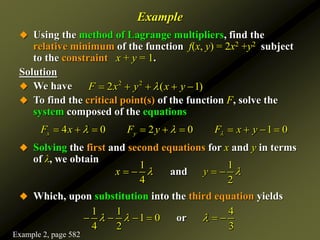
 We have
 To find the critical point(s) of the function F, solve the
system composed of the equations
 Solving the first and second equations for x and y in terms
of λ, we obtain
 Which, upon substitution into the third equation yields
2 2
2 ( 1)
F x y x y

    
4 0 2 0 1 0
x y
F x F y F x y

 
         
1 1
4 2
and
x y
 
   
1 1 4
1 0
4 2 3
or
  
     
Example 2, page 582
Example
 Using the method of Lagrange multipliers, find the
relative minimum of the function f(x, y) = 2x2 +y2 subject
to the constraint x + y = 1.
Solution
 Substituting
 Therefore, and , and results in a
constrained minimum of the function f.
1 4 1 1 4 2
( ) ( )
4 3 3 2 3 3
yields and
x y
       
4 1 1
3 4 2
x y
  
     
into and
1
3
x 
2
3
y 
1 2
,
3 3
 
 
 
Example 2, page 582
Applied Example: Designing a Cruise-Ship Pool
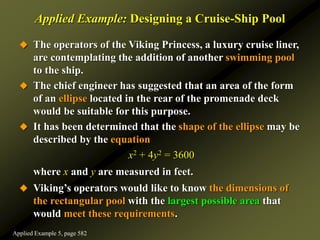
 The operators of the Viking Princess, a luxury cruise liner,
are contemplating the addition of another swimming pool
to the ship.
 The chief engineer has suggested that an area of the form
of an ellipse located in the rear of the promenade deck
would be suitable for this purpose.
 It has been determined that the shape of the ellipse may be
described by the equation
x2 + 4y2 = 3600
where x and y are measured in feet.
 Viking’s operators would like to know the dimensions of
the rectangular pool with the largest possible area that
would meet these requirements.
Applied Example 5, page 582
Applied Example: Designing a Cruise-Ship Pool
Solution
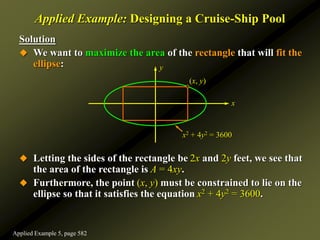
 We want to maximize the area of the rectangle that will fit the
ellipse:
 Letting the sides of the rectangle be 2x and 2y feet, we see that
the area of the rectangle is A = 4xy.
 Furthermore, the point (x, y) must be constrained to lie on the
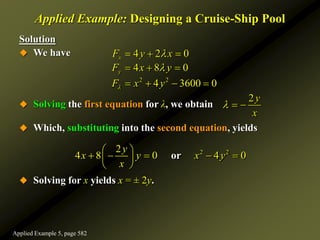
ellipse so that it satisfies the equation x2 + 4y2 = 3600.
x
y
(x, y)
x2 + 4y2 = 3600
Applied Example 5, page 582
Applied Example: Designing a Cruise-Ship Pool
Solution
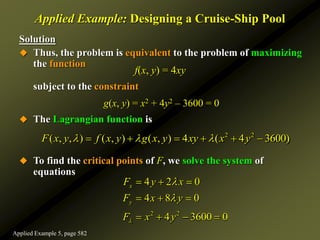
 Thus, the problem is equivalent to the problem of maximizing
the function
subject to the constraint
g(x, y) = x2 + 4y2 – 3600 = 0
 The Lagrangian function is
 To find the critical points of F, we solve the system of
equations
2 2
( , , ) ( , ) ( , ) 4 ( 4 3600)
F x y f x y g x y xy x y
  
     
2 2
4 2 0
4 8 0
4 3600 0
x
y
F y x
F x y
F x y



  
  
   
f(x, y) = 4xy
Applied Example 5, page 582
Applied Example: Designing a Cruise-Ship Pool
Solution
 We have
 Solving the first equation for λ, we obtain
 Which, substituting into the second equation, yields
 Solving for x yields x = ± 2y.
2y
x
  
2 2
2
4 8 0 4 0
or
y
x y x y
x
 
    
 
 
2 2
4 2 0
4 8 0
4 3600 0
x
y
F y x
F x y
F x y



  
  
   
Applied Example 5, page 582
Applied Example: Designing a Cruise-Ship Pool
Solution
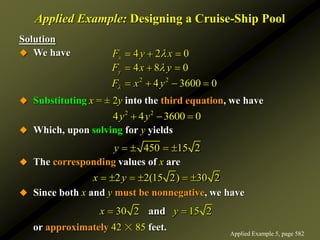
 We have
 Substituting x = ± 2y into the third equation, we have
 Which, upon solving for y yields
 The corresponding values of x are
 Since both x and y must be nonnegative, we have
or approximately 42 ☓ 85 feet.
2 2
4 4 3600 0
y y
  
450 15 2
y    
2 2(15 2) 30 2
x y
     
30 2 15 2
and
x y
 
2 2
4 2 0
4 8 0
4 3600 0
x
y
F y x
F x y
F x y



  
  
   
Applied Example 5, page 582
8.6
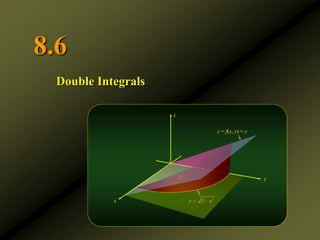
Double Integrals
z
x
y
2
1
y x
 
2
1
y x
 
R
z = f(x, y) = y
 You may recall that we can do a Riemann sum to
approximate the area under the graph of a function of one
variable by adding the areas of the rectangles that form
below the graph resulting from small increments of x (x)
within a given interval [a, b]:
x
y
A Geometric Interpretation of the Double Integral
y= f(x)
a b
x
z
A Geometric Interpretation of the Double Integral
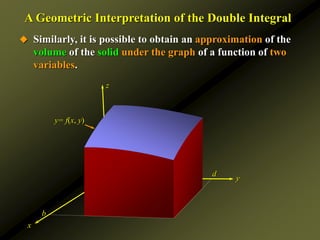
 Similarly, it is possible to obtain an approximation of the
volume of the solid under the graph of a function of two
variables.
y
x
a
b
c d
R
y= f(x, y)
z
A Geometric Interpretation of the Double Integral
y
x
a
b
c d
x
y
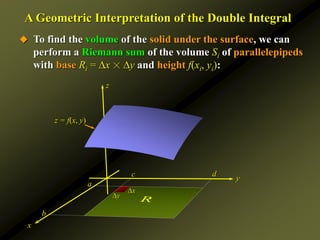
 To find the volume of the solid under the surface, we can
perform a Riemann sum of the volume Si of parallelepipeds
with base Ri = x ☓ y and height f(xi, yi):
z = f(x, y)
R
z
A Geometric Interpretation of the Double Integral
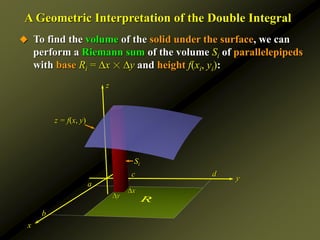
 To find the volume of the solid under the surface, we can
perform a Riemann sum of the volume Si of parallelepipeds
with base Ri = x ☓ y and height f(xi, yi):
y
x
a
b
c d
x
y
Si
z = f(x, y)
R
y
a
b
c d
z
x
A Geometric Interpretation of the Double Integral
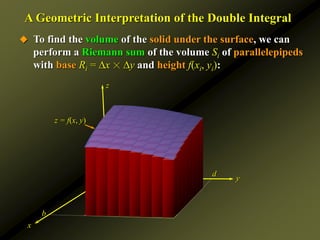
 To find the volume of the solid under the surface, we can
perform a Riemann sum of the volume Si of parallelepipeds
with base Ri = x ☓ y and height f(xi, yi):
z = f(x, y)
z
A Geometric Interpretation of the Double Integral
z = f(x, y)
y
x
a
b
c d
x
y
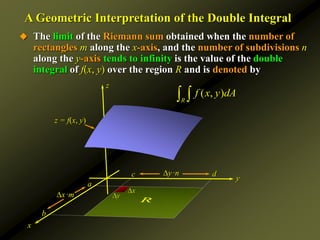
 The limit of the Riemann sum obtained when the number of
rectangles m along the x-axis, and the number of subdivisions n
along the y-axis tends to infinity is the value of the double
integral of f(x, y) over the region R and is denoted by
R
( , )
R
f x y dA
 
y ·n
x ·m
Theorem 1
Evaluating a Double Integral Over a Plane Region
a. Suppose g1(x) and g2(x) are continuous functions on [a, b] and
the region R is defined by R = {(x, y)| g1(x)  y  g2(x); a  x  b}.
Then,
2
1
( )
( )
( , ) ( , )
b g x
R a g x
f x y dA f x y dy dx
 

 
 
   
x
y
a b
y = g1(x)
y = g2(x)
R
Theorem 1
Evaluating a Double Integral Over a Plane Region
b. Suppose h1(y) and h2(y) are continuous functions on [c, d] and
the region R is defined by R = {(x, y)| h1(y)  x  h2(y); c  y  d}.
Then,
2
1
( )
( )
( , ) ( , )
d h y
R c h y
f x y dA f x y dx dy
 

 
 
   
x
y
c
d
x = h1(y) x = h2(y)
R
4
3
2
1
1 2 3 4
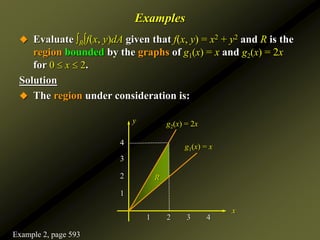
Examples
 Evaluate ∫R∫f(x, y)dA given that f(x, y) = x2 + y2 and R is the
region bounded by the graphs of g1(x) = x and g2(x) = 2x
for 0  x  2.
Solution
 The region under consideration is:
x
g2(x) = 2x
R
y
g1(x) = x
Example 2, page 593
Examples
 Evaluate ∫R∫f(x, y)dA given that f(x, y) = x2 + y2 and R is the
region bounded by the graphs of g1(x) = x and g2(x) = 2x
for 0  x  2.
Solution
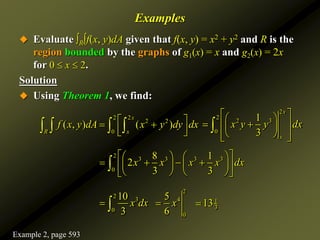
 Using Theorem 1, we find:
2 2
2 2
0
( , ) ( )
x
R x
f x y dA x y dy dx
 
 
 
 
   
2
2
2 3
0
1
3
x
x
x y y dx
 
 
 
 
 
 
 
 

2
3 3 3 3
0
8 1
2
3 3
x x x x dx
 
   
   
   
 
   
 

2
3
0
10
3
x dx
 
2
4
0
5
6
x
 1
3
13

Example 2, page 593
1
1
Examples
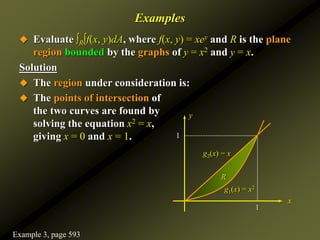
 Evaluate ∫R∫f(x, y)dA, where f(x, y) = xey and R is the plane
region bounded by the graphs of y = x2 and y = x.
Solution
 The region under consideration is:
x
g1(x) = x2
R
y
g2(x) = x
 The points of intersection of
the two curves are found by
solving the equation x2 = x,
giving x = 0 and x = 1.
Example 3, page 593
Examples
 Evaluate ∫R∫f(x, y)dA, where f(x, y) = xey and R is the plane
region bounded by the graphs of y = x2 and y = x.
Solution
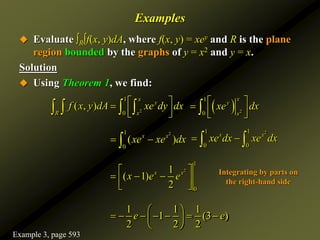
 Using Theorem 1, we find:
2
1
0
( , )
x
y
R x
f x y dA xe dy dx
 

 
 
      2
1
0
x
y
x
xe dx
 

 
 

2
1
0
( )
x x
xe xe dx
 

2
1 1
0 0
x x
xe dx xe dx
 
 
2
1
0
1
( 1)
2
x x
x e e
 
  
 
 
1 1 1
1 (3 )
2 2 2
e e
 
      
 
 
Integrating by parts on
the right-hand side
Example 3, page 593
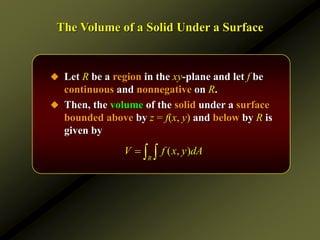
The Volume of a Solid Under a Surface
 Let R be a region in the xy-plane and let f be
continuous and nonnegative on R.
 Then, the volume of the solid under a surface
bounded above by z = f(x, y) and below by R is
given by
( , )
R
V f x y dA
  
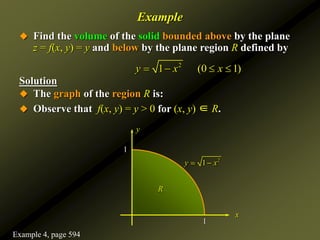
Example
 Find the volume of the solid bounded above by the plane
z = f(x, y) = y and below by the plane region R defined by
Solution
 The graph of the region R is:
1
1
x
y
2
1
y x
 
R
 Observe that f(x, y) = y > 0 for (x, y) ∈ R.
2
1 (0 1)
y x x
   
Example 4, page 594
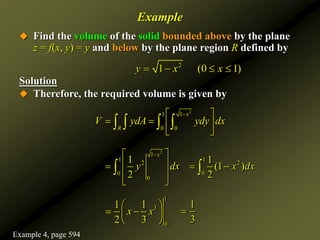
 Find the volume of the solid bounded above by the plane
z = f(x, y) = y and below by the plane region R defined by
Solution
 Therefore, the required volume is given by
2
1 1
0 0
x
R
V ydA ydy dx

 
   
 
   
2
1
1
2
0
0
1
2
x
y dx

 
 

 
 

1
2
0
1
(1 )
2
x dx
 

1
3
0
1 1
2 3
x x
 
 
 
 
1
3

Example
2
1 (0 1)
y x x
   
Example 4, page 594
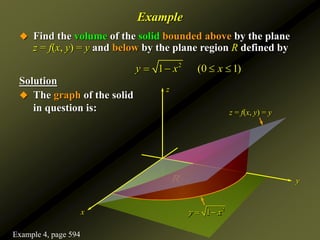
 Find the volume of the solid bounded above by the plane
z = f(x, y) = y and below by the plane region R defined by
Solution
2
1 (0 1)
y x x
   
z
x
y
Example
 The graph of the solid
in question is:
2
1
y x
 
R
z = f(x, y) = y
Example 4, page 594
End of
Chapter

Calculusseveralvariables.ppt

  • 1.
    8  Functions ofSeveral Variables  Partial Derivatives  Maxima and Minima of Functions of Several Variables  The Method of Least Squares  Constrained Maxima and Minima and the Method of Lagrange Multipliers  Double Integrals Calculus of Several Variables
  • 2.
    8.1 Functions of SeveralVariables z y x f(x, y) = x2 + y2 x2 + y2 = 0 x2 + y2 = 1 x2 + y2 = 4 x2 + y2 = 9 x2 + y2 = 16
  • 3.
    Functions of TwoVariables A real-valued function of two variables f, consists of 1. A set A of ordered pairs of real numbers (x, y) called the domain of the function. 2. A rule that associates with each ordered pair in the domain of f one and only one real number, denoted by z = f(x, y).
  • 4.
    Examples  Let fbe the function defined by  Compute f(0, 0), f(1, 2), and f(2, 1). Solution  The domain of a function of two variables f(x, y), is a set of ordered pairs of real numbers and may therefore be viewed as a subset of the xy-plane. 2 ( , ) 2 f x y x xy y     2 (0,0) 0 (0)(0) 0 2 2 f      2 (1,2) 1 (1)(2) 2 2 9 f      2 (2,1) 2 (2)(1) 1 2 7 f      Example 1, page 536
  • 5.
    Examples  Find thedomain of the function Solution  f(x, y) is defined for all real values of x and y, so the domain of the function f is the set of all points (x, y) in the xy-plane. 2 2 ( , ) f x y x y   Example 2, page 536
  • 6.
    Examples  Find thedomain of the function Solution  g(x, y) is defined for all x ≠ y, so the domain of the function g is the set of all points (x, y) in the xy-plane except those lying on the y = x line. 2 ( , ) g x y x y   x y y = x Example 2, page 536
  • 7.
    Examples  Find thedomain of the function Solution  We require that 1 – x2 – y2  0 or x2 + y2  1 which is the set of all points (x, y) lying on and inside the circle of radius 1 with center at the origin: 2 2 ( , ) 1 h x y x y    x y x2 + y2 = 1 –1 1 1 –1 Example 2, page 536
  • 8.
    Applied Example: RevenueFunctions  Acrosonic manufactures a bookshelf loudspeaker system that may be bought fully assembled or in a kit.  The demand equations that relate the unit price, p and q, to the quantities demanded weekly, x and y, of the assembled and kit versions of the loudspeaker systems are given by a. What is the weekly total revenue function R(x, y)? b. What is the domain of the function R? 1 1 1 3 300 240 4 8 8 8 and p x y q x y       Applied Example 3, page 537
  • 9.
    Applied Example: RevenueFunctions Solution a. The weekly revenue from selling x units assembled speaker systems at p dollars per unit is given by xp dollars. Similarly, the weekly revenue from selling y speaker kits at q dollars per unit is given by yq dollars. Therefore, the weekly total revenue function R is given by ( , ) R x y xp yq   1 1 1 3 300 240 4 8 8 8 x x y y x y                   2 2 1 3 1 300 240 4 8 4 x y xy x y       Applied Example 3, page 537
  • 10.
    1000 2000 Applied Example:Revenue Functions Solution b. To find the domain of the function R, note that the quantities x, y, p, and q must be nonnegative, which leads to the following system of linear inequalities: 1 1 300 0 4 8 x y    1 3 240 0 8 8 x y    0 y  0 x  Thus, the graph of the domain is: x y 2000 1000 1 1 300 0 4 8 x y    1 3 240 0 8 8 x y    D Applied Example 3, page 537
  • 11.
    P(1, 2, 3) Graphsof Functions of Two Variables  Consider the task of locating P(1, 2, 3) in 3-space:  One method to achieve this is to start at the origin and measure out from there, axis by axis: y x 1 2 3 z
  • 12.
    P(1, 2, 3) Graphsof Functions of Two Variables (1, 2) y z x 1 2 3  Consider the task of locating P(1, 2, 3) in 3-space:  Another common method is to find the xy coordinate and from there elevate to the level of the z value:
  • 13.
    Q(–1, 2, 3) Graphsof Functions of Two Variables y x 3 R(1, 2, –2) –2 S(1, –1, 0) z  Locate the following points in 3-space: Q(–1, 2, 3), R(1, 2, –2), and S(1, –1, 0). Solution
  • 14.
    Graphs of Functionsof Two Variables (x, y) (x, y, z)  The graph of a function in 3-space is a surface.  For every (x, y) in the domain of f, there is a z value on the surface. z y x z = f(x, y)
  • 15.
    Level Curves  Thegraph of a function of two variables is often difficult to sketch.  It can therefore be useful to apply the method used to construct topographic maps.  This method is relatively easy to apply and conveys sufficient information to enable one to obtain a feel for the graph of the function.
  • 16.
    z y x  In the3-space graph we just saw, we can delineate the contour of the graph as it is cut by a z = c plane: Level Curves z = c f(x, y) = c z = f(x, y)
  • 17.
    z y x Examples  Sketch acontour map of the function f(x, y) = x2 + y2. Solution  The function f(x, y) = x2 + y2 is a revolving parabola called a paraboloid. f(x, y) = x2 + y2 Example 5, page 540
  • 18.
    – 4 –2 2 4 4 2 – 2 – 4 z y x Examples  Sketch a contour map of the function f(x, y) = x2 + y2. Solution  A level curve is the graph of the equation x2 + y2 = c, which describes a circle with radius .  Taking different values of c we obtain: y x f(x, y) = x2 + y2 x2 + y2 = 0 x2 + y2 = 1 x2 + y2 = 4 x2 + y2 = 9 x2 + y2 = 16 x2 + y2 = 0 x2 + y2 = 1 x2 + y2 = 4 x2 + y2 = 9 x2 + y2 = 16 c Example 5, page 540
  • 19.
    – 2 –1 1 2 4 3 2 1 0 – 1 – 2 Examples  Sketch level curves of the function f(x, y) = 2x2 – y corresponding to z = –2, –1, 0, 1, and 2. Solution  The level curves are the graphs of the equation 2x2 – y = k or for k = –2, –1, 0, 1, and 2: y x 2x2 – y = – 2 2x2 – y = – 1 2x2 – y = 0 2x2 – y = 1 2x2 – y = 2 Example 6, page 540
  • 20.
    8.2 Partial Derivatives f f x  x   y  y   f x   f x   f y   f y   x  x   y  y   2 f f xy x y               2 f f x y x y               2 2 f f y y y              2 2 f f y y y              x  x   y  y   2 2 f f x x x              2 2 f f x x x              2 f f y x y x               2 f f y x y x               2 2 f f y x x y        2 2 f f y x x y        When both are continuous
  • 21.
    First Partial Derivatives FirstPartial Derivatives of f(x, y)  Suppose f(x, y) is a function of two variables x and y.  Then, the first partial derivative of f with respect to x at the point (x, y) is provided the limit exists.  The first partial derivative of f with respect to y at the point (x, y) is provided the limit exists. 0 ( , ) ( , ) lim h f f x h y f x y x h       0 ( , ) ( , ) lim k f f x y k f x y y k      
  • 22.
    x y f x   What does mean? GeometricInterpretation of the Partial Derivative z f(x, y)
  • 23.
    z Geometric Interpretation ofthe Partial Derivative f(x, y) y = b plane a x y b (a, b) ( , ) f f x b x    slope of f(x, b) f x   What does mean?
  • 24.
    z x y What does ean? m f y   GeometricInterpretation of the Partial Derivative f(x, y)
  • 25.
    x y Geometric Interpretation ofthe Partial Derivative f(x, y) c (c, d) x = c plane f(c, y) ( , ) slope of f f c y y    What does ean? m f y   z d
  • 26.
    Examples  Find thepartial derivatives ∂f/∂x and ∂f/∂y of the function  Use the partials to determine the rate of change of f in the x-direction and in the y-direction at the point (1, 2) . Solution  To compute ∂f/∂x, think of the variable y as a constant and differentiate the resulting function of x with respect to x: 2 2 3 ( , ) f x y x xy y    2 2 3 ( , ) f y x y y x x    2 2 f x y x     Example 1, page 546
  • 27.
    Examples  Find thepartial derivatives ∂f/∂x and ∂f/∂y of the function  Use the partials to determine the rate of change of f in the x-direction and in the y-direction at the point (1, 2). Solution  To compute ∂f/∂y, think of the variable x as a constant and differentiate the resulting function of y with respect to y: 2 2 3 ( , ) f x y x xy y    2 2 3 ( , ) f y y y x x x    2 2 3 x f y y y      Example 1, page 546
  • 28.
    Examples  Find thepartial derivatives ∂f/∂x and ∂f/∂y of the function  Use the partials to determine the rate of change of f in the x-direction and in the y-direction at the point (1, 2). Solution  The rate of change of f in the x-direction at the point (1, 2) is given by  The rate of change of f in the y-direction at the point (1, 2) is given by 2 2 3 ( , ) f x y x xy y    2 (1,2) 2(1) 2 2 f x       2 (1,2) 2(1)(2) 3(2) 8 f y       Example 1, page 546
  • 29.
    Examples  Find thefirst partial derivatives of the function Solution  To compute ∂w/∂x, think of the variable y as a constant and differentiate the resulting function of x with respect to x: 2 2 ( , ) xy w x y x y   2 2 ( , ) x y w y x y x   2 2 2 2 2 ( ) (2 ) ( ) w x x x x x y y y y       2 2 2 2 2 ( ) ( ) y y x x y    Example 2, page 547
  • 30.
    Examples  Find thefirst partial derivatives of the function Solution  To compute ∂w/∂y, think of the variable x as a constant and differentiate the resulting function of y with respect to y: 2 2 ( , ) xy w x y x y   2 2 ( , ) xy w y x y x   2 2 2 2 2 ( ) (2 ) ( ) x x x x w y y y y y       2 2 2 2 2 ( ) ( ) x x y x y    Example 2, page 547
  • 31.
    Examples  Find thefirst partial derivatives of the function Solution  To compute ∂g/∂s, think of the variable t as a constant and differentiate the resulting function of s with respect to s: 2 2 5 ( , ) ( ) g s t s st t    2 2 5 ( , ) ( ) g s t st s t    2 2 4 5( ) (2 ) g s st t t s s        2 2 4 5(2 )( ) s t s st t     Example 2, page 547
  • 32.
    Examples  Find thefirst partial derivatives of the function Solution  To compute ∂g/∂t, think of the variable s as a constant and differentiate the resulting function of t with respect to t: 2 2 5 ( , ) ( ) g s t s st t    2 2 5 ( , ) ( ) g s t st s t    4 2 2 5( ) ( 2 ) s s g t t s t t         2 2 4 5(2 )( ) t s s st t     Example 2, page 547
  • 33.
    Examples  Find thefirst partial derivatives of the function Solution  To compute ∂h/∂u, think of the variable v as a constant and differentiate the resulting function of u with respect to u: 2 2 ( , ) u v h u v e   2 2 ( , ) u v h e v u   2 2 2 u v h e u u      2 2 2 u v ue   Example 2, page 547
  • 34.
    Examples  Find thefirst partial derivatives of the function Solution  To compute ∂h/∂v, think of the variable u as a constant and differentiate the resulting function of v with respect to v: 2 2 ( , ) u v h u v e   2 2 ( , ) u v h v e u   2 2 ( 2 ) v u h e v u       2 2 2 u v ve    Example 2, page 547
  • 35.
    Examples  Find thefirst partial derivatives of the function Solution  Here we have a function of three variables, x, y, and z, and we are required to compute  For short, we can label these first partial derivatives respectively fx, fy, and fz. ( , , ) ln yz w f x y z xyz xe x y     , , f f f x y z       Example 3, page 549
  • 36.
    Examples  Find thefirst partial derivatives of the function Solution  To find fx, think of the variables y and z as a constant and differentiate the resulting function of x with respect to x: ( , , ) ln yz w f x y z xyz xe x y     ( , ln , ) yz y z yz e w y f x x x x     ln y x z yz e f y    Example 3, page 549
  • 37.
    Examples  Find thefirst partial derivatives of the function Solution  To find fy, think of the variables x and z as a constant and differentiate the resulting function of y with respect to y: ( , , ) ln yz w f x y z xyz xe x y     ( , , ) ln yz w f y y x z x xe z y x     y y z x xz xz f e y    Example 3, page 549
  • 38.
    Examples  Find thefirst partial derivatives of the function Solution  To find fz, think of the variables x and y as a constant and differentiate the resulting function of z with respect to z: ( , , ) ln yz w f x y z xyz xe x y     ( , ) ln , z y x y xy w f z y z e x x     z y z f xy xye   Example 3, page 549
  • 39.
    The Cobb-Douglas ProductionFunction  The Cobb-Douglass Production Function is of the form f(x, y) = axby1–b (0 < b < 1) where a and b are positive constants, x stands for the cost of labor, y stands for the cost of capital equipment, and f measures the output of the finished product.
  • 40.
    The Cobb-Douglas ProductionFunction  The Cobb-Douglass Production Function is of the form f(x, y) = axby1–b (0 < b < 1)  The first partial derivative fx is called the marginal productivity of labor. ✦ It measures the rate of change of production with respect to the amount of money spent on labor, with the level of capital kept constant.  The first partial derivative fy is called the marginal productivity of capital. ✦ It measures the rate of change of production with respect to the amount of money spent on capital, with the level of labor kept constant.
  • 41.
    Applied Example: MarginalProductivity  A certain country’s production in the early years following World War II is described by the function f(x, y) = 30x2/3y1/3 when x units of labor and y units of capital were used.  Compute fx and fy.  Find the marginal productivity of labor and the marginal productivity of capital when the amount expended on labor and capital was 125 units and 27 units, respectively.  Should the government have encouraged capital investment rather than increase expenditure on labor to increase the country’s productivity? Applied Example 4, page 550
  • 42.
    Applied Example: MarginalProductivity f(x, y) = 30x2/3y1/3 Solution  The first partial derivatives are 1/3 1/3 1/3 2 30 20 3 x y f x y x           2/3 2/3 2/3 1 30 10 3 y x f x y y           Applied Example 4, page 550
  • 43.
    Applied Example: MarginalProductivity f(x, y) = 30x2/3y1/3 Solution  The required marginal productivity of labor is given by or 12 units of output per unit increase in labor expenditure (keeping capital constant).  The required marginal productivity of capital is given by or 27 7/9 units of output per unit increase in capital expenditure (keeping labor constant). 1/3 27 3 (125,27) 20 20 12 125 5 x f                2/3 7 9 125 25 (125,27) 10 10 27 27 9 y f                Applied Example 4, page 550
  • 44.
    Applied Example: MarginalProductivity f(x, y) = 30x2/3y1/3 Solution  The government should definitely have encouraged capital investment.  A unit increase in capital expenditure resulted in a much faster increase in productivity than a unit increase in labor: 27 7/9 versus 12 per unit of investment, respectively. Applied Example 4, page 550
  • 45.
    Second Order PartialDerivatives  The first partial derivatives fx(x, y) and fy(x, y) of a function f(x, y) of two variables x and y are also functions of x and y.  As such, we may differentiate each of the functions fx and fy to obtain the second-order partial derivatives of f.
  • 46.
    Second Order PartialDerivatives  Differentiating the function fx with respect to x leads to the second partial derivative  But the function fx can also be differentiated with respect to y leading to a different second partial derivative 2 2 ( ) xx x f f f x x       2 ( ) xy x f f f y x y       
  • 47.
    Second Order PartialDerivatives  Similarly, differentiating the function fy with respect to y leads to the second partial derivative  Finally, the function fy can also be differentiated with respect to x leading to the second partial derivative 2 2 ( ) yy y f f f y y       2 ( ) yx y f f f x y x       
  • 48.
    Second Order PartialDerivatives  Thus, four second-order partial derivatives can be obtained of a function of two variables: f x   y   f x   f y   x   y   2 f f x y x y               2 2 f f y y y              x   y   2 2 f f x x x              2 f f y x y x               2 2 f f y x x y        When both are continuous
  • 49.
    Examples  Find thesecond-order partial derivatives of the function Solution  First, calculate fx and use it to find fxx and fxy: 3 2 2 2 ( , ) 3 3 f x y x x y xy y     2 2 3 6 3 x xy y    3 2 2 2 ( 3 3 ) x f x x y xy y x       2 2 (3 6 3 ) xx f x xy y x      6 6 x y   2 2 (3 6 3 ) xy f x xy y y      6 6 x y    6( ) x y   6( ) y x   Example 6, page 552
  • 50.
    Examples  Find thesecond-order partial derivatives of the function Solution  Then, calculate fy and use it to find fyx and fyy: 3 2 2 2 ( , ) 3 3 f x y x x y xy y     2 3 6 2 x xy y     3 2 2 2 ( 3 3 ) y f x x y xy y y       2 ( 3 6 2 ) yx f x xy y x       6 6 x y    2 ( 3 6 2 ) yy f x xy y y       6 2 x   6( ) y x   2(3 1) x   Example 6, page 552
  • 51.
    Examples  Find thesecond-order partial derivatives of the function Solution  First, calculate fx and use it to find fxx and fxy: 2 ( , ) xy f x y e  2 2 xy y e  2 ( ) xy x f e x    2 2 ( ) xy xx f y e x    2 4 xy y e  2 2 ( ) xy xy f y e y    2 2 3 2 2 xy xy ye xy e   2 2 2 (1 ) xy ye xy   Example 7, page 553
  • 52.
    Examples  Find thesecond-order partial derivatives of the function Solution  Then, calculate fy and use it to find fyx and fyy: 2 ( , ) xy f x y e  2 2 xy xye  2 ( ) xy y f e y    2 (2 ) xy yx f xye x    2 2 3 2 2 xy xy ye xy e   2 (2 ) xy yy f xye y    2 2 2 (2 )(2 ) xy xy xe xy xy e   2 2 2 (1 2 ) xy xe xy   2 2 2 (1 ) xy ye xy   Example 7, page 553
  • 53.
    8.3 Maxima and Minima ofFunctions of Several Variables y x z (a, b) (c, d) (e, f ) (g, h)
  • 54.
    Relative Extrema ofa Function of Two Variables  Let f be a function defined on a region R containing the point (a, b).  Then, f has a relative maximum at (a, b) if f(x, y)  f(a, b) for all points (x, y) that are sufficiently close to (a, b). ✦ The number f(a, b) is called a relative maximum value.  Similarly, f has a relative minimum at (a, b) if f(x, y)  f(a, b) for all points (x, y) that are sufficiently close to (a, b). ✦ The number f(a, b) is called a relative minimum value.
  • 55.
    y x z (a, b)  Thereis a relative maximum at (a, b). Graphic Example
  • 56.
    y x z (c, d)  Thereis an absolute maximum at (c, d). (It is also a relative maximum) Graphic Example
  • 57.
    y x z (e, f ) There is a relative minimum at (e, f ). Graphic Example
  • 58.
    y x z (g, h)  Thereis an absolute minimum at (g, h). (It is also a relative minimum) Graphic Example
  • 59.
    z y x  At aminimum point of the graph of a function of two variables, such as point (a, b) below, the plane tangent to the graph of the function is horizontal (assuming the surface of the graph is smooth): Relative Minima (a, b)
  • 60.
    z y x  Thus, ata minimum point, the graph of the function has a slope of zero along a direction parallel to the x-axis: Relative Minima ( , ) 0 f a b x    (a, b)
  • 61.
    z y x ( , )0 f a b y    (a, b)  Similarly, at a minimum point, the graph of the function has a slope of zero along a direction parallel to the y-axis: Relative Minima
  • 62.
     At amaximum point of the graph of a function of two variables, such as point (a, b) below, the plane tangent to the graph of the function is horizontal (assuming the surface of the graph is smooth): y x Relative Maxima z (a, b)
  • 63.
    z y x Relative Maxima (a, b) Thus, at a maximum point, the graph of the function has a slope of zero along a direction parallel to the x-axis: ( , ) 0 f a b x   
  • 64.
    z y x Relative Maxima (a, b) Similarly, at a maximum point, the graph of the function has a slope of zero along a direction parallel to the y-axis: ( , ) 0 f a b y   
  • 65.
    x Saddle Point  Inthe case of a saddle point, both partials are equal to zero, but the point is neither a maximum nor a minimum. y z
  • 66.
    In the caseof a saddle point, the function is at a minimum along one vertical plane… x Saddle Point y z (a, b) ( , ) 0 f a b x   
  • 67.
    z … but ata maximum along the perpendicular vertical plane. x Saddle Point y (a, b) ( , ) 0 f a b y   
  • 68.
    (a, b) z y x (a, b,f(a, b)) Extrema When Partial Derivatives are Not Defined  A maximum (or minimum) may also occur when both partial derivatives are not defined, such as point (a, b) in the graph below:
  • 69.
    Critical Point ofa Function  A critical point of f is a point (a, b) in the domain of f such that both or at least one of the partial derivatives does not exist. ( , ) 0 ( , ) 0 and f f a b a b x y      
  • 70.
    Determining Relative Extrema 1.Find the critical points of f(x, y) by solving the system of simultaneous equations fx = 0 fy = 0 2. The second derivative test: Let D(x, y) = fxx fyy – f 2 xy 3. Then, a. D(a, b) > 0 and fxx(a, b) < 0 implies that f(x, y) has a relative maximum at the point (a, b). b. D(a, b) > 0 and fxx(a, b) > 0 implies that f(x, y) has a relative minimum at the point (a, b). c. D(a, b) < 0 implies that f(x, y) has neither a relative maximum nor a relative minimum at the point (a, b), it has instead a saddle point. d. D(a, b) = 0 implies that the test is inconclusive, so some other technique must be used to solve the problem.
  • 71.
    Examples  Find therelative extrema of the function Solution  We have fx = 2x and fy = 2y.  To find the critical points, we set fx = 0 and fy = 0 and solve the resulting system of simultaneous equations 2x = 0 and 2y = 0 obtaining x = 0, y = 0, or (0, 0), as the sole critical point.  Next, apply the second derivative test to determine the nature of the critical point (0, 0).  We compute fxx = 2, fyy = 2, and fxy = 0,  Thus, D(x, y) = fxx fyy – f 2 xy = (2)(2) – (0)2 = 4. 2 2 ( , ) f x y x y   Example 1, page 561
  • 72.
    Examples  Find therelative extrema of the function Solution  We have D(x, y) = 4, and in particular, D(0, 0) = 4.  Since D(0, 0) > 0 and fxx = 2 > 0, we conclude that f has a relative minimum at the point (0, 0).  The relative minimum value, f (0, 0) = 0, also happens to be the absolute minimum of f. 2 2 ( , ) f x y x y   Example 1, page 561
  • 73.
    Examples  Find therelative extrema of the function Solution 2 2 ( , ) f x y x y    The relative minimum value, f(0, 0) = 0, also happens to be the absolute minimum of f: z y x f(x, y) = x2 + y2 Absolute minimum at (0, 0, 0). Example 1, page 561
  • 74.
    Examples  Find therelative extrema of the function Solution  We have  To find the critical points, we set fx = 0 and fy = 0 and solve the resulting system of simultaneous equations 6x – 4y – 4 = 0 and – 4x + 8y + 8 = 0 obtaining x = 0, y = –1, or (0, –1), as the sole critical point.  Next, apply the second derivative test to determine the nature of the critical point (0, –1).  We compute fxx = 6, fyy = 8, and fxy = – 4,  Thus, D(x, y) = fxx · fyy – f 2 xy = (6)(8) – (– 4)2 = 32. 2 2 ( , ) 3 4 4 4 8 4 f x y x xy y x y       6 4 4 4 8 8 and x y f x y f x y        Example 2, page 562
  • 75.
    Examples  Find therelative extrema of the function Solution  We have D(x, y) = 32, and in particular, D(0, –1) = 32.  Since D(0, –1) > 0 and fxx = 6 > 0, we conclude that f has a relative minimum at the point (0, –1).  The relative minimum value, f (0, –1) = 0, also happens to be the absolute minimum of f. 2 2 ( , ) 3 4 4 4 8 4 f x y x xy y x y       Example 2, page 562
  • 76.
    Examples  Find therelative extrema of the function Solution  We have  To find the critical points, we set fx = 0 and fy = 0 and solve the resulting system of simultaneous equations  The first equation implies that x = 0, while the second equation implies that y = –1 or y = 3.  Thus, there are two critical points of f : (0, –1) and (0, 3).  To apply the second derivative test, we calculate fxx = 2 fyy = 24(y – 1) fxy = 0 D(x, y) = fxx · fyy – f 2 xy = (2)· 24(y – 1) – (0)2 = 48(y – 1) 3 2 2 ( , ) 4 12 36 2 f x y y x y y      2 2 12 24 36 and x y f x f y y     2 2 0 12 24 36 0 nd a x y y     Example 3, page 562
  • 77.
    Examples  Find therelative extrema of the function Solution  Apply the second derivative test to the critical point (0, –1):  We have D(x, y) = 48(y – 1).  In particular, D(0, –1) = 48[(–1) – 1] = – 96.  Since D(0, –1) = – 96 < 0 we conclude that f has a saddle point at (0, –1).  The saddle point value is f (0, –1) = 22, so there is a saddle point at (0, –1, 22). 3 2 2 ( , ) 4 12 36 2 f x y y x y y      Example 3, page 562
  • 78.
    Examples  Find therelative extrema of the function Solution  Apply the second derivative test to the critical point (0, 3):  We have D(x, y) = 48(y – 1).  In particular, D(0, 3) = 48[(3) – 1] = 96.  Since D(0, –1) = 96 > 0 and fxx (0, 3) = 2 > 0, we conclude that f has a relative minimum at the point (0, 3).  The relative minimum value, f (0, 3) = –106, so there is a relative minimum at (0, 3, –106). 3 2 2 ( , ) 4 12 36 2 f x y y x y y      Example 3, page 562
  • 79.
    Applied Example: MaximizingProfit  The total weekly revenue that Acrosonic realizes in producing and selling its loudspeaker system is given by where x denotes the number of fully assembled units and y denotes the number of kits produced and sold each week.  The total weekly cost attributable to the production of these loudspeakers is  Determine how many assembled units and how many kits should be produced per week to maximize profits. 2 2 1 3 1 ( , ) 300 240 4 8 4 R x y x y xy x y       ( , ) 180 140 5000 C x y x y    Applied Example 3, page 563
  • 80.
    Applied Example: MaximizingProfit Solution  The contribution to Acrosonic’s weekly profit stemming from the production and sale of the bookshelf loudspeaker system is given by 2 2 2 2 ( , ) ( , ) ( , ) 1 3 1 300 240 (180 140 5000) 4 8 4 1 3 1 120 100 5000 4 8 4 P x y R x y C x y x y xy x y x y x y xy x y                         Applied Example 3, page 563
  • 81.
    Applied Example: MaximizingProfit Solution  We have  To find the relative maximum of the profit function P, we first locate the critical points of P.  Setting Px and Py equal to zero, we obtain  Solving the system of equations we get x = 208 and y = 64.  Therefore, P has only one critical point at (208, 64). 2 2 1 3 1 ( , ) 120 100 5000 4 8 4 P x y x y xy x y        1 1 3 1 120 0 100 0 2 4 4 4 and x y P x y P y x           Applied Example 3, page 563
  • 82.
    Applied Example: MaximizingProfit Solution  To test if the point (208, 64) is a solution to the problem, we use the second derivative test.  We compute  So,  In particular, D(208, 64) = 5/16 > 0.  Since D(208, 64) > 0 and Pxx(208, 64) < 0, the point (208, 64) yields a relative maximum of P. 2 1 3 1 3 1 5 ( , ) 2 4 4 8 16 16 D x y                        1 3 1 2 4 4 xx yy xy P P P       Applied Example 3, page 563
  • 83.
    Applied Example: MaximizingProfit Solution  The relative maximum at (208, 64) is also the absolute maximum of P.  We conclude that Acrosonic can maximize its weekly profit by manufacturing 208 assembled units and 64 kits.  The maximum weekly profit realizable with this output is 2 2 1 3 1 (208,64) (208) (64) (208)(64) 4 8 4 120(208) 100(64) 5000 $10,680 P         2 2 1 3 1 ( , ) 120 100 5000 4 8 4 P x y x y xy x y        Applied Example 3, page 563
  • 84.
    8.4 The Method ofLeast Squares 10 5 5 10 x y d4 d5 d3 d2 d1 L
  • 85.
    10 5 5 10 The Methodof Least Squares  Suppose we are given the data points P1(x1, y1), P2(x2, y2), P3(x3, y3), P4(x4, y4), and P5(x5, y5) that describe the relationship between two variables x and y.  By plotting these data points, we obtain a scatter diagram: x y P1 P2 P3 P4 P5
  • 86.
    10 5 5 10 The Methodof Least Squares  Suppose we try to fit a straight line L to the data points P1, P2, P3, P4, and P5.  The line will miss these points by the amounts d1, d2, d3, d4, and d5 respectively. x y L d4 d5 d3 d2 d1
  • 87.
    10 5 5 10 The Methodof Least Squares  The principle of least squares states that the straight line L that fits the data points best is the one chosen by requiring that the sum of the squares of d1, d2, d3, d4, and d5, that is be made as small as possible. x y 2 2 2 2 2 1 2 3 4 5 d d d d d     L d4 d5 d3 d2 d1
  • 88.
    10 5 5 10 The Methodof Least Squares  Suppose the regression line L is y = f(x) = mx + b, where m and b are to be determined.  The distances d1, d2, d3, d4, and d5, represent the errors the line L is making in estimating these points, so that x y d4 d5 d3 d2 d1 L 1 1 1 2 2 2 3 3 3 ( ) ( ) ( ) , , , and so on. d f x y d f x y d f x y      
  • 89.
    The Method ofLeast Squares  Observe that  This may be viewed as a function of two variables m and b.  Thus, the least-squares criterion is equivalent to minimizing the function 2 2 2 2 2 1 2 3 4 5 d d d d d     2 2 2 1 1 2 2 3 3 2 2 4 4 5 5 [ ( ) ] [ ( ) ] [ ( ) ] [ ( ) ] [ ( ) ] f x y f x y f x y f x y f x y           2 2 2 1 1 2 2 3 3 2 2 4 4 5 5 [ ] [ ] [ ] [ ] [ ] mx b y mx b y mx b y mx b y mx b y                2 2 2 1 1 2 2 3 3 2 2 4 4 5 5 ( , ) ( ) ( ) ( ) ( ) ( ) f m b mx b y mx b y mx b y mx b y mx b y               
  • 90.
    The Method ofLeast Squares  We want to minimize  We first find the partial derivative with respect to m: 1 1 1 2 2 2 3 3 3 4 4 4 5 5 5 2( ) 2( ) 2( ) 2( ) 2( ) f mx b y x mx b y x mx b y x m mx b y x mx b y x                  2 2 2 1 1 1 1 2 2 2 2 3 3 3 3 2 2 4 4 4 4 5 5 5 5 2[ ] mx bx y x mx bx y x mx bx y x mx bx y x mx bx y x                2 2 2 2 2 1 2 3 4 5 1 2 3 4 5 1 1 2 2 3 3 4 4 5 5 2[( ) ( ) ( )] x x x x x m x x x x x b y x y x y x y x y x                2 2 2 1 1 2 2 3 3 2 2 4 4 5 5 ( , ) ( ) ( ) ( ) ( ) ( ) f m b mx b y mx b y mx b y mx b y mx b y               
  • 91.
    The Method ofLeast Squares  We want to minimize  We now find the partial derivative with respect to b: 1 1 2 2 3 3 4 4 5 5 2( ) 2( ) 2( ) 2( ) 2( ) f mx b y mx b y mx b y b mx b y mx b y                  1 2 3 4 5 1 2 3 4 5 2[( ) 5 ( )] x x x x x m b y y y y y            2 2 2 1 1 2 2 3 3 2 2 4 4 5 5 ( , ) ( ) ( ) ( ) ( ) ( ) f m b mx b y mx b y mx b y mx b y mx b y               
  • 92.
    The Method ofLeast Squares  Setting gives and  Solving the two simultaneous equations for m and b then leads to an equation y = mx + b.  This equation will be the ‘best fit’ line, or regression line for the given data points. 1 2 3 4 5 1 2 3 4 5 ( ) 5 x x x x x m b y y y y y           0 0 and f f m b       2 2 2 2 2 1 2 3 4 5 1 2 3 4 5 1 1 2 2 3 3 4 4 5 5 ( ) ( ) x x x x x m x x x x x b y x y x y x y x y x              
  • 93.
    The Method ofLeast Squares  Suppose we are given n data points: P1(x1, y1), P2(x2, y2), P3(x3, y3), … , Pn(xn, yn)  Then, the least-squares (regression) line for the data is given by the linear equation y = f(x) = mx + b where the constants m and b satisfy the equations and simultaneously.  These last two equations are called normal equations. 1 2 3 1 2 3 ( ... ) ... n n x x x x m nb y y y y           2 2 2 2 1 2 3 1 2 3 1 1 2 2 3 3 ( ... ) ( ... ) ... n n n n x x x x m x x x x b y x y x y x y x              
  • 94.
    Example  Find theequation of the least-squares line for the data P1(1, 1), P2(2, 3), P3(3, 4), P4(4, 3), and P5(5, 6) 6 5 4 3 2 1 1 2 3 4 5 x y Example 1, page 570
  • 95.
    Example  Find theequation of the least-squares line for the data P1(1, 1), P2(2, 3), P3(3, 4), P4(4, 3), and P5(5, 6) Solution  Here, we have n = 5 and x1 = 1 x2 = 2 x3 = 3 x4 = 4 x5 = 5 y1 = 1 y2 = 3 y3 = 4 y4 = 3 y5 = 6  Substituting in the first equation we get 2 2 2 2 1 2 3 1 2 3 1 1 2 2 3 3 ( ... ) ( ... ) ... n n n n x x x x m x x x x b y x y x y x y x               2 2 2 2 2 (1 2 3 4 5 ) (1 2 3 4 5) (1)(1) (3)(2) (4)(3) (3)(4) (6)(5) m b               55 15 61 m b   Example 1, page 570
  • 96.
    Example  Find theequation of the least-squares line for the data P1(1, 1), P2(2, 3), P3(3, 4), P4(4, 3), and P5(5, 6) Solution  Here, we have n = 5 and x1 = 1 x2 = 2 x3 = 3 x4 = 4 x5 = 5 y1 = 1 y2 = 3 y3 = 4 y4 = 3 y5 = 6  Substituting in the second equation we get 15 5 17 m b   1 2 3 1 2 3 ( ... ) 5 ... n n x x x x m b y y y y           (1 2 3 4 5) 5 1 3 4 3 6 m b           Example 1, page 570
  • 97.
    Example  Find theequation of the least-squares line for the data P1(1, 1), P2(2, 3), P3(3, 4), P4(4, 3), and P5(5, 6) Solution  Solving the simultaneous equations gives m = 1 and b = 0.4.  Therefore, the required least-squares line is y = x + 0.4 15 5 17 m b   55 15 61 m b  
  • 98.
    Example  Find theequation of the least-squares line for the data P1(1, 1), P2(2, 3), P3(3, 4), P4(4, 3), and P5(5, 6) Solution  Below is the graph of the required least-squares line y = x + 0.4 6 5 4 3 2 1 1 2 3 4 5 x y L Example 1, page 570
  • 99.
    Applied Example: MaximizingProfit  A market research study provided the following data based on the projected monthly sales x (in thousands) of an adventure movie DVD.  Find the demand equation if the demand curve is the least- squares line for these data.  The total monthly cost function associated with producing and distributing the DVD is given by C(x) = 4x + 25 where x denotes the number of discs (in thousands) produced and sold, and C(x) is in thousands of dollars.  Determine the unit wholesale price that will maximize monthly profits. p 38 36 34.5 30 28.5 x 2.2 5.4 7.0 11.5 14.6 Applied Example 3, page 572
  • 100.
    Solution  The calculationsrequired for obtaining the normal equations may be summarized as follows:  Thus, the nominal equations are Applied Example: Maximizing Profit x p x2 xp 2.2 38.0 4.84 83.6 5.4 36.0 29.16 194.4 7.0 34.5 49.00 241.5 11.5 30.0 132.25 345.0 14.6 28.5 213.16 416.1 40.7 167.0 428.41 1280.6 5 40.7 167 40.7 428.41 1280.6 and b m b m     Applied Example 3, page 572
  • 101.
    Solution  Solving thesystem of linear equations simultaneously, we find that  Therefore, the required demand equation is given by Applied Example: Maximizing Profit 0.81 39.99 and m b    ( ) 0.81 39.99 (0 49.37) p f x x x       Applied Example 3, page 572
  • 102.
    Solution  The totalrevenue function in this case is given by  Since the total cost function is C(x) = 4x + 25 we see that the profit function is Applied Example: Maximizing Profit 2 ( ) ( 0.81 39.99) 0.81 39.99 R x xp x x x x        2 2 ( ) 0.81 39.99 (4 25) 0.81 35.99 25 P x R C x x x x x            Applied Example 3, page 572
  • 103.
    Solution  To findthe absolute maximum of P(x) over the closed interval [0, 49.37], we compute  Since P(x) = 0 , we find that x ≈ 22.22 as the only critical point of P.  Finally, from the table we see that the optimal wholesale price is or $21.99 per disc. Applied Example: Maximizing Profit ( ) 1.62 35.99 P x x     x 0 22.22 49.37 P(x) –25 374.78 – 222.47 0.81(22.22) 39.99 21.99 p     Applied Example 3, page 572
  • 104.
    8.5 Constrained Maxima andMinima and the Method of Lagrange Multipliers z y x f(x, y) = 2x2 + y2 g(x, y) = 0 h(x) = 3x2 – 2x + 1 (a, b) (a, b, f(a, b))
  • 105.
    Constrained Maxima andMinima  In many practical optimization problems, we must maximize or minimize a function in which the independent variables are subjected to certain further constraints.  We shall discuss a powerful method for determining relative extrema of a function f(x, y) whose independent variables x and y are required to satisfy one or more constraints of the form g(x, y) = 0.
  • 106.
    Example  Find therelative minimum of f(x, y) = 2x2 +y2 subject to the constraint g(x, y) = x + y – 1 = 0. Solution  Solving the constraint equation for y explicitly in terms of x, we obtain y = – x + 1  Substituting this value of y into f(x, y) results in a function of x, 2 2 2 ( ) 2 ( 1) 3 2 1 h x x x x x        Example 1, page 580
  • 107.
    Example  Find therelative minimum of f(x, y) = 2x2 +y2 subject to the constraint g(x, y) = x + y – 1 = 0. Solution z y x f(x, y) = 2x2 + y2  We have h(x) = 3x2 – 2x + 1.  The function h describes the curve lying on the graph of f on which the constrained relative minimum point (a, b) of f occurs: g(x, y) = 0 h(x) = 3x2 – 2x + 1 (a, b) (a, b, f(a, b)) Example 1, page 580
  • 108.
    Example  Find therelative minimum of f(x, y) = 2x2 +y2 subject to the constraint g(x, y) = x + y – 1 = 0. Solution  To find this point (a, b), we determine the relative extrema of a function of one variable:  Setting h′ = 0 gives x = as the sole critical point of h.  Next, we find h″(x) = 6 and, in particular, h″( ) = 6 > 0.  Therefore, by the second derivative test, the point gives rise to a relative minimum of h.  Substitute x = into the constraint equation x +y – 1 = 0 to get y = . ( ) 6 2 2(3 1) h x x x      1 3 1 3 1 3 1 3 Example 1, page 580
  • 109.
    Example  Find therelative minimum of f(x, y) = 2x2 +y2 subject to the constraint g(x, y) = x + y – 1 = 0. Solution  Thus, the point ( ) gives rise to the required constrained relative minimum of f.  Since , the required constrained relative minimum value of f is at the point .  It may be shown that is in fact a constrained absolute minimum value of f. 1 2 , 3 3 2 2 1 2 1 2 2 , 2 3 3 3 3 3 f                      2 3 1 2 , 3 3       2 3 Example 1, page 580
  • 110.
    The Method ofLagrange Multipliers To find the relative extrema of the function f(x, y) subject to the constraint g(x, y) = 0 (assuming that these extreme values exist), 1. Form an auxiliary function called the Lagrangian function (the variable λ is called the Lagrange multiplier). 2. Solve the system that consists of the equations Fx = 0 Fy = 0 Fλ = 0 for all values of x, y, and λ. 3. The solutions found in step 2 are candidates for the extrema of f. ( , , ) ( , ) ( , ) F x y f x y g x y    
  • 111.
    Example  Using themethod of Lagrange multipliers, find the relative minimum of the function f(x, y) = 2x2 +y2 subject to the constraint x + y = 1. Solution  Write the constraint equation x + y = 1 in the form g(x, y) = x + y – 1 = 0  Then, form the Lagrangian function 2 2 ( , , ) ( , ) ( , ) (2 ) ( 1) F x y f x y g x y x y x y           Example 2, page 582
  • 112.
    Example  Using themethod of Lagrange multipliers, find the relative minimum of the function f(x, y) = 2x2 +y2 subject to the constraint x + y = 1. Solution  We have  To find the critical point(s) of the function F, solve the system composed of the equations  Solving the first and second equations for x and y in terms of λ, we obtain  Which, upon substitution into the third equation yields 2 2 2 ( 1) F x y x y       4 0 2 0 1 0 x y F x F y F x y              1 1 4 2 and x y       1 1 4 1 0 4 2 3 or          Example 2, page 582
  • 113.
    Example  Using themethod of Lagrange multipliers, find the relative minimum of the function f(x, y) = 2x2 +y2 subject to the constraint x + y = 1. Solution  Substituting  Therefore, and , and results in a constrained minimum of the function f. 1 4 1 1 4 2 ( ) ( ) 4 3 3 2 3 3 yields and x y         4 1 1 3 4 2 x y          into and 1 3 x  2 3 y  1 2 , 3 3       Example 2, page 582
  • 114.
    Applied Example: Designinga Cruise-Ship Pool  The operators of the Viking Princess, a luxury cruise liner, are contemplating the addition of another swimming pool to the ship.  The chief engineer has suggested that an area of the form of an ellipse located in the rear of the promenade deck would be suitable for this purpose.  It has been determined that the shape of the ellipse may be described by the equation x2 + 4y2 = 3600 where x and y are measured in feet.  Viking’s operators would like to know the dimensions of the rectangular pool with the largest possible area that would meet these requirements. Applied Example 5, page 582
  • 115.
    Applied Example: Designinga Cruise-Ship Pool Solution  We want to maximize the area of the rectangle that will fit the ellipse:  Letting the sides of the rectangle be 2x and 2y feet, we see that the area of the rectangle is A = 4xy.  Furthermore, the point (x, y) must be constrained to lie on the ellipse so that it satisfies the equation x2 + 4y2 = 3600. x y (x, y) x2 + 4y2 = 3600 Applied Example 5, page 582
  • 116.
    Applied Example: Designinga Cruise-Ship Pool Solution  Thus, the problem is equivalent to the problem of maximizing the function subject to the constraint g(x, y) = x2 + 4y2 – 3600 = 0  The Lagrangian function is  To find the critical points of F, we solve the system of equations 2 2 ( , , ) ( , ) ( , ) 4 ( 4 3600) F x y f x y g x y xy x y          2 2 4 2 0 4 8 0 4 3600 0 x y F y x F x y F x y              f(x, y) = 4xy Applied Example 5, page 582
  • 117.
    Applied Example: Designinga Cruise-Ship Pool Solution  We have  Solving the first equation for λ, we obtain  Which, substituting into the second equation, yields  Solving for x yields x = ± 2y. 2y x    2 2 2 4 8 0 4 0 or y x y x y x            2 2 4 2 0 4 8 0 4 3600 0 x y F y x F x y F x y              Applied Example 5, page 582
  • 118.
    Applied Example: Designinga Cruise-Ship Pool Solution  We have  Substituting x = ± 2y into the third equation, we have  Which, upon solving for y yields  The corresponding values of x are  Since both x and y must be nonnegative, we have or approximately 42 ☓ 85 feet. 2 2 4 4 3600 0 y y    450 15 2 y     2 2(15 2) 30 2 x y       30 2 15 2 and x y   2 2 4 2 0 4 8 0 4 3600 0 x y F y x F x y F x y              Applied Example 5, page 582
  • 119.
    8.6 Double Integrals z x y 2 1 y x  2 1 y x   R z = f(x, y) = y
  • 120.
     You mayrecall that we can do a Riemann sum to approximate the area under the graph of a function of one variable by adding the areas of the rectangles that form below the graph resulting from small increments of x (x) within a given interval [a, b]: x y A Geometric Interpretation of the Double Integral y= f(x) a b x
  • 121.
    z A Geometric Interpretationof the Double Integral  Similarly, it is possible to obtain an approximation of the volume of the solid under the graph of a function of two variables. y x a b c d R y= f(x, y)
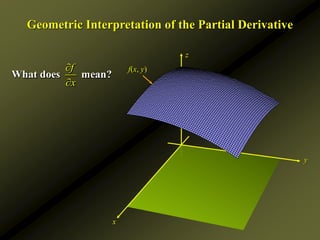
  • 122.
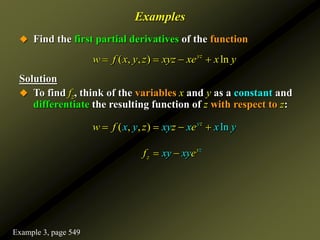
    z A Geometric Interpretationof the Double Integral y x a b c d x y  To find the volume of the solid under the surface, we can perform a Riemann sum of the volume Si of parallelepipeds with base Ri = x ☓ y and height f(xi, yi): z = f(x, y) R
  • 123.
    z A Geometric Interpretationof the Double Integral  To find the volume of the solid under the surface, we can perform a Riemann sum of the volume Si of parallelepipeds with base Ri = x ☓ y and height f(xi, yi): y x a b c d x y Si z = f(x, y) R
  • 124.
    y a b c d z x A GeometricInterpretation of the Double Integral  To find the volume of the solid under the surface, we can perform a Riemann sum of the volume Si of parallelepipeds with base Ri = x ☓ y and height f(xi, yi): z = f(x, y)
  • 125.
    z A Geometric Interpretationof the Double Integral z = f(x, y) y x a b c d x y  The limit of the Riemann sum obtained when the number of rectangles m along the x-axis, and the number of subdivisions n along the y-axis tends to infinity is the value of the double integral of f(x, y) over the region R and is denoted by R ( , ) R f x y dA   y ·n x ·m
  • 126.
    Theorem 1 Evaluating aDouble Integral Over a Plane Region a. Suppose g1(x) and g2(x) are continuous functions on [a, b] and the region R is defined by R = {(x, y)| g1(x)  y  g2(x); a  x  b}. Then, 2 1 ( ) ( ) ( , ) ( , ) b g x R a g x f x y dA f x y dy dx            x y a b y = g1(x) y = g2(x) R
  • 127.
    Theorem 1 Evaluating aDouble Integral Over a Plane Region b. Suppose h1(y) and h2(y) are continuous functions on [c, d] and the region R is defined by R = {(x, y)| h1(y)  x  h2(y); c  y  d}. Then, 2 1 ( ) ( ) ( , ) ( , ) d h y R c h y f x y dA f x y dx dy            x y c d x = h1(y) x = h2(y) R
  • 128.
    4 3 2 1 1 2 34 Examples  Evaluate ∫R∫f(x, y)dA given that f(x, y) = x2 + y2 and R is the region bounded by the graphs of g1(x) = x and g2(x) = 2x for 0  x  2. Solution  The region under consideration is: x g2(x) = 2x R y g1(x) = x Example 2, page 593
  • 129.
    Examples  Evaluate ∫R∫f(x,y)dA given that f(x, y) = x2 + y2 and R is the region bounded by the graphs of g1(x) = x and g2(x) = 2x for 0  x  2. Solution  Using Theorem 1, we find: 2 2 2 2 0 ( , ) ( ) x R x f x y dA x y dy dx             2 2 2 3 0 1 3 x x x y y dx                  2 3 3 3 3 0 8 1 2 3 3 x x x x dx                        2 3 0 10 3 x dx   2 4 0 5 6 x  1 3 13  Example 2, page 593
  • 130.
    1 1 Examples  Evaluate ∫R∫f(x,y)dA, where f(x, y) = xey and R is the plane region bounded by the graphs of y = x2 and y = x. Solution  The region under consideration is: x g1(x) = x2 R y g2(x) = x  The points of intersection of the two curves are found by solving the equation x2 = x, giving x = 0 and x = 1. Example 3, page 593
  • 131.
    Examples  Evaluate ∫R∫f(x,y)dA, where f(x, y) = xey and R is the plane region bounded by the graphs of y = x2 and y = x. Solution  Using Theorem 1, we find: 2 1 0 ( , ) x y R x f x y dA xe dy dx              2 1 0 x y x xe dx         2 1 0 ( ) x x xe xe dx    2 1 1 0 0 x x xe dx xe dx     2 1 0 1 ( 1) 2 x x x e e          1 1 1 1 (3 ) 2 2 2 e e              Integrating by parts on the right-hand side Example 3, page 593
  • 132.
    The Volume ofa Solid Under a Surface  Let R be a region in the xy-plane and let f be continuous and nonnegative on R.  Then, the volume of the solid under a surface bounded above by z = f(x, y) and below by R is given by ( , ) R V f x y dA   
  • 133.
    Example  Find thevolume of the solid bounded above by the plane z = f(x, y) = y and below by the plane region R defined by Solution  The graph of the region R is: 1 1 x y 2 1 y x   R  Observe that f(x, y) = y > 0 for (x, y) ∈ R. 2 1 (0 1) y x x     Example 4, page 594
  • 134.
     Find thevolume of the solid bounded above by the plane z = f(x, y) = y and below by the plane region R defined by Solution  Therefore, the required volume is given by 2 1 1 0 0 x R V ydA ydy dx              2 1 1 2 0 0 1 2 x y dx            1 2 0 1 (1 ) 2 x dx    1 3 0 1 1 2 3 x x         1 3  Example 2 1 (0 1) y x x     Example 4, page 594
  • 135.
     Find thevolume of the solid bounded above by the plane z = f(x, y) = y and below by the plane region R defined by Solution 2 1 (0 1) y x x     z x y Example  The graph of the solid in question is: 2 1 y x   R z = f(x, y) = y Example 4, page 594
  • 136.