Distribution of calcium in the human
body
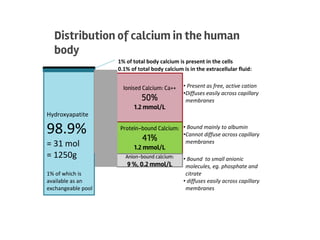
Hydroxyapatite
98.9%
= 31 mol
= 1250g
1% of which is
available as an
exchangeable pool
0.1% of total body calcium is in the extracellular fluid:
Ionised Calcium: Ca++
50%
1.2 mmol/L
1% of total body calcium is present in the cells
Protein-bound Calcium:
41%
1.2 mmol/L
Anion-bound calcium:
9 %, 0.2 mmol/L
• Present as free, active cation
•Diffuses easily across capillary
membranes
• Bound mainly to albumin
•Cannot diffuse across capillary
membranes
• Bound to small anionic
molecules, eg. phosphate and
citrate
• diffuses easily across capillary
membranes
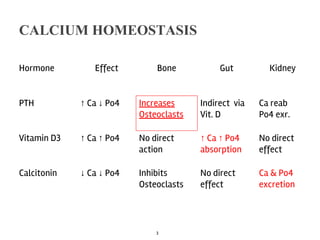
CALCIUM HOMEOSTASIS
Hormone Effect Bone Gut Kidney
PTH ↑ Ca ↓ Po4 Increases
Osteoclasts
Indirect via
Vit. D
Ca reab
Po4 exr.
Vitamin D3 ↑ Ca ↑ Po4 No direct
action
↑ Ca ↑ Po4
absorption
No direct
effect
Calcitonin ↓ Ca ↓ Po4 Inhibits
Osteoclasts
No direct
effect
Ca & Po4
excretion
3
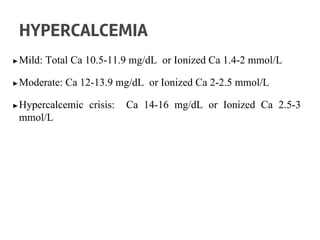
▶Mild: Total Ca 10.5-11.9 mg/dL or Ionized Ca 1.4-2 mmol/L
▶Moderate: Ca 12-13.9 mg/dL or Ionized Ca 2-2.5 mmol/L
▶Hypercalcemic crisis: Ca 14-16 mg/dL or Ionized Ca 2.5-3
mmol/L
HYPERCALCEMIA
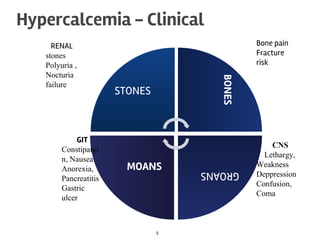
Hypercalcemia - Clinical
STONES
BONES
GROANSMOANS
5
RENAL
stones
Polyuria ,
Nocturia
failure
Bone pain
Fracture
risk
GIT
Constipatio
n, Nausea
Anorexia,
Pancreatitis
Gastric
ulcer
CNS
Lethargy,
Weakness
Deppression
Confusion,
Coma
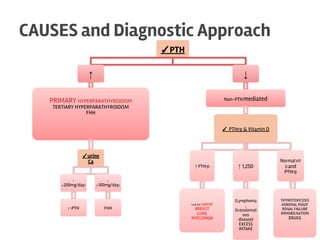
CAUSES and Diagnostic Approach
✓PTH
↑
PRIMARY HYPERPARATHYROIDISM
TERTIARY HYPERPARATHYROIDISM
FHH
✓urine
Ca
↑
(>200mg/day)
1° ↑PTH
↓
(<100mg/day)
FHH
↓
Non-PTHmediated
✓ PTHrp & Vitamin D
↑ PTHrp
Look for cancer
BREAST
LUNG
MYELOMQA
↑ 1,25D
(Lymphoma
,
Granulomat
ous
disease)
EXCESS
INTAKE
NormalVIT
Dand
PTHrp
THYROTOXICOSIS
ADRENAL INSUF
RENAL FAILURE
IMMOBILISATION
DRUGS
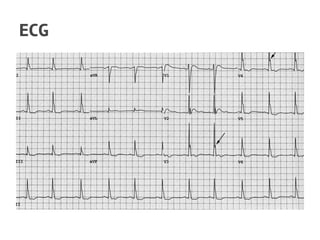
ECG
▶Mild, asymptomatic hypercalcemia do not require immediate
therapy, and manage underlying cause.
▶ Symptomatic hypercalcemia requires therapeutic intervention
▶ Initial therapy - volume expansion because hypercalcemia
invariably leads to dehydration
▶ 4–6 L of i/v saline may be required over the first 24 h
▶ Loop diuretics - enhance sodium and calcium excretion.
.
Treatment
In hypercalcemia of malignancy
drugs that inhibit bone resorption should be considered.
▶Zoledronic acid (e.g., 4 mg I/V over 30 min)
▶Pamidronate ,Etidronate
▶Onset of action is within 1–3 days.
Because of their effectiveness, bisphosphonates have replaced
calcitonin widely
▶In rare instances, dialysis may be necessary.
▶I/V phosphate may be used, it can be toxic , ca-po4 complexes
cause extensive organ damage.
▶In 1,25(OH) D-mediated hypercalcemia- oral or i/v steroids
preffered ,decrease 1,25(OH) D production.
▶Recently, US FDA approved denosumab (RANKL inhibitor)
for treatment of hypercalcemia of malignancy refractory to
bisphosphonate therapy in December 2014
▶Serum ca < 8.5 mg/dL or an ionized ca <1.0 mmol/L
▶ Ionized ca is the definitive method for diagnosis
▶ Corrected ca(mg%) = serum ca + (4.0 - albumin g%) x 0.8
Hypocalcemia
Cardiovascular effects :
▶acute hypocalcemia - syncope, CHF, and angina
Neuromuscular symptoms :
▶Numbness and tingling sensations - perioral area or in the
fingers and toes
▶Muscle cramps, in the back and lower extremities; may
progress to carpopedal spasm (ie, tetany)
▶Wheezing ,Dysphagia,Voice changes
History
Neurologic symptoms :
▶Irritability, impaired intellectual capacity, depression, and
personality changes
▶Fatigue,Seizures
Chronic hypocalcemia - dermatologic manifestations:
▶Coarse hair,Brittle nails
▶Psoriasis,Dry skin
▶Chronic pruritus
▶Poor dentition
▶ Hair may appear coarse, and alopecia may be present.
▶ In chronic hypocalcemia - dental caries,enamel hypoplasia.
▶ Eye examination-subcapsular cataract or papilledema
▶ Patient may appear confused, disoriented, Irritabile
▶ Hallucinations, dementia, and seizures may occur.
▶On R/S-wheezes , laryngeal stridor
▶ On CVS- bradycardia, tachycardia, S3
, signs of HF.
PHYSICAL EXAMINATION
▶Chvostek sign - tapping the skin over the facial nerve about 2 cm
anterior to the external auditory meatus.
▶Ipsilateral contraction of the facial muscles is a positive sign.
▶Depending on the ca level, a graded response will occur:
twitching first at the angle of the mouth, then by nose, eye and
the facial muscles.
▶ 10% of the population will have a positive Chvostek sign in the
absence of hypocalcemia so test is not diagnostic
▶ Trousseau sign- placing a blood pressure cuff on the patient’s
arm and inflating to 20 mm Hg above SBP for 3-5 minutes.
▶flexion of wrist and MCP joints ,extension of IP joints and
adduction of the thumb (carpal spasm).
▶The Trousseau sign is more specific than the Chvostek sign
Extra pyramidal symptom :
▶Choreoathetosis ,Parkinsonism,Hemiballism
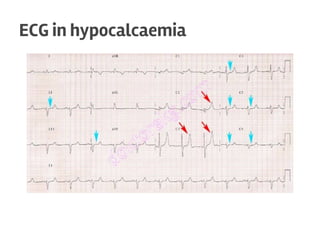
ECG in hypocalcaemia
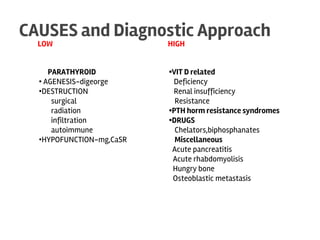
CAUSES and Diagnostic Approach
LOW PARATHYROID
HORMONE LEVEL
HIGH PARATHYROID HORMONE
LEVEL
PARATHYROID
• AGENESIS-digeorge
•DESTRUCTION
surgical
radiation
infiltration
autoimmune
•HYPOFUNCTION-mg,CaSR
•VIT D related
Deficiency
Renal insufficiency
Resistance
•PTH horm resistance syndromes
•DRUGS
Chelators,biphosphanates
Miscellaneous
Acute pancreatitis
Acute rhabdomyolisis
Hungry bone
Osteoblastic metastasis
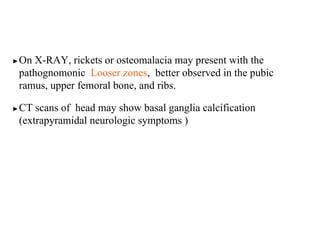
▶On X-RAY, rickets or osteomalacia may present with the
pathognomonic Looser zones, better observed in the pubic
ramus, upper femoral bone, and ribs.
▶CT scans of head may show basal ganglia calcification
(extrapyramidal neurologic symptoms )
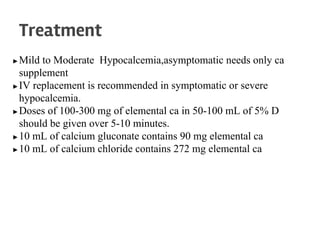
▶Mild to Moderate Hypocalcemia,asymptomatic needs only ca
supplement
▶IV replacement is recommended in symptomatic or severe
hypocalcemia.
▶Doses of 100-300 mg of elemental ca in 50-100 mL of 5% D
should be given over 5-10 minutes.
▶10 mL of calcium gluconate contains 90 mg elemental ca
▶10 mL of calcium chloride contains 272 mg elemental ca
Treatment
▶Measure serum calcium every 4-6 hours to maintain at levels of
8-9 mg/dL.
▶Start oral calcium and vitamin D treatment early
▶oral calcium supplements must be given between meals
otherwise, they will act as phosphate binders
▶ Vit D deficiency - vitamin D supplementation (50,000 U, 2–3
times per week for several months)
▶ Vit D deficiency due to malabsorption- higher doses (100,000
U/d or more).

Calcium

  • 1.
    Distribution of calciumin the human body Hydroxyapatite 98.9% = 31 mol = 1250g 1% of which is available as an exchangeable pool 0.1% of total body calcium is in the extracellular fluid: Ionised Calcium: Ca++ 50% 1.2 mmol/L 1% of total body calcium is present in the cells Protein-bound Calcium: 41% 1.2 mmol/L Anion-bound calcium: 9 %, 0.2 mmol/L • Present as free, active cation •Diffuses easily across capillary membranes • Bound mainly to albumin •Cannot diffuse across capillary membranes • Bound to small anionic molecules, eg. phosphate and citrate • diffuses easily across capillary membranes
  • 3.
    CALCIUM HOMEOSTASIS Hormone EffectBone Gut Kidney PTH ↑ Ca ↓ Po4 Increases Osteoclasts Indirect via Vit. D Ca reab Po4 exr. Vitamin D3 ↑ Ca ↑ Po4 No direct action ↑ Ca ↑ Po4 absorption No direct effect Calcitonin ↓ Ca ↓ Po4 Inhibits Osteoclasts No direct effect Ca & Po4 excretion 3
  • 4.
    ▶Mild: Total Ca10.5-11.9 mg/dL or Ionized Ca 1.4-2 mmol/L ▶Moderate: Ca 12-13.9 mg/dL or Ionized Ca 2-2.5 mmol/L ▶Hypercalcemic crisis: Ca 14-16 mg/dL or Ionized Ca 2.5-3 mmol/L HYPERCALCEMIA
  • 5.
    Hypercalcemia - Clinical STONES BONES GROANSMOANS 5 RENAL stones Polyuria, Nocturia failure Bone pain Fracture risk GIT Constipatio n, Nausea Anorexia, Pancreatitis Gastric ulcer CNS Lethargy, Weakness Deppression Confusion, Coma
  • 6.
    CAUSES and DiagnosticApproach ✓PTH ↑ PRIMARY HYPERPARATHYROIDISM TERTIARY HYPERPARATHYROIDISM FHH ✓urine Ca ↑ (>200mg/day) 1° ↑PTH ↓ (<100mg/day) FHH ↓ Non-PTHmediated ✓ PTHrp & Vitamin D ↑ PTHrp Look for cancer BREAST LUNG MYELOMQA ↑ 1,25D (Lymphoma , Granulomat ous disease) EXCESS INTAKE NormalVIT Dand PTHrp THYROTOXICOSIS ADRENAL INSUF RENAL FAILURE IMMOBILISATION DRUGS
  • 7.
  • 8.
    ▶Mild, asymptomatic hypercalcemiado not require immediate therapy, and manage underlying cause. ▶ Symptomatic hypercalcemia requires therapeutic intervention ▶ Initial therapy - volume expansion because hypercalcemia invariably leads to dehydration ▶ 4–6 L of i/v saline may be required over the first 24 h ▶ Loop diuretics - enhance sodium and calcium excretion. . Treatment
  • 9.
    In hypercalcemia ofmalignancy drugs that inhibit bone resorption should be considered. ▶Zoledronic acid (e.g., 4 mg I/V over 30 min) ▶Pamidronate ,Etidronate ▶Onset of action is within 1–3 days. Because of their effectiveness, bisphosphonates have replaced calcitonin widely ▶In rare instances, dialysis may be necessary.
  • 10.
    ▶I/V phosphate maybe used, it can be toxic , ca-po4 complexes cause extensive organ damage. ▶In 1,25(OH) D-mediated hypercalcemia- oral or i/v steroids preffered ,decrease 1,25(OH) D production. ▶Recently, US FDA approved denosumab (RANKL inhibitor) for treatment of hypercalcemia of malignancy refractory to bisphosphonate therapy in December 2014
  • 11.
    ▶Serum ca <8.5 mg/dL or an ionized ca <1.0 mmol/L ▶ Ionized ca is the definitive method for diagnosis ▶ Corrected ca(mg%) = serum ca + (4.0 - albumin g%) x 0.8 Hypocalcemia
  • 12.
    Cardiovascular effects : ▶acutehypocalcemia - syncope, CHF, and angina Neuromuscular symptoms : ▶Numbness and tingling sensations - perioral area or in the fingers and toes ▶Muscle cramps, in the back and lower extremities; may progress to carpopedal spasm (ie, tetany) ▶Wheezing ,Dysphagia,Voice changes History
  • 13.
    Neurologic symptoms : ▶Irritability,impaired intellectual capacity, depression, and personality changes ▶Fatigue,Seizures Chronic hypocalcemia - dermatologic manifestations: ▶Coarse hair,Brittle nails ▶Psoriasis,Dry skin ▶Chronic pruritus ▶Poor dentition
  • 14.
    ▶ Hair mayappear coarse, and alopecia may be present. ▶ In chronic hypocalcemia - dental caries,enamel hypoplasia. ▶ Eye examination-subcapsular cataract or papilledema ▶ Patient may appear confused, disoriented, Irritabile ▶ Hallucinations, dementia, and seizures may occur. ▶On R/S-wheezes , laryngeal stridor ▶ On CVS- bradycardia, tachycardia, S3 , signs of HF. PHYSICAL EXAMINATION
  • 15.
    ▶Chvostek sign -tapping the skin over the facial nerve about 2 cm anterior to the external auditory meatus. ▶Ipsilateral contraction of the facial muscles is a positive sign. ▶Depending on the ca level, a graded response will occur: twitching first at the angle of the mouth, then by nose, eye and the facial muscles. ▶ 10% of the population will have a positive Chvostek sign in the absence of hypocalcemia so test is not diagnostic
  • 16.
    ▶ Trousseau sign-placing a blood pressure cuff on the patient’s arm and inflating to 20 mm Hg above SBP for 3-5 minutes. ▶flexion of wrist and MCP joints ,extension of IP joints and adduction of the thumb (carpal spasm). ▶The Trousseau sign is more specific than the Chvostek sign Extra pyramidal symptom : ▶Choreoathetosis ,Parkinsonism,Hemiballism
  • 17.
  • 18.
    CAUSES and DiagnosticApproach LOW PARATHYROID HORMONE LEVEL HIGH PARATHYROID HORMONE LEVEL PARATHYROID • AGENESIS-digeorge •DESTRUCTION surgical radiation infiltration autoimmune •HYPOFUNCTION-mg,CaSR •VIT D related Deficiency Renal insufficiency Resistance •PTH horm resistance syndromes •DRUGS Chelators,biphosphanates Miscellaneous Acute pancreatitis Acute rhabdomyolisis Hungry bone Osteoblastic metastasis
  • 19.
    ▶On X-RAY, ricketsor osteomalacia may present with the pathognomonic Looser zones, better observed in the pubic ramus, upper femoral bone, and ribs. ▶CT scans of head may show basal ganglia calcification (extrapyramidal neurologic symptoms )
  • 20.
    ▶Mild to ModerateHypocalcemia,asymptomatic needs only ca supplement ▶IV replacement is recommended in symptomatic or severe hypocalcemia. ▶Doses of 100-300 mg of elemental ca in 50-100 mL of 5% D should be given over 5-10 minutes. ▶10 mL of calcium gluconate contains 90 mg elemental ca ▶10 mL of calcium chloride contains 272 mg elemental ca Treatment
  • 21.
    ▶Measure serum calciumevery 4-6 hours to maintain at levels of 8-9 mg/dL. ▶Start oral calcium and vitamin D treatment early ▶oral calcium supplements must be given between meals otherwise, they will act as phosphate binders ▶ Vit D deficiency - vitamin D supplementation (50,000 U, 2–3 times per week for several months) ▶ Vit D deficiency due to malabsorption- higher doses (100,000 U/d or more).