CUTANEOUS
MANIFESTATIONS OF
HIV
Human Immunodeficiency Virus
▶Derived from SIV
▶Lymphotropic virus ,affects CD4+ T
cells and CD 4+ cells of monocytic
lineage
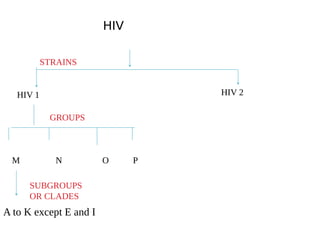
HIV
HIV 1 HIV 2
M N O P
STRAINS
GROUPS
A to K except E and I
SUBGROUPS
OR CLADES
▶Genus- Lentivirus
▶Family- Retroviridae
▶120 nm icosahedral single stranded
positive sense enveloped RNA virus
STRUCTURE OF HIV
▶ Cutaneous manifestations, may be the earliest signs
▶ Have prognostic significance
▶ >90% -some cutaneous manifestation
HIV IN DERMATOLOGY
◦Generalized maculo-papular rash
on face, palms and soles
◦Non itchy
◦Oral ulcers, genital ulcers
Acute retroviral syndrome
▶Pruritis and xerosis
▶Pigmentation disorders-
hyperpigmentation
hypopigmentation
▶Inflammatory disorders-
seborrheic dermatitis
psoriasis
granuloma annulare
eosinophilic folliculitis
PPE
Classification
▶Infections
Bacterial –Staph, strep, TB, syphilis, bacillary
angiomatosis
Viral- HSV HZV HPV Molluscum
Fungal- superficial and deep
Parasitic- scabies
▶Malignancy
▶Drug induced- drug rash
▶ENUMARATE THESE DISORDERS AND WRITE
▶ATYPICAL SITE
▶ATYPICAL MORPHOLOGY
▶EXTENSIVE LESIONS
▶DONOT RESPOND TO CONVENTIONAL
TREATMENT
▶LONGER DURATION OF TREATMENT
REQUIRED
▶Commonly found in HIV
▶May develop prurigo nodularis
PRURITIS, XEROSIS
▶Both hyperpigmentation and hypopigmentation
disorders
▶Hyperpigmentation of skin nails mucosa
PIGMENTATION DISORDERS
▶Persistent serpentine supravenous
hyperpigmentation
▶Acanthosis nigricans
▶Generalised hyperpigmentation
▶Oral and anal hyperpigmentation
▶Hypopigmentation disorders –rare
▶Vitiligo
▶Extensive hypopigmentation (drug photosensitivity)
▶Seborrheic Dermatitis
▶Psoriasis
▶Eosiniphilic Folliculitis
▶PPE
▶Granuloma Annulare
INFLAMMATORY
DERMATOSES
▶May occur at ANY CD4
▶HIV- more disseminated ,erythroderma can be presenting
feature
SEBORRHEIC DERMATITIS
▶Presentation may be atypical
▶2 subgroups
▶1) Pre-existing psoriasis patients developing HIV – develop
typical plaque psoriasis
▶2) HIV patients going on to develop Psoriasis –
◦ Inverse psoriasis
◦ Palmoplantar psoriasis
◦ Psoriatic arthritis
PSORIASIS
▶Pruritic
▶skin-colored to erythematous
▶papules
▶on the mainly extremities, trunk,
▶mucous membranes (mouth, nostrils, eyes, genitals), palms,
spared.
PAPULOPRURITIC ERUPTION
▶PPE is a diagnosis of exclusion
▶a/w CD4 100-200
▶a/w CD4 cell counts‹ 250 - 300
▶Very rare nowadays- due to ART
▶M>>F
▶highly Pruritic
▶Edematous
▶papulopustular eruption of sterile pustules.
▶Centripetal distribution , above nipple line
EOSINOPHILIC FOLLICULITIS
▶Generalized (59%) ,
▶atypical (including oral and perforating) occur in HIV
GRANULOMAANNULARE
BACTERIAL INFECTIONS
INFECTIONS
▶Staphylococcus aureus > Pseudomonas> E.coli >
Streptococcus
▶Cellulitis,soft tissue infection, bullous impetigo,
ecthyma, SSSS, TSS, abscesses,folliculitis,
pyomyositis, botryomycosis
▶Psedomonas aeruginosa-
Ecthyma gangrenosum, panniculitis, septicemia
▶Group A streptococcus- erysipelas, lymphadenitis
SYPHILIS
■May present atypically
■Primary : genital ulcers can be mutiple, larger and
deeper
■Secondary : lues maligna
False negative serology
▶Bartonella henselae
▶Red to violaceous, soft to firm papules, nodules or
plaques, few mm to 2-3cm
BACILLARY ANGIOMATOSIS
MYCOBACTERIUM TUBERCULOSIS
▶Extrapulmonary, including cutaneous is common-
AIDS
defining illness
Atypical mycobacterial infections common-
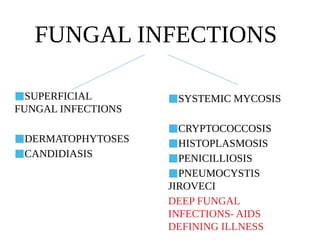
FUNGAL INFECTIONS
■SUPERFICIAL
FUNGAL INFECTIONS
■DERMATOPHYTOSES
■CANDIDIASIS
■SYSTEMIC MYCOSIS
■CRYPTOCOCCOSIS
■HISTOPLASMOSIS
■PENICILLIOSIS
■PNEUMOCYSTIS
JIROVECI
DEEP FUNGAL
INFECTIONS- AIDS
DEFINING ILLNESS
DERMATOPHYTOSES
▶Common in HIV , More prevalent in MSM-even
without HIV
▶Tinea cruris , Tinea corporis, Tinea pedis ,
onychomycosis
▶Widespread dermatophytoses NOT common in HIV
➢Atypical morphology
➢Lesions have little inflammation and often lack the
elevated border
➢Atypical presentations like deep , invasive
dermatophytosis , Majocchi’s granuloma
➢Atypical sites
➢Penis scrotum
➢Tinea capitis in adults –could be a sign of HIV
▶Esophageal candidiasis ,candidiasis of trachea
bronchi lungs- AIDS defining illness
CANDIDIASIS
VIRAL INFECTIONS
▶Both HSV 1 and 2 are common
▶Atypical, extensive ,respond poorly to conventional
treatment
▶Large deep ulcers
▶Chronic herpetic ulcers of longer than 1 month
duration- AIDS defining illness
HERPES SIMPLEX VIRUS
▶Varicella / chicken pox
↖Prolonged course
↖Lesions may be Verrucous
↖Complications- pneumonitis, meningitis,bacterial
infections
VARICELLA ZOSTER INFECTION
➢ Herpes zoster
-occurs in younger age group in HIV patients
-Can present as atypical forms
Multidermatomal HZ
Disseminated HZ
Verrucous lesion
necrotic or ulcerative lesions
-systemic complications like fulminant hepatitis and acute
meningoencephalitis
-recurrences are common
▶Atypical in location, morphology, and size
▶Extensive ,giant , warty , Extragenital sites(FACE)
MOLLUSCUM CONTAGIOSUM
ORAL HAIRY LEUKOPLAKIA
-EBV
-Asymptomatic raised corrugated white lesion on the
lateral tongue .
-D/d -oral candidiasis
HUMAN PAPILLOMA VIRUS
➢Common warts ,anogenital warts, oral lesions
-diffuse
-occur at multiple sites
-vegetating types
➢ Increased risk of premalignant and malignant
conditions
PARASITIC INFECTIONS
➢Norwegian scabies
SCABIES
NEOPLASMS
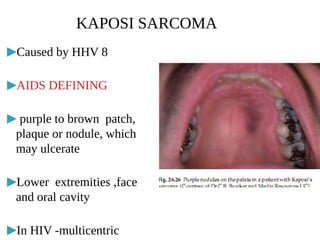
KAPOSI SARCOMA
▶Caused by HHV 8
▶AIDS DEFINING
▶ purple to brown patch,
plaque or nodule, which
may ulcerate
▶Lower extremities ,face
and oral cavity
▶In HIV -multicentric
▶Primary skin malignancies are most common NADCs
▶SCC: BCC in HIV infected individuals is 1 : 7
▶SCC may present atypically, at a younger age, at
unusual sites (e.g. the nail fold) and be multifocal and
aggressive
NON AIDS DEFINING CANCERS
➢Melanoma- present atypically and behave more
aggressively. May occur as benign macules or multiple
naevoid lesions.
DRUG REACTIONS
▶Commonly used drugs
◦ATT
◦ART
◦Antibiotics esp Septran
▶Therefore, a prior drug reaction does not constitute
an absolute contraindication to continued or further
treatment with a particular drug.
▶ART
◦Pruritis
◦Rash
◦SJS/TEN
IRIS (IMMUNE RECONSTITUTION
INFLAMMATORY SYNDROME)
TAKE HOME MESSAGE
ALL skin diseases in HIV patients in general
have
▶Unusual sites
▶Unusual presentations
▶Refractory to conventional therapy
▶Longer duration of treatment required
▶Continue ART
Skin manifestations may be due
to
▶Disease
OR
▶Drug
In patients presenting with
▶Unusual/rare diseases
▶Unusual presentations of common
diseases
▶Not responding to Conventional
therapy
Think of HIV
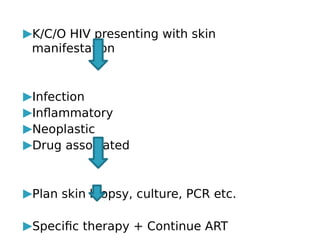
▶K/C/O HIV presenting with skin
manifestation
▶Infection
▶Inflammatory
▶Neoplastic
▶Drug associated
▶Plan skin biopsy, culture, PCR etc.
▶Specific therapy + Continue ART

Cutaneous hiv