
A SEMINAR ON
CAGE CULTURE OF FISH THEIR TREND, STATUS AND
PRODUCTION
Ashish sahu
INDEX
1) Introduction
2) Cultivable species
3) Type of cage
4) Construction of cage
5) Environmental impact 0f cage culture
6) Stocking
7) Cage culture production
8) Advantage
9) Disadvantage
10)Reference
INTRODUCTION
Cage culture is an aquaculture production system where fish
are held in cage .
Cage culture is a system in which the cultured fish are
enclosed from all side allowing water to pass freely through
the enclosures .
The mesh size of the cage is kept smaller than the fish body.
Cage culture seem to have developed around 200 year ago
in Cambodia
According to FAO cage culture is being practiced in more
than 62 countries world wide .
Around 80 species are being culture in cage.
In India sea cage start in 2007 for culture sea bass at
Vishakhapatnam by CMFRI.
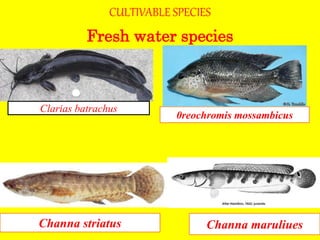
CULTIVABLE SPECIES
Fresh water species
Clarias batrachus
0reochromis mossambicus
Channa striatus Channa maruliues
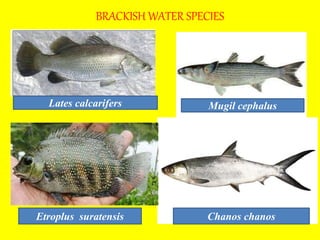
BRACKISH WATER SPECIES
Lates calcarifers Mugil cephalus
Chanos chanosEtroplus suratensis
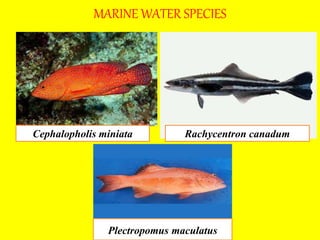
MARINE WATER SPECIES
Cephalopholis miniata Rachycentron canadum
Plectropomus maculatus
Types of cage
Floating
cage
Fixed cage
Submersible
cage
Submerged
cage
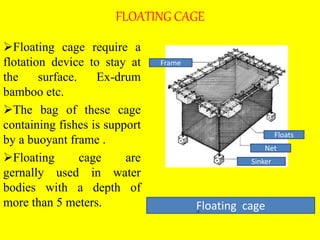
FLOATING CAGE
Floating cage require a
flotation device to stay at
the surface. Ex-drum
bamboo etc.
The bag of these cage
containing fishes is support
by a buoyant frame .
Floating cage are
gernally used in water
bodies with a depth of
more than 5 meters. Floating cage
Frame
Floats
Net
Sinker
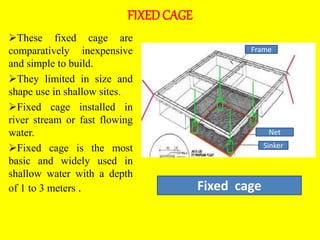
FIXEDCAGE
These fixed cage are
comparatively inexpensive
and simple to build.
They limited in size and
shape use in shallow sites.
Fixed cage installed in
river stream or fast flowing
water.
Fixed cage is the most
basic and widely used in
shallow water with a depth
of 1 to 3 meters . Fixed cage
Frame
Net
Sinker
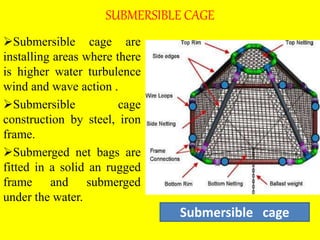
SUBMERSIBLE CAGE
Submersible cage are
installing areas where there
is higher water turbulence
wind and wave action .
Submersible cage
construction by steel, iron
frame.
Submerged net bags are
fitted in a solid an rugged
frame and submerged
under the water.
Submersible cage
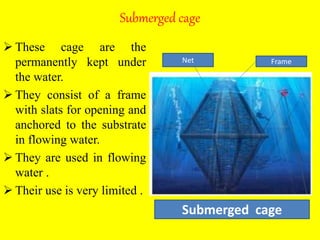
Submerged cage
 These cage are the
permanently kept under
the water.
 They consist of a frame
with slats for opening and
anchored to the substrate
in flowing water.
 They are used in flowing
water .
 Their use is very limited .
Submerged cage
FrameNet
CONTRUCTION OF CAGE
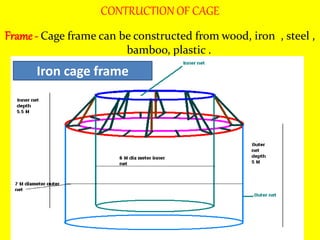
Frame - Cage frame can be constructed from wood, iron , steel ,
bamboo, plastic .
Iron cage frame
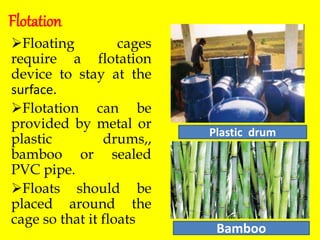
Flotation
Floating cages
require a flotation
device to stay at the
surface.
Flotation can be
provided by metal or
plastic drums,,
bamboo or sealed
PVC pipe.
Floats should be
placed around the
cage so that it floats
Plastic drum
Bamboo
MESH or NETTING
Mesh or netting made from wire mesh or nylon
netting . Plastic netting is durable , semirigid ,
light weight and less expensive than the wire
mesh .
Nylon mesh is inexpensive moderately durable ,
light weight and easy to handle.
The mesh size of cage is kept smaller then the fish
body . Mesh size of tilapia cage should be at least
1.5 cm but 2 cm is preferred.
Large mesh size facilitates the entry of wild fish
into the cage .
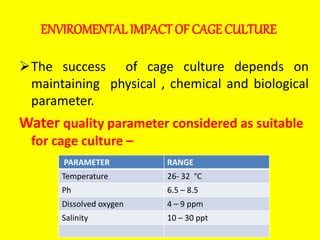
ENVIROMENTAL IMPACT OF CAGE CULTURE
The success of cage culture depends on
maintaining physical , chemical and biological
parameter.
Water quality parameter considered as suitable
for cage culture –
PARAMETER RANGE
Temperature 26- 32 °C
Ph 6.5 – 8.5
Dissolved oxygen 4 – 9 ppm
Salinity 10 – 30 ppt
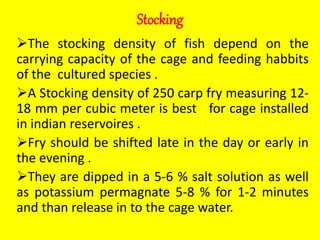
Stocking
The stocking density of fish depend on the
carrying capacity of the cage and feeding habbits
of the cultured species .
A Stocking density of 250 carp fry measuring 12-
18 mm per cubic meter is best for cage installed
in indian reservoires .
Fry should be shifted late in the day or early in
the evening .
They are dipped in a 5-6 % salt solution as well
as potassium permagnate 5-8 % for 1-2 minutes
and than release in to the cage water.
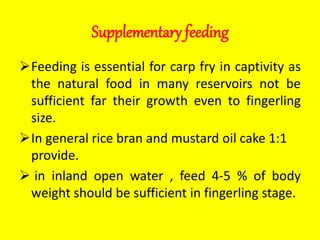
Supplementary feeding
Feeding is essential for carp fry in captivity as
the natural food in many reservoirs not be
sufficient far their growth even to fingerling
size.
In general rice bran and mustard oil cake 1:1
provide.
 in inland open water , feed 4-5 % of body
weight should be sufficient in fingerling stage.
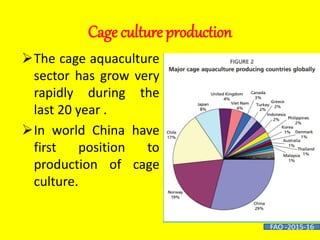
Cage culture production
The cage aquaculture
sector has grow very
rapidly during the
last 20 year .
In world China have
first position to
production of cage
culture.
FAO -2015-16
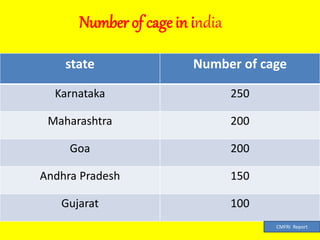
Number of cage in india
state Number of cage
Karnataka 250
Maharashtra 200
Goa 200
Andhra Pradesh 150
Gujarat 100
CMFRI Report
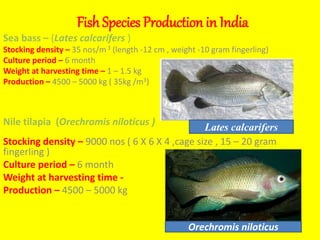
Fish Species Production in India
Sea bass – (Lates calcarifers )
Stocking density – 35 nos/m3 (length -12 cm , weight -10 gram fingerling)
Culture period – 6 month
Weight at harvesting time – 1 – 1.5 kg
Production – 4500 – 5000 kg ( 35kg /m3)
Nile tilapia (Orechromis niloticus )
Stocking density – 9000 nos ( 6 X 6 X 4 ,cage size , 15 – 20 gram
fingerling )
Culture period – 6 month
Weight at harvesting time -
Production – 4500 – 5000 kg
Lates calcarifers
Orechromis niloticus
ADVANTAGE
 Its installation is easy.
 Less manpower requirement.
 In emergencies it can be removed from one place to
another place.
 Treatment of disease is much simple than pond culture.
 Many types of water resources can be used, including
lakes, reservoirs, ponds and rivers.
 fish harvesting are very simple.
 Fish culture in the cage is to practice monoculture of
selected species.
DISADVANTAGE
Disease are common problem in cage culture .The
crowding in cage promotes stress and allows disease
organisms spread rapidly.
Cage fish an unable to get the natural food of their
choice , where it is readily available to the free fish.
During feeding a significant amount of fish feed passes
out through the mesh there fore fish require feeding many
time a day.
Stocked fish simply affected by the external water
quality problems.
Predation can be a problem , if cage are not constructed
or managed properly .
Reference
 Hand book of aquaculture – Dr. S. Ayyappan
(page no-469 to 490 chapter no – 21 , First edition )
 General and applied ichthyology – S.K. Gupta & P.C.
Gupta ( page no-725-730 first edition 2006)
 www. Cage culture .com (image)
 CMFRI cage culture research center karwar report
(2015 – 16)
CAGE CULTURE OF FISH THEIR TREND,STATUS AND PRODUCTION