Cryptography and its application for data security.ppt
1.
Cryptography is thescience of using
mathematics to encrypt and decrypt data.
Cryptography enables you to store sensitive
information or transmit it across insecure
networks (like the Internet) so that it cannot be
read by anyone except the intended recipient.
2.
What is Cryptography?
•The art of secret writing
• The art of protection using information
• The science of encrypting or hiding
secrets
• Needed for confidentiality
6.
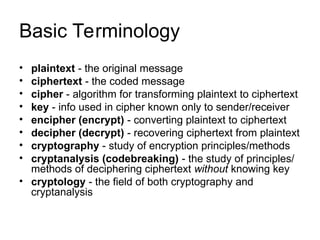
Basic Terminology
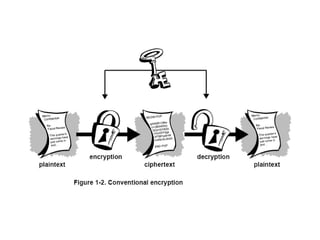
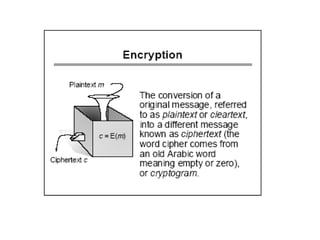
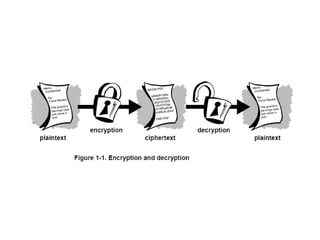
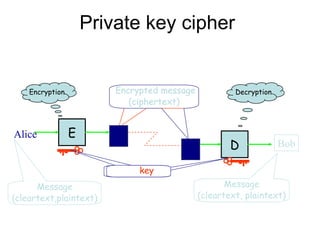
• plaintext- the original message
• ciphertext - the coded message
• cipher - algorithm for transforming plaintext to ciphertext
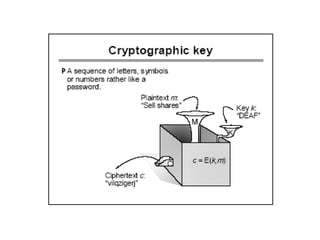
• key - info used in cipher known only to sender/receiver
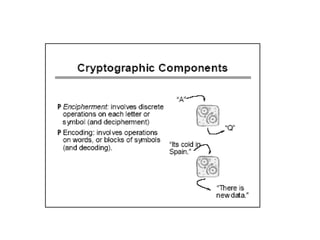
• encipher (encrypt) - converting plaintext to ciphertext
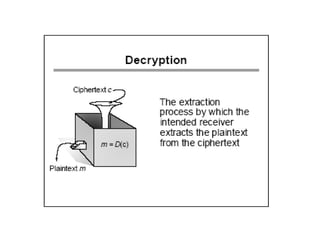
• decipher (decrypt) - recovering ciphertext from plaintext
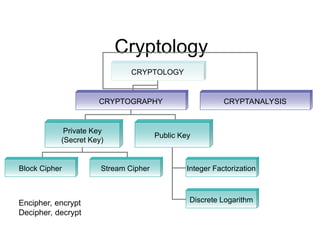
• cryptography - study of encryption principles/methods
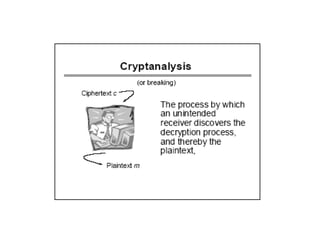
• cryptanalysis (codebreaking) - the study of principles/
methods of deciphering ciphertext without knowing key
• cryptology - the field of both cryptography and
cryptanalysis
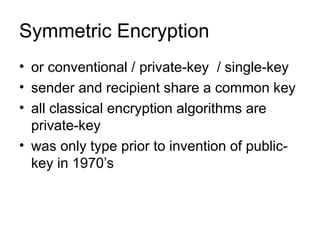
Symmetric Encryption
• orconventional / private-key / single-key
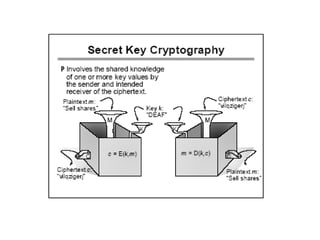
• sender and recipient share a common key
• all classical encryption algorithms are
private-key
• was only type prior to invention of public-
key in 1970’s
20.
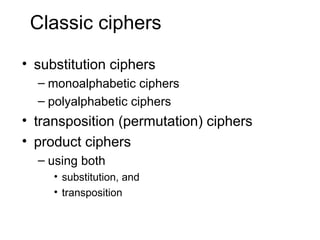
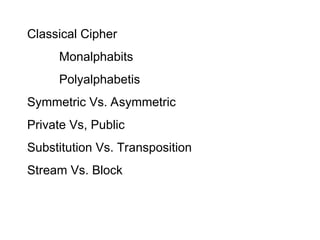
Classic ciphers
• substitutionciphers
– monoalphabetic ciphers
– polyalphabetic ciphers
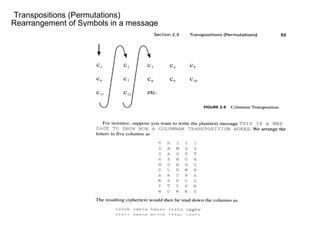
• transposition (permutation) ciphers
• product ciphers
– using both
• substitution, and
• transposition
21.
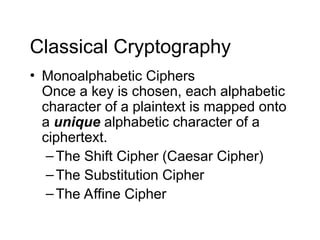
Classical Cryptography
• MonoalphabeticCiphers
Once a key is chosen, each alphabetic
character of a plaintext is mapped onto
a unique alphabetic character of a
ciphertext.
–The Shift Cipher (Caesar Cipher)
–The Substitution Cipher
–The Affine Cipher
22.
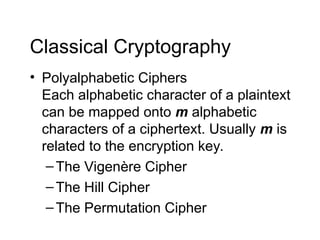
Classical Cryptography
• PolyalphabeticCiphers
Each alphabetic character of a plaintext
can be mapped onto m alphabetic
characters of a ciphertext. Usually m is
related to the encryption key.
–The Vigenère Cipher
–The Hill Cipher
–The Permutation Cipher
23.
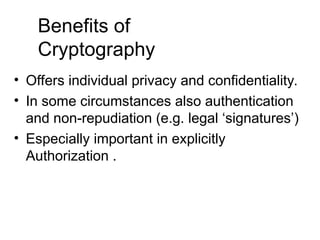
Benefits of
Cryptography
• Offersindividual privacy and confidentiality.
• In some circumstances also authentication
and non-repudiation (e.g. legal ‘signatures’)
• Especially important in explicitly
Authorization .
25.
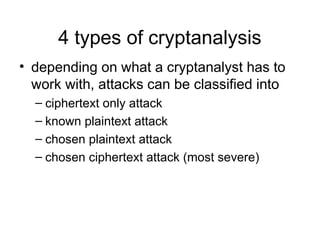
4 types ofcryptanalysis
• depending on what a cryptanalyst has to
work with, attacks can be classified into
– ciphertext only attack
– known plaintext attack
– chosen plaintext attack
– chosen ciphertext attack (most severe)
26.
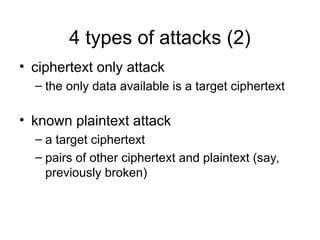
4 types ofattacks (2)
• ciphertext only attack
– the only data available is a target ciphertext
• known plaintext attack
– a target ciphertext
– pairs of other ciphertext and plaintext (say,
previously broken)
27.
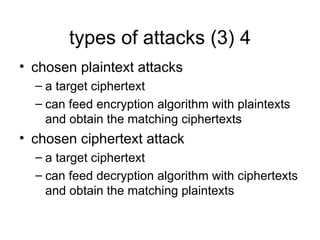
4
types of attacks(3)
• chosen plaintext attacks
– a target ciphertext
– can feed encryption algorithm with plaintexts
and obtain the matching ciphertexts
• chosen ciphertext attack
– a target ciphertext
– can feed decryption algorithm with ciphertexts
and obtain the matching plaintexts
28.
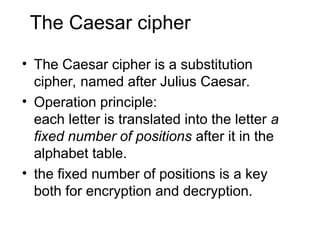
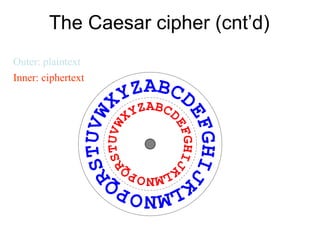
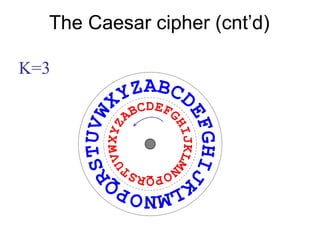
The Caesar cipher
•The Caesar cipher is a substitution
cipher, named after Julius Caesar.
• Operation principle:
each letter is translated into the letter a
fixed number of positions after it in the
alphabet table.
• the fixed number of positions is a key
both for encryption and decryption.
Caesar Cipher
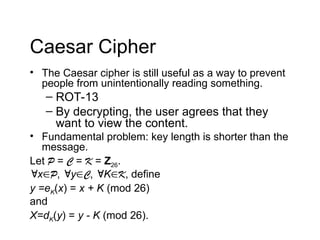
• TheCaesar cipher is still useful as a way to prevent
people from unintentionally reading something.
– ROT-13
– By decrypting, the user agrees that they
want to view the content.
• Fundamental problem: key length is shorter than the
message.
Let P = C = K = Z26.
xP, yC, KK, define
y =eK(x) = x + K (mod 26)
and
X=dK(y) = y - K (mod 26).
33.
An example
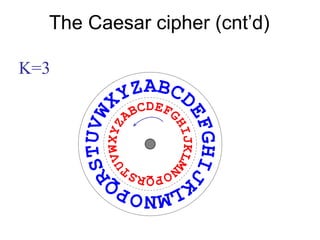
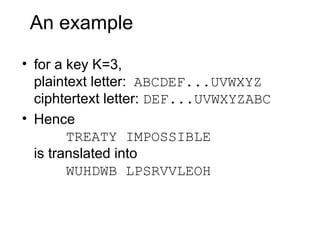
• fora key K=3,
plaintext letter: ABCDEF...UVWXYZ
ciphtertext letter: DEF...UVWXYZABC
• Hence
TREATY IMPOSSIBLE
is translated into
WUHDWB LPSRVVLEOH
34.
Breaking the Caesarcipher
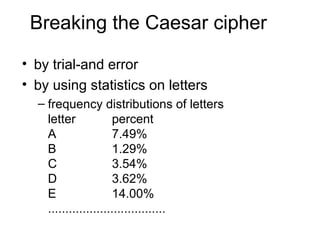
• by trial-and error
• by using statistics on letters
– frequency distributions of letters
letter percent
A 7.49%
B 1.29%
C 3.54%
D 3.62%
E 14.00%
..................................
36.
Shift cipher
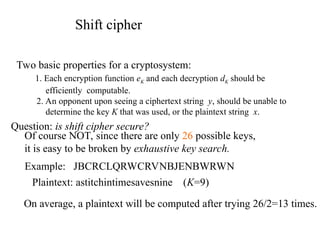
Two basicproperties for a cryptosystem:
1. Each encryption function eK and each decryption dK should be
efficiently computable.
2. An opponent upon seeing a ciphertext string y, should be unable to
determine the key K that was used, or the plaintext string x.
Question: is shift cipher secure?
Of course NOT, since there are only 26 possible keys,
it is easy to be broken by exhaustive key search.
Example: JBCRCLQRWCRVNBJENBWRWN
On average, a plaintext will be computed after trying 26/2=13 times.
Plaintext: astitchintimesavesnine (K=9)
37.
Substitution Ciphers
• Symbolsare replaced by other symbols according to a key.
– Caesar cipher is a substitution cipher.
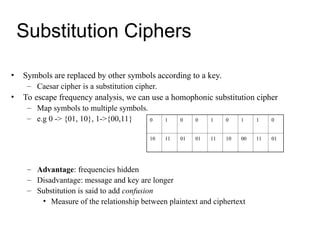
• To escape frequency analysis, we can use a homophonic substitution cipher
– Map symbols to multiple symbols.
– e.g 0 -> {01, 10}, 1->{00,11}
– Advantage: frequencies hidden
– Disadvantage: message and key are longer
– Substitution is said to add confusion
• Measure of the relationship between plaintext and ciphertext
0
1
1
0
1
0
0
1
0
01
11
00
10
11
01
01
11
10
38.
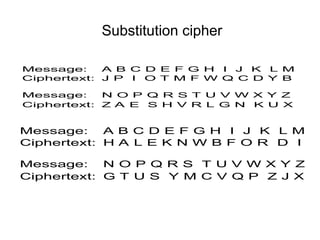
Substitution cipher
Message: AB C D E F G H I J K L M
Ciphertext: J P I O T M F W Q C D Y B
Message: N O P Q R S T U V W X Y Z
Ciphertext: Z A E S H V R L G N K U X
Message: A B C D E F G H I J K L M
Ciphertext: H A L E K N W B F O R D I
Message: N O P Q R S T U V W X Y Z
Ciphertext: G T U S Y M C V Q P Z J X
39.
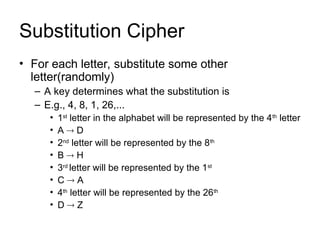
Substitution Cipher
• Foreach letter, substitute some other
letter(randomly)
– A key determines what the substitution is
– E.g., 4, 8, 1, 26,...
• 1st
letter in the alphabet will be represented by the 4th
letter
• A D
• 2nd
letter will be represented by the 8th
• B H
• 3rd
letter will be represented by the 1st
• C A
• 4th
letter will be represented by the 26th
• D Z
40.
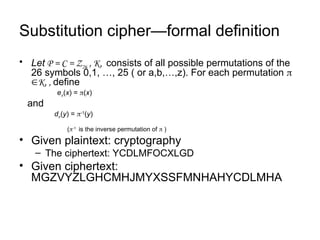
Substitution cipher—formal definition
•Let P = C = Z26 , K, consists of all possible permutations of the
26 symbols 0,1, …, 25 ( or a,b,…,z). For each permutation
K, , define
e(x) = (x)
and
d(y) = -1
(y)
(-1
is the inverse permutation of )
• Given plaintext: cryptography
– The ciphertext: YCDLMFOCXLGD
• Given ciphertext:
MGZVYZLGHCMHJMYXSSFMNHAHYCDLMHA
41.
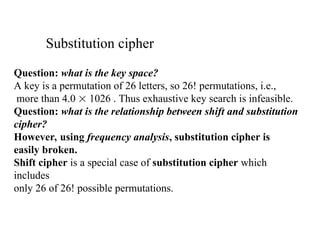
Substitution cipher
Question: whatis the key space?
A key is a permutation of 26 letters, so 26! permutations, i.e.,
more than 4.0 1026 . Thus exhaustive key search is infeasible.
Question: what is the relationship between shift and substitution
cipher?
However, using frequency analysis, substitution cipher is
easily broken.
Shift cipher is a special case of substitution cipher which
includes
only 26 of 26! possible permutations.
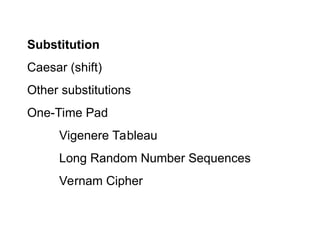
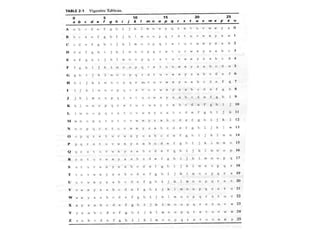
One-Time Pads
• Calledthe Perfect Key
• Large number of nonrepeating keys are
used
• Use Vigenere Tableau
• Problems:
– Absolute Synchronization between Sender
and Receiver
– Need for an Unlimited Number of Keys
46.
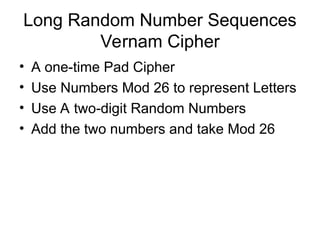
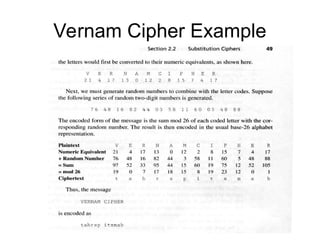
Long Random NumberSequences
Vernam Cipher
• A one-time Pad Cipher
• Use Numbers Mod 26 to represent Letters
• Use A two-digit Random Numbers
• Add the two numbers and take Mod 26
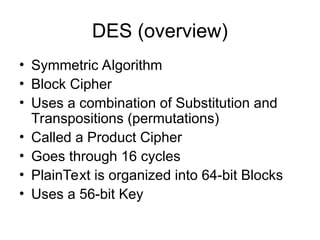
DES (overview)
• SymmetricAlgorithm
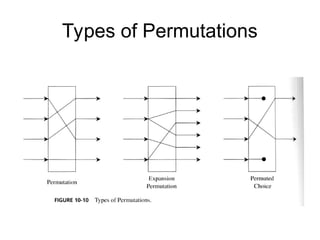
• Block Cipher
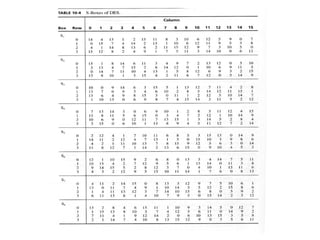
• Uses a combination of Substitution and
Transpositions (permutations)
• Called a Product Cipher
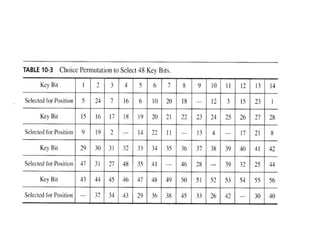
• Goes through 16 cycles
• PlainText is organized into 64-bit Blocks
• Uses a 56-bit Key
53.
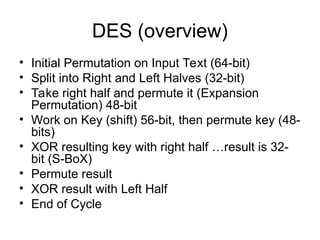
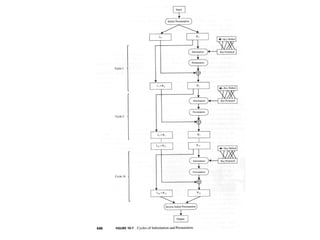
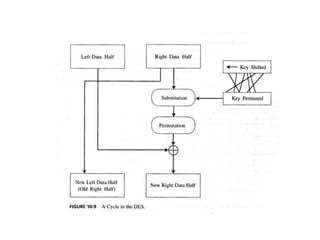
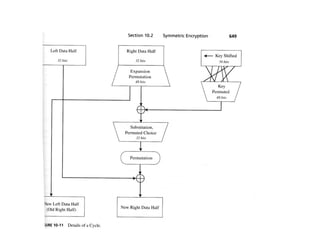
DES (overview)
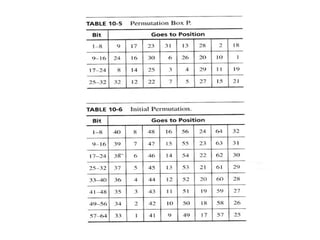
• InitialPermutation on Input Text (64-bit)
• Split into Right and Left Halves (32-bit)
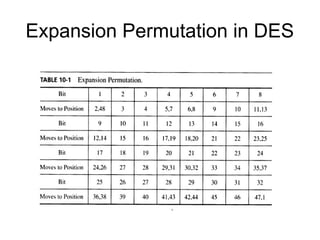
• Take right half and permute it (Expansion
Permutation) 48-bit
• Work on Key (shift) 56-bit, then permute key (48-
bits)
• XOR resulting key with right half …result is 32-
bit (S-BoX)
• Permute result
• XOR result with Left Half
• End of Cycle
54.
DES (cont.)
• Thenext cycle begins with:
– The result of previous cycle as its right half
– The old Right half (48-bit) as Its left half
Repeat
55.
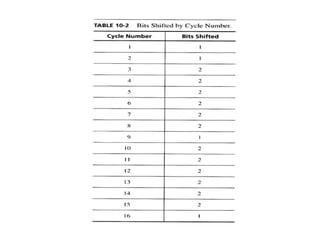
Key Transformation
• Startswith 64-bit
• Drop every eighth bit = 56 bits
• Split into two 28-bits halves
• Shift each key to the lift (number of bits)
• Paste both halves
• 48-bit key is then permuted
Advanced Encryption Standard
AES
"Itseems very simple."
"It is very simple. But if you don't know what
the key is it's virtually indecipherable."
—Talking to Strange Men, Ruth Rendell
66.
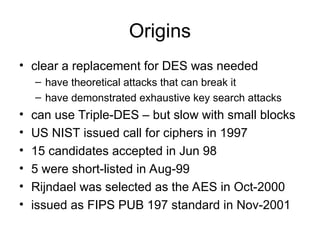
Origins
• clear areplacement for DES was needed
– have theoretical attacks that can break it
– have demonstrated exhaustive key search attacks
• can use Triple-DES – but slow with small blocks
• US NIST issued call for ciphers in 1997
• 15 candidates accepted in Jun 98
• 5 were short-listed in Aug-99
• Rijndael was selected as the AES in Oct-2000
• issued as FIPS PUB 197 standard in Nov-2001
67.
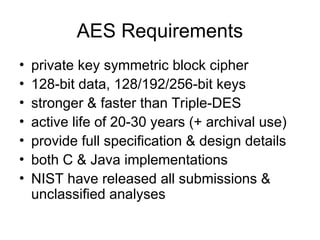
AES Requirements
• privatekey symmetric block cipher
• 128-bit data, 128/192/256-bit keys
• stronger & faster than Triple-DES
• active life of 20-30 years (+ archival use)
• provide full specification & design details
• both C & Java implementations
• NIST have released all submissions &
unclassified analyses
68.
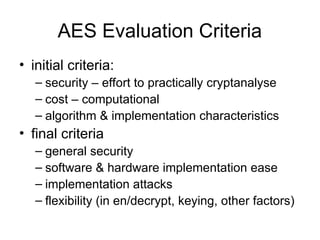
AES Evaluation Criteria
•initial criteria:
– security – effort to practically cryptanalyse
– cost – computational
– algorithm & implementation characteristics
• final criteria
– general security
– software & hardware implementation ease
– implementation attacks
– flexibility (in en/decrypt, keying, other factors)
69.
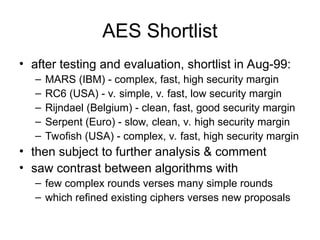
AES Shortlist
• aftertesting and evaluation, shortlist in Aug-99:
– MARS (IBM) - complex, fast, high security margin
– RC6 (USA) - v. simple, v. fast, low security margin
– Rijndael (Belgium) - clean, fast, good security margin
– Serpent (Euro) - slow, clean, v. high security margin
– Twofish (USA) - complex, v. fast, high security margin
• then subject to further analysis & comment
• saw contrast between algorithms with
– few complex rounds verses many simple rounds
– which refined existing ciphers verses new proposals
70.
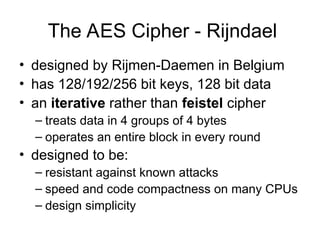
The AES Cipher- Rijndael
• designed by Rijmen-Daemen in Belgium
• has 128/192/256 bit keys, 128 bit data
• an iterative rather than feistel cipher
– treats data in 4 groups of 4 bytes
– operates an entire block in every round
• designed to be:
– resistant against known attacks
– speed and code compactness on many CPUs
– design simplicity
71.
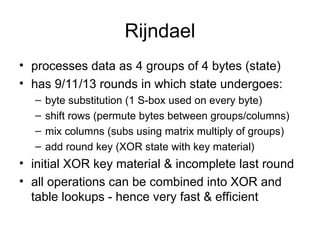
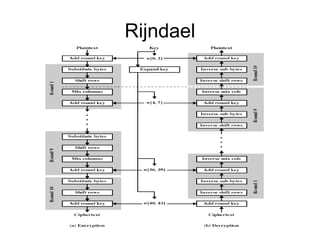
Rijndael
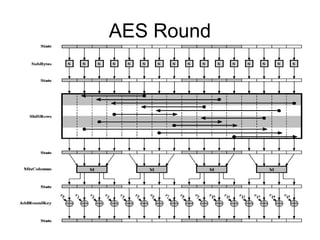
• processes dataas 4 groups of 4 bytes (state)
• has 9/11/13 rounds in which state undergoes:
– byte substitution (1 S-box used on every byte)
– shift rows (permute bytes between groups/columns)
– mix columns (subs using matrix multiply of groups)
– add round key (XOR state with key material)
• initial XOR key material & incomplete last round
• all operations can be combined into XOR and
table lookups - hence very fast & efficient
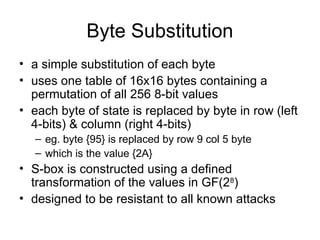
Byte Substitution
• asimple substitution of each byte
• uses one table of 16x16 bytes containing a
permutation of all 256 8-bit values
• each byte of state is replaced by byte in row (left
4-bits) & column (right 4-bits)
– eg. byte {95} is replaced by row 9 col 5 byte
– which is the value {2A}
• S-box is constructed using a defined
transformation of the values in GF(28
)
• designed to be resistant to all known attacks
74.
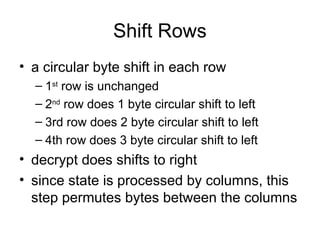
Shift Rows
• acircular byte shift in each row
– 1st
row is unchanged
– 2nd
row does 1 byte circular shift to left
– 3rd row does 2 byte circular shift to left
– 4th row does 3 byte circular shift to left
• decrypt does shifts to right
• since state is processed by columns, this
step permutes bytes between the columns
75.
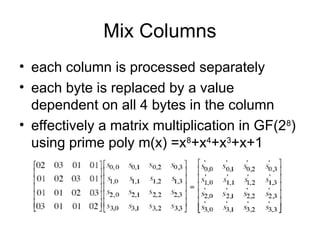
Mix Columns
• eachcolumn is processed separately
• each byte is replaced by a value
dependent on all 4 bytes in the column
• effectively a matrix multiplication in GF(28
)
using prime poly m(x) =x8
+x4
+x3
+x+1
76.
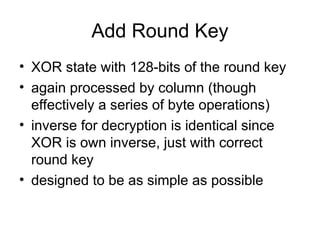
Add Round Key
•XOR state with 128-bits of the round key
• again processed by column (though
effectively a series of byte operations)
• inverse for decryption is identical since
XOR is own inverse, just with correct
round key
• designed to be as simple as possible
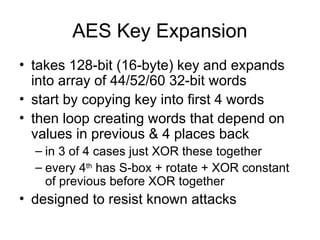
AES Key Expansion
•takes 128-bit (16-byte) key and expands
into array of 44/52/60 32-bit words
• start by copying key into first 4 words
• then loop creating words that depend on
values in previous & 4 places back
– in 3 of 4 cases just XOR these together
– every 4th
has S-box + rotate + XOR constant
of previous before XOR together
• designed to resist known attacks
79.
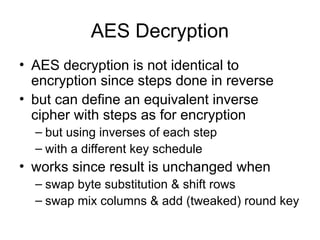
AES Decryption
• AESdecryption is not identical to
encryption since steps done in reverse
• but can define an equivalent inverse
cipher with steps as for encryption
– but using inverses of each step
– with a different key schedule
• works since result is unchanged when
– swap byte substitution & shift rows
– swap mix columns & add (tweaked) round key
80.
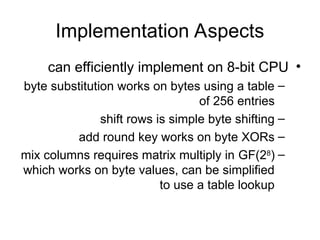
Implementation Aspects
•
can efficientlyimplement on 8-bit CPU
–
byte substitution works on bytes using a table
of 256 entries
–
shift rows is simple byte shifting
–
add round key works on byte XORs
–
mix columns requires matrix multiply in GF(28
)
which works on byte values, can be simplified
to use a table lookup
81.
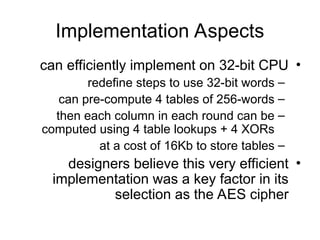
Implementation Aspects
•
can efficientlyimplement on 32-bit CPU
–
redefine steps to use 32-bit words
–
can pre-compute 4 tables of 256-words
–
then each column in each round can be
computed using 4 table lookups + 4 XORs
–
at a cost of 16Kb to store tables
•
designers believe this very efficient
implementation was a key factor in its
selection as the AES cipher
82.
Summary
•
have considered
:
–
the AESselection process
–
the details of Rijndael – the AES cipher
–
looked at the steps in each round
–
the key expansion
–
implementation aspects
Problems with privatekey ciphers
• In order for Alice & Bob to be able to
communicate securely using a private key
cipher, such as DES, they have to have a
shared key in the first place.
– Question:
What if they have never met before ?
• Alice needs to keep 100 different keys if
she wishes to communicate with 100
different people
87.
A question
• Considera group of n people, each wishing to
communicate securely with all other members
in the group, by using a private key cipher,
say DES.
– How many different secret keys does each
member of the group have to keep ?
– What’s the total number of different secret keys
that have to be kept by all members of the group ?
88.
Motivation of Diffie& Hellman
• Is it possible for Alice & Bob, who have no
shared secret key, to communicate
securely ?
• This led to the SINGLE MOST IMPORTANT
discovery in the history of secure
communications:
W. Diffie & M. Hellman: New Directions in Cryptography,
IEEE Transactions on Information Theory, Vol. IT-22, No.6,
Nov. 1976, pp.644-654.
89.
Main ideas
• Bob:
–publishes, say in Yellow/White pages, his
• public (encryption) key, and
• encryption algorithm.
– keeps to himself
• the matching secret (decryption) key.
90.
Main ideas (2)
•Alice:
– Looks up the phone book, and finds out Bob’s
• public (encryption) key, and
• encryption algorithm.
– Encrypts a message using Bob’s public key
and encryption algorithm.
– sends the ciphertext to Bob.
91.
Main ideas (3)
•Bob:
– Receives the ciphertext from Alice
– Decrypts the ciphertext using his secret
decryption key, together with the decryption
algorithm
92.
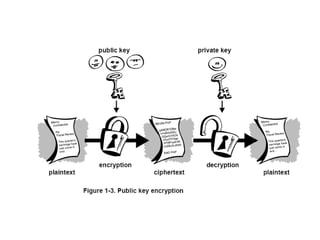
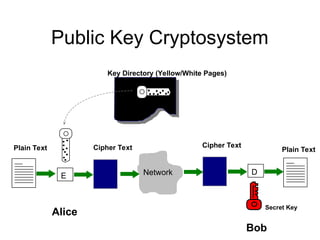
Public Key Cryptosystem
ENetwork
Plain Text Cipher Text Cipher Text
D
Plain Text
Alice
Bob
Bob:
Key Directory (Yellow/White Pages)
Secret Key
93.
Main differences withDES
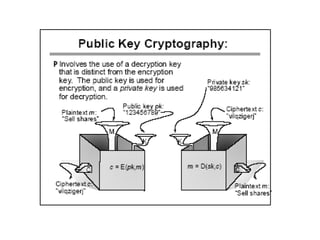
• The public encryption key is different from
the secret decryption key.
• Infeasible for an attacker to find out the
secret decryption key from the public
encryption key.
• no need for Alice & Bob to distribute a shared
secret key beforehand !
• only one pair of public and secret keys is
required for each user !
94.
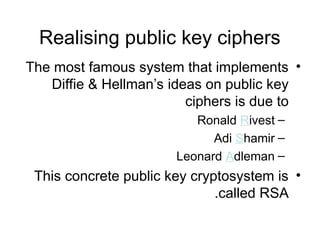
Realising public keyciphers
•
The most famous system that implements
Diffie & Hellman’s ideas on public key
ciphers is due to
–
Ronald Rivest
–
Adi Shamir
–
Leonard Adleman
•
This concrete public key cryptosystem is
called RSA
.
95.
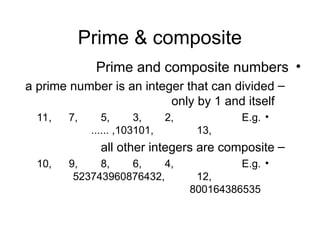
Prime & composite
•
Primeand composite numbers
–
a prime number is an integer that can divided
only by 1 and itself
•
E.g.
2,
3,
5,
7,
11,
13,
101,
103
...... ,
–
all other integers are composite
•
E.g.
4,
6,
8,
9,
10,
12,
523743960876432,
800164386535
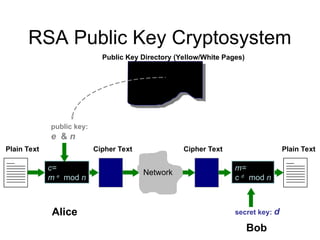
RSA Public KeyCryptosystem
c=
m e
mod n
Network
Plain Text Cipher Text Cipher Text Plain Text
Alice
Bob
Bob: (e, n)
Public Key Directory (Yellow/White Pages)
public key:
e & n
secret key: d
m=
c d
mod n
98.
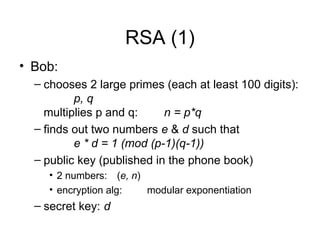
RSA (1)
• Bob:
–chooses 2 large primes (each at least 100 digits):
p, q
multiplies p and q: n = p*q
– finds out two numbers e & d such that
e * d = 1 (mod (p-1)(q-1))
– public key (published in the phone book)
• 2 numbers: (e, n)
• encryption alg: modular exponentiation
– secret key: d
99.
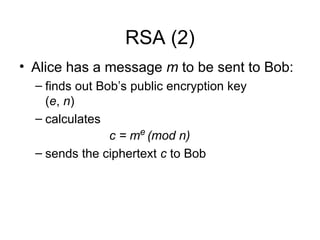
RSA (2)
• Alicehas a message m to be sent to Bob:
– finds out Bob’s public encryption key
(e, n)
– calculates
c = me
(mod n)
– sends the ciphertext c to Bob
100.
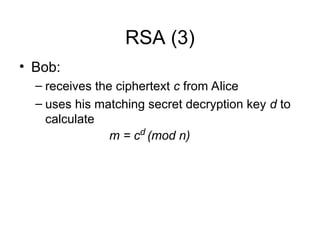
RSA (3)
• Bob:
–receives the ciphertext c from Alice
– uses his matching secret decryption key d to
calculate
m = cd
(mod n)
101.
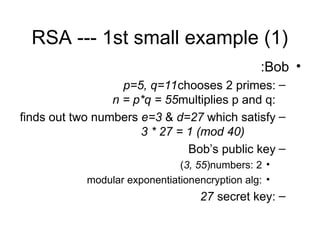
RSA --- 1stsmall example (1)
•
Bob
:
–
chooses 2 primes:
p=5, q=11
multiplies p and q:
n = p*q = 55
–
finds out two numbers e=3 & d=27 which satisfy
3 * 27 = 1 (mod 40)
–
Bob’s public key
•
2
numbers:
(3, 55)
•
encryption alg:
modular exponentiation
–
secret key:
27
102.
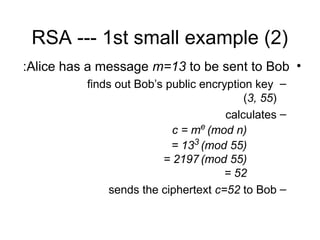
RSA --- 1stsmall example (2)
•
Alice has a message m=13 to be sent to Bob
:
–
finds out Bob’s public encryption key
(3, 55)
–
calculates
c = me
(mod n)
= 133
(mod 55)
= 2197 (mod 55)
= 52
–
sends the ciphertext c=52 to Bob
103.
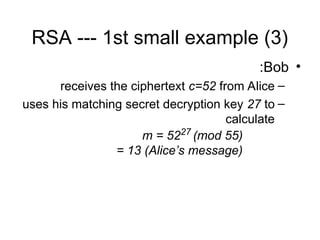
RSA --- 1stsmall example (3)
•
Bob
:
–
receives the ciphertext c=52 from Alice
–
uses his matching secret decryption key 27 to
calculate
m = 5227
(mod 55)
= 13 (Alice’s message)
104.
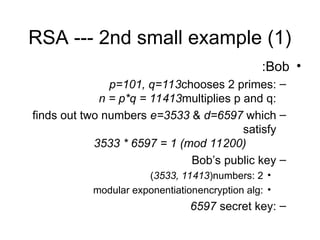
RSA --- 2ndsmall example (1)
•
Bob
:
–
chooses 2 primes:
p=101, q=113
multiplies p and q:
n = p*q = 11413
–
finds out two numbers e=3533 & d=6597 which
satisfy
3533 * 6597 = 1 (mod 11200)
–
Bob’s public key
•
2
numbers:
(3533, 11413)
•
encryption alg:
modular exponentiation
–
secret key:
6597
105.
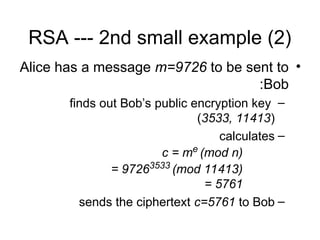
RSA --- 2ndsmall example (2)
•
Alice has a message m=9726 to be sent to
Bob
:
–
finds out Bob’s public encryption key
(3533, 11413)
–
calculates
c = me
(mod n)
= 97263533
(mod 11413)
= 5761
–
sends the ciphertext c=5761 to Bob
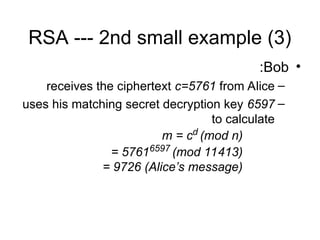
106.
RSA --- 2ndsmall example (3)
•
Bob
:
–
receives the ciphertext c=5761 from Alice
–
uses his matching secret decryption key 6597
to calculate
m = cd
(mod n)
= 57616597
(mod 11413)
= 9726 (Alice’s message)
107.
Remarks on RSA
•
Themessage m has to be an integer
between in the range [1, n]
.
•
To encrypt long messages we can use
modes of operation as for private key
ciphers, or a hybrid cryptosystem (see
later)
.
108.
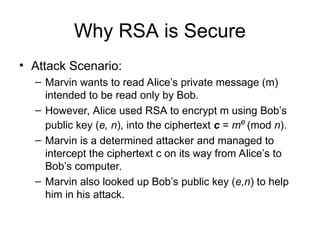
Why RSA isSecure
• Attack Scenario:
– Marvin wants to read Alice’s private message (m)
intended to be read only by Bob.
– However, Alice used RSA to encrypt m using Bob’s
public key (e, n), into the ciphertext c = me
(mod n).
– Marvin is a determined attacker and managed to
intercept the ciphertext c on its way from Alice’s to
Bob’s computer.
– Marvin also looked up Bob’s public key (e,n) to help
him in his attack.
109.
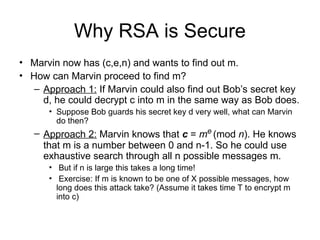
Why RSA isSecure
• Marvin now has (c,e,n) and wants to find out m.
• How can Marvin proceed to find m?
– Approach 1: If Marvin could also find out Bob’s secret key
d, he could decrypt c into m in the same way as Bob does.
• Suppose Bob guards his secret key d very well, what can Marvin
do then?
– Approach 2: Marvin knows that c = me
(mod n). He knows
that m is a number between 0 and n-1. So he could use
exhaustive search through all n possible messages m.
• But if n is large this takes a long time!
• Exercise: If m is known to be one of X possible messages, how
long does this attack take? (Assume it takes time T to encrypt m
into c)
110.
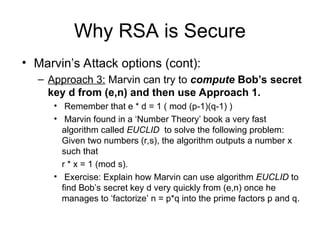
Why RSA isSecure
• Marvin’s Attack options (cont):
– Approach 3: Marvin can try to compute Bob’s secret
key d from (e,n) and then use Approach 1.
• Remember that e * d = 1 ( mod (p-1)(q-1) )
• Marvin found in a ‘Number Theory’ book a very fast
algorithm called EUCLID to solve the following problem:
Given two numbers (r,s), the algorithm outputs a number x
such that
r * x = 1 (mod s).
• Exercise: Explain how Marvin can use algorithm EUCLID to
find Bob’s secret key d very quickly from (e,n) once he
manages to ‘factorize’ n = p*q into the prime factors p and q.
111.
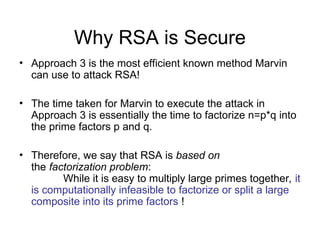
Why RSA isSecure
• Approach 3 is the most efficient known method Marvin
can use to attack RSA!
• The time taken for Marvin to execute the attack in
Approach 3 is essentially the time to factorize n=p*q into
the prime factors p and q.
• Therefore, we say that RSA is based on
the factorization problem:
While it is easy to multiply large primes together, it
is computationally infeasible to factorize or split a large
composite into its prime factors !
112.
Why RSA isSecure
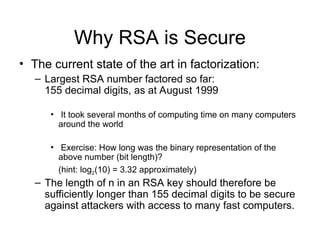
• The current state of the art in factorization:
– Largest RSA number factored so far:
155 decimal digits, as at August 1999
• It took several months of computing time on many computers
around the world
• Exercise: How long was the binary representation of the
above number (bit length)?
(hint: log2(10) = 3.32 approximately)
– The length of n in an RSA key should therefore be
sufficiently longer than 155 decimal digits to be secure
against attackers with access to many fast computers.
113.
Why RSA isSecure
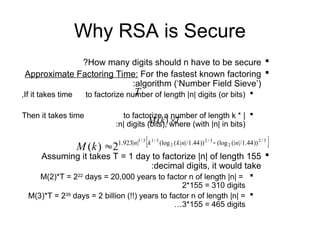
How many digits should n have to be secure
?
Approximate Factoring Time: For the fastest known factoring
algorithm (‘Number Field Sieve’)
:
If it takes time to factorize number of length |n| digits (or bits)
,
Then it takes time to factorize a number of length k * |
n| digits (bits), where (with |n| in bits)
:
Assuming it takes T = 1 day to factorize |n| of length 155
decimal digits, it would take
:
M(2)*T = 222
days = 20,000 years to factor n of length |n| =
2*155 = 310 digits
M(3)*T = 239
days = 2 billion (!!) years to factor n of length |n| =
3*155 = 465 digits
…
T
k
M
)
(
T
3
/
2
2
3
/
2
2
3
/
1
3
/
1
))
44
.
1
/
|
(|
(log
))
44
.
1
/
|
|
(
(log
|
|
923
.
1
2
)
( n
n
k
k
n
k
M
114.
Why RSA isSecure
•
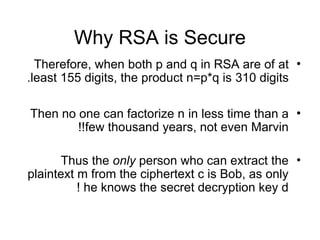
Therefore, when both p and q in RSA are of at
least 155 digits, the product n=p*q is 310 digits
.
•
Then no one can factorize n in less time than a
few thousand years, not even Marvin
!!
•
Thus the only person who can extract the
plaintext m from the ciphertext c is Bob, as only
he knows the secret decryption key d
!
115.
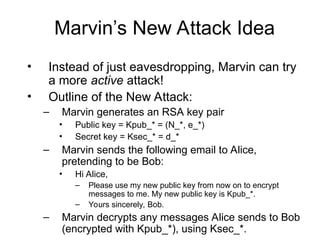
Marvin’s New AttackIdea
• Instead of just eavesdropping, Marvin can try
a more active attack!
• Outline of the New Attack:
– Marvin generates an RSA key pair
• Public key = Kpub_* = (N_*, e_*)
• Secret key = Ksec_* = d_*
– Marvin sends the following email to Alice,
pretending to be Bob:
• Hi Alice,
– Please use my new public key from now on to encrypt
messages to me. My new public key is Kpub_*.
– Yours sincerely, Bob.
– Marvin decrypts any messages Alice sends to Bob
(encrypted with Kpub_*), using Ksec_*.
116.
Preventing Marvin’s ActiveAttack
• The active attack works because:
– Alice was tricked by Marvin into encrypting a
message intended for Bob using a “fake” public key
which is NOT Bob’s public key (in fact it was
Marvin’s).
• To prevent the attack:
– Before Alice encrypts a message for Bob, she must make sure
she has Bob’s CORRECT public key (and not a fake one).
– Alice needs a way of testing the truth of any “Bob’s key
message” informing Alice of Bob’s Public Key.
– No one besides Bob should be able to produce such a message
so that it will pass Alice’s Test.
117.
Preventing Marvin’s ActiveAttack (2)
•
This is a setting where Alice and Bob have a message
integrity security requirement
!
–
Ie. Alice and Bob want to prevent fabrication and/or
modification of a “Bob’s key message” (a message
informing Alice of Bob’s public key) by unautorised
parties (like Marvin)
.
•
The main cryptographic tool used to achieve message
integrity is “Digital Signatures
.”
•
In a later lecture (after we have covered “Digital
Signatures”), we will come back to this topic and see how
Digital Signatures can be used to prevent Marvin’s Attack
!
118.
Private key ciphers
•Good points
– in-expensive to use
– fast
– low cost VLSI chips available
• bad points
– key distribution is a problem
119.
Public key ciphers
•good points
– key distribution is NOT a problem
• bad points
– relatively expensive to use
– relatively slow
– VLSI chips not available or relatively high cost
120.
Combining 2 typeof ciphers
• In practice, we
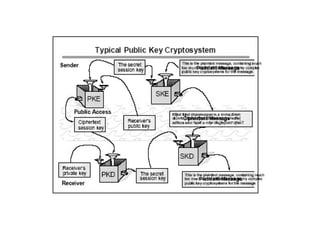
– use a public key cipher (such as RSA) to
distribute keys
– use a private key cipher (such as DES) to
encrypt and decrypt messages
Editor's Notes
#66 The AES candidates are the latest generation of block ciphers, and now we see a significant increase in the block size - from the old standard of 64-bits up to 128-bits; and keys from 128 to 256-bits. In part this has been driven by the public demonstrations of exhaustive key searches of DES. Whilst triple-DES is regarded as secure and well understood, it is slow, especially in s/w.
#68 Initial criteria were issued with call, and used to evaluate field of 15 candidates to select shortlist of 5.
The final criteria were used to select Rijndael from that short-list.
#69 The shortlist is as shown. Note mix of commercial (MARS, RC6, Twofish) verses academic (Rijndael, Serpent) proposals, sourced from various countries.
All were thought to be good – came down to best balance of attributes to meet criteria.
#70 Rijndael is an academic submission, based on the earlier Square cipher, from Belgium academics Dr Joan Daemen and Dr Vincent Rijmen.
It is an iterative cipher (operates on entire data block in every round) rather than feistel (operate on halves at a time). cf IDEA cipher
#71 Data is written into the state matrix by columns; this matrix is manipulated at stage of the en/decryption process, and is then finally copied to the output.
The key is expanded into 44/52/60 lots of 32-bit words (see later), with 4 used in each round.
The data computation then consists of an “add round key” step, then 9/11/13 rounds with all 4 steps, and a final 10th/12th/14th step of byte subs + mix cols + add round key. All steps are easily reversed.
Note only the “add round key” step makes use of the key and obscures the result, hence MUST be used at start and end of each round, since otherwise could undo effect of other steps. But the other steps provide confusion/diffusion/non-linearity. ie can look at cipher as a series of XOR with key then scramble/permute block repeated. This is efficient and highly secure it is believed.
#73 There is a single 8-bit wide S-box used on every byte. This S-box is a permutation of all 256 8-bit values, constructed using a transformation which treats the values as polynomials in GF(28) – however it is fixed, so really only need to know the table when implementing. Decryption requires the inverse of the table.
#74 This step provides “permutation” of the data, whereas the other steps involve substitutions.
#75 This step is also a substitution, but one involving ALL values in a column. Designed as a matrix multiplication where each byte is treated as a polynomial in GF(28). The inverse used for decryption involves a different set of constants.
The constants used are based on a linear code with maximal distance between code words – this gives good mixing of the bytes within each column. Combined with the “shift rows” step provides good avalanche, so that within a few rounds, all output bits depend on all input bits.
#78 Key expansion is designed to be simple to implement, but by using round constants break symmetries, and make it much harder to deduce other key bits if just some are known (but once have as many consecutive bits as are in key, can then easily recreate the full expansion).
#79 By constructing an equivalent inverse cipher with steps in same order as for encryption, can derive a more efficient implementation. Clearly swapping the byte substitutions and shift rows has no effect, since work just on bytes. Swapping the mix columns and add round key steps requires the inverse mix columns step be applied to the round keys first – this makes the decryption schedule a little more complex with this construction.
#83 Last lecture we saw the data encryption standard. However this require that the secret keys need to be exchanged between the parties and a number of pairs of such keys has to be maintained by each user (How many are they if you communicate with n different people and there are m such people in the population and assume n <m).
We want to look at another method which avoids knowing that many no of keys
#84 We will discuss in this lecture why we need public key cryptography, how it works and an example of a system
#86 The major problem with the private key encryption technique is how securely you can exchange the key over the network without being evedropped.
Also how many such keys you need to remember if you communicate with n other individual?
#87 Each person has to remember (n-1) keys and there are n people and hence the total number of keys will be n(n-1)/2 because either A communicates with B or B communicates with A, there is only one key is required.
When n is large, this can be large?
What happen when you new person joins the group?
#88 Can we avoid secret key, yet transmit the message in an encrypted form so that it is difficult to dicipher?
#89 First let us look at the idea before formalise the method itself.
Public key may consists of 2 parts (usually 2 numbers – a binary string)
#90 Public key is published, either in yellow pages (such as in the individual web page).
#91 The receiver uses his private key to decrypt the message.
The trick is how the message encrypted by a key can be decrypted with another key (in other words what property these keys should satisfy so that the encryption and decryption can be done!
#92 Pictorially we mean by public key cryptosystem is shown in this slide.
#93 The major difference between secret key decryption and public key encryption is described in this slide.
#94 The most popular implementation of public key encryption system is due to RSA – named after three people who suggested the system.
#98 Without going into the modulo operation theory, this is what happens and you can take for granted from me that this will work.
The following slides explains through examples.
#107 The only restriction is that the message has to be less than n.
Probably we can break the message into chunks so that the above requirement is met.



![Remarks on RSA
•
The message m has to be an integer
between in the range [1, n]
.
•
To encrypt long messages we can use
modes of operation as for private key
ciphers, or a hybrid cryptosystem (see
later)
.](https://image.slidesharecdn.com/ch02-251007080801-db854d02/85/Cryptography-and-its-application-for-data-security-ppt-107-320.jpg)