Chapter – 5
Classification of Consonants according
to Manner of articulation & Place of
articulation
DESCRIPTION OF A CONSONANT
i. the state of the glottis
ii.the nature of the air-stream mechanism
iii. the position of the velum or soft palate
iv. the articulators involved
v. the nature of the stricture.
• For the production of English sounds we use
an egressive pulmonic air-stream, that is, the
air is pushed out of the lungs.
• Consonants can be voiceless or voiced,
depending upon whether the vocal cords are
held wide apart or in vibration.
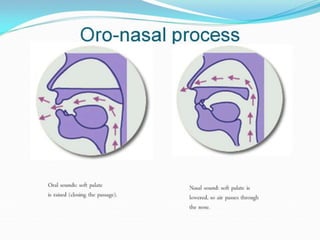
• There are the oral and nasal sounds.
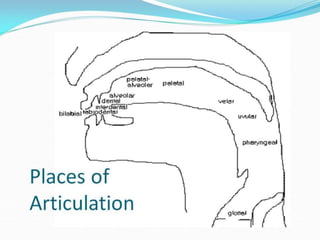
• Dental - The tip of the tongue is the active
articulator and the upper front teeth are the
passive articulators.[θ] as in think, [ð]as in
then
• Alveolar - The tip or the blade of the tongue is
the active articulator and the teeth-ridge is
the passive articulator.
/t/ as in stick ,/d/as in day /l/as in lid /n/ as in
nose, /s /as in sun /z/ as in zip
Post-alveolar. The tip of the tongue is the active
articulator and the back of the teeth-ridge is
the passive articulator. / r / as in red

Palato-alveolar. The tip, blade, and front of the
tongue are the active articulators and the
teeth-ridge and hard palate are the passive
articulators. /ʃ/ as in shame /3/ as in pleasure
/tʃ ] as in chin /dʒ/ as in jam
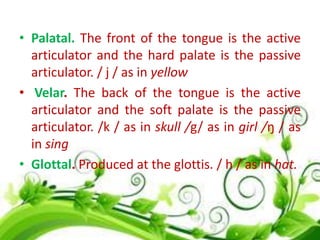
• Palatal. The front of the tongue is the active
articulator and the hard palate is the passive
articulator. / j / as in yellow
• Velar. The back of the tongue is the active
articulator and the soft palate is the passive
articulator. /k / as in skull /g/ as in girl /ŋ / as
in sing
• Glottal. Produced at the glottis. / h / as in hat.
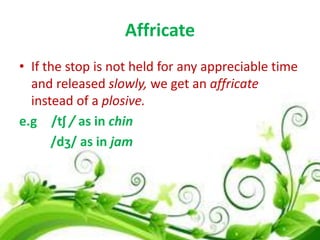
Affricate
• If the stop is not held for any appreciable time
and released slowly, we get an affricate
instead of a plosive.
e.g /tʃ / as in chin
/dʒ/ as in jam
Trill
• A trill is a consonant in the production of
which the active articulator taps several
times against the passive articulator. The
stricture involved can be called a stricture of
intermittent closure.
e.g Scottish / r / in which the tip of the longue
strikes against the teeth-ridge a number of
times. An example is the Telugu word [
gurramu ] for 'horse'.
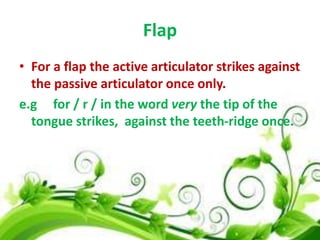
Flap
• For a flap the active articulator strikes against
the passive articulator once only.
e.g for / r / in the word very the tip of the
tongue strikes, against the teeth-ridge once.
Lateral
• A lateral consonant is produced by a stricture
of closure in the centre of the vocal tract, but
the air has a free passage on the sides.
e.g. / l / as in life.
Fricative
• In the production of a fricative consonant the stricture is
one of close approximation. The active articulator is
brought so close to the passive articulator that the passage
between them is very narrow and the air passes through it
with audible friction.
• /f / as in fill
• / v/ as in van
• /θ / as in three
• /ð /as in these
• / s /as in sit
• / z / as in zoo
• /ʃ/ as in shoe
• / 3 / as in leisure
• /h/as in has
Frictionless continuant
• A frictionless continuant is produced with an
open approximation of the articulators, so
that there is no audible friction.
e.g /r/ as in red
Semi-vowel
• A semi-vowel is a vowel glide functioning as a
consonant.
Semivowels are vowel-like
consonants like the w of wet or the y of yard.
The airflow doesn't stop like with a 'p' or 'b'.
e.g / j / as in yet
/w/ as in water
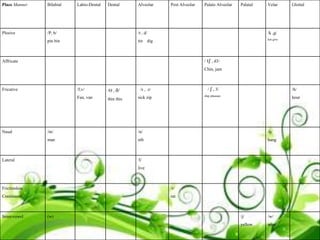
Place Manner

Bilabial

Labio-Dental

Dental

Alveolar

Post Alveolar

Palato Alveolar

Palatal

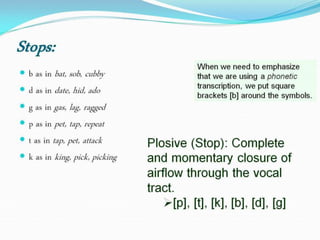
Plosive

/P, b/

/t , d/

/k ,g/

pin bin

tin

kin give

dig

Velar

Glottal

/ tʃ , d3/

Affricate

Chin, jam

Fricative

/f,v/
Fan, van

/Ө , ð/
thin this

/s , z/

/ ʃ , 3/

sick zip

ship pleasure

/h/
hour

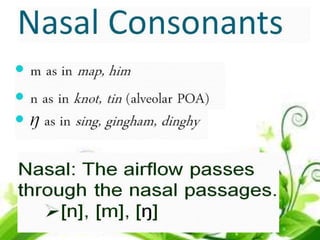
/m/

/n/

/ŋ/

man

Nasal

nib

hang

Lateral

/l/
live

Frictionless

/r/

Continuant

rat

Semi-vowel

(w)

/j/

/w/

yellow

wine

Phonetics presentation part II

  • 1.
    Chapter – 5 Classificationof Consonants according to Manner of articulation & Place of articulation
  • 2.
    DESCRIPTION OF ACONSONANT i. the state of the glottis ii.the nature of the air-stream mechanism iii. the position of the velum or soft palate iv. the articulators involved v. the nature of the stricture.
  • 3.
    • For theproduction of English sounds we use an egressive pulmonic air-stream, that is, the air is pushed out of the lungs. • Consonants can be voiceless or voiced, depending upon whether the vocal cords are held wide apart or in vibration. • There are the oral and nasal sounds.
  • 6.
    • Dental -The tip of the tongue is the active articulator and the upper front teeth are the passive articulators.[θ] as in think, [ð]as in then • Alveolar - The tip or the blade of the tongue is the active articulator and the teeth-ridge is the passive articulator. /t/ as in stick ,/d/as in day /l/as in lid /n/ as in nose, /s /as in sun /z/ as in zip
  • 7.
    Post-alveolar. The tipof the tongue is the active articulator and the back of the teeth-ridge is the passive articulator. / r / as in red Palato-alveolar. The tip, blade, and front of the tongue are the active articulators and the teeth-ridge and hard palate are the passive articulators. /ʃ/ as in shame /3/ as in pleasure /tʃ ] as in chin /dʒ/ as in jam
  • 8.
    • Palatal. Thefront of the tongue is the active articulator and the hard palate is the passive articulator. / j / as in yellow • Velar. The back of the tongue is the active articulator and the soft palate is the passive articulator. /k / as in skull /g/ as in girl /ŋ / as in sing • Glottal. Produced at the glottis. / h / as in hat.
  • 11.
    Affricate • If thestop is not held for any appreciable time and released slowly, we get an affricate instead of a plosive. e.g /tʃ / as in chin /dʒ/ as in jam
  • 13.
    Trill • A trillis a consonant in the production of which the active articulator taps several times against the passive articulator. The stricture involved can be called a stricture of intermittent closure. e.g Scottish / r / in which the tip of the longue strikes against the teeth-ridge a number of times. An example is the Telugu word [ gurramu ] for 'horse'.
  • 14.
    Flap • For aflap the active articulator strikes against the passive articulator once only. e.g for / r / in the word very the tip of the tongue strikes, against the teeth-ridge once.
  • 15.
    Lateral • A lateralconsonant is produced by a stricture of closure in the centre of the vocal tract, but the air has a free passage on the sides. e.g. / l / as in life.
  • 16.
    Fricative • In theproduction of a fricative consonant the stricture is one of close approximation. The active articulator is brought so close to the passive articulator that the passage between them is very narrow and the air passes through it with audible friction. • /f / as in fill • / v/ as in van • /θ / as in three • /ð /as in these • / s /as in sit • / z / as in zoo • /ʃ/ as in shoe • / 3 / as in leisure • /h/as in has
  • 17.
    Frictionless continuant • Africtionless continuant is produced with an open approximation of the articulators, so that there is no audible friction. e.g /r/ as in red
  • 18.
    Semi-vowel • A semi-vowelis a vowel glide functioning as a consonant. Semivowels are vowel-like consonants like the w of wet or the y of yard. The airflow doesn't stop like with a 'p' or 'b'. e.g / j / as in yet /w/ as in water
  • 19.
    Place Manner Bilabial Labio-Dental Dental Alveolar Post Alveolar PalatoAlveolar Palatal Plosive /P, b/ /t , d/ /k ,g/ pin bin tin kin give dig Velar Glottal / tʃ , d3/ Affricate Chin, jam Fricative /f,v/ Fan, van /Ө , ð/ thin this /s , z/ / ʃ , 3/ sick zip ship pleasure /h/ hour /m/ /n/ /ŋ/ man Nasal nib hang Lateral /l/ live Frictionless /r/ Continuant rat Semi-vowel (w) /j/ /w/ yellow wine