How to compare
Week 5,
Sem 1, 2015/2016
ROHANA ABDUL HAMID
TECHNIQUES
• 1. CASE STUDIES
• 2. FOCUSED COMPARISON
• 3. STATISTICAL ANALYSIS
1. Case studies
What is a case study ?
Intensive scrutiny of one case
Micro level and macro level analysis : the selection of
cases. Thus, it is a case oriented , not variable oriented.
Thick description. Multi-method : reading academic lit,
secondary documents, primary materials, interviews
What are cases ?
Individuals, organisations, processes, programs,
institutions, events
RQ : How and why questions:
Examples of case studies
• 1) Graham Allison’s study of a single case
(1971) about 1962 Cuban Missile Crises. He
explained the crises by using three competing
theories – U.S and Soviet Union performed as
a) rationale actors, b) complex bureaucracies
and c) politically motivated groups or persons.
• Single case study
Examples
2) A book about major strategies for improving
social conditions by illustrating four policy topics :
welfare reform, strengthening the child
education, education reform and transforming
neighborhoods. The book refers to specific cases
of successful programs.
• Results : The writer develops generalization
based on the case studies of the need for the
successful programs to be results oriented
• Multiple case cross analysis
Example [case studies with multiple cases]
3) A book with 8 social programs . The commonalities
in the program : the effectiveness of the programs
[although many these policy programs often meets
failure].
• However, the programs varied widely in their focus
such as : education, nutrition, drug prevention,
preschool education, delinquent youths, drug
treatment, homelessness, mental health.
• Findings : can identify programs that are low in cost ,
programs that have convincing evidence of long term
effects; enable the government to replicate
the programs
Single case study : comparative?
1) Single case study can be subsumed under
comparative method if it is theory-driven.
How ?
a) Theory infirming and theory confirming case
study : analysis of a single case within the
framework of established generalizations.
The case is the test of the proposition , which
in turn may confirmed or infirmed by it.
….
b) Deviant case : studies of single case that are
known to deviate from established
generalizations.
So , why do we select the case ?
We want to uncover relevant variables that are not
considered previously.
What is the theoretical value?
It weakens the original proposition , able to suggest
modified proposition that may be stronger.
…..
• C) Representative case : Typical and standard
example of a wider category. It is common, useful
and undramatic.
• A collection of representation of cases
(representative) will provide raw materials for
later distillation/ subsequent generalizations.
Example : Coalition government – choose to study
the phenomena in your country in detail. Home
country is your research site, but you hope that
the results would contribute to broader
comparative understanding. HOW ?
Disadvantage of single case study and
who do we do about it ?
• 1) What works in country A may not work in
country B.
• Why ?
Contextual differences. But by drawing
analogies , case studies can encourage the
search for more general knowledge .
Asking question : What differences between
countries explain why the same policy led to
contrasting result ?
Other types of case study
4) Prototypical case study = The case is chosen
because it is expected to become so.
Example : US has been used as a prototype case for
democracy. Why ? This is because it is pioneering
in democracy. Thus, when we study the case, it
helps us to understand the phenomenon
occurred elsewhere.
• 5) Archetypical case study = creates the category.
• Example : French Revolution. Refer to French
revolution when you want to look at the study of
revolution.
….
• 6) Critical type of case study : if it works here,
it would work anywhere.
• Example: Imposing democracy in Iraq (case).
Iraq – a country with little experience of
democracy (a case). If democracy survives in
Iraq, it would work anywhere such as Libya,
Syria.
2. FOCUSED COMPARISON
• What is it ?
• A small N studies – concentrate on the intensive
comparison ( of a political phenomenon)
• Choose a study because of the case
• The number of countries – either 2 ( paired ,
binary comparison) or 3 (triangular comparison)
Works well when few countries are compared over
time.
How do you select the countries ?
• Apply two approaches : Most similar design
and Most Different Design
Advantage of most similar design : the more
similar units being compared, it is possible to
isolate the factors responsible for differences
between them .
Example : Social security programs in Canada
and USA
….
• Advantage of Most Different design : Can test the
relationship by finding out whether it can be
observed in a range of different countries.
• If it is proven to be positive, our confidence that
the relationship is real (the relationship is not on
the basis of third factors, unmeasured variable)
• Example: If we find that plurality method of
election of is associated with two-party system in
the diverse group of countries, the
robustness(strong, sturdy) in the relationship
would increase.
Statistical Analysis
• Variable-based, not country specific.
• Large number of countries/cases. The data are
used for generalisation.
• It permits us to explore covariation between
variables.
• The variables – we can measure quantitatively.
• In statistical analysis, the variables are –
dependent and independent.
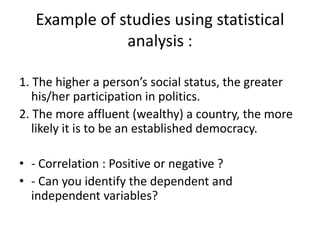
Example of studies using statistical
analysis :
1. The higher a person’s social status, the greater
his/her participation in politics.
2. The more affluent (wealthy) a country, the more
likely it is to be an established democracy.
• - Correlation : Positive or negative ?
• - Can you identify the dependent and
independent variables?
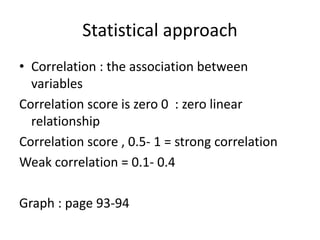
Statistical approach
• Correlation : the association between
variables
Correlation score is zero 0 : zero linear
relationship
Correlation score , 0.5- 1 = strong correlation
Weak correlation = 0.1- 0.4
Graph : page 93-94
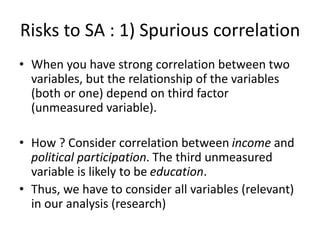
Risks to SA : 1) Spurious correlation
• When you have strong correlation between two
variables, but the relationship of the variables
(both or one) depend on third factor
(unmeasured variable).
• How ? Consider correlation between income and
political participation. The third unmeasured
variable is likely to be education.
• Thus, we have to consider all variables (relevant)
in our analysis (research)
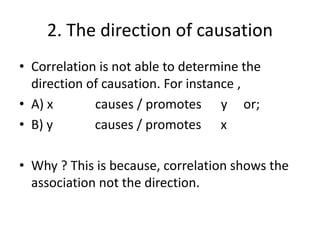
2. The direction of causation
• Correlation is not able to determine the
direction of causation. For instance ,
• A) x causes / promotes y or;
• B) y causes / promotes x
• Why ? This is because, correlation shows the
association not the direction.
C4 - Comparison Techniques

C4 - Comparison Techniques

  • 1.
    How to compare Week5, Sem 1, 2015/2016 ROHANA ABDUL HAMID
  • 2.
    TECHNIQUES • 1. CASESTUDIES • 2. FOCUSED COMPARISON • 3. STATISTICAL ANALYSIS
  • 3.
    1. Case studies Whatis a case study ? Intensive scrutiny of one case Micro level and macro level analysis : the selection of cases. Thus, it is a case oriented , not variable oriented. Thick description. Multi-method : reading academic lit, secondary documents, primary materials, interviews What are cases ? Individuals, organisations, processes, programs, institutions, events RQ : How and why questions:
  • 4.
    Examples of casestudies • 1) Graham Allison’s study of a single case (1971) about 1962 Cuban Missile Crises. He explained the crises by using three competing theories – U.S and Soviet Union performed as a) rationale actors, b) complex bureaucracies and c) politically motivated groups or persons. • Single case study
  • 5.
    Examples 2) A bookabout major strategies for improving social conditions by illustrating four policy topics : welfare reform, strengthening the child education, education reform and transforming neighborhoods. The book refers to specific cases of successful programs. • Results : The writer develops generalization based on the case studies of the need for the successful programs to be results oriented • Multiple case cross analysis
  • 6.
    Example [case studieswith multiple cases] 3) A book with 8 social programs . The commonalities in the program : the effectiveness of the programs [although many these policy programs often meets failure]. • However, the programs varied widely in their focus such as : education, nutrition, drug prevention, preschool education, delinquent youths, drug treatment, homelessness, mental health. • Findings : can identify programs that are low in cost , programs that have convincing evidence of long term effects; enable the government to replicate the programs
  • 7.
    Single case study: comparative? 1) Single case study can be subsumed under comparative method if it is theory-driven. How ? a) Theory infirming and theory confirming case study : analysis of a single case within the framework of established generalizations. The case is the test of the proposition , which in turn may confirmed or infirmed by it.
  • 8.
    …. b) Deviant case: studies of single case that are known to deviate from established generalizations. So , why do we select the case ? We want to uncover relevant variables that are not considered previously. What is the theoretical value? It weakens the original proposition , able to suggest modified proposition that may be stronger.
  • 9.
    ….. • C) Representativecase : Typical and standard example of a wider category. It is common, useful and undramatic. • A collection of representation of cases (representative) will provide raw materials for later distillation/ subsequent generalizations. Example : Coalition government – choose to study the phenomena in your country in detail. Home country is your research site, but you hope that the results would contribute to broader comparative understanding. HOW ?
  • 10.
    Disadvantage of singlecase study and who do we do about it ? • 1) What works in country A may not work in country B. • Why ? Contextual differences. But by drawing analogies , case studies can encourage the search for more general knowledge . Asking question : What differences between countries explain why the same policy led to contrasting result ?
  • 11.
    Other types ofcase study 4) Prototypical case study = The case is chosen because it is expected to become so. Example : US has been used as a prototype case for democracy. Why ? This is because it is pioneering in democracy. Thus, when we study the case, it helps us to understand the phenomenon occurred elsewhere. • 5) Archetypical case study = creates the category. • Example : French Revolution. Refer to French revolution when you want to look at the study of revolution.
  • 12.
    …. • 6) Criticaltype of case study : if it works here, it would work anywhere. • Example: Imposing democracy in Iraq (case). Iraq – a country with little experience of democracy (a case). If democracy survives in Iraq, it would work anywhere such as Libya, Syria.
  • 13.
    2. FOCUSED COMPARISON •What is it ? • A small N studies – concentrate on the intensive comparison ( of a political phenomenon) • Choose a study because of the case • The number of countries – either 2 ( paired , binary comparison) or 3 (triangular comparison) Works well when few countries are compared over time.
  • 14.
    How do youselect the countries ? • Apply two approaches : Most similar design and Most Different Design Advantage of most similar design : the more similar units being compared, it is possible to isolate the factors responsible for differences between them . Example : Social security programs in Canada and USA
  • 15.
    …. • Advantage ofMost Different design : Can test the relationship by finding out whether it can be observed in a range of different countries. • If it is proven to be positive, our confidence that the relationship is real (the relationship is not on the basis of third factors, unmeasured variable) • Example: If we find that plurality method of election of is associated with two-party system in the diverse group of countries, the robustness(strong, sturdy) in the relationship would increase.
  • 16.
    Statistical Analysis • Variable-based,not country specific. • Large number of countries/cases. The data are used for generalisation. • It permits us to explore covariation between variables. • The variables – we can measure quantitatively. • In statistical analysis, the variables are – dependent and independent.
  • 17.
    Example of studiesusing statistical analysis : 1. The higher a person’s social status, the greater his/her participation in politics. 2. The more affluent (wealthy) a country, the more likely it is to be an established democracy. • - Correlation : Positive or negative ? • - Can you identify the dependent and independent variables?
  • 18.
    Statistical approach • Correlation: the association between variables Correlation score is zero 0 : zero linear relationship Correlation score , 0.5- 1 = strong correlation Weak correlation = 0.1- 0.4 Graph : page 93-94
  • 19.
    Risks to SA: 1) Spurious correlation • When you have strong correlation between two variables, but the relationship of the variables (both or one) depend on third factor (unmeasured variable). • How ? Consider correlation between income and political participation. The third unmeasured variable is likely to be education. • Thus, we have to consider all variables (relevant) in our analysis (research)
  • 20.
    2. The directionof causation • Correlation is not able to determine the direction of causation. For instance , • A) x causes / promotes y or; • B) y causes / promotes x • Why ? This is because, correlation shows the association not the direction.