ASSIGNMENT #6
POLS 365
IDENTIFYING VARIABLES AND PROPOSING HYPOTHESIS
NAME:
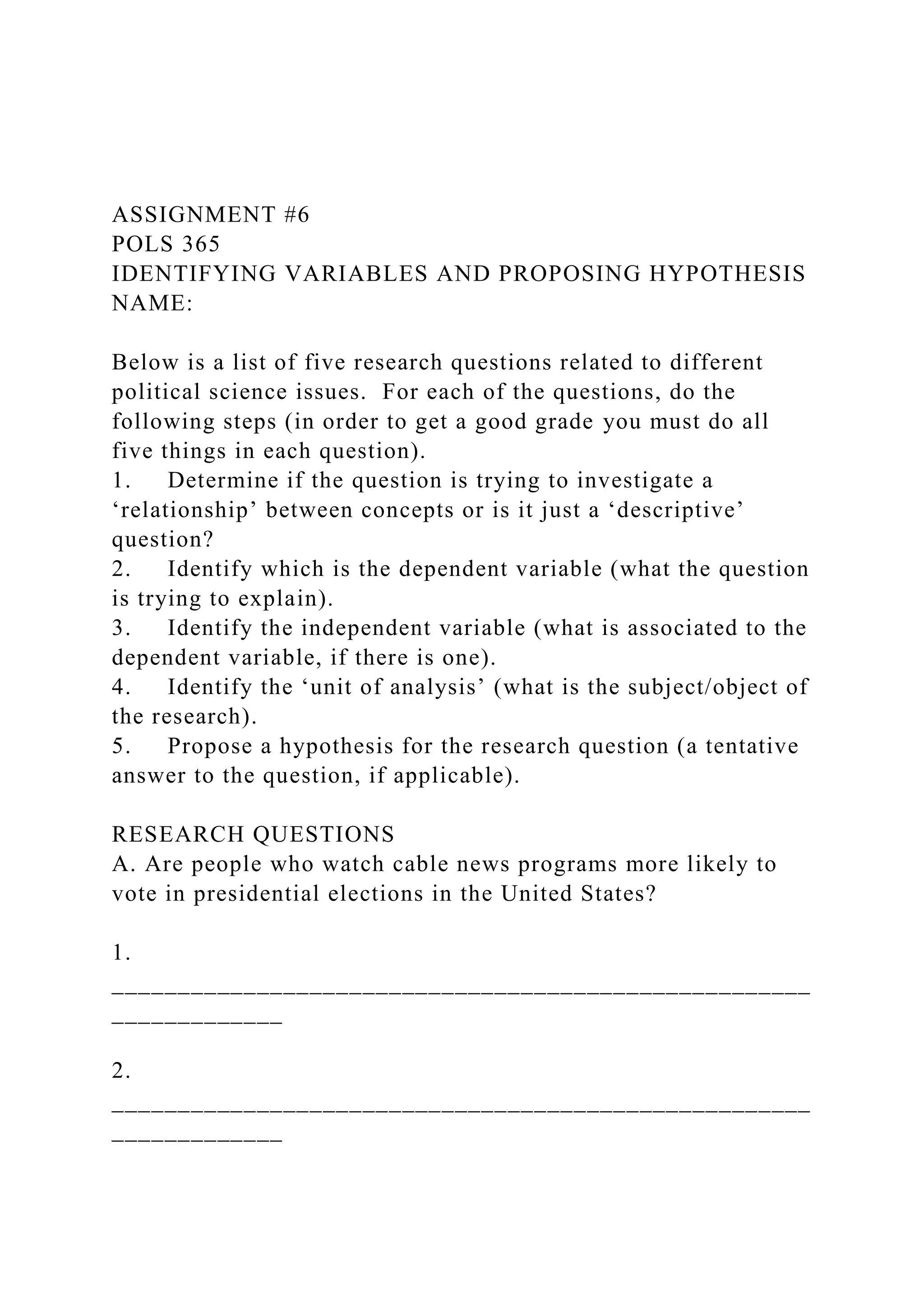
Below is a list of five research questions related to different
political science issues. For each of the questions, do the
following steps (in order to get a good grade you must do all
five things in each question).
1. Determine if the question is trying to investigate a
‘relationship’ between concepts or is it just a ‘descriptive’
question?
2. Identify which is the dependent variable (what the question
is trying to explain).
3. Identify the independent variable (what is associated to the
dependent variable, if there is one).
4. Identify the ‘unit of analysis’ (what is the subject/object of
the research).
5. Propose a hypothesis for the research question (a tentative
answer to the question, if applicable).
RESEARCH QUESTIONS
A. Are people who watch cable news programs more likely to
vote in presidential elections in the United States?
1.
_____________________________________________________
_____________
2.
_____________________________________________________
_____________
3.
_____________________________________________________
_____________
4.
_____________________________________________________
_____________
5.
_____________________________________________________
_____________
_____________________________________________________
________.
B. What was the turnout rate in the last legislative elections in
Italy?
1.
________________________________________________
__________________
2.
________________________________________________
__________________
3.
________________________________________________
__________________
4.
________________________________________________
__________________
5.
________________________________________________
__________________.
C. Are countries with high levels of poverty less likely to have
democratic regimes?
1.
________________________________________________
__________________
2.
________________________________________________
__________________
3.
________________________________________________
__________________
4.
________________________________________________
__________________
5.
________________________________________________
__________________
_____________________________________________________
________.
C. Are Americans with higher levels of education more
concerned with global warming?
1.
________________________________________________
__________________
2.
________________________________________________
__________________
3.
________________________________________________
__________________
4.
________________________________________________
__________________
5.
________________________________________________
__________________
_____________________________________________________
________.
D. Do American states with higher percentage of rural
population have a lower crime rate?
1.
________________________________________________
__________________
2.
________________________________________________
__________________
3.
________________________________________________
__________________
4.
________________________________________________
__________________
5.
________________________________________________
__________________
_____________________________________________________
________.
1
EXERCISE
POLS 365
FINDING SCHOLARLY LITERATURE
NAME:
A. Find one or preferably two sources related to ONE of your
research questions. More specifically, they should be related to
the issue you are trying to explain (your dependent variable).
· The source must be an academic journal (preferably a Political
Science journal). Only use articles published after 1980. If you
provide two sources, one of them must be an academic article.
· Remember that you have to open the article and read the
abstract (if available) or the introduction in order to determine
whether or not the article is related to your research. In
academic journals, the title often contains the name of the
dependent variable, but the title is not enough to allow you to
determine whether the article is related to your research.
B. Include the citation in a Word document and upload it to
Blackboard. Make sure the following information is included.
You can use any citation style. Remember that you can email
yourself the citation to make things easier.
1. Name of the author(s)
2. Name of article
3. Name of journal
4. Date of publication
C. Articles often have “abstracts” at the beginning. If that is
the case, copy and paste the abstract in the same Word
document. If there is no abstract read the introduction of the
article and write a summary in your own words (one paragraph).
1
POLITICAL DATA ANALYSIS
POLS 365
AGGREGATE DATA
NAME:
1. Select ONE country in each of the following regions, in
addition to the United States.
1. United States
2. Western
Europe_______________________________________________
______________________________________
3. Eastern Europe (former communist, not former Soviet
Union)
_______________________________________________
4. South
America______________________________________________
________________________________________
5. Central America
_____________________________________________________
________________________________
6. Pacific Islands
(Oceania)_____________________________________________
__________________________________
7.
Asia_________________________________________________
______________________________________________
8. Eurasia (former Soviet Union)
_____________________________________________________
____________________
9. Africa (not Middle
East)________________________________________________
______________________________
10. Middle East
_____________________________________________________
__________________________________
2. Fill out TABLE 1 AND TABLE 2 with the data obtained
from different websites included in the list provided by Prof.
Azpuru. If you don’t find a particular indicator for one country
put n/a (not available). Try to understand what is the meaning
of the indexes, how they are constructed, what they are
supposed to represent and what concepts are behind those
measurements.
3. Complete the following columns in Table 3: Concept, Range.
We will do the descriptive and the relationship questions
together.
4. In the last page (Comments), follow the instructions and
complete it.
5. Please work neatly. Use small numbers and words. I will
deduct points for a messy assignment.
Information for Exercise on Aggregate Data
IMPORTANT POINTS (will be included in next exam):
· Data (indicators) mean something: there is a concept behind
each one of the indicators used in the exercise.
· The indicator is the operational definition of a concept.
· It is important to look at the range of the indicator: what do
the numbers mean, which result is good: high or low? The range
varies from indicator to indicator.
· Think of questions (descriptive and relationship questions)
that you can develop using each of these indicators.
· The indicator should not be confused with the “rank”. A rank
is the position a country occupies in the list, but it is not the
score.
· Think of hypotheses that you can formulate based on these
indicators. Remember that hypotheses are tentative answers to
your research question.
· Not for exam: It is important to look at the methodology used
by the organization that compiles the indicator.
TABLE 1. INDEXES AND MEASURES FOR COMPARISONS
BETWEEN COUNTRIES(use the most recent year available for
each indicator)
INDICATOR/COUNTRY
Freedom House Score
Corruption Perception Index
Human Development Index
Fragile States
Index
KOF Globalization Index
Index of Economic Freedom
1. United States
2.
3.
4.
5.
6.
7.
8.
9.
10.
TABLE 2. OTHER INDICATORS WORLD BANK (WB)
INDICATOR/COUNTRY
GDP per capita
(WB, Economy and Growth)
Proportion of seats held by women in national assemblies
(WB, Social Development)
% of urban population
(WB, Urban Development)
Gini Index of Inequality
(WB , Poverty
or UNDP)
http://hdr.undp.org/en/content/income-gini-coefficient
Individuals using the Internet (%)
(WB, Infrastructure)
Homicide rates x 100,000 inhabitants
(WB)
1. United States
2.
3.
4.
5.
6.
7.
8.
9.
10.
TABLE 3. ADDITIONAL INFORMATION
Indicator
(operational definition)
Concept
Range
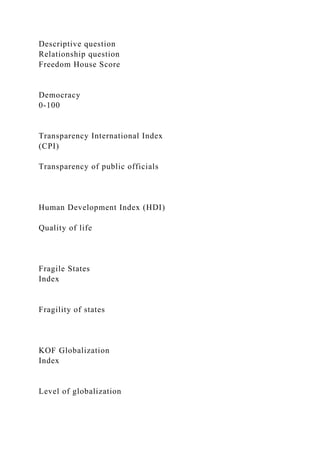
Descriptive question
Relationship question
Freedom House Score
Democracy
0-100
Transparency International Index
(CPI)
Transparency of public officials
Human Development Index (HDI)
Quality of life
Fragile States
Index
Fragility of states
KOF Globalization
Index
Level of globalization
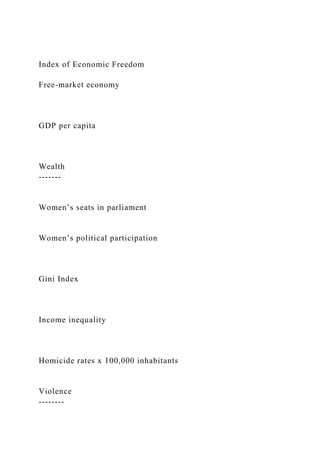
Index of Economic Freedom
Free-market economy
GDP per capita
Wealth
-------
Women’s seats in parliament
Women’s political participation
Gini Index
Income inequality
Homicide rates x 100,000 inhabitants
Violence
--------
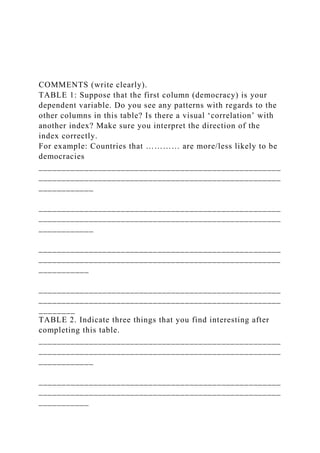
COMMENTS (write clearly).
TABLE 1: Suppose that the first column (democracy) is your
dependent variable. Do you see any patterns with regards to the
other columns in this table? Is there a visual ‘correlation’ with
another index? Make sure you interpret the direction of the
index correctly.
For example: Countries that ………… are more/less likely to be
democracies
_____________________________________________________
_____________________________________________________
____________
_____________________________________________________
_____________________________________________________
____________
_____________________________________________________
_____________________________________________________
___________
_____________________________________________________
_____________________________________________________
________
TABLE 2. Indicate three things that you find interesting after
completing this table.
_____________________________________________________
_____________________________________________________
____________
_____________________________________________________
_____________________________________________________
___________
_____________________________________________________
_____________________________________________________
____________
_____________________________________________________
_____________________________________________________
____________
6
POLITICAL DATA ANALYSIS
POLS 365
DR. Dinorah Azpuru
SURVEY DATA
(INDIVIDUAL-LEVEL DATA, SECONDARY DATA)
NAME_______________________________________________
_____________
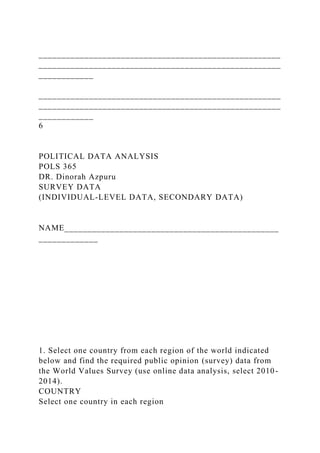
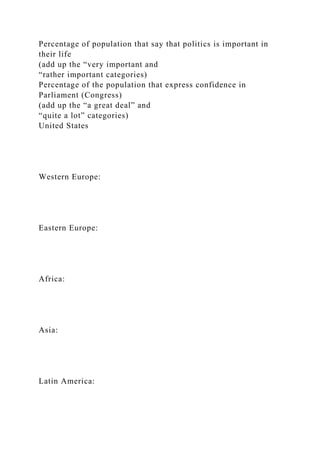
1. Select one country from each region of the world indicated
below and find the required public opinion (survey) data from
the World Values Survey (use online data analysis, select 2010-
2014).
COUNTRY
Select one country in each region
Percentage of population that say that politics is important in
their life
(add up the “very important and
“rather important categories)
Percentage of the population that express confidence in
Parliament (Congress)
(add up the “a great deal” and
“quite a lot” categories)
United States
Western Europe:
Eastern Europe:
Africa:
Asia:
Latin America:
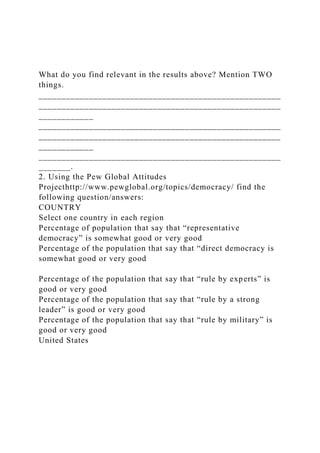
What do you find relevant in the results above? Mention TWO
things.
_____________________________________________________
_____________________________________________________
____________
_____________________________________________________
_____________________________________________________
____________
_____________________________________________________
_______.
2. Using the Pew Global Attitudes
Projecthttp://www.pewglobal.org/topics/democracy/ find the
following question/answers:
COUNTRY
Select one country in each region
Percentage of population that say that “representative
democracy” is somewhat good or very good
Percentage of the population that say that “direct democracy is
somewhat good or very good
Percentage of the population that say that “rule by experts” is
good or very good
Percentage of the population that say that “rule by a strong
leader” is good or very good
Percentage of the population that say that “rule by military” is
good or very good
United States
Western Europe:
Eastern Europe:
Africa:
Asia:
Latin America:
What do you find relevant in the results above? Mention TWO
things.
_____________________________________________________
_____________________________________________________
____________
_____________________________________________________
_____________________________________________________
____________
_____________________________________________________
_______.
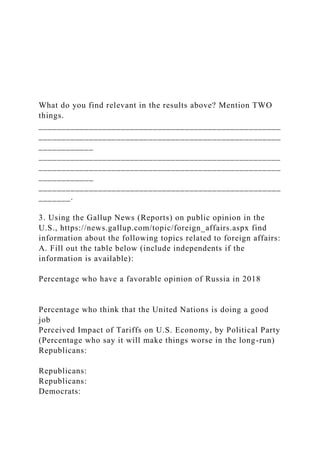
3. Using the Gallup News (Reports) on public opinion in the
U.S., https://news.gallup.com/topic/foreign_affairs.aspx find
information about the following topics related to foreign affairs:
A. Fill out the table below (include independents if the
information is available):
Percentage who have a favorable opinion of Russia in 2018
Percentage who think that the United Nations is doing a good
job
Perceived Impact of Tariffs on U.S. Economy, by Political Party
(Percentage who say it will make things worse in the long-run)
Republicans:
Republicans:
Republicans:
Democrats:
Democrats:
Democrats:
Independents:
Independents:
Independents:
What do you find relevant in the results above? Mention TWO
things.
_____________________________________________________
_____________________________________________________
____________
_____________________________________________________
_____________________________________________________
____________
_____________________________________________________
_______.
Do you see any particular cross-time patterns?
_____________________________________________________
_____________________________________________________
____________
_____________________________________________________
_____________________________________________________
____________
_____________________________________________________
_______.
4. Using data collected by the American National Election
Studies (ANES)https://electionstudies.org/resources/ fill in the
spaces below:
a. Find the distribution of “ideological self-identification” in
the United States (Found in Utilities and then ANES Guide to
Public Opinion and Electoral Behavior).
b. In the Table below indicate the results for the most recent
year available:
IDEOLOGICAL DISTRIBUTION
Percentage
Extremely liberal
Liberal
Slightly liberal
Moderate
Slightly conservative
Conservative
Very conservative
c. Briefly indicate TWO things that you find relevant in the
table above
_____________________________________________________
_____________________________________________________
____________
_____________________________________________________
_____________________________________________________
____________
_____________________________________________________
_____________________________________________________
___________.
d. Compare the most recent results with those of previous years
(cross-time data).
_____________________________________________________
_____________________________________________________
__________
_____________________________________________________
_____________________________________________________
__________
_____________________________________________________
_____________.
5. Using the Pew Research Center data for the United States
http://www.pewresearch.org/topics/ indicate and briefly
discuss Americans’ opinions about these four topics of
importance in the current political debate (Try to use the most
current information available and put the year in parentheses.
Note any differences that you find relevant, for instance
division by partisanship, or age if available):
TOPIC
PERCENTAGES
TRENDS (DISCUSSION)
DEATH PENALTY
GUN CONTROL
GAY MARRIAGE
(same-sex)
LEGALIZATION OF MARIJUANA
(see Drugs)
7
Each topic & question is worth 2 points
POLITICAL DATA ANALYSIS
POLS 365
THREE TOPICS AND QUESTIONS
NAME:
Indicate THREE topics/issues that you would like to “explain”
and a potential research question for each of them. The topics
have to be related to politics (or to social science in general).
They would be the “dependent variable” in a research project.
Propose one topic and an empirical question related to that topic
for each of the subfields of Political Science.
Read the Barrington chapter, as well as the suggested reading
by Johnson & Reynolds in order to better understand how to
propose a good research question. At this point you can write
descriptive questions about ONE variable (the dependent
variable): who, what, where, when, how. You don’t need to
write a ‘why’ question, unless you are sure of what you are
doing.
1. AMERICAN POLITICS
2. COMPARATIVE POLITICS
3. INTERNATIONAL RELATIONS
1
ASSIGNMENT #7
POLS365
PROPOSING YOUR OWN HYPOTHESIS
Suggestion: use words such as “likely to” “prone to” “higher
than…” “lower than….”
1. Propose a hypothesis using these variables: gender (men or
women), party ID (Republican or Democrat)
2. Propose a hypothesis (a tentative answer) to your research
question
Assignment #1
Political Data Analysis
Due: Sunday, August 26 by 11 p.m. (via Blackboard)
3 points of total grade
--Download (buy) the Kindle book called “Political Science for
the Curious” from Amazon. You can download it to your
computer or tablet (you don’t need a Kindle device).
--Indicate two things that you find interesting (or that you were
not aware of) in two chapters of the book. Your assignment
should be at least one-page long (double-spaced).
Remember that you must read Chapter 5, and select another
chapter of the ones indicated in the Syllabus.
--Submit your assignment via Blackboard. We will discuss it in
class on Monday, August 27.

ASSIGNMENT #6POLS 365IDENTIFYING VARIABLES AND PROPOSING HYP.docx

  • 1.
    ASSIGNMENT #6 POLS 365 IDENTIFYINGVARIABLES AND PROPOSING HYPOTHESIS NAME: Below is a list of five research questions related to different political science issues. For each of the questions, do the following steps (in order to get a good grade you must do all five things in each question). 1. Determine if the question is trying to investigate a ‘relationship’ between concepts or is it just a ‘descriptive’ question? 2. Identify which is the dependent variable (what the question is trying to explain). 3. Identify the independent variable (what is associated to the dependent variable, if there is one). 4. Identify the ‘unit of analysis’ (what is the subject/object of the research). 5. Propose a hypothesis for the research question (a tentative answer to the question, if applicable). RESEARCH QUESTIONS A. Are people who watch cable news programs more likely to vote in presidential elections in the United States? 1. _____________________________________________________ _____________ 2. _____________________________________________________ _____________
  • 2.
    3. _____________________________________________________ _____________ 4. _____________________________________________________ _____________ 5. _____________________________________________________ _____________ _____________________________________________________ ________. B. What wasthe turnout rate in the last legislative elections in Italy? 1. ________________________________________________ __________________ 2. ________________________________________________ __________________ 3. ________________________________________________ __________________ 4. ________________________________________________ __________________ 5. ________________________________________________
  • 3.
    __________________. C. Are countrieswith high levels of poverty less likely to have democratic regimes? 1. ________________________________________________ __________________ 2. ________________________________________________ __________________ 3. ________________________________________________ __________________ 4. ________________________________________________ __________________ 5. ________________________________________________ __________________ _____________________________________________________ ________. C. Are Americans with higher levels of education more concerned with global warming? 1. ________________________________________________ __________________ 2.
  • 4.
    ________________________________________________ __________________ 3. ________________________________________________ __________________ 4. ________________________________________________ __________________ 5. ________________________________________________ __________________ _____________________________________________________ ________. D. Do Americanstates with higher percentage of rural population have a lower crime rate? 1. ________________________________________________ __________________ 2. ________________________________________________ __________________ 3. ________________________________________________ __________________ 4. ________________________________________________ __________________
  • 5.
    5. ________________________________________________ __________________ _____________________________________________________ ________. 1 EXERCISE POLS 365 FINDING SCHOLARLYLITERATURE NAME: A. Find one or preferably two sources related to ONE of your research questions. More specifically, they should be related to the issue you are trying to explain (your dependent variable). · The source must be an academic journal (preferably a Political Science journal). Only use articles published after 1980. If you provide two sources, one of them must be an academic article. · Remember that you have to open the article and read the abstract (if available) or the introduction in order to determine whether or not the article is related to your research. In academic journals, the title often contains the name of the dependent variable, but the title is not enough to allow you to determine whether the article is related to your research. B. Include the citation in a Word document and upload it to Blackboard. Make sure the following information is included. You can use any citation style. Remember that you can email yourself the citation to make things easier. 1. Name of the author(s) 2. Name of article 3. Name of journal 4. Date of publication C. Articles often have “abstracts” at the beginning. If that is
  • 6.
    the case, copyand paste the abstract in the same Word document. If there is no abstract read the introduction of the article and write a summary in your own words (one paragraph). 1 POLITICAL DATA ANALYSIS POLS 365 AGGREGATE DATA NAME: 1. Select ONE country in each of the following regions, in addition to the United States. 1. United States 2. Western Europe_______________________________________________ ______________________________________ 3. Eastern Europe (former communist, not former Soviet Union) _______________________________________________ 4. South America______________________________________________ ________________________________________ 5. Central America _____________________________________________________ ________________________________ 6. Pacific Islands (Oceania)_____________________________________________ __________________________________ 7. Asia_________________________________________________ ______________________________________________
  • 7.
    8. Eurasia (formerSoviet Union) _____________________________________________________ ____________________ 9. Africa (not Middle East)________________________________________________ ______________________________ 10. Middle East _____________________________________________________ __________________________________ 2. Fill out TABLE 1 AND TABLE 2 with the data obtained from different websites included in the list provided by Prof. Azpuru. If you don’t find a particular indicator for one country put n/a (not available). Try to understand what is the meaning of the indexes, how they are constructed, what they are supposed to represent and what concepts are behind those measurements. 3. Complete the following columns in Table 3: Concept, Range. We will do the descriptive and the relationship questions together. 4. In the last page (Comments), follow the instructions and complete it. 5. Please work neatly. Use small numbers and words. I will deduct points for a messy assignment. Information for Exercise on Aggregate Data IMPORTANT POINTS (will be included in next exam): · Data (indicators) mean something: there is a concept behind each one of the indicators used in the exercise. · The indicator is the operational definition of a concept.
  • 8.
    · It isimportant to look at the range of the indicator: what do the numbers mean, which result is good: high or low? The range varies from indicator to indicator. · Think of questions (descriptive and relationship questions) that you can develop using each of these indicators. · The indicator should not be confused with the “rank”. A rank is the position a country occupies in the list, but it is not the score. · Think of hypotheses that you can formulate based on these indicators. Remember that hypotheses are tentative answers to your research question. · Not for exam: It is important to look at the methodology used by the organization that compiles the indicator. TABLE 1. INDEXES AND MEASURES FOR COMPARISONS BETWEEN COUNTRIES(use the most recent year available for each indicator) INDICATOR/COUNTRY Freedom House Score Corruption Perception Index Human Development Index Fragile States Index KOF Globalization Index Index of Economic Freedom 1. United States
  • 9.
  • 10.
  • 11.
    9. 10. TABLE 2. OTHERINDICATORS WORLD BANK (WB) INDICATOR/COUNTRY GDP per capita (WB, Economy and Growth) Proportion of seats held by women in national assemblies (WB, Social Development) % of urban population (WB, Urban Development) Gini Index of Inequality (WB , Poverty or UNDP)
  • 12.
    http://hdr.undp.org/en/content/income-gini-coefficient Individuals using theInternet (%) (WB, Infrastructure) Homicide rates x 100,000 inhabitants (WB) 1. United States 2. 3.
  • 13.
  • 14.
    8. 9. 10. TABLE 3. ADDITIONALINFORMATION Indicator (operational definition) Concept Range
  • 15.
    Descriptive question Relationship question FreedomHouse Score Democracy 0-100 Transparency International Index (CPI) Transparency of public officials Human Development Index (HDI) Quality of life Fragile States Index Fragility of states KOF Globalization Index Level of globalization
  • 16.
    Index of EconomicFreedom Free-market economy GDP per capita Wealth ------- Women’s seats in parliament Women’s political participation Gini Index Income inequality Homicide rates x 100,000 inhabitants Violence --------
  • 17.
    COMMENTS (write clearly). TABLE1: Suppose that the first column (democracy) is your dependent variable. Do you see any patterns with regards to the other columns in this table? Is there a visual ‘correlation’ with another index? Make sure you interpret the direction of the index correctly. For example: Countries that ………… are more/less likely to be democracies _____________________________________________________ _____________________________________________________ ____________ _____________________________________________________ _____________________________________________________ ____________ _____________________________________________________ _____________________________________________________ ___________ _____________________________________________________ _____________________________________________________ ________ TABLE 2. Indicate three things that you find interesting after completing this table. _____________________________________________________ _____________________________________________________ ____________ _____________________________________________________ _____________________________________________________ ___________
  • 18.
    _____________________________________________________ _____________________________________________________ ____________ _____________________________________________________ _____________________________________________________ ____________ 6 POLITICAL DATA ANALYSIS POLS365 DR. Dinorah Azpuru SURVEY DATA (INDIVIDUAL-LEVEL DATA, SECONDARY DATA) NAME_______________________________________________ _____________ 1. Select one country from each region of the world indicated below and find the required public opinion (survey) data from the World Values Survey (use online data analysis, select 2010- 2014). COUNTRY Select one country in each region
  • 19.
    Percentage of populationthat say that politics is important in their life (add up the “very important and “rather important categories) Percentage of the population that express confidence in Parliament (Congress) (add up the “a great deal” and “quite a lot” categories) United States Western Europe: Eastern Europe: Africa: Asia: Latin America:
  • 20.
    What do youfind relevant in the results above? Mention TWO things. _____________________________________________________ _____________________________________________________ ____________ _____________________________________________________ _____________________________________________________ ____________ _____________________________________________________ _______. 2. Using the Pew Global Attitudes Projecthttp://www.pewglobal.org/topics/democracy/ find the following question/answers: COUNTRY Select one country in each region Percentage of population that say that “representative democracy” is somewhat good or very good Percentage of the population that say that “direct democracy is somewhat good or very good Percentage of the population that say that “rule by experts” is good or very good Percentage of the population that say that “rule by a strong leader” is good or very good Percentage of the population that say that “rule by military” is good or very good United States
  • 21.
  • 22.
    What do youfind relevant in the results above? Mention TWO things. _____________________________________________________ _____________________________________________________ ____________ _____________________________________________________ _____________________________________________________ ____________ _____________________________________________________ _______. 3. Using the Gallup News (Reports) on public opinion in the U.S., https://news.gallup.com/topic/foreign_affairs.aspx find information about the following topics related to foreign affairs: A. Fill out the table below (include independents if the information is available): Percentage who have a favorable opinion of Russia in 2018 Percentage who think that the United Nations is doing a good job Perceived Impact of Tariffs on U.S. Economy, by Political Party (Percentage who say it will make things worse in the long-run) Republicans: Republicans: Republicans: Democrats:
  • 23.
    Democrats: Democrats: Independents: Independents: Independents: What do youfind relevant in the results above? Mention TWO things. _____________________________________________________ _____________________________________________________ ____________ _____________________________________________________ _____________________________________________________ ____________ _____________________________________________________ _______. Do you see any particular cross-time patterns? _____________________________________________________ _____________________________________________________ ____________ _____________________________________________________ _____________________________________________________ ____________ _____________________________________________________ _______. 4. Using data collected by the American National Election Studies (ANES)https://electionstudies.org/resources/ fill in the spaces below: a. Find the distribution of “ideological self-identification” in the United States (Found in Utilities and then ANES Guide to Public Opinion and Electoral Behavior). b. In the Table below indicate the results for the most recent year available: IDEOLOGICAL DISTRIBUTION
  • 24.
    Percentage Extremely liberal Liberal Slightly liberal Moderate Slightlyconservative Conservative Very conservative c. Briefly indicate TWO things that you find relevant in the table above _____________________________________________________ _____________________________________________________ ____________ _____________________________________________________ _____________________________________________________ ____________ _____________________________________________________ _____________________________________________________ ___________. d. Compare the most recent results with those of previous years (cross-time data). _____________________________________________________ _____________________________________________________ __________ _____________________________________________________ _____________________________________________________ __________
  • 25.
    _____________________________________________________ _____________. 5. Using thePew Research Center data for the United States http://www.pewresearch.org/topics/ indicate and briefly discuss Americans’ opinions about these four topics of importance in the current political debate (Try to use the most current information available and put the year in parentheses. Note any differences that you find relevant, for instance division by partisanship, or age if available): TOPIC PERCENTAGES TRENDS (DISCUSSION) DEATH PENALTY GUN CONTROL GAY MARRIAGE (same-sex)
  • 26.
    LEGALIZATION OF MARIJUANA (seeDrugs) 7 Each topic & question is worth 2 points POLITICAL DATA ANALYSIS POLS 365 THREE TOPICS AND QUESTIONS NAME: Indicate THREE topics/issues that you would like to “explain” and a potential research question for each of them. The topics have to be related to politics (or to social science in general). They would be the “dependent variable” in a research project. Propose one topic and an empirical question related to that topic for each of the subfields of Political Science. Read the Barrington chapter, as well as the suggested reading by Johnson & Reynolds in order to better understand how to propose a good research question. At this point you can write
  • 27.
    descriptive questions aboutONE variable (the dependent variable): who, what, where, when, how. You don’t need to write a ‘why’ question, unless you are sure of what you are doing. 1. AMERICAN POLITICS 2. COMPARATIVE POLITICS 3. INTERNATIONAL RELATIONS 1 ASSIGNMENT #7 POLS365 PROPOSING YOUR OWN HYPOTHESIS Suggestion: use words such as “likely to” “prone to” “higher than…” “lower than….” 1. Propose a hypothesis using these variables: gender (men or women), party ID (Republican or Democrat) 2. Propose a hypothesis (a tentative answer) to your research question
  • 28.
    Assignment #1 Political DataAnalysis Due: Sunday, August 26 by 11 p.m. (via Blackboard) 3 points of total grade --Download (buy) the Kindle book called “Political Science for the Curious” from Amazon. You can download it to your computer or tablet (you don’t need a Kindle device). --Indicate two things that you find interesting (or that you were not aware of) in two chapters of the book. Your assignment should be at least one-page long (double-spaced). Remember that you must read Chapter 5, and select another chapter of the ones indicated in the Syllabus. --Submit your assignment via Blackboard. We will discuss it in class on Monday, August 27.