CHEMISTRY 3
PERIODIC TABLE
EARLY PERIODIC
TABLE
• Early 1800s - LESSTHAN 40
ELEMENTS
• NEW ELEMENTS discovered
REGULARLY
• Noticed patterns in the way they worked -
PROPERTIES
• Worked out Atomic Weight
JOHN NEWLAND
• In order of ATOMIC MASS
• LAW OF OCTAVES - Similarities in
PROPERTIES of every 8TH ELEMENT
JOHN NEWLAND -
Problems
• Some groups had a MIX of METAL and
NON METAL
• Only worked for FIRST FEW
ELEMENTS
• Elements still being discovered
DMITRI MENDELEEV
• Arranged in PERIODIC way
• LEFT GAPS for UNDISCOVERED
ELEMENTS
• otherwise elements wouldn’t have
SIMILAR PROPERTIES
• predicted Atomic Mass and Properties
to undiscovered elements.
AFTER MENDELEEV...
• ... These were discovered:
• Noble Gases
• Electrons
• Atomic Structure
• accuracies in atomic number ordering
• Groups and Periods (modern table)
MODERN PERIODIC
TABLE
MODERN PERIODIC
TABLE
• Order by ATOMIC NUMBER - Makes all
elements fit into groups with SIMILAR
PROPERTIES
• GROUPS tell us the number of electrons
in the OUTER SHELL
GROUP 1 - ALKALI
METALS
• All LOW DENSITY
• React w/ NON-METALS = IONIC
COMPOUNDS
• React w/ WATER = RELEASE
HYDROGEN
• Form HYDROXIDES that dissolve in
water = ALKALINE SOLUTION
GROUP 1 - ALKALI
METALS
• The FURTHER DOWNTHE GROUP
the MORE REACTIVETHE ELEMENT
• The LOWER the MELTING&BOILING
POINT
• Purple flame - SODIUM AND
ONWARDS
GROUP 2
TRANSITION METALS
• COMPARED TO GROUP 1 - HIGHER
MELTING&BOILING POINTS except
for mercury.
• HARDER&STRONGER
• LESS reactive, don’t react as much with
WATER&OXYGEN
GROUP 2
TRANSITION METALS
• Build buildings due to being LESS
REACTIVE
• Form IONS with different charges
• Form COLOURED compounds
[COPPER SULFATE - BLUE]
• Useful as CATALYSTS
GROUP 7
HALOGENS
• Bad conductors
• POISONOUS
• Coloured vapours
• React with METALS to form IONIC
COMPOUNDS [ SODIUM CHLORIDE]
GROUP 7
HALOGENS
• ION produced called HALIDE
• E.G. Fluorine - Fluoride etc.
• Each has -1 Charge
• FURTHER DOWN - LESS reactive
• HIGHER Melting & Boiling points
GROUP 7
HALOGENS
• DIATONIC MOLECULES
• Higher the reactivity , in
DISPLACEMENT reaction, element with
HIGHER reactivity will displace lower
reacivity.
TRENDS IN
REACTIVITY
TRENDS IN
REACTIVITY
• GROUP 1 DOWN - MORE reactive
• GROUP 7 DOWN - LESS reactive
• The HIGHER the energy level of the
OUTER ELECTRONS:
• The easier electrons are LOST
• The LESS easily electrons are GAINED
TRENDS IN
REACTIVITY
• GROUP 1 elements need to LOSE
electrons to react.
• LESS ENERGY LEVELS:
• STRONGER attraction [ To NUCLEUS]
• Less SCREENING/SHIELDING by
INNER ELECTRONS
• Electrons lost LESS easily
TRENDS IN
REACTIVITY
• MORE ENERGY LEVELS:
• Outer Electron FURTHER from nucleus
• WEAKER attraction [ TO NUCLEUS]
• MORE screening/Shielding by inner
electrons
• Electron lost EASILY
GROUP 7
REACTIVITY
• Needs to GAIN electron
• LESS energy levels :
• Outer electron CLOSER to nucleus
• Stronger attraction [ TO NUCLEUS]
• LESS screening/shielding by INNER
ELECTRONS
GROUP 7
REACTIVITY
• MORE energy levels :
• Outer electron FURTHER to nucleus
• Weaker attraction [ TO NUCLEUS]
• MORE screening/shielding by INNER
ELECTRONS
HARD AND SOFT
WATER
INTRO
• SOFT water : can LATHER [produce
bubbles when soaped]
• HARD water : CAN’T Lather : creates
SCUM&SCALE
• contains DISSOLVED COMPOUNDS
• AND MAGNESIUM&CALCIUM
compounds [river flows over substances]
HARD WATER
• SCUM : INSOLUBLE precipitate
• Formed by REACTION with SOAP
• CA2+ [Calcium Ion] REACTS with
HARD WATER
• MORE soap needed [more expensive]
• SOAPLESS detergents made to avoid
scum [no Sodium Stearate won’t react]
HARD WATER
• SCALE : INSOLUBLE SOLID
• REDUCES efficiency
• E.G. Kettle - SCALE is POOR
CONDUCTOR OF HEAT - Kettle has
to work harder to heat water.
• BENEFITS : Bone development ;Teeth
development ; Reduce Heart Disease
HARD WATER
• TEMPORARY - Softened by
Heating/Boiling
• PERMANENT - Remains hard even when
Heated / Boiled
SOFTENING HARD
WATER
• Contains CA2+ [CALCIUM IONS]
• Contains MG2+ [MAGNESIUM IONS]
• TO SOFTEN - Add WASHING SODA
(Sodium Carbonate) =
SOFTENING USING
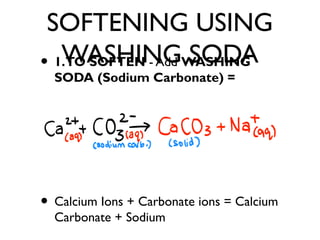
WASHING SODA• 1.TO SOFTEN - Add WASHING
SODA (Sodium Carbonate) =
• Calcium Ions + Carbonate ions = Calcium
Carbonate + Sodium
SOFTENING USING
ION EXCHANGE
• 2. Use ION EXCHANGE COLUMN
• Cylinder containing RESIN containing
SODIUM (NA+) or HYDROGEN
(MG2+) ions
• Magnesium&Calcium ions exchange
with Sodium/Hydrogen ions
• Sodium/Hydrogen Ions left in water
TEMPORARY HARD
WATER
• Softened when HEATED
• contains HCO -₃⁻ Hydrogen Carbonate
Ions
• HCO₃⁻ DECOMPOSES to
CARBONATE IONS
• Carbonate Ions REACT with magnesium
ions / Calcium Ions to form carbonates
TITRATION
TITRATION METHOD
• The METHOD to see how much ACID
or ALKALI is needed to create a
NEUTRAL SOLUTION.
• 1. measure and add volume of ALKALI
into CONICAL FLASK using a
PIPETTE
• 2. measure drops of Phenolphthalein/
Methyl Orange
TITRATION METHOD
• 3. Pour acid in BURETTE and RECORD
READING
• 4. OPEN TAP in Burette, add little acid,
swirl conical flask to mix.
• 5.ADD ACID until solution is
NEUTRAL (shown by indicator)& repeat
• Pheno - Pink to Colourless
TITRATION
CALCULATION
• Should be able to calculate QUANTITIES
in titrations involving :
• concentrations - MOLES per dm³
• masses - GRAMS per dm³
• If conc. of one reactant is known, it
can be used to find the conc. of the
other reactant.
TITRATION
CALCULATION
• 1 decimetre cubed = 1000cm³ = 1 LITRE
• CONC. OF SOLUTION = Moles per
dm³ [ 3 moles per 1 dm³ ]
• MOLES - mass [g] of 1 MOLE of a
substance is it’s RELATIVE FORMULA
MASS in Grams. [ Add all relative atomic
masses in a compound together = 1 mole]
TITRATION
CALCULATION E.G.
• Make 1 mole per dm³ solution of Sodium
Hydroxide NaOH
• Relative atomic masses =
• Na=23 O=16 H=1 1 MOLE = 40g
• Take 1dm³ [1000 cm³ ] of water and put
40g of NaOH in it
TITRATION
CALCULATION E.G.2
• Put 40g in 500cm³ of water , what is the
Concentration in Moles/dm³?
• 500cm³ is half 1dm³ , so you Double the
mass = 80g = 2 moles/dm³
TITRATION
CALCULATION E.G.3
• What MASS of sodium hydroxide is there
in 250 cm³ of a 2 moles/dm³ solution?
• 2 mol = 80g
• 250cm³ = 1/4 of 1000
• 1/4 x 80g = 20g
TITRATION
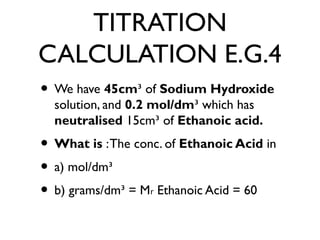
CALCULATION E.G.4
• We have 45cm³ of Sodium Hydroxide
solution, and 0.2 mol/dm³ which has
neutralised 15cm³ of Ethanoic acid.
• What is :The conc. of Ethanoic Acid in
• a) mol/dm³
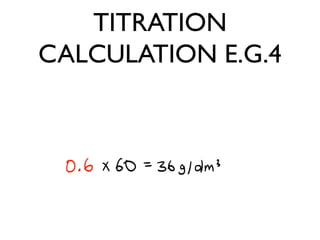
• b) grams/dm³ = M Ethanoic Acid = 60ᵣ
TITRATION
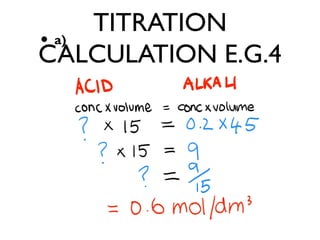
CALCULATION E.G.4
• a)
TITRATION
CALCULATION E.G.4
TITRATION
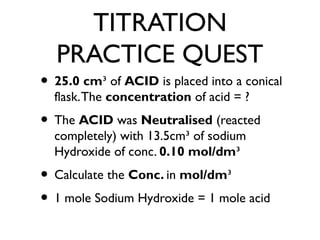
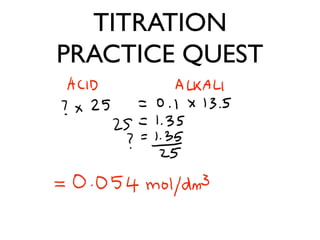
PRACTICE QUEST
• 25.0 cm³ of ACID is placed into a conical
flask.The concentration of acid = ?
• The ACID was Neutralised (reacted
completely) with 13.5cm³ of sodium
Hydroxide of conc. 0.10 mol/dm³
• Calculate the Conc. in mol/dm³
• 1 mole Sodium Hydroxide = 1 mole acid
TITRATION
PRACTICE QUEST
TITRATION
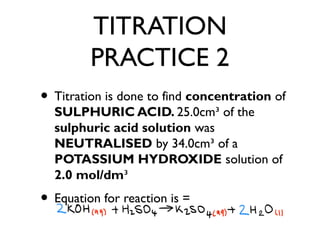
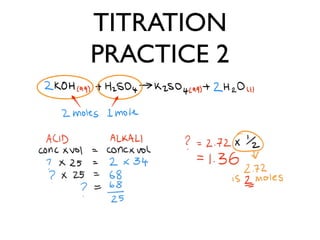
PRACTICE 2
• Titration is done to find concentration of
SULPHURIC ACID. 25.0cm³ of the
sulphuric acid solution was
NEUTRALISED by 34.0cm³ of a
POTASSIUM HYDROXIDE solution of
2.0 mol/dm³
• Equation for reaction is =
TITRATION
PRACTICE 2
ENERGY LEVEL
DIAGRAMS
ENERGY LEVEL
DIAGRAM
• The reaction is either ENDOTHERMIC
or EXOTHERMIC
• Energy needs to be supplied to the atoms
to BREAKTHE BONDS and this takes
energy from the environment.
• When making bonds, energy is
RELEASED to the environment.
ENERGY LEVEL
DIAGRAM• If the graph shows a higher energy going
to a lower energy level, it is
EXOTHERMIC, as energy is released.

C3 revision (Chemistry unit 3)

  • 1.
  • 2.
  • 3.
    EARLY PERIODIC TABLE • Early1800s - LESSTHAN 40 ELEMENTS • NEW ELEMENTS discovered REGULARLY • Noticed patterns in the way they worked - PROPERTIES • Worked out Atomic Weight
  • 4.
    JOHN NEWLAND • Inorder of ATOMIC MASS • LAW OF OCTAVES - Similarities in PROPERTIES of every 8TH ELEMENT
  • 5.
    JOHN NEWLAND - Problems •Some groups had a MIX of METAL and NON METAL • Only worked for FIRST FEW ELEMENTS • Elements still being discovered
  • 6.
    DMITRI MENDELEEV • Arrangedin PERIODIC way • LEFT GAPS for UNDISCOVERED ELEMENTS • otherwise elements wouldn’t have SIMILAR PROPERTIES • predicted Atomic Mass and Properties to undiscovered elements.
  • 7.
    AFTER MENDELEEV... • ...These were discovered: • Noble Gases • Electrons • Atomic Structure • accuracies in atomic number ordering • Groups and Periods (modern table)
  • 8.
  • 9.
    MODERN PERIODIC TABLE • Orderby ATOMIC NUMBER - Makes all elements fit into groups with SIMILAR PROPERTIES • GROUPS tell us the number of electrons in the OUTER SHELL
  • 10.
    GROUP 1 -ALKALI METALS • All LOW DENSITY • React w/ NON-METALS = IONIC COMPOUNDS • React w/ WATER = RELEASE HYDROGEN • Form HYDROXIDES that dissolve in water = ALKALINE SOLUTION
  • 11.
    GROUP 1 -ALKALI METALS • The FURTHER DOWNTHE GROUP the MORE REACTIVETHE ELEMENT • The LOWER the MELTING&BOILING POINT • Purple flame - SODIUM AND ONWARDS
  • 12.
    GROUP 2 TRANSITION METALS •COMPARED TO GROUP 1 - HIGHER MELTING&BOILING POINTS except for mercury. • HARDER&STRONGER • LESS reactive, don’t react as much with WATER&OXYGEN
  • 13.
    GROUP 2 TRANSITION METALS •Build buildings due to being LESS REACTIVE • Form IONS with different charges • Form COLOURED compounds [COPPER SULFATE - BLUE] • Useful as CATALYSTS
  • 14.
    GROUP 7 HALOGENS • Badconductors • POISONOUS • Coloured vapours • React with METALS to form IONIC COMPOUNDS [ SODIUM CHLORIDE]
  • 15.
    GROUP 7 HALOGENS • IONproduced called HALIDE • E.G. Fluorine - Fluoride etc. • Each has -1 Charge • FURTHER DOWN - LESS reactive • HIGHER Melting & Boiling points
  • 16.
    GROUP 7 HALOGENS • DIATONICMOLECULES • Higher the reactivity , in DISPLACEMENT reaction, element with HIGHER reactivity will displace lower reacivity.
  • 17.
  • 18.
    TRENDS IN REACTIVITY • GROUP1 DOWN - MORE reactive • GROUP 7 DOWN - LESS reactive • The HIGHER the energy level of the OUTER ELECTRONS: • The easier electrons are LOST • The LESS easily electrons are GAINED
  • 19.
    TRENDS IN REACTIVITY • GROUP1 elements need to LOSE electrons to react. • LESS ENERGY LEVELS: • STRONGER attraction [ To NUCLEUS] • Less SCREENING/SHIELDING by INNER ELECTRONS • Electrons lost LESS easily
  • 20.
    TRENDS IN REACTIVITY • MOREENERGY LEVELS: • Outer Electron FURTHER from nucleus • WEAKER attraction [ TO NUCLEUS] • MORE screening/Shielding by inner electrons • Electron lost EASILY
  • 21.
    GROUP 7 REACTIVITY • Needsto GAIN electron • LESS energy levels : • Outer electron CLOSER to nucleus • Stronger attraction [ TO NUCLEUS] • LESS screening/shielding by INNER ELECTRONS
  • 22.
    GROUP 7 REACTIVITY • MOREenergy levels : • Outer electron FURTHER to nucleus • Weaker attraction [ TO NUCLEUS] • MORE screening/shielding by INNER ELECTRONS
  • 23.
  • 24.
    INTRO • SOFT water: can LATHER [produce bubbles when soaped] • HARD water : CAN’T Lather : creates SCUM&SCALE • contains DISSOLVED COMPOUNDS • AND MAGNESIUM&CALCIUM compounds [river flows over substances]
  • 25.
    HARD WATER • SCUM: INSOLUBLE precipitate • Formed by REACTION with SOAP • CA2+ [Calcium Ion] REACTS with HARD WATER • MORE soap needed [more expensive] • SOAPLESS detergents made to avoid scum [no Sodium Stearate won’t react]
  • 26.
    HARD WATER • SCALE: INSOLUBLE SOLID • REDUCES efficiency • E.G. Kettle - SCALE is POOR CONDUCTOR OF HEAT - Kettle has to work harder to heat water. • BENEFITS : Bone development ;Teeth development ; Reduce Heart Disease
  • 27.
    HARD WATER • TEMPORARY- Softened by Heating/Boiling • PERMANENT - Remains hard even when Heated / Boiled
  • 28.
    SOFTENING HARD WATER • ContainsCA2+ [CALCIUM IONS] • Contains MG2+ [MAGNESIUM IONS] • TO SOFTEN - Add WASHING SODA (Sodium Carbonate) =
  • 29.
    SOFTENING USING WASHING SODA•1.TO SOFTEN - Add WASHING SODA (Sodium Carbonate) = • Calcium Ions + Carbonate ions = Calcium Carbonate + Sodium
  • 30.
    SOFTENING USING ION EXCHANGE •2. Use ION EXCHANGE COLUMN • Cylinder containing RESIN containing SODIUM (NA+) or HYDROGEN (MG2+) ions • Magnesium&Calcium ions exchange with Sodium/Hydrogen ions • Sodium/Hydrogen Ions left in water
  • 31.
    TEMPORARY HARD WATER • Softenedwhen HEATED • contains HCO -₃⁻ Hydrogen Carbonate Ions • HCO₃⁻ DECOMPOSES to CARBONATE IONS • Carbonate Ions REACT with magnesium ions / Calcium Ions to form carbonates
  • 32.
  • 33.
    TITRATION METHOD • TheMETHOD to see how much ACID or ALKALI is needed to create a NEUTRAL SOLUTION. • 1. measure and add volume of ALKALI into CONICAL FLASK using a PIPETTE • 2. measure drops of Phenolphthalein/ Methyl Orange
  • 34.
    TITRATION METHOD • 3.Pour acid in BURETTE and RECORD READING • 4. OPEN TAP in Burette, add little acid, swirl conical flask to mix. • 5.ADD ACID until solution is NEUTRAL (shown by indicator)& repeat • Pheno - Pink to Colourless
  • 35.
    TITRATION CALCULATION • Should beable to calculate QUANTITIES in titrations involving : • concentrations - MOLES per dm³ • masses - GRAMS per dm³ • If conc. of one reactant is known, it can be used to find the conc. of the other reactant.
  • 36.
    TITRATION CALCULATION • 1 decimetrecubed = 1000cm³ = 1 LITRE • CONC. OF SOLUTION = Moles per dm³ [ 3 moles per 1 dm³ ] • MOLES - mass [g] of 1 MOLE of a substance is it’s RELATIVE FORMULA MASS in Grams. [ Add all relative atomic masses in a compound together = 1 mole]
  • 37.
    TITRATION CALCULATION E.G. • Make1 mole per dm³ solution of Sodium Hydroxide NaOH • Relative atomic masses = • Na=23 O=16 H=1 1 MOLE = 40g • Take 1dm³ [1000 cm³ ] of water and put 40g of NaOH in it
  • 38.
    TITRATION CALCULATION E.G.2 • Put40g in 500cm³ of water , what is the Concentration in Moles/dm³? • 500cm³ is half 1dm³ , so you Double the mass = 80g = 2 moles/dm³
  • 39.
    TITRATION CALCULATION E.G.3 • WhatMASS of sodium hydroxide is there in 250 cm³ of a 2 moles/dm³ solution? • 2 mol = 80g • 250cm³ = 1/4 of 1000 • 1/4 x 80g = 20g
  • 40.
    TITRATION CALCULATION E.G.4 • Wehave 45cm³ of Sodium Hydroxide solution, and 0.2 mol/dm³ which has neutralised 15cm³ of Ethanoic acid. • What is :The conc. of Ethanoic Acid in • a) mol/dm³ • b) grams/dm³ = M Ethanoic Acid = 60ᵣ
  • 41.
  • 42.
  • 43.
    TITRATION PRACTICE QUEST • 25.0cm³ of ACID is placed into a conical flask.The concentration of acid = ? • The ACID was Neutralised (reacted completely) with 13.5cm³ of sodium Hydroxide of conc. 0.10 mol/dm³ • Calculate the Conc. in mol/dm³ • 1 mole Sodium Hydroxide = 1 mole acid
  • 44.
  • 45.
    TITRATION PRACTICE 2 • Titrationis done to find concentration of SULPHURIC ACID. 25.0cm³ of the sulphuric acid solution was NEUTRALISED by 34.0cm³ of a POTASSIUM HYDROXIDE solution of 2.0 mol/dm³ • Equation for reaction is =
  • 46.
  • 47.
  • 48.
    ENERGY LEVEL DIAGRAM • Thereaction is either ENDOTHERMIC or EXOTHERMIC • Energy needs to be supplied to the atoms to BREAKTHE BONDS and this takes energy from the environment. • When making bonds, energy is RELEASED to the environment.
  • 49.
    ENERGY LEVEL DIAGRAM• Ifthe graph shows a higher energy going to a lower energy level, it is EXOTHERMIC, as energy is released.