This revision guide is designed to help you study for the
chemistry part of the IGCSE Coordinated Science course.
The guide contains everything that the syllabus says you
need you need to know, and nothing extra.
The material that is only covered in the supplementary
part of the course (which can be ignored by core
candidates) is highlighted in dashed boxes:
Some very useful websites to help you further your
understanding include:
•http://www.docbrown.info/ - whilst not the
prettiest site this contains a lot of very useful and
nicely explained information.
•http://www.bbc.co.uk/schools/gcsebitesize/scienc
e/ - well presented with many clear diagrams,
animations and quizzes. Can occasionally lack
depth.
•http://www.chemguide.co.uk/ - whilst mostly
targeted at A-Levels this site contains very detailed
CHEMISTRY REVISION GUIDE
for IGCSE Coordinated Science
CHEMISTRY REVISION GUIDE
for IGCSE Coordinated Science
Whilst this guide is intended to help with your revision, it
should not be your only revision. It is intended as a
starting point but only a starting point. You should make
sure that you also read your text books and use the
internet to supplement your study in conjunction with
your syllabus document.
Whilst this guide does contain the entire syllabus, it just
has the bare minimum and is not in itself sufficient for
those candidates aiming for the highest grades. If that is
you, you should make sure you read around a range of
sources to get a deeper knowledge and understanding.
targeted at A-Levels this site contains very detailed
information suitable for those looking to deepen
their knowledge and hit the highest grades.
Finally, remember revision is not just reading but should
be an active process and could involve:
•Making notes
•Condensing class notes
•Drawing Mind-maps
•Practicing past exam questions
•Making flashcards
The golden rule is that what makes you think makes you
learn.
Happy studying, Mr Field.
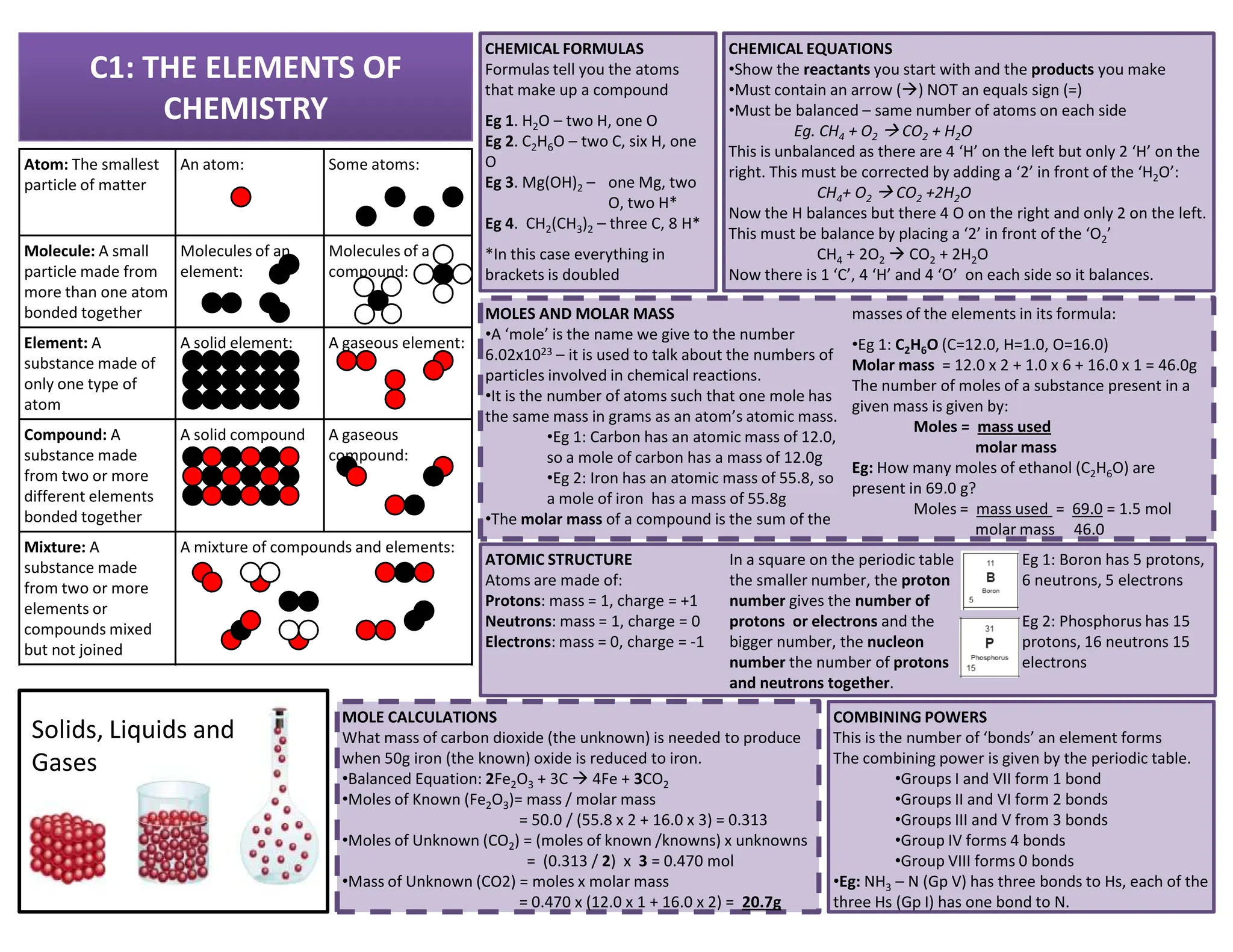
C1: THE ELEMENTS OF
CHEMISTRY
Atom: The smallest
particle of matter
An atom: Some atoms:
Molecule: A small
particle made from
more than one atom
bonded together
Molecules of an
element:
Molecules of a
compound:
Element: A
substance made of
only one type of
atom
A solid element: A gaseous element:
Compound: A
substance made
from two or more
A solid compound A gaseous
compound:
CHEMICAL FORMULAS
Formulas tell you the atoms
that make up a compound
Eg 1. H2O – two H, one O
Eg 2. C2H6O – two C, six H, one
O
Eg 3. Mg(OH)2 – one Mg, two
O, two H*
Eg 4. CH2(CH3)2 – three C, 8 H*
*In this case everything in
brackets is doubled
CHEMICAL EQUATIONS
•Show the reactants you start with and the products you make
•Must contain an arrow () NOT an equals sign (=)
•Must be balanced – same number of atoms on each side
Eg. CH4 + O2  CO2 + H2O
This is unbalanced as there are 4 ‘H’ on the left but only 2 ‘H’ on the
right. This must be corrected by adding a ‘2’ in front of the ‘H2O’:
CH4+ O2  CO2 +2H2O
Now the H balances but there 4 O on the right and only 2 on the left.
This must be balance by placing a ‘2’ in front of the ‘O2’
CH4 + 2O2  CO2 + 2H2O
Now there is 1 ‘C’, 4 ‘H’ and 4 ‘O’ on each side so it balances.
MOLES AND MOLAR MASS
•A ‘mole’ is the name we give to the number
6.02x10²³ – it is used to talk about the numbers of
particles involved in chemical reactions.
•It is the number of atoms such that one mole has
the same mass in grams as an atom’s atomic mass.
•Eg 1: Carbon has an atomic mass of 12.0,
so a mole of carbon has a mass of 12.0g
•Eg 2: Iron has an atomic mass of 55.8, so
masses of the elements in its formula:
•Eg 1: C2H6O (C=12.0, H=1.0, O=16.0)
Molar mass = 12.0 x 2 + 1.0 x 6 + 16.0 x 1 = 46.0g
The number of moles of a substance present in a
given mass is given by:
Moles = mass used
molar mass
Eg: How many moles of ethanol (C2H6O) are
Solids, Liquids and
Gases
from two or more
different elements
bonded together
Mixture: A
substance made
from two or more
elements or
compounds mixed
but not joined
A mixture of compounds and elements:
•Eg 2: Iron has an atomic mass of 55.8, so
a mole of iron has a mass of 55.8g
•The molar mass of a compound is the sum of the
Eg: How many moles of ethanol (C2H6O) are
present in 69.0 g?
Moles = mass used = 69.0 = 1.5 mol
molar mass 46.0
MOLE CALCULATIONS
What mass of carbon dioxide (the unknown) is needed to produce
when 50g iron (the known) oxide is reduced to iron.
•Balanced Equation: 2Fe2O3 + 3C  4Fe + 3CO2
•Moles of Known (Fe2O3)= mass / molar mass
= 50.0 / (55.8 x 2 + 16.0 x 3) = 0.313
•Moles of Unknown (CO2) = (moles of known /knowns) x unknowns
= (0.313 / 2) x 3 = 0.470 mol
•Mass of Unknown (CO2) = moles x molar mass
= 0.470 x (12.0 x 1 + 16.0 x 2) = 20.7g
COMBINING POWERS
This is the number of ‘bonds’ an element forms
The combining power is given by the periodic table.
•Groups I and VII form 1 bond
•Groups II and VI form 2 bonds
•Groups III and V from 3 bonds
•Group IV forms 4 bonds
•Group VIII forms 0 bonds
•Eg: NH3 – N (Gp V) has three bonds to Hs, each of the
three Hs (Gp I) has one bond to N.
ATOMIC STRUCTURE
Atoms are made of:
Protons: mass = 1, charge = +1
Neutrons: mass = 1, charge = 0
Electrons: mass = 0, charge = -1
In a square on the periodic table
the smaller number, the proton
number gives the number of
protons or electrons and the
bigger number, the nucleon
number the number of protons
and neutrons together.
Eg 1: Boron has 5 protons,
6 neutrons, 5 electrons
Eg 2: Phosphorus has 15
protons, 16 neutrons 15
electrons
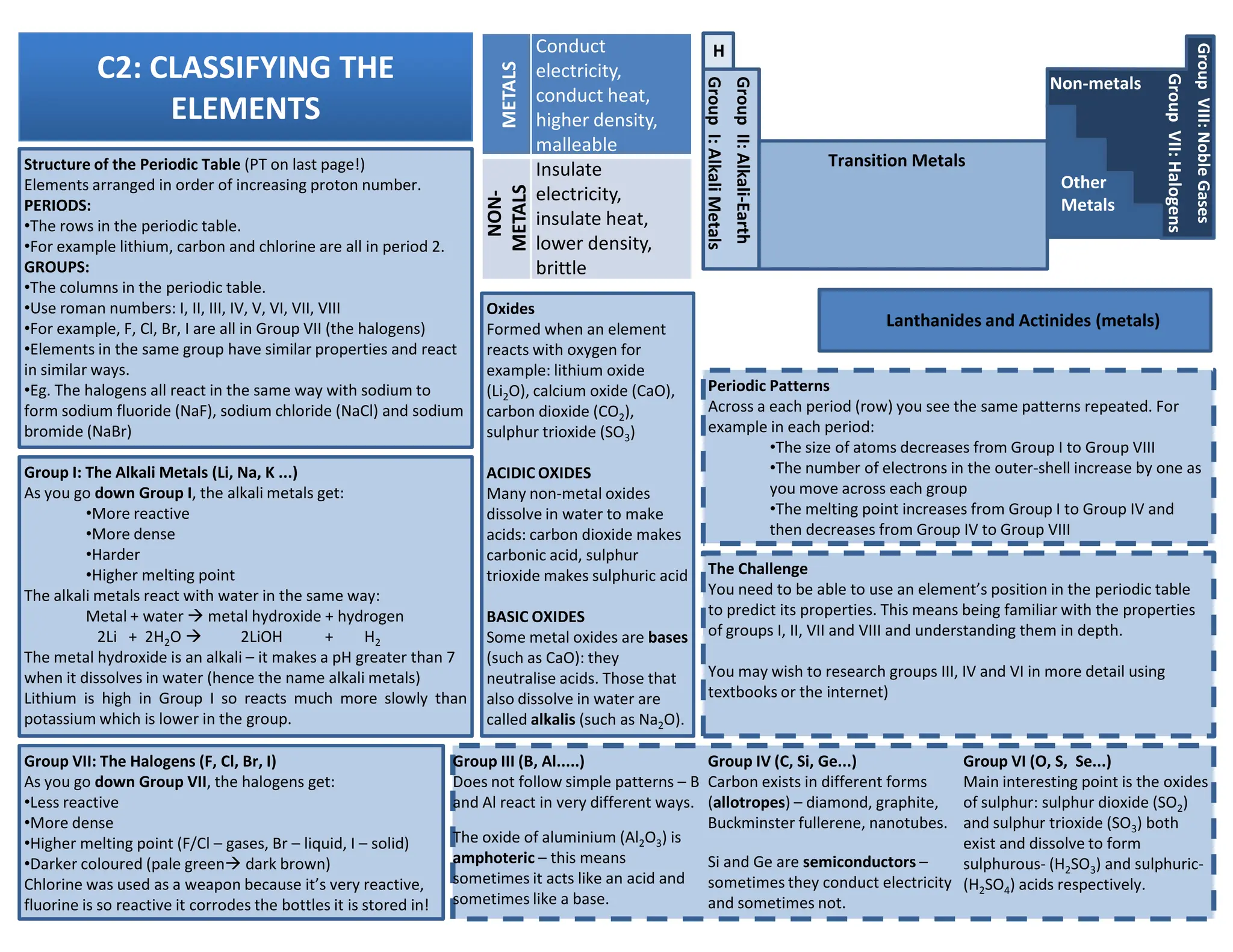
C2: CLASSIFYING THE
ELEMENTS
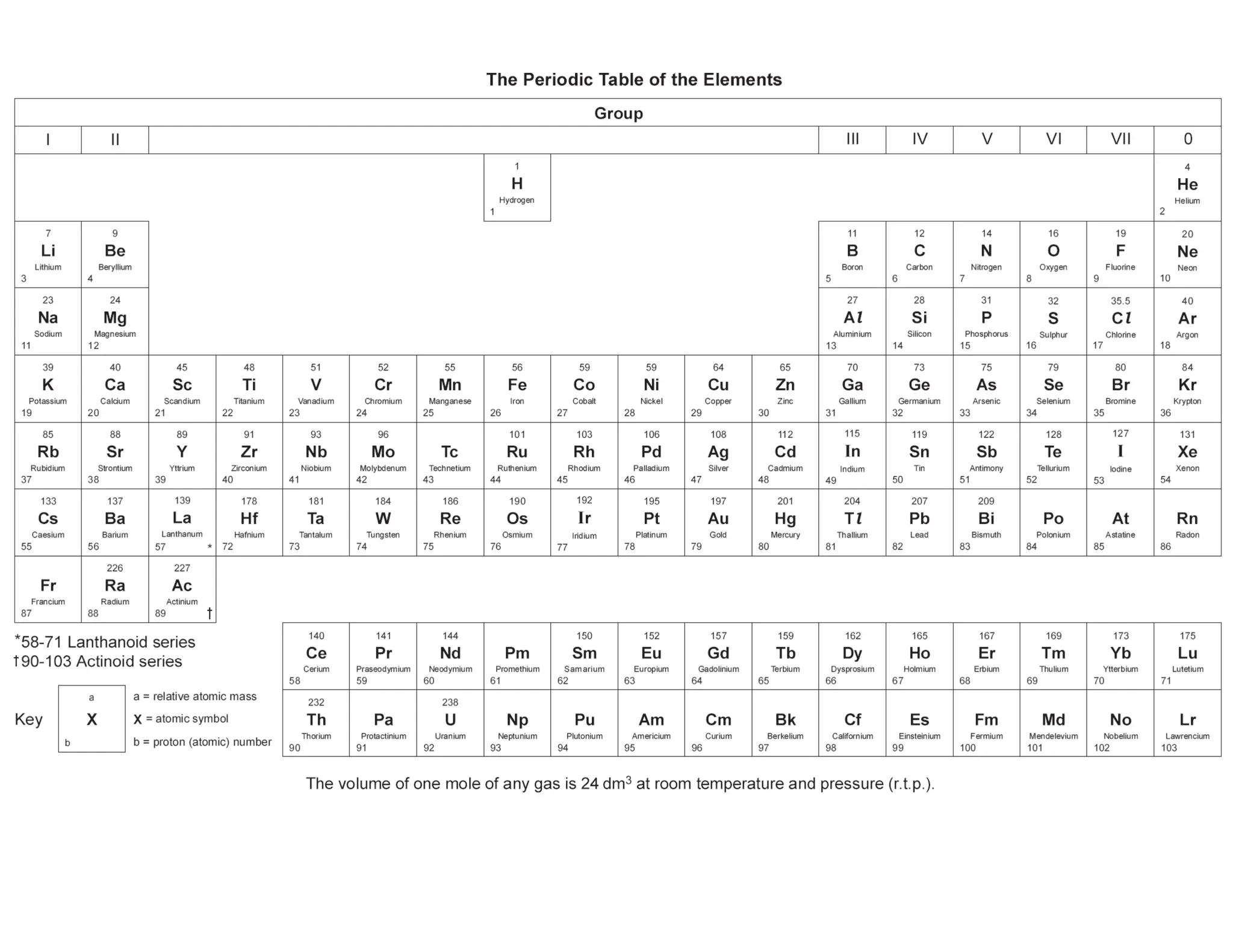
Structure of the Periodic Table (PT on last page!)
Elements arranged in order of increasing proton number.
PERIODS:
•The rows in the periodic table.
•For example lithium, carbon and chlorine are all in period 2.
GROUPS:
•The columns in the periodic table.
•Use roman numbers: I, II, III, IV, V, VI, VII, VIII
•For example, F, Cl, Br, I are all in Group VII (the halogens)
•Elements in the same group have similar properties and react
in similar ways.
•Eg. The halogens all react in the same way with sodium to
form sodium fluoride (NaF), sodium chloride (NaCl) and sodium
bromide (NaBr)
Periodic Patterns
Across a each period (row) you see the same patterns repeated. For
example in each period:
•The size of atoms decreases from Group I to Group VIII
•The number of electrons in the outer-shell increase by one as
Non-metals
Transition Metals
Group
VIII:
Noble
Gases
Group
I:
Alkali
Metals
Group
II:
Alkali-Earth
Lanthanides and Actinides (metals)
Other
Metals
H
METALS
Conduct
electricity,
conduct heat,
higher density,
malleable
NON-
METALS
Insulate
electricity,
insulate heat,
lower density,
brittle
Group
VII:
Halogens
Group I: The Alkali Metals (Li, Na, K ...)
Oxides
Formed when an element
reacts with oxygen for
example: lithium oxide
(Li2O), calcium oxide (CaO),
carbon dioxide (CO2),
sulphur trioxide (SO3)
ACIDIC OXIDES •The number of electrons in the outer-shell increase by one as
you move across each group
•The melting point increases from Group I to Group IV and
then decreases from Group IV to Group VIII
Group I: The Alkali Metals (Li, Na, K ...)
As you go down Group I, the alkali metals get:
•More reactive
•More dense
•Harder
•Higher melting point
The alkali metals react with water in the same way:
Metal + water  metal hydroxide + hydrogen
2Li + 2H2O  2LiOH + H2
The metal hydroxide is an alkali – it makes a pH greater than 7
when it dissolves in water (hence the name alkali metals)
Lithium is high in Group I so reacts much more slowly than
potassium which is lower in the group.
ACIDIC OXIDES
Many non-metal oxides
dissolve in water to make
acids: carbon dioxide makes
carbonic acid, sulphur
trioxide makes sulphuric acid
BASIC OXIDES
Some metal oxides are bases
(such as CaO): they
neutralise acids. Those that
also dissolve in water are
called alkalis (such as Na2O).
Group VII: The Halogens (F, Cl, Br, I)
As you go down Group VII, the halogens get:
•Less reactive
•More dense
•Higher melting point (F/Cl – gases, Br – liquid, I – solid)
•Darker coloured (pale green dark brown)
Chlorine was used as a weapon because it’s very reactive,
fluorine is so reactive it corrodes the bottles it is stored in!
The Challenge
You need to be able to use an element’s position in the periodic table
to predict its properties. This means being familiar with the properties
of groups I, II, VII and VIII and understanding them in depth.
You may wish to research groups III, IV and VI in more detail using
textbooks or the internet)
Group III (B, Al.....)
Does not follow simple patterns – B
and Al react in very different ways.
The oxide of aluminium (Al2O3) is
amphoteric – this means
sometimes it acts like an acid and
sometimes like a base.
Group IV (C, Si, Ge...)
Carbon exists in different forms
(allotropes) – diamond, graphite,
Buckminster fullerene, nanotubes.
Si and Ge are semiconductors –
sometimes they conduct electricity
and sometimes not.
Group VI (O, S, Se...)
Main interesting point is the oxides
of sulphur: sulphur dioxide (SO2)
and sulphur trioxide (SO3) both
exist and dissolve to form
sulphurous- (H2SO3) and sulphuric-
(H2SO4) acids respectively.
C3: PETROCHEMICALS –
Refining Crude Oil
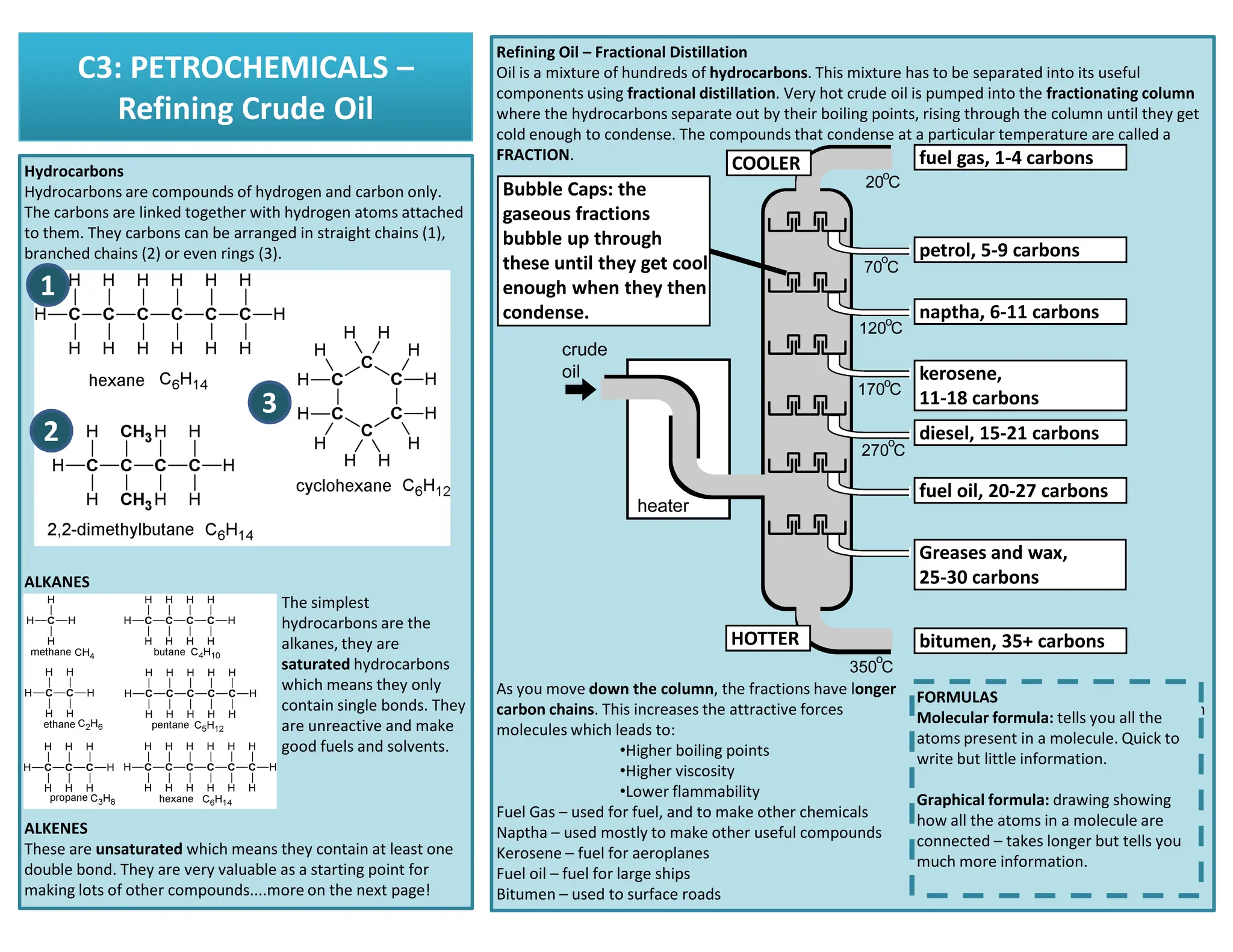
Hydrocarbons
Hydrocarbons are compounds of hydrogen and carbon only.
The carbons are linked together with hydrogen atoms attached
to them. They carbons can be arranged in straight chains (1),
branched chains (2) or even rings (3).
Refining Oil – Fractional Distillation
Oil is a mixture of hundreds of hydrocarbons. This mixture has to be separated into its useful
components using fractional distillation. Very hot crude oil is pumped into the fractionating column
where the hydrocarbons separate out by their boiling points, rising through the column until they get
cold enough to condense. The compounds that condense at a particular temperature are called a
FRACTION.
1
2
3
fuel gas, 1-4 carbons
petrol, 5-9 carbons
naptha, 6-11 carbons
kerosene,
11-18 carbons
diesel, 15-21 carbons
COOLER
Bubble Caps: the
gaseous fractions
bubble up through
these until they get cool
enough when they then
condense.
ALKANES
The simplest
hydrocarbons are the
alkanes, they are
saturated hydrocarbons
which means they only
contain single bonds. They
are unreactive and make
good fuels and solvents.
ALKENES
These are unsaturated which means they contain at least one
double bond. They are very valuable as a starting point for
making lots of other compounds....more on the next page!
As you move down the column, the fractions have longer
carbon chains. This increases the attractive forces between
molecules which leads to:
•Higher boiling points
•Higher viscosity
•Lower flammability
Fuel Gas – used for fuel, and to make other chemicals
Naptha – used mostly to make other useful compounds
Kerosene – fuel for aeroplanes
Fuel oil – fuel for large ships
Bitumen – used to surface roads
fuel oil, 20-27 carbons
Greases and wax,
25-30 carbons
bitumen, 35+ carbons
HOTTER
FORMULAS
Molecular formula: tells you all the
atoms present in a molecule. Quick to
write but little information.
Graphical formula: drawing showing
how all the atoms in a molecule are
connected – takes longer but tells you
much more information.
C3: PETROCHEMICALS –
Using the Products
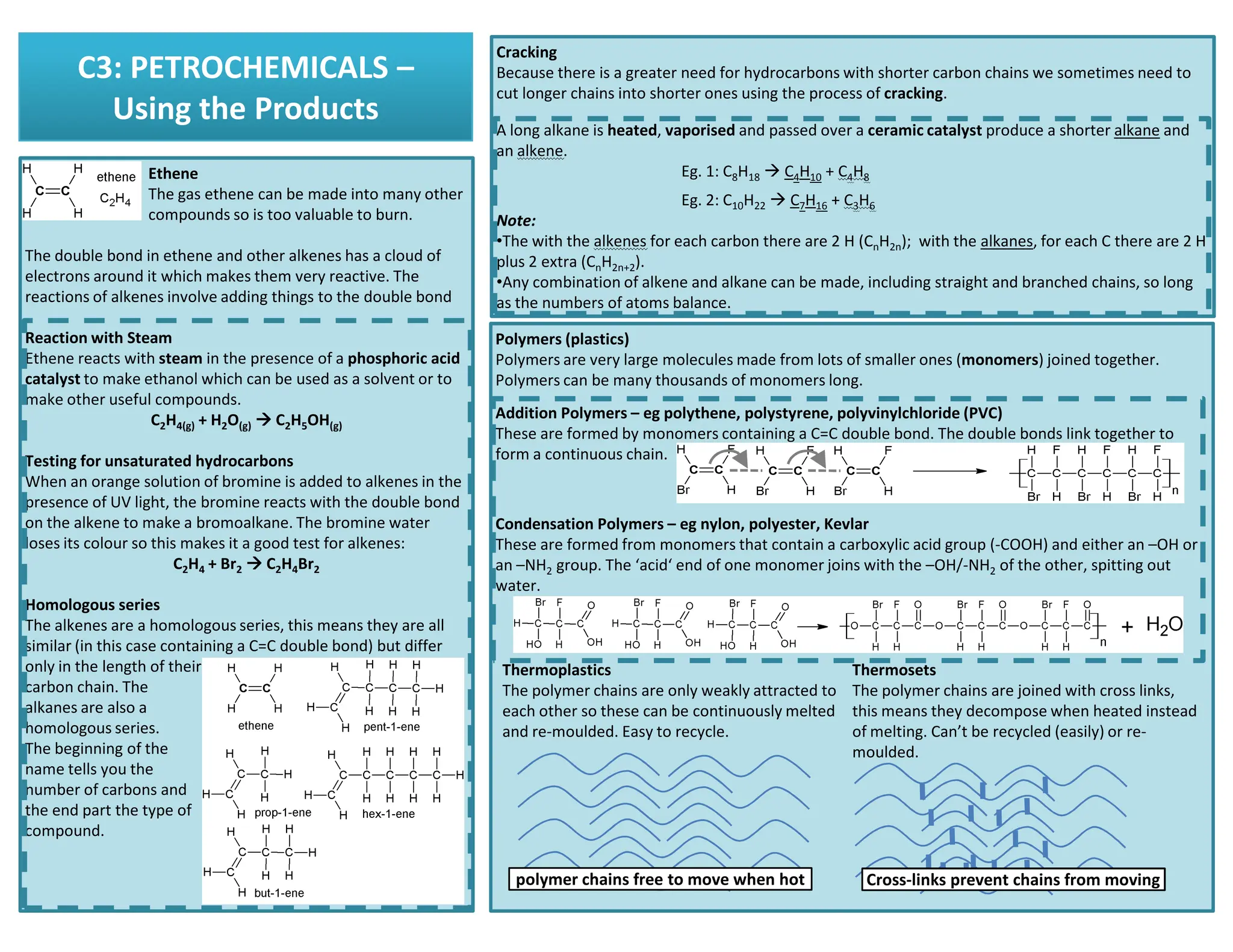
Ethene
The gas ethene can be made into many other
compounds so is too valuable to burn.
The double bond in ethene and other alkenes has a cloud of
electrons around it which makes them very reactive. The
reactions of alkenes involve adding things to the double bond
Reaction with Steam
Ethene reacts with steam in the presence of a phosphoric acid
catalyst to make ethanol which can be used as a solvent or to
make other useful compounds.
C2H4(g) + H2O(g) 


 C2H5OH(g)
Testing for unsaturated hydrocarbons
When an orange solution of bromine is added to alkenes in the
Cracking
Because there is a greater need for hydrocarbons with shorter carbon chains we sometimes need to
cut longer chains into shorter ones using the process of cracking.
A long alkane is heated, vaporised and passed over a ceramic catalyst produce a shorter alkane and
an alkene.
Eg. 1: C8H18  C4H10 + C4H8
Eg. 2: C10H22  C7H16 + C3H6
Note:
•The with the alkenes for each carbon there are 2 H (CnH2n); with the alkanes, for each C there are 2 H
plus 2 extra (CnH2n+2).
•Any combination of alkene and alkane can be made, including straight and branched chains, so long
as the numbers of atoms balance.
Polymers (plastics)
Polymers are very large molecules made from lots of smaller ones (monomers) joined together.
Polymers can be many thousands of monomers long.
Addition Polymers – eg polythene, polystyrene, polyvinylchloride (PVC)
These are formed by monomers containing a C=C double bond. The double bonds link together to
form a continuous chain.
When an orange solution of bromine is added to alkenes in the
presence of UV light, the bromine reacts with the double bond
on the alkene to make a bromoalkane. The bromine water
loses its colour so this makes it a good test for alkenes:
C2H4 + Br2 


 C2H4Br2
Homologous series
The alkenes are a homologous series, this means they are all
similar (in this case containing a C=C double bond) but differ
only in the length of their
carbon chain. The
alkanes are also a
homologous series.
The beginning of the
name tells you the
number of carbons and
the end part the type of
compound.
Condensation Polymers – eg nylon, polyester, Kevlar
These are formed from monomers that contain a carboxylic acid group (-COOH) and either an –OH or
an –NH2 group. The ‘acid‘ end of one monomer joins with the –OH/-NH2 of the other, spitting out
water.
Thermoplastics
The polymer chains are only weakly attracted to
each other so these can be continuously melted
and re-moulded. Easy to recycle.
Thermosets
The polymer chains are joined with cross links,
this means they decompose when heated instead
of melting. Can’t be recycled (easily) or re-
moulded.
polymer chains free to move when hot Cross-links prevent chains from moving
C4: CHEMICALS FROM
PLANTS
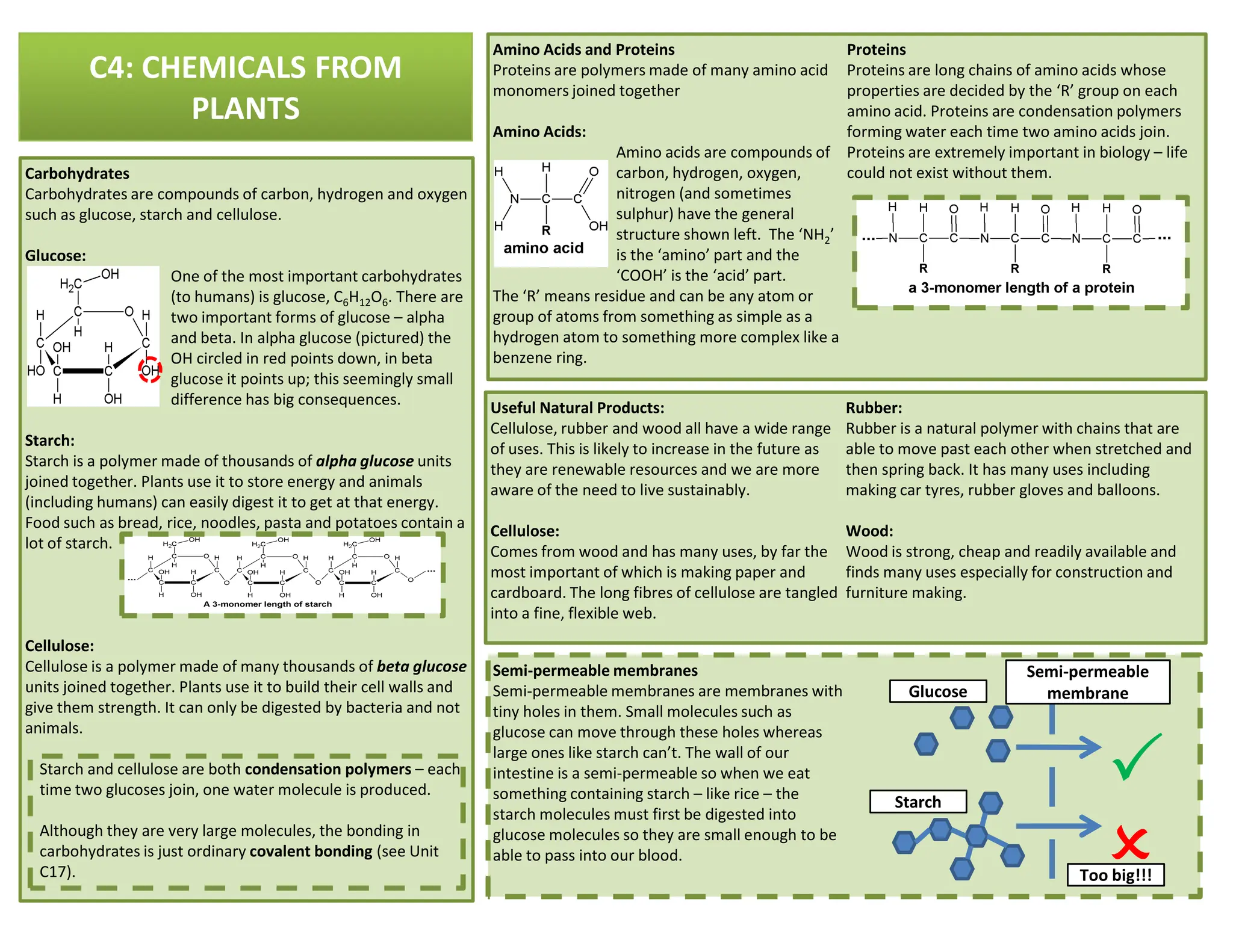
Carbohydrates
Carbohydrates are compounds of carbon, hydrogen and oxygen
such as glucose, starch and cellulose.
Glucose:
One of the most important carbohydrates
(to humans) is glucose, C6H12O6. There are
two important forms of glucose – alpha
and beta. In alpha glucose (pictured) the
OH circled in red points down, in beta
glucose it points up; this seemingly small
difference has big consequences.
Starch:
Starch is a polymer made of thousands of alpha glucose units
joined together. Plants use it to store energy and animals
Amino Acids and Proteins
Proteins are polymers made of many amino acid
monomers joined together
Amino Acids:
Amino acids are compounds of
carbon, hydrogen, oxygen,
nitrogen (and sometimes
sulphur) have the general
structure shown left. The ‘NH2’
is the ‘amino’ part and the
‘COOH’ is the ‘acid’ part.
The ‘R’ means residue and can be any atom or
group of atoms from something as simple as a
hydrogen atom to something more complex like a
benzene ring.
Proteins
Proteins are long chains of amino acids whose
properties are decided by the ‘R’ group on each
amino acid. Proteins are condensation polymers
forming water each time two amino acids join.
Proteins are extremely important in biology – life
could not exist without them.
Useful Natural Products:
Cellulose, rubber and wood all have a wide range
of uses. This is likely to increase in the future as
they are renewable resources and we are more
Rubber:
Rubber is a natural polymer with chains that are
able to move past each other when stretched and
then spring back. It has many uses including
joined together. Plants use it to store energy and animals
(including humans) can easily digest it to get at that energy.
Food such as bread, rice, noodles, pasta and potatoes contain a
lot of starch.
Cellulose:
Cellulose is a polymer made of many thousands of beta glucose
units joined together. Plants use it to build their cell walls and
give them strength. It can only be digested by bacteria and not
animals.
Starch and cellulose are both condensation polymers – each
time two glucoses join, one water molecule is produced.
Although they are very large molecules, the bonding in
carbohydrates is just ordinary covalent bonding (see Unit
C17).
Semi-permeable membranes
Semi-permeable membranes are membranes with
tiny holes in them. Small molecules such as
glucose can move through these holes whereas
large ones like starch can’t. The wall of our
intestine is a semi-permeable so when we eat
something containing starch – like rice – the
starch molecules must first be digested into
glucose molecules so they are small enough to be
able to pass into our blood.
they are renewable resources and we are more
aware of the need to live sustainably.
Cellulose:
Comes from wood and has many uses, by far the
most important of which is making paper and
cardboard. The long fibres of cellulose are tangled
into a fine, flexible web.
then spring back. It has many uses including
making car tyres, rubber gloves and balloons.
Wood:
Wood is strong, cheap and readily available and
finds many uses especially for construction and
furniture making.


Too big!!!
Starch
Glucose
Semi-permeable
membrane
C5: MATERIALS AND
STRUCTURES
Properties of materials
Materials can be described using words such as:
•Strength – how much force it can resist?
•Elasticity – how stretchy is it?
•Hardness – how difficult is it to scratch?
•Porosity – can air/water pass through it?
•Transparency – does light pass through it?
•Conductivity – does it conduct electricity or heat?
•Biodegradability – does it break down naturally outside?
Molecules
A molecule is a small particle made from a few
non-metal atoms bonded together – often fewer
than 10 but sometimes much more (think
polymers).
covalent bonds.
Molecular compounds have low melting points
due to the weak intermolecular forces and do not
conduct electricity as all electrons are stuck in
Ionic Compounds
Most compounds of a metal and a non-metal a
made of ions – atoms that have gained or lost
electrons. Usually the metal atom loses electrons
to make a positive ion (cation) and the non-metal
gains electrons to make negative ion (anion).
The positive and negative ions strongly attract
each other – this is an ionic bond.
Giant Ionic Structures
Ionic compounds don’t form molecules, they form
crystals made of alternating positive and negative
ions repeating millions of times in all directions.
This is called a giant ionic lattice.
Properties of Ionic Compounds
When you melt or dissolve an ionic compound it
conducts electricity because the ions are free to
move towards the positive and negative
electrodes. When
solid the ions are
stuck in position
and there are no
free electrons so
they don’t conduct.
Glass
Glass is made of silicon (IV) oxide - aka silica, SiO2 – with various
metal oxides (such as sodium oxide or calcium oxide) added to
it. The biggest source of silicon (IV) oxide is sand.
The metal ions cause the glass to have an amorphous giant
polymers).
The atoms in a molecule are joined by strong
covalent bonds. In a solid each molecule is held
close to its neighbour by weak intermolecular
forces. When a substance melts, it is these weak
intermolecular forces that break NOT the strong
conduct electricity as all electrons are stuck in
bonds and so unable to move.
Giant Covalent Lattices
A crystal made of a repeating pattern of atoms
joined with covalent bonds that repeats millions
of times in all directions.
Examples include silica (SiO2) diamond (C) and
graphite (C). They have high melting points
because melting requires the breaking of strong
covalent bonds. The don’t conduct electricity
(except graphite) as there are no electrons free to
move – they are stuck in bonds.
Graphite
Diamond
Silica
The metal ions cause the glass to have an amorphous giant
structure, this is different to other giant structures because
the atoms are disordered and do not form regular patterns.
Metal ions can be added to glass to give it colour for example:
•Cobalt – blue
•Iron (II) oxide – blue-green
•Manganese – pale violet
•Copper oxide – turquoise
•Titanium – yellowish-brown
Recycling glass is beneficial for the environment as it uses less
energy and resources. However it is hard to control the quality
and consistency so is unsuitable for specialised applications.
Ceramics have a similar structure to glass and are made from
clay that is fired at high temperature causing a chemical
reaction that fuses its particles together.
C6: OXIDATION AND
REDUCTION
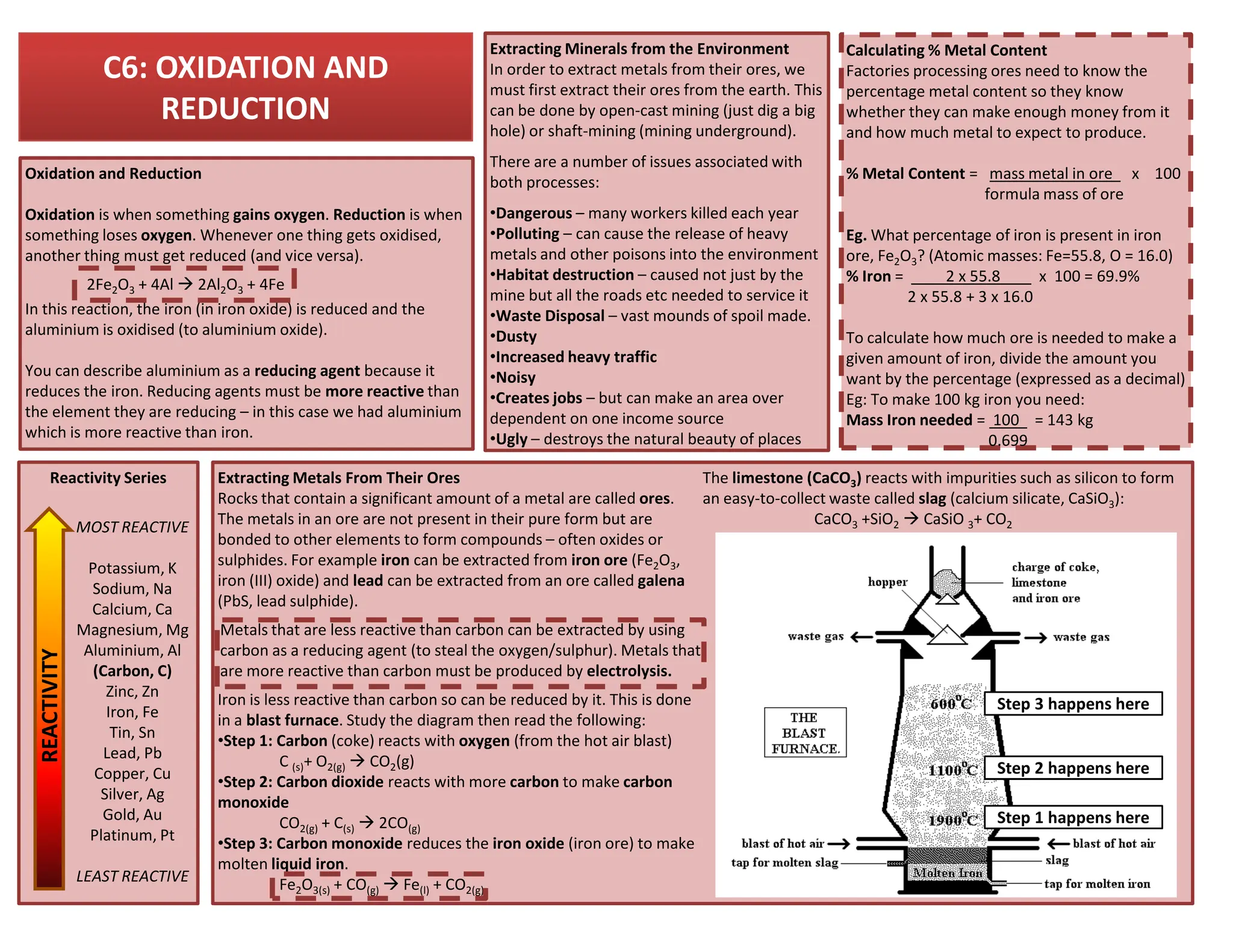
Oxidation and Reduction
Oxidation is when something gains oxygen. Reduction is when
something loses oxygen. Whenever one thing gets oxidised,
another thing must get reduced (and vice versa).
2Fe2O3 + 4Al  2Al2O3 + 4Fe
In this reaction, the iron (in iron oxide) is reduced and the
aluminium is oxidised (to aluminium oxide).
You can describe aluminium as a reducing agent because it
reduces the iron. Reducing agents must be more reactive than
the element they are reducing – in this case we had aluminium
which is more reactive than iron.
Calculating % Metal Content
Factories processing ores need to know the
percentage metal content so they know
whether they can make enough money from it
and how much metal to expect to produce.
% Metal Content = mass metal in ore x 100
formula mass of ore
Eg. What percentage of iron is present in iron
ore, Fe2O3? (Atomic masses: Fe=55.8, O = 16.0)
% Iron = 2 x 55.8 x 100 = 69.9%
2 x 55.8 + 3 x 16.0
To calculate how much ore is needed to make a
given amount of iron, divide the amount you
want by the percentage (expressed as a decimal)
Eg: To make 100 kg iron you need:
Mass Iron needed = 100 = 143 kg
0.699
Reactivity Series Extracting Metals From Their Ores The limestone (CaCO ) reacts with impurities such as silicon to form
Extracting Minerals from the Environment
In order to extract metals from their ores, we
must first extract their ores from the earth. This
can be done by open-cast mining (just dig a big
hole) or shaft-mining (mining underground).
There are a number of issues associated with
both processes:
•Dangerous – many workers killed each year
•Polluting – can cause the release of heavy
metals and other poisons into the environment
•Habitat destruction – caused not just by the
mine but all the roads etc needed to service it
•Waste Disposal – vast mounds of spoil made.
•Dusty
•Increased heavy traffic
•Noisy
•Creates jobs – but can make an area over
dependent on one income source
•Ugly – destroys the natural beauty of places
Reactivity Series
MOST REACTIVE
Potassium, K
Sodium, Na
Calcium, Ca
Magnesium, Mg
Aluminium, Al
(Carbon, C)
Zinc, Zn
Iron, Fe
Tin, Sn
Lead, Pb
Copper, Cu
Silver, Ag
Gold, Au
Platinum, Pt
LEAST REACTIVE
REACTIVITY
Extracting Metals From Their Ores
Rocks that contain a significant amount of a metal are called ores.
The metals in an ore are not present in their pure form but are
bonded to other elements to form compounds – often oxides or
sulphides. For example iron can be extracted from iron ore (Fe2O3,
iron (III) oxide) and lead can be extracted from an ore called galena
(PbS, lead sulphide).
Metals that are less reactive than carbon can be extracted by using
carbon as a reducing agent (to steal the oxygen/sulphur). Metals that
are more reactive than carbon must be produced by electrolysis.
Iron is less reactive than carbon so can be reduced by it. This is done
in a blast furnace. Study the diagram then read the following:
•Step 1: Carbon (coke) reacts with oxygen (from the hot air blast)
C (s)+ O2(g)  CO2(g)
•Step 2: Carbon dioxide reacts with more carbon to make carbon
monoxide
CO2(g) + C(s)  2CO(g)
•Step 3: Carbon monoxide reduces the iron oxide (iron ore) to make
molten liquid iron.
Fe2O3(s) + CO(g)  Fe(l) + CO2(g)
The limestone (CaCO3) reacts with impurities such as silicon to form
an easy-to-collect waste called slag (calcium silicate, CaSiO3):
CaCO3 +SiO2  CaSiO 3+ CO2
Step 1 happens here
Step 2 happens here
Step 3 happens here
C7: IONS AND ELECTROLYSIS
Products of Electrolysis
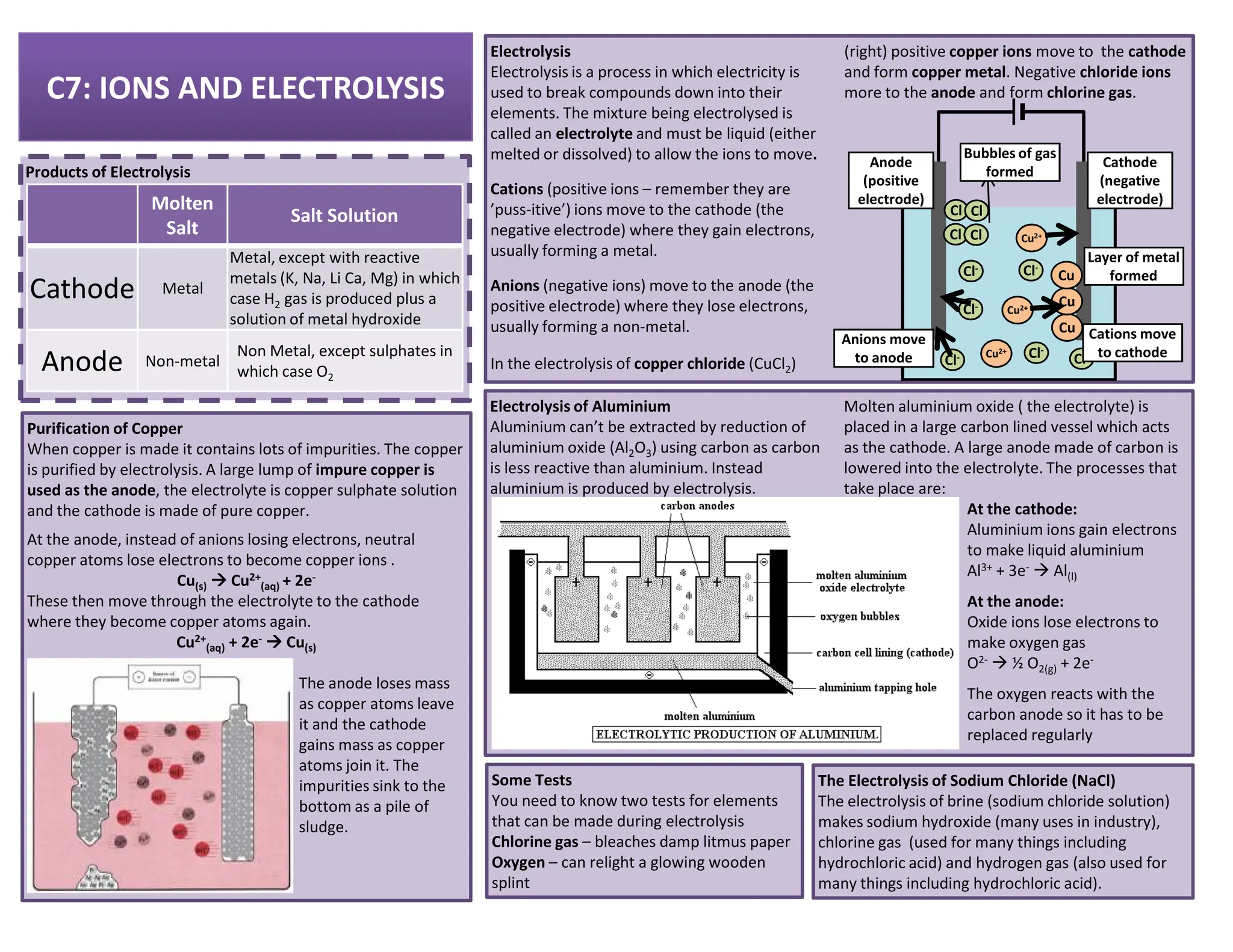
Electrolysis
Electrolysis is a process in which electricity is
used to break compounds down into their
elements. The mixture being electrolysed is
called an electrolyte and must be liquid (either
melted or dissolved) to allow the ions to move.
Cations (positive ions – remember they are
’puss-itive’) ions move to the cathode (the
negative electrode) where they gain electrons,
usually forming a metal.
Anions (negative ions) move to the anode (the
positive electrode) where they lose electrons,
usually forming a non-metal.
In the electrolysis of copper chloride (CuCl2)
(right) positive copper ions move to the cathode
and form copper metal. Negative chloride ions
more to the anode and form chlorine gas.
Cu2+
Cu2+
Cu2+
Cu
Cu
Cu
Cl- Cl-
Cl-
Cl- Cl-
Cl-
Cl Cl
Cl Cl
Cathode
(negative
electrode)
Anode
(positive
electrode)
Anions move
to anode
Cations move
to cathode
Layer of metal
formed
Bubbles of gas
formed
Molten
Salt
Salt Solution
Cathode Metal
Metal, except with reactive
metals (K, Na, Li Ca, Mg) in which
case H2 gas is produced plus a
solution of metal hydroxide
Anode Non-metal
Non Metal, except sulphates in
which case O2
Electrolysis of Aluminium
Aluminium can’t be extracted by reduction of
aluminium oxide (Al2O3) using carbon as carbon
is less reactive than aluminium. Instead
Molten aluminium oxide ( the electrolyte) is
placed in a large carbon lined vessel which acts
as the cathode. A large anode made of carbon is
lowered into the electrolyte. The processes that
Purification of Copper
When copper is made it contains lots of impurities. The copper
is purified by electrolysis. A large lump of impure copper is is less reactive than aluminium. Instead
aluminium is produced by electrolysis.
lowered into the electrolyte. The processes that
take place are:
At the cathode:
Aluminium ions gain electrons
to make liquid aluminium
Al3+ + 3e-  Al(l)
At the anode:
Oxide ions lose electrons to
make oxygen gas
O2-  ½ O2(g) + 2e-
The oxygen reacts with the
carbon anode so it has to be
replaced regularly
is purified by electrolysis. A large lump of impure copper is
used as the anode, the electrolyte is copper sulphate solution
and the cathode is made of pure copper.
At the anode, instead of anions losing electrons, neutral
copper atoms lose electrons to become copper ions .
Cu(s) 


 Cu2+
(aq) + 2e-
These then move through the electrolyte to the cathode
where they become copper atoms again.
Cu2+
(aq) + 2e- 


 Cu(s)
The anode loses mass
as copper atoms leave
it and the cathode
gains mass as copper
atoms join it. The
impurities sink to the
bottom as a pile of
sludge.
Some Tests
You need to know two tests for elements
that can be made during electrolysis
Chlorine gas – bleaches damp litmus paper
Oxygen – can relight a glowing wooden
splint
The Electrolysis of Sodium Chloride (NaCl)
The electrolysis of brine (sodium chloride solution)
makes sodium hydroxide (many uses in industry),
chlorine gas (used for many things including
hydrochloric acid) and hydrogen gas (also used for
many things including hydrochloric acid).
C8: SOLVENTS AND
SOLUTIONS
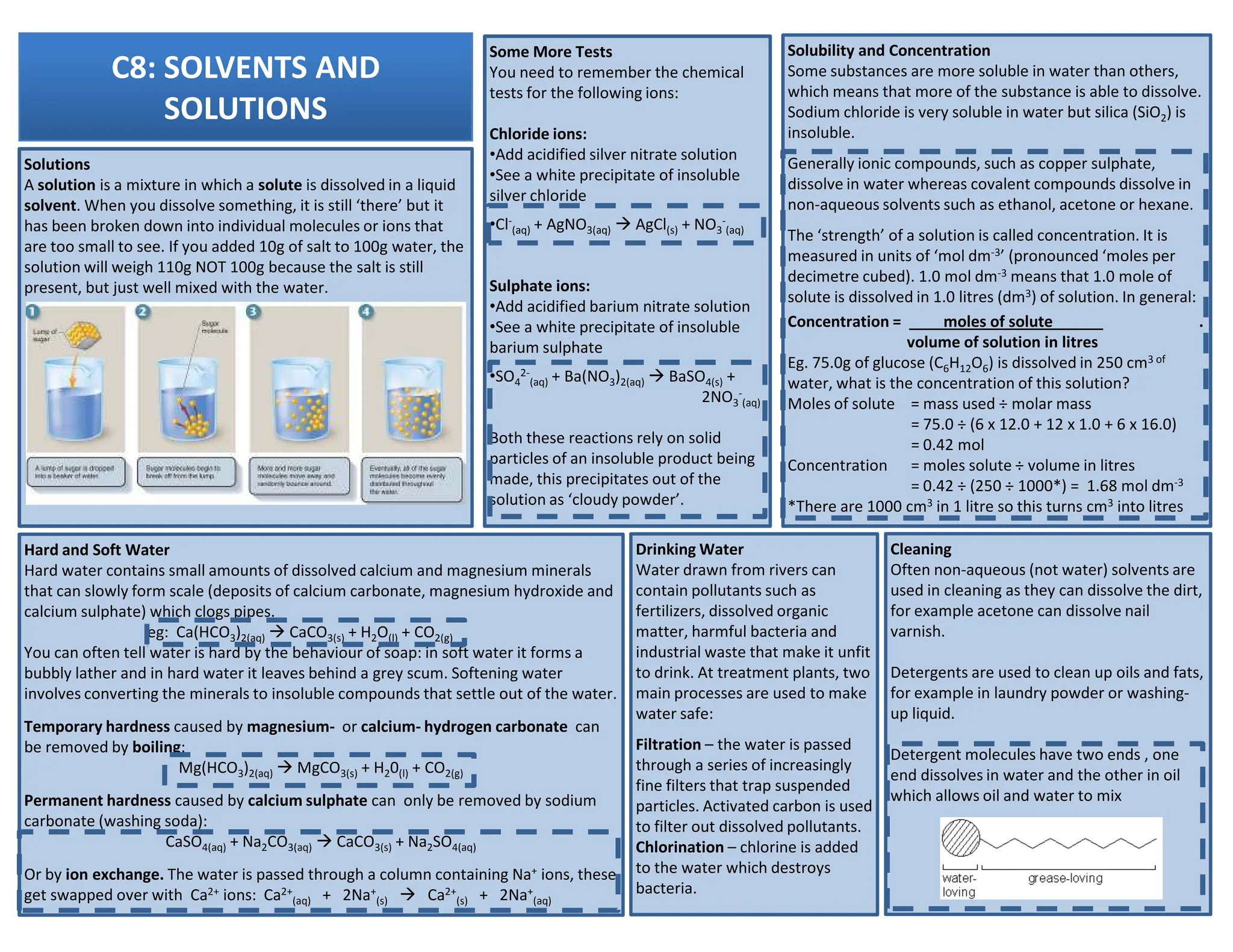
Solutions
A solution is a mixture in which a solute is dissolved in a liquid
solvent. When you dissolve something, it is still ‘there’ but it
has been broken down into individual molecules or ions that
are too small to see. If you added 10g of salt to 100g water, the
solution will weigh 110g NOT 100g because the salt is still
present, but just well mixed with the water.
Solubility and Concentration
Some substances are more soluble in water than others,
which means that more of the substance is able to dissolve.
Sodium chloride is very soluble in water but silica (SiO2) is
insoluble.
Generally ionic compounds, such as copper sulphate,
dissolve in water whereas covalent compounds dissolve in
non-aqueous solvents such as ethanol, acetone or hexane.
The ‘strength’ of a solution is called concentration. It is
measured in units of ‘mol dm-3’ (pronounced ‘moles per
decimetre cubed). 1.0 mol dm-3 means that 1.0 mole of
solute is dissolved in 1.0 litres (dm3) of solution. In general:
Concentration = moles of solute .
volume of solution in litres
Eg. 75.0g of glucose (C6H12O6) is dissolved in 250 cm3 of
water, what is the concentration of this solution?
Moles of solute = mass used ÷ molar mass
= 75.0 ÷ (6 x 12.0 + 12 x 1.0 + 6 x 16.0)
= 0.42 mol
Concentration = moles solute ÷ volume in litres
= 0.42 ÷ (250 ÷ 1000*) = 1.68 mol dm-3
Some More Tests
You need to remember the chemical
tests for the following ions:
Chloride ions:
•Add acidified silver nitrate solution
•See a white precipitate of insoluble
silver chloride
•Cl-
(aq) + AgNO3(aq)  AgCl(s) + NO3
-
(aq)
Sulphate ions:
•Add acidified barium nitrate solution
•See a white precipitate of insoluble
barium sulphate
•SO4
2-
(aq) + Ba(NO3)2(aq)  BaSO4(s) +
. 2NO3
-
(aq)
Both these reactions rely on solid
particles of an insoluble product being
made, this precipitates out of the = 0.42 ÷ (250 ÷ 1000*) = 1.68 mol dm-3
*There are 1000 cm3 in 1 litre so this turns cm3 into litres
made, this precipitates out of the
solution as ‘cloudy powder’.
Hard and Soft Water
Hard water contains small amounts of dissolved calcium and magnesium minerals
that can slowly form scale (deposits of calcium carbonate, magnesium hydroxide and
calcium sulphate) which clogs pipes.
eg: Ca(HCO3)2(aq)  CaCO3(s) + H2O(l) + CO2(g)
You can often tell water is hard by the behaviour of soap: in soft water it forms a
bubbly lather and in hard water it leaves behind a grey scum. Softening water
involves converting the minerals to insoluble compounds that settle out of the water.
Temporary hardness caused by magnesium- or calcium- hydrogen carbonate can
be removed by boiling:
Mg(HCO3)2(aq)  MgCO3(s) + H20(l) + CO2(g)
Permanent hardness caused by calcium sulphate can only be removed by sodium
carbonate (washing soda):
CaSO4(aq) + Na2CO3(aq)  CaCO3(s) + Na2SO4(aq)
Or by ion exchange. The water is passed through a column containing Na+ ions, these
get swapped over with Ca2+ ions: Ca2+
(aq) + 2Na+
(s)  Ca2+
(s) + 2Na+
(aq)
Drinking Water
Water drawn from rivers can
contain pollutants such as
fertilizers, dissolved organic
matter, harmful bacteria and
industrial waste that make it unfit
to drink. At treatment plants, two
main processes are used to make
water safe:
Filtration – the water is passed
through a series of increasingly
fine filters that trap suspended
particles. Activated carbon is used
to filter out dissolved pollutants.
Chlorination – chlorine is added
to the water which destroys
bacteria.
Cleaning
Often non-aqueous (not water) solvents are
used in cleaning as they can dissolve the dirt,
for example acetone can dissolve nail
varnish.
Detergents are used to clean up oils and fats,
for example in laundry powder or washing-
up liquid.
Detergent molecules have two ends , one
end dissolves in water and the other in oil
which allows oil and water to mix
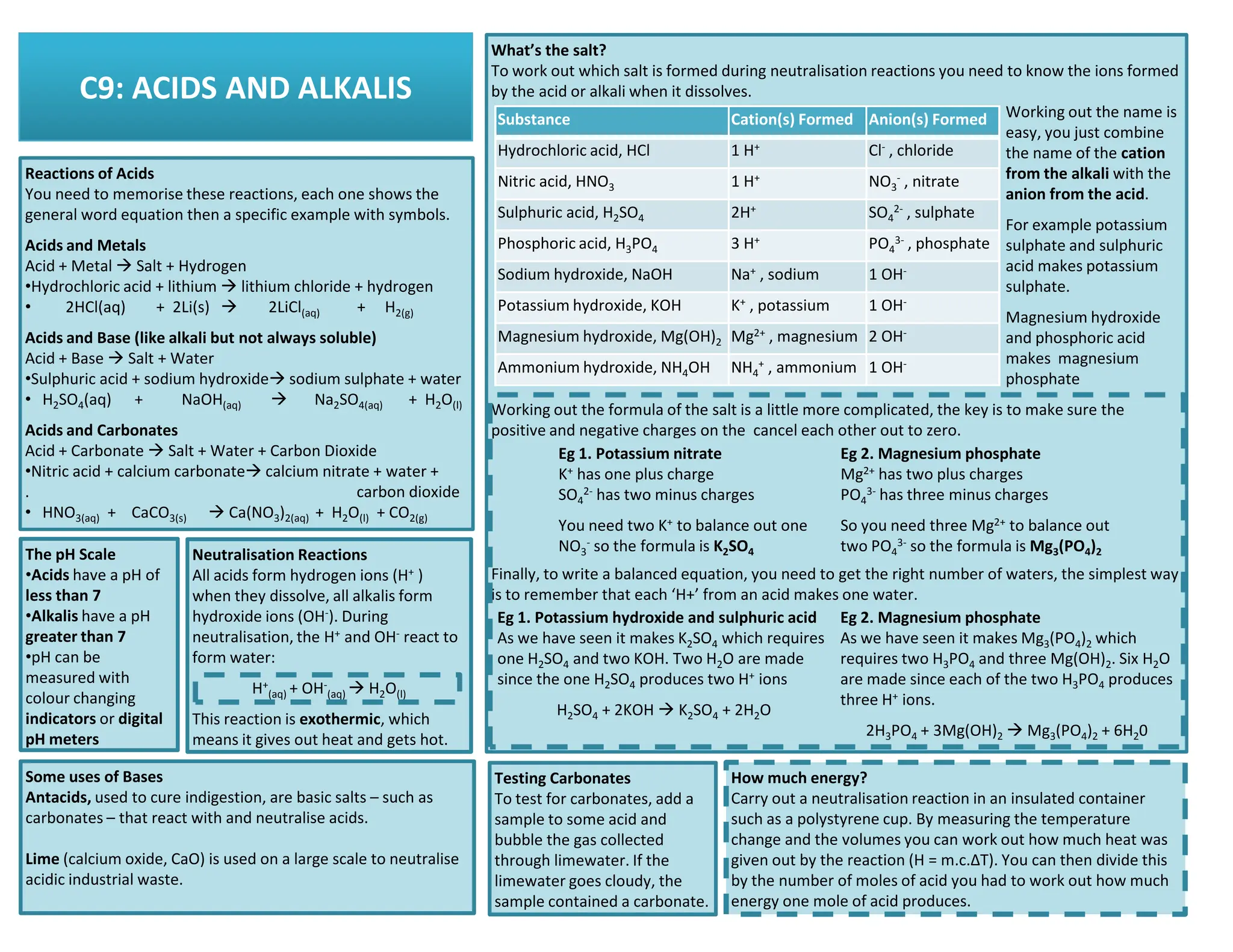
C9: ACIDS AND ALKALIS
Reactions of Acids
You need to memorise these reactions, each one shows the
general word equation then a specific example with symbols.
Acids and Metals
Acid + Metal  Salt + Hydrogen
•Hydrochloric acid + lithium  lithium chloride + hydrogen
• 2HCl(aq) + 2Li(s)  2LiCl(aq) + H2(g)
Acids and Base (like alkali but not always soluble)
Acid + Base  Salt + Water
•Sulphuric acid + sodium hydroxide sodium sulphate + water
• H2SO4(aq) + NaOH(aq)  Na2SO4(aq) + H2O(l)
Acids and Carbonates
Acid + Carbonate  Salt + Water + Carbon Dioxide
•Nitric acid + calcium carbonate calcium nitrate + water +
What’s the salt?
To work out which salt is formed during neutralisation reactions you need to know the ions formed
by the acid or alkali when it dissolves.
Working out the name is
easy, you just combine
the name of the cation
from the alkali with the
anion from the acid.
For example potassium
sulphate and sulphuric
acid makes potassium
sulphate.
Magnesium hydroxide
and phosphoric acid
makes magnesium
phosphate
Working out the formula of the salt is a little more complicated, the key is to make sure the
positive and negative charges on the cancel each other out to zero.
Substance Cation(s) Formed Anion(s) Formed
Hydrochloric acid, HCl 1 H+ Cl- , chloride
Nitric acid, HNO3 1 H+ NO3
- , nitrate
Sulphuric acid, H2SO4 2H+ SO4
2- , sulphate
Phosphoric acid, H3PO4 3 H+ PO4
3- , phosphate
Sodium hydroxide, NaOH Na+ , sodium 1 OH-
Potassium hydroxide, KOH K+ , potassium 1 OH-
Magnesium hydroxide, Mg(OH)2 Mg2+ , magnesium 2 OH-
Ammonium hydroxide, NH4OH NH4
+ , ammonium 1 OH-
Eg 1. Potassium nitrate
K+ has one plus charge
Eg 2. Magnesium phosphate
Mg2+ has two plus charges
•Nitric acid + calcium carbonate calcium nitrate + water +
. carbon dioxide
• HNO3(aq) + CaCO3(s)  Ca(NO3)2(aq) + H2O(l) + CO2(g)
Neutralisation Reactions
All acids form hydrogen ions (H+ )
when they dissolve, all alkalis form
hydroxide ions (OH-). During
neutralisation, the H+ and OH- react to
form water:
H+
(aq) + OH-
(aq)  H2O(l)
This reaction is exothermic, which
means it gives out heat and gets hot.
Finally, to write a balanced equation, you need to get the right number of waters, the simplest way
is to remember that each ‘H+’ from an acid makes one water.
K+ has one plus charge
SO4
2- has two minus charges
You need two K+ to balance out one
NO3
- so the formula is K2SO4
Mg2+ has two plus charges
PO4
3- has three minus charges
So you need three Mg2+ to balance out
two PO4
3- so the formula is Mg3(PO4)2
Eg 1. Potassium hydroxide and sulphuric acid
As we have seen it makes K2SO4 which requires
one H2SO4 and two KOH. Two H2O are made
since the one H2SO4 produces two H+ ions
H2SO4 + 2KOH  K2SO4 + 2H2O
Eg 2. Magnesium phosphate
As we have seen it makes Mg3(PO4)2 which
requires two H3PO4 and three Mg(OH)2. Six H2O
are made since each of the two H3PO4 produces
three H+ ions.
2H3PO4 + 3Mg(OH)2  Mg3(PO4)2 + 6H20
The pH Scale
•Acids have a pH of
less than 7
•Alkalis have a pH
greater than 7
•pH can be
measured with
colour changing
indicators or digital
pH meters
Some uses of Bases
Antacids, used to cure indigestion, are basic salts – such as
carbonates – that react with and neutralise acids.
Lime (calcium oxide, CaO) is used on a large scale to neutralise
acidic industrial waste.
Testing Carbonates
To test for carbonates, add a
sample to some acid and
bubble the gas collected
through limewater. If the
limewater goes cloudy, the
sample contained a carbonate.
How much energy?
Carry out a neutralisation reaction in an insulated container
such as a polystyrene cup. By measuring the temperature
change and the volumes you can work out how much heat was
given out by the reaction (H = m.c.ΔT). You can then divide this
by the number of moles of acid you had to work out how much
energy one mole of acid produces.
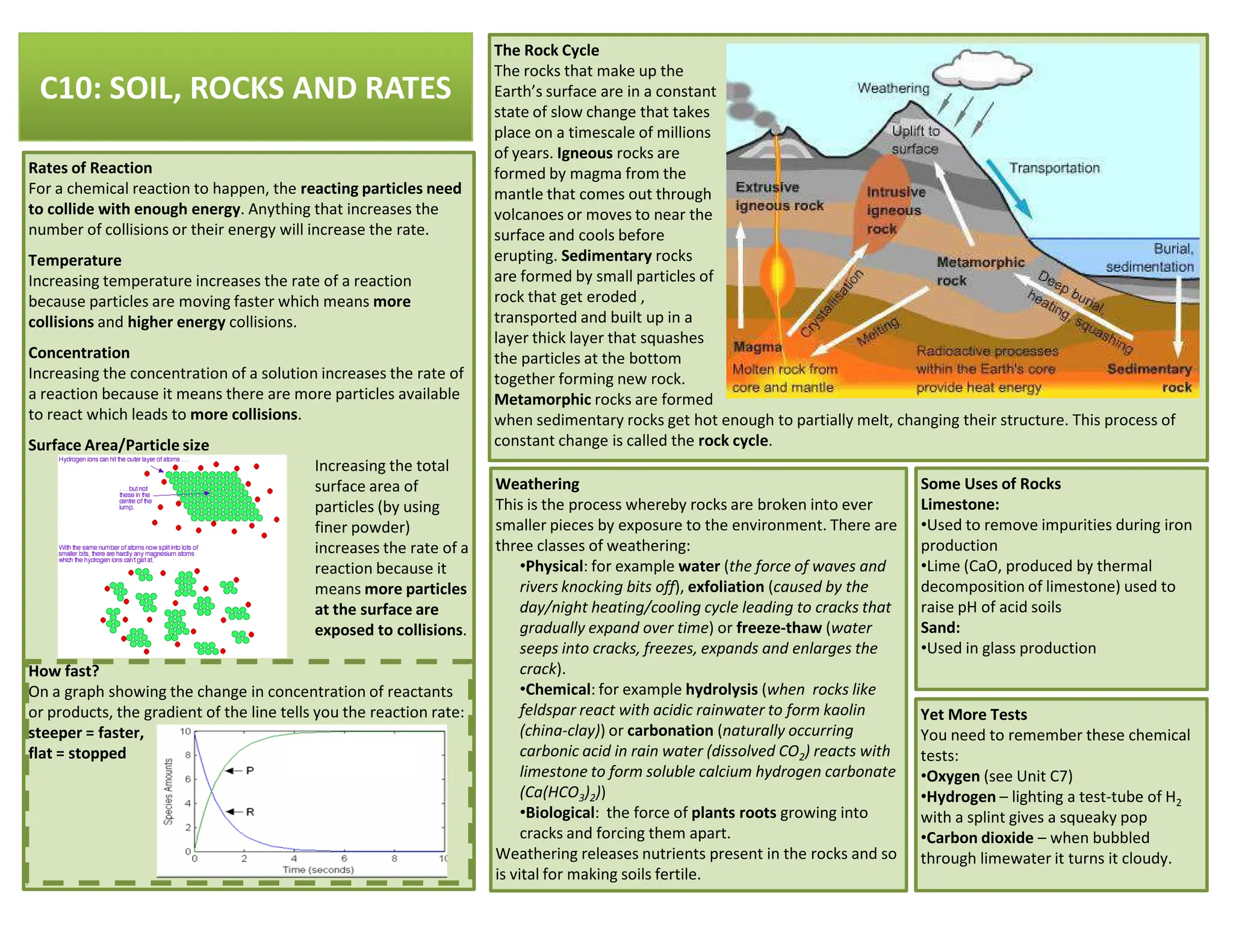
C10: SOIL, ROCKS AND RATES
Rates of Reaction
For a chemical reaction to happen, the reacting particles need
to collide with enough energy. Anything that increases the
number of collisions or their energy will increase the rate.
Temperature
Increasing temperature increases the rate of a reaction
because particles are moving faster which means more
collisions and higher energy collisions.
Concentration
Increasing the concentration of a solution increases the rate of
a reaction because it means there are more particles available
to react which leads to more collisions.
Surface Area/Particle size
Increasing the total
surface area of
The Rock Cycle
The rocks that make up the
Earth’s surface are in a constant
state of slow change that takes
place on a timescale of millions
of years. Igneous rocks are
formed by magma from the
mantle that comes out through
volcanoes or moves to near the
surface and cools before
erupting. Sedimentary rocks
are formed by small particles of
rock that get eroded ,
transported and built up in a
layer thick layer that squashes
the particles at the bottom
together forming new rock.
Metamorphic rocks are formed
when sedimentary rocks get hot enough to partially melt, changing their structure. This process of
constant change is called the rock cycle.
Weathering Some Uses of Rocks
surface area of
particles (by using
finer powder)
increases the rate of a
reaction because it
means more particles
at the surface are
exposed to collisions.
How fast?
On a graph showing the change in concentration of reactants
or products, the gradient of the line tells you the reaction rate:
steeper = faster,
flat = stopped
Weathering
This is the process whereby rocks are broken into ever
smaller pieces by exposure to the environment. There are
three classes of weathering:
•Physical: for example water (the force of waves and
rivers knocking bits off), exfoliation (caused by the
day/night heating/cooling cycle leading to cracks that
gradually expand over time) or freeze-thaw (water
seeps into cracks, freezes, expands and enlarges the
crack).
•Chemical: for example hydrolysis (when rocks like
feldspar react with acidic rainwater to form kaolin
(china-clay)) or carbonation (naturally occurring
carbonic acid in rain water (dissolved CO2) reacts with
limestone to form soluble calcium hydrogen carbonate
(Ca(HCO3)2))
•Biological: the force of plants roots growing into
cracks and forcing them apart.
Weathering releases nutrients present in the rocks and so
is vital for making soils fertile.
Some Uses of Rocks
Limestone:
•Used to remove impurities during iron
production
•Lime (CaO, produced by thermal
decomposition of limestone) used to
raise pH of acid soils
Sand:
•Used in glass production
Yet More Tests
You need to remember these chemical
tests:
•Oxygen (see Unit C7)
•Hydrogen – lighting a test-tube of H2
with a splint gives a squeaky pop
•Carbon dioxide – when bubbled
through limewater it turns it cloudy.
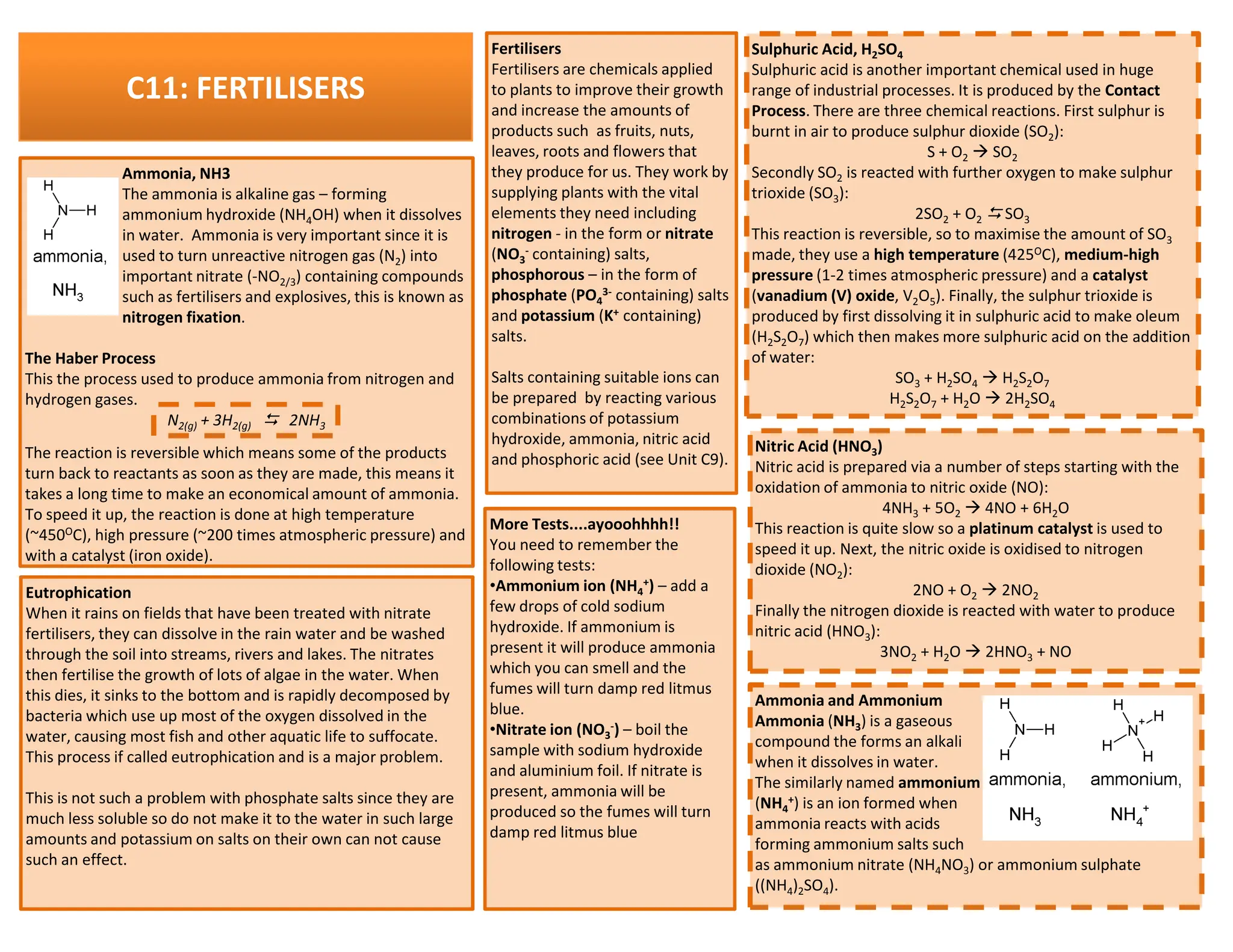
C11: FERTILISERS
Ammonia, NH3
The ammonia is alkaline gas – forming
ammonium hydroxide (NH4OH) when it dissolves
in water. Ammonia is very important since it is
used to turn unreactive nitrogen gas (N2) into
important nitrate (-NO2/3) containing compounds
such as fertilisers and explosives, this is known as
nitrogen fixation.
The Haber Process
This the process used to produce ammonia from nitrogen and
hydrogen gases.
N2(g) + 3H2(g)  2NH3
The reaction is reversible which means some of the products
turn back to reactants as soon as they are made, this means it
Sulphuric Acid, H2SO4
Sulphuric acid is another important chemical used in huge
range of industrial processes. It is produced by the Contact
Process. There are three chemical reactions. First sulphur is
burnt in air to produce sulphur dioxide (SO2):
S + O2  SO2
Secondly SO2 is reacted with further oxygen to make sulphur
trioxide (SO3):
2SO2 + O2  SO3
This reaction is reversible, so to maximise the amount of SO3
made, they use a high temperature (425OC), medium-high
pressure (1-2 times atmospheric pressure) and a catalyst
(vanadium (V) oxide, V2O5). Finally, the sulphur trioxide is
produced by first dissolving it in sulphuric acid to make oleum
(H2S2O7) which then makes more sulphuric acid on the addition
of water:
SO3 + H2SO4  H2S2O7
H2S2O7 + H2O  2H2SO4
Fertilisers
Fertilisers are chemicals applied
to plants to improve their growth
and increase the amounts of
products such as fruits, nuts,
leaves, roots and flowers that
they produce for us. They work by
supplying plants with the vital
elements they need including
nitrogen - in the form or nitrate
(NO3
- containing) salts,
phosphorous – in the form of
phosphate (PO4
3- containing) salts
and potassium (K+ containing)
salts.
Salts containing suitable ions can
be prepared by reacting various
combinations of potassium
hydroxide, ammonia, nitric acid
and phosphoric acid (see Unit C9).
Nitric Acid (HNO3)
Nitric acid is prepared via a number of steps starting with the
turn back to reactants as soon as they are made, this means it
takes a long time to make an economical amount of ammonia.
To speed it up, the reaction is done at high temperature
(~450OC), high pressure (~200 times atmospheric pressure) and
with a catalyst (iron oxide).
oxidation of ammonia to nitric oxide (NO):
4NH3 + 5O2  4NO + 6H2O
This reaction is quite slow so a platinum catalyst is used to
speed it up. Next, the nitric oxide is oxidised to nitrogen
dioxide (NO2):
2NO + O2  2NO2
Finally the nitrogen dioxide is reacted with water to produce
nitric acid (HNO3):
3NO2 + H2O  2HNO3 + NO
More Tests....ayooohhhh!!
You need to remember the
following tests:
•Ammonium ion (NH4
+) – add a
few drops of cold sodium
hydroxide. If ammonium is
present it will produce ammonia
which you can smell and the
fumes will turn damp red litmus
blue.
•Nitrate ion (NO3
-) – boil the
sample with sodium hydroxide
and aluminium foil. If nitrate is
present, ammonia will be
produced so the fumes will turn
damp red litmus blue
Eutrophication
When it rains on fields that have been treated with nitrate
fertilisers, they can dissolve in the rain water and be washed
through the soil into streams, rivers and lakes. The nitrates
then fertilise the growth of lots of algae in the water. When
this dies, it sinks to the bottom and is rapidly decomposed by
bacteria which use up most of the oxygen dissolved in the
water, causing most fish and other aquatic life to suffocate.
This process if called eutrophication and is a major problem.
This is not such a problem with phosphate salts since they are
much less soluble so do not make it to the water in such large
amounts and potassium on salts on their own can not cause
such an effect.
Ammonia and Ammonium
Ammonia (NH3) is a gaseous
compound the forms an alkali
when it dissolves in water.
The similarly named ammonium
(NH4
+) is an ion formed when
ammonia reacts with acids
forming ammonium salts such
as ammonium nitrate (NH4NO3) or ammonium sulphate
((NH4)2SO4).
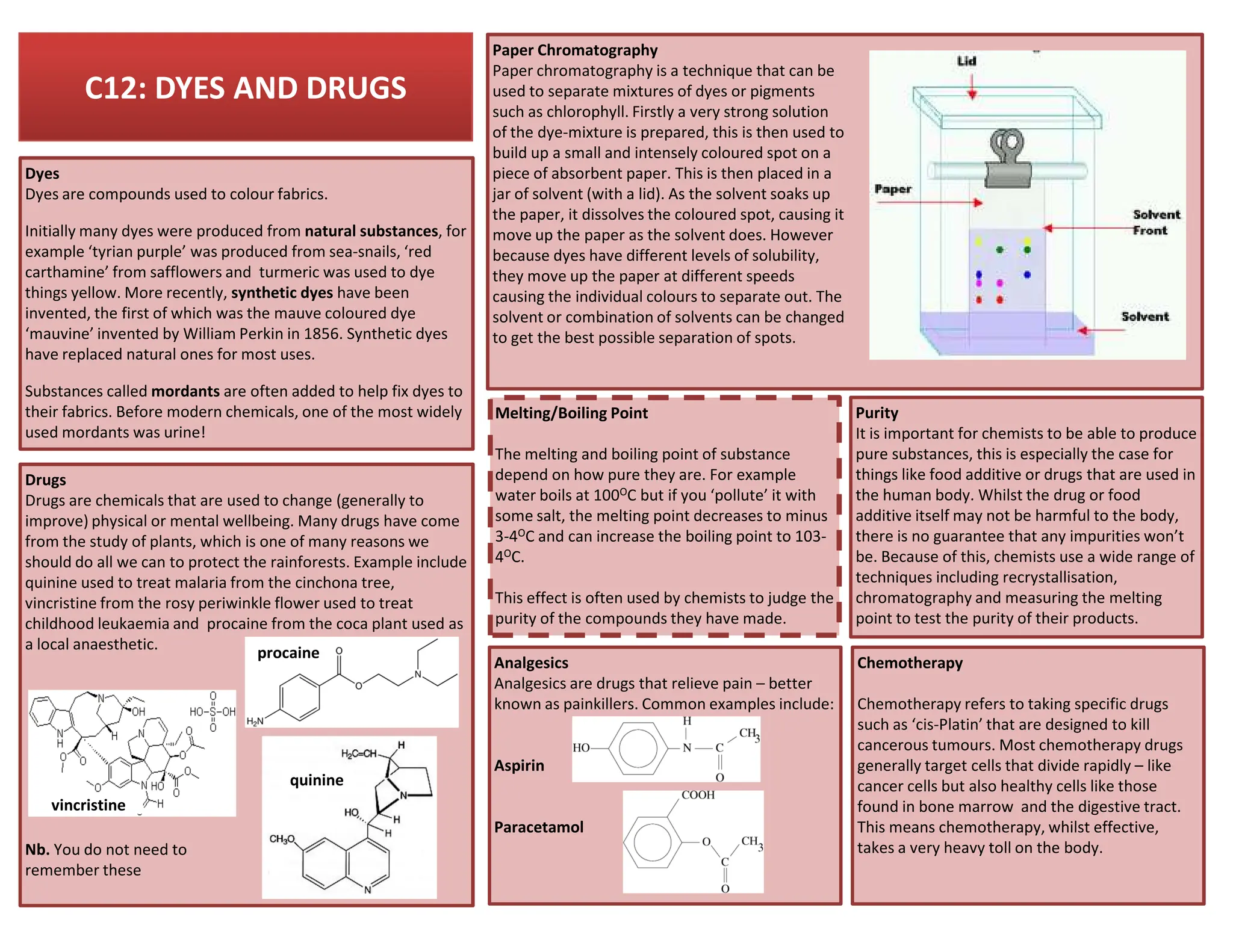
C12: DYES AND DRUGS
Dyes
Dyes are compounds used to colour fabrics.
Initially many dyes were produced from natural substances, for
example ‘tyrian purple’ was produced from sea-snails, ‘red
carthamine’ from safflowers and turmeric was used to dye
things yellow. More recently, synthetic dyes have been
invented, the first of which was the mauve coloured dye
‘mauvine’ invented by William Perkin in 1856. Synthetic dyes
have replaced natural ones for most uses.
Substances called mordants are often added to help fix dyes to
their fabrics. Before modern chemicals, one of the most widely
used mordants was urine!
Melting/Boiling Point
The melting and boiling point of substance
depend on how pure they are. For example
Drugs
Paper Chromatography
Paper chromatography is a technique that can be
used to separate mixtures of dyes or pigments
such as chlorophyll. Firstly a very strong solution
of the dye-mixture is prepared, this is then used to
build up a small and intensely coloured spot on a
piece of absorbent paper. This is then placed in a
jar of solvent (with a lid). As the solvent soaks up
the paper, it dissolves the coloured spot, causing it
move up the paper as the solvent does. However
because dyes have different levels of solubility,
they move up the paper at different speeds
causing the individual colours to separate out. The
solvent or combination of solvents can be changed
to get the best possible separation of spots.
Purity
It is important for chemists to be able to produce
pure substances, this is especially the case for
things like food additive or drugs that are used in
depend on how pure they are. For example
water boils at 100OC but if you ‘pollute’ it with
some salt, the melting point decreases to minus
3-4OC and can increase the boiling point to 103-
4OC.
This effect is often used by chemists to judge the
purity of the compounds they have made.
Drugs
Drugs are chemicals that are used to change (generally to
improve) physical or mental wellbeing. Many drugs have come
from the study of plants, which is one of many reasons we
should do all we can to protect the rainforests. Example include
quinine used to treat malaria from the cinchona tree,
vincristine from the rosy periwinkle flower used to treat
childhood leukaemia and procaine from the coca plant used as
a local anaesthetic.
Nb. You do not need to
remember these
vincristine
procaine
quinine
Analgesics
Analgesics are drugs that relieve pain – better
known as painkillers. Common examples include:
Aspirin
Paracetamol
things like food additive or drugs that are used in
the human body. Whilst the drug or food
additive itself may not be harmful to the body,
there is no guarantee that any impurities won’t
be. Because of this, chemists use a wide range of
techniques including recrystallisation,
chromatography and measuring the melting
point to test the purity of their products.
Chemotherapy
Chemotherapy refers to taking specific drugs
such as ‘cis-Platin’ that are designed to kill
cancerous tumours. Most chemotherapy drugs
generally target cells that divide rapidly – like
cancer cells but also healthy cells like those
found in bone marrow and the digestive tract.
This means chemotherapy, whilst effective,
takes a very heavy toll on the body.
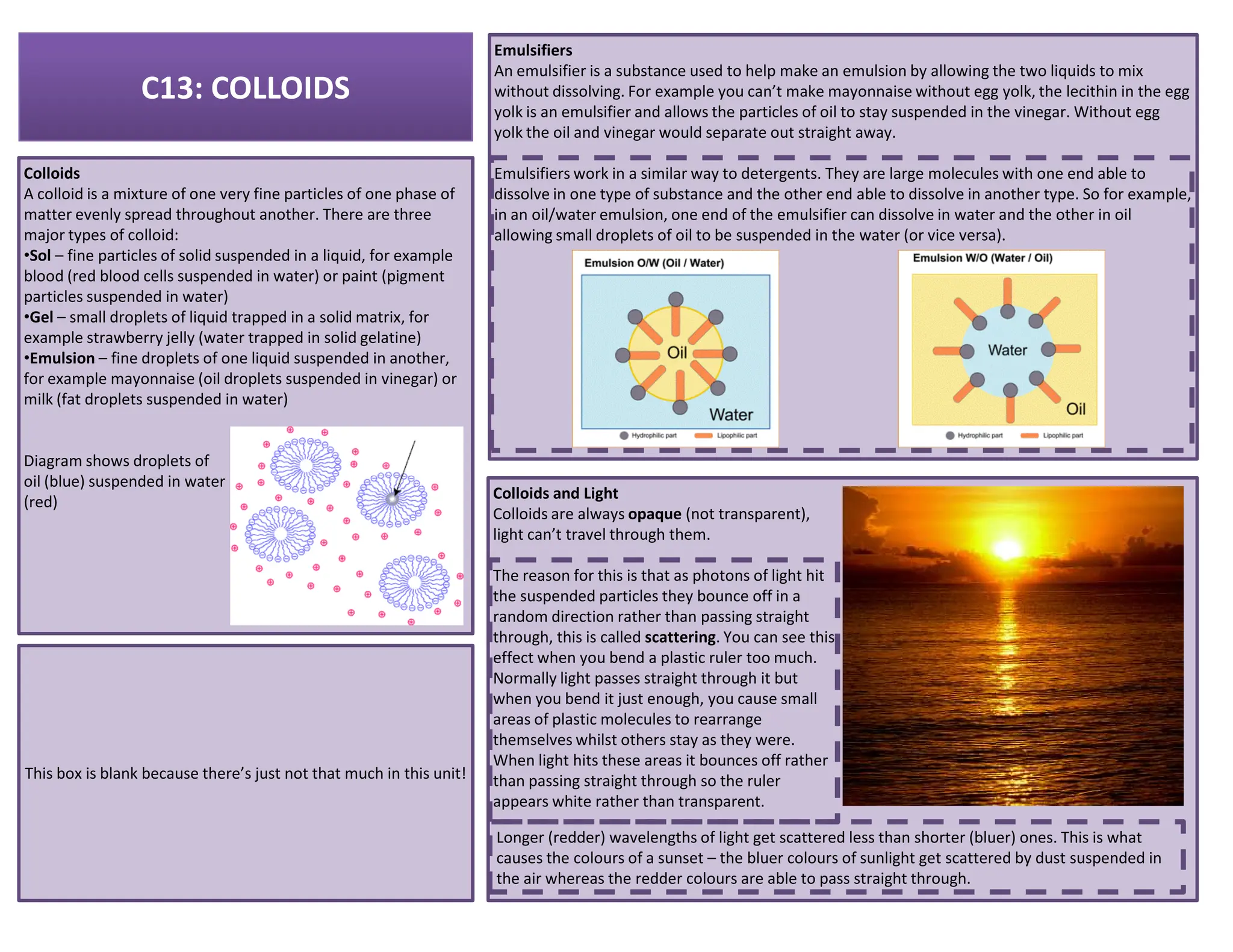
C13: COLLOIDS
Colloids
A colloid is a mixture of one very fine particles of one phase of
matter evenly spread throughout another. There are three
major types of colloid:
•Sol – fine particles of solid suspended in a liquid, for example
blood (red blood cells suspended in water) or paint (pigment
particles suspended in water)
•Gel – small droplets of liquid trapped in a solid matrix, for
example strawberry jelly (water trapped in solid gelatine)
•Emulsion – fine droplets of one liquid suspended in another,
for example mayonnaise (oil droplets suspended in vinegar) or
milk (fat droplets suspended in water)
Diagram shows droplets of
oil (blue) suspended in water
Emulsifiers
An emulsifier is a substance used to help make an emulsion by allowing the two liquids to mix
without dissolving. For example you can’t make mayonnaise without egg yolk, the lecithin in the egg
yolk is an emulsifier and allows the particles of oil to stay suspended in the vinegar. Without egg
yolk the oil and vinegar would separate out straight away.
Emulsifiers work in a similar way to detergents. They are large molecules with one end able to
dissolve in one type of substance and the other end able to dissolve in another type. So for example,
in an oil/water emulsion, one end of the emulsifier can dissolve in water and the other in oil
allowing small droplets of oil to be suspended in the water (or vice versa).
oil (blue) suspended in water
(red)
Colloids and Light
Colloids are always opaque (not transparent),
light can’t travel through them.
The reason for this is that as photons of light hit
the suspended particles they bounce off in a
random direction rather than passing straight
through, this is called scattering. You can see this
effect when you bend a plastic ruler too much.
Normally light passes straight through it but
when you bend it just enough, you cause small
areas of plastic molecules to rearrange
themselves whilst others stay as they were.
When light hits these areas it bounces off rather
than passing straight through so the ruler
appears white rather than transparent.
Longer (redder) wavelengths of light get scattered less than shorter (bluer) ones. This is what
causes the colours of a sunset – the bluer colours of sunlight get scattered by dust suspended in
the air whereas the redder colours are able to pass straight through.
This box is blank because there’s just not that much in this unit!
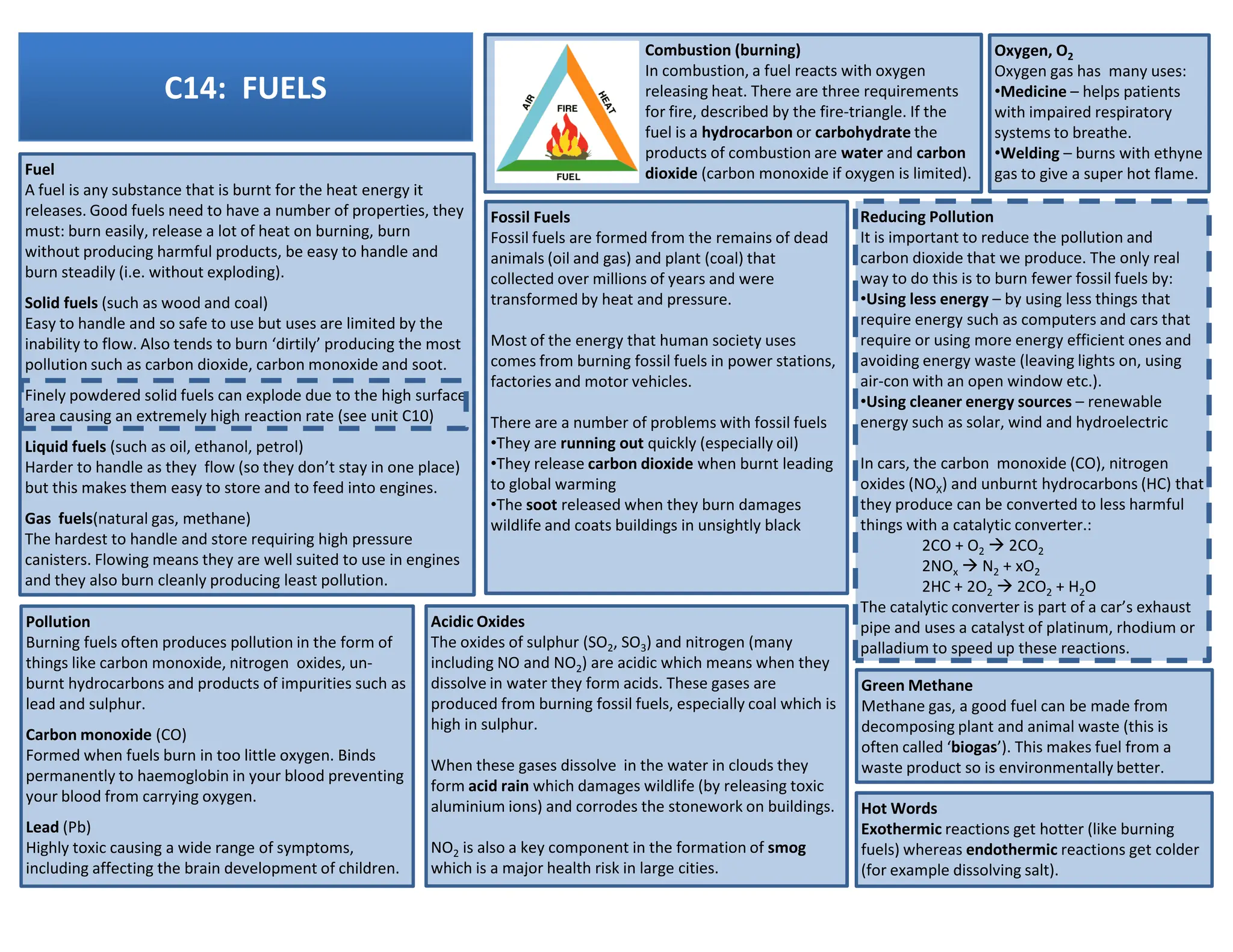
C14: FUELS
Combustion (burning)
In combustion, a fuel reacts with oxygen
releasing heat. There are three requirements
for fire, described by the fire-triangle. If the
fuel is a hydrocarbon or carbohydrate the
products of combustion are water and carbon
dioxide (carbon monoxide if oxygen is limited).
Fuel
A fuel is any substance that is burnt for the heat energy it
releases. Good fuels need to have a number of properties, they
must: burn easily, release a lot of heat on burning, burn
without producing harmful products, be easy to handle and
burn steadily (i.e. without exploding).
Solid fuels (such as wood and coal)
Easy to handle and so safe to use but uses are limited by the
inability to flow. Also tends to burn ‘dirtily’ producing the most
pollution such as carbon dioxide, carbon monoxide and soot.
Finely powdered solid fuels can explode due to the high surface
area causing an extremely high reaction rate (see unit C10)
Liquid fuels (such as oil, ethanol, petrol)
Harder to handle as they flow (so they don’t stay in one place)
Fossil Fuels
Fossil fuels are formed from the remains of dead
animals (oil and gas) and plant (coal) that
collected over millions of years and were
transformed by heat and pressure.
Most of the energy that human society uses
comes from burning fossil fuels in power stations,
factories and motor vehicles.
There are a number of problems with fossil fuels
•They are running out quickly (especially oil)
•They release carbon dioxide when burnt leading
to global warming
Oxygen, O2
Oxygen gas has many uses:
•Medicine – helps patients
with impaired respiratory
systems to breathe.
•Welding – burns with ethyne
gas to give a super hot flame.
Reducing Pollution
It is important to reduce the pollution and
carbon dioxide that we produce. The only real
way to do this is to burn fewer fossil fuels by:
•Using less energy – by using less things that
require energy such as computers and cars that
require or using more energy efficient ones and
avoiding energy waste (leaving lights on, using
air-con with an open window etc.).
•Using cleaner energy sources – renewable
energy such as solar, wind and hydroelectric
In cars, the carbon monoxide (CO), nitrogen
oxides (NO ) and unburnt hydrocarbons (HC) that
but this makes them easy to store and to feed into engines.
Gas fuels(natural gas, methane)
The hardest to handle and store requiring high pressure
canisters. Flowing means they are well suited to use in engines
and they also burn cleanly producing least pollution.
to global warming
•The soot released when they burn damages
wildlife and coats buildings in unsightly black
Pollution
Burning fuels often produces pollution in the form of
things like carbon monoxide, nitrogen oxides, un-
burnt hydrocarbons and products of impurities such as
lead and sulphur.
Carbon monoxide (CO)
Formed when fuels burn in too little oxygen. Binds
permanently to haemoglobin in your blood preventing
your blood from carrying oxygen.
Lead (Pb)
Highly toxic causing a wide range of symptoms,
including affecting the brain development of children.
Acidic Oxides
The oxides of sulphur (SO2, SO3) and nitrogen (many
including NO and NO2) are acidic which means when they
dissolve in water they form acids. These gases are
produced from burning fossil fuels, especially coal which is
high in sulphur.
When these gases dissolve in the water in clouds they
form acid rain which damages wildlife (by releasing toxic
aluminium ions) and corrodes the stonework on buildings.
NO2 is also a key component in the formation of smog
which is a major health risk in large cities.
oxides (NOX) and unburnt hydrocarbons (HC) that
they produce can be converted to less harmful
things with a catalytic converter.:
2CO + O2  2CO2
2NOx  N2 + xO2
2HC + 2O2  2CO2 + H2O
The catalytic converter is part of a car’s exhaust
pipe and uses a catalyst of platinum, rhodium or
palladium to speed up these reactions.
Green Methane
Methane gas, a good fuel can be made from
decomposing plant and animal waste (this is
often called ‘biogas’). This makes fuel from a
waste product so is environmentally better.
Hot Words
Exothermic reactions get hotter (like burning
fuels) whereas endothermic reactions get colder
(for example dissolving salt).
C15: BATTERIES
Reactivity of Metals (check Unit
The reactivity of metals can be seen by the way they react with
steam or with acid (see Unit C6 for the reactivity series).
Reaction with water (see Unit C2 for details of this reaction):
The most reactive metals (K-Ca) react with cold water, fairly
reactive metals (Mg-Fe) will only react with steam whereas the
least reactive metals (Sn-Pt) don’t react at all.
Reaction with dilute acids (see Unit C9 for details)
The reaction of metals with acids shows a similar patter with
the most reactive metals (K-Ca) reacting violently, the fairly
reactive metals (Mg-Pb) reacting gradually more slowly and the
least reactive metals (Cu-Pt) not reacting at all.
The reactivity of metals relates to how easily they form ions,
more reactive metals like K form K+ ions much more easily
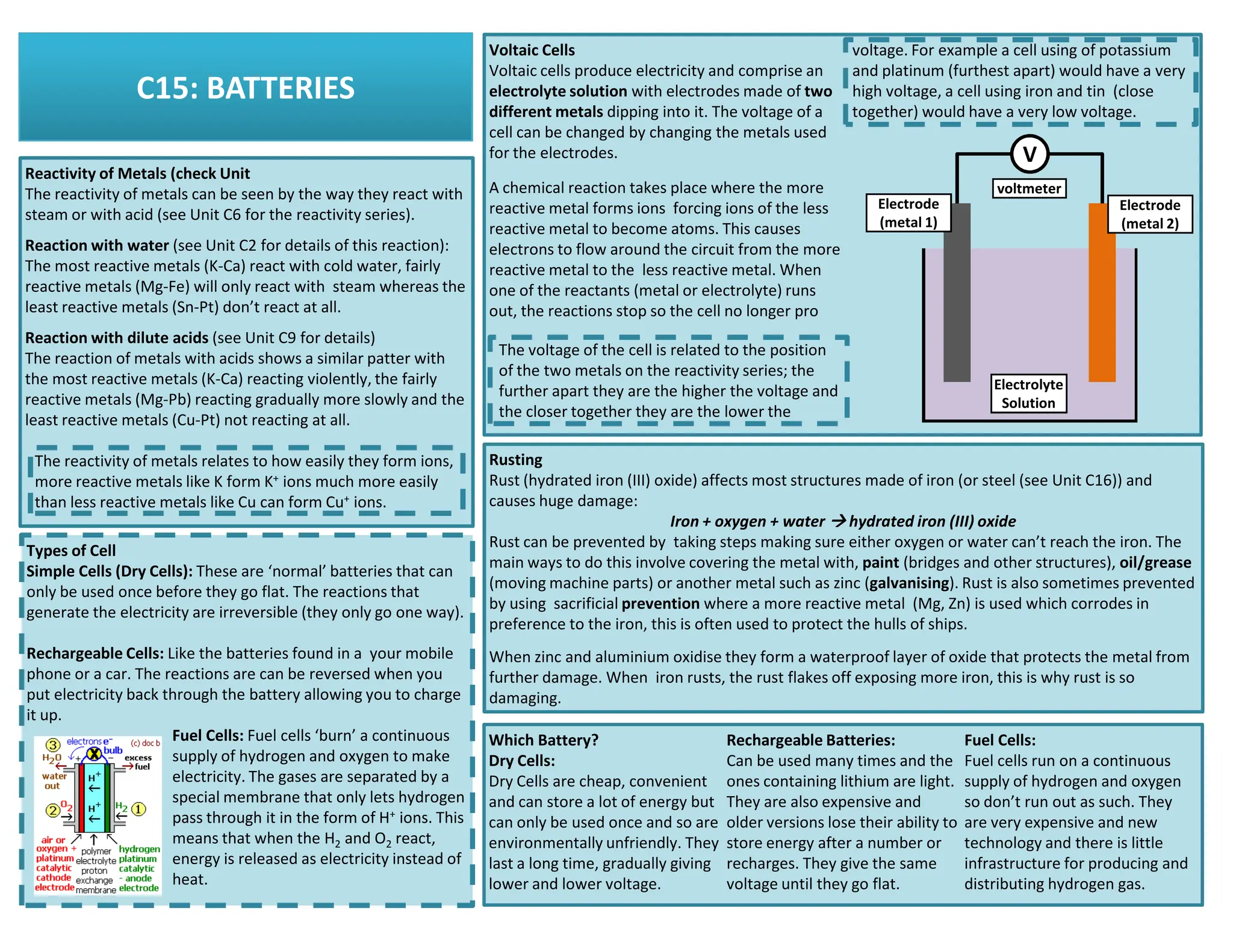
Voltaic Cells
Voltaic cells produce electricity and comprise an
electrolyte solution with electrodes made of two
different metals dipping into it. The voltage of a
cell can be changed by changing the metals used
for the electrodes.
A chemical reaction takes place where the more
reactive metal forms ions forcing ions of the less
reactive metal to become atoms. This causes
electrons to flow around the circuit from the more
reactive metal to the less reactive metal. When
one of the reactants (metal or electrolyte) runs
out, the reactions stop so the cell no longer pro
The voltage of the cell is related to the position
of the two metals on the reactivity series; the
further apart they are the higher the voltage and
the closer together they are the lower the
voltage. For example a cell using of potassium
and platinum (furthest apart) would have a very
high voltage, a cell using iron and tin (close
together) would have a very low voltage.
V
Electrode
(metal 1)
Electrolyte
Solution
voltmeter
Electrode
(metal 2)
Rusting
Rust (hydrated iron (III) oxide) affects most structures made of iron (or steel (see Unit C16)) and
more reactive metals like K form K+ ions much more easily
than less reactive metals like Cu can form Cu+ ions.
Types of Cell
Simple Cells (Dry Cells): These are ‘normal’ batteries that can
only be used once before they go flat. The reactions that
generate the electricity are irreversible (they only go one way).
Rechargeable Cells: Like the batteries found in a your mobile
phone or a car. The reactions are can be reversed when you
put electricity back through the battery allowing you to charge
it up.
Fuel Cells: Fuel cells ‘burn’ a continuous
supply of hydrogen and oxygen to make
electricity. The gases are separated by a
special membrane that only lets hydrogen
pass through it in the form of H+ ions. This
means that when the H2 and O2 react,
energy is released as electricity instead of
heat.
Rust (hydrated iron (III) oxide) affects most structures made of iron (or steel (see Unit C16)) and
causes huge damage:
Iron + oxygen + water 


 hydrated iron (III) oxide
Rust can be prevented by taking steps making sure either oxygen or water can’t reach the iron. The
main ways to do this involve covering the metal with, paint (bridges and other structures), oil/grease
(moving machine parts) or another metal such as zinc (galvanising). Rust is also sometimes prevented
by using sacrificial prevention where a more reactive metal (Mg, Zn) is used which corrodes in
preference to the iron, this is often used to protect the hulls of ships.
When zinc and aluminium oxidise they form a waterproof layer of oxide that protects the metal from
further damage. When iron rusts, the rust flakes off exposing more iron, this is why rust is so
damaging.
Which Battery?
Dry Cells:
Dry Cells are cheap, convenient
and can store a lot of energy but
can only be used once and so are
environmentally unfriendly. They
last a long time, gradually giving
lower and lower voltage.
Rechargeable Batteries:
Can be used many times and the
ones containing lithium are light.
They are also expensive and
older versions lose their ability to
store energy after a number or
recharges. They give the same
voltage until they go flat.
Fuel Cells:
Fuel cells run on a continuous
supply of hydrogen and oxygen
so don’t run out as such. They
are very expensive and new
technology and there is little
infrastructure for producing and
distributing hydrogen gas.
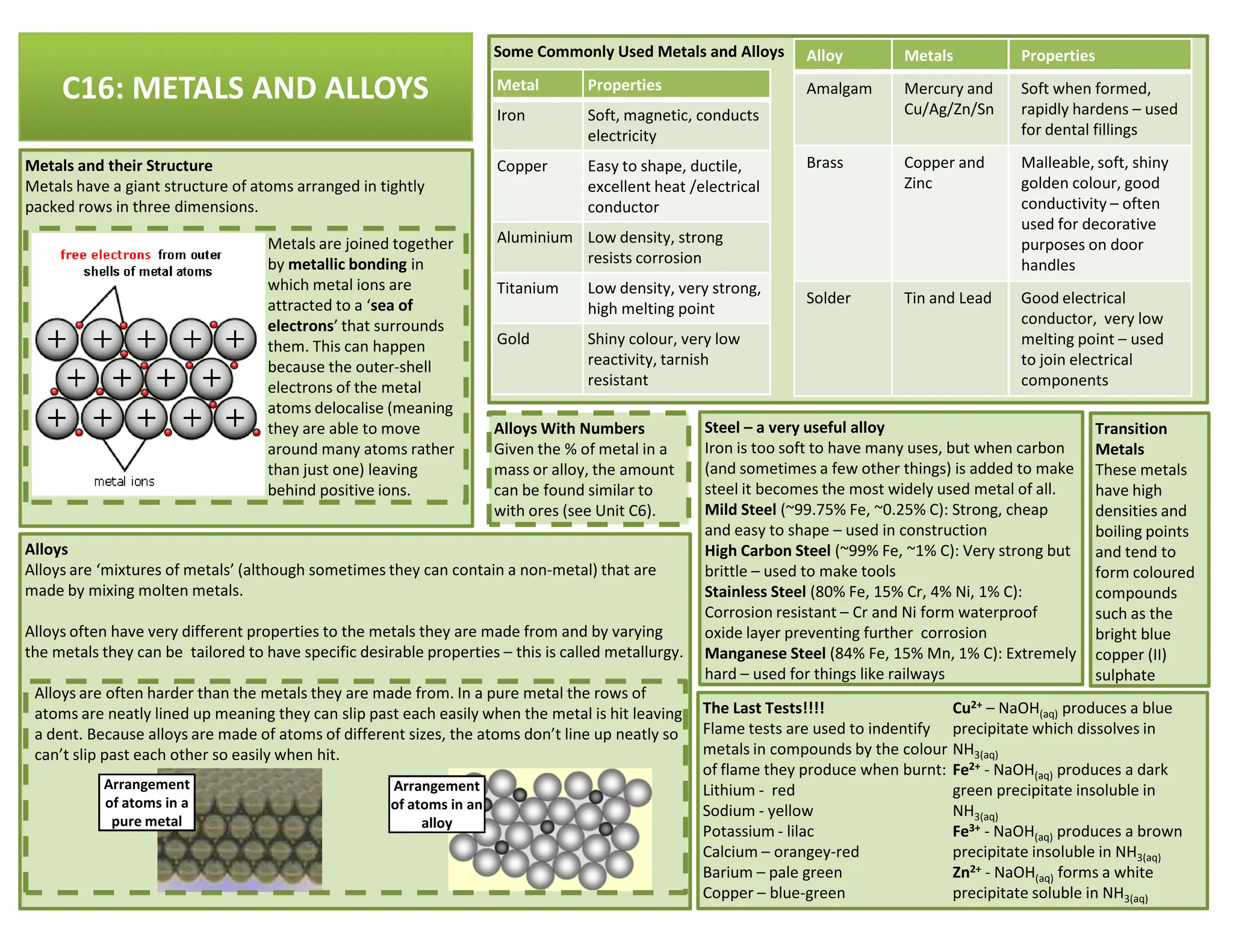
C16: METALS AND ALLOYS
Metals and their Structure
Metals have a giant structure of atoms arranged in tightly
packed rows in three dimensions.
Metals are joined together
by metallic bonding in
which metal ions are
attracted to a ‘sea of
electrons’ that surrounds
them. This can happen
because the outer-shell
electrons of the metal
atoms delocalise (meaning
they are able to move
around many atoms rather
than just one) leaving
Some Commonly Used Metals and Alloys
Metal Properties
Iron Soft, magnetic, conducts
electricity
Copper Easy to shape, ductile,
excellent heat /electrical
conductor
Aluminium Low density, strong
resists corrosion
Titanium Low density, very strong,
high melting point
Gold Shiny colour, very low
reactivity, tarnish
resistant
Alloy Metals Properties
Amalgam Mercury and
Cu/Ag/Zn/Sn
Soft when formed,
rapidly hardens – used
for dental fillings
Brass Copper and
Zinc
Malleable, soft, shiny
golden colour, good
conductivity – often
used for decorative
purposes on door
handles
Solder Tin and Lead Good electrical
conductor, very low
melting point – used
to join electrical
components
Alloys With Numbers
Given the % of metal in a
mass or alloy, the amount
Steel – a very useful alloy
Iron is too soft to have many uses, but when carbon
(and sometimes a few other things) is added to make
Transition
Metals
These metals
than just one) leaving
behind positive ions.
Alloys
Alloys are ‘mixtures of metals’ (although sometimes they can contain a non-metal) that are
made by mixing molten metals.
Alloys often have very different properties to the metals they are made from and by varying
the metals they can be tailored to have specific desirable properties – this is called metallurgy.
Alloys are often harder than the metals they are made from. In a pure metal the rows of
atoms are neatly lined up meaning they can slip past each easily when the metal is hit leaving
a dent. Because alloys are made of atoms of different sizes, the atoms don’t line up neatly so
can’t slip past each other so easily when hit.
Arrangement
of atoms in an
alloy
Arrangement
of atoms in a
pure metal
mass or alloy, the amount
can be found similar to
with ores (see Unit C6).
(and sometimes a few other things) is added to make
steel it becomes the most widely used metal of all.
Mild Steel (~99.75% Fe, ~0.25% C): Strong, cheap
and easy to shape – used in construction
High Carbon Steel (~99% Fe, ~1% C): Very strong but
brittle – used to make tools
Stainless Steel (80% Fe, 15% Cr, 4% Ni, 1% C):
Corrosion resistant – Cr and Ni form waterproof
oxide layer preventing further corrosion
Manganese Steel (84% Fe, 15% Mn, 1% C): Extremely
hard – used for things like railways
The Last Tests!!!!
Flame tests are used to indentify
metals in compounds by the colour
of flame they produce when burnt:
Lithium - red
Sodium - yellow
Potassium - lilac
Calcium – orangey-red
Barium – pale green
Copper – blue-green
Cu2+ – NaOH(aq) produces a blue
precipitate which dissolves in
NH3(aq)
Fe2+ - NaOH(aq) produces a dark
green precipitate insoluble in
NH3(aq)
Fe3+ - NaOH(aq) produces a brown
precipitate insoluble in NH3(aq)
Zn2+ - NaOH(aq) forms a white
precipitate soluble in NH3(aq)
These metals
have high
densities and
boiling points
and tend to
form coloured
compounds
such as the
bright blue
copper (II)
sulphate
C17: ATOMS, BONDING AND
THE PERIODIC TABLE
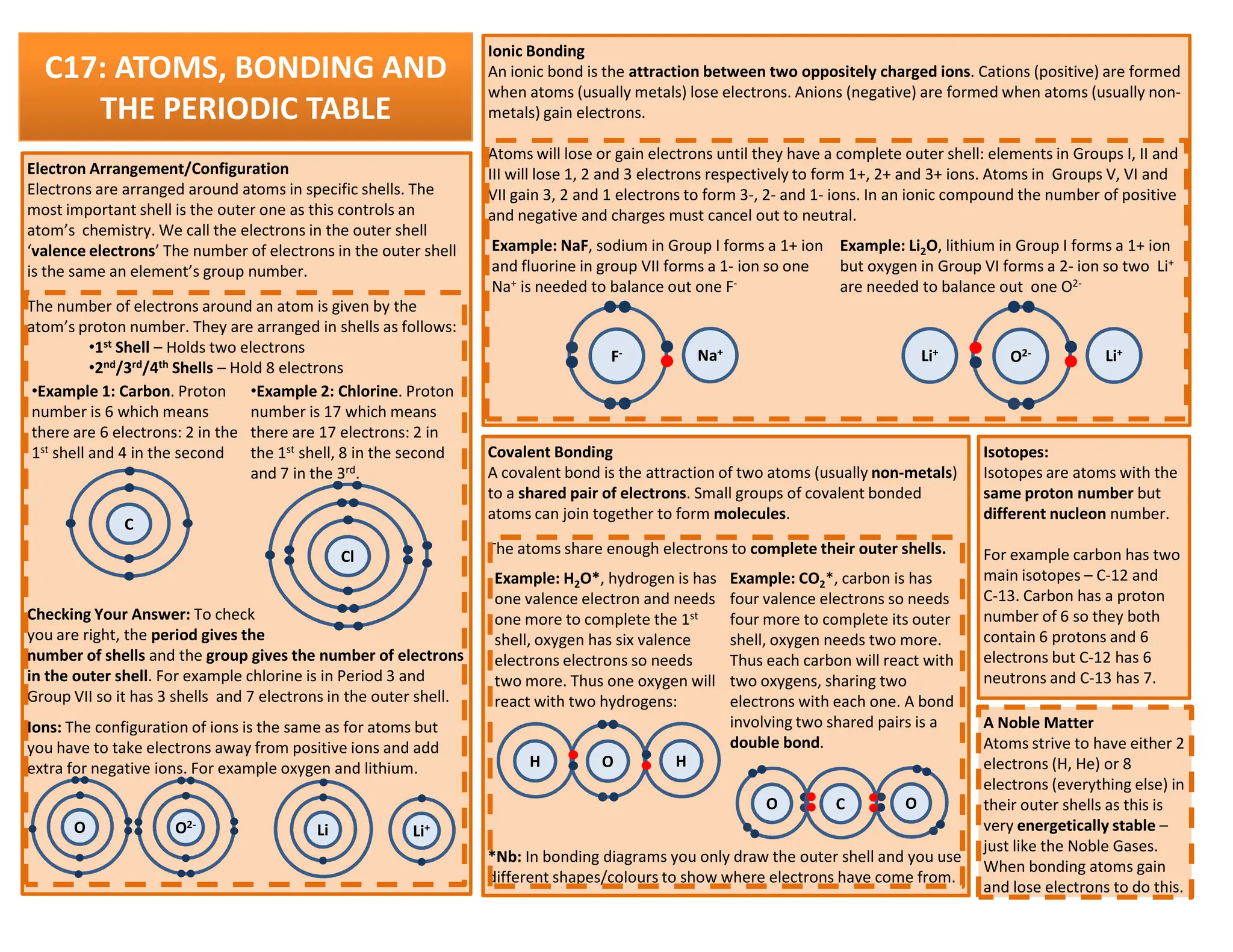
Electron Arrangement/Configuration
Electrons are arranged around atoms in specific shells. The
most important shell is the outer one as this controls an
atom’s chemistry. We call the electrons in the outer shell
‘valence electrons’ The number of electrons in the outer shell
is the same an element’s group number.
The number of electrons around an atom is given by the
atom’s proton number. They are arranged in shells as follows:
•1st Shell – Holds two electrons
•2nd/3rd/4th Shells – Hold 8 electrons
•Example 1: Carbon. Proton
number is 6 which means
there are 6 electrons: 2 in the
1st shell and 4 in the second
•Example 2: Chlorine. Proton
number is 17 which means
there are 17 electrons: 2 in
the 1st shell, 8 in the second
and 7 in the 3rd.
Ionic Bonding
An ionic bond is the attraction between two oppositely charged ions. Cations (positive) are formed
when atoms (usually metals) lose electrons. Anions (negative) are formed when atoms (usually non-
metals) gain electrons.
Atoms will lose or gain electrons until they have a complete outer shell: elements in Groups I, II and
III will lose 1, 2 and 3 electrons respectively to form 1+, 2+ and 3+ ions. Atoms in Groups V, VI and
VII gain 3, 2 and 1 electrons to form 3-, 2- and 1- ions. In an ionic compound the number of positive
and negative and charges must cancel out to neutral.
Example: NaF, sodium in Group I forms a 1+ ion
and fluorine in group VII forms a 1- ion so one
Na+ is needed to balance out one F-
Example: Li2O, lithium in Group I forms a 1+ ion
but oxygen in Group VI forms a 2- ion so two Li+
are needed to balance out one O2-
Li+
O2-
Li+
Na+
F-
Covalent Bonding
A covalent bond is the attraction of two atoms (usually non-metals)
Isotopes:
Isotopes are atoms with the
Checking Your Answer: To check
you are right, the period gives the
number of shells and the group gives the number of electrons
in the outer shell. For example chlorine is in Period 3 and
Group VII so it has 3 shells and 7 electrons in the outer shell.
Ions: The configuration of ions is the same as for atoms but
you have to take electrons away from positive ions and add
extra for negative ions. For example oxygen and lithium.
and 7 in the 3 .
C
Cl
Li Li+
O2-
O
A covalent bond is the attraction of two atoms (usually non-metals)
to a shared pair of electrons. Small groups of covalent bonded
atoms can join together to form molecules.
The atoms share enough electrons to complete their outer shells.
*Nb: In bonding diagrams you only draw the outer shell and you use
different shapes/colours to show where electrons have come from.
Example: H2O*, hydrogen is has
one valence electron and needs
one more to complete the 1st
shell, oxygen has six valence
electrons electrons so needs
two more. Thus one oxygen will
react with two hydrogens:
Example: CO2*, carbon is has
four valence electrons so needs
four more to complete its outer
shell, oxygen needs two more.
Thus each carbon will react with
two oxygens, sharing two
electrons with each one. A bond
involving two shared pairs is a
double bond.
H H
O
O O
C
Isotopes are atoms with the
same proton number but
different nucleon number.
For example carbon has two
main isotopes – C-12 and
C-13. Carbon has a proton
number of 6 so they both
contain 6 protons and 6
electrons but C-12 has 6
neutrons and C-13 has 7.
A Noble Matter
Atoms strive to have either 2
electrons (H, He) or 8
electrons (everything else) in
their outer shells as this is
very energetically stable –
just like the Noble Gases.
When bonding atoms gain
and lose electrons to do this.
dokumen.tips_chemistry-revision-guide-for-igcse-coordinated-revision-guide-is-designed-to.pdf

dokumen.tips_chemistry-revision-guide-for-igcse-coordinated-revision-guide-is-designed-to.pdf

  • 1.
    This revision guideis designed to help you study for the chemistry part of the IGCSE Coordinated Science course. The guide contains everything that the syllabus says you need you need to know, and nothing extra. The material that is only covered in the supplementary part of the course (which can be ignored by core candidates) is highlighted in dashed boxes: Some very useful websites to help you further your understanding include: •http://www.docbrown.info/ - whilst not the prettiest site this contains a lot of very useful and nicely explained information. •http://www.bbc.co.uk/schools/gcsebitesize/scienc e/ - well presented with many clear diagrams, animations and quizzes. Can occasionally lack depth. •http://www.chemguide.co.uk/ - whilst mostly targeted at A-Levels this site contains very detailed CHEMISTRY REVISION GUIDE for IGCSE Coordinated Science CHEMISTRY REVISION GUIDE for IGCSE Coordinated Science Whilst this guide is intended to help with your revision, it should not be your only revision. It is intended as a starting point but only a starting point. You should make sure that you also read your text books and use the internet to supplement your study in conjunction with your syllabus document. Whilst this guide does contain the entire syllabus, it just has the bare minimum and is not in itself sufficient for those candidates aiming for the highest grades. If that is you, you should make sure you read around a range of sources to get a deeper knowledge and understanding. targeted at A-Levels this site contains very detailed information suitable for those looking to deepen their knowledge and hit the highest grades. Finally, remember revision is not just reading but should be an active process and could involve: •Making notes •Condensing class notes •Drawing Mind-maps •Practicing past exam questions •Making flashcards The golden rule is that what makes you think makes you learn. Happy studying, Mr Field.
  • 2.
    C1: THE ELEMENTSOF CHEMISTRY Atom: The smallest particle of matter An atom: Some atoms: Molecule: A small particle made from more than one atom bonded together Molecules of an element: Molecules of a compound: Element: A substance made of only one type of atom A solid element: A gaseous element: Compound: A substance made from two or more A solid compound A gaseous compound: CHEMICAL FORMULAS Formulas tell you the atoms that make up a compound Eg 1. H2O – two H, one O Eg 2. C2H6O – two C, six H, one O Eg 3. Mg(OH)2 – one Mg, two O, two H* Eg 4. CH2(CH3)2 – three C, 8 H* *In this case everything in brackets is doubled CHEMICAL EQUATIONS •Show the reactants you start with and the products you make •Must contain an arrow () NOT an equals sign (=) •Must be balanced – same number of atoms on each side Eg. CH4 + O2 CO2 + H2O This is unbalanced as there are 4 ‘H’ on the left but only 2 ‘H’ on the right. This must be corrected by adding a ‘2’ in front of the ‘H2O’: CH4+ O2 CO2 +2H2O Now the H balances but there 4 O on the right and only 2 on the left. This must be balance by placing a ‘2’ in front of the ‘O2’ CH4 + 2O2 CO2 + 2H2O Now there is 1 ‘C’, 4 ‘H’ and 4 ‘O’ on each side so it balances. MOLES AND MOLAR MASS •A ‘mole’ is the name we give to the number 6.02x10²³ – it is used to talk about the numbers of particles involved in chemical reactions. •It is the number of atoms such that one mole has the same mass in grams as an atom’s atomic mass. •Eg 1: Carbon has an atomic mass of 12.0, so a mole of carbon has a mass of 12.0g •Eg 2: Iron has an atomic mass of 55.8, so masses of the elements in its formula: •Eg 1: C2H6O (C=12.0, H=1.0, O=16.0) Molar mass = 12.0 x 2 + 1.0 x 6 + 16.0 x 1 = 46.0g The number of moles of a substance present in a given mass is given by: Moles = mass used molar mass Eg: How many moles of ethanol (C2H6O) are Solids, Liquids and Gases from two or more different elements bonded together Mixture: A substance made from two or more elements or compounds mixed but not joined A mixture of compounds and elements: •Eg 2: Iron has an atomic mass of 55.8, so a mole of iron has a mass of 55.8g •The molar mass of a compound is the sum of the Eg: How many moles of ethanol (C2H6O) are present in 69.0 g? Moles = mass used = 69.0 = 1.5 mol molar mass 46.0 MOLE CALCULATIONS What mass of carbon dioxide (the unknown) is needed to produce when 50g iron (the known) oxide is reduced to iron. •Balanced Equation: 2Fe2O3 + 3C 4Fe + 3CO2 •Moles of Known (Fe2O3)= mass / molar mass = 50.0 / (55.8 x 2 + 16.0 x 3) = 0.313 •Moles of Unknown (CO2) = (moles of known /knowns) x unknowns = (0.313 / 2) x 3 = 0.470 mol •Mass of Unknown (CO2) = moles x molar mass = 0.470 x (12.0 x 1 + 16.0 x 2) = 20.7g COMBINING POWERS This is the number of ‘bonds’ an element forms The combining power is given by the periodic table. •Groups I and VII form 1 bond •Groups II and VI form 2 bonds •Groups III and V from 3 bonds •Group IV forms 4 bonds •Group VIII forms 0 bonds •Eg: NH3 – N (Gp V) has three bonds to Hs, each of the three Hs (Gp I) has one bond to N. ATOMIC STRUCTURE Atoms are made of: Protons: mass = 1, charge = +1 Neutrons: mass = 1, charge = 0 Electrons: mass = 0, charge = -1 In a square on the periodic table the smaller number, the proton number gives the number of protons or electrons and the bigger number, the nucleon number the number of protons and neutrons together. Eg 1: Boron has 5 protons, 6 neutrons, 5 electrons Eg 2: Phosphorus has 15 protons, 16 neutrons 15 electrons
  • 3.
    C2: CLASSIFYING THE ELEMENTS Structureof the Periodic Table (PT on last page!) Elements arranged in order of increasing proton number. PERIODS: •The rows in the periodic table. •For example lithium, carbon and chlorine are all in period 2. GROUPS: •The columns in the periodic table. •Use roman numbers: I, II, III, IV, V, VI, VII, VIII •For example, F, Cl, Br, I are all in Group VII (the halogens) •Elements in the same group have similar properties and react in similar ways. •Eg. The halogens all react in the same way with sodium to form sodium fluoride (NaF), sodium chloride (NaCl) and sodium bromide (NaBr) Periodic Patterns Across a each period (row) you see the same patterns repeated. For example in each period: •The size of atoms decreases from Group I to Group VIII •The number of electrons in the outer-shell increase by one as Non-metals Transition Metals Group VIII: Noble Gases Group I: Alkali Metals Group II: Alkali-Earth Lanthanides and Actinides (metals) Other Metals H METALS Conduct electricity, conduct heat, higher density, malleable NON- METALS Insulate electricity, insulate heat, lower density, brittle Group VII: Halogens Group I: The Alkali Metals (Li, Na, K ...) Oxides Formed when an element reacts with oxygen for example: lithium oxide (Li2O), calcium oxide (CaO), carbon dioxide (CO2), sulphur trioxide (SO3) ACIDIC OXIDES •The number of electrons in the outer-shell increase by one as you move across each group •The melting point increases from Group I to Group IV and then decreases from Group IV to Group VIII Group I: The Alkali Metals (Li, Na, K ...) As you go down Group I, the alkali metals get: •More reactive •More dense •Harder •Higher melting point The alkali metals react with water in the same way: Metal + water metal hydroxide + hydrogen 2Li + 2H2O 2LiOH + H2 The metal hydroxide is an alkali – it makes a pH greater than 7 when it dissolves in water (hence the name alkali metals) Lithium is high in Group I so reacts much more slowly than potassium which is lower in the group. ACIDIC OXIDES Many non-metal oxides dissolve in water to make acids: carbon dioxide makes carbonic acid, sulphur trioxide makes sulphuric acid BASIC OXIDES Some metal oxides are bases (such as CaO): they neutralise acids. Those that also dissolve in water are called alkalis (such as Na2O). Group VII: The Halogens (F, Cl, Br, I) As you go down Group VII, the halogens get: •Less reactive •More dense •Higher melting point (F/Cl – gases, Br – liquid, I – solid) •Darker coloured (pale green dark brown) Chlorine was used as a weapon because it’s very reactive, fluorine is so reactive it corrodes the bottles it is stored in! The Challenge You need to be able to use an element’s position in the periodic table to predict its properties. This means being familiar with the properties of groups I, II, VII and VIII and understanding them in depth. You may wish to research groups III, IV and VI in more detail using textbooks or the internet) Group III (B, Al.....) Does not follow simple patterns – B and Al react in very different ways. The oxide of aluminium (Al2O3) is amphoteric – this means sometimes it acts like an acid and sometimes like a base. Group IV (C, Si, Ge...) Carbon exists in different forms (allotropes) – diamond, graphite, Buckminster fullerene, nanotubes. Si and Ge are semiconductors – sometimes they conduct electricity and sometimes not. Group VI (O, S, Se...) Main interesting point is the oxides of sulphur: sulphur dioxide (SO2) and sulphur trioxide (SO3) both exist and dissolve to form sulphurous- (H2SO3) and sulphuric- (H2SO4) acids respectively.
  • 4.
    C3: PETROCHEMICALS – RefiningCrude Oil Hydrocarbons Hydrocarbons are compounds of hydrogen and carbon only. The carbons are linked together with hydrogen atoms attached to them. They carbons can be arranged in straight chains (1), branched chains (2) or even rings (3). Refining Oil – Fractional Distillation Oil is a mixture of hundreds of hydrocarbons. This mixture has to be separated into its useful components using fractional distillation. Very hot crude oil is pumped into the fractionating column where the hydrocarbons separate out by their boiling points, rising through the column until they get cold enough to condense. The compounds that condense at a particular temperature are called a FRACTION. 1 2 3 fuel gas, 1-4 carbons petrol, 5-9 carbons naptha, 6-11 carbons kerosene, 11-18 carbons diesel, 15-21 carbons COOLER Bubble Caps: the gaseous fractions bubble up through these until they get cool enough when they then condense. ALKANES The simplest hydrocarbons are the alkanes, they are saturated hydrocarbons which means they only contain single bonds. They are unreactive and make good fuels and solvents. ALKENES These are unsaturated which means they contain at least one double bond. They are very valuable as a starting point for making lots of other compounds....more on the next page! As you move down the column, the fractions have longer carbon chains. This increases the attractive forces between molecules which leads to: •Higher boiling points •Higher viscosity •Lower flammability Fuel Gas – used for fuel, and to make other chemicals Naptha – used mostly to make other useful compounds Kerosene – fuel for aeroplanes Fuel oil – fuel for large ships Bitumen – used to surface roads fuel oil, 20-27 carbons Greases and wax, 25-30 carbons bitumen, 35+ carbons HOTTER FORMULAS Molecular formula: tells you all the atoms present in a molecule. Quick to write but little information. Graphical formula: drawing showing how all the atoms in a molecule are connected – takes longer but tells you much more information.
  • 5.
    C3: PETROCHEMICALS – Usingthe Products Ethene The gas ethene can be made into many other compounds so is too valuable to burn. The double bond in ethene and other alkenes has a cloud of electrons around it which makes them very reactive. The reactions of alkenes involve adding things to the double bond Reaction with Steam Ethene reacts with steam in the presence of a phosphoric acid catalyst to make ethanol which can be used as a solvent or to make other useful compounds. C2H4(g) + H2O(g) C2H5OH(g) Testing for unsaturated hydrocarbons When an orange solution of bromine is added to alkenes in the Cracking Because there is a greater need for hydrocarbons with shorter carbon chains we sometimes need to cut longer chains into shorter ones using the process of cracking. A long alkane is heated, vaporised and passed over a ceramic catalyst produce a shorter alkane and an alkene. Eg. 1: C8H18 C4H10 + C4H8 Eg. 2: C10H22 C7H16 + C3H6 Note: •The with the alkenes for each carbon there are 2 H (CnH2n); with the alkanes, for each C there are 2 H plus 2 extra (CnH2n+2). •Any combination of alkene and alkane can be made, including straight and branched chains, so long as the numbers of atoms balance. Polymers (plastics) Polymers are very large molecules made from lots of smaller ones (monomers) joined together. Polymers can be many thousands of monomers long. Addition Polymers – eg polythene, polystyrene, polyvinylchloride (PVC) These are formed by monomers containing a C=C double bond. The double bonds link together to form a continuous chain. When an orange solution of bromine is added to alkenes in the presence of UV light, the bromine reacts with the double bond on the alkene to make a bromoalkane. The bromine water loses its colour so this makes it a good test for alkenes: C2H4 + Br2 C2H4Br2 Homologous series The alkenes are a homologous series, this means they are all similar (in this case containing a C=C double bond) but differ only in the length of their carbon chain. The alkanes are also a homologous series. The beginning of the name tells you the number of carbons and the end part the type of compound. Condensation Polymers – eg nylon, polyester, Kevlar These are formed from monomers that contain a carboxylic acid group (-COOH) and either an –OH or an –NH2 group. The ‘acid‘ end of one monomer joins with the –OH/-NH2 of the other, spitting out water. Thermoplastics The polymer chains are only weakly attracted to each other so these can be continuously melted and re-moulded. Easy to recycle. Thermosets The polymer chains are joined with cross links, this means they decompose when heated instead of melting. Can’t be recycled (easily) or re- moulded. polymer chains free to move when hot Cross-links prevent chains from moving
  • 6.
    C4: CHEMICALS FROM PLANTS Carbohydrates Carbohydratesare compounds of carbon, hydrogen and oxygen such as glucose, starch and cellulose. Glucose: One of the most important carbohydrates (to humans) is glucose, C6H12O6. There are two important forms of glucose – alpha and beta. In alpha glucose (pictured) the OH circled in red points down, in beta glucose it points up; this seemingly small difference has big consequences. Starch: Starch is a polymer made of thousands of alpha glucose units joined together. Plants use it to store energy and animals Amino Acids and Proteins Proteins are polymers made of many amino acid monomers joined together Amino Acids: Amino acids are compounds of carbon, hydrogen, oxygen, nitrogen (and sometimes sulphur) have the general structure shown left. The ‘NH2’ is the ‘amino’ part and the ‘COOH’ is the ‘acid’ part. The ‘R’ means residue and can be any atom or group of atoms from something as simple as a hydrogen atom to something more complex like a benzene ring. Proteins Proteins are long chains of amino acids whose properties are decided by the ‘R’ group on each amino acid. Proteins are condensation polymers forming water each time two amino acids join. Proteins are extremely important in biology – life could not exist without them. Useful Natural Products: Cellulose, rubber and wood all have a wide range of uses. This is likely to increase in the future as they are renewable resources and we are more Rubber: Rubber is a natural polymer with chains that are able to move past each other when stretched and then spring back. It has many uses including joined together. Plants use it to store energy and animals (including humans) can easily digest it to get at that energy. Food such as bread, rice, noodles, pasta and potatoes contain a lot of starch. Cellulose: Cellulose is a polymer made of many thousands of beta glucose units joined together. Plants use it to build their cell walls and give them strength. It can only be digested by bacteria and not animals. Starch and cellulose are both condensation polymers – each time two glucoses join, one water molecule is produced. Although they are very large molecules, the bonding in carbohydrates is just ordinary covalent bonding (see Unit C17). Semi-permeable membranes Semi-permeable membranes are membranes with tiny holes in them. Small molecules such as glucose can move through these holes whereas large ones like starch can’t. The wall of our intestine is a semi-permeable so when we eat something containing starch – like rice – the starch molecules must first be digested into glucose molecules so they are small enough to be able to pass into our blood. they are renewable resources and we are more aware of the need to live sustainably. Cellulose: Comes from wood and has many uses, by far the most important of which is making paper and cardboard. The long fibres of cellulose are tangled into a fine, flexible web. then spring back. It has many uses including making car tyres, rubber gloves and balloons. Wood: Wood is strong, cheap and readily available and finds many uses especially for construction and furniture making. Too big!!! Starch Glucose Semi-permeable membrane
  • 7.
    C5: MATERIALS AND STRUCTURES Propertiesof materials Materials can be described using words such as: •Strength – how much force it can resist? •Elasticity – how stretchy is it? •Hardness – how difficult is it to scratch? •Porosity – can air/water pass through it? •Transparency – does light pass through it? •Conductivity – does it conduct electricity or heat? •Biodegradability – does it break down naturally outside? Molecules A molecule is a small particle made from a few non-metal atoms bonded together – often fewer than 10 but sometimes much more (think polymers). covalent bonds. Molecular compounds have low melting points due to the weak intermolecular forces and do not conduct electricity as all electrons are stuck in Ionic Compounds Most compounds of a metal and a non-metal a made of ions – atoms that have gained or lost electrons. Usually the metal atom loses electrons to make a positive ion (cation) and the non-metal gains electrons to make negative ion (anion). The positive and negative ions strongly attract each other – this is an ionic bond. Giant Ionic Structures Ionic compounds don’t form molecules, they form crystals made of alternating positive and negative ions repeating millions of times in all directions. This is called a giant ionic lattice. Properties of Ionic Compounds When you melt or dissolve an ionic compound it conducts electricity because the ions are free to move towards the positive and negative electrodes. When solid the ions are stuck in position and there are no free electrons so they don’t conduct. Glass Glass is made of silicon (IV) oxide - aka silica, SiO2 – with various metal oxides (such as sodium oxide or calcium oxide) added to it. The biggest source of silicon (IV) oxide is sand. The metal ions cause the glass to have an amorphous giant polymers). The atoms in a molecule are joined by strong covalent bonds. In a solid each molecule is held close to its neighbour by weak intermolecular forces. When a substance melts, it is these weak intermolecular forces that break NOT the strong conduct electricity as all electrons are stuck in bonds and so unable to move. Giant Covalent Lattices A crystal made of a repeating pattern of atoms joined with covalent bonds that repeats millions of times in all directions. Examples include silica (SiO2) diamond (C) and graphite (C). They have high melting points because melting requires the breaking of strong covalent bonds. The don’t conduct electricity (except graphite) as there are no electrons free to move – they are stuck in bonds. Graphite Diamond Silica The metal ions cause the glass to have an amorphous giant structure, this is different to other giant structures because the atoms are disordered and do not form regular patterns. Metal ions can be added to glass to give it colour for example: •Cobalt – blue •Iron (II) oxide – blue-green •Manganese – pale violet •Copper oxide – turquoise •Titanium – yellowish-brown Recycling glass is beneficial for the environment as it uses less energy and resources. However it is hard to control the quality and consistency so is unsuitable for specialised applications. Ceramics have a similar structure to glass and are made from clay that is fired at high temperature causing a chemical reaction that fuses its particles together.
  • 8.
    C6: OXIDATION AND REDUCTION Oxidationand Reduction Oxidation is when something gains oxygen. Reduction is when something loses oxygen. Whenever one thing gets oxidised, another thing must get reduced (and vice versa). 2Fe2O3 + 4Al 2Al2O3 + 4Fe In this reaction, the iron (in iron oxide) is reduced and the aluminium is oxidised (to aluminium oxide). You can describe aluminium as a reducing agent because it reduces the iron. Reducing agents must be more reactive than the element they are reducing – in this case we had aluminium which is more reactive than iron. Calculating % Metal Content Factories processing ores need to know the percentage metal content so they know whether they can make enough money from it and how much metal to expect to produce. % Metal Content = mass metal in ore x 100 formula mass of ore Eg. What percentage of iron is present in iron ore, Fe2O3? (Atomic masses: Fe=55.8, O = 16.0) % Iron = 2 x 55.8 x 100 = 69.9% 2 x 55.8 + 3 x 16.0 To calculate how much ore is needed to make a given amount of iron, divide the amount you want by the percentage (expressed as a decimal) Eg: To make 100 kg iron you need: Mass Iron needed = 100 = 143 kg 0.699 Reactivity Series Extracting Metals From Their Ores The limestone (CaCO ) reacts with impurities such as silicon to form Extracting Minerals from the Environment In order to extract metals from their ores, we must first extract their ores from the earth. This can be done by open-cast mining (just dig a big hole) or shaft-mining (mining underground). There are a number of issues associated with both processes: •Dangerous – many workers killed each year •Polluting – can cause the release of heavy metals and other poisons into the environment •Habitat destruction – caused not just by the mine but all the roads etc needed to service it •Waste Disposal – vast mounds of spoil made. •Dusty •Increased heavy traffic •Noisy •Creates jobs – but can make an area over dependent on one income source •Ugly – destroys the natural beauty of places Reactivity Series MOST REACTIVE Potassium, K Sodium, Na Calcium, Ca Magnesium, Mg Aluminium, Al (Carbon, C) Zinc, Zn Iron, Fe Tin, Sn Lead, Pb Copper, Cu Silver, Ag Gold, Au Platinum, Pt LEAST REACTIVE REACTIVITY Extracting Metals From Their Ores Rocks that contain a significant amount of a metal are called ores. The metals in an ore are not present in their pure form but are bonded to other elements to form compounds – often oxides or sulphides. For example iron can be extracted from iron ore (Fe2O3, iron (III) oxide) and lead can be extracted from an ore called galena (PbS, lead sulphide). Metals that are less reactive than carbon can be extracted by using carbon as a reducing agent (to steal the oxygen/sulphur). Metals that are more reactive than carbon must be produced by electrolysis. Iron is less reactive than carbon so can be reduced by it. This is done in a blast furnace. Study the diagram then read the following: •Step 1: Carbon (coke) reacts with oxygen (from the hot air blast) C (s)+ O2(g) CO2(g) •Step 2: Carbon dioxide reacts with more carbon to make carbon monoxide CO2(g) + C(s) 2CO(g) •Step 3: Carbon monoxide reduces the iron oxide (iron ore) to make molten liquid iron. Fe2O3(s) + CO(g) Fe(l) + CO2(g) The limestone (CaCO3) reacts with impurities such as silicon to form an easy-to-collect waste called slag (calcium silicate, CaSiO3): CaCO3 +SiO2 CaSiO 3+ CO2 Step 1 happens here Step 2 happens here Step 3 happens here
  • 9.
    C7: IONS ANDELECTROLYSIS Products of Electrolysis Electrolysis Electrolysis is a process in which electricity is used to break compounds down into their elements. The mixture being electrolysed is called an electrolyte and must be liquid (either melted or dissolved) to allow the ions to move. Cations (positive ions – remember they are ’puss-itive’) ions move to the cathode (the negative electrode) where they gain electrons, usually forming a metal. Anions (negative ions) move to the anode (the positive electrode) where they lose electrons, usually forming a non-metal. In the electrolysis of copper chloride (CuCl2) (right) positive copper ions move to the cathode and form copper metal. Negative chloride ions more to the anode and form chlorine gas. Cu2+ Cu2+ Cu2+ Cu Cu Cu Cl- Cl- Cl- Cl- Cl- Cl- Cl Cl Cl Cl Cathode (negative electrode) Anode (positive electrode) Anions move to anode Cations move to cathode Layer of metal formed Bubbles of gas formed Molten Salt Salt Solution Cathode Metal Metal, except with reactive metals (K, Na, Li Ca, Mg) in which case H2 gas is produced plus a solution of metal hydroxide Anode Non-metal Non Metal, except sulphates in which case O2 Electrolysis of Aluminium Aluminium can’t be extracted by reduction of aluminium oxide (Al2O3) using carbon as carbon is less reactive than aluminium. Instead Molten aluminium oxide ( the electrolyte) is placed in a large carbon lined vessel which acts as the cathode. A large anode made of carbon is lowered into the electrolyte. The processes that Purification of Copper When copper is made it contains lots of impurities. The copper is purified by electrolysis. A large lump of impure copper is is less reactive than aluminium. Instead aluminium is produced by electrolysis. lowered into the electrolyte. The processes that take place are: At the cathode: Aluminium ions gain electrons to make liquid aluminium Al3+ + 3e- Al(l) At the anode: Oxide ions lose electrons to make oxygen gas O2- ½ O2(g) + 2e- The oxygen reacts with the carbon anode so it has to be replaced regularly is purified by electrolysis. A large lump of impure copper is used as the anode, the electrolyte is copper sulphate solution and the cathode is made of pure copper. At the anode, instead of anions losing electrons, neutral copper atoms lose electrons to become copper ions . Cu(s) Cu2+ (aq) + 2e- These then move through the electrolyte to the cathode where they become copper atoms again. Cu2+ (aq) + 2e- Cu(s) The anode loses mass as copper atoms leave it and the cathode gains mass as copper atoms join it. The impurities sink to the bottom as a pile of sludge. Some Tests You need to know two tests for elements that can be made during electrolysis Chlorine gas – bleaches damp litmus paper Oxygen – can relight a glowing wooden splint The Electrolysis of Sodium Chloride (NaCl) The electrolysis of brine (sodium chloride solution) makes sodium hydroxide (many uses in industry), chlorine gas (used for many things including hydrochloric acid) and hydrogen gas (also used for many things including hydrochloric acid).
  • 10.
    C8: SOLVENTS AND SOLUTIONS Solutions Asolution is a mixture in which a solute is dissolved in a liquid solvent. When you dissolve something, it is still ‘there’ but it has been broken down into individual molecules or ions that are too small to see. If you added 10g of salt to 100g water, the solution will weigh 110g NOT 100g because the salt is still present, but just well mixed with the water. Solubility and Concentration Some substances are more soluble in water than others, which means that more of the substance is able to dissolve. Sodium chloride is very soluble in water but silica (SiO2) is insoluble. Generally ionic compounds, such as copper sulphate, dissolve in water whereas covalent compounds dissolve in non-aqueous solvents such as ethanol, acetone or hexane. The ‘strength’ of a solution is called concentration. It is measured in units of ‘mol dm-3’ (pronounced ‘moles per decimetre cubed). 1.0 mol dm-3 means that 1.0 mole of solute is dissolved in 1.0 litres (dm3) of solution. In general: Concentration = moles of solute . volume of solution in litres Eg. 75.0g of glucose (C6H12O6) is dissolved in 250 cm3 of water, what is the concentration of this solution? Moles of solute = mass used ÷ molar mass = 75.0 ÷ (6 x 12.0 + 12 x 1.0 + 6 x 16.0) = 0.42 mol Concentration = moles solute ÷ volume in litres = 0.42 ÷ (250 ÷ 1000*) = 1.68 mol dm-3 Some More Tests You need to remember the chemical tests for the following ions: Chloride ions: •Add acidified silver nitrate solution •See a white precipitate of insoluble silver chloride •Cl- (aq) + AgNO3(aq) AgCl(s) + NO3 - (aq) Sulphate ions: •Add acidified barium nitrate solution •See a white precipitate of insoluble barium sulphate •SO4 2- (aq) + Ba(NO3)2(aq) BaSO4(s) + . 2NO3 - (aq) Both these reactions rely on solid particles of an insoluble product being made, this precipitates out of the = 0.42 ÷ (250 ÷ 1000*) = 1.68 mol dm-3 *There are 1000 cm3 in 1 litre so this turns cm3 into litres made, this precipitates out of the solution as ‘cloudy powder’. Hard and Soft Water Hard water contains small amounts of dissolved calcium and magnesium minerals that can slowly form scale (deposits of calcium carbonate, magnesium hydroxide and calcium sulphate) which clogs pipes. eg: Ca(HCO3)2(aq) CaCO3(s) + H2O(l) + CO2(g) You can often tell water is hard by the behaviour of soap: in soft water it forms a bubbly lather and in hard water it leaves behind a grey scum. Softening water involves converting the minerals to insoluble compounds that settle out of the water. Temporary hardness caused by magnesium- or calcium- hydrogen carbonate can be removed by boiling: Mg(HCO3)2(aq) MgCO3(s) + H20(l) + CO2(g) Permanent hardness caused by calcium sulphate can only be removed by sodium carbonate (washing soda): CaSO4(aq) + Na2CO3(aq) CaCO3(s) + Na2SO4(aq) Or by ion exchange. The water is passed through a column containing Na+ ions, these get swapped over with Ca2+ ions: Ca2+ (aq) + 2Na+ (s) Ca2+ (s) + 2Na+ (aq) Drinking Water Water drawn from rivers can contain pollutants such as fertilizers, dissolved organic matter, harmful bacteria and industrial waste that make it unfit to drink. At treatment plants, two main processes are used to make water safe: Filtration – the water is passed through a series of increasingly fine filters that trap suspended particles. Activated carbon is used to filter out dissolved pollutants. Chlorination – chlorine is added to the water which destroys bacteria. Cleaning Often non-aqueous (not water) solvents are used in cleaning as they can dissolve the dirt, for example acetone can dissolve nail varnish. Detergents are used to clean up oils and fats, for example in laundry powder or washing- up liquid. Detergent molecules have two ends , one end dissolves in water and the other in oil which allows oil and water to mix
  • 11.
    C9: ACIDS ANDALKALIS Reactions of Acids You need to memorise these reactions, each one shows the general word equation then a specific example with symbols. Acids and Metals Acid + Metal Salt + Hydrogen •Hydrochloric acid + lithium lithium chloride + hydrogen • 2HCl(aq) + 2Li(s) 2LiCl(aq) + H2(g) Acids and Base (like alkali but not always soluble) Acid + Base Salt + Water •Sulphuric acid + sodium hydroxide sodium sulphate + water • H2SO4(aq) + NaOH(aq) Na2SO4(aq) + H2O(l) Acids and Carbonates Acid + Carbonate Salt + Water + Carbon Dioxide •Nitric acid + calcium carbonate calcium nitrate + water + What’s the salt? To work out which salt is formed during neutralisation reactions you need to know the ions formed by the acid or alkali when it dissolves. Working out the name is easy, you just combine the name of the cation from the alkali with the anion from the acid. For example potassium sulphate and sulphuric acid makes potassium sulphate. Magnesium hydroxide and phosphoric acid makes magnesium phosphate Working out the formula of the salt is a little more complicated, the key is to make sure the positive and negative charges on the cancel each other out to zero. Substance Cation(s) Formed Anion(s) Formed Hydrochloric acid, HCl 1 H+ Cl- , chloride Nitric acid, HNO3 1 H+ NO3 - , nitrate Sulphuric acid, H2SO4 2H+ SO4 2- , sulphate Phosphoric acid, H3PO4 3 H+ PO4 3- , phosphate Sodium hydroxide, NaOH Na+ , sodium 1 OH- Potassium hydroxide, KOH K+ , potassium 1 OH- Magnesium hydroxide, Mg(OH)2 Mg2+ , magnesium 2 OH- Ammonium hydroxide, NH4OH NH4 + , ammonium 1 OH- Eg 1. Potassium nitrate K+ has one plus charge Eg 2. Magnesium phosphate Mg2+ has two plus charges •Nitric acid + calcium carbonate calcium nitrate + water + . carbon dioxide • HNO3(aq) + CaCO3(s) Ca(NO3)2(aq) + H2O(l) + CO2(g) Neutralisation Reactions All acids form hydrogen ions (H+ ) when they dissolve, all alkalis form hydroxide ions (OH-). During neutralisation, the H+ and OH- react to form water: H+ (aq) + OH- (aq) H2O(l) This reaction is exothermic, which means it gives out heat and gets hot. Finally, to write a balanced equation, you need to get the right number of waters, the simplest way is to remember that each ‘H+’ from an acid makes one water. K+ has one plus charge SO4 2- has two minus charges You need two K+ to balance out one NO3 - so the formula is K2SO4 Mg2+ has two plus charges PO4 3- has three minus charges So you need three Mg2+ to balance out two PO4 3- so the formula is Mg3(PO4)2 Eg 1. Potassium hydroxide and sulphuric acid As we have seen it makes K2SO4 which requires one H2SO4 and two KOH. Two H2O are made since the one H2SO4 produces two H+ ions H2SO4 + 2KOH K2SO4 + 2H2O Eg 2. Magnesium phosphate As we have seen it makes Mg3(PO4)2 which requires two H3PO4 and three Mg(OH)2. Six H2O are made since each of the two H3PO4 produces three H+ ions. 2H3PO4 + 3Mg(OH)2 Mg3(PO4)2 + 6H20 The pH Scale •Acids have a pH of less than 7 •Alkalis have a pH greater than 7 •pH can be measured with colour changing indicators or digital pH meters Some uses of Bases Antacids, used to cure indigestion, are basic salts – such as carbonates – that react with and neutralise acids. Lime (calcium oxide, CaO) is used on a large scale to neutralise acidic industrial waste. Testing Carbonates To test for carbonates, add a sample to some acid and bubble the gas collected through limewater. If the limewater goes cloudy, the sample contained a carbonate. How much energy? Carry out a neutralisation reaction in an insulated container such as a polystyrene cup. By measuring the temperature change and the volumes you can work out how much heat was given out by the reaction (H = m.c.ΔT). You can then divide this by the number of moles of acid you had to work out how much energy one mole of acid produces.
  • 12.
    C10: SOIL, ROCKSAND RATES Rates of Reaction For a chemical reaction to happen, the reacting particles need to collide with enough energy. Anything that increases the number of collisions or their energy will increase the rate. Temperature Increasing temperature increases the rate of a reaction because particles are moving faster which means more collisions and higher energy collisions. Concentration Increasing the concentration of a solution increases the rate of a reaction because it means there are more particles available to react which leads to more collisions. Surface Area/Particle size Increasing the total surface area of The Rock Cycle The rocks that make up the Earth’s surface are in a constant state of slow change that takes place on a timescale of millions of years. Igneous rocks are formed by magma from the mantle that comes out through volcanoes or moves to near the surface and cools before erupting. Sedimentary rocks are formed by small particles of rock that get eroded , transported and built up in a layer thick layer that squashes the particles at the bottom together forming new rock. Metamorphic rocks are formed when sedimentary rocks get hot enough to partially melt, changing their structure. This process of constant change is called the rock cycle. Weathering Some Uses of Rocks surface area of particles (by using finer powder) increases the rate of a reaction because it means more particles at the surface are exposed to collisions. How fast? On a graph showing the change in concentration of reactants or products, the gradient of the line tells you the reaction rate: steeper = faster, flat = stopped Weathering This is the process whereby rocks are broken into ever smaller pieces by exposure to the environment. There are three classes of weathering: •Physical: for example water (the force of waves and rivers knocking bits off), exfoliation (caused by the day/night heating/cooling cycle leading to cracks that gradually expand over time) or freeze-thaw (water seeps into cracks, freezes, expands and enlarges the crack). •Chemical: for example hydrolysis (when rocks like feldspar react with acidic rainwater to form kaolin (china-clay)) or carbonation (naturally occurring carbonic acid in rain water (dissolved CO2) reacts with limestone to form soluble calcium hydrogen carbonate (Ca(HCO3)2)) •Biological: the force of plants roots growing into cracks and forcing them apart. Weathering releases nutrients present in the rocks and so is vital for making soils fertile. Some Uses of Rocks Limestone: •Used to remove impurities during iron production •Lime (CaO, produced by thermal decomposition of limestone) used to raise pH of acid soils Sand: •Used in glass production Yet More Tests You need to remember these chemical tests: •Oxygen (see Unit C7) •Hydrogen – lighting a test-tube of H2 with a splint gives a squeaky pop •Carbon dioxide – when bubbled through limewater it turns it cloudy.
  • 13.
    C11: FERTILISERS Ammonia, NH3 Theammonia is alkaline gas – forming ammonium hydroxide (NH4OH) when it dissolves in water. Ammonia is very important since it is used to turn unreactive nitrogen gas (N2) into important nitrate (-NO2/3) containing compounds such as fertilisers and explosives, this is known as nitrogen fixation. The Haber Process This the process used to produce ammonia from nitrogen and hydrogen gases. N2(g) + 3H2(g) 2NH3 The reaction is reversible which means some of the products turn back to reactants as soon as they are made, this means it Sulphuric Acid, H2SO4 Sulphuric acid is another important chemical used in huge range of industrial processes. It is produced by the Contact Process. There are three chemical reactions. First sulphur is burnt in air to produce sulphur dioxide (SO2): S + O2 SO2 Secondly SO2 is reacted with further oxygen to make sulphur trioxide (SO3): 2SO2 + O2 SO3 This reaction is reversible, so to maximise the amount of SO3 made, they use a high temperature (425OC), medium-high pressure (1-2 times atmospheric pressure) and a catalyst (vanadium (V) oxide, V2O5). Finally, the sulphur trioxide is produced by first dissolving it in sulphuric acid to make oleum (H2S2O7) which then makes more sulphuric acid on the addition of water: SO3 + H2SO4 H2S2O7 H2S2O7 + H2O 2H2SO4 Fertilisers Fertilisers are chemicals applied to plants to improve their growth and increase the amounts of products such as fruits, nuts, leaves, roots and flowers that they produce for us. They work by supplying plants with the vital elements they need including nitrogen - in the form or nitrate (NO3 - containing) salts, phosphorous – in the form of phosphate (PO4 3- containing) salts and potassium (K+ containing) salts. Salts containing suitable ions can be prepared by reacting various combinations of potassium hydroxide, ammonia, nitric acid and phosphoric acid (see Unit C9). Nitric Acid (HNO3) Nitric acid is prepared via a number of steps starting with the turn back to reactants as soon as they are made, this means it takes a long time to make an economical amount of ammonia. To speed it up, the reaction is done at high temperature (~450OC), high pressure (~200 times atmospheric pressure) and with a catalyst (iron oxide). oxidation of ammonia to nitric oxide (NO): 4NH3 + 5O2 4NO + 6H2O This reaction is quite slow so a platinum catalyst is used to speed it up. Next, the nitric oxide is oxidised to nitrogen dioxide (NO2): 2NO + O2 2NO2 Finally the nitrogen dioxide is reacted with water to produce nitric acid (HNO3): 3NO2 + H2O 2HNO3 + NO More Tests....ayooohhhh!! You need to remember the following tests: •Ammonium ion (NH4 +) – add a few drops of cold sodium hydroxide. If ammonium is present it will produce ammonia which you can smell and the fumes will turn damp red litmus blue. •Nitrate ion (NO3 -) – boil the sample with sodium hydroxide and aluminium foil. If nitrate is present, ammonia will be produced so the fumes will turn damp red litmus blue Eutrophication When it rains on fields that have been treated with nitrate fertilisers, they can dissolve in the rain water and be washed through the soil into streams, rivers and lakes. The nitrates then fertilise the growth of lots of algae in the water. When this dies, it sinks to the bottom and is rapidly decomposed by bacteria which use up most of the oxygen dissolved in the water, causing most fish and other aquatic life to suffocate. This process if called eutrophication and is a major problem. This is not such a problem with phosphate salts since they are much less soluble so do not make it to the water in such large amounts and potassium on salts on their own can not cause such an effect. Ammonia and Ammonium Ammonia (NH3) is a gaseous compound the forms an alkali when it dissolves in water. The similarly named ammonium (NH4 +) is an ion formed when ammonia reacts with acids forming ammonium salts such as ammonium nitrate (NH4NO3) or ammonium sulphate ((NH4)2SO4).
  • 14.
    C12: DYES ANDDRUGS Dyes Dyes are compounds used to colour fabrics. Initially many dyes were produced from natural substances, for example ‘tyrian purple’ was produced from sea-snails, ‘red carthamine’ from safflowers and turmeric was used to dye things yellow. More recently, synthetic dyes have been invented, the first of which was the mauve coloured dye ‘mauvine’ invented by William Perkin in 1856. Synthetic dyes have replaced natural ones for most uses. Substances called mordants are often added to help fix dyes to their fabrics. Before modern chemicals, one of the most widely used mordants was urine! Melting/Boiling Point The melting and boiling point of substance depend on how pure they are. For example Drugs Paper Chromatography Paper chromatography is a technique that can be used to separate mixtures of dyes or pigments such as chlorophyll. Firstly a very strong solution of the dye-mixture is prepared, this is then used to build up a small and intensely coloured spot on a piece of absorbent paper. This is then placed in a jar of solvent (with a lid). As the solvent soaks up the paper, it dissolves the coloured spot, causing it move up the paper as the solvent does. However because dyes have different levels of solubility, they move up the paper at different speeds causing the individual colours to separate out. The solvent or combination of solvents can be changed to get the best possible separation of spots. Purity It is important for chemists to be able to produce pure substances, this is especially the case for things like food additive or drugs that are used in depend on how pure they are. For example water boils at 100OC but if you ‘pollute’ it with some salt, the melting point decreases to minus 3-4OC and can increase the boiling point to 103- 4OC. This effect is often used by chemists to judge the purity of the compounds they have made. Drugs Drugs are chemicals that are used to change (generally to improve) physical or mental wellbeing. Many drugs have come from the study of plants, which is one of many reasons we should do all we can to protect the rainforests. Example include quinine used to treat malaria from the cinchona tree, vincristine from the rosy periwinkle flower used to treat childhood leukaemia and procaine from the coca plant used as a local anaesthetic. Nb. You do not need to remember these vincristine procaine quinine Analgesics Analgesics are drugs that relieve pain – better known as painkillers. Common examples include: Aspirin Paracetamol things like food additive or drugs that are used in the human body. Whilst the drug or food additive itself may not be harmful to the body, there is no guarantee that any impurities won’t be. Because of this, chemists use a wide range of techniques including recrystallisation, chromatography and measuring the melting point to test the purity of their products. Chemotherapy Chemotherapy refers to taking specific drugs such as ‘cis-Platin’ that are designed to kill cancerous tumours. Most chemotherapy drugs generally target cells that divide rapidly – like cancer cells but also healthy cells like those found in bone marrow and the digestive tract. This means chemotherapy, whilst effective, takes a very heavy toll on the body.
  • 15.
    C13: COLLOIDS Colloids A colloidis a mixture of one very fine particles of one phase of matter evenly spread throughout another. There are three major types of colloid: •Sol – fine particles of solid suspended in a liquid, for example blood (red blood cells suspended in water) or paint (pigment particles suspended in water) •Gel – small droplets of liquid trapped in a solid matrix, for example strawberry jelly (water trapped in solid gelatine) •Emulsion – fine droplets of one liquid suspended in another, for example mayonnaise (oil droplets suspended in vinegar) or milk (fat droplets suspended in water) Diagram shows droplets of oil (blue) suspended in water Emulsifiers An emulsifier is a substance used to help make an emulsion by allowing the two liquids to mix without dissolving. For example you can’t make mayonnaise without egg yolk, the lecithin in the egg yolk is an emulsifier and allows the particles of oil to stay suspended in the vinegar. Without egg yolk the oil and vinegar would separate out straight away. Emulsifiers work in a similar way to detergents. They are large molecules with one end able to dissolve in one type of substance and the other end able to dissolve in another type. So for example, in an oil/water emulsion, one end of the emulsifier can dissolve in water and the other in oil allowing small droplets of oil to be suspended in the water (or vice versa). oil (blue) suspended in water (red) Colloids and Light Colloids are always opaque (not transparent), light can’t travel through them. The reason for this is that as photons of light hit the suspended particles they bounce off in a random direction rather than passing straight through, this is called scattering. You can see this effect when you bend a plastic ruler too much. Normally light passes straight through it but when you bend it just enough, you cause small areas of plastic molecules to rearrange themselves whilst others stay as they were. When light hits these areas it bounces off rather than passing straight through so the ruler appears white rather than transparent. Longer (redder) wavelengths of light get scattered less than shorter (bluer) ones. This is what causes the colours of a sunset – the bluer colours of sunlight get scattered by dust suspended in the air whereas the redder colours are able to pass straight through. This box is blank because there’s just not that much in this unit!
  • 16.
    C14: FUELS Combustion (burning) Incombustion, a fuel reacts with oxygen releasing heat. There are three requirements for fire, described by the fire-triangle. If the fuel is a hydrocarbon or carbohydrate the products of combustion are water and carbon dioxide (carbon monoxide if oxygen is limited). Fuel A fuel is any substance that is burnt for the heat energy it releases. Good fuels need to have a number of properties, they must: burn easily, release a lot of heat on burning, burn without producing harmful products, be easy to handle and burn steadily (i.e. without exploding). Solid fuels (such as wood and coal) Easy to handle and so safe to use but uses are limited by the inability to flow. Also tends to burn ‘dirtily’ producing the most pollution such as carbon dioxide, carbon monoxide and soot. Finely powdered solid fuels can explode due to the high surface area causing an extremely high reaction rate (see unit C10) Liquid fuels (such as oil, ethanol, petrol) Harder to handle as they flow (so they don’t stay in one place) Fossil Fuels Fossil fuels are formed from the remains of dead animals (oil and gas) and plant (coal) that collected over millions of years and were transformed by heat and pressure. Most of the energy that human society uses comes from burning fossil fuels in power stations, factories and motor vehicles. There are a number of problems with fossil fuels •They are running out quickly (especially oil) •They release carbon dioxide when burnt leading to global warming Oxygen, O2 Oxygen gas has many uses: •Medicine – helps patients with impaired respiratory systems to breathe. •Welding – burns with ethyne gas to give a super hot flame. Reducing Pollution It is important to reduce the pollution and carbon dioxide that we produce. The only real way to do this is to burn fewer fossil fuels by: •Using less energy – by using less things that require energy such as computers and cars that require or using more energy efficient ones and avoiding energy waste (leaving lights on, using air-con with an open window etc.). •Using cleaner energy sources – renewable energy such as solar, wind and hydroelectric In cars, the carbon monoxide (CO), nitrogen oxides (NO ) and unburnt hydrocarbons (HC) that but this makes them easy to store and to feed into engines. Gas fuels(natural gas, methane) The hardest to handle and store requiring high pressure canisters. Flowing means they are well suited to use in engines and they also burn cleanly producing least pollution. to global warming •The soot released when they burn damages wildlife and coats buildings in unsightly black Pollution Burning fuels often produces pollution in the form of things like carbon monoxide, nitrogen oxides, un- burnt hydrocarbons and products of impurities such as lead and sulphur. Carbon monoxide (CO) Formed when fuels burn in too little oxygen. Binds permanently to haemoglobin in your blood preventing your blood from carrying oxygen. Lead (Pb) Highly toxic causing a wide range of symptoms, including affecting the brain development of children. Acidic Oxides The oxides of sulphur (SO2, SO3) and nitrogen (many including NO and NO2) are acidic which means when they dissolve in water they form acids. These gases are produced from burning fossil fuels, especially coal which is high in sulphur. When these gases dissolve in the water in clouds they form acid rain which damages wildlife (by releasing toxic aluminium ions) and corrodes the stonework on buildings. NO2 is also a key component in the formation of smog which is a major health risk in large cities. oxides (NOX) and unburnt hydrocarbons (HC) that they produce can be converted to less harmful things with a catalytic converter.: 2CO + O2 2CO2 2NOx N2 + xO2 2HC + 2O2 2CO2 + H2O The catalytic converter is part of a car’s exhaust pipe and uses a catalyst of platinum, rhodium or palladium to speed up these reactions. Green Methane Methane gas, a good fuel can be made from decomposing plant and animal waste (this is often called ‘biogas’). This makes fuel from a waste product so is environmentally better. Hot Words Exothermic reactions get hotter (like burning fuels) whereas endothermic reactions get colder (for example dissolving salt).
  • 17.
    C15: BATTERIES Reactivity ofMetals (check Unit The reactivity of metals can be seen by the way they react with steam or with acid (see Unit C6 for the reactivity series). Reaction with water (see Unit C2 for details of this reaction): The most reactive metals (K-Ca) react with cold water, fairly reactive metals (Mg-Fe) will only react with steam whereas the least reactive metals (Sn-Pt) don’t react at all. Reaction with dilute acids (see Unit C9 for details) The reaction of metals with acids shows a similar patter with the most reactive metals (K-Ca) reacting violently, the fairly reactive metals (Mg-Pb) reacting gradually more slowly and the least reactive metals (Cu-Pt) not reacting at all. The reactivity of metals relates to how easily they form ions, more reactive metals like K form K+ ions much more easily Voltaic Cells Voltaic cells produce electricity and comprise an electrolyte solution with electrodes made of two different metals dipping into it. The voltage of a cell can be changed by changing the metals used for the electrodes. A chemical reaction takes place where the more reactive metal forms ions forcing ions of the less reactive metal to become atoms. This causes electrons to flow around the circuit from the more reactive metal to the less reactive metal. When one of the reactants (metal or electrolyte) runs out, the reactions stop so the cell no longer pro The voltage of the cell is related to the position of the two metals on the reactivity series; the further apart they are the higher the voltage and the closer together they are the lower the voltage. For example a cell using of potassium and platinum (furthest apart) would have a very high voltage, a cell using iron and tin (close together) would have a very low voltage. V Electrode (metal 1) Electrolyte Solution voltmeter Electrode (metal 2) Rusting Rust (hydrated iron (III) oxide) affects most structures made of iron (or steel (see Unit C16)) and more reactive metals like K form K+ ions much more easily than less reactive metals like Cu can form Cu+ ions. Types of Cell Simple Cells (Dry Cells): These are ‘normal’ batteries that can only be used once before they go flat. The reactions that generate the electricity are irreversible (they only go one way). Rechargeable Cells: Like the batteries found in a your mobile phone or a car. The reactions are can be reversed when you put electricity back through the battery allowing you to charge it up. Fuel Cells: Fuel cells ‘burn’ a continuous supply of hydrogen and oxygen to make electricity. The gases are separated by a special membrane that only lets hydrogen pass through it in the form of H+ ions. This means that when the H2 and O2 react, energy is released as electricity instead of heat. Rust (hydrated iron (III) oxide) affects most structures made of iron (or steel (see Unit C16)) and causes huge damage: Iron + oxygen + water hydrated iron (III) oxide Rust can be prevented by taking steps making sure either oxygen or water can’t reach the iron. The main ways to do this involve covering the metal with, paint (bridges and other structures), oil/grease (moving machine parts) or another metal such as zinc (galvanising). Rust is also sometimes prevented by using sacrificial prevention where a more reactive metal (Mg, Zn) is used which corrodes in preference to the iron, this is often used to protect the hulls of ships. When zinc and aluminium oxidise they form a waterproof layer of oxide that protects the metal from further damage. When iron rusts, the rust flakes off exposing more iron, this is why rust is so damaging. Which Battery? Dry Cells: Dry Cells are cheap, convenient and can store a lot of energy but can only be used once and so are environmentally unfriendly. They last a long time, gradually giving lower and lower voltage. Rechargeable Batteries: Can be used many times and the ones containing lithium are light. They are also expensive and older versions lose their ability to store energy after a number or recharges. They give the same voltage until they go flat. Fuel Cells: Fuel cells run on a continuous supply of hydrogen and oxygen so don’t run out as such. They are very expensive and new technology and there is little infrastructure for producing and distributing hydrogen gas.
  • 18.
    C16: METALS ANDALLOYS Metals and their Structure Metals have a giant structure of atoms arranged in tightly packed rows in three dimensions. Metals are joined together by metallic bonding in which metal ions are attracted to a ‘sea of electrons’ that surrounds them. This can happen because the outer-shell electrons of the metal atoms delocalise (meaning they are able to move around many atoms rather than just one) leaving Some Commonly Used Metals and Alloys Metal Properties Iron Soft, magnetic, conducts electricity Copper Easy to shape, ductile, excellent heat /electrical conductor Aluminium Low density, strong resists corrosion Titanium Low density, very strong, high melting point Gold Shiny colour, very low reactivity, tarnish resistant Alloy Metals Properties Amalgam Mercury and Cu/Ag/Zn/Sn Soft when formed, rapidly hardens – used for dental fillings Brass Copper and Zinc Malleable, soft, shiny golden colour, good conductivity – often used for decorative purposes on door handles Solder Tin and Lead Good electrical conductor, very low melting point – used to join electrical components Alloys With Numbers Given the % of metal in a mass or alloy, the amount Steel – a very useful alloy Iron is too soft to have many uses, but when carbon (and sometimes a few other things) is added to make Transition Metals These metals than just one) leaving behind positive ions. Alloys Alloys are ‘mixtures of metals’ (although sometimes they can contain a non-metal) that are made by mixing molten metals. Alloys often have very different properties to the metals they are made from and by varying the metals they can be tailored to have specific desirable properties – this is called metallurgy. Alloys are often harder than the metals they are made from. In a pure metal the rows of atoms are neatly lined up meaning they can slip past each easily when the metal is hit leaving a dent. Because alloys are made of atoms of different sizes, the atoms don’t line up neatly so can’t slip past each other so easily when hit. Arrangement of atoms in an alloy Arrangement of atoms in a pure metal mass or alloy, the amount can be found similar to with ores (see Unit C6). (and sometimes a few other things) is added to make steel it becomes the most widely used metal of all. Mild Steel (~99.75% Fe, ~0.25% C): Strong, cheap and easy to shape – used in construction High Carbon Steel (~99% Fe, ~1% C): Very strong but brittle – used to make tools Stainless Steel (80% Fe, 15% Cr, 4% Ni, 1% C): Corrosion resistant – Cr and Ni form waterproof oxide layer preventing further corrosion Manganese Steel (84% Fe, 15% Mn, 1% C): Extremely hard – used for things like railways The Last Tests!!!! Flame tests are used to indentify metals in compounds by the colour of flame they produce when burnt: Lithium - red Sodium - yellow Potassium - lilac Calcium – orangey-red Barium – pale green Copper – blue-green Cu2+ – NaOH(aq) produces a blue precipitate which dissolves in NH3(aq) Fe2+ - NaOH(aq) produces a dark green precipitate insoluble in NH3(aq) Fe3+ - NaOH(aq) produces a brown precipitate insoluble in NH3(aq) Zn2+ - NaOH(aq) forms a white precipitate soluble in NH3(aq) These metals have high densities and boiling points and tend to form coloured compounds such as the bright blue copper (II) sulphate
  • 19.
    C17: ATOMS, BONDINGAND THE PERIODIC TABLE Electron Arrangement/Configuration Electrons are arranged around atoms in specific shells. The most important shell is the outer one as this controls an atom’s chemistry. We call the electrons in the outer shell ‘valence electrons’ The number of electrons in the outer shell is the same an element’s group number. The number of electrons around an atom is given by the atom’s proton number. They are arranged in shells as follows: •1st Shell – Holds two electrons •2nd/3rd/4th Shells – Hold 8 electrons •Example 1: Carbon. Proton number is 6 which means there are 6 electrons: 2 in the 1st shell and 4 in the second •Example 2: Chlorine. Proton number is 17 which means there are 17 electrons: 2 in the 1st shell, 8 in the second and 7 in the 3rd. Ionic Bonding An ionic bond is the attraction between two oppositely charged ions. Cations (positive) are formed when atoms (usually metals) lose electrons. Anions (negative) are formed when atoms (usually non- metals) gain electrons. Atoms will lose or gain electrons until they have a complete outer shell: elements in Groups I, II and III will lose 1, 2 and 3 electrons respectively to form 1+, 2+ and 3+ ions. Atoms in Groups V, VI and VII gain 3, 2 and 1 electrons to form 3-, 2- and 1- ions. In an ionic compound the number of positive and negative and charges must cancel out to neutral. Example: NaF, sodium in Group I forms a 1+ ion and fluorine in group VII forms a 1- ion so one Na+ is needed to balance out one F- Example: Li2O, lithium in Group I forms a 1+ ion but oxygen in Group VI forms a 2- ion so two Li+ are needed to balance out one O2- Li+ O2- Li+ Na+ F- Covalent Bonding A covalent bond is the attraction of two atoms (usually non-metals) Isotopes: Isotopes are atoms with the Checking Your Answer: To check you are right, the period gives the number of shells and the group gives the number of electrons in the outer shell. For example chlorine is in Period 3 and Group VII so it has 3 shells and 7 electrons in the outer shell. Ions: The configuration of ions is the same as for atoms but you have to take electrons away from positive ions and add extra for negative ions. For example oxygen and lithium. and 7 in the 3 . C Cl Li Li+ O2- O A covalent bond is the attraction of two atoms (usually non-metals) to a shared pair of electrons. Small groups of covalent bonded atoms can join together to form molecules. The atoms share enough electrons to complete their outer shells. *Nb: In bonding diagrams you only draw the outer shell and you use different shapes/colours to show where electrons have come from. Example: H2O*, hydrogen is has one valence electron and needs one more to complete the 1st shell, oxygen has six valence electrons electrons so needs two more. Thus one oxygen will react with two hydrogens: Example: CO2*, carbon is has four valence electrons so needs four more to complete its outer shell, oxygen needs two more. Thus each carbon will react with two oxygens, sharing two electrons with each one. A bond involving two shared pairs is a double bond. H H O O O C Isotopes are atoms with the same proton number but different nucleon number. For example carbon has two main isotopes – C-12 and C-13. Carbon has a proton number of 6 so they both contain 6 protons and 6 electrons but C-12 has 6 neutrons and C-13 has 7. A Noble Matter Atoms strive to have either 2 electrons (H, He) or 8 electrons (everything else) in their outer shells as this is very energetically stable – just like the Noble Gases. When bonding atoms gain and lose electrons to do this.