CHEMISTRY C3
Topic 1 – Qualitative Analysis
■ Demonstrate an understanding that analysis may be qualitative or quantitative.
■ Explain why the test for any ion must be unique.
■ Purity of drinking water.
■ Describe tests to show:
– Aluminium,Calcium,Copper, Iron (II) and Iron (III)
– Ammonium plus sodium hydroxide solution
– Cl, Br, I using dilute nitric acid and silver nitrate solution.
WaterTesting
■ Qualitative: Investigation into what kind of substances are present.
■ Quantitative: Investigation into the amount of substances that are present.
■ Flame tests are qualitative:
– If 2 metal ions produce a similar colour, you could get
the wrong identification.
– So, you can add acid and silver nitrate, which
forms a precipitate.This can identify some anions
in a more clear way.
FlameTest recap:
Potassium – lilac
Calcium – brick red
Copper – green
Sodium - yellow
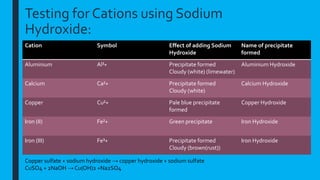
Testing for Cations using Sodium
Hydroxide:
Cation Symbol Effect of adding Sodium
Hydroxide
Name of precipitate
formed
Aluminium Al³+ Precipitate formed
Cloudy (white) (limewater)
Aluminium Hydroxide
Calcium Ca²+ Precipitate formed
Cloudy (white)
Calcium Hydroxide
Copper Cu²+ Pale blue precipitate
formed
Copper Hydroxide
Iron (II) Fe²+ Green precipitate Iron Hydroxide
Iron (III) Fe³+ Precipitate formed
Cloudy (brown(rust))
Iron Hydroxide
Copper sulfate + sodium hydroxide → copper hydroxide + sodium sulfate
CuSO4 + 2NaOH → Cu(OH)2 +Na2SO4
Qualitative tests are carried out before
quantitative tests
■ 1) If the precipitate formed is brown, the ion present is _______________
■ 2) If the precipitate formed is white, the ion could be ______ or _______
■ 3)The level of salt in food is: quantitative or qualitative?
■ 4)The source of pollution in a river is: quantitative or qualitative?
■ 5) aluminium sulfate + sodium hydroxide → __________ + ____________
Qualitative tests are carried out before
quantitative tests
■ 1) If the precipitate formed is brown, the ion present is Iron (III)
■ 2) If the precipitate formed is white, the ion could be Calcium or Aluminium
■ 3)The level of salt in food is: quantitative or qualitative?
■ 4)The source of pollution in a river is: quantitative or qualitative?
■ 5) aluminium sulfate + sodium hydroxide → aluminium hydroxide + sodium sulfate
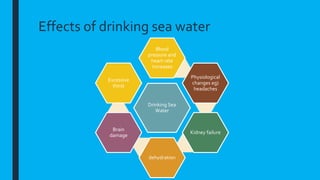
Effects of drinking sea water
Drinking Sea
Water
Blood
pressure and
heart rate
increases
Physiological
changes eg)
headaches
Kidney failure
dehydration
Brain
damage
Excessive
thirst
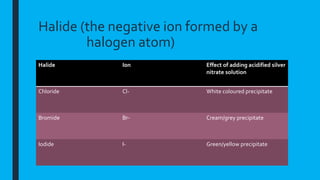
Halide (the negative ion formed by a
halogen atom)
Halide Ion Effect of adding acidified silver
nitrate solution
Chloride Cl- White coloured precipitate
Bromide Br- Cream/grey precipitate
Iodide I- Green/yellow precipitate
Method to test for Halide ions:
■ Carefully, pour 1cm³ of each halide into 3 separate test tubes (chloride, bromide,
iodide).
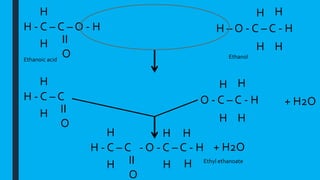
■ Add a few drops of acidified silver nitrate solution until a precipitate begins to form.
■ Shake and allow to settle.
■ Record results.
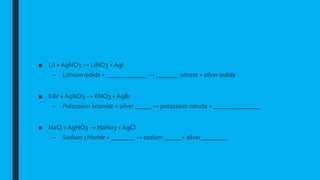
■ LiI + AgNO3 → LiNO3 + AgI
– Lithium iodide + _____ _______ → _______ nitrate + silver iodide
■ KBr + AgNO3 → KNO3 +AgBr
– Potassium bromide + silver _____ → potassium nitrate + ______ ________
■ NaCl + AgNO3 → NaNo3 + AgCl
– Sodium chloride + _______ → sodium _____ + silver ________
■ LiI + AgNO3 → LiNO3 + AgI
– Lithium iodide + silver nitrate → lithium nitrate + silver iodide
■ KBr + AgNO3 → KNO3 +AgBr
– Potassium bromide + silver nitrate → potassium nitrate + silver bromide
■ NaCl + AgNO3 → NaNo3 + AgCl
– Sodium chloride + silver nitrate → sodium nitrate + silver chloride
Testing for ammonium ions
Observations after warming with sodium hydroxide
solution.
Smell Effect on moist red litmus
paper.
A Ammonia → pungent Blue/purple
B No smell No change
C Ammonia → pungent Blue/purple
D Ammonia → pungent Blue/purple
Therefore, Fertiliser B is not an ammonium ion.
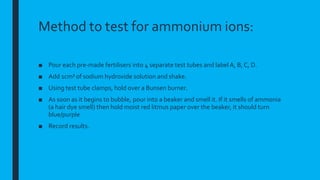
Method to test for ammonium ions:
■ Pour each pre-made fertilisers into 4 separate test tubes and label A, B, C, D.
■ Add 1cm³ of sodium hydroxide solution and shake.
■ Using test tube clamps, hold over a Bunsen burner.
■ As soon as it begins to bubble, pour into a beaker and smell it. If it smells of ammonia
(a hair dye smell) then hold moist red litmus paper over the beaker, it should turn
blue/purple
■ Record results.
■ To practice this, find a sheet based on Ions in our water and writing chemical equations
(C3.2d sheet and C3.4b sheet).
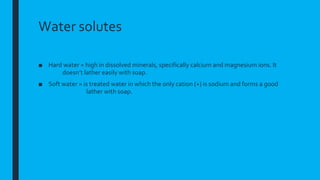
Water solutes
■ Hard water = high in dissolved minerals, specifically calcium and magnesium ions. It
doesn’t lather easily with soap.

■ Soft water = is treated water in which the only cation (+) is sodium and forms a good
lather with soap.
Hard water
Hard water
makes scum
• Reacts with soap to
make a nasty precipitate
called scum.
• Hard water is caused by
Ca²+ and Mg²+ ions.
Magnesium
sulfate (MgSO4)
dissolves in
water.
• So does calcium sulfate
Calcium
carbonate
• Calcium carbonate exists as
chalk, limestone or marble.
• It can react with acid rain to
form hydrogencarbonate
Ca(HCO3)2.
• It is soluble in water and
releases Ca²+.
My results
Sample Amount of soap needed
Distilled 5ml Softer
A 20% 13ml
B 60% 20ml
C 100% 25ml
D 140% 30ml Harder
Method to test hard/soft water
■ Measure 25cm³ of a sampled concentration of water into a boiling tube or conical flask.
■ Pour 5ml of the soap solution into the flask or boiling tube using a pipette.
■ Fit a bung and shake well
■ Allow to settle
■ If a lather has not formed, add another 5ml of soap solution and repeat until a lather forms.
■ Record the amount of soap solution needed.
■ To conclude, the pure water forms a lather easier because it is softer and doesn’t contain
magnesium or calcium ions.Whereas, the 140% concentrated sample was harder to form a
lather as it contained more magnesium and calcium ions.
calculations
■ M = mass of solute (g)
■ C = concentration (g dm-3)
■ V = volume (dm3)
■ 1 dm3 = 1 litre = 1000cm3
– Eg) 250cm3 = 0.25dm3
– Eg) 50mg = 0.05g
Worked example
■ What mass of sodium chloride is in 300cm3 of solution with a concentration of 12gdm-3?
– 300cm3 = 0.3dm3
– M = c x v
– 0.3 x 12 = 3.6g
■ There are 0.4g of calcium ions dissolved in 2 litres of water.What is the concentration?
– C = m ÷ v
– C = 0.4 ÷ 2
– C = 0.2 gdm-3
Hard and soft water
■ Magnesium ions and calcium ions make up hard water.
– They react with the stearate in the soap.
■ What are the problems with hard water?
Temporary hardness
■ Temporary hardness = property of hard water that can be removed by boiling the
water.
■ So, this is a thermal decomposition reaction forming insoluble calcium carbonate
which forms a limescale precipitate.
■ Permanent hard water = property of hard water that cannot be removed by boiling
the water.
– has no dissolved hydrogencarbonate ions to decompose – so when it is heated there
is no change and the water stays hard.
– Permanent water contains Ca and Mg chlorides and/or sulfates, which become more
soluble as the temperature increases.
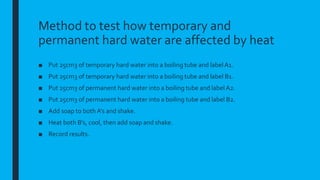
Method to test how temporary and
permanent hard water are affected by heat
■ Put 25cm3 of temporary hard water into a boiling tube and label A1.
■ Put 25cm3 of temporary hard water into a boiling tube and label B1.
■ Put 25cm3 of permanent hard water into a boiling tube and label A2.
■ Put 25cm3 of permanent hard water into a boiling tube and label B2.
■ Add soap to both A’s and shake.
■ Heat both B’s, cool, then add soap and shake.
■ Record results.
Ion exchange column
■ Both types of hard water can be softened by passing them through an ion exchange
column.
■ This swaps the calcium ions and magnesium ions in the water for sodium ions.
■ Sodium ions do not cause hardness in water.
■ An ion exchange column is packed with tiny plastic beads made of ‘resin’ (polymer).
■ When hard water is passed through the column, positively charged Ca and Mg ions in
the water swap with positively charged Na ions which are weakly attached to the
resin.
■ The swap of ions makes the water softer.
TESTSTO REMEMBER!
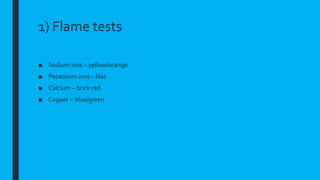
1) Flame tests
■ Sodium ions – yellow/orange
■ Potassium ions – lilac
■ Calcium – brick red
■ Copper – blue/green
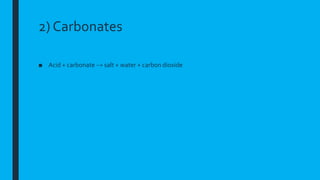
2) Carbonates
■ Acid + carbonate → salt + water + carbon dioxide
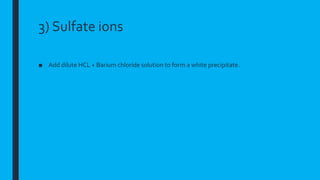
3) Sulfate ions
■ Add dilute HCL + Barium chloride solution to form a white precipitate.
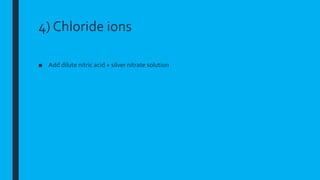
4) Chloride ions
■ Add dilute nitric acid + silver nitrate solution
5) Positive ions
■ Add a few drops of sodium hydroxide solution to your mystery compound.
■ Calcium – white precipitate
■ Copper – blue precipitate
■ Iron (II) – green precipitate
■ Iron (III) – brown precipitate
■ Aluminium – white precipitate at first but then it re-dissolves to form a colourless
solution.
6) Halides
■ Add nitric acid + silver nitrate solution.
■ Chloride – white
■ Bromide – cream
■ Iodide - yellow
Particles and moles
■ Diamond is made up of carbon atoms. How much diamond is there?
– How many carbon atoms are there in 12g of Diamond?
– 6.02x10^23
– How do we know??!!
Avogadro’s number
■ The amount of a substance can be measured in grams, number of particles, or number
of moles.
■ The mass of an element equal to its atomic mass in grams always contain 6.02x10^23
atoms.
■ This is Avogadro’s number.
Your turn
■ How many atoms are there in 32g of sulphur?
Your turn
■ How many atoms are there in 32g of sulphur?
■ = sulphur = mass number = 32
■ Therefore the mass and the mass number is equal so avogadros number is the answer!
■ 6.02x10^23
Particles and moles
■ Mole = the quantity of a substance which is equivalent to its relative atomic/formula
mass in grams.
■ Eg) RFM (Mr) of water is 18 (H2O = 1+1+16).
– 18g of water contains an Avogadro’s number of water molecules, so 1 mole of water
has a mass of 18g.
Which of these contains 1 mole of
particles?
■ 8g of oxygen
■ 20g of magnesium
■ 44g of carbon dioxide
■ 40g of potassium
Which of these contains 1 mole of
particles?
■ 8g of oxygen
– 0=16 (6.02x10^23) ÷ 2 = 3.01x10^23 = 0.5M
■ 20g of magnesium
– Mg=24 20g=0.83M
■ 44g of carbon dioxide
– CO2=44 44=44=1M
■ 40g of potassium
– K=39 39 ÷ 40 = 0.975M
Calculation
■ How many moles are there in 88g of CO2?
– CO2 = 44g = 1M 88g = 2M
■ How much mass is there in 162M of water?
– H2O = 18 18x162 = 2916g
■ How many moles are there in 80g of calcium?
– Ca = 40 = 2M
Solutions
■ Concentrations can be given in: gdm-3 or moldm-3.
■ You can calculate moldm-3 using this equation:
Your turn
■ Seawater contains 30g of NaCl in every 1dm3. calculate the concentration.
Your turn
■ Seawater contains 30g of NaCl in every 1dm3. calculate the concentration.
■ 30 ÷ 58.5 = 0.512820mdm3
Preparing soluble salts
■ If soluble salts are prepared from an acid and an insoluble reactant:
– Excess of the reactant can be added to ensure that all the acid is used up.
– The excess reactant can be removed by filtration.
– The remaining solution is only salt and water.
 Sodium hydroxide + hydrochloric acid → sodium chloride + water
 Copper oxide + hydrochloric acid → copper chloride + water
 = neutralisation
Making copper sulfate (CuSo4)
■ Copper oxide + hydrochloric acid → copper chloride + water
■ =a soluble salt made form an insoluble base.
■ 1) pour 20cm3 of sulphuric acid into a beaker.
■ 2) warm over Bunsen burner whilst adding excess copper oxide to the solution.
■ 3) remove from heat and pour into a filter over an evaporating dish.
■ 4) it should drip out as a blue solution.
■ 5) heat the evaporating dish until the liquid boils.
■ 6) leave to cool.
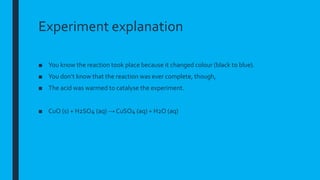
Experiment explanation
■ You know the reaction took place because it changed colour (black to blue).
■ You don’t know that the reaction was ever complete, though,
■ The acid was warmed to catalyse the experiment.
■ CuO (s) + H2SO4 (aq) → CuSO4 (aq) + H2O (aq)
Titrations
■ Titrations are used to find out concentrations.
■ An acid-based titration is a neutralisation reaction where Hydrogen ions from an acid
react with hydroxide ions from a soluble base (alkali).
■ H+ + OH- → H2O
■ Titrations allow you to find out exactly how much acid is needed to neutralise a
quantity of alkali (or vise versa).
Method
■ 1) add 25cm3 of alkali to a conical flask, along with 2 or 3 drops of indicator.
■ 2) the indicator used depends on the strengths of the acid and alkali:
– Phenolphthalein = used for a weak acid + a strong alkali.
– Methyl orange = used for a strong acid + a weak alkali.
– If both the acid and the alkali are strong, then any acid based indicator can be used.
■ 3) fill a burette with acid, below eye level.
■ 4) using a burette, add the acid to the alkali a small amount at a time – giving the conical
flask a regular swirl.Go slowly when you think the end-point (colour change) is about to be
reached.
■ 5) the indicator changes colour when all the alkali has been neutralised.
– Eg) phenolphthalein is pink in alkalis, but colourless in acids.
■ 6) record the volume of acid used to neutralise the alkali.
Titration step-by-step calculations.
■ 25cm3 of NaOH solution was titrated against 0.1Moldm-3 HCL.An average of 20cm3
of the acid was needed to react completely.What is the concentration of the NaOH
solution?
Titration step-by-step calculations.
■ 25cm3 of NaOH solution was titrated against 0.1Moldm-3 HCL.An average of 20cm3
of the acid was needed to react completely.What is the concentration of the NaOH
solution?
■ Step 1: Number of moles of HCL acid = concentration of HCL xVolume used
– Number of moles of HCL acid = 0.1 x (20÷100) = 0.002mol
Titration step-by-step calculations.
■ 25cm3 of NaOH solution was titrated against 0.1Moldm-3 HCL.An average of 20cm3
of the acid was needed to react completely.What is the concentration of the NaOH
solution?
■ Step 1: Number of moles of HCL acid = concentration of HCL xVolume used
– Number of moles of HCL acid = 0.1 x (20÷100) = 0.002mol
■ Step 2: write the balanced equation:
– NaOH + HCL → NaCl + H2O
– The equation shows that the ratio of NaOH : HCL is 1:1 so the moles are equal.
– Therefore, 0.002:0.002 moles.
Titration step-by-step calculations.
■ 25cm3 of NaOH solution was titrated against 0.1Moldm-3 HCL. An average of 20cm3 of the
acid was needed to react completely. What is the concentration of the NaOH solution?
■ Step 1: Number of moles of HCL acid = concentration of HCL xVolume used
– Number of moles of HCL acid = 0.1 x (20÷100) = 0.002mol
■ Step 2: write the balanced equation:
– NaOH + HCL → NaCl + H2O
– The equation shows that the artio of NaOH : HCL is 1:1 so the moles are equal.
– Therefore, 0.002:0.002 moles.
■ Step 3: concentration of NaOH = moles of NaOH ÷ volume of NaOH
– Concentartion of NaOH = 0.002 ÷ (25÷1000)
– Concentration of NaOH = 0.002 ÷ 0.025 = 0.08moldm-3
Electrolysis
■ 1) electricity comes from a battery, providing a direct current.
■ 2) It requires a liquid to conduct electricity (an electrolyte).
■ 3) the electricity is applied by two electrodes.
■ 4) this breaks down the compound into its component parts (often as a gas).
■ O – Oxidation
■ I – Is
■ L – loss of electron
■ R – reduction
■ I – is
■ G – gain of electron
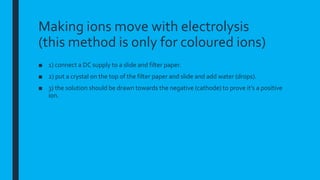
Making ions move with electrolysis
(this method is only for coloured ions)
■ 1) connect a DC supply to a slide and filter paper.
■ 2) put a crystal on the top of the filter paper and slide and add water (drops).
■ 3) the solution should be drawn towards the negative (cathode) to prove it’s a positive
ion.
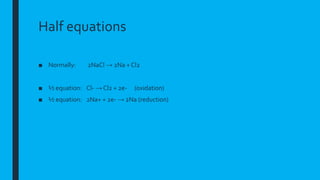
Half equations
■ Normally: 2NaCl → 2Na + Cl2
■ ½ equation: Cl- → Cl2 + 2e- (oxidation)
■ ½ equation: 2Na+ + 2e- → 2Na (reduction)
Practice these: (normally to ½
equations)
■ 1) 2LiI → Li + I2
Practice these: (normally to ½
equations)
■ 1) 2LiI → Li + I2
– Li + e- → Li (cathode)
– 2I → I2 + 2e- (anode)
Electrolysis of salts
Observations Anode (+) Cathide (-) Solution left
Sodium sulfate Bubbles at both
electrodes
O2- H2+ Sodium sulfate
Sodium chloride Fizzing, bubbling,
clouding
Cl2- H2+ Sodium hydroxide
Copper chloride Bubbles and visible
copper
Cl2- Cu2+ Water
Copper sulfate Copper at cathode,
bubbles at anode,
pieces of visible
metal.
O2- Cu2+ Sulphuric acid
Rule
■ At the cathode: Always Hydrogen will be formed, unless the metal is less reactive
than hydrogen.
■ At the anode:Always Oxygen unless a halide is present.
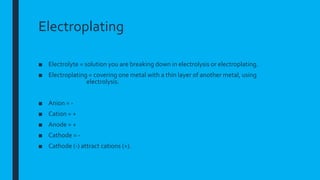
Electroplating
■ Electrolyte = solution you are breaking down in electrolysis or electroplating.
■ Electroplating = covering one metal with a thin layer of another metal, using
electrolysis.
■ Anion = -
■ Cation = +
■ Anode = +
■ Cathode = -
■ Cathode (-) attract cations (+).
Electroplating has many uses:
■ Jewellery and decorative items:
– With metals like gold and silver.
– Improves appearance.
■ Cooking utensils and cutlery:
– Stop them corroding.
– With unreactive metals which don’t corrode easily (eg nickel or chromium).
■ Electrolysis = 2 products
■ Electroplating = one product transferred to the cathode.
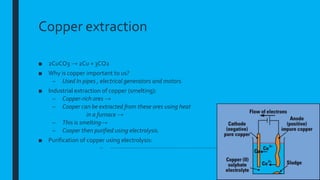
Copper extraction
■ 2CuCO3 → 2Cu + 3CO2
■ Why is copper important to us?
– Used In pipes , electrical generators and motors.
■ Industrial extraction of copper (smelting):
– Copper-rich ores →
– Cooper can be extracted from these ores using heat
in a furnace →
– This is smelting→
– Cooper then purified using electrolysis.
■ Purification of copper using electrolysis:
– -------------------------------------------------------------------
■ Ore = a naturally occurring solid material from which a metal or valuable mineral
can be extracted profitably.
■ Extraction = separation of a compound.
■ Impure = containing more than one material other than the intended pure material.
■ Smelting = an extraction method using heat, usually also resulting in oxidation.
Search the ‘Haber process’
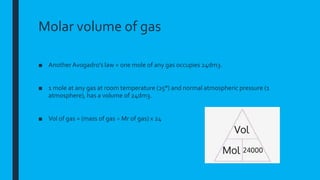
Molar volume of gas
■ Another Avogadro’s law = one mole of any gas occupies 24dm3.
■ 1 mole at any gas at room temperature (25°) and normal atmospheric pressure (1
atmosphere), has a volume of 24dm3.
■ Vol of gas = (mass of gas ÷ Mr of gas) x 24
Reversible/irreversible reactions
■ Reactants → products = irreversible.
■ Reactants products = forwards reversible
■ Products reactants = backwards reversible
■ Reversible reaction = a chemical recation that can work in both directions.
Industrial manufacture of ammonia
■ Pressure = 200 atmosphere
■ Temperature = 450°C
■ Catalyst = iron.
■ Ammonia is used to make nitrogenous fertilisers.
■ N2 + 3H2 2NH3
■ N2 = from the air and 3H2 = from natural gases.
■ Not all the nitrogen and hydrogen will convert to ammonia.The reaction reaches a dynamic
equilibrium.
■ 1) air liquefied under pressure
– Optimum temp = 450°C = forwards reaction
– Optimum pressure = 200 atmospheres = forward reaction
– Iron catalyst
– Exothermic reaction = heat produced.
■ Increasing the temperature will speed up the rate of reaction, making it turn into a backwards
reaction which they don’t want, so they must be accurate with not surpassing or exceeding the
temperature too much.
Ammonia
■ Cleaning
■ Very strong alkali
■ Explosives
■ 85% used for nitrogenous fertilisers
■ Can cause eutrophication.
Dynamic equilibrium
■ = the reactions are taking place in both directions at exactly the same rate, so there is
no overall affect.
■ This occurs in a closed system, where no reactants or products can escape.
■ Forwards = exothermic = releases heat
■ Backwards = endothermic = takes in heat.
■ Catalysts = decrease the activation energy.
Le Chantelier’s Principle
■ Rule = any change made to a reaction which is in equilibrium, will result in the
equilibrium position moving to minimise the change made.
■ Exothermic
– High temp = backwards
– Low temp = forwards
■ Endothermic
– High temp = forwards
– Low temp = backwards
■ Same for pressure
Questions
■ Define the dynamic equilibrium.
■ What will a higher pressure do to the equilibrium yield of ammonia?
■ What would a lower temperature do to the equilibrium yield?
■ What is a catalyst used for?
■ What is the minimum volume of Hydrogen required to convert 1000dm3 of nitrogen
into ammonia?
Questions
■ Define the dynamic equilibrium.
– = rate of reactions in both direction occur at exactly the same rate.
■ What will a higher pressure do to the equilibrium yield of ammonia?
– = increase the yield of ammonia.
■ What would a lower temperature do to the equilibrium yield?
– = Increase the equilibrium yield.
■ What is a catalyst used for?
– = to increase the rate of reaction.
■ What is the minimum volume of Hydrogen required to convert 1000dm3 of nitrogen into
ammonia?
– N2 + 3H2 → 2NH3
– 1 : 3
– 1000 x 3 = 3000dm3.
Alcoholic drinks and ethanol production
■ 1 unit = 10cm3 of pure ethanol.
– Average amount that can be processed in one hour.
■ Ethanol catalyst ethene + steam.
Making ethanol
From ethane
(cracking crude oil)
Fermentation with
yeast
Fermentation with yeast
■ Sugar yeast ethanol + carbon dioxide
■ Yeast contains enzymes which convert sugar to ethanol.
■ The optimum temperature is 37°C because Zymase works best at this temperature (if it is
too hot the enzyme will denature, but if too cold the reaction will be too slow.
■ The optimum pH is pH 4 as Zymase likes slightly acidic conditions.
■ No oxygen should enter the reaction, as this converts ethanol to vinegar (ethanoic acid).
■ When a concentration of 10-15% is reached, the fermentation stops because the enzyme
becomes denatured by the ethanol.
■ This process is too slow for large-scale production.
■ Ethanol boils at a lower temperature than water = fractional distillation.
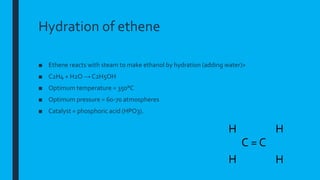
Hydration of ethene
■ Ethene reacts with steam to make ethanol by hydration (adding water)>
■ C2H4 + H2O → C2H5OH
■ Optimum temperature = 350°C
■ Optimum pressure = 60-70 atmospheres
■ Catalyst = phosphoric acid (HPO3).
C = C
H
C
HH
H
Adv. / Disadv.
Advantage Disadvantage
Fermentation Uses a renewable source. The quality of the ethanol
produced isn’t a high
standard.
Its expensive to concentrate
and purify.
Less space for farming.
Takes a long time.
Ethene 100% pure.
Little/no waste products.
Quick, continuous, cheap.
Crude oil is non-renewable.
High energy costs to maintain
high temperature and
pressure.
Homologous series
■ A group of similar compounds (with the same general formula and similar properties,
but have different number of carbon atoms). Eg) alkanes, alkenes and alcohols.
(alkane = CnH2n+2 alkene = CnH2n alcohols = CnH2n+OH)
■ Methane = one carbon atom
■ Ethane = two carbon atoms.
■ Propane = three carbon atoms.
■ Alcohols have an ‘-OH’ functional group and end in ‘-ol’.
– Eg) methanol
– Eg) ethanol
– Eg) propanol.
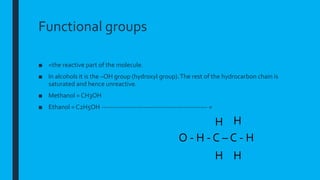
Functional groups
■ =the reactive part of the molecule.
■ In alcohols it is the –OH group (hydroxyl group).The rest of the hydrocarbon chain is
saturated and hence unreactive.
■ Methanol = CH3OH
■ Ethanol = C2H5OH ------------------------------------------------ =
O - H - C – C - H
H
H H
H
Alcohol
■ Alcohols combust with oxygen to produce carbon dioxide and water.
■ Alcohol is flammable, good fuels and have a clearer flame than hydrocarbons.
liquid methanol Ethanol Propanol hexane
No. of carbon atoms. 1 2 3 6
Test 1: mixing with
water.
Mixed. Pretty mixed. Most mixed but if left
will separate to two
layers.
Two layers.
Test 2: how does it
burn?
Orange flame.
Easily.
Blue ish flame Blue flame, burns
very well.
Extremely easily
ignited. But doesn’t
last as long.Orange
flame.
Test 3: reaction with
sodium.
Fizzing Fizzing fizzing
Ethanoic acid
■ = in vinegar.
■ If wine or beer is left open, the ethanol is oxidised to ethanoic acid.
■ Ethanol + oxygen → vinegar + water
■ C2H5OH + O2 → CH3COOH +H2O
■ This reaction is also used for the commercial production of vinegar.
■ Vinegar can be used for flavouring and the preservation of food.
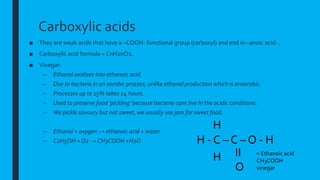
Carboxylic acids
■ They are weak acids that have a –COOH- functional group (carboxyl) and end in –anoic acid- .
■ Carboxylic acid formula = CnH2nO2.
■ Vinegar:
– Ethanol oxidises into ethanoic acid.
– Due to bacteria in an aerobic process, unlike ethanol production which is anaerobic.
– Processes up to 15% takes 24 hours.
– Used to preserve food ‘pickling’ because bacteria cant live In the acidic conditions.
– We pickle savoury but not sweet, we usually use jam for sweet food.
– Ethanol + oxygen → ethanoic acid + water
– C2H5OH + O2 → CH3COOH +H2O H - C – C – O - H
H
H II
O
= Ethanoic acid
CH3COOH
vinegar
Properties of carboxylic acids
■ A) testing ethanoic acid with universal indicator
– = it turns red.
■ B) observations when heated
– = the copper oxide formed a blue salt solution.
■ C) Adding magnesium
– = hydrogen gas is given off
– = fizzing and bubbles
■ D) adding sodium hydrogencarbonate
– = carbon dioxide produced
– = Fizzing and bubbles and turned limewater cloudy.
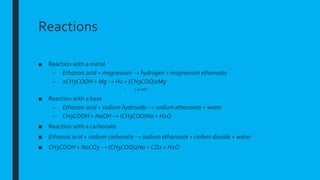
Reactions
■ Reaction with a metal
– Ethanoic acid + magnesium → hydrogen + magnesium ethanoate
– 2CH3COOH + Mg → H2 + (CH3COO)2Mg
– = a salt
■ Reaction with a base
– Ethanoic acid + sodium hydroxide → sodium ethanoate + water
– CH3COOH + NaOH → (CH3COO)Na + H2O
■ Reaction with a carbonate
■ Ethanoic acid + sodium carbonate → sodium ethanoate + carbon dioxide + water
■ CH3COOH + NaCO3 → (CH3COO)2Na + CO2 + H2O
Esters
■ Have the functional group –COO- and end in –yl…-oate.
■ Theyre formed when an alcohol reacts with a carboxylic acid.
■ They have sweet and fruity smell and comes in many flavourings and perfumes eg)
peardrops.
■ They are volatile.
■ They are made from an esterification reaction:
– Alcohol + carboxylic acid ester + water
H - C – C – O - H
H
H II
O
H – O - C – C - H
H
H H
H
H - C – C
H
H II
O
O - C – C - H
H
H H
H
+ H2O
H - C – C
H
H II
O
- O - C – C - H
H
H H
H
+ H2O
Ethanoic acid Ethanol
Ethyl ethanoate
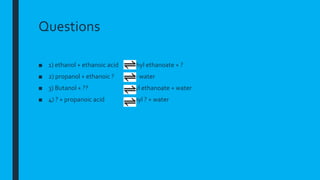
Questions
■ 1) ethanol + ethanoic acid ethyl ethanoate + ?
■ 2) propanol + ethanoic ? ? + water
■ 3) Butanol + ?? Butyl ethanoate + water
■ 4) ? + propanoic acid Ethyl ? + water
Questions
■ 1) ethanol + ethanoic acid ethyl ethanoate + ?
■ 2) propanol + ethanoic ? ? + water
■ 3) Butanol + ?? Butyl ethanoate + water
■ 4) ? + propanoic acid Ethyl ? + water
■ 1) water
■ 2) acid and propyl ethanoate
■ 3) ethanoic acid
■ 4) ethanol and propanoate
method
■ 250cm3 of boiling water into a beaker.
■ Put 2cm of ethanol into a test tube.
■ Get a pre-prepared test tube of 1cm3 concentrated sulphuric acid.
■ Mix the two test tubes together. Stand the test tube in the hot water beaker for 5
mins.
■ collect 50cm3 sodium hydrogencarbonate into a beaker.
■ Tip the test tube into the hydrogencarbonate and stir.
■ smell.And record results.
■
polyesters
■ = polymers made form 2 types of monomer:
– A carboxyl group ( from a carboxylic acid)
– A hydroxyl group ( from an alcohol).
■ Polyesters can be made into long, thin fibres which can be woven together to make
fabrics or drinks bottles.
■ Drinks bottles can be recycled to make fleece, which can be used to make clothing.
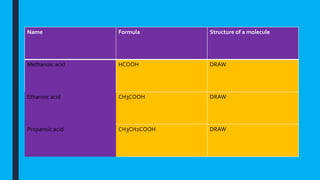
Name Formula Structure of a molecule
Methanoic acid HCOOH DRAW
Ethanoic acid CH3COOH DRAW
Propanoic acid CH3CH2COOH DRAW
Fats and oils
■ Ethanol ahs OH and ethanoic acid has OH with a double bond of O.
■ Fats:
– Esters
– Saturated
– Bromine water = stays orange
– Solid at room temperature
■ Oils:
– Esters
– Unsaturated
– Decolourises bromine water
– Liquid at room temperature
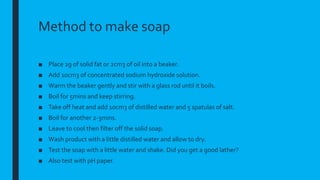
Method to make soap
■ Place 2g of solid fat or 2cm3 of oil into a beaker.
■ Add 10cm3 of concentrated sodium hydroxide solution.
■ Warm the beaker gently and stir with a glass rod until it boils.
■ Boil for 5mins and keep stirring.
■ Take off heat and add 10cm3 of distilled water and 5 spatulas of salt.
■ Boil for another 2-3mins.
■ Leave to cool then filter off the solid soap.
■ Wash product with a little distilled water and allow to dry.
■ Test the soap with a little water and shake. Did you get a good lather?
■ Also test with pH paper.
Soap – glycerol tristearate
■ Boil fats/oils with concentrated alkali.
■ Esters break down to form
– An alcohol called glycerol
– Sodium stearate (long chain carboxylic acid salts).
■ Sodium hydroxide + glycerol tristearate → sodium stearate + glycerol.
■ Concentrated alkali + oil/fat → soap + glycerol
How does soap work?
■ The active part of the soap is the anion (stearate group).
■ The head is hydrophilic (water loving) which dissolves in water.
■ The tail is hydrophobic (water hating) which dissolves in oily dirt/grease.
■ The hydrophobic tails dissolve in the grease and the hydrophilic head dissolves in the
water.
■ Some of the soap anions get beneath the grease and start to lift it off the fabric.
■ Grease leaves the fabric, surrounded by soap anions and mixes with the water.
Turning oil into fats
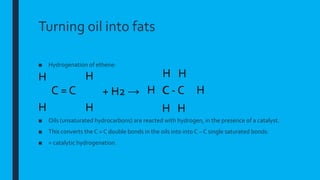
■ Hydrogenation of ethene:
■ Oils (unsaturated hydrocarbons) are reacted with hydrogen, in the presence of a catalyst.
■ This converts the C = C double bonds in the oils into into C – C single saturated bonds.
■ = catalytic hydrogenation.
C = C
H
C
HH
H
+ H2 → C - C
H
C
H
H
H
H
H

Chemistry c3 revsion notes!

  • 1.
  • 2.
    Topic 1 –Qualitative Analysis ■ Demonstrate an understanding that analysis may be qualitative or quantitative. ■ Explain why the test for any ion must be unique. ■ Purity of drinking water. ■ Describe tests to show: – Aluminium,Calcium,Copper, Iron (II) and Iron (III) – Ammonium plus sodium hydroxide solution – Cl, Br, I using dilute nitric acid and silver nitrate solution.
  • 3.
    WaterTesting ■ Qualitative: Investigationinto what kind of substances are present. ■ Quantitative: Investigation into the amount of substances that are present. ■ Flame tests are qualitative: – If 2 metal ions produce a similar colour, you could get the wrong identification. – So, you can add acid and silver nitrate, which forms a precipitate.This can identify some anions in a more clear way. FlameTest recap: Potassium – lilac Calcium – brick red Copper – green Sodium - yellow
  • 4.
    Testing for Cationsusing Sodium Hydroxide: Cation Symbol Effect of adding Sodium Hydroxide Name of precipitate formed Aluminium Al³+ Precipitate formed Cloudy (white) (limewater) Aluminium Hydroxide Calcium Ca²+ Precipitate formed Cloudy (white) Calcium Hydroxide Copper Cu²+ Pale blue precipitate formed Copper Hydroxide Iron (II) Fe²+ Green precipitate Iron Hydroxide Iron (III) Fe³+ Precipitate formed Cloudy (brown(rust)) Iron Hydroxide Copper sulfate + sodium hydroxide → copper hydroxide + sodium sulfate CuSO4 + 2NaOH → Cu(OH)2 +Na2SO4
  • 5.
    Qualitative tests arecarried out before quantitative tests ■ 1) If the precipitate formed is brown, the ion present is _______________ ■ 2) If the precipitate formed is white, the ion could be ______ or _______ ■ 3)The level of salt in food is: quantitative or qualitative? ■ 4)The source of pollution in a river is: quantitative or qualitative? ■ 5) aluminium sulfate + sodium hydroxide → __________ + ____________
  • 6.
    Qualitative tests arecarried out before quantitative tests ■ 1) If the precipitate formed is brown, the ion present is Iron (III) ■ 2) If the precipitate formed is white, the ion could be Calcium or Aluminium ■ 3)The level of salt in food is: quantitative or qualitative? ■ 4)The source of pollution in a river is: quantitative or qualitative? ■ 5) aluminium sulfate + sodium hydroxide → aluminium hydroxide + sodium sulfate
  • 7.
    Effects of drinkingsea water Drinking Sea Water Blood pressure and heart rate increases Physiological changes eg) headaches Kidney failure dehydration Brain damage Excessive thirst
  • 8.
    Halide (the negativeion formed by a halogen atom) Halide Ion Effect of adding acidified silver nitrate solution Chloride Cl- White coloured precipitate Bromide Br- Cream/grey precipitate Iodide I- Green/yellow precipitate
  • 9.
    Method to testfor Halide ions: ■ Carefully, pour 1cm³ of each halide into 3 separate test tubes (chloride, bromide, iodide). ■ Add a few drops of acidified silver nitrate solution until a precipitate begins to form. ■ Shake and allow to settle. ■ Record results.
  • 10.
    ■ LiI +AgNO3 → LiNO3 + AgI – Lithium iodide + _____ _______ → _______ nitrate + silver iodide ■ KBr + AgNO3 → KNO3 +AgBr – Potassium bromide + silver _____ → potassium nitrate + ______ ________ ■ NaCl + AgNO3 → NaNo3 + AgCl – Sodium chloride + _______ → sodium _____ + silver ________
  • 11.
    ■ LiI +AgNO3 → LiNO3 + AgI – Lithium iodide + silver nitrate → lithium nitrate + silver iodide ■ KBr + AgNO3 → KNO3 +AgBr – Potassium bromide + silver nitrate → potassium nitrate + silver bromide ■ NaCl + AgNO3 → NaNo3 + AgCl – Sodium chloride + silver nitrate → sodium nitrate + silver chloride
  • 12.
    Testing for ammoniumions Observations after warming with sodium hydroxide solution. Smell Effect on moist red litmus paper. A Ammonia → pungent Blue/purple B No smell No change C Ammonia → pungent Blue/purple D Ammonia → pungent Blue/purple Therefore, Fertiliser B is not an ammonium ion.
  • 13.
    Method to testfor ammonium ions: ■ Pour each pre-made fertilisers into 4 separate test tubes and label A, B, C, D. ■ Add 1cm³ of sodium hydroxide solution and shake. ■ Using test tube clamps, hold over a Bunsen burner. ■ As soon as it begins to bubble, pour into a beaker and smell it. If it smells of ammonia (a hair dye smell) then hold moist red litmus paper over the beaker, it should turn blue/purple ■ Record results.
  • 14.
    ■ To practicethis, find a sheet based on Ions in our water and writing chemical equations (C3.2d sheet and C3.4b sheet).
  • 15.
    Water solutes ■ Hardwater = high in dissolved minerals, specifically calcium and magnesium ions. It doesn’t lather easily with soap. ■ Soft water = is treated water in which the only cation (+) is sodium and forms a good lather with soap.
  • 16.
    Hard water Hard water makesscum • Reacts with soap to make a nasty precipitate called scum. • Hard water is caused by Ca²+ and Mg²+ ions. Magnesium sulfate (MgSO4) dissolves in water. • So does calcium sulfate Calcium carbonate • Calcium carbonate exists as chalk, limestone or marble. • It can react with acid rain to form hydrogencarbonate Ca(HCO3)2. • It is soluble in water and releases Ca²+.
  • 17.
    My results Sample Amountof soap needed Distilled 5ml Softer A 20% 13ml B 60% 20ml C 100% 25ml D 140% 30ml Harder
  • 18.
    Method to testhard/soft water ■ Measure 25cm³ of a sampled concentration of water into a boiling tube or conical flask. ■ Pour 5ml of the soap solution into the flask or boiling tube using a pipette. ■ Fit a bung and shake well ■ Allow to settle ■ If a lather has not formed, add another 5ml of soap solution and repeat until a lather forms. ■ Record the amount of soap solution needed. ■ To conclude, the pure water forms a lather easier because it is softer and doesn’t contain magnesium or calcium ions.Whereas, the 140% concentrated sample was harder to form a lather as it contained more magnesium and calcium ions.
  • 19.
    calculations ■ M =mass of solute (g) ■ C = concentration (g dm-3) ■ V = volume (dm3) ■ 1 dm3 = 1 litre = 1000cm3 – Eg) 250cm3 = 0.25dm3 – Eg) 50mg = 0.05g
  • 20.
    Worked example ■ Whatmass of sodium chloride is in 300cm3 of solution with a concentration of 12gdm-3? – 300cm3 = 0.3dm3 – M = c x v – 0.3 x 12 = 3.6g ■ There are 0.4g of calcium ions dissolved in 2 litres of water.What is the concentration? – C = m ÷ v – C = 0.4 ÷ 2 – C = 0.2 gdm-3
  • 21.
    Hard and softwater ■ Magnesium ions and calcium ions make up hard water. – They react with the stearate in the soap. ■ What are the problems with hard water?
  • 22.
    Temporary hardness ■ Temporaryhardness = property of hard water that can be removed by boiling the water. ■ So, this is a thermal decomposition reaction forming insoluble calcium carbonate which forms a limescale precipitate. ■ Permanent hard water = property of hard water that cannot be removed by boiling the water. – has no dissolved hydrogencarbonate ions to decompose – so when it is heated there is no change and the water stays hard. – Permanent water contains Ca and Mg chlorides and/or sulfates, which become more soluble as the temperature increases.
  • 23.
    Method to testhow temporary and permanent hard water are affected by heat ■ Put 25cm3 of temporary hard water into a boiling tube and label A1. ■ Put 25cm3 of temporary hard water into a boiling tube and label B1. ■ Put 25cm3 of permanent hard water into a boiling tube and label A2. ■ Put 25cm3 of permanent hard water into a boiling tube and label B2. ■ Add soap to both A’s and shake. ■ Heat both B’s, cool, then add soap and shake. ■ Record results.
  • 24.
    Ion exchange column ■Both types of hard water can be softened by passing them through an ion exchange column. ■ This swaps the calcium ions and magnesium ions in the water for sodium ions. ■ Sodium ions do not cause hardness in water. ■ An ion exchange column is packed with tiny plastic beads made of ‘resin’ (polymer). ■ When hard water is passed through the column, positively charged Ca and Mg ions in the water swap with positively charged Na ions which are weakly attached to the resin. ■ The swap of ions makes the water softer.
  • 25.
  • 26.
    1) Flame tests ■Sodium ions – yellow/orange ■ Potassium ions – lilac ■ Calcium – brick red ■ Copper – blue/green
  • 27.
    2) Carbonates ■ Acid+ carbonate → salt + water + carbon dioxide
  • 28.
    3) Sulfate ions ■Add dilute HCL + Barium chloride solution to form a white precipitate.
  • 29.
    4) Chloride ions ■Add dilute nitric acid + silver nitrate solution
  • 30.
    5) Positive ions ■Add a few drops of sodium hydroxide solution to your mystery compound. ■ Calcium – white precipitate ■ Copper – blue precipitate ■ Iron (II) – green precipitate ■ Iron (III) – brown precipitate ■ Aluminium – white precipitate at first but then it re-dissolves to form a colourless solution.
  • 31.
    6) Halides ■ Addnitric acid + silver nitrate solution. ■ Chloride – white ■ Bromide – cream ■ Iodide - yellow
  • 32.
    Particles and moles ■Diamond is made up of carbon atoms. How much diamond is there? – How many carbon atoms are there in 12g of Diamond? – 6.02x10^23 – How do we know??!!
  • 33.
    Avogadro’s number ■ Theamount of a substance can be measured in grams, number of particles, or number of moles. ■ The mass of an element equal to its atomic mass in grams always contain 6.02x10^23 atoms. ■ This is Avogadro’s number.
  • 34.
    Your turn ■ Howmany atoms are there in 32g of sulphur?
  • 35.
    Your turn ■ Howmany atoms are there in 32g of sulphur? ■ = sulphur = mass number = 32 ■ Therefore the mass and the mass number is equal so avogadros number is the answer! ■ 6.02x10^23
  • 36.
    Particles and moles ■Mole = the quantity of a substance which is equivalent to its relative atomic/formula mass in grams. ■ Eg) RFM (Mr) of water is 18 (H2O = 1+1+16). – 18g of water contains an Avogadro’s number of water molecules, so 1 mole of water has a mass of 18g.
  • 37.
    Which of thesecontains 1 mole of particles? ■ 8g of oxygen ■ 20g of magnesium ■ 44g of carbon dioxide ■ 40g of potassium
  • 38.
    Which of thesecontains 1 mole of particles? ■ 8g of oxygen – 0=16 (6.02x10^23) ÷ 2 = 3.01x10^23 = 0.5M ■ 20g of magnesium – Mg=24 20g=0.83M ■ 44g of carbon dioxide – CO2=44 44=44=1M ■ 40g of potassium – K=39 39 ÷ 40 = 0.975M
  • 39.
    Calculation ■ How manymoles are there in 88g of CO2? – CO2 = 44g = 1M 88g = 2M ■ How much mass is there in 162M of water? – H2O = 18 18x162 = 2916g ■ How many moles are there in 80g of calcium? – Ca = 40 = 2M
  • 40.
    Solutions ■ Concentrations canbe given in: gdm-3 or moldm-3. ■ You can calculate moldm-3 using this equation:
  • 41.
    Your turn ■ Seawatercontains 30g of NaCl in every 1dm3. calculate the concentration.
  • 42.
    Your turn ■ Seawatercontains 30g of NaCl in every 1dm3. calculate the concentration. ■ 30 ÷ 58.5 = 0.512820mdm3
  • 43.
    Preparing soluble salts ■If soluble salts are prepared from an acid and an insoluble reactant: – Excess of the reactant can be added to ensure that all the acid is used up. – The excess reactant can be removed by filtration. – The remaining solution is only salt and water.  Sodium hydroxide + hydrochloric acid → sodium chloride + water  Copper oxide + hydrochloric acid → copper chloride + water  = neutralisation
  • 44.
    Making copper sulfate(CuSo4) ■ Copper oxide + hydrochloric acid → copper chloride + water ■ =a soluble salt made form an insoluble base. ■ 1) pour 20cm3 of sulphuric acid into a beaker. ■ 2) warm over Bunsen burner whilst adding excess copper oxide to the solution. ■ 3) remove from heat and pour into a filter over an evaporating dish. ■ 4) it should drip out as a blue solution. ■ 5) heat the evaporating dish until the liquid boils. ■ 6) leave to cool.
  • 45.
    Experiment explanation ■ Youknow the reaction took place because it changed colour (black to blue). ■ You don’t know that the reaction was ever complete, though, ■ The acid was warmed to catalyse the experiment. ■ CuO (s) + H2SO4 (aq) → CuSO4 (aq) + H2O (aq)
  • 46.
    Titrations ■ Titrations areused to find out concentrations. ■ An acid-based titration is a neutralisation reaction where Hydrogen ions from an acid react with hydroxide ions from a soluble base (alkali). ■ H+ + OH- → H2O ■ Titrations allow you to find out exactly how much acid is needed to neutralise a quantity of alkali (or vise versa).
  • 47.
    Method ■ 1) add25cm3 of alkali to a conical flask, along with 2 or 3 drops of indicator. ■ 2) the indicator used depends on the strengths of the acid and alkali: – Phenolphthalein = used for a weak acid + a strong alkali. – Methyl orange = used for a strong acid + a weak alkali. – If both the acid and the alkali are strong, then any acid based indicator can be used. ■ 3) fill a burette with acid, below eye level. ■ 4) using a burette, add the acid to the alkali a small amount at a time – giving the conical flask a regular swirl.Go slowly when you think the end-point (colour change) is about to be reached. ■ 5) the indicator changes colour when all the alkali has been neutralised. – Eg) phenolphthalein is pink in alkalis, but colourless in acids. ■ 6) record the volume of acid used to neutralise the alkali.
  • 48.
  • 49.
    Titration step-by-step calculations. ■25cm3 of NaOH solution was titrated against 0.1Moldm-3 HCL.An average of 20cm3 of the acid was needed to react completely.What is the concentration of the NaOH solution?
  • 50.
    Titration step-by-step calculations. ■25cm3 of NaOH solution was titrated against 0.1Moldm-3 HCL.An average of 20cm3 of the acid was needed to react completely.What is the concentration of the NaOH solution? ■ Step 1: Number of moles of HCL acid = concentration of HCL xVolume used – Number of moles of HCL acid = 0.1 x (20÷100) = 0.002mol
  • 51.
    Titration step-by-step calculations. ■25cm3 of NaOH solution was titrated against 0.1Moldm-3 HCL.An average of 20cm3 of the acid was needed to react completely.What is the concentration of the NaOH solution? ■ Step 1: Number of moles of HCL acid = concentration of HCL xVolume used – Number of moles of HCL acid = 0.1 x (20÷100) = 0.002mol ■ Step 2: write the balanced equation: – NaOH + HCL → NaCl + H2O – The equation shows that the ratio of NaOH : HCL is 1:1 so the moles are equal. – Therefore, 0.002:0.002 moles.
  • 52.
    Titration step-by-step calculations. ■25cm3 of NaOH solution was titrated against 0.1Moldm-3 HCL. An average of 20cm3 of the acid was needed to react completely. What is the concentration of the NaOH solution? ■ Step 1: Number of moles of HCL acid = concentration of HCL xVolume used – Number of moles of HCL acid = 0.1 x (20÷100) = 0.002mol ■ Step 2: write the balanced equation: – NaOH + HCL → NaCl + H2O – The equation shows that the artio of NaOH : HCL is 1:1 so the moles are equal. – Therefore, 0.002:0.002 moles. ■ Step 3: concentration of NaOH = moles of NaOH ÷ volume of NaOH – Concentartion of NaOH = 0.002 ÷ (25÷1000) – Concentration of NaOH = 0.002 ÷ 0.025 = 0.08moldm-3
  • 53.
    Electrolysis ■ 1) electricitycomes from a battery, providing a direct current. ■ 2) It requires a liquid to conduct electricity (an electrolyte). ■ 3) the electricity is applied by two electrodes. ■ 4) this breaks down the compound into its component parts (often as a gas). ■ O – Oxidation ■ I – Is ■ L – loss of electron ■ R – reduction ■ I – is ■ G – gain of electron
  • 54.
    Making ions movewith electrolysis (this method is only for coloured ions) ■ 1) connect a DC supply to a slide and filter paper. ■ 2) put a crystal on the top of the filter paper and slide and add water (drops). ■ 3) the solution should be drawn towards the negative (cathode) to prove it’s a positive ion.
  • 55.
    Half equations ■ Normally:2NaCl → 2Na + Cl2 ■ ½ equation: Cl- → Cl2 + 2e- (oxidation) ■ ½ equation: 2Na+ + 2e- → 2Na (reduction)
  • 56.
    Practice these: (normallyto ½ equations) ■ 1) 2LiI → Li + I2
  • 57.
    Practice these: (normallyto ½ equations) ■ 1) 2LiI → Li + I2 – Li + e- → Li (cathode) – 2I → I2 + 2e- (anode)
  • 58.
    Electrolysis of salts ObservationsAnode (+) Cathide (-) Solution left Sodium sulfate Bubbles at both electrodes O2- H2+ Sodium sulfate Sodium chloride Fizzing, bubbling, clouding Cl2- H2+ Sodium hydroxide Copper chloride Bubbles and visible copper Cl2- Cu2+ Water Copper sulfate Copper at cathode, bubbles at anode, pieces of visible metal. O2- Cu2+ Sulphuric acid
  • 59.
    Rule ■ At thecathode: Always Hydrogen will be formed, unless the metal is less reactive than hydrogen. ■ At the anode:Always Oxygen unless a halide is present.
  • 60.
    Electroplating ■ Electrolyte =solution you are breaking down in electrolysis or electroplating. ■ Electroplating = covering one metal with a thin layer of another metal, using electrolysis. ■ Anion = - ■ Cation = + ■ Anode = + ■ Cathode = - ■ Cathode (-) attract cations (+).
  • 61.
    Electroplating has manyuses: ■ Jewellery and decorative items: – With metals like gold and silver. – Improves appearance. ■ Cooking utensils and cutlery: – Stop them corroding. – With unreactive metals which don’t corrode easily (eg nickel or chromium). ■ Electrolysis = 2 products ■ Electroplating = one product transferred to the cathode.
  • 62.
    Copper extraction ■ 2CuCO3→ 2Cu + 3CO2 ■ Why is copper important to us? – Used In pipes , electrical generators and motors. ■ Industrial extraction of copper (smelting): – Copper-rich ores → – Cooper can be extracted from these ores using heat in a furnace → – This is smelting→ – Cooper then purified using electrolysis. ■ Purification of copper using electrolysis: – -------------------------------------------------------------------
  • 63.
    ■ Ore =a naturally occurring solid material from which a metal or valuable mineral can be extracted profitably. ■ Extraction = separation of a compound. ■ Impure = containing more than one material other than the intended pure material. ■ Smelting = an extraction method using heat, usually also resulting in oxidation.
  • 64.
  • 65.
    Molar volume ofgas ■ Another Avogadro’s law = one mole of any gas occupies 24dm3. ■ 1 mole at any gas at room temperature (25°) and normal atmospheric pressure (1 atmosphere), has a volume of 24dm3. ■ Vol of gas = (mass of gas ÷ Mr of gas) x 24
  • 66.
    Reversible/irreversible reactions ■ Reactants→ products = irreversible. ■ Reactants products = forwards reversible ■ Products reactants = backwards reversible ■ Reversible reaction = a chemical recation that can work in both directions.
  • 67.
    Industrial manufacture ofammonia ■ Pressure = 200 atmosphere ■ Temperature = 450°C ■ Catalyst = iron. ■ Ammonia is used to make nitrogenous fertilisers. ■ N2 + 3H2 2NH3 ■ N2 = from the air and 3H2 = from natural gases. ■ Not all the nitrogen and hydrogen will convert to ammonia.The reaction reaches a dynamic equilibrium. ■ 1) air liquefied under pressure – Optimum temp = 450°C = forwards reaction – Optimum pressure = 200 atmospheres = forward reaction – Iron catalyst – Exothermic reaction = heat produced. ■ Increasing the temperature will speed up the rate of reaction, making it turn into a backwards reaction which they don’t want, so they must be accurate with not surpassing or exceeding the temperature too much.
  • 68.
    Ammonia ■ Cleaning ■ Verystrong alkali ■ Explosives ■ 85% used for nitrogenous fertilisers ■ Can cause eutrophication.
  • 69.
    Dynamic equilibrium ■ =the reactions are taking place in both directions at exactly the same rate, so there is no overall affect. ■ This occurs in a closed system, where no reactants or products can escape. ■ Forwards = exothermic = releases heat ■ Backwards = endothermic = takes in heat. ■ Catalysts = decrease the activation energy.
  • 70.
    Le Chantelier’s Principle ■Rule = any change made to a reaction which is in equilibrium, will result in the equilibrium position moving to minimise the change made. ■ Exothermic – High temp = backwards – Low temp = forwards ■ Endothermic – High temp = forwards – Low temp = backwards ■ Same for pressure
  • 71.
    Questions ■ Define thedynamic equilibrium. ■ What will a higher pressure do to the equilibrium yield of ammonia? ■ What would a lower temperature do to the equilibrium yield? ■ What is a catalyst used for? ■ What is the minimum volume of Hydrogen required to convert 1000dm3 of nitrogen into ammonia?
  • 72.
    Questions ■ Define thedynamic equilibrium. – = rate of reactions in both direction occur at exactly the same rate. ■ What will a higher pressure do to the equilibrium yield of ammonia? – = increase the yield of ammonia. ■ What would a lower temperature do to the equilibrium yield? – = Increase the equilibrium yield. ■ What is a catalyst used for? – = to increase the rate of reaction. ■ What is the minimum volume of Hydrogen required to convert 1000dm3 of nitrogen into ammonia? – N2 + 3H2 → 2NH3 – 1 : 3 – 1000 x 3 = 3000dm3.
  • 73.
    Alcoholic drinks andethanol production ■ 1 unit = 10cm3 of pure ethanol. – Average amount that can be processed in one hour. ■ Ethanol catalyst ethene + steam. Making ethanol From ethane (cracking crude oil) Fermentation with yeast
  • 74.
    Fermentation with yeast ■Sugar yeast ethanol + carbon dioxide ■ Yeast contains enzymes which convert sugar to ethanol. ■ The optimum temperature is 37°C because Zymase works best at this temperature (if it is too hot the enzyme will denature, but if too cold the reaction will be too slow. ■ The optimum pH is pH 4 as Zymase likes slightly acidic conditions. ■ No oxygen should enter the reaction, as this converts ethanol to vinegar (ethanoic acid). ■ When a concentration of 10-15% is reached, the fermentation stops because the enzyme becomes denatured by the ethanol. ■ This process is too slow for large-scale production. ■ Ethanol boils at a lower temperature than water = fractional distillation.
  • 75.
    Hydration of ethene ■Ethene reacts with steam to make ethanol by hydration (adding water)> ■ C2H4 + H2O → C2H5OH ■ Optimum temperature = 350°C ■ Optimum pressure = 60-70 atmospheres ■ Catalyst = phosphoric acid (HPO3). C = C H C HH H
  • 76.
    Adv. / Disadv. AdvantageDisadvantage Fermentation Uses a renewable source. The quality of the ethanol produced isn’t a high standard. Its expensive to concentrate and purify. Less space for farming. Takes a long time. Ethene 100% pure. Little/no waste products. Quick, continuous, cheap. Crude oil is non-renewable. High energy costs to maintain high temperature and pressure.
  • 77.
    Homologous series ■ Agroup of similar compounds (with the same general formula and similar properties, but have different number of carbon atoms). Eg) alkanes, alkenes and alcohols. (alkane = CnH2n+2 alkene = CnH2n alcohols = CnH2n+OH) ■ Methane = one carbon atom ■ Ethane = two carbon atoms. ■ Propane = three carbon atoms. ■ Alcohols have an ‘-OH’ functional group and end in ‘-ol’. – Eg) methanol – Eg) ethanol – Eg) propanol.
  • 78.
    Functional groups ■ =thereactive part of the molecule. ■ In alcohols it is the –OH group (hydroxyl group).The rest of the hydrocarbon chain is saturated and hence unreactive. ■ Methanol = CH3OH ■ Ethanol = C2H5OH ------------------------------------------------ = O - H - C – C - H H H H H
  • 79.
    Alcohol ■ Alcohols combustwith oxygen to produce carbon dioxide and water. ■ Alcohol is flammable, good fuels and have a clearer flame than hydrocarbons. liquid methanol Ethanol Propanol hexane No. of carbon atoms. 1 2 3 6 Test 1: mixing with water. Mixed. Pretty mixed. Most mixed but if left will separate to two layers. Two layers. Test 2: how does it burn? Orange flame. Easily. Blue ish flame Blue flame, burns very well. Extremely easily ignited. But doesn’t last as long.Orange flame. Test 3: reaction with sodium. Fizzing Fizzing fizzing
  • 80.
    Ethanoic acid ■ =in vinegar. ■ If wine or beer is left open, the ethanol is oxidised to ethanoic acid. ■ Ethanol + oxygen → vinegar + water ■ C2H5OH + O2 → CH3COOH +H2O ■ This reaction is also used for the commercial production of vinegar. ■ Vinegar can be used for flavouring and the preservation of food.
  • 81.
    Carboxylic acids ■ Theyare weak acids that have a –COOH- functional group (carboxyl) and end in –anoic acid- . ■ Carboxylic acid formula = CnH2nO2. ■ Vinegar: – Ethanol oxidises into ethanoic acid. – Due to bacteria in an aerobic process, unlike ethanol production which is anaerobic. – Processes up to 15% takes 24 hours. – Used to preserve food ‘pickling’ because bacteria cant live In the acidic conditions. – We pickle savoury but not sweet, we usually use jam for sweet food. – Ethanol + oxygen → ethanoic acid + water – C2H5OH + O2 → CH3COOH +H2O H - C – C – O - H H H II O = Ethanoic acid CH3COOH vinegar
  • 82.
    Properties of carboxylicacids ■ A) testing ethanoic acid with universal indicator – = it turns red. ■ B) observations when heated – = the copper oxide formed a blue salt solution. ■ C) Adding magnesium – = hydrogen gas is given off – = fizzing and bubbles ■ D) adding sodium hydrogencarbonate – = carbon dioxide produced – = Fizzing and bubbles and turned limewater cloudy.
  • 83.
    Reactions ■ Reaction witha metal – Ethanoic acid + magnesium → hydrogen + magnesium ethanoate – 2CH3COOH + Mg → H2 + (CH3COO)2Mg – = a salt ■ Reaction with a base – Ethanoic acid + sodium hydroxide → sodium ethanoate + water – CH3COOH + NaOH → (CH3COO)Na + H2O ■ Reaction with a carbonate ■ Ethanoic acid + sodium carbonate → sodium ethanoate + carbon dioxide + water ■ CH3COOH + NaCO3 → (CH3COO)2Na + CO2 + H2O
  • 84.
    Esters ■ Have thefunctional group –COO- and end in –yl…-oate. ■ Theyre formed when an alcohol reacts with a carboxylic acid. ■ They have sweet and fruity smell and comes in many flavourings and perfumes eg) peardrops. ■ They are volatile. ■ They are made from an esterification reaction: – Alcohol + carboxylic acid ester + water
  • 85.
    H - C– C – O - H H H II O H – O - C – C - H H H H H H - C – C H H II O O - C – C - H H H H H + H2O H - C – C H H II O - O - C – C - H H H H H + H2O Ethanoic acid Ethanol Ethyl ethanoate
  • 86.
    Questions ■ 1) ethanol+ ethanoic acid ethyl ethanoate + ? ■ 2) propanol + ethanoic ? ? + water ■ 3) Butanol + ?? Butyl ethanoate + water ■ 4) ? + propanoic acid Ethyl ? + water
  • 87.
    Questions ■ 1) ethanol+ ethanoic acid ethyl ethanoate + ? ■ 2) propanol + ethanoic ? ? + water ■ 3) Butanol + ?? Butyl ethanoate + water ■ 4) ? + propanoic acid Ethyl ? + water ■ 1) water ■ 2) acid and propyl ethanoate ■ 3) ethanoic acid ■ 4) ethanol and propanoate
  • 88.
    method ■ 250cm3 ofboiling water into a beaker. ■ Put 2cm of ethanol into a test tube. ■ Get a pre-prepared test tube of 1cm3 concentrated sulphuric acid. ■ Mix the two test tubes together. Stand the test tube in the hot water beaker for 5 mins. ■ collect 50cm3 sodium hydrogencarbonate into a beaker. ■ Tip the test tube into the hydrogencarbonate and stir. ■ smell.And record results. ■
  • 89.
    polyesters ■ = polymersmade form 2 types of monomer: – A carboxyl group ( from a carboxylic acid) – A hydroxyl group ( from an alcohol). ■ Polyesters can be made into long, thin fibres which can be woven together to make fabrics or drinks bottles. ■ Drinks bottles can be recycled to make fleece, which can be used to make clothing.
  • 90.
    Name Formula Structureof a molecule Methanoic acid HCOOH DRAW Ethanoic acid CH3COOH DRAW Propanoic acid CH3CH2COOH DRAW
  • 91.
    Fats and oils ■Ethanol ahs OH and ethanoic acid has OH with a double bond of O. ■ Fats: – Esters – Saturated – Bromine water = stays orange – Solid at room temperature ■ Oils: – Esters – Unsaturated – Decolourises bromine water – Liquid at room temperature
  • 92.
    Method to makesoap ■ Place 2g of solid fat or 2cm3 of oil into a beaker. ■ Add 10cm3 of concentrated sodium hydroxide solution. ■ Warm the beaker gently and stir with a glass rod until it boils. ■ Boil for 5mins and keep stirring. ■ Take off heat and add 10cm3 of distilled water and 5 spatulas of salt. ■ Boil for another 2-3mins. ■ Leave to cool then filter off the solid soap. ■ Wash product with a little distilled water and allow to dry. ■ Test the soap with a little water and shake. Did you get a good lather? ■ Also test with pH paper.
  • 93.
    Soap – glyceroltristearate ■ Boil fats/oils with concentrated alkali. ■ Esters break down to form – An alcohol called glycerol – Sodium stearate (long chain carboxylic acid salts). ■ Sodium hydroxide + glycerol tristearate → sodium stearate + glycerol. ■ Concentrated alkali + oil/fat → soap + glycerol
  • 94.
    How does soapwork? ■ The active part of the soap is the anion (stearate group). ■ The head is hydrophilic (water loving) which dissolves in water. ■ The tail is hydrophobic (water hating) which dissolves in oily dirt/grease. ■ The hydrophobic tails dissolve in the grease and the hydrophilic head dissolves in the water. ■ Some of the soap anions get beneath the grease and start to lift it off the fabric. ■ Grease leaves the fabric, surrounded by soap anions and mixes with the water.
  • 95.
    Turning oil intofats ■ Hydrogenation of ethene: ■ Oils (unsaturated hydrocarbons) are reacted with hydrogen, in the presence of a catalyst. ■ This converts the C = C double bonds in the oils into into C – C single saturated bonds. ■ = catalytic hydrogenation. C = C H C HH H + H2 → C - C H C H H H H H