Business Research Methodology
Introduction to Research
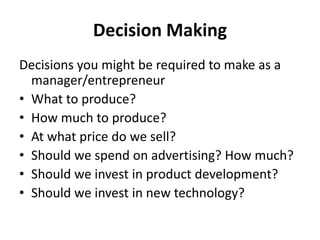
Decision Making
Decisions you might be required to make as a
manager/entrepreneur
• What to produce?
• How much to produce?
• At what price do we sell?
• Should we spend on advertising? How much?
• Should we invest in product development?
• Should we invest in new technology?
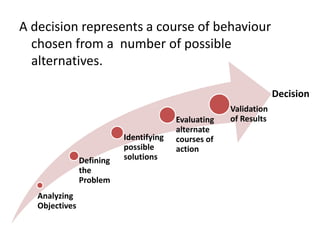
A decision represents a course of behaviour
chosen from a number of possible
alternatives.
Analyzing
Objectives
Defining
the
Problem
Identifying
possible
solutions
Evaluating
alternate
courses of
action
Validation
of Results
Decision
What is Research?
• Research is a systematic and objective investigation of a subject or
problem in order to discover relevant information or principles.
 Young defines Research as “a scientific undertaking which, by means of
logical and systematic techniques, aims to:
• Discover new facts or verify and test old facts
• Analyze their sequences, interrelationships and causal explanations
• Develop new scientific tools, concepts and theories
Features of Research
• Systematic and critical investigation into a phenomenon
• Purposive investigation aiming at describing, interpreting and explaining
a phenomenon
• Adoption of scientific method
• Objective and logical
• Based on observable experience or empirical evidence
• Directed towards finding answers to pertinent questions and solutions
to problems
• Emphasis on development of generalization, principles or theories
• Purpose is not only to arrive at an answer but also to stand up the test
of criticism
Purpose of Research
• Extension of knowledge of human beings, social life and environment
(What-Where-When-How-Why)
• Bringing to light information that might never be discovered fully during
the ordinary course of life
• Establishment of generalizations and general laws and contribution to
theory building in various fields of knowledge
• Verification and testing of existing facts and theory
• Making reliable predictions of events yet to happen
• Analysis of inter-relationships between variables and to derive casual
explanations – Better understanding of world in which we live
Purpose of Research
• Finding solution to problems (social, economic, health, human relations
in organizations)
• Development of new tools, concepts and theories for better study of
unknown phenomenon
• Aid in planning and contribution to national development
Requirements for a good Research
• Clearly Defined Purpose
• Ethical process and purpose
• Clear and well planned methodology
• Researcher should be a skilled expert
• Unbiased procedure and analysis
• Justifiable conclusions
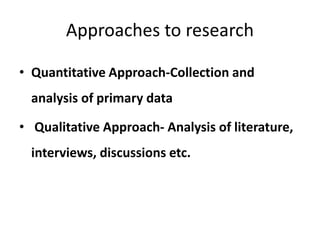
Approaches to research
• Quantitative Approach-Collection and
analysis of primary data
• Qualitative Approach- Analysis of literature,
interviews, discussions etc.
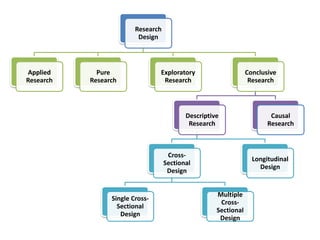
Research
Design
Applied
Research
Exploratory
Research
Pure
Research
Conclusive
Research
Descriptive
Research
Cross-
Sectional
Design
Single Cross-
Sectional
Design
Multiple
Cross-
Sectional
Design
Longitudinal
Design
Causal
Research
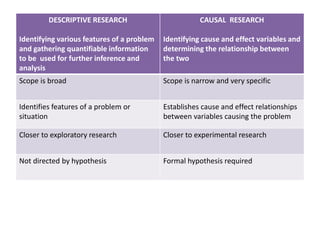
DESCRIPTIVE RESEARCH
Identifying various features of a problem
and gathering quantifiable information
to be used for further inference and
analysis
CAUSAL RESEARCH
Identifying cause and effect variables and
determining the relationship between
the two
Scope is broad Scope is narrow and very specific
Identifies features of a problem or
situation
Establishes cause and effect relationships
between variables causing the problem
Closer to exploratory research Closer to experimental research
Not directed by hypothesis Formal hypothesis required
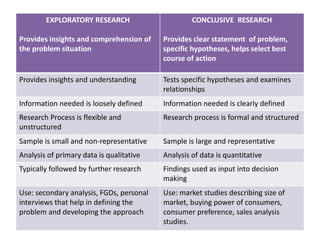
EXPLORATORY RESEARCH
Provides insights and comprehension of
the problem situation
CONCLUSIVE RESEARCH
Provides clear statement of problem,
specific hypotheses, helps select best
course of action
Provides insights and understanding Tests specific hypotheses and examines
relationships
Information needed is loosely defined Information needed is clearly defined
Research Process is flexible and
unstructured
Research process is formal and structured
Sample is small and non-representative Sample is large and representative
Analysis of primary data is qualitative Analysis of data is quantitative
Typically followed by further research Findings used as input into decision
making
Use: secondary analysis, FGDs, personal
interviews that help in defining the
problem and developing the approach
Use: market studies describing size of
market, buying power of consumers,
consumer preference, sales analysis
studies.
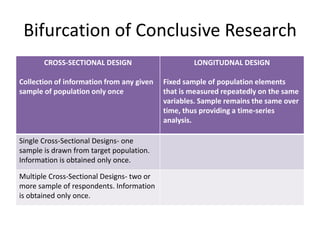
Bifurcation of Conclusive Research
CROSS-SECTIONAL DESIGN
Collection of information from any given
sample of population only once
LONGITUDNAL DESIGN
Fixed sample of population elements
that is measured repeatedly on the same
variables. Sample remains the same over
time, thus providing a time-series
analysis.
Single Cross-Sectional Designs- one
sample is drawn from target population.
Information is obtained only once.
Multiple Cross-Sectional Designs- two or
more sample of respondents. Information
is obtained only once.
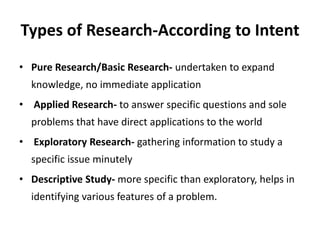
Types of Research-According to Intent
• Pure Research/Basic Research- undertaken to expand
knowledge, no immediate application
• Applied Research- to answer specific questions and sole
problems that have direct applications to the world
• Exploratory Research- gathering information to study a
specific issue minutely
• Descriptive Study- more specific than exploratory, helps in
identifying various features of a problem.
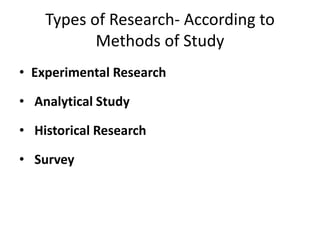
Types of Research- According to
Methods of Study
• Experimental Research
• Analytical Study
• Historical Research
• Survey
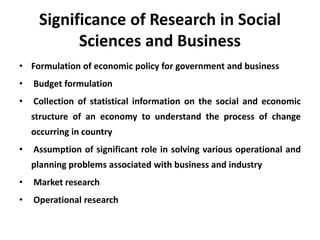
Significance of Research in Social
Sciences and Business
• Formulation of economic policy for government and business
• Budget formulation
• Collection of statistical information on the social and economic
structure of an economy to understand the process of change
occurring in country
• Assumption of significant role in solving various operational and
planning problems associated with business and industry
• Market research
• Operational research
Business Research
• Business research refers to a set of research
techniques that companies employ to determine
whether a specific business endeavor is worth their
time and effort.
• Research methods help companies establish the
viability of business success and choose an appropriate
marketing approach for their products and services.
• For managers, the purpose of research is to fulfill the
need for
– knowledge of the organization,
– the market
– the economy
Scope/Applications of Business
Research
• Marketing Research
• Research in Financial Management
• Research in Personnel/human resource
management
• Research in Production management
• Research in Rural Management
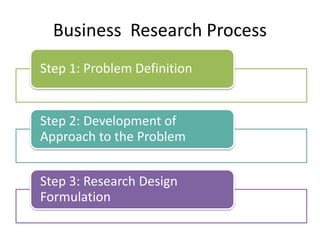
Business Research Process
Step 1: Problem Definition
Step 2: Development of
Approach to the Problem
Step 3: Research Design
Formulation
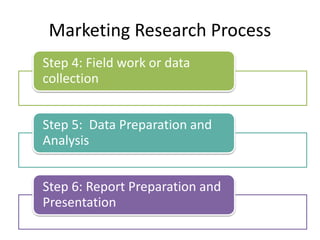
Step 4: Field work or data
collection
Step 5: Data Preparation and
Analysis
Step 6: Report Preparation and
Presentation
Marketing Research Process

Business research methodology

  • 1.
  • 2.
    Decision Making Decisions youmight be required to make as a manager/entrepreneur • What to produce? • How much to produce? • At what price do we sell? • Should we spend on advertising? How much? • Should we invest in product development? • Should we invest in new technology?
  • 3.
    A decision representsa course of behaviour chosen from a number of possible alternatives. Analyzing Objectives Defining the Problem Identifying possible solutions Evaluating alternate courses of action Validation of Results Decision
  • 4.
    What is Research? •Research is a systematic and objective investigation of a subject or problem in order to discover relevant information or principles.  Young defines Research as “a scientific undertaking which, by means of logical and systematic techniques, aims to: • Discover new facts or verify and test old facts • Analyze their sequences, interrelationships and causal explanations • Develop new scientific tools, concepts and theories
  • 5.
    Features of Research •Systematic and critical investigation into a phenomenon • Purposive investigation aiming at describing, interpreting and explaining a phenomenon • Adoption of scientific method • Objective and logical • Based on observable experience or empirical evidence • Directed towards finding answers to pertinent questions and solutions to problems • Emphasis on development of generalization, principles or theories • Purpose is not only to arrive at an answer but also to stand up the test of criticism
  • 6.
    Purpose of Research •Extension of knowledge of human beings, social life and environment (What-Where-When-How-Why) • Bringing to light information that might never be discovered fully during the ordinary course of life • Establishment of generalizations and general laws and contribution to theory building in various fields of knowledge • Verification and testing of existing facts and theory • Making reliable predictions of events yet to happen • Analysis of inter-relationships between variables and to derive casual explanations – Better understanding of world in which we live
  • 7.
    Purpose of Research •Finding solution to problems (social, economic, health, human relations in organizations) • Development of new tools, concepts and theories for better study of unknown phenomenon • Aid in planning and contribution to national development
  • 8.
    Requirements for agood Research • Clearly Defined Purpose • Ethical process and purpose • Clear and well planned methodology • Researcher should be a skilled expert • Unbiased procedure and analysis • Justifiable conclusions
  • 9.
    Approaches to research •Quantitative Approach-Collection and analysis of primary data • Qualitative Approach- Analysis of literature, interviews, discussions etc.
  • 10.
  • 11.
    DESCRIPTIVE RESEARCH Identifying variousfeatures of a problem and gathering quantifiable information to be used for further inference and analysis CAUSAL RESEARCH Identifying cause and effect variables and determining the relationship between the two Scope is broad Scope is narrow and very specific Identifies features of a problem or situation Establishes cause and effect relationships between variables causing the problem Closer to exploratory research Closer to experimental research Not directed by hypothesis Formal hypothesis required
  • 12.
    EXPLORATORY RESEARCH Provides insightsand comprehension of the problem situation CONCLUSIVE RESEARCH Provides clear statement of problem, specific hypotheses, helps select best course of action Provides insights and understanding Tests specific hypotheses and examines relationships Information needed is loosely defined Information needed is clearly defined Research Process is flexible and unstructured Research process is formal and structured Sample is small and non-representative Sample is large and representative Analysis of primary data is qualitative Analysis of data is quantitative Typically followed by further research Findings used as input into decision making Use: secondary analysis, FGDs, personal interviews that help in defining the problem and developing the approach Use: market studies describing size of market, buying power of consumers, consumer preference, sales analysis studies.
  • 13.
    Bifurcation of ConclusiveResearch CROSS-SECTIONAL DESIGN Collection of information from any given sample of population only once LONGITUDNAL DESIGN Fixed sample of population elements that is measured repeatedly on the same variables. Sample remains the same over time, thus providing a time-series analysis. Single Cross-Sectional Designs- one sample is drawn from target population. Information is obtained only once. Multiple Cross-Sectional Designs- two or more sample of respondents. Information is obtained only once.
  • 14.
    Types of Research-Accordingto Intent • Pure Research/Basic Research- undertaken to expand knowledge, no immediate application • Applied Research- to answer specific questions and sole problems that have direct applications to the world • Exploratory Research- gathering information to study a specific issue minutely • Descriptive Study- more specific than exploratory, helps in identifying various features of a problem.
  • 15.
    Types of Research-According to Methods of Study • Experimental Research • Analytical Study • Historical Research • Survey
  • 16.
    Significance of Researchin Social Sciences and Business • Formulation of economic policy for government and business • Budget formulation • Collection of statistical information on the social and economic structure of an economy to understand the process of change occurring in country • Assumption of significant role in solving various operational and planning problems associated with business and industry • Market research • Operational research
  • 17.
    Business Research • Businessresearch refers to a set of research techniques that companies employ to determine whether a specific business endeavor is worth their time and effort. • Research methods help companies establish the viability of business success and choose an appropriate marketing approach for their products and services. • For managers, the purpose of research is to fulfill the need for – knowledge of the organization, – the market – the economy
  • 18.
    Scope/Applications of Business Research •Marketing Research • Research in Financial Management • Research in Personnel/human resource management • Research in Production management • Research in Rural Management
  • 19.
    Business Research Process Step1: Problem Definition Step 2: Development of Approach to the Problem Step 3: Research Design Formulation
  • 20.
    Step 4: Fieldwork or data collection Step 5: Data Preparation and Analysis Step 6: Report Preparation and Presentation Marketing Research Process