Term Paper 2
QUESTION: WHAT IS THE PURPOSE OF A
DIVIDEND POLICY? EXPLAIN ITS
DETERMINANTS AND CONSTRAINTS.
Guided by
Ashutosh Prayas Dash
Presented by
Priyanka Sahu
Roll No.- M4317007
What is Dividend?
 The tern “Dividend” refers to that part of profits of a company which is
distributed by the company among its shareholders, based on Board of
Director’s decision
 It is the reward of the shareholders for investments made by them in the
shares of the company
Definition of Dividend:
The Companies Act, 2013 defines dividend as the profit of a company which
is not retained in the business and is distributed among the shareholders in
proportion to the amount paid up on the shares held by them.
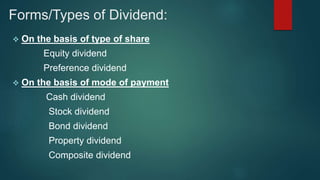
Forms/Types of Dividend:
 On the basis of type of share
Equity dividend
Preference dividend
 On the basis of mode of payment
Cash dividend
Stock dividend
Bond dividend
Property dividend
Composite dividend
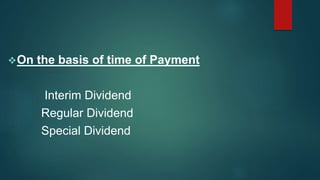
On the basis of time of Payment
Interim Dividend
Regular Dividend
Special Dividend
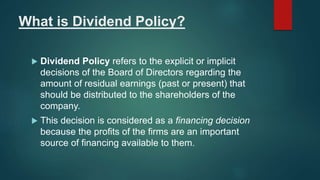
What is Dividend Policy?
 Dividend Policy refers to the explicit or implicit
decisions of the Board of Directors regarding the
amount of residual earnings (past or present) that
should be distributed to the shareholders of the
company.
 This decision is considered as a financing decision
because the profits of the firms are an important
source of financing available to them.
Dividend policy refers to the portion of net income paid out to
shareholders. It is paid in cash and/or stock for making
investment and bearing risk.
Dividend policy affects shareholders wealth and value of the
firm.
The % of earning paid out in the form of cash dividend is known
as dividend pay-out ratio.
The % of retained earnings in the firm is called retention ratio.
Types Of Dividend Policy
 Regular Dividend Policy
 Stable Dividend Policy
Constant Dividend per share
Constant Pay out
Stable rupee dividend plus extra dividend
 Irregular Dividend Policy
Dividend Policies involve the decisions, whether-
o To distribute all of its earnings in the form of cash
dividends; or
o To retain all of its earnings for re-investment purpose; or
o To distribute a part of earnings as dividend and retain the
rest for reinvestment.
Purpose of Dividend Policy:
The Dividend policy must be formulated with two basic
purposes in mind viz.
The wealth of the firm’s owner &
Providing for sufficient financing.
a) Wealth Maximization:
To maximize the share price is not enough but to maximize
wealth in long run should be kept in mind, as the firm is
assumed to have an infinite life and it will be reflected in the
level of future return they forecast.
b) Providing for Sufficient Financing:
The wealth maximization process cannot be carried out
without sufficient financing to implement acceptable projects.
Framing a sound dividend policy is a challenging task for a
finance manager. An appropriate dividend policy requires
answering the following questions:
How much dividend should a company distribute to its
shareholders?
What will be the impact of the dividend policy on share
prices of the company?
What will happen if the amount of dividend changes from
year to year?
Determinants of Dividend Policy:
1.Dividend Pay-out Ratio
2. Stability of Dividend
3. Divisible Profits
4.Legal, Contractual and Internal
constraints and restriction
5.Owner’s Consideration
6. Capital Market Conditions
7. Type of Industry
8. Ownership Structure
9. Age of Corporation
10. Magnitude and Trend of earnings
11. Future Financial Requirements
12. Government’s Policy
13. Business Cycles
14. Taxation Policy
15. Growth
Constraints of Dividend Policy:
I. Legal Restrictions
II. Financial Condition and Borrowing Capacity
III. Access to the Capital Market
iv. Liquidity Restriction in Loan Agreements
v. Inflation
vi. Liquidity
vii. Control
THANK YOU

dividend policy and its determinants and constraints

  • 1.
    Term Paper 2 QUESTION:WHAT IS THE PURPOSE OF A DIVIDEND POLICY? EXPLAIN ITS DETERMINANTS AND CONSTRAINTS.
  • 2.
    Guided by Ashutosh PrayasDash Presented by Priyanka Sahu Roll No.- M4317007
  • 3.
    What is Dividend? The tern “Dividend” refers to that part of profits of a company which is distributed by the company among its shareholders, based on Board of Director’s decision  It is the reward of the shareholders for investments made by them in the shares of the company Definition of Dividend: The Companies Act, 2013 defines dividend as the profit of a company which is not retained in the business and is distributed among the shareholders in proportion to the amount paid up on the shares held by them.
  • 4.
    Forms/Types of Dividend: On the basis of type of share Equity dividend Preference dividend  On the basis of mode of payment Cash dividend Stock dividend Bond dividend Property dividend Composite dividend
  • 5.
    On the basisof time of Payment Interim Dividend Regular Dividend Special Dividend
  • 6.
    What is DividendPolicy?  Dividend Policy refers to the explicit or implicit decisions of the Board of Directors regarding the amount of residual earnings (past or present) that should be distributed to the shareholders of the company.  This decision is considered as a financing decision because the profits of the firms are an important source of financing available to them.
  • 7.
    Dividend policy refersto the portion of net income paid out to shareholders. It is paid in cash and/or stock for making investment and bearing risk. Dividend policy affects shareholders wealth and value of the firm. The % of earning paid out in the form of cash dividend is known as dividend pay-out ratio. The % of retained earnings in the firm is called retention ratio.
  • 8.
    Types Of DividendPolicy  Regular Dividend Policy  Stable Dividend Policy Constant Dividend per share Constant Pay out Stable rupee dividend plus extra dividend  Irregular Dividend Policy
  • 9.
    Dividend Policies involvethe decisions, whether- o To distribute all of its earnings in the form of cash dividends; or o To retain all of its earnings for re-investment purpose; or o To distribute a part of earnings as dividend and retain the rest for reinvestment.
  • 10.
    Purpose of DividendPolicy: The Dividend policy must be formulated with two basic purposes in mind viz. The wealth of the firm’s owner & Providing for sufficient financing.
  • 11.
    a) Wealth Maximization: Tomaximize the share price is not enough but to maximize wealth in long run should be kept in mind, as the firm is assumed to have an infinite life and it will be reflected in the level of future return they forecast. b) Providing for Sufficient Financing: The wealth maximization process cannot be carried out without sufficient financing to implement acceptable projects.
  • 12.
    Framing a sounddividend policy is a challenging task for a finance manager. An appropriate dividend policy requires answering the following questions: How much dividend should a company distribute to its shareholders? What will be the impact of the dividend policy on share prices of the company? What will happen if the amount of dividend changes from year to year?
  • 13.
    Determinants of DividendPolicy: 1.Dividend Pay-out Ratio 2. Stability of Dividend 3. Divisible Profits 4.Legal, Contractual and Internal constraints and restriction 5.Owner’s Consideration 6. Capital Market Conditions 7. Type of Industry 8. Ownership Structure 9. Age of Corporation 10. Magnitude and Trend of earnings 11. Future Financial Requirements 12. Government’s Policy 13. Business Cycles 14. Taxation Policy 15. Growth
  • 14.
    Constraints of DividendPolicy: I. Legal Restrictions II. Financial Condition and Borrowing Capacity III. Access to the Capital Market iv. Liquidity Restriction in Loan Agreements v. Inflation vi. Liquidity vii. Control
  • 15.