
Business Processes Reengineering
Simple approach to do it
Ognyan Drenski
School of Business Competence, Sofia, Bulgaria
22 June 2017
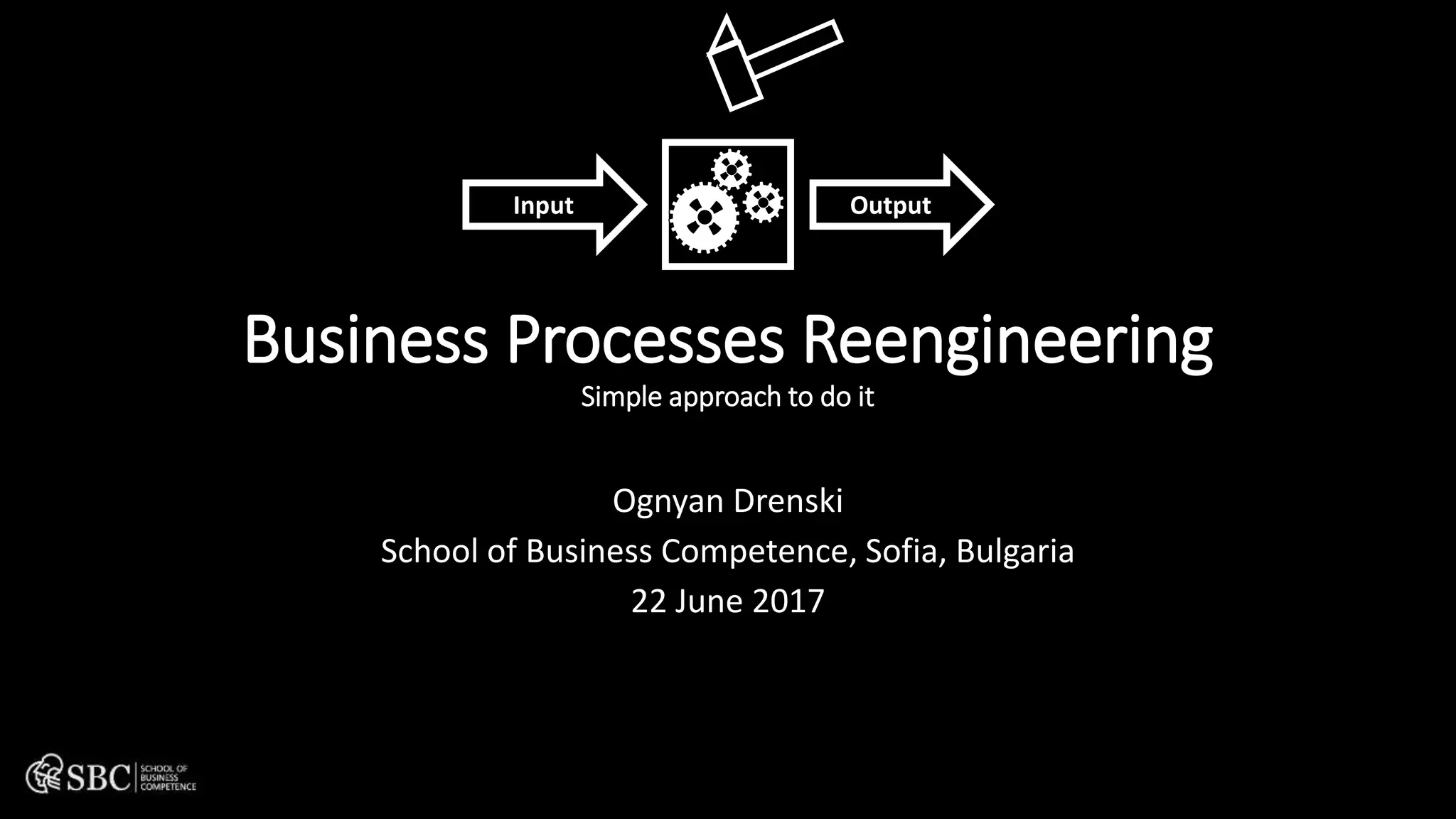
Input Output
Reengineering the Corporation
In 1993 Michael Hammer and James Champy published:
“Reengineering the corporation: A manifesto for Business Revolution”
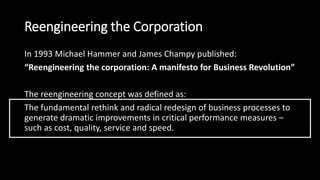
The reengineering concept was defined as:
The fundamental rethink and radical redesign of business processes to
generate dramatic improvements in critical performance measures –
such as cost, quality, service and speed.
Business Processes Reengineering (BPR)
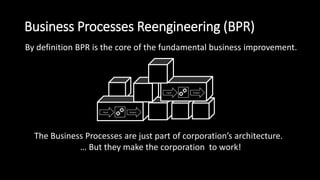
By definition BPR is the core of the fundamental business improvement.
Input Output
Input Output
The Business Processes are just part of corporation’s architecture.
… But they make the corporation to work!
BPR is in fashion again
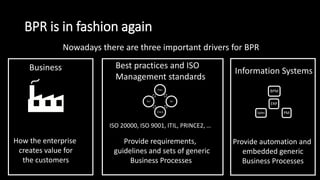
Nowadays there are three important drivers for BPR
Business
How the enterprise
creates value for
the customers
Plan
Do
Check
Act
Best practices and ISO
Management standards
ISO 20000, ISO 9001, ITIL, PRINCE2, …
Provide requirements,
guidelines and sets of generic
Business Processes
Information Systems
ERP
BPM
PMSales
Provide automation and
embedded generic
Business Processes
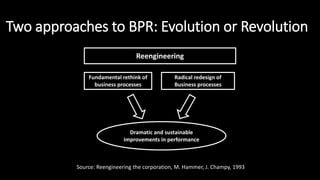
Two approaches to BPR: Evolution or Revolution
Fundamental rethink of
business processes
Dramatic and sustainable
improvements in performance
Reengineering
Radical redesign of
Business processes
Source: Reengineering the corporation, M. Hammer, J. Champy, 1993
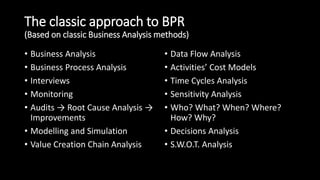
The classic approach to BPR
(Based on classic Business Analysis methods)
• Business Analysis
• Business Process Analysis
• Interviews
• Monitoring
• Audits → Root Cause Analysis →
Improvements
• Modelling and Simulation
• Value Creation Chain Analysis
• Data Flow Analysis
• Activities’ Cost Models
• Time Cycles Analysis
• Sensitivity Analysis
• Who? What? When? Where?
How? Why?
• Decisions Analysis
• S.W.O.T. Analysis
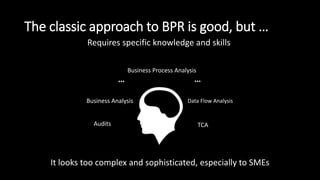
The classic approach to BPR is good, but …
Requires specific knowledge and skills
It looks too complex and sophisticated, especially to SMEs
Business Analysis
Business Process Analysis
Data Flow Analysis
Audits TCA
… …
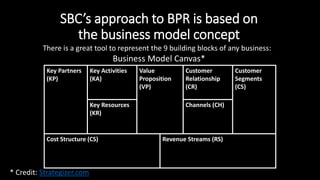
SBC’s approach to BPR is based on
the business model concept
There is a great tool to represent the 9 building blocks of any business:
Business Model Canvas*
Key Partners
(KP)
Key Activities
(KA)
Value
Proposition
(VP)
Customer
Relationship
(CR)
Customer
Segments
(CS)
Key Resources
(KR)
Channels (CH)
Cost Structure (CS) Revenue Streams (RS)
* Credit: Strategizer.com
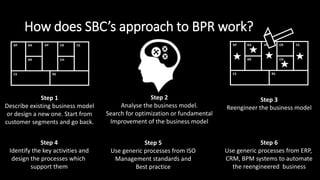
How does SBC’s approach to BPR work?
KP KA VP CR CS
KR CH
CS RS
Step 1
Describe existing business model
or design a new one. Start from
customer segments and go back.
KP KA VP CR CS
KR CH
CS RS
Step 2
Analyse the business model.
Search for optimization or fundamental
Improvement of the business model
Step 3
Reengineer the business model
Step 4
Identify the key activities and
design the processes which
support them
Step 5
Use generic processes from ISO
Management standards and
Best practice
Step 6
Use generic processes from ERP,
CRM, BPM systems to automate
the reengineered business
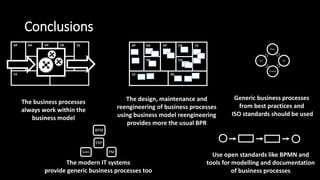
Conclusions
KP KA VP CR CS
KR CH
CS RS
The modern IT systems
provide generic business processes too
KP KA VP CR CS
KR CH
CS RS
The design, maintenance and
reengineering of business processes
using business model reengineering
provides more the usual BPR
Plan
Do
Check
Act
Generic business processes
from best practices and
ISO standards should be used
ERP
BPM
PMSales
The business processes
always work within the
business model
Use open standards like BPMN and
tools for modelling and documentation
of business processes
Contacts
Ognyan.Drenski@sbc.bg
www.sbc.bg

Business processes reengineering based on business model concept

  • 1.
    Business Processes Reengineering Simpleapproach to do it Ognyan Drenski School of Business Competence, Sofia, Bulgaria 22 June 2017 Input Output
  • 2.
    Reengineering the Corporation In1993 Michael Hammer and James Champy published: “Reengineering the corporation: A manifesto for Business Revolution” The reengineering concept was defined as: The fundamental rethink and radical redesign of business processes to generate dramatic improvements in critical performance measures – such as cost, quality, service and speed.
  • 3.
    Business Processes Reengineering(BPR) By definition BPR is the core of the fundamental business improvement. Input Output Input Output The Business Processes are just part of corporation’s architecture. … But they make the corporation to work!
  • 4.
    BPR is infashion again Nowadays there are three important drivers for BPR Business How the enterprise creates value for the customers Plan Do Check Act Best practices and ISO Management standards ISO 20000, ISO 9001, ITIL, PRINCE2, … Provide requirements, guidelines and sets of generic Business Processes Information Systems ERP BPM PMSales Provide automation and embedded generic Business Processes
  • 5.
    Two approaches toBPR: Evolution or Revolution Fundamental rethink of business processes Dramatic and sustainable improvements in performance Reengineering Radical redesign of Business processes Source: Reengineering the corporation, M. Hammer, J. Champy, 1993
  • 6.
    The classic approachto BPR (Based on classic Business Analysis methods) • Business Analysis • Business Process Analysis • Interviews • Monitoring • Audits → Root Cause Analysis → Improvements • Modelling and Simulation • Value Creation Chain Analysis • Data Flow Analysis • Activities’ Cost Models • Time Cycles Analysis • Sensitivity Analysis • Who? What? When? Where? How? Why? • Decisions Analysis • S.W.O.T. Analysis
  • 7.
    The classic approachto BPR is good, but … Requires specific knowledge and skills It looks too complex and sophisticated, especially to SMEs Business Analysis Business Process Analysis Data Flow Analysis Audits TCA … …
  • 8.
    SBC’s approach toBPR is based on the business model concept There is a great tool to represent the 9 building blocks of any business: Business Model Canvas* Key Partners (KP) Key Activities (KA) Value Proposition (VP) Customer Relationship (CR) Customer Segments (CS) Key Resources (KR) Channels (CH) Cost Structure (CS) Revenue Streams (RS) * Credit: Strategizer.com
  • 9.
    How does SBC’sapproach to BPR work? KP KA VP CR CS KR CH CS RS Step 1 Describe existing business model or design a new one. Start from customer segments and go back. KP KA VP CR CS KR CH CS RS Step 2 Analyse the business model. Search for optimization or fundamental Improvement of the business model Step 3 Reengineer the business model Step 4 Identify the key activities and design the processes which support them Step 5 Use generic processes from ISO Management standards and Best practice Step 6 Use generic processes from ERP, CRM, BPM systems to automate the reengineered business
  • 10.
    Conclusions KP KA VPCR CS KR CH CS RS The modern IT systems provide generic business processes too KP KA VP CR CS KR CH CS RS The design, maintenance and reengineering of business processes using business model reengineering provides more the usual BPR Plan Do Check Act Generic business processes from best practices and ISO standards should be used ERP BPM PMSales The business processes always work within the business model Use open standards like BPMN and tools for modelling and documentation of business processes
  • 11.