Business Cycle
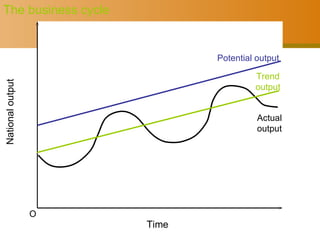
Meaning of a Business Cycle A  wave like fluctuation of economic activity characterized by recurring phases of expansion & contraction in periods varying from 3 to 4 years Fluctuations found in aggregate economic activity of nations A cycle consists of general expansions, followed by general recessions, contractions & revivals which merge with the expansion phase of the next cycle This sequence of change is recurrent but not periodic
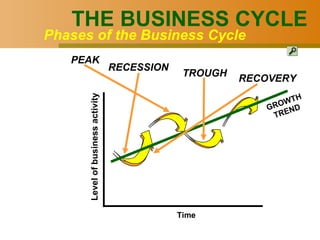
THE BUSINESS CYCLE Phases of the Business Cycle PEAK Level of business activity Time RECESSION TROUGH RECOVERY GROWTH TREND
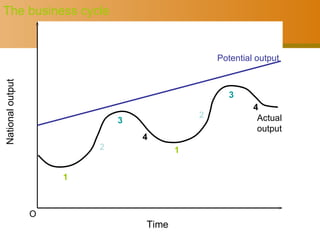
The business cycle O National output Time 1 2 3 4 Potential output 1 2 3 4 Actual output
The business cycle O National output Time Potential output Actual output Trend output
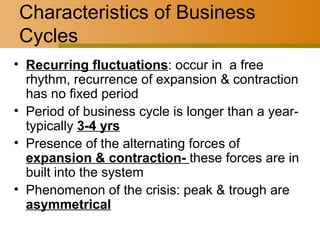
Characteristics of Business Cycles Recurring fluctuations : occur in  a free rhythm, recurrence of expansion & contraction has no fixed period Period of business cycle is longer than a year- typically  3-4 yrs Presence of the alternating forces of  expansion & contraction-  these forces are in built into the system Phenomenon of the crisis: peak & trough are  asymmetrical
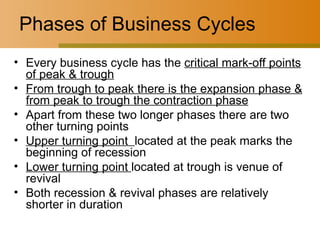
Phases of Business Cycles Every business cycle has the  critical mark-off points of peak & trough From trough to peak there is the expansion phase & from peak to trough the contraction phase Apart from these two longer phases there are two other turning points Upper turning point  located at the peak marks the beginning of recession Lower turning point  located at trough is venue of revival Both recession & revival phases are relatively shorter in duration
Phases of Business Cycles Acc. To Burns & Mitchell four distinct phases are: Revival Expansion Recession Contraction
Prosperity or Expansion The expansion phase begins from an equilibrium position under the stimulus of forces which create  expectations of rising profits  which in turn induce entrepreneurs to increase the scope of their activities Leads to  more employment, more demand for raw materials, leads to larger employment in other industries, more wages, increase in demand for consumption goods
Prosperity or Expansion Rapid increase in supply &  modest increase in prices Supply in later stages increases with a lag & this leads to  rise in prices  which gathers momentum  later on Delay in price rise due to  unutilized plant capacity available in the early stages , later stages bottlenecks appear
Prosperity or Expansion Rise in prices more marked when large proportion of productive capacity is set up New factories, steel plants, increased production of heavy engineering goods, commercial & housing complexes, power projects Increases income , consumption Supply of consumption goods does not keep pace so increase in prices
Prosperity or Expansion Distortions of price relations : price do not rise uniformly during this phase Prices of raw materials & semi-finished goods rises faster than prices of consumption goods Wages, salaries, long pd interest rates, rentals, taxes lag behind
Prosperity or Expansion Expansion reaching its heights : rising profits & optimism about its continuance boost the stock prices  Increase in investment by entrepreneurs-  higher output, prices & profits Expansion in money supply  especially bank credit Confidence in business  induce banks to expand credit, speed up velocity of circulation of money Leads to growth of fixed capital-  plant, machinery & equipment, wages increase, consumption increases Manufacturers, wholesalers & retailers stock up  inventories
Prosperity or Expansion The end of expansion : expansion itself brings into play forces which lead to recession Gradual rise of costs relative to prices , narrows down profit margin & expansion gets weakened During later phase increase in costs due to  growing pressure of demand for materials, labor & finance
Recession This phase is a turning point & is relatively shorter Forces of expansion weakened & those of contraction strengthened Recession is characterized by liquidation in stock market, strains in banking system, some fall in prices, sharp reduction in demand for capital & abandoning of projects Production of consumer goods does not decline immediately - people persist with their living standards for some time despite fall in income It falls with a lag
Recession In contrast  fall in production of capital goods is dramatic Abandoning of investment programs, demand for equipment, machinery & plant falls Most dramatic & noticeable signs of recession’s advent is the  weakening of the stock market Borrowers on stock market find that their collateral is shrinking & find it necessary to repay some of their loans
Recession New issues are postponed  meaning corporate shelve their investment programs Orders for plants, machinery, equipment or buildings are reduced Banks are reluctant to expand the volume of credit Keynes has explained the turning point from expansion to recession by a  collapse in the Marginal Efficiency of Capital
Depression or Contraction Recession ultimately merges into depression  which is the phase of relatively low economic activity When economy moves from recession to depression there is a  notable fall in production & employment Agriculture & Retail is affected less, manufacturing,, mining & construction affected more Industrial sector:  worst affected are those which produce machines, tools, plants, equipment & steel
Depression or Contraction There is a substantial reduction in incomes of people & thus the  demand for consumer goods & services declines Still decline is far less than the demand for machines & equipment Substantial  reduction in demand for durable goods Production & employment less affected in sectors producing non durable goods General price level falls , producers & wholesalers seeing falling demand  liquidate inventories  piled up during prosperity phase Leads to  increase in supply & fall in prices , also  reduced purchasing power  due to contraction also leads to fall in prices
Depression or Contraction Steadily declining prices  erode the profits  of producers & traders alike Pessimism  , some firms close own,  MEC collapses  so  no new investments, reduction in bank credit, distortions in price structure Distortions also appear in cost-price relations because  costs do not fall proportionately to prices Some costs are rigid  while others fall sharply Wages & salaries are sticky, rents, interest rates, insurance premium & taxes are slow to move downwards Prices keep falling & profit margins are wiped out
Recovery Recovery starts when forces that work to restore the normal price relations & cost price relations start operating effectively Recovery is gradual,  starts when prices stop falling When  inventories are exhausted , supplies reach scarcity levels &  downward movement of prices is arrested   then producers see  no risk in undertaking production Demand for durable goods & MEC , investment starts increasing
Recovery Along with restoration of normal price relations, there is  correction of distortions in cost-price relations Lagging costs which had eroded profits during depression start falling Interest rates  fall in the later phase of depression & so does  rents, insurance & taxes Efficiency increases  as efficient plants are used & inefficient managers have been dropped- lowers the AC  Losses are replaced by profits-  recovery gains momentum There is revival of stock exchange Profit expectations lead to  new investment ventures  & expansion, innovating activities get a boost

Business cycle 2011

  • 1.
  • 2.
    Meaning of aBusiness Cycle A wave like fluctuation of economic activity characterized by recurring phases of expansion & contraction in periods varying from 3 to 4 years Fluctuations found in aggregate economic activity of nations A cycle consists of general expansions, followed by general recessions, contractions & revivals which merge with the expansion phase of the next cycle This sequence of change is recurrent but not periodic
  • 3.
    THE BUSINESS CYCLEPhases of the Business Cycle PEAK Level of business activity Time RECESSION TROUGH RECOVERY GROWTH TREND
  • 4.
    The business cycleO National output Time 1 2 3 4 Potential output 1 2 3 4 Actual output
  • 5.
    The business cycleO National output Time Potential output Actual output Trend output
  • 6.
    Characteristics of BusinessCycles Recurring fluctuations : occur in a free rhythm, recurrence of expansion & contraction has no fixed period Period of business cycle is longer than a year- typically 3-4 yrs Presence of the alternating forces of expansion & contraction- these forces are in built into the system Phenomenon of the crisis: peak & trough are asymmetrical
  • 7.
    Phases of BusinessCycles Every business cycle has the critical mark-off points of peak & trough From trough to peak there is the expansion phase & from peak to trough the contraction phase Apart from these two longer phases there are two other turning points Upper turning point located at the peak marks the beginning of recession Lower turning point located at trough is venue of revival Both recession & revival phases are relatively shorter in duration
  • 8.
    Phases of BusinessCycles Acc. To Burns & Mitchell four distinct phases are: Revival Expansion Recession Contraction
  • 9.
    Prosperity or ExpansionThe expansion phase begins from an equilibrium position under the stimulus of forces which create expectations of rising profits which in turn induce entrepreneurs to increase the scope of their activities Leads to more employment, more demand for raw materials, leads to larger employment in other industries, more wages, increase in demand for consumption goods
  • 10.
    Prosperity or ExpansionRapid increase in supply & modest increase in prices Supply in later stages increases with a lag & this leads to rise in prices which gathers momentum later on Delay in price rise due to unutilized plant capacity available in the early stages , later stages bottlenecks appear
  • 11.
    Prosperity or ExpansionRise in prices more marked when large proportion of productive capacity is set up New factories, steel plants, increased production of heavy engineering goods, commercial & housing complexes, power projects Increases income , consumption Supply of consumption goods does not keep pace so increase in prices
  • 12.
    Prosperity or ExpansionDistortions of price relations : price do not rise uniformly during this phase Prices of raw materials & semi-finished goods rises faster than prices of consumption goods Wages, salaries, long pd interest rates, rentals, taxes lag behind
  • 13.
    Prosperity or ExpansionExpansion reaching its heights : rising profits & optimism about its continuance boost the stock prices Increase in investment by entrepreneurs- higher output, prices & profits Expansion in money supply especially bank credit Confidence in business induce banks to expand credit, speed up velocity of circulation of money Leads to growth of fixed capital- plant, machinery & equipment, wages increase, consumption increases Manufacturers, wholesalers & retailers stock up inventories
  • 14.
    Prosperity or ExpansionThe end of expansion : expansion itself brings into play forces which lead to recession Gradual rise of costs relative to prices , narrows down profit margin & expansion gets weakened During later phase increase in costs due to growing pressure of demand for materials, labor & finance
  • 15.
    Recession This phaseis a turning point & is relatively shorter Forces of expansion weakened & those of contraction strengthened Recession is characterized by liquidation in stock market, strains in banking system, some fall in prices, sharp reduction in demand for capital & abandoning of projects Production of consumer goods does not decline immediately - people persist with their living standards for some time despite fall in income It falls with a lag
  • 16.
    Recession In contrast fall in production of capital goods is dramatic Abandoning of investment programs, demand for equipment, machinery & plant falls Most dramatic & noticeable signs of recession’s advent is the weakening of the stock market Borrowers on stock market find that their collateral is shrinking & find it necessary to repay some of their loans
  • 17.
    Recession New issuesare postponed meaning corporate shelve their investment programs Orders for plants, machinery, equipment or buildings are reduced Banks are reluctant to expand the volume of credit Keynes has explained the turning point from expansion to recession by a collapse in the Marginal Efficiency of Capital
  • 18.
    Depression or ContractionRecession ultimately merges into depression which is the phase of relatively low economic activity When economy moves from recession to depression there is a notable fall in production & employment Agriculture & Retail is affected less, manufacturing,, mining & construction affected more Industrial sector: worst affected are those which produce machines, tools, plants, equipment & steel
  • 19.
    Depression or ContractionThere is a substantial reduction in incomes of people & thus the demand for consumer goods & services declines Still decline is far less than the demand for machines & equipment Substantial reduction in demand for durable goods Production & employment less affected in sectors producing non durable goods General price level falls , producers & wholesalers seeing falling demand liquidate inventories piled up during prosperity phase Leads to increase in supply & fall in prices , also reduced purchasing power due to contraction also leads to fall in prices
  • 20.
    Depression or ContractionSteadily declining prices erode the profits of producers & traders alike Pessimism , some firms close own, MEC collapses so no new investments, reduction in bank credit, distortions in price structure Distortions also appear in cost-price relations because costs do not fall proportionately to prices Some costs are rigid while others fall sharply Wages & salaries are sticky, rents, interest rates, insurance premium & taxes are slow to move downwards Prices keep falling & profit margins are wiped out
  • 21.
    Recovery Recovery startswhen forces that work to restore the normal price relations & cost price relations start operating effectively Recovery is gradual, starts when prices stop falling When inventories are exhausted , supplies reach scarcity levels & downward movement of prices is arrested then producers see no risk in undertaking production Demand for durable goods & MEC , investment starts increasing
  • 22.
    Recovery Along withrestoration of normal price relations, there is correction of distortions in cost-price relations Lagging costs which had eroded profits during depression start falling Interest rates fall in the later phase of depression & so does rents, insurance & taxes Efficiency increases as efficient plants are used & inefficient managers have been dropped- lowers the AC Losses are replaced by profits- recovery gains momentum There is revival of stock exchange Profit expectations lead to new investment ventures & expansion, innovating activities get a boost