
Presented by:
Surabhi Parashar
Prateek Jain
PGDM-BM
Three Types of Business Cycle
Business Cycle Phases
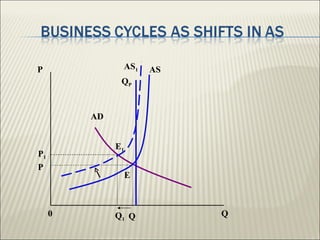
Business Cycles as shifts in AD and AS
Business Cycle Methods
 The business cycle occurs when economic
  activity speeds up or slows down.
 A business cycle is a swing in total national
  output, income and employment, usually
  lasting for a period of 2 to 10 years, marked by
  widespread expansion or contraction in many
  sectors of the economy.
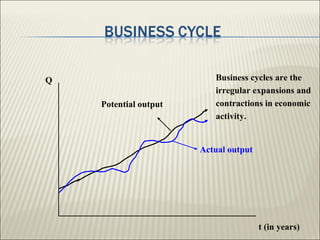
Q                         Business cycles are the
                          irregular expansions and
    Potential output      contractions in economic
                          activity.


                       Actual output


                                       t (in years)
   Economic theory define three types of
    business cycle:
     Short-term   (Kitchin) cycle: from 2 to 4 years,
      it results from the changes in business
      inventories.
     Medium-term (Jouglar) cycle: from 7 to 11
      years, it refers to new business investment.
     Long-term (Kondratiev) cycle: from 30 to 50
      years, it results from the technological
      innovation.
   A business cycle can be divided into
    four major phases:
     Recession   – the downturn of a business cycle. This
      is a period in which real GDP declines for at least 2
      consecutive quarter-years.
     Trough – the lowest point of real GDP at the end of
      a recession.
 Expansion  (boom) is a period in which output
  increases and approaches potential GDP or
  perhaps even overshoots it.
 Peak – the point at which recession begins, the
  highest point in real GDP before a recession.
   Business cycle generally occurs as a
    result of shifts in the AD. Decline in the
    AD lowers output and as a result of
    downward shift in the AD curve, the gap
    between actual and potential GDP
    becomes greater during a recession.
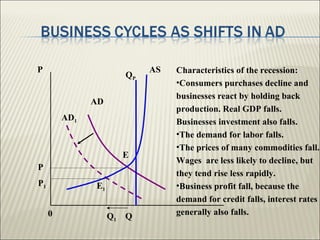
P                             AS   Characteristics of the recession:
                         QP
                                   •Consumers purchases decline and
                                   businesses react by holding back
               AD
                                   production. Real GDP falls.
         AD1                       Businesses investment also falls.
                                   •The demand for labor falls.
                                   •The prices of many commodities fall.
                         E
                                   Wages are less likely to decline, but
P
                                   they tend rise less rapidly.
P1             E1                  •Business profit fall, because the
                                   demand for credit falls, interest rates
     0              Q1   Q         generally also falls.
P                      AS
                QP

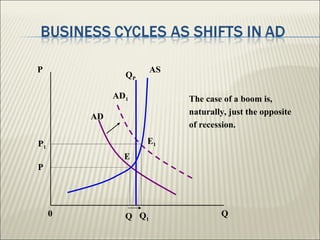
              AD1           The case of a boom is,
                            naturally, just the opposite
         AD
                            of recession.

P1                   E1
                E
P


     0          Q Q1                Q
P                  AS1   AS
               QP


         AD


              E1
P1
P
                   E


     0        Q1 Q            Q
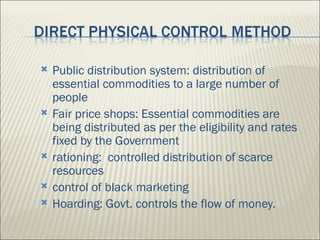
   Public distribution system: distribution of
    essential commodities to a large number of
    people
   Fair price shops: Essential commodities are
    being distributed as per the eligibility and rates
    fixed by the Government
   rationing: controlled distribution of scarce
    resources
   control of black marketing
   Hoarding: Govt. controls the flow of money.
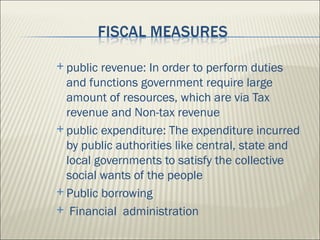
 public revenue: In order to perform duties
  and functions government require large
  amount of resources, which are via Tax
  revenue and Non-tax revenue
 public expenditure: The expenditure incurred
  by public authorities like central, state and
  local governments to satisfy the collective
  social wants of the people
 Public borrowing

 Financial administration
Business cycle

Business cycle

  • 1.
  • 2.
    Three Types ofBusiness Cycle Business Cycle Phases Business Cycles as shifts in AD and AS Business Cycle Methods
  • 3.
     The businesscycle occurs when economic activity speeds up or slows down.  A business cycle is a swing in total national output, income and employment, usually lasting for a period of 2 to 10 years, marked by widespread expansion or contraction in many sectors of the economy.
  • 4.
    Q Business cycles are the irregular expansions and Potential output contractions in economic activity. Actual output t (in years)
  • 5.
    Economic theory define three types of business cycle:  Short-term (Kitchin) cycle: from 2 to 4 years, it results from the changes in business inventories.  Medium-term (Jouglar) cycle: from 7 to 11 years, it refers to new business investment.  Long-term (Kondratiev) cycle: from 30 to 50 years, it results from the technological innovation.
  • 6.
    A business cycle can be divided into four major phases:  Recession – the downturn of a business cycle. This is a period in which real GDP declines for at least 2 consecutive quarter-years.  Trough – the lowest point of real GDP at the end of a recession.
  • 7.
     Expansion (boom) is a period in which output increases and approaches potential GDP or perhaps even overshoots it.  Peak – the point at which recession begins, the highest point in real GDP before a recession.
  • 8.
    Business cycle generally occurs as a result of shifts in the AD. Decline in the AD lowers output and as a result of downward shift in the AD curve, the gap between actual and potential GDP becomes greater during a recession.
  • 9.
    P AS Characteristics of the recession: QP •Consumers purchases decline and businesses react by holding back AD production. Real GDP falls. AD1 Businesses investment also falls. •The demand for labor falls. •The prices of many commodities fall. E Wages are less likely to decline, but P they tend rise less rapidly. P1 E1 •Business profit fall, because the demand for credit falls, interest rates 0 Q1 Q generally also falls.
  • 10.
    P AS QP AD1 The case of a boom is, naturally, just the opposite AD of recession. P1 E1 E P 0 Q Q1 Q
  • 11.
    P AS1 AS QP AD E1 P1 P E 0 Q1 Q Q
  • 13.
    Public distribution system: distribution of essential commodities to a large number of people  Fair price shops: Essential commodities are being distributed as per the eligibility and rates fixed by the Government  rationing: controlled distribution of scarce resources  control of black marketing  Hoarding: Govt. controls the flow of money.
  • 14.
     public revenue:In order to perform duties and functions government require large amount of resources, which are via Tax revenue and Non-tax revenue  public expenditure: The expenditure incurred by public authorities like central, state and local governments to satisfy the collective social wants of the people  Public borrowing  Financial administration

Editor's Notes