LITERATURE STUDY: 
1. Architectural Space 
1.1 Museum Space 
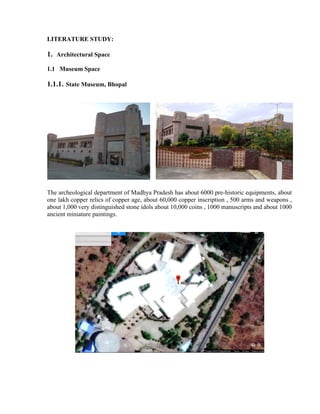
1.1.1. State Museum, Bhopal 
The archeological department of Madhya Pradesh has about 6000 pre-historic equipments, about 
one lakh copper relics of copper age, about 60,000 copper inscription , 500 arms and weapons , 
about 1,000 very distinguished stone idols about 10,000 coins , 1000 manuscripts and about 1000 
ancient miniature paintings.
Location: 
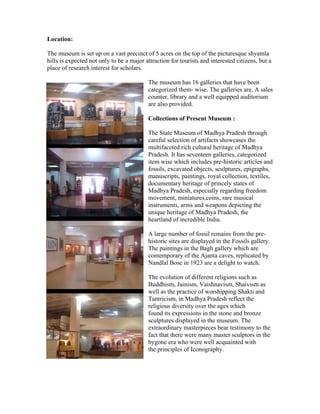
The museum is set up on a vast precinct of 5 acres on the top of the picturesque shyamla 
hills is expected not only to be a major attraction for tourists and interested citizens, but a 
place of research interest for scholars. 
The museum has 16 galleries that have been 
categorized them- wise. The galleries are, A sales 
counter, library and a well equipped auditorium 
are also provided. 
Collections of Present Museum : 
The State Museum of Madhya Pradesh through 
careful selection of artifacts showcases the 
multifaceted rich cultural heritage of Madhya 
Pradesh. It has seventeen galleries, categorized 
item wise which includes pre-historic articles and 
fossils, excavated objects, sculptures, epigraphs, 
manuscripts, paintings, royal collection, textiles, 
documentary heritage of princely states of 
Madhya Pradesh, especially regarding freedom 
movement, miniatures,coins, rare musical 
instruments, arms and weapons depicting the 
unique heritage of Madhya Pradesh, the 
heartland of incredible India. 
A large number of fossil remains from the pre-historic 
sites are displayed in the Fossils gallery. 
The paintings in the Bagh gallery which are 
contemporary of the Ajanta caves, replicated by 
Nandlal Bose in 1923 are a delight to watch. 
The evolution of different religions such as 
Buddhism, Jainism, Vaishnavism, Shaivism as 
well as the practice of worshipping Shakti and 
Tantricism, in Madhya Pradesh reflect the 
religious diversity over the ages which 
found its expressions in the stone and bronze 
sculptures displayed in the museum. The 
extraordinary masterpieces bear testimony to the 
fact that there were many master sculptors in the 
bygone era who were well acquainted with 
the principles of Iconography.
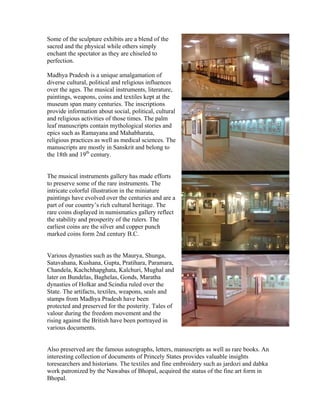
Some of the sculpture exhibits are a blend of the 
sacred and the physical while others simply 
enchant the spectator as they are chiseled to 
perfection. 
Madhya Pradesh is a unique amalgamation of 
diverse cultural, political and religious influences 
over the ages. The musical instruments, literature, 
paintings, weapons, coins and textiles kept at the 
museum span many centuries. The inscriptions 
provide information about social, political, cultural 
and religious activities of those times. The palm 
leaf manuscripts contain mythological stories and 
epics such as Ramayana and Mahabharata, 
religious practices as well as medical sciences. The 
manuscripts are mostly in Sanskrit and belong to 
the 18th and 19th century. 
The musical instruments gallery has made efforts 
to preserve some of the rare instruments. The 
intricate colorful illustration in the miniature 
paintings have evolved over the centuries and are a 
part of our country’s rich cultural heritage. The 
rare coins displayed in numismatics gallery reflect 
the stability and prosperity of the rulers. The 
earliest coins are the silver and copper punch 
marked coins form 2nd century B.C. 
Various dynasties such as the Maurya, Shunga, 
Satavahana, Kushana, Gupta, Pratihara, Paramara, 
Chandela, Kachchhapghata, Kalchuri, Mughal and 
later on Bundelas, Baghelas, Gonds, Maratha 
dynasties of Holkar and Scindia ruled over the 
State. The artifacts, textiles, weapons, seals and 
stamps from Madhya Pradesh have been 
protected and preserved for the posterity. Tales of 
valour during the freedom movement and the 
rising against the British have been portrayed in 
various documents. 
Also preserved are the famous autographs, letters, manuscripts as well as rare books. An 
interesting collection of documents of Princely States provides valuable insights 
toresearchers and historians. The textiles and fine embroidery such as jardozi and dabka 
work patronized by the Nawabas of Bhopal, acquired the status of the fine art form in 
Bhopal.
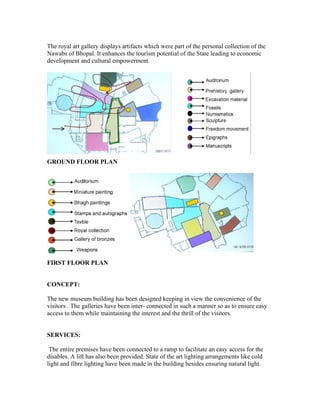
The royal art gallery displays artifacts which were part of the personal collection of the 
Nawabs of Bhopal. It enhances the tourism potential of the State leading to economic 
development and cultural empowerment. 
GROUND FLOOR PLAN 
FIRST FLOOR PLAN 
CONCEPT: 
The new museum building has been designed keeping in view the convenience of the 
visitors . The galleries have been inter- connected in such a manner so as to ensure easy 
access to them while maintaining the interest and the thrill of the visitors. 
SERVICES: 
The entire premises have been connected to a ramp to facilitate an easy access for the 
disables. A lift has also been provided. State of the art lighting arrangements like cold 
light and fibre lighting have been made in the building besides ensuring natural light.
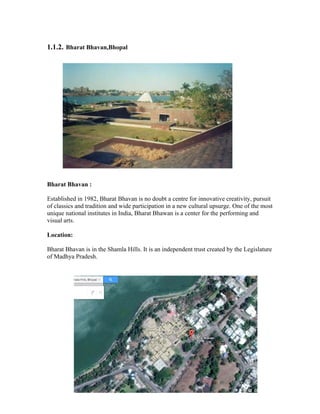
1.1.2. Bharat Bhavan,Bhopal 
Bharat Bhavan : 
Established in 1982, Bharat Bhavan is no doubt a centre for innovative creativity, pursuit 
of classics and tradition and wide participation in a new cultural upsurge. One of the most 
unique national institutes in India, Bharat Bhawan is a center for the performing and 
visual arts. 
Location: 
Bharat Bhavan is in the Shamla Hills. It is an independent trust created by the Legislature 
of Madhya Pradesh.
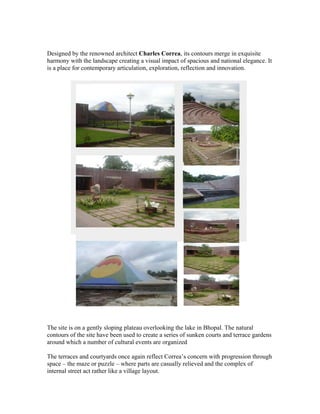
Designed by the renowned architect Charles Correa, its contours merge in exquisite 
harmony with the landscape creating a visual impact of spacious and national elegance. It 
is a place for contemporary articulation, exploration, reflection and innovation. 
The site is on a gently sloping plateau overlooking the lake in Bhopal. The natural 
contours of the site have been used to create a series of sunken courts and terrace gardens 
around which a number of cultural events are organized 
The terraces and courtyards once again reflect Correa’s concern with progression through 
space – the maze or puzzle – where parts are casually relieved and the complex of 
internal street act rather like a village layout.
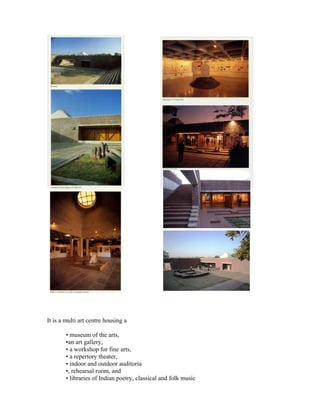
It is a multi art centre housing a 
• museum of the arts, 
•an art gallery, 
• a workshop for fine arts, 
• a repertory theater, 
• indoor and outdoor auditoria 
•, rehearsal room, and 
• libraries of Indian poetry, classical and folk music
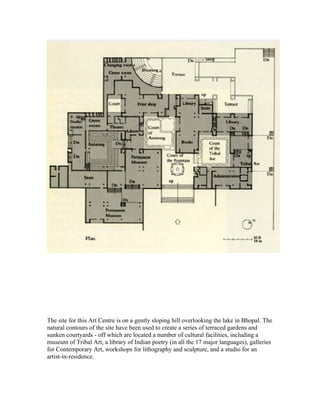
The site for this Art Centre is on a gently sloping hill overlooking the lake in Bhopal. The 
natural contours of the site have been used to create a series of terraced gardens and 
sunken courtyards - off which are located a number of cultural facilities, including a 
museum of Tribal Art, a library of Indian poetry (in all the 17 major languages), galleries 
for Contemporary Art, workshops for lithography and sculpture, and a studio for an 
artist-in-residence.
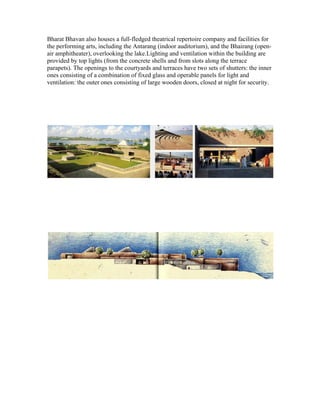
Bharat Bhavan also houses a full-fledged theatrical repertoire company and facilities for 
the performing arts, including the Antarang (indoor auditorium), and the Bhairang (open-air 
amphitheater), overlooking the lake.Lighting and ventilation within the building are 
provided by top lights (from the concrete shells and from slots along the terrace 
parapets). The openings to the courtyards and terraces have two sets of shutters: the inner 
ones consisting of a combination of fixed glass and operable panels for light and 
ventilation: the outer ones consisting of large wooden doors, closed at night for security.
1.1.3. Science Centre,Bhopal 
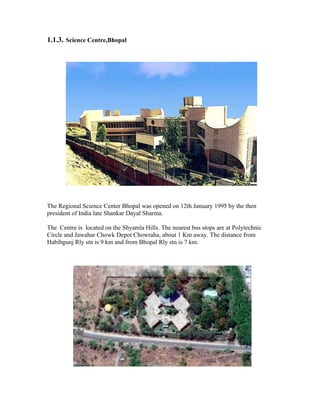
The Regional Science Center Bhopal was opened on 12th January 1995 by the then 
president of India late Shankar Dayal Sharma. 
The Centre is located on the Shyamla Hills. The nearest bus stops are at Polytechnic 
Circle and Jawahar Chowk Depot Chowraha, about 1 Km away. The distance from 
Habibgunj Rly stn is 9 km and from Bhopal Rly stn is 7 km.
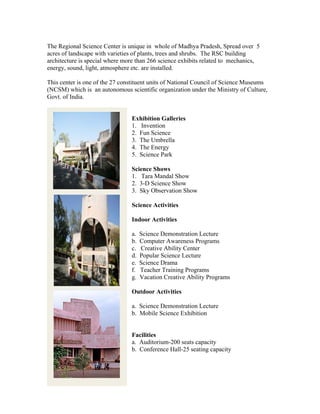
The Regional Science Center is unique in whole of Madhya Pradesh, Spread over 5 
acres of landscape with varieties of plants, trees and shrubs. The RSC building 
architecture is special where more than 266 science exhibits related to mechanics, 
energy, sound, light, atmosphere etc. are installed. 
This center is one of the 27 constituent units of National Council of Science Museums 
(NCSM) which is an autonomous scientific organization under the Ministry of Culture, 
Govt. of India. 
Exhibition Galleries 
1. Invention 
2. Fun Science 
3. The Umbrella 
4. The Energy 
5. Science Park 
Science Shows 
1. Tara Mandal Show 
2. 3-D Science Show 
3. Sky Observation Show 
Science Activities 
Indoor Activities 
a. Science Demonstration Lecture 
b. Computer Awareness Programs 
c. Creative Ability Center 
d. Popular Science Lecture 
e. Science Drama 
f. Teacher Training Programs 
g. Vacation Creative Ability Programs 
Outdoor Activities 
a. Science Demonstration Lecture 
b. Mobile Science Exhibition 
Facilities 
a. Auditorium-200 seats capacity 
b. Conference Hall-25 seating capacity
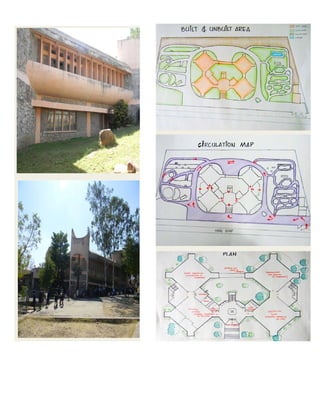
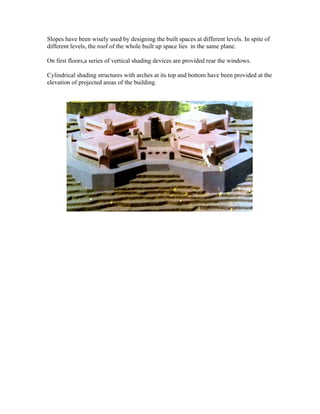
Slopes have been wisely used by designing the built spaces at different levels. In spite of 
different levels, the roof of the whole built up space lies in the same plane. 
On first floors,a series of vertical shading devices are provided rear the windows. 
Cylindrical shading structures with arches at its top and bottom have been provided at the 
elevation of projected areas of the building.
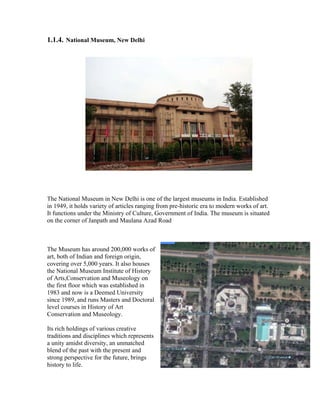
1.1.4. National Museum, New Delhi 
The National Museum in New Delhi is one of the largest museums in India. Established 
in 1949, it holds variety of articles ranging from pre-historic era to modern works of art. 
It functions under the Ministry of Culture, Government of India. The museum is situated 
on the corner of Janpath and Maulana Azad Road 
The Museum has around 200,000 works of 
art, both of Indian and foreign origin, 
covering over 5,000 years. It also houses 
the National Museum Institute of History 
of Arts,Conservation and Museology on 
the first floor which was established in 
1983 and now is a Deemed University 
since 1989, and runs Masters and Doctoral 
level courses in History of Art 
Conservation and Museology. 
Its rich holdings of various creative 
traditions and disciplines which represents 
a unity amidst diversity, an unmatched 
blend of the past with the present and 
strong perspective for the future, brings 
history to life.
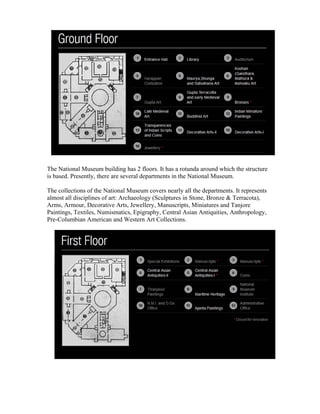
The National Museum building has 2 floors. It has a rotunda around which the structure 
is based. Presently, there are several departments in the National Museum. 
The collections of the National Museum covers nearly all the departments. It represents 
almost all disciplines of art: Archaeology (Sculptures in Stone, Bronze & Terracota), 
Arms, Armour, Decorative Arts, Jewellery, Manuscripts, Miniatures and Tanjore 
Paintings, Textiles, Numismatics, Epigraphy, Central Asian Antiquities, Anthropology, 
Pre-Columbian American and Western Art Collections.
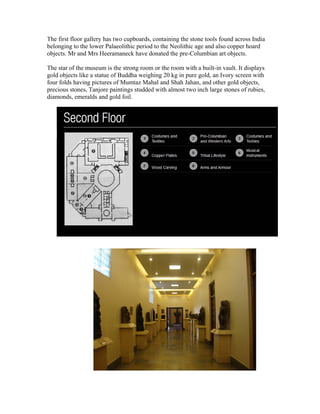
The first floor gallery has two cupboards, containing the stone tools found across India 
belonging to the lower Palaeolithic period to the Neolithic age and also copper hoard 
objects. Mr and Mrs Heeramaneck have donated the pre-Columbian art objects. 
The star of the museum is the strong room or the room with a built-in vault. It displays 
gold objects like a statue of Buddha weighing 20 kg in pure gold, an Ivory screen with 
four folds having pictures of Mumtaz Mahal and Shah Jahan, and other gold objects, 
precious stones, Tanjore paintings studded with almost two inch large stones of rubies, 
diamonds, emeralds and gold foil.
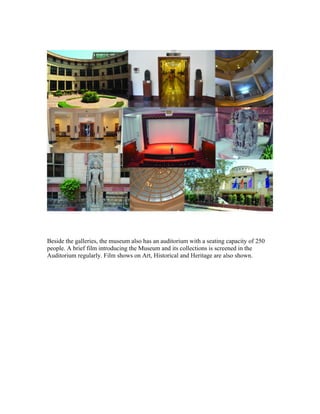
Beside the galleries, the museum also has an auditorium with a seating capacity of 250 
people. A brief film introducing the Museum and its collections is screened in the 
Auditorium regularly. Film shows on Art, Historical and Heritage are also shown.

Museum Case Studies

  • 1.
    LITERATURE STUDY: 1.Architectural Space 1.1 Museum Space 1.1.1. State Museum, Bhopal The archeological department of Madhya Pradesh has about 6000 pre-historic equipments, about one lakh copper relics of copper age, about 60,000 copper inscription , 500 arms and weapons , about 1,000 very distinguished stone idols about 10,000 coins , 1000 manuscripts and about 1000 ancient miniature paintings.
  • 2.
    Location: The museumis set up on a vast precinct of 5 acres on the top of the picturesque shyamla hills is expected not only to be a major attraction for tourists and interested citizens, but a place of research interest for scholars. The museum has 16 galleries that have been categorized them- wise. The galleries are, A sales counter, library and a well equipped auditorium are also provided. Collections of Present Museum : The State Museum of Madhya Pradesh through careful selection of artifacts showcases the multifaceted rich cultural heritage of Madhya Pradesh. It has seventeen galleries, categorized item wise which includes pre-historic articles and fossils, excavated objects, sculptures, epigraphs, manuscripts, paintings, royal collection, textiles, documentary heritage of princely states of Madhya Pradesh, especially regarding freedom movement, miniatures,coins, rare musical instruments, arms and weapons depicting the unique heritage of Madhya Pradesh, the heartland of incredible India. A large number of fossil remains from the pre-historic sites are displayed in the Fossils gallery. The paintings in the Bagh gallery which are contemporary of the Ajanta caves, replicated by Nandlal Bose in 1923 are a delight to watch. The evolution of different religions such as Buddhism, Jainism, Vaishnavism, Shaivism as well as the practice of worshipping Shakti and Tantricism, in Madhya Pradesh reflect the religious diversity over the ages which found its expressions in the stone and bronze sculptures displayed in the museum. The extraordinary masterpieces bear testimony to the fact that there were many master sculptors in the bygone era who were well acquainted with the principles of Iconography.
  • 3.
    Some of thesculpture exhibits are a blend of the sacred and the physical while others simply enchant the spectator as they are chiseled to perfection. Madhya Pradesh is a unique amalgamation of diverse cultural, political and religious influences over the ages. The musical instruments, literature, paintings, weapons, coins and textiles kept at the museum span many centuries. The inscriptions provide information about social, political, cultural and religious activities of those times. The palm leaf manuscripts contain mythological stories and epics such as Ramayana and Mahabharata, religious practices as well as medical sciences. The manuscripts are mostly in Sanskrit and belong to the 18th and 19th century. The musical instruments gallery has made efforts to preserve some of the rare instruments. The intricate colorful illustration in the miniature paintings have evolved over the centuries and are a part of our country’s rich cultural heritage. The rare coins displayed in numismatics gallery reflect the stability and prosperity of the rulers. The earliest coins are the silver and copper punch marked coins form 2nd century B.C. Various dynasties such as the Maurya, Shunga, Satavahana, Kushana, Gupta, Pratihara, Paramara, Chandela, Kachchhapghata, Kalchuri, Mughal and later on Bundelas, Baghelas, Gonds, Maratha dynasties of Holkar and Scindia ruled over the State. The artifacts, textiles, weapons, seals and stamps from Madhya Pradesh have been protected and preserved for the posterity. Tales of valour during the freedom movement and the rising against the British have been portrayed in various documents. Also preserved are the famous autographs, letters, manuscripts as well as rare books. An interesting collection of documents of Princely States provides valuable insights toresearchers and historians. The textiles and fine embroidery such as jardozi and dabka work patronized by the Nawabas of Bhopal, acquired the status of the fine art form in Bhopal.
  • 4.
    The royal artgallery displays artifacts which were part of the personal collection of the Nawabs of Bhopal. It enhances the tourism potential of the State leading to economic development and cultural empowerment. GROUND FLOOR PLAN FIRST FLOOR PLAN CONCEPT: The new museum building has been designed keeping in view the convenience of the visitors . The galleries have been inter- connected in such a manner so as to ensure easy access to them while maintaining the interest and the thrill of the visitors. SERVICES: The entire premises have been connected to a ramp to facilitate an easy access for the disables. A lift has also been provided. State of the art lighting arrangements like cold light and fibre lighting have been made in the building besides ensuring natural light.
  • 5.
    1.1.2. Bharat Bhavan,Bhopal Bharat Bhavan : Established in 1982, Bharat Bhavan is no doubt a centre for innovative creativity, pursuit of classics and tradition and wide participation in a new cultural upsurge. One of the most unique national institutes in India, Bharat Bhawan is a center for the performing and visual arts. Location: Bharat Bhavan is in the Shamla Hills. It is an independent trust created by the Legislature of Madhya Pradesh.
  • 6.
    Designed by therenowned architect Charles Correa, its contours merge in exquisite harmony with the landscape creating a visual impact of spacious and national elegance. It is a place for contemporary articulation, exploration, reflection and innovation. The site is on a gently sloping plateau overlooking the lake in Bhopal. The natural contours of the site have been used to create a series of sunken courts and terrace gardens around which a number of cultural events are organized The terraces and courtyards once again reflect Correa’s concern with progression through space – the maze or puzzle – where parts are casually relieved and the complex of internal street act rather like a village layout.
  • 7.
    It is amulti art centre housing a • museum of the arts, •an art gallery, • a workshop for fine arts, • a repertory theater, • indoor and outdoor auditoria •, rehearsal room, and • libraries of Indian poetry, classical and folk music
  • 8.
    The site forthis Art Centre is on a gently sloping hill overlooking the lake in Bhopal. The natural contours of the site have been used to create a series of terraced gardens and sunken courtyards - off which are located a number of cultural facilities, including a museum of Tribal Art, a library of Indian poetry (in all the 17 major languages), galleries for Contemporary Art, workshops for lithography and sculpture, and a studio for an artist-in-residence.
  • 9.
    Bharat Bhavan alsohouses a full-fledged theatrical repertoire company and facilities for the performing arts, including the Antarang (indoor auditorium), and the Bhairang (open-air amphitheater), overlooking the lake.Lighting and ventilation within the building are provided by top lights (from the concrete shells and from slots along the terrace parapets). The openings to the courtyards and terraces have two sets of shutters: the inner ones consisting of a combination of fixed glass and operable panels for light and ventilation: the outer ones consisting of large wooden doors, closed at night for security.
  • 10.
    1.1.3. Science Centre,Bhopal The Regional Science Center Bhopal was opened on 12th January 1995 by the then president of India late Shankar Dayal Sharma. The Centre is located on the Shyamla Hills. The nearest bus stops are at Polytechnic Circle and Jawahar Chowk Depot Chowraha, about 1 Km away. The distance from Habibgunj Rly stn is 9 km and from Bhopal Rly stn is 7 km.
  • 11.
    The Regional ScienceCenter is unique in whole of Madhya Pradesh, Spread over 5 acres of landscape with varieties of plants, trees and shrubs. The RSC building architecture is special where more than 266 science exhibits related to mechanics, energy, sound, light, atmosphere etc. are installed. This center is one of the 27 constituent units of National Council of Science Museums (NCSM) which is an autonomous scientific organization under the Ministry of Culture, Govt. of India. Exhibition Galleries 1. Invention 2. Fun Science 3. The Umbrella 4. The Energy 5. Science Park Science Shows 1. Tara Mandal Show 2. 3-D Science Show 3. Sky Observation Show Science Activities Indoor Activities a. Science Demonstration Lecture b. Computer Awareness Programs c. Creative Ability Center d. Popular Science Lecture e. Science Drama f. Teacher Training Programs g. Vacation Creative Ability Programs Outdoor Activities a. Science Demonstration Lecture b. Mobile Science Exhibition Facilities a. Auditorium-200 seats capacity b. Conference Hall-25 seating capacity
  • 13.
    Slopes have beenwisely used by designing the built spaces at different levels. In spite of different levels, the roof of the whole built up space lies in the same plane. On first floors,a series of vertical shading devices are provided rear the windows. Cylindrical shading structures with arches at its top and bottom have been provided at the elevation of projected areas of the building.
  • 14.
    1.1.4. National Museum,New Delhi The National Museum in New Delhi is one of the largest museums in India. Established in 1949, it holds variety of articles ranging from pre-historic era to modern works of art. It functions under the Ministry of Culture, Government of India. The museum is situated on the corner of Janpath and Maulana Azad Road The Museum has around 200,000 works of art, both of Indian and foreign origin, covering over 5,000 years. It also houses the National Museum Institute of History of Arts,Conservation and Museology on the first floor which was established in 1983 and now is a Deemed University since 1989, and runs Masters and Doctoral level courses in History of Art Conservation and Museology. Its rich holdings of various creative traditions and disciplines which represents a unity amidst diversity, an unmatched blend of the past with the present and strong perspective for the future, brings history to life.
  • 15.
    The National Museumbuilding has 2 floors. It has a rotunda around which the structure is based. Presently, there are several departments in the National Museum. The collections of the National Museum covers nearly all the departments. It represents almost all disciplines of art: Archaeology (Sculptures in Stone, Bronze & Terracota), Arms, Armour, Decorative Arts, Jewellery, Manuscripts, Miniatures and Tanjore Paintings, Textiles, Numismatics, Epigraphy, Central Asian Antiquities, Anthropology, Pre-Columbian American and Western Art Collections.
  • 16.
    The first floorgallery has two cupboards, containing the stone tools found across India belonging to the lower Palaeolithic period to the Neolithic age and also copper hoard objects. Mr and Mrs Heeramaneck have donated the pre-Columbian art objects. The star of the museum is the strong room or the room with a built-in vault. It displays gold objects like a statue of Buddha weighing 20 kg in pure gold, an Ivory screen with four folds having pictures of Mumtaz Mahal and Shah Jahan, and other gold objects, precious stones, Tanjore paintings studded with almost two inch large stones of rubies, diamonds, emeralds and gold foil.
  • 17.
    Beside the galleries,the museum also has an auditorium with a seating capacity of 250 people. A brief film introducing the Museum and its collections is screened in the Auditorium regularly. Film shows on Art, Historical and Heritage are also shown.