CULTURAL
COMPLEXES
Submitted by:
Sakshi Aggarwal
Prashant Shishodia
Ideal School of
Architecture
B.Arch II Year
LITERATURE STUDY
CULTURE : It consists of all the shared
products of human groups which include
physical objects, beliefs, values, and
behaviors shared by a group.
The distinct ways that people, live differently,
classified and represented their experiences,
and acted creatively.
CULTURAL COMPLEX : A cultural complex
may be defined as a platform of different
cultural activities, social gathering and
different exhibitions.
INTRODUCTION
ACTIVITIES IN CULTURAL
COMPLEXES
Requirements of cultural complex:
DANCE AND MUSIC STUDIO
AUDITORIUM
OPEN AIR THEATRE (OAT)
MUSEUM/ART GALLERY
DANCE STUDIO
A place where one practices or learn
the art of dance.
Includes a smooth floor covering or, if
used for tap dancing, by a hardwood floor.
The smooth vinyl floor covering, also
known as a performance surface and
commonly called "marley", is generally not
affixed permanently to the underlying floor
and can be rolled up and transported to
performance venues if needed.
Sprung dance floors with matting ballet
bars with full height mirrors.
Portable ballet bars surrounding room
allowing room to split into two.
SPACE REQUIRED BY A PERSON
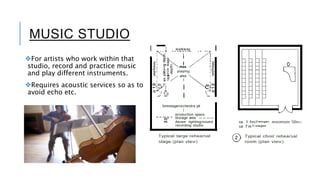
MUSIC STUDIO
For artists who work within that
studio, record and practice music
and play different instruments.
Requires acoustic services so as to
avoid echo etc.
AUDITORIUM
A room built to enable an audience to
hear and watch performances at
venues such as theatres.
Requirements to consider in a
auditorium are acoustical, illumination,
doors, communication, and safety
measures etc.
Provide carpet in the aisles and forward
area, a hardwood floor on the stage, in
front of the main curtain, softwood
elsewhere.
Provide sound shaping devices as
required for proper acoustics in the
auditorium.
Fluorescent house system, stage
lighting system, with means of lowering
the fixtures for service. SIZE OF AUDITORIUM: area of 0.5m2/spectator is
for sitting.
LENGTH OF ROWS: max. 16 seats per aisle or 25 seats
per aisle if one side exit door 1m wide is provided per
3-4 rows.
PROPORTIONS OF AUDITORIUM : obtained
from spectator’s psychological perception &
viewing angle as well as the good view from
all seats.
Good view without head movement, but slight
eye movement of about 30o .
Good view with slight head movement and
slight eye movement approx. 60o.
Maximum perception angle without head
movement is about 110o.
With full head and shoulder movement, a
perception field of 360o is possible.
WIDTH OF AUDITORIUM : from the fact that
spectators sitting to one side should still be
able to see the stage clearly
STANDING PLACES SHOULD
BE ARRANGED IN ROWS,
SEPARATED BY FIXED
BARRIERS ACCORDING TO
MINIMUM DIMENSIONS
BOXES MAY HAVE UP TO 10
LOOSE CHAIRS, ELSE FIXED
CHAIRS HAVE AREA MINIMUM
0.65M2 PER PERSON
ELEVATION OF SEATING : obtained from lines of vision.
Since spectators sit in gaps, only every second row requires full sight elevation
(12cm).
Rows of spectator should be formed in a circular segment with respect to the
stage, not just for better alignment but also to achieve better mutual perception.
SUPER ELEVATION OF SEATING
GRADIENT CURVE AND ITS MODIFICATION
OFFSETTING OF SEATS IN ROW IS
ACHIEVED BY DIFFERENT SEAT WIDTHS
(0.50-0.53-0.56)
CONTACT RELATIONSHIPS B/W PUBLIC & STAGE &
AMONG ONE ANOTHER
Exits: 1m wide/ 150 people should be
provided or min. 08m.
VOLUME: 4-5M3 THEATRE OR 6-
8M3 FOR OPERA PER SPECTATOR.
99 seats*0.6m2 needs a stage area
of 60m2(2/3)+30m2(1/3) i.e., 90-
100m2.
A room proportion of 1:1:6 is the best
option for multiple use.
Proscenium height should be
determined first. Then apron height,
banking of the stalls & volume of
auditorium are determined.
Lines of ceiling are obtained from
acoustic requirements.
Aim should be for the reflected sound
from stage or apron to be equally
distributed through auditorium.
PROSCENIUM HEIGHT : WIDTH = 1 : 6
CEILING SHAPE AND SOUND REFLECTION
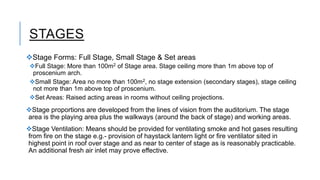
Stage Forms: Full Stage, Small Stage & Set areas
Full Stage: More than 100m2 of Stage area. Stage ceiling more than 1m above top of
proscenium arch.
Small Stage: Area no more than 100m2, no stage extension (secondary stages), stage ceiling
not more than 1m above top of proscenium.
Set Areas: Raised acting areas in rooms without ceiling projections.
Stage proportions are developed from the lines of vision from the auditorium. The stage
area is the playing area plus the walkways (around the back of stage) and working areas.
Stage Ventilation: Means should be provided for ventilating smoke and hot gases resulting
from fire on the stage e.g.- provision of haystack lantern light or fire ventilator sited in
highest point in roof over stage and as near to center of stage as is reasonably practicable.
An additional fresh air inlet may prove effective.
STAGES
OPEN AREA THEATRE (OAT)
Open stages require considerably less scenery than normal stages because the
playing area is viewed from several sides.
Scenery store : for theatres and multipurpose theatres, production is 10-12 and for
opera it is up to 50 & more.
Per play/production, around 20-25% of playing area is required as storage area (for
theatres about three times & for opera it is about ten times).
Space requirement for costumes : 1-12cm/costume or 1-15 costumes per rod.
MUSEUM AND ART GALLERY
The main concerns of museums & art galleries are collecting, documenting,
preserving, researching, interpreting and exhibiting some form of material
evidence.
CIRCULATION IN ART GALLERY
INSTALLATION OF
LIGHTING : angles of
incidence correspond with
natural lighting
TYPICAL CROSS SECTION FOR
MUSEUM OF NATURAL HISTORY
GALLERY PASSAGE :
lit from one side
only, lower part with
indirect lighting
Each group of pictures in art gallery should have a separate room & each
picture a wall to itself, which means small rooms.
The normal human angle of vision starts 27o up from eye level.
WELL LIT PICTURES
SHOULD BE HUNG 10M
AWAY WITH TOP NOT
MORE THAN 4.9M
ABOVE EYE LEVEL &
BOTTOM ABOUT 70CM
BELOW.
SLIDING STEEL MESH FRAMES ON WHICH PICTURES
CAN BE HUNG AS DESIRED & BE AVAILABLE FOR
STUDY
EXHIBITION ROOM
WITH SIDE LIGHTING
3-5m2 hanging surface per picture, 6-10m2 ground surface per sculpture &
1m2 cabinet space per 400 coins.
A sill height of 2.13m for pictures and a viewing range of 3-3.65m for
sculpture.
FIELD OF VISION : height/size and distance
EXHIBITION ROOM WITH FOLDING SCREEN
ALLOWS GREAT VARIETY OF ROOM
ARRANGEMENTS
CASE STUDY (TRIVENI
KALA KENDRA )
ARCHITECT: Joseph Allen Stein
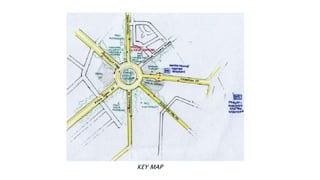
LOCATION : The center is situated on a small
plot of about one acre at TANSEN MRG near
MANDI HOUSE round about.
The other institutes that surround it are
SANGEET BHARARTI, SRI RAM CENTER,
RABINDRA BHAWAN, etc.
FOUNDER: Sundari K. Shridharani
Ar. JOSEPH ALLEN STEIN
LOCATION
KEY MAP
Architect Joseph Allen Stein (1957-1977) in
India, who also designed several important
building in New Delhi, like India International
Centre and India Habitat Centre, Lodhi Road.
Designed in modern architecture style, the
complex is noted for its "multiple spaces for
multiple purposes" and use of jali work , which
was one of the first buildings by noted
American Stein's hallmark.
INTRODUCTION
The idea of starting a dance institution in Delhi was raised by Sundari K.
Shridharani, a former student of dancer Uday Shankar, in 1950 when she had
just moved to Delhi after marriage. The name 'Triveni Kala Sangam' was
coined by Flautist, Vijay Rgahav Roy and literally meaning "confluence of
arts".
It started in one room above a Coffee House in Connaught Place Delhi, with
two students under noted artist K. S. Kulkarni. Soon her efforts got noticed,
and Pandit Nehru allotted her the land for the institution. Gradually, she
organized a small group of people, started organizing concerts, and
collecting funds. Guru Rajkumar Singhajit Singh joined Triveni in 1954, as
Head of the Manipur Dance Section, and later in 1962, founded the ‘Triveni
Ballet’ of which he was Director and Principal Dancer.
HISTORY
Triveni Kala kendra is an important cultural and arts complex and education centre
in New Delhi. Founded in 1950, by Sundari K. Shridharani, who was also its
Founding Director.
Triveni kala kendra contains-
four art galleries
a chamber theatre
outdoor theatre (open air theatre)
open air sculpture gallery
besides this it runs its various arts, music and dance classes.
1
2
3
4
5
1. AUDITORIUM
2. STAGE
3. OPEN AIR
THEATER
4. ART GALLERY
5. MAIN ENTRY
6. CLASSROOMS
7. APARTMENTS
8. OFFICE
9. STUDIO
N
7
6
8
4
3
7
6
1
9
2
ARCHITECT
URAL
PLANNING
Basically the space of kala bhawan/Kendra is divided into three parts as
follow:
1. formal : space used for any presentation, audio or visual programs
formally.
2. informal : spaces where people gather for social activities like sculpture
court (with sitting space provided) etc.
3. semi formal : where formal and informal activities takes place : OAT,
cafeteria etc.
There are three entry gates in Triveni kala kendra, one is main entry which
leads to office and classrooms, another one is for Auditorium, photography
studio (formal space) and third gate is for O.A.T.
There is a corridor in front of Admin. Office which connects both the
buildings of Triveni Kala Kendra.
SPACES
FORMAL
SPACE
INFORMAL
SPACE
SEMI FORMAL
SPACE
50% area is for semi formal & approx. 35% for formal + informal
CIRCULATION IN
TRIVENI
MAIN ENTRYENTRY ENTRY
ART GALLERY
RESIDENCE FOR CARE
TAKER
MUSIC CLASSES
DANCE CLASSROOMS
DIFFERENT ACTIVITIES IN TRIVENI KALA KENDRA
The Kendra also have a cafeteria which
named as ‘terrace restaurant’ which
serve for the guests, audience, artists
and other peoples.
It seems that foyer has been converted
into terrace restaurant because of the
temporary material used in roofing.
It has high plinth level and low ceiling
height. CAFETAR
IA
OPEN AIR
THEATRE
Various types of performing art classes are going in Triveni kala Kendra like
music, dance, paintings and sculpture making etc.
There are four art galleries in kendra - Shridharni Gallery, Art Heritage
Gallery, Triveni Gallery and a basement gallery run by Art Heritage.
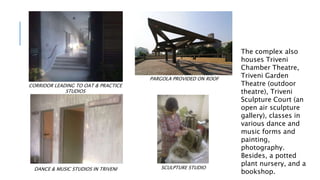
CORRIDOR LEADING TO OAT & PRACTICE
STUDIOS
DANCE & MUSIC STUDIOS IN TRIVENI
PARGOLA PROVIDED ON ROOF
SCULPTURE STUDIO
The complex also
houses Triveni
Chamber Theatre,
Triveni Garden
Theatre (outdoor
theatre), Triveni
Sculpture Court (an
open air sculpture
gallery), classes in
various dance and
music forms and
painting,
photography.
Besides, a potted
plant nursery, and a
bookshop.
SERVICES IN TRIVENI
GENERATOR/POWER
ROOM PROVISION
ABOVE AUDITORIUM
TOILET-MALE &
FEMALE ON 3rd &
4th FLOOR,
RESPECTIVELY
TOILET-MALE &
FEMALE ON 3rd & 4th
FLOOR, RESPECTIVELY
NEAR THE STAIRS
WITH CAFETERIA
SERVICES AT TRIVENI
MODERN CONSTRUCTION MATERIALS USED
WITH JAALI IN TRIVENI IS A TRADEMARK OF AR.
JOSEPH ALLEN STEIN
WOODEN BLOCK FLOORING ON THE STAGE
PROVIDED FOR OAT
CONSTRUCTION MATERIALS
Triveni Kala Kendra is easily accessible.
Triveni kala Kendra has a systematic and a good arrangement of spaces.
It is well orientated to receive more day light.
Arrangement of space are in such a manner that the activity does not clash
each other.
Open air theatre is in east-south direction so that in day time the events
does not require any artificial lighting.
Formal and informal space has their separate entry/exits, without
disturbing other activities.
CONCLUSION
SITE ANALYSIS
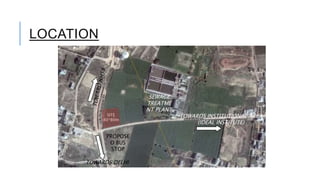
LOCATION
TOWARDS INSTITUTIONAL AREA
(IDEAL INSTITUTE)
TOWARDS DELHI
SITE
80*80m
SEWAGE
TREATME
NT PLANT
PROPOSE
D BUS
STOP
AREA & ACCESS : 80*80m is provided for the cultural complex with 6m wide
service lane and 18m wide main road. It easily accessible.
VICINITY : There is a proposed bus stop plan near the site and an institution
and residences around it.
TOPOGRAPHY : Flat land with 3 feet level down from road level.
VEGETATION : No vegetation, agricultural land.
CLIMATE :
Macro climate - As it is connected to the national capital, its temperature and
rainfall are similar to Delhi.
Rajasthan's dust storms and snowfall in the Himalayas, Kumaon and Garhwal hills name
their impact in the weather regularly.
The monsoon arrives in the district during the end of the June or the first week of July and
normally it rains until October.
As in other districts of northern India mainly three seasons - summer, winter and rainy -
prevail here, but sometimes due to severe snowfall in the Himalayas and Kumaon Hills,
adverse weather can also seen.
Micro climate - no affect on micro climate of site due
to absence of water bodies, sandy or hilly areas.
MONTHLY PRECIPITATION AMOUNT
AVERAGE NUMBER OF DAYS IN ANY
MONTH TO SEE RAIN FALLING
AVERAGE HIGH AND LOW TEMPERATURE
FOR EACH MONTH OF THE YEAR
AVERAGE DAILY WIND SPEED
SOURCES
http://commons.wikimedia.org/
http://www.bharatonline.com/
http://www.weather.com/
https://danceacademyusa.wordpress.com
http://carspecreview2015.top/
http://www.cadviet.com
http://www.masongross.rutgers.edu/
http://scribd.com
http://www.trivenikalasangam.org.in
http://www.slideshare.com

Cultural complexes

  • 1.
    CULTURAL COMPLEXES Submitted by: Sakshi Aggarwal PrashantShishodia Ideal School of Architecture B.Arch II Year
  • 2.
  • 3.
    CULTURE : Itconsists of all the shared products of human groups which include physical objects, beliefs, values, and behaviors shared by a group. The distinct ways that people, live differently, classified and represented their experiences, and acted creatively. CULTURAL COMPLEX : A cultural complex may be defined as a platform of different cultural activities, social gathering and different exhibitions. INTRODUCTION
  • 4.
    ACTIVITIES IN CULTURAL COMPLEXES Requirementsof cultural complex: DANCE AND MUSIC STUDIO AUDITORIUM OPEN AIR THEATRE (OAT) MUSEUM/ART GALLERY
  • 5.
    DANCE STUDIO A placewhere one practices or learn the art of dance. Includes a smooth floor covering or, if used for tap dancing, by a hardwood floor. The smooth vinyl floor covering, also known as a performance surface and commonly called "marley", is generally not affixed permanently to the underlying floor and can be rolled up and transported to performance venues if needed. Sprung dance floors with matting ballet bars with full height mirrors. Portable ballet bars surrounding room allowing room to split into two. SPACE REQUIRED BY A PERSON
  • 6.
    MUSIC STUDIO For artistswho work within that studio, record and practice music and play different instruments. Requires acoustic services so as to avoid echo etc.
  • 7.
    AUDITORIUM A room builtto enable an audience to hear and watch performances at venues such as theatres. Requirements to consider in a auditorium are acoustical, illumination, doors, communication, and safety measures etc. Provide carpet in the aisles and forward area, a hardwood floor on the stage, in front of the main curtain, softwood elsewhere. Provide sound shaping devices as required for proper acoustics in the auditorium. Fluorescent house system, stage lighting system, with means of lowering the fixtures for service. SIZE OF AUDITORIUM: area of 0.5m2/spectator is for sitting. LENGTH OF ROWS: max. 16 seats per aisle or 25 seats per aisle if one side exit door 1m wide is provided per 3-4 rows.
  • 8.
    PROPORTIONS OF AUDITORIUM: obtained from spectator’s psychological perception & viewing angle as well as the good view from all seats. Good view without head movement, but slight eye movement of about 30o . Good view with slight head movement and slight eye movement approx. 60o. Maximum perception angle without head movement is about 110o. With full head and shoulder movement, a perception field of 360o is possible. WIDTH OF AUDITORIUM : from the fact that spectators sitting to one side should still be able to see the stage clearly STANDING PLACES SHOULD BE ARRANGED IN ROWS, SEPARATED BY FIXED BARRIERS ACCORDING TO MINIMUM DIMENSIONS BOXES MAY HAVE UP TO 10 LOOSE CHAIRS, ELSE FIXED CHAIRS HAVE AREA MINIMUM 0.65M2 PER PERSON
  • 9.
    ELEVATION OF SEATING: obtained from lines of vision. Since spectators sit in gaps, only every second row requires full sight elevation (12cm). Rows of spectator should be formed in a circular segment with respect to the stage, not just for better alignment but also to achieve better mutual perception. SUPER ELEVATION OF SEATING GRADIENT CURVE AND ITS MODIFICATION OFFSETTING OF SEATS IN ROW IS ACHIEVED BY DIFFERENT SEAT WIDTHS (0.50-0.53-0.56) CONTACT RELATIONSHIPS B/W PUBLIC & STAGE & AMONG ONE ANOTHER
  • 10.
    Exits: 1m wide/150 people should be provided or min. 08m. VOLUME: 4-5M3 THEATRE OR 6- 8M3 FOR OPERA PER SPECTATOR. 99 seats*0.6m2 needs a stage area of 60m2(2/3)+30m2(1/3) i.e., 90- 100m2. A room proportion of 1:1:6 is the best option for multiple use. Proscenium height should be determined first. Then apron height, banking of the stalls & volume of auditorium are determined. Lines of ceiling are obtained from acoustic requirements. Aim should be for the reflected sound from stage or apron to be equally distributed through auditorium. PROSCENIUM HEIGHT : WIDTH = 1 : 6 CEILING SHAPE AND SOUND REFLECTION
  • 11.
    Stage Forms: FullStage, Small Stage & Set areas Full Stage: More than 100m2 of Stage area. Stage ceiling more than 1m above top of proscenium arch. Small Stage: Area no more than 100m2, no stage extension (secondary stages), stage ceiling not more than 1m above top of proscenium. Set Areas: Raised acting areas in rooms without ceiling projections. Stage proportions are developed from the lines of vision from the auditorium. The stage area is the playing area plus the walkways (around the back of stage) and working areas. Stage Ventilation: Means should be provided for ventilating smoke and hot gases resulting from fire on the stage e.g.- provision of haystack lantern light or fire ventilator sited in highest point in roof over stage and as near to center of stage as is reasonably practicable. An additional fresh air inlet may prove effective. STAGES
  • 12.
    OPEN AREA THEATRE(OAT) Open stages require considerably less scenery than normal stages because the playing area is viewed from several sides. Scenery store : for theatres and multipurpose theatres, production is 10-12 and for opera it is up to 50 & more. Per play/production, around 20-25% of playing area is required as storage area (for theatres about three times & for opera it is about ten times). Space requirement for costumes : 1-12cm/costume or 1-15 costumes per rod.
  • 13.
    MUSEUM AND ARTGALLERY The main concerns of museums & art galleries are collecting, documenting, preserving, researching, interpreting and exhibiting some form of material evidence. CIRCULATION IN ART GALLERY INSTALLATION OF LIGHTING : angles of incidence correspond with natural lighting TYPICAL CROSS SECTION FOR MUSEUM OF NATURAL HISTORY GALLERY PASSAGE : lit from one side only, lower part with indirect lighting
  • 14.
    Each group ofpictures in art gallery should have a separate room & each picture a wall to itself, which means small rooms. The normal human angle of vision starts 27o up from eye level. WELL LIT PICTURES SHOULD BE HUNG 10M AWAY WITH TOP NOT MORE THAN 4.9M ABOVE EYE LEVEL & BOTTOM ABOUT 70CM BELOW. SLIDING STEEL MESH FRAMES ON WHICH PICTURES CAN BE HUNG AS DESIRED & BE AVAILABLE FOR STUDY EXHIBITION ROOM WITH SIDE LIGHTING
  • 15.
    3-5m2 hanging surfaceper picture, 6-10m2 ground surface per sculpture & 1m2 cabinet space per 400 coins. A sill height of 2.13m for pictures and a viewing range of 3-3.65m for sculpture. FIELD OF VISION : height/size and distance EXHIBITION ROOM WITH FOLDING SCREEN ALLOWS GREAT VARIETY OF ROOM ARRANGEMENTS
  • 16.
  • 17.
    ARCHITECT: Joseph AllenStein LOCATION : The center is situated on a small plot of about one acre at TANSEN MRG near MANDI HOUSE round about. The other institutes that surround it are SANGEET BHARARTI, SRI RAM CENTER, RABINDRA BHAWAN, etc. FOUNDER: Sundari K. Shridharani Ar. JOSEPH ALLEN STEIN
  • 18.
  • 19.
  • 20.
    Architect Joseph AllenStein (1957-1977) in India, who also designed several important building in New Delhi, like India International Centre and India Habitat Centre, Lodhi Road. Designed in modern architecture style, the complex is noted for its "multiple spaces for multiple purposes" and use of jali work , which was one of the first buildings by noted American Stein's hallmark. INTRODUCTION
  • 21.
    The idea ofstarting a dance institution in Delhi was raised by Sundari K. Shridharani, a former student of dancer Uday Shankar, in 1950 when she had just moved to Delhi after marriage. The name 'Triveni Kala Sangam' was coined by Flautist, Vijay Rgahav Roy and literally meaning "confluence of arts". It started in one room above a Coffee House in Connaught Place Delhi, with two students under noted artist K. S. Kulkarni. Soon her efforts got noticed, and Pandit Nehru allotted her the land for the institution. Gradually, she organized a small group of people, started organizing concerts, and collecting funds. Guru Rajkumar Singhajit Singh joined Triveni in 1954, as Head of the Manipur Dance Section, and later in 1962, founded the ‘Triveni Ballet’ of which he was Director and Principal Dancer. HISTORY
  • 22.
    Triveni Kala kendrais an important cultural and arts complex and education centre in New Delhi. Founded in 1950, by Sundari K. Shridharani, who was also its Founding Director. Triveni kala kendra contains- four art galleries a chamber theatre outdoor theatre (open air theatre) open air sculpture gallery besides this it runs its various arts, music and dance classes.
  • 23.
    1 2 3 4 5 1. AUDITORIUM 2. STAGE 3.OPEN AIR THEATER 4. ART GALLERY 5. MAIN ENTRY 6. CLASSROOMS 7. APARTMENTS 8. OFFICE 9. STUDIO N 7 6 8 4 3 7 6 1 9 2 ARCHITECT URAL PLANNING
  • 24.
    Basically the spaceof kala bhawan/Kendra is divided into three parts as follow: 1. formal : space used for any presentation, audio or visual programs formally. 2. informal : spaces where people gather for social activities like sculpture court (with sitting space provided) etc. 3. semi formal : where formal and informal activities takes place : OAT, cafeteria etc. There are three entry gates in Triveni kala kendra, one is main entry which leads to office and classrooms, another one is for Auditorium, photography studio (formal space) and third gate is for O.A.T. There is a corridor in front of Admin. Office which connects both the buildings of Triveni Kala Kendra. SPACES
  • 25.
    FORMAL SPACE INFORMAL SPACE SEMI FORMAL SPACE 50% areais for semi formal & approx. 35% for formal + informal
  • 26.
  • 27.
    ART GALLERY RESIDENCE FORCARE TAKER MUSIC CLASSES DANCE CLASSROOMS DIFFERENT ACTIVITIES IN TRIVENI KALA KENDRA
  • 28.
    The Kendra alsohave a cafeteria which named as ‘terrace restaurant’ which serve for the guests, audience, artists and other peoples. It seems that foyer has been converted into terrace restaurant because of the temporary material used in roofing. It has high plinth level and low ceiling height. CAFETAR IA OPEN AIR THEATRE
  • 29.
    Various types ofperforming art classes are going in Triveni kala Kendra like music, dance, paintings and sculpture making etc. There are four art galleries in kendra - Shridharni Gallery, Art Heritage Gallery, Triveni Gallery and a basement gallery run by Art Heritage.
  • 30.
    CORRIDOR LEADING TOOAT & PRACTICE STUDIOS DANCE & MUSIC STUDIOS IN TRIVENI PARGOLA PROVIDED ON ROOF SCULPTURE STUDIO The complex also houses Triveni Chamber Theatre, Triveni Garden Theatre (outdoor theatre), Triveni Sculpture Court (an open air sculpture gallery), classes in various dance and music forms and painting, photography. Besides, a potted plant nursery, and a bookshop.
  • 31.
    SERVICES IN TRIVENI GENERATOR/POWER ROOMPROVISION ABOVE AUDITORIUM TOILET-MALE & FEMALE ON 3rd & 4th FLOOR, RESPECTIVELY TOILET-MALE & FEMALE ON 3rd & 4th FLOOR, RESPECTIVELY NEAR THE STAIRS WITH CAFETERIA SERVICES AT TRIVENI
  • 32.
    MODERN CONSTRUCTION MATERIALSUSED WITH JAALI IN TRIVENI IS A TRADEMARK OF AR. JOSEPH ALLEN STEIN WOODEN BLOCK FLOORING ON THE STAGE PROVIDED FOR OAT CONSTRUCTION MATERIALS
  • 33.
    Triveni Kala Kendrais easily accessible. Triveni kala Kendra has a systematic and a good arrangement of spaces. It is well orientated to receive more day light. Arrangement of space are in such a manner that the activity does not clash each other. Open air theatre is in east-south direction so that in day time the events does not require any artificial lighting. Formal and informal space has their separate entry/exits, without disturbing other activities. CONCLUSION
  • 34.
  • 35.
    LOCATION TOWARDS INSTITUTIONAL AREA (IDEALINSTITUTE) TOWARDS DELHI SITE 80*80m SEWAGE TREATME NT PLANT PROPOSE D BUS STOP
  • 36.
    AREA & ACCESS: 80*80m is provided for the cultural complex with 6m wide service lane and 18m wide main road. It easily accessible. VICINITY : There is a proposed bus stop plan near the site and an institution and residences around it. TOPOGRAPHY : Flat land with 3 feet level down from road level. VEGETATION : No vegetation, agricultural land. CLIMATE : Macro climate - As it is connected to the national capital, its temperature and rainfall are similar to Delhi. Rajasthan's dust storms and snowfall in the Himalayas, Kumaon and Garhwal hills name their impact in the weather regularly. The monsoon arrives in the district during the end of the June or the first week of July and normally it rains until October. As in other districts of northern India mainly three seasons - summer, winter and rainy - prevail here, but sometimes due to severe snowfall in the Himalayas and Kumaon Hills, adverse weather can also seen.
  • 37.
    Micro climate -no affect on micro climate of site due to absence of water bodies, sandy or hilly areas. MONTHLY PRECIPITATION AMOUNT AVERAGE NUMBER OF DAYS IN ANY MONTH TO SEE RAIN FALLING AVERAGE HIGH AND LOW TEMPERATURE FOR EACH MONTH OF THE YEAR AVERAGE DAILY WIND SPEED
  • 38.